
Mealybugs on Caudex Plants: Why Sprays Fail and What Works
Mealybugs on caudex plants hide in waxy folds and roots. Learn how coverage, labels, inspection, and cautious treatment choices affect control.
Rachel Torres · 2026-06-14 · Updated 2026-08-04 · 17 min read
Key Takeaways
- Waxy coverings and hidden positions let part of a colony survive a contact spray. Coverage, formulation, life stage, and direct contact all decide the result.
- Caudex folds and rootballs need inspection methods that do not rely on a clear line of sight. Open creases gently and check below the soil line.
- Warm conditions can speed development for some species, but there is no universal summer generation schedule. Use warmth as a cue to inspect more often.
- A soil systemic may reach feeding tissue, yet studies and labels do not guarantee eradication. Follow the current label and keep inspecting.
- Repeated foliar failure is a reason to check roots and neighboring plants, not proof of root mealybugs. Bare-root heat treatment remains experimental for caudex plants.
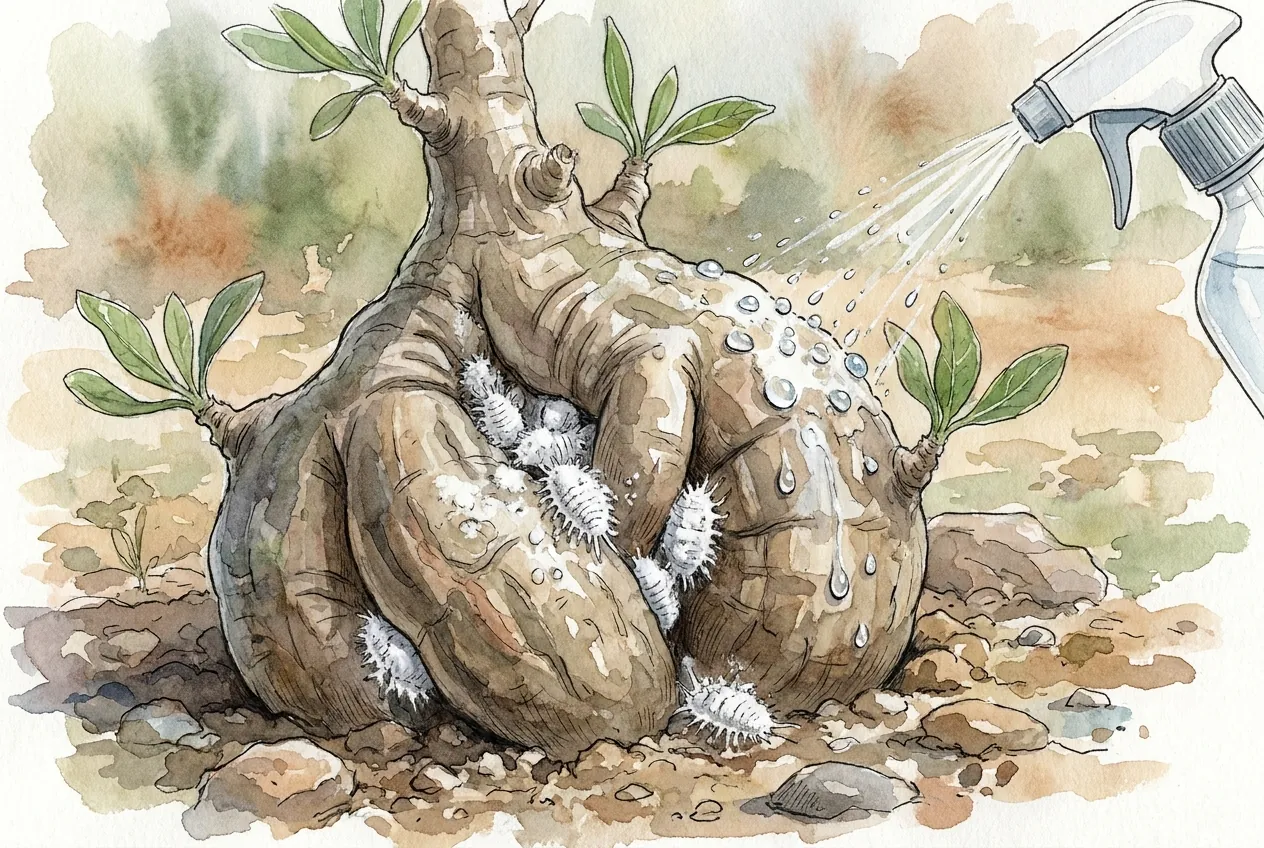
A spray can make the visible cotton disappear while a colony remains in a fold, axil, collar, or rootball. The usual problem is incomplete coverage and hidden life stages rather than one universally weak product.
Warm conditions can shorten development for some mealybug species, so survivors may rebuild a population quickly. Match contact coverage and the delivery method to the colony’s location.
Why do mealybugs survive sprays in caudex folds?
Understand the Two Coverage Barriers
A waxy covering can reduce wetting for some stages, while crevice geometry can keep droplets from reaching insects. Product formulation, dose, resistance, and direct coverage still affect the result.
Read the wax and crevice problem
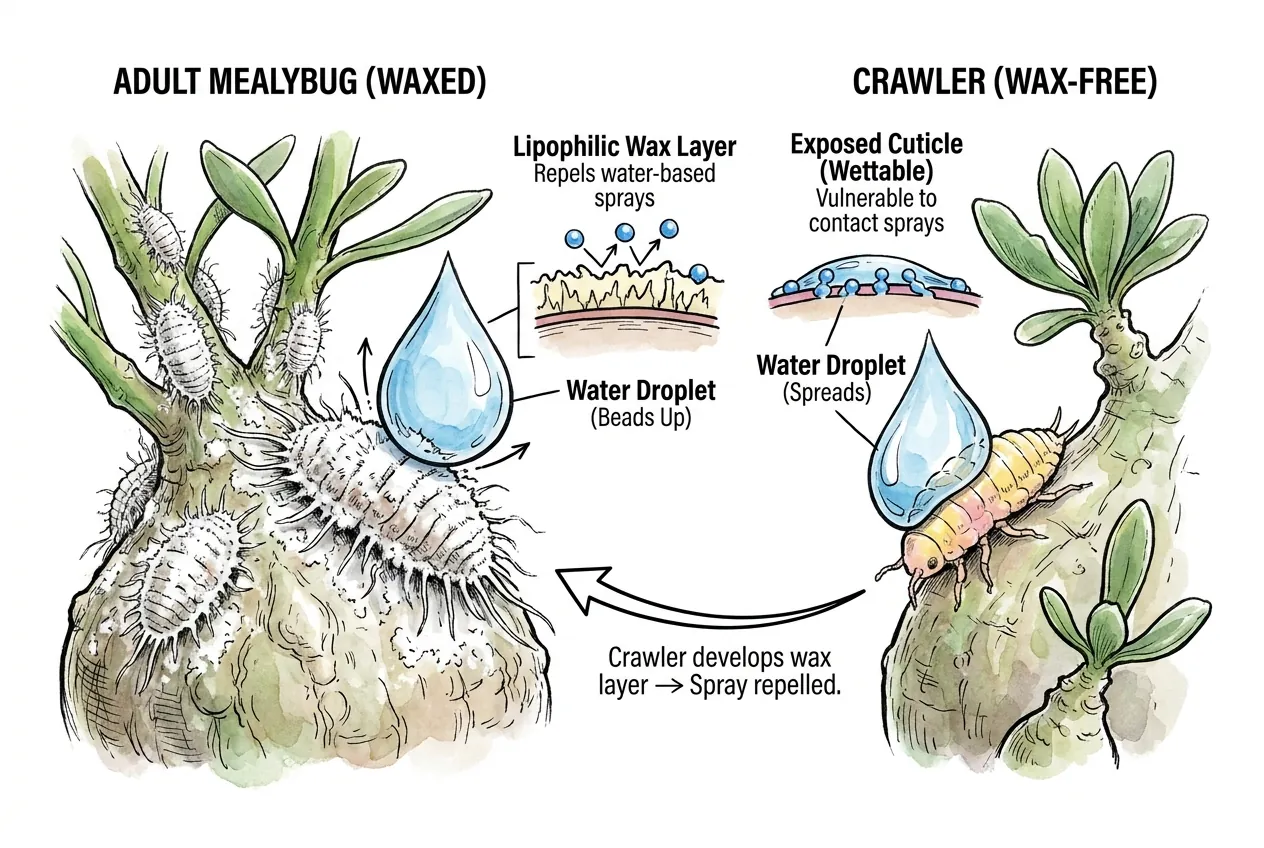
A mealybug is a soft, sap-sucking insect that coats itself in a white, hydrophobic wax. Water droplets bead up on that wax and roll off before any active ingredient can penetrate.
Keep label and coverage limits visible
UC IPM describes the wax as reducing the effectiveness of many contact insecticides and notes that aggregation in hidden locations makes coverage difficult.
Expect live insects after a visible spray
NC State Extension likewise describes adults and nymphs in plant nooks where thorough pesticide coverage is difficult.
A spray can therefore leave part of the colony alive. Wax can reduce wetting on some stages, and insects deep in a fold may never receive a sufficient dose.
What is the waxy coating and why does it repel sprays?
Why wax changes contact treatment
The coating is a lipophilic wax layer that makes the insect difficult to wet, so water-based droplets may not stick or spread. Newly hatched crawlers are less protected, but contact efficacy still depends on the product, dose, and coverage.
Judge the formulation by the label
The wax can make a water-based droplet bead or spread unevenly. That does not mean every formulation fails, so judge the result by the label, coverage, life stage, and follow-up inspection.
Track crawler timing instead of a fixed interval
Crawlers emerge with less wax and later settle and develop a covering. The timing varies by species and conditions, so repeated inspection matters more than a fixed interval.
Treat direct contact as stage-dependent
Contact treatments are more likely to work on exposed, less-waxed stages than on a protected adult cluster, but no stage guarantees control by itself.
How many eggs hide in one ovisac?
Account for eggs hidden in an ovisac
Many female mealybugs place eggs in a waxy ovisac, so removing visible adults may not remove the next generation. Egg numbers and hatch timing vary substantially by species.
Expect an ovisac to reduce coverage
Ovisac material can hinder direct coverage, but the degree of protection depends on the species, product, and exposure.
Continue inspection after the first treatment
One missed ovisac can reseed a plant. Continue inspection after the first treatment rather than assuming the colony is gone.
Where exactly do they hide on a caudex plant?
Search Every Likely Refuge
Check leaf and petiole axils, deep caudex folds, the collar where caudex meets soil, and the roots below the line. Each location can make coverage incomplete, but the degree of shelter varies with plant shape and product.
Check folds on swollen stems
On Adenium, Pachypodium, Stephania, and similar caudiciforms, swollen stems can create creases and shoulders that a spray may not reach. Do not assume that a dry-looking fold or a single pass proves the colony is protected or gone.
Why does crevice geometry block the spray?
Match delivery to the crevice geometry
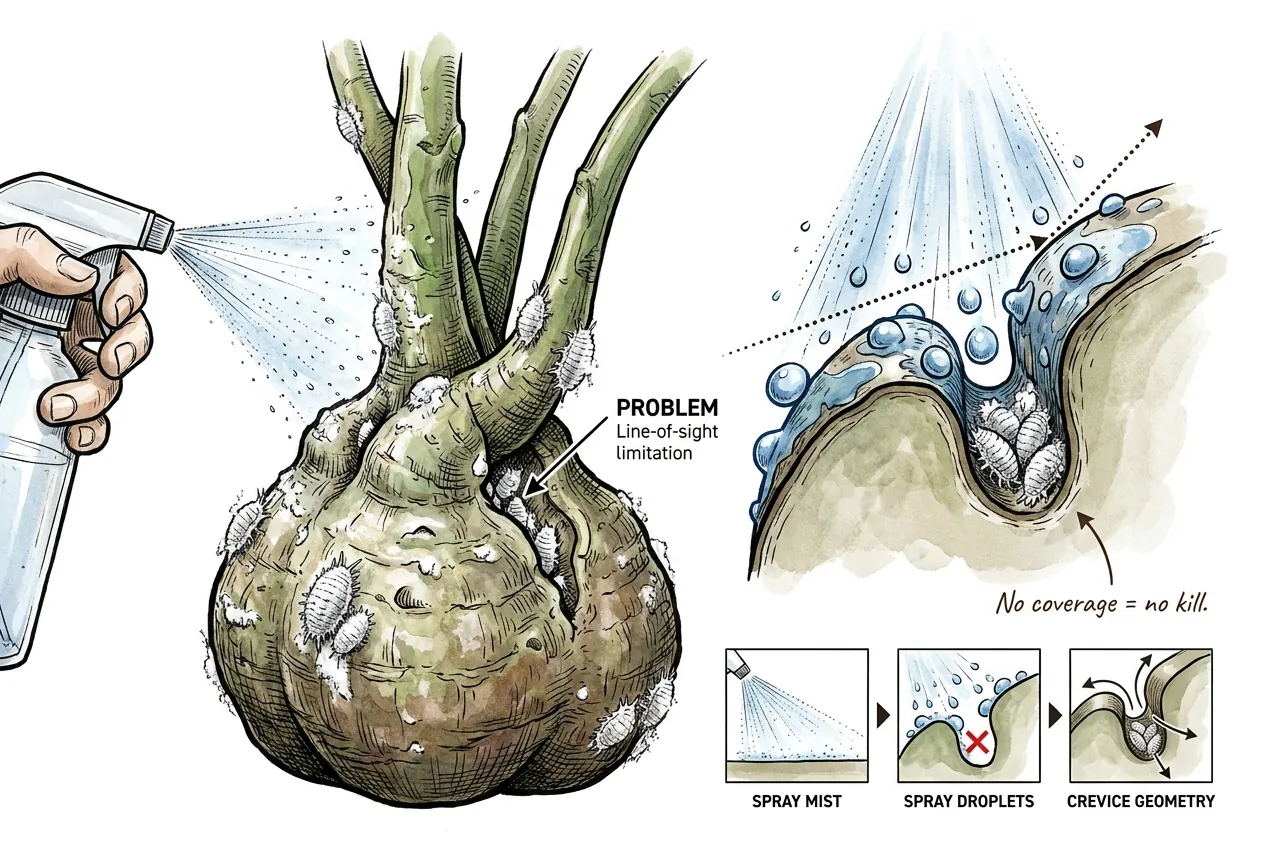
Contact insecticide works only where a droplet reaches the insect, and a fold interior may be outside the droplet's line of sight. Incomplete coverage can therefore leave a viable colony even when the visible surface looks treated.
Read the line-of-sight limitation
A spray deposits droplets on surfaces it can see. Tuck a colony under the caudex shoulder or inside a tight crease and the droplets never arrive.
Choose a method that reaches the refuge
Horticultural-oil guidance emphasizes that contact treatment requires thorough coverage of the exposed insect population.
Do not solve geometry with finer mist
So the fix is usually not a finer mist. It is a delivery method that does not depend on line-of-sight droplets.
Are there mealybugs below the soil line too?
Inspect below the soil line when needed
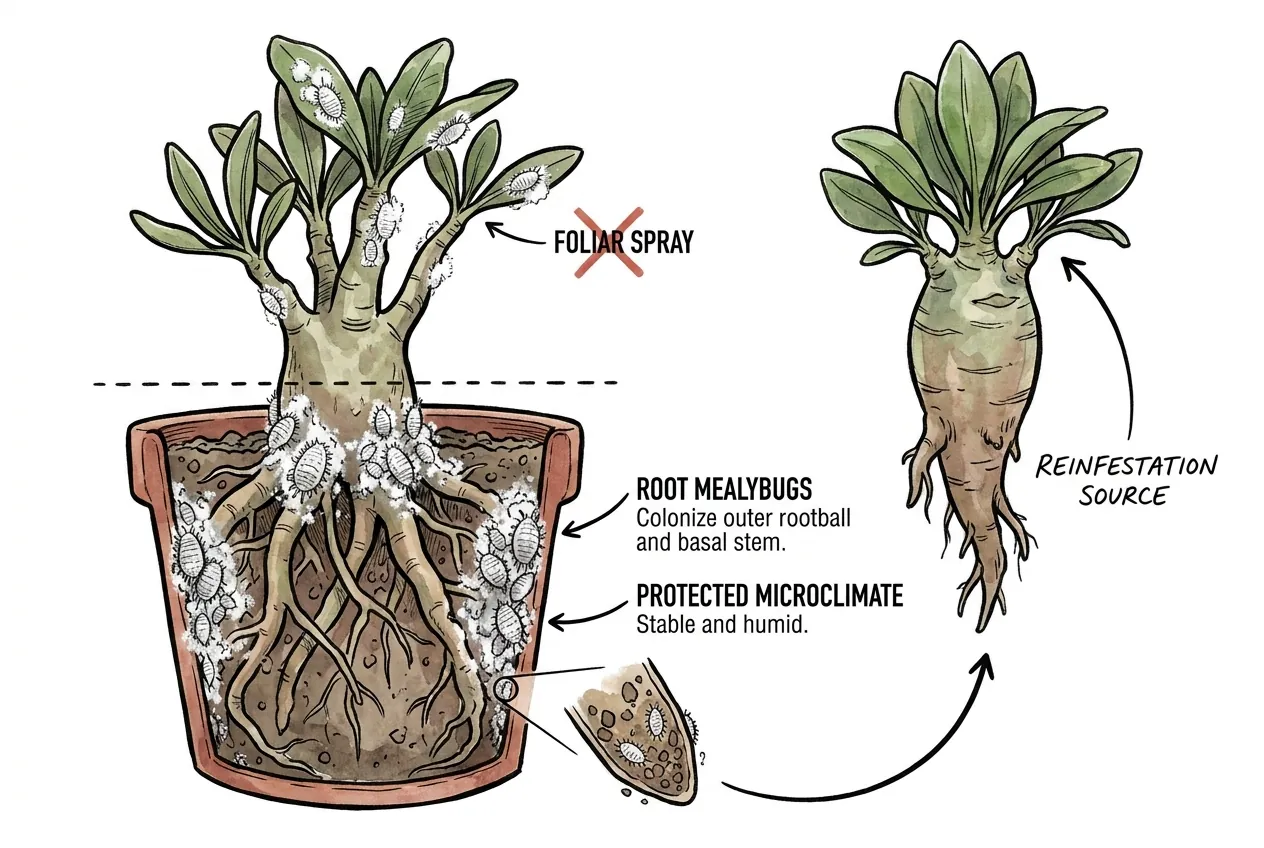
Yes. Root mealybugs can colonize the outer rootball and basal stem, where a foliar spray may not reach. They are one possible reason a plant reinfests after the visible foliage is cleaned.
Use root-zone clues as supporting evidence
UC IPM describes ground mealybugs feeding on basal stems and roots. They may concentrate on the outer portion of the rootball between roots and the pot, while also occurring elsewhere in the root mass.
Inspect roots after repeated foliar failure
Below the soil line, a foliar program is unlikely to contact the colony. If above-ground treatment keeps failing, inspect the roots instead of assuming the spray needs to be stronger.
How can warm conditions change infestation risk?
Use Warm Conditions as a Monitoring Cue
Temperature affects mealybug development, but the size of the effect is species-specific. Studies on individual species show faster development within a suitable warm range and failure outside their tolerance, so use warmth as a monitoring cue rather than a universal schedule.
Is there a temperature that is worst for infestations?
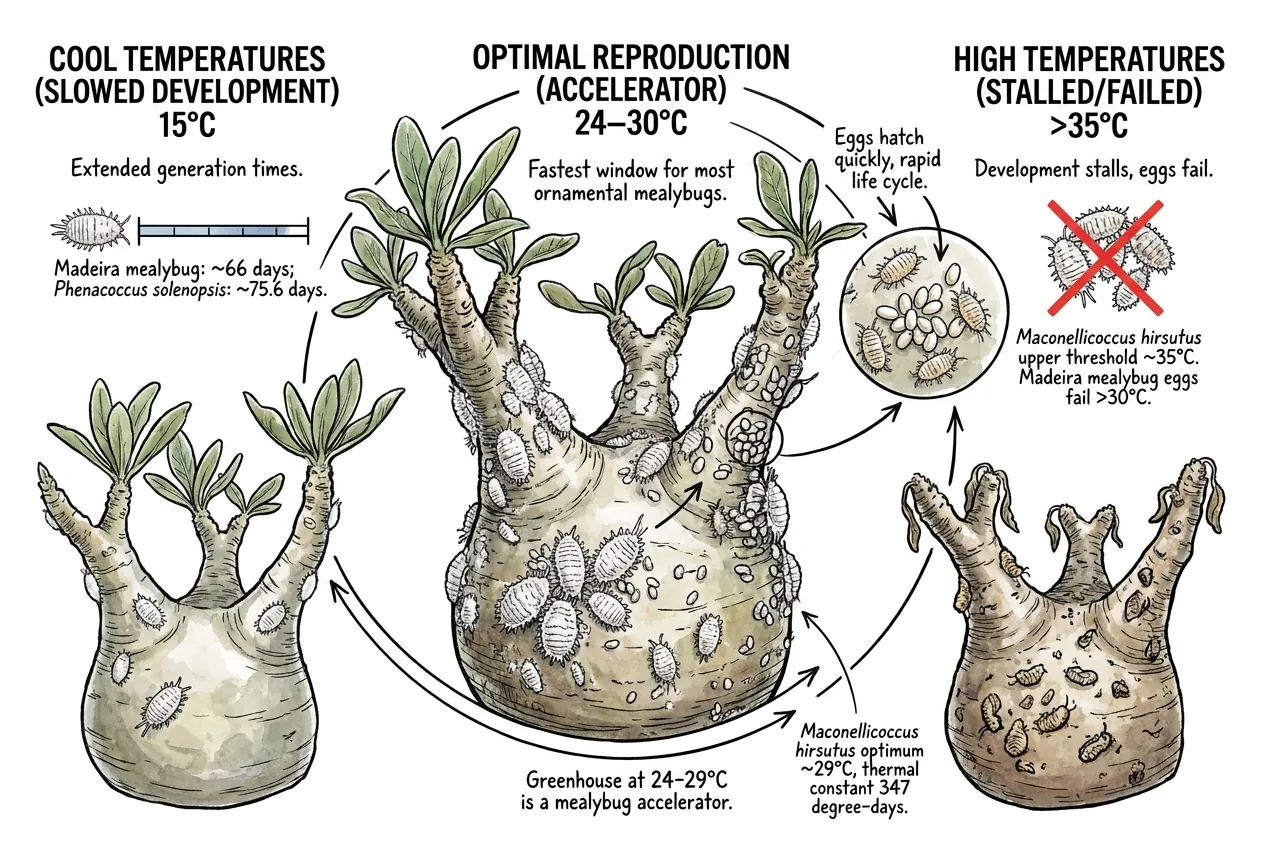
Do not copy a universal heat threshold
There is no single worst temperature for all ornamental mealybugs. Warm, stable conditions often accelerate development for a given species, while excessive heat can reduce egg hatch or survival. Use species-specific evidence when available and inspect more frequently during warm periods.
Use temperature examples as context
The examples below come from different species, hosts, and constant-temperature studies. They illustrate why warmth can change development, not a treatment threshold for a caudex plant.
| Species | Cool temp / time | Warm temp / time |
|---|---|---|
| Madeira mealybug | 15°C / slower female development | 25°C / faster female development |
| Phenacoccus solenopsis | Study-specific low-temperature endpoint | Study-specific warm-temperature endpoint |
| Maconellicoccus hirsutus | Modeled lower threshold near 14.5°C | Modeled optimum near 29°C |
Does feeding the plant feed the pest?
Keep feeding from pushing soft growth
Heavy nitrogen feeding can produce soft new growth that may be easier for sap-feeders to exploit, but the relationship depends on species, plant condition, and feeding level. Avoid pushing lush growth during an active infestation.
Connect nitrogen and tender growth cautiously
Mealybugs feed on phloem sap. High nitrogen and frequent watering can produce tender growth that favors some sap-feeders, but the size of the effect depends on the species and plant condition.
Ease off high-nitrogen feed during an outbreak
During an outbreak, ease off high-nitrogen feed. Let the plant firm up rather than push the lush growth mealybugs prefer.
How can I find a hidden colony early?
Use Visible Field Signals to Trigger Inspection
Check for white cottony masses in folds and axils, sticky honeydew, black sooty mold, and trailing ants. Then inspect the refuges from top to bottom, and unpot only when the signs persist without a visible colony or the root zone also warrants inspection.
Use ants as a clue, not a diagnosis
Mealybugs excrete sugary honeydew. Sooty mold fungi grow on the honeydew, and ants may tend the mealybugs and defend them from predators.
Ants marching up a caudex can be a useful clue, but they do not prove an infestation. Follow them to inspect nearby folds. Sticky leaves or a black film increase suspicion even when no insect is visible.
What is the right inspection sequence?
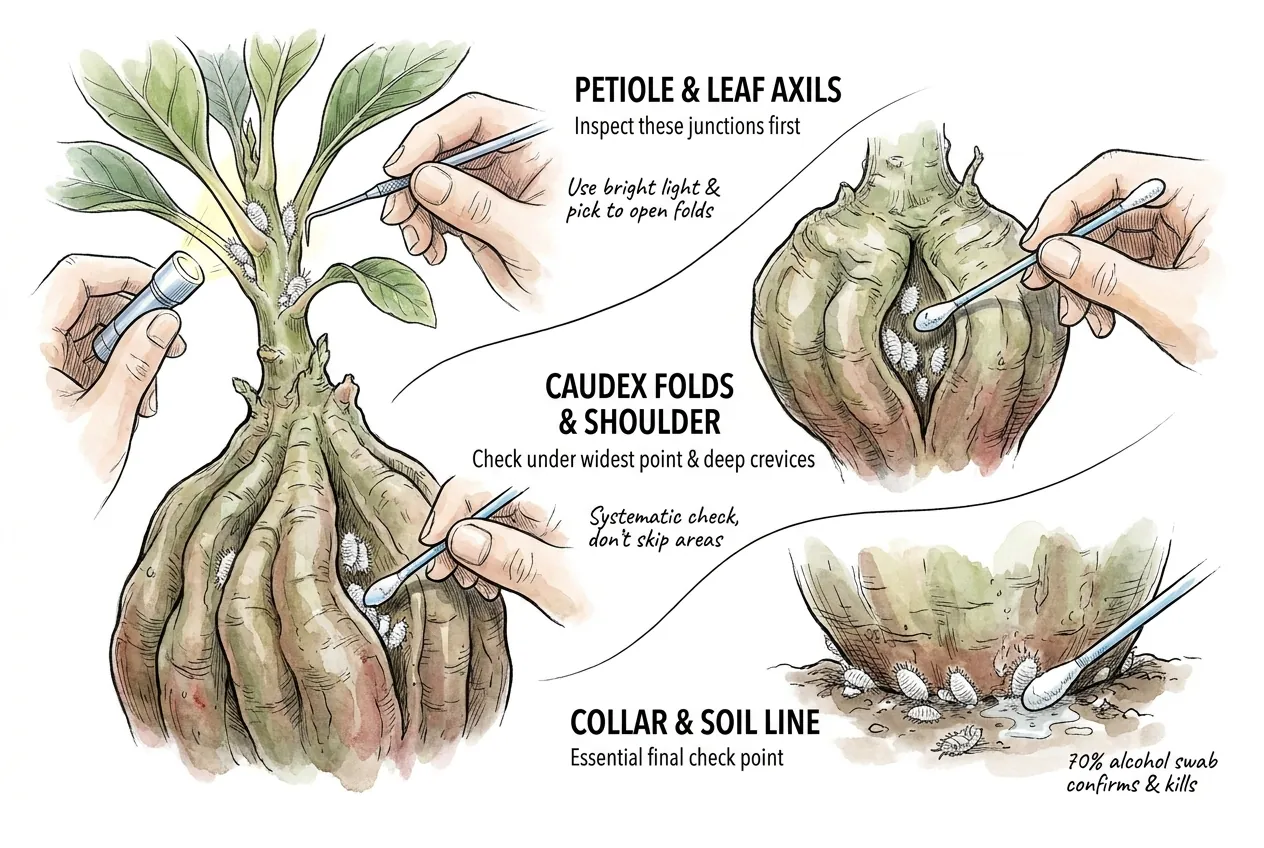
Follow a repeatable inspection order
Start with petioles and leaf axils, then check caudex folds and the shoulder under the widest point, followed by the collar where caudex meets soil. Use a bright light and magnifier. Open tight folds gently with a cotton swab or blunt tool, and avoid sharp picks that can puncture the caudex skin.
Repeat inspections only help if I can return to the same folds, so I take one overhead photograph and four marked side views. On duplicate images, I assign a permanent number to every deep fold, crowded axil, underside shoulder, and collar recess. I keep those numbers after treatment because a clean-looking plant is only useful if I can return to the exact refuge where the colony was found.
Each numbered refuge gets a fresh swab or clean soft brush, which goes straight into a sealable waste bag afterward. No tool travels from fold to fold because it can move crawlers or waxy debris and confuse the next location. My notes distinguish moving insects, ovisacs, loose wax, honeydew, and an empty refuge.
After visible cleanup, I photograph the same numbered recess before applying any compatible labeled treatment. At follow-up I compare that empty-after-cleanup frame with the new view. Old white residue no longer becomes a false survivor, and fresh wax in the same recess becomes easier to detect before a large cottony mass returns.
Use alcohol only for visible spot work
An alcohol swab may help remove a visible colony, but it does not confirm the pest by itself. Use only a plant-safe concentration and method, test a small area, and avoid saturating sensitive caudex skin.
Complete every refuge in the sequence
Be systematic. Skipping the collar or the underside of the caudex shoulder is how colonies survive an otherwise thorough check.
How can I inspect for root mealybugs with less disruption?
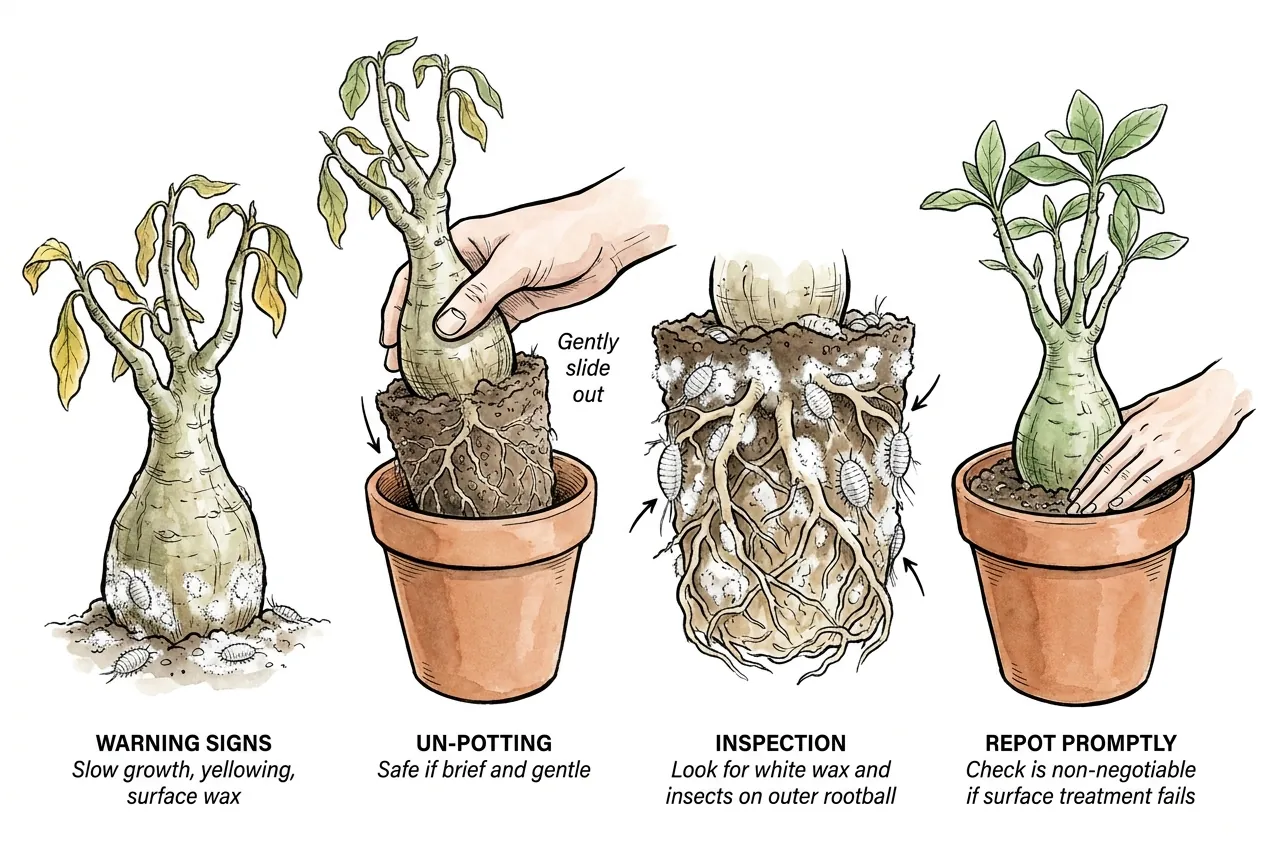
Inspect the outer rootball with minimal disruption
Slide the plant out of its pot and look at the outer rootball for white powdery wax and slow-moving whitish insects. Slow growth, yellowing, or premature leaf drop can support suspicion, but they are not specific to root mealybugs.
Use secondary signs carefully
UC IPM advises inspecting roots for white powdery wax and slow-moving whitish insects on the outer rootball and between roots and pot.
Inspect before escalating chemistry
A brief, careful inspection is usually less disruptive than repeated unverified spraying. If above-ground treatment keeps failing, inspect the roots before escalating.
What can help when a spray cannot reach the colony?
Choose a Method by How It Reaches the Colony
Several approaches address the coverage problem. A systemic may move inside the plant toward feeding tissue. Horticultural oils act on insects they coat, while insecticidal soaps damage the insect membrane and cuticle on direct contact. Alcohol can help with small visible infestations when the plant tolerates it. A practical plan should follow the product label and may combine inspection with compatible contact methods.
Map delivery to colony location
The table below maps each method to how it reaches the colony and where it falls short.
| Method | How it reaches the colony | Main limitation |
|---|---|---|
| Plain contact spray | Droplet line-of-sight only | Misses crevices, beads off wax |
| Systemic drench | Moves inside the plant to the feeding site | Slow uptake and incomplete control in the cited study |
| Horticultural oil | Coats insects reached by the product | Needs thorough coverage and carries heat phytotoxicity risk |
| Insecticidal soap | Damages membrane and cuticle on direct contact | Needs direct coverage and a plant-sensitivity test |
| Plant-safe alcohol swab | Dissolves wax on direct contact | Spot-scale only, must touch each bug |
How does a systemic drench reach the roots and folds?
Treat a systemic drench as conditional
A labeled soil systemic may be absorbed through roots and move toward feeding tissue, but uptake and distribution depend on the plant, formulation, and conditions. A phloem-feeding insect may ingest the active ingredient while feeding, yet efficacy can be partial.
Keep systemic expectations partial
Do not promise a fixed onset or complete hidden-colony control. A controlled greenhouse study of citrus mealybug found mortality below 50 percent across six tested systemics and did not prevent later reproduction under those conditions.
Continue inspection after a drench
Treat a drench as one conditional component. Continue inspection and use compatible contact or sanitation measures when the label and plant condition allow.
Check the label before choosing a systemic
The relevant product is a root-absorbed systemic labeled for container ornamentals and the pest in question. Confirm the active ingredient, formulation, permitted sites, and current label before deciding whether it fits the plant and jurisdiction.
How to use it
Follow the actual product label for how it is applied. Some systemics are ready-to-use granules that are measured onto the potting-soil surface, lightly worked into the top inch or two, and then watered in rather than mixed with water and drenched. Applying a pesticide differently from its label can create a safety and efficacy problem. Do not assume that another formulation uses the same method.
Honest tradeoff
Neonicotinoid products can carry pollinator and site restrictions. Follow the current label and local rules, and combine any systemic with inspection and physical removal only when those steps are compatible with the plant and product.
How do I get oil and alcohol into the crevices?
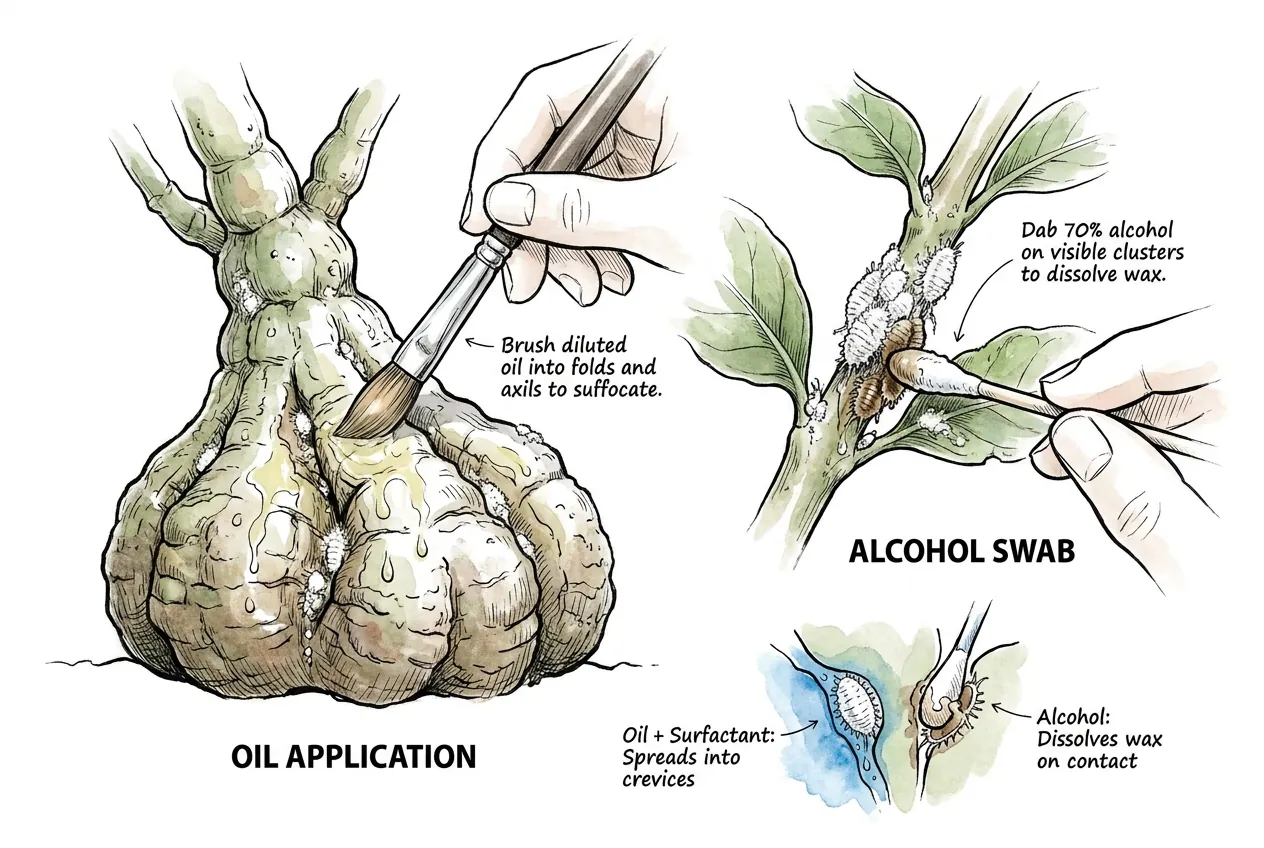
Use hands-on contact only where the label allows
Hands-on application can improve coverage of reachable folds. Brush or dab only as the product label and plant tolerance allow. An alcohol swab may help with visible insects, but it must touch the colony.
Reach only accessible folds
Horticultural oils act on exposed insects they coat, so complete coverage remains important. Hand application may improve reach in a small, accessible fold, but it does not make an unlabeled method safe or guarantee control.
Repeat only at the label interval
If the label permits, use a soft brush or swab to reach exposed folds without pooling product in the crevice. Repeat only at the label interval and continue inspecting for new crawlers. Species and product schedules differ.
Choose contact control by plant tolerance
A neem-based or horticultural-oil product may provide a contact option, while a plant-safe alcohol product may help with spot work. Follow each label rather than mixing or inventing rates. A clarified hydrophobic neem-oil extract behaves differently from raw cold-pressed neem oil, so read which type a product is before use.
How to use it
Follow the current product label for dilution, timing, coverage, and any small-area test. Do not carry directions from one neem or horticultural-oil formulation to another. Brushing into folds is not a substitute for the labeled application method. Avoid pooling oil in a crevice and do not invent a rate.
Honest tradeoff
Oil is contact-only and will not reach root colonies. It also carries phytotoxicity risk in heat and direct sun. Use the product's repeat interval and test a small area first.
For spot work, use only an alcohol concentration and application method that the plant tolerates. Test first and avoid saturating the caudex.
When is oil dangerous to the plant?
Control heat and sunlight during oil treatment
Oil is riskier to the plant in heat and direct sun, because the film can trap heat and stress the tissue. Apply early in the day, out of direct sun, and avoid spraying during high heat.
Follow temperature and timing limits
Extension guidance warns that heat raises oil-phytotoxicity risk. Follow the label's temperature and timing limits, keep treated plants out of harsh direct sun while the product dries, and never treat a heat-stressed plant.
How do I deal with root mealybugs and reduce reinfestation risk?
Rebuild the Plan Around a Confirmed Root Colony
When above-ground treatment keeps failing, inspect the roots and rebuild the management plan around the actual colony. Heat treatment is experimental for caudex plants. A labeled systemic, sanitation, and quarantine may be alternatives depending on the situation.
Do not equate visible improvement with eradication
Root colonies can reseed the foliage, so visible improvement is not proof of eradication.
How do you treat root mealybugs?
Use sanitation before experimental heat treatment
Root inspection and sanitation may be necessary when a colony is confirmed. Repotting into fresh, clean mix can be considered after the plant and roots are assessed. A warm-water treatment should not be treated as a validated caudex method.
Keep heat treatment experimental
Published hot-water protocols were developed for other plants and pests, not caudiciform root mealybugs. They do not establish a safe bare-root soak for a caudex, and heat can injure the plant.
Contain contaminated material
If heat treatment is considered, treat it as experimental and do not transfer another species' temperature or duration. A properly labeled soil systemic may be an alternative, not a guaranteed lower-risk choice. Discard infested soil, clean the pot, and contain wash water and debris so crawlers do not spread.
Does the mealybug destroyer beetle actually work?
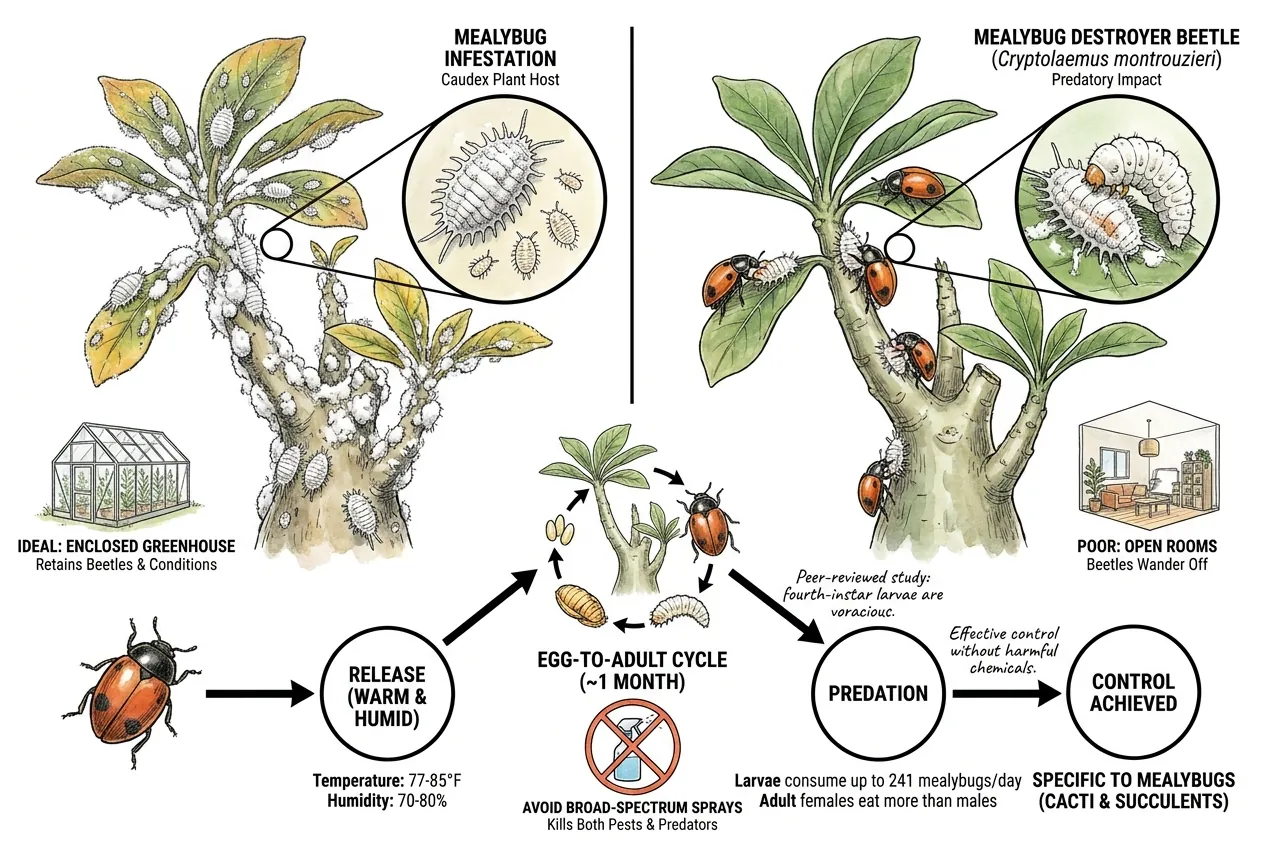
Set realistic limits for beneficial predators
It can help under the right conditions. Cryptolaemus montrouzieri is a polyphagous predator of several mealybug species, not a predator specific to cacti and succulents. Its success depends on warmth, prey density, release quality, and the absence of incompatible pesticide residues.
Match the predator to conditions
A laboratory study reported high consumption by one larval predator and prey combination. That result is illustrative of appetite, not a guaranteed daily rate or control outcome.
Follow supplier release guidance
Use the supplier's release guidance for the actual crop and infestation. Biological and chemical control may be incompatible when residues harm the beetles.
Protect released predators from incompatible residues
Avoid broad-spectrum insecticides around release and follow the supplier's required pesticide-history interval, because residues can kill the beetle. This option is usually more feasible in an enclosed greenhouse than in an open room, where the beetles may wander off.
What ongoing routine can reduce reinfestation risk?
Make inspection and quarantine routine
Quarantine new plants, control ants, inspect folds during warm periods, and avoid pushing lush growth during outbreaks. Prevention can reduce repeated treatment and reinfestation risk.
Repeat quarantine inspections
Keep new arrivals isolated long enough for more than one inspection cycle. Inspect roots when source, symptoms, or repeated foliar failure make that proportionate.
Control ants and inspect warm-season refuges
Control ants, because they can protect and move mealybugs between plants. Inspect folds and the collar at watering and more often during warm periods when development accelerates.