
Sinningia Leucotricha Dormancy Care: Protect the Tuber
Tell normal Sinningia leucotricha dormancy from rot after flowering, and adjust watering to the tuber instead of a fixed calendar.
Rachel Torres · 2026-06-26 · Updated 2026-07-30 · 27 min read
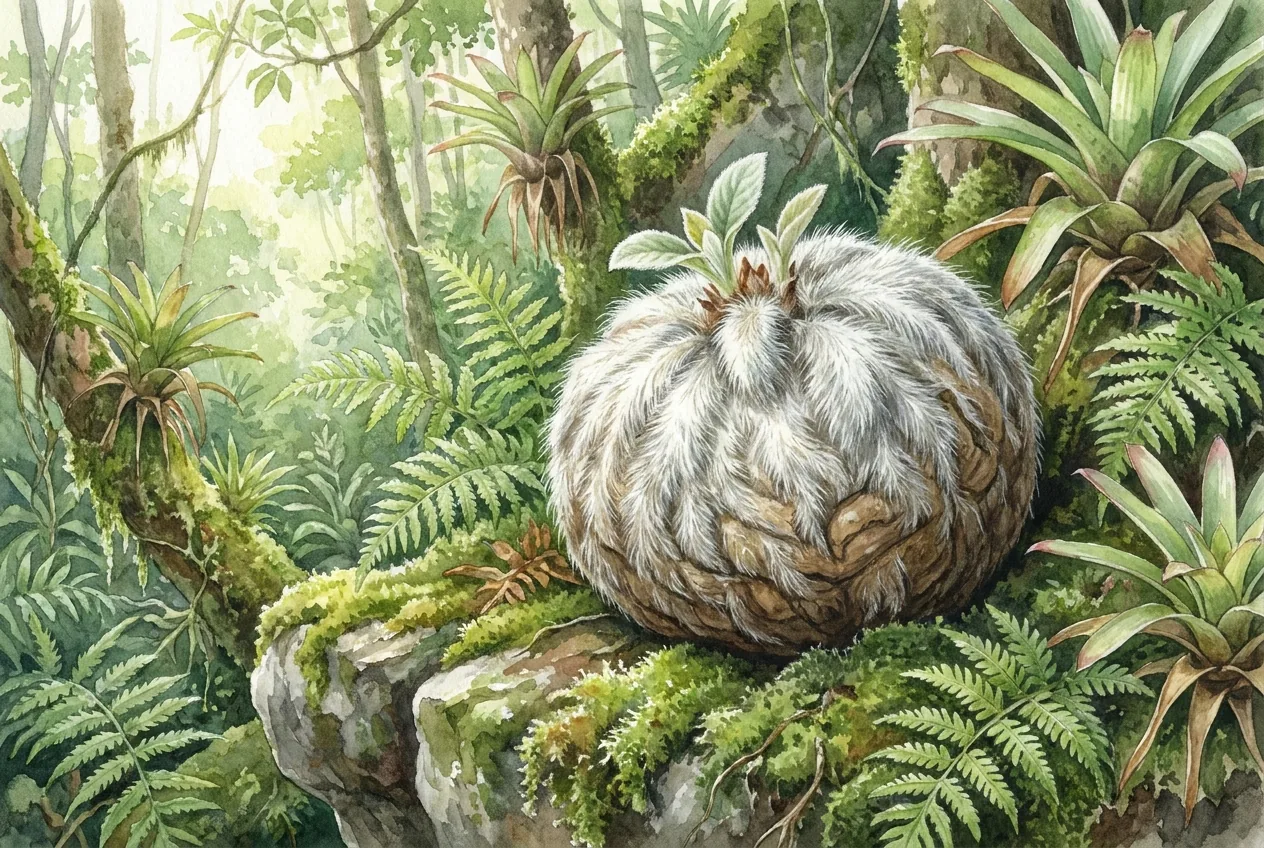
Key Takeaways
- This Brazilian cliff tuber can go leafless and rest for part of the year, so leaf drop is often normal rather than a sign of death. Timing varies from post-bloom rest to winter-deciduous, so judge dormancy by the plant, not the month.
- Do not cut water from a plant that still has leaves and is growing just because it is summer. Reduce water after it has actually dropped its foliage and stopped growing.
- Firmness, smell, and colour are useful clues but not proof. A firm tuber is reassuring, soft or wet brown tissue signals rot, and a wrinkled tuber may simply be thirsty. Check the roots when unsure.
- While the plant is truly resting, keep the mix on the dry side and do not fertilize. Overwatering a dormant tuber is a common way to create losses.
- Keep a resting tuber cool, out of harsh sun, and in moving air, then resume watering when new fuzzy shoots appear. Feed only after growth is established.
Your silver-fuzzy showpiece dropped every leaf in mid-summer, leaving a bare lump in the pot. A leafless Sinningia leucotricha is often resting rather than dying because this tuber has a normal dormant phase, but a bare tuber still needs a firmness, moisture, and rot check before you decide how much water it can handle.
This species has an unusually variable, much-debated dormancy. Some growers see a rest after early bloom, while the RHS describes it as winter-deciduous, growing in spring and resting dry in winter.
Rather than trust a fixed July rule, watch what the plant does and do not stop watering a leafy, actively growing plant solely because of the season. The biggest danger is treating uncertain dormancy as a cue for extra water, fertilizer, or heat.
Why Does Sinningia Leucotricha Go Dormant in Summer?
Read the Tuber as a Seasonal Lithophyte
When it rests, it does so as a seasonally dormant Brazilian cliff Gesneriad rather than by following a desert-caudex calendar. Growers commonly report a post-bloom rest, but the timing varies and habitat summer is the wet, growing season.
The admired caudex is botanically a stem tuber. The lithophyte grows in rock crevices and cliffs in Paraná, southern Brazil, a seasonally dry environment rather than a desert, and survives its dry-stress window by abandoning leaves and living off the tuber.
What Actually Triggers the Dormancy (Photoperiod or Heat?)
Do not overstate the dormancy trigger
The trigger is not settled.
A popular grower essay reasons that a buried tuber can’t directly sense day length, and proposes a post-bloom hormonal signal plus an internal timer, but that source is explicitly speculative (its author uses words like my guess and by no means certain), so it’s a plausible idea, not proof.
And a buried tuber can’t read day length doesn’t rule out photoperiod. The plant’s leaves and stems can sense day length and signal the tuber, as the article itself acknowledges.
In short, both heat and photoperiod may play a role, and neither is confirmed for this species.
What is reasonably well described is the visible sequence. The bloom often comes early, sometimes before the leaves are fully out. The foliage then expands, loses its silver sheen, and each shoot is eventually shed from the tuber, leaving a bare carapace.
Heat can accelerate leaf drop through ordinary heat-stress physiology, and some growers report the plant stalling in high heat (figures around 90 °F/32 °C are quoted).
Treat that as anecdote, not a validated dormancy threshold. It comes from individual grower reports, not controlled trials, and heat stress and normal seasonal rest are not the same thing.
Don’t use it hit 32 °C as a reason to stop watering a leafy, growing plant.
Why Is This the Opposite of My Other Caudex Plants?
Do not transfer a desert calendar
Classic desert caudiciforms often grow hardest in the hot months and rest in winter, while cultivated Brazilian Edelweiss may follow a different or variable cycle.
Applying Adenium logic without checking the individual plant is a common conceptual mistake.
The University of Arkansas Cooperative Extension describes desert caudiciforms plainly. Most grow during the hot summer months and are dormant in winter.
In cultivation, Sinningia leucotricha may show a different or variable phenology, so do not transfer the desert calendar without checking the plant.
Here’s the honest complication. Its native campos rupestres climate has wet summers and dry winters in the Southern Hemisphere. Meaning summer is its growing season in habitat, which is why RHS describes it as winter-deciduous.
Some cultivated plants nonetheless take a post-bloom rest that can fall in the Northern-Hemisphere summer.
The takeaway is not it rests in July but that its cycle is variable and often out of step with desert caudiciforms, so you have to read the individual plant.
| Feature | Sinningia leucotricha | Desert caudiciform (Adenium / Pachypodium) |
|---|---|---|
| Origin | Brazilian rock cliffs (campos rupestres) | Desert / arid scrub |
| Growth season | Often spring growth and early-summer bloom. Variable in cultivation | Hot summer months |
| Dormant season | Reported mid-summer through autumn or winter rest. Variable | Winter |
| Trigger | Reported post-bloom or seasonal cues. Heat may contribute | Cool, dry winter |
| How to decide care | Go by the plant: water while in leaf and growing. Ease off only once it has dropped its leaves and rested | Water and feed through the warm growing season |
Can I Keep It in Leaf Through Summer?
Use current growth to decide whether to maintain leaves
A plant may remain leafy through summer if it stays cool and actively growing, but reports vary. Do not promise that a young specimen will stay leafy or that a mature one must rest on a fixed date.
A young plant in a cooler, stable setup may remain leafy longer, while a mature plant under heat may rest earlier. Use leaf and shoot activity rather than a fixed temperature, and remember that neither maintaining leaves nor allowing rest is guaranteed.
How Do You Tell Sinningia Dormancy From Tuber Rot?
Use Firmness as a Starting Clue
Firmness is a useful first clue. A tuber that has dropped its leaves but remains firm, plump, and undamaged is more consistent with a living rest, while soft, mushy, translucent-brown, or jelly-like tissue is concerning for rot.
Early internal rot can hide under a firm surface, and severe dehydration can also soften a tuber. Firmness comes from turgor pressure in thin-walled storage cells, so combine it with color, smell, pot moisture, and root condition rather than trusting one squeeze.
What Does Rot Look and Smell Like?
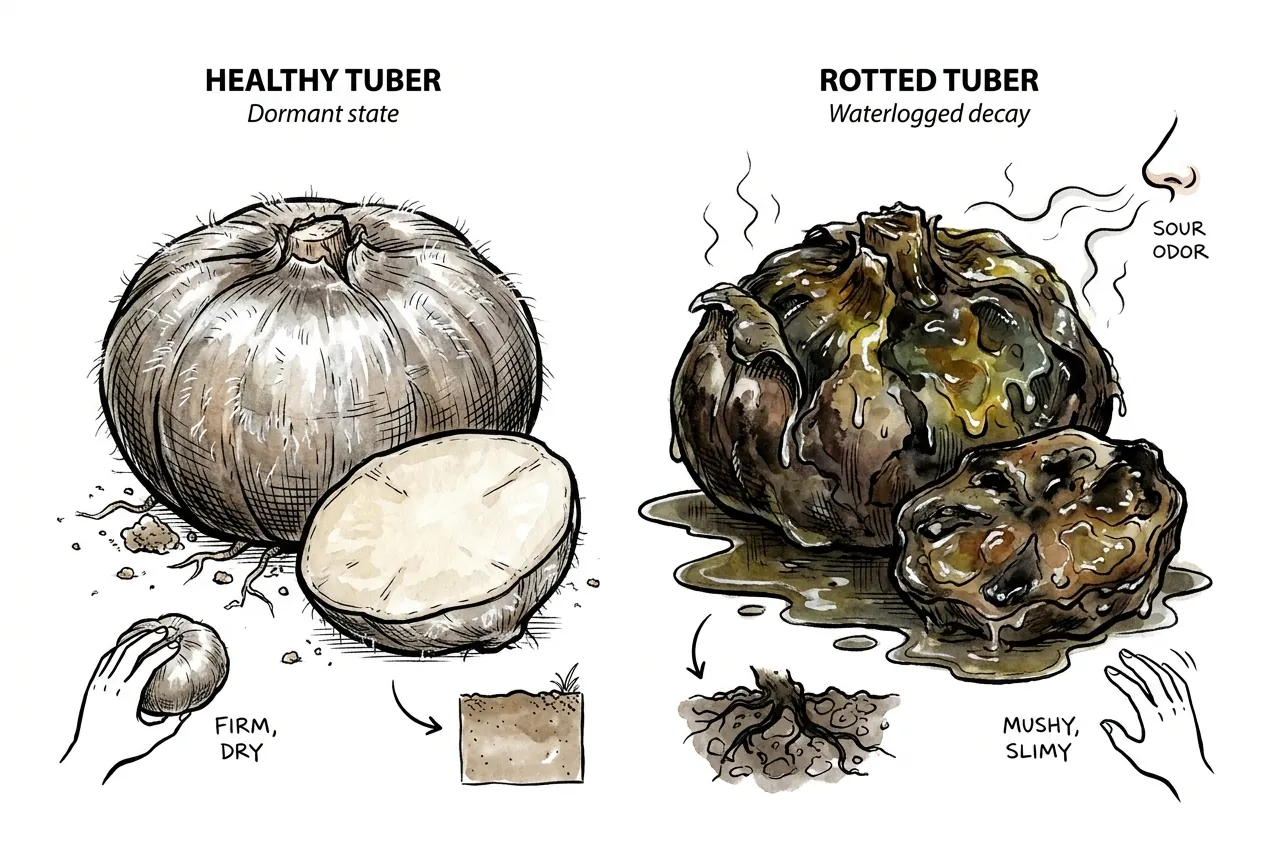
Inspect color, smell, and tissue together
Rot often reads wet and mushy with discoloration or a sour odor, unlike a dry, firm resting tuber. Waterlogged conditions displace oxygen and favor rot organisms, including water molds such as Pythium and Phytophthora.
These signs are concerning but not a complete diagnosis. If the tuber is soft, wet, browning, or sour-smelling, inspect the root zone and whole tuber before choosing a rescue, and avoid another soak until the roots and base have been assessed.
How Is Dehydration Different From Rot?
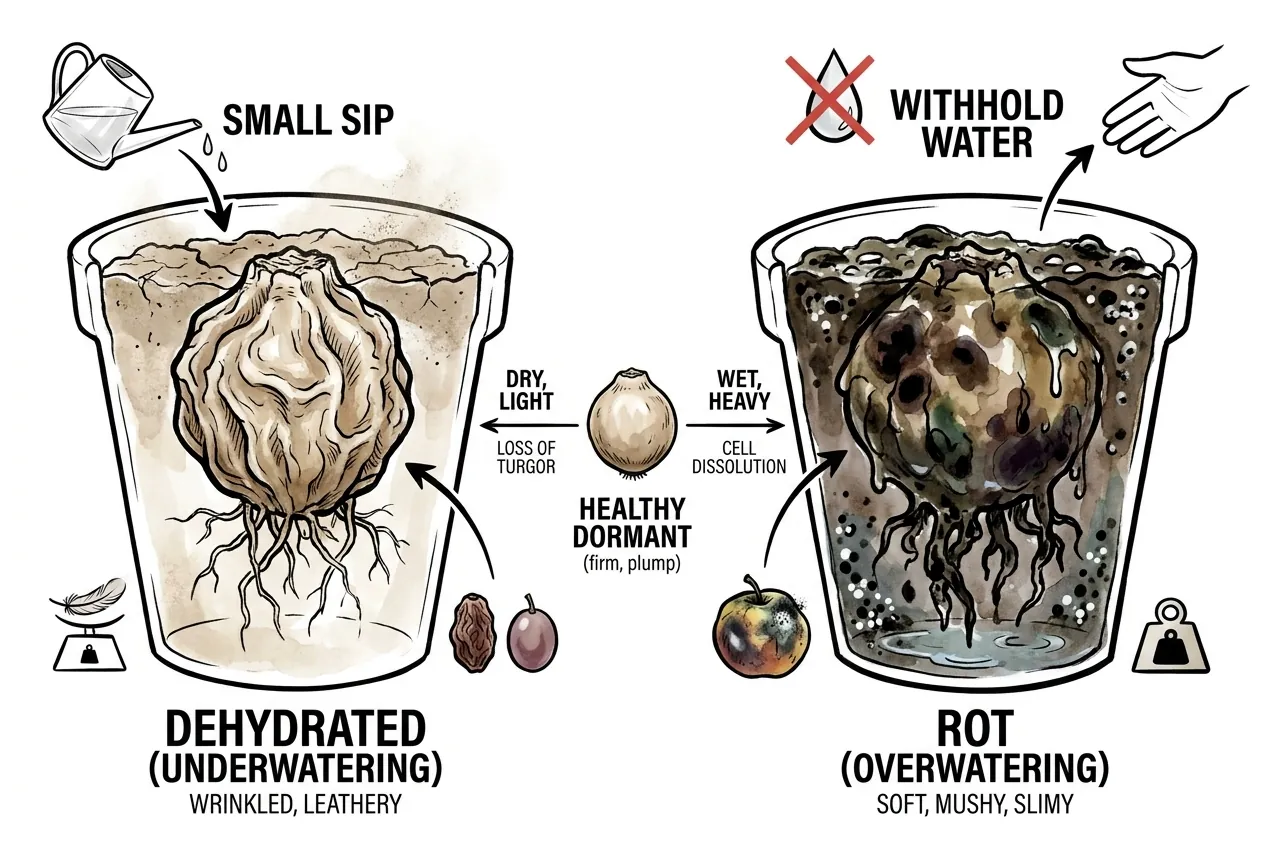
Dehydration often looks shriveled and leathery rather than wet and mushy. Cells have lost turgor from water loss, while the pot may feel noticeably light, but texture alone does not settle the diagnosis because rot can also soften a tuber.
When the root zone is genuinely dry and no rot signs are present, give a careful, measured sip rather than flooding a heat-stressed tuber. Aim at the soil while avoiding the crown.
| Sign | Healthy dormant | Rot (overwatering) | Dehydration (underwatering) |
|---|---|---|---|
| Texture | Firm, plump | Soft, mushy, slimy | Wrinkled, leathery |
| Color | Normal | Translucent brown to black | Normal, just shrunken |
| Smell | None | Often sour or foul | None |
| Pot weight | Normal | Heavy, stays wet | Very light |
| Right action | Usually leave it undisturbed | Assess roots and remove affected tissue if confirmed | Small careful sip |
Could It Be Pests Instead?
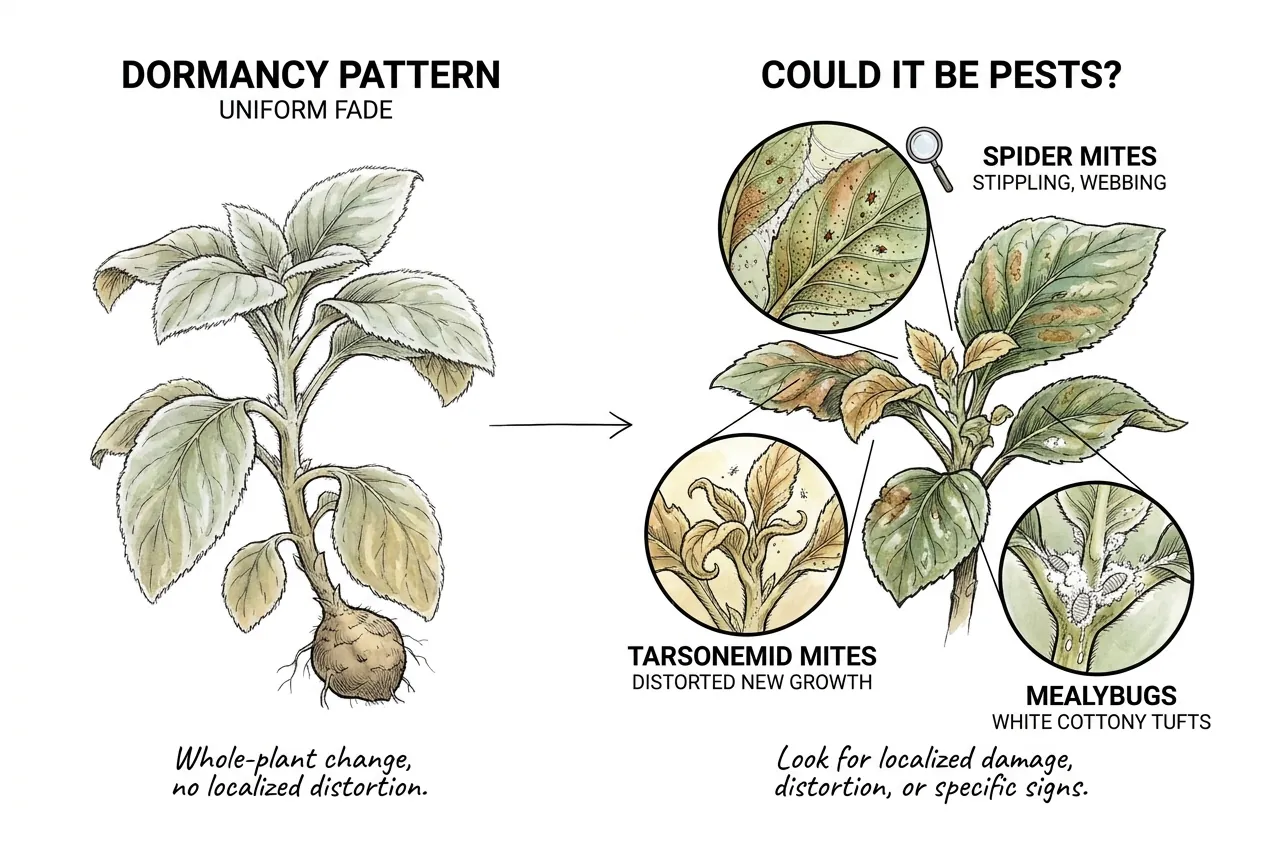
Pest stress is a separate pattern that can show up as stippling, bronzing, or distorted new growth rather than a uniform whole-plant fade.
Inspect the silver-fuzzy foliage and growing points for mites or other pests.
Clemson’s Land-Grant Press reports that spider mites are tiny, roughly 0.15 to 0.3 mm, and hide on leaf undersides.
They cause stippling and bronzing, with webbing only at high density.
Tarsonemid cyclamen and broad mites attack growing tips and cause curled, distorted, brittle new leaves, through their feeding damage to the meristem and growing tip.
Distortion concentrated in the newest growth can point toward mites, while a uniform whole-plant fade is more consistent with dormancy.
Inspect the fuzzy crown and leaf undersides with a loupe.
Fine stippling with webbing can indicate spider mites. Twisted, stunted new growth can indicate cyclamen or broad mites. White cottony tufts in leaf axils can indicate mealybugs.
How Do You Water a Dormant Sinningia Leucotricha Tuber?
Taper watering as leaves fade, then keep the medium on the dry side while the tuber is genuinely resting.
A small maintenance drink may be appropriate only when the plant is dry, firm, and losing condition. Prolonged wetness is the larger risk.
A dormant tuber has shed its transpiring leaves, so it draws almost no water and its metabolism is minimal.
Water sitting unused in the pot just displaces soil air.
The Gesneriad Society care sheet states the trade-off bluntly. Perpetually wet soil may rot the tuber, while dry conditions usually induce premature dormancy.
NC State Extension’s guidance for the close relative Sinningia speciosa is to reduce watering until the foliage dies back, then keep it barely moist.
Avoid overhead watering when the crown is fuzzy or dormant, because prolonged moisture on the crown can promote rot or gray mold.
RHS advises keeping the soil dry while the plant is dormant, subject to the tuber’s condition.
How Dry Should a Dormant Sinningia Tuber Be Kept?
Hold the medium dry through the bulk of the pot, and consider an occasional crown-avoiding sip only if the tuber visibly loses condition.
Some specialist guidance suggests once a month or less, but the interval depends on pot size, temperature, mix, and the tuber’s condition.
The tuber is a water-storage organ, so it can buffer itself through a dry rest from its own reserves.
That is why a mostly dry rest can be survivable.
Standing moisture raises rot risk because a resting tuber is using less water.
If the tuber starts to look visibly wrinkled over a long rest, bottom-water the pot or water at the soil edge, enough to dampen but not saturate.
Then let it dry again.
Avoid wetting the fuzzy crown where practical.
Water can pool in the trichome-covered growing point and linger there, increasing crown-rot and gray-mold risk rather than evaporating quickly.
When in doubt, avoid prolonged wetness and inspect before adding more water. A slightly under-watered dormant tuber may recover more readily than one already affected by rot.
How Can Overwatering Damage a Resting Tuber?
Overwatering can link two problems. Water displaces soil oxygen, and stressed or damaged tissue becomes more vulnerable to water-mold pathogens.
Allowing an appropriate dry-down is a useful rot-prevention measure, but the right interval depends on the mix and plant state.
Clemson Cooperative Extension lays out the chain directly.
Prolonged standing water or water-soaked soil drops soil oxygen significantly, producing anaerobic conditions favorable for root suffocation and infection by soil-borne pathogens such as Phytophthora and Pythium.
Those are water molds that thrive under low oxygen.
Healthy, oxygenated tissue is generally less vulnerable to these organisms.
They can exploit stressed roots and storage tissue, so risk rises when overwatering reduces oxygen.
The cold-plus-wet pairing is especially concerning because cold can slow the tuber’s defenses while pathogens remain active.
So do not leave a damp dormant pot in a chilly garage, and do not keep it in dense, water-retentive soil.
Does the Pot Material Change How Often I Water?
Pot material changes the dry-down rate. Porous terracotta often dries faster than plastic of the same size, but the difference depends on humidity, airflow, pot thickness, and mix.
Unglazed clay can exchange some water and oxygen through its walls, but it is not a guarantee against overwatering.
If you tend to overwater, pair a porous pot with a gritty mix and check the actual root-zone condition.
How Do I Verify the Tuber Is Actually Dry Before I Water?
Use a measurement tool rather than guessing.
The rot driver you most need to check, soil moisture, is invisible to the eye in deep gritty mix and on a partly-exposed tuber.
A finger test reads only the top inch, which may dry first and fail to represent the root zone below.
The relevant spec for a moisture tool is simply a probe long enough to reach the depth where the tuber’s roots actually sit.
That way you are reading the root zone rather than the surface.
A simple no-battery moisture probe can give a rough directional reading of how wet the mix is.
Treat it as a supporting hint only. These resistance meters read unreliably in gritty, low-salt mineral mixes (they often read dry when the mix still holds water), and a long probe can spear a small tuber or its roots, so favor lifting the pot to feel its weight, and don’t base a watering decision on the meter alone.
The honest caveat matters here. Galvanic analog meters infer moisture from electrical conductivity, so in gritty, mineral, low-salt mixes they read lower than reality, and they are not lab-accurate. Treat the reading as a relative wet-versus-dry trend, insert it to root depth, and store it dry between uses to avoid corroding the tip.
Cross-check with tuber firmness and pot weight rather than trusting a single number.
A grower who wants numeric reliability can step up to a capacitance digital sensor with a stated accuracy spec, and it helps to choose watering tools that measure dormant dry-down rather than guessing.
What Light and Temperature Does a Resting Tuber Need?
A leafless dormant tuber needs little useful light and, above all, needs to stay cool.
With no leaves to photosynthesize, it lives on stored starch, so low light or shade is generally acceptable during rest.
The real summer threat is warmth plus moisture, a combination that can favour rot organisms.
Once the silver leaves have dropped, the tuber has no photosynthetic machinery left to feed.
It is a storage organ running on reserves through cellular respiration, so useful light is no longer the main resource during rest.
This is why specialist growers often store dormant tubers in paper bags in dark, cool spots.
So do not waste your brightest windowsill on a bare tuber, and do not panic if the only spot is dim.
Reserve the bright indirect light for when new growth appears at wake-up.
Why Is a Hot Windowsill So Dangerous?
Heat can turn a harmless rest into a higher-risk rot situation.
Some rot organisms are favoured by warm conditions, and a hot windowsill or heat mat can push the tuber’s micro-environment toward those conditions.
UC IPM states that some Pythium species, such as P. aphanidermatum, are pathogens only at high temperatures above 77°F (25°C). The same source notes that soil moisture at 70% or higher of available water capacity is conducive to infection.
Cornell notes Rhizoctonia disease is favored by warm temperatures, with losses typically in summer.
Heat alone on a dry tuber is generally less concerning than heat combined with lingering moisture, which can raise rot risk.
So keep the resting tuber cool and away from concentrated heat sources.
Avoid setting it on a heat mat, on top of electronics, against a hot south-facing pane, or over a radiator.
How Do Humidity and Airflow Affect the Fuzzy Crown?
The silver hairs that make this plant distinctive can hold moisture around the crown, so give it gentle moving air.
Humid air sitting on the fuzzy crown can favour gray mold. Ventilation helps the surface dry.
Ohio State University Extension reports that for Botrytis gray mold, the optimum temperature for spore germination is 72 to 77°F (22 to 25°C). Disease is favored at relative humidity at or above 85 percent, and good air circulation reduces humidity within the canopy.
Notice the germination optimum is just ordinary room temperature, so the variable you actually control is humidity and airflow.
Give the resting tuber a spot with gentle air movement, such as an open shelf or a room with a fan on low.
Avoid a sealed terrarium or a closed closet with dead air.
A conservative storage setup is cool but frost-free, dry, and ventilated.
The RHS rates the species H2, so avoid freezing and avoid hot, stagnant positions. Use the tuber’s condition to refine the placement.
When Does Sinningia Leucotricha Wake Up After Dormancy?
The rest often lasts several months, but duration varies with provenance, age, temperature, and light.
Sources disagree on the exact month, so wait for fresh sprouts and a firm tuber instead of forcing a calendar date.
Reports cluster around leaf-drop in late summer through October and re-emergence anywhere from late autumn to early spring.
The published houseplant author Lisa Eldred Steinkopf reports her plant dies down around October, rests 3 to 4 months, then re-grows in early February and flowers by mid-March.
An Italian specialist nursery reports foliage loss in late summer and recovery in March.
The RHS simply says it loses leaves in winter and re-grows in spring.
The common thread is a roughly seasonal rest with re-emergence in late winter to early spring under temperate indoor culture, with the exact date depending on your conditions.
So do not circle a calendar date and force a wake-up.
Watch the bare tuber for sprouts as that window closes.
What Is the First Sign of Life, and How Do I Restart Care?
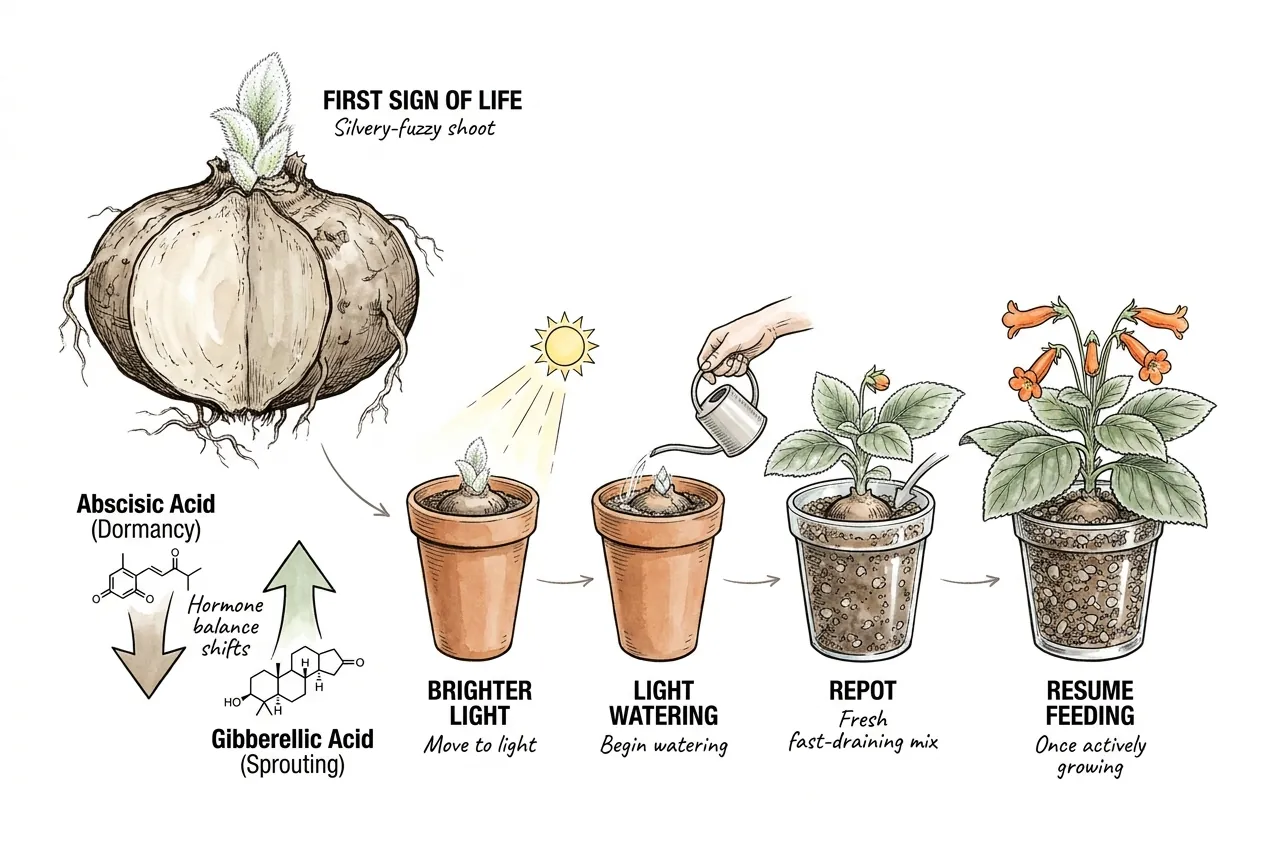
The first sign is often a small silvery-fuzzy shoot pushing from the top of the tuber.
Use that new growth, together with firmness and root-zone condition, to begin resuming care. Until then, keep the plant stable.
The mechanism is a shifting hormone balance.
In geophytes generally, sprouting is associated with a changing balance between abscisic acid, which supports dormancy, and gibberellic acid, which can promote sprouting.
A cool, dry rest may help the dormancy-maintaining signal decline until conditions favour emergence, but the exact control for this species is not established.
That is why a warm, wet rescue mid-rest is unlikely to force healthy growth and can instead increase rot risk.
When sprouts appear, move the plant to brighter light, begin light watering, and ramp up as the foliage expands.
If repotting is needed, use fresh fast-draining mix and a pot sized to the current tuber and root system rather than a large wet reservoir.
Resume feeding only once it is actively growing.
Flowers opening before the leaves fully expand is normal phenology for this species, not a defect.
What Mistakes Can Damage a Resting Tuber?
Keep a Resting Tuber Cool and Mostly Dry
A common mistake is trying to force a resting tuber awake with extra water, fertilizer, repotting, or heat.
Those changes can turn a healthy rest into a wet, stressed root zone.
A lower-risk baseline is a cool, ventilated, mostly dry setup with checks for firmness and rot.
A grower who panics at leaf-drop and starts watering harder may create the wet conditions that favour root-rot pathogens.
Pathogen activity depends on species, temperature, oxygen, and duration of wetness rather than a single indoor range.
When a resting tuber has little root activity, added moisture can remain in the pot longer than the plant can use it.
Treat dormancy watering as a conditional maintenance decision, not an automatic soak.
Why Avoid Fertilizing a Dormant Tuber?
Reserve fertilizer for active growth
Feeding a plant that has shut down growth is unlikely to help and can load the soil with salts the plant is not using.
Keep fertilizer for active growth unless a species-specific protocol says otherwise.
Fertilizer salts raise the osmotic concentration of the soil solution and can stress roots and storage tissue, especially when the pot is not being flushed by active growth.
The University of Maryland Extension documents salt injury as browning, dead root tips, and a white crust on the media surface.
Pause feeding as growth fades and resume only after new growth is clearly established. If salt buildup is suspected, leach cautiously once the plant is actively growing.
What Substrate Lowers the Rot Risk?
Build the Finished Mix for Reliable Dry-Down
A gritty, mineral-heavy mix can reduce how long the tuber stays wet.
The goal is a structure that drains and re-oxygenates reliably in your pot, not a fixed air-filled-porosity target transferred from another crop.
University substrate science quantifies the trade-off.
UC ANR’s nursery guidance gives broad air-filled-porosity ranges, but those values are crop- and mix-dependent.
Use the measurements as context rather than a Sinningia prescription.
Purdue’s controlled-environment lab adds that ideal air space is 20 to 25 percent of pore space for proper root growth.
Larger particles generally create more connected air space and faster drainage, but the result depends on particle shape, fines, pot geometry, and watering.
More air can reduce the saturated, low-oxygen conditions that favour water molds, without guaranteeing disease prevention.
A mineral-forward mix is a reasonable starting point for a dormant tuber, but the ratio should fit the pot and environment.
Coarse, stable aggregate in a consistent grade can improve drainage. pH and particle size depend on the source and should be checked rather than assumed.
Pumice is one practical mineral component. It is stable and porous, but a pumice amendment does not guarantee a fixed air-filled porosity across every mix.
Check the grade before buying, since bagged pumice varies (some is coarser than the 3–6 mm often suggested) and its exact particle size and pH depend on the source.
The honest tradeoff is weight and cost. Pumice is heavier and pricier per quart than perlite. If you already run a fast-draining mineral mix, or you want the lightest possible pot, you may not need it. Perlite is the cheaper substitute, but its very low density near 0.1 g/cm³ lets it float to the surface and gives less root anchorage.
How and When Should You Propagate It?
Propagate During Active Growth
Propagation is more forgiving during active growth, when cuttings and divisions can be observed and supported.
A dormant or declining plant is a poorer starting point, but local conditions and material quality still matter.
Sinningia leucotricha is described as a determinate grower.
Each shoot grows, flowers at its tip, feeds the tuber, and then may stop as the flowering stem matures.
That helps explain why cuttings from mature or dormant tissue can root poorly or fail to form a tuber.
A specialist Sinningia source recommends taking stem cuttings before maturity, while NC State guidance for the related S. speciosa favours active spring growth.
Those recommendations are useful starting points, not a controlled S. leucotricha success guarantee.
If your plant is already heading into dormancy, postponing cuttings until the next active flush may reduce stress and make the result easier to observe.
Which Methods Work, and How Long Until a Tuber Forms?
Compare propagation methods by evidence
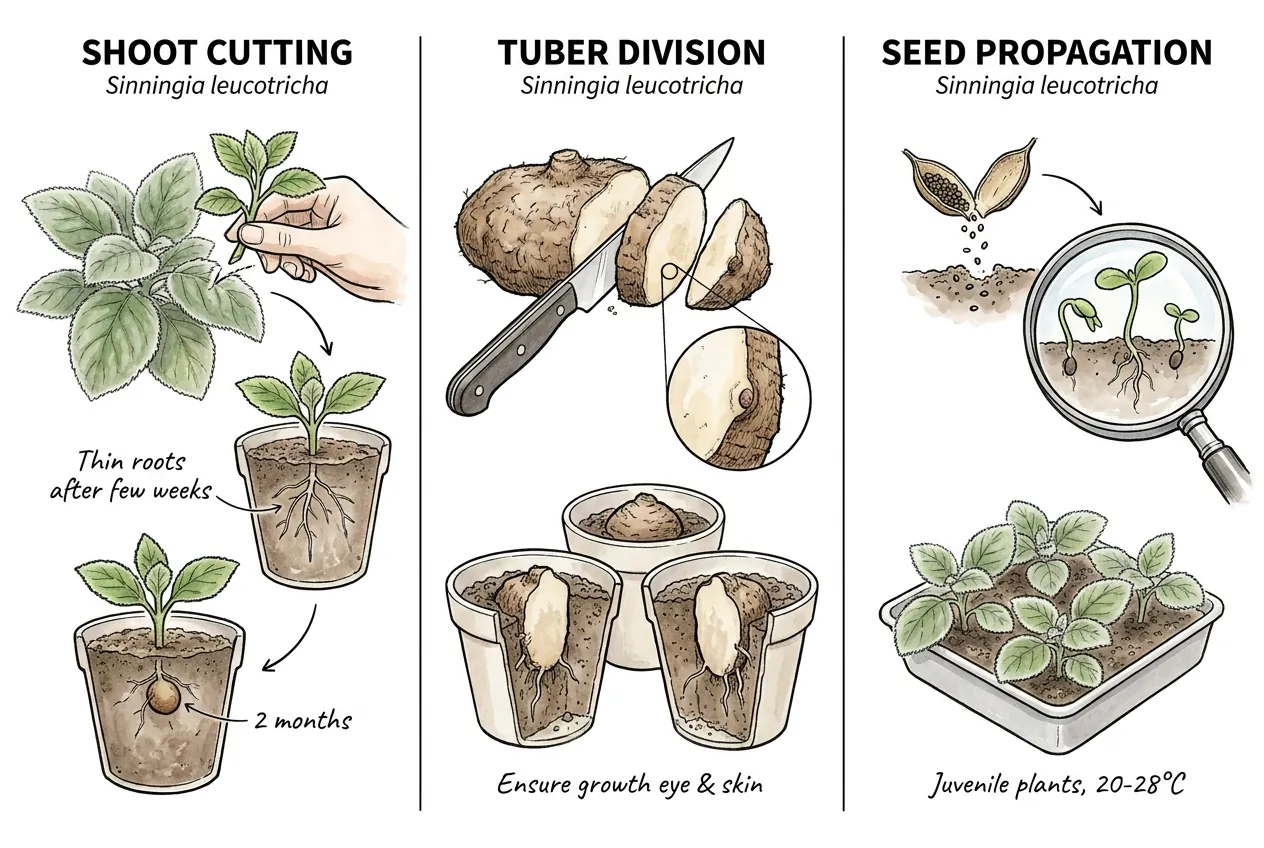
Potential methods include cuttings from young shoots, tuber division, and seed.
A successful cutting may form its own tuber underground over a months-long period, so patience and observation are part of the technique.
Sinningia leaf tissue can regenerate whole plants, but be careful how far you read that.
The high success figures (for example ~91.7% shoot induction) come from laboratory micropropagation of a different Sinningia on sterile, hormone-supplemented media, not from soil cuttings of this species, so they don’t predict home-cutting success.
In fact, the RHS notes that for S. leucotricha, cuttings may rot, fail to root, or never form a tuber, and recommends growing it from seed.
So treat leaf or tuber cuttings as worth trying but unreliable, and consider seed the more dependable route.
Rooting and tuber formation can take weeks to months.
Keep the cutting stable and judge it by persistent new growth and resistance rather than digging to check a calendar milestone.
For division, aim for each piece to carry a growth eye and some original outer tissue. Specialist guidance associates root emergence with that tissue rather than the starchy cut face.
Seed produces juvenile plants and is often used when cutting success is uncertain. Germination temperature should follow the seed source and local conditions rather than a fixed species rule.
Illustrative propagation comparison. Times are observation ranges, not guarantees for every clone or batch.
| Method | Best timing | Time to a new tuber | Key requirement |
|---|---|---|---|
| Tip / leaf cutting | Spring, juvenile growth | Variable. Often weeks to months | Young tissue. Follow the source protocol for leaf size |
| Tuber division | At or near wake-up | Resumes from existing eye | One growth eye plus original outer skin per piece |
| Seed | Warm season | Tubers over several months | Use seed-source and local conditions |
Practical conclusion
Let the Tuber Set the Pace
A leafless Sinningia leucotricha is usually resting, not dying.
Here is the whole approach, led by the plant rather than the calendar.
Reframe the seasonal calendar
This is a seasonally dormant Brazilian cliff Gesneriad rather than a desert caudex. Dormancy timing is variable and debated, and the exact trigger may involve heat, photoperiod, or post-bloom signals. Watch the plant instead of applying a fixed month.
Diagnose with more than firmness
A firm, plump bare tuber is often consistent with resting. Soft, wet, brown, or sour tissue can point to rot, while wrinkled, leathery tissue can point to dehydration. Distorted new growth may suggest pests. Firmness is a strong clue, not proof, so check the roots when unsure.
Water by state, not date
Keep watering a plant that is in leaf and growing. Once it has truly dropped its leaves and rested, keep the mix on the dry side and use only an occasional small sip away from the crown if the tuber shrivels.
Keep the resting setup cool and airy
Keep the tuber out of harsh sun and away from hot windowsills or heat mats. Do not seal it in dead air.
Let new growth set the restart
Resume water when fresh fuzzy growth appears and feed once growth is established. Repot only when the root and medium condition warrants it, and propagate during active growth. Use seed when a more dependable route is needed because cuttings are inconsistent for this species.
A fixed photograph lets me follow rest without disturbing the tuber, so a pot-rim mark keeps the same exposed tuber face in view. My note adds pot mass, firmness at one named point on that face, and the last leaf date. Digging it up merely to check a calendar milestone would defeat that non-destructive record.
I weigh every seven days at the same hour before watering and use median loss across the first three leafless intervals as the baseline. I flag a later loss only when it exceeds twice that median and 2% of the previous pot mass. That rule screens for an unusual change rather than defining dormancy, reducing false alarms from scale noise or ordinary evaporation.
Do that and your silver-leaved Queen of the Abyss may resume growth on its own schedule. A firm tuber is encouraging, but future flowering is not guaranteed.