
Adenium Seedling Stem Pinch: When and How to Branch It
Adenium seedling stem pinching is a shape decision, not a guaranteed caudex-thickening method. Use active growth, node availability, root condition, and wound care to decide whether to cut or wait.
Nathan Brooks · 2026-07-10 · Updated 2026-07-21 · 20 min read
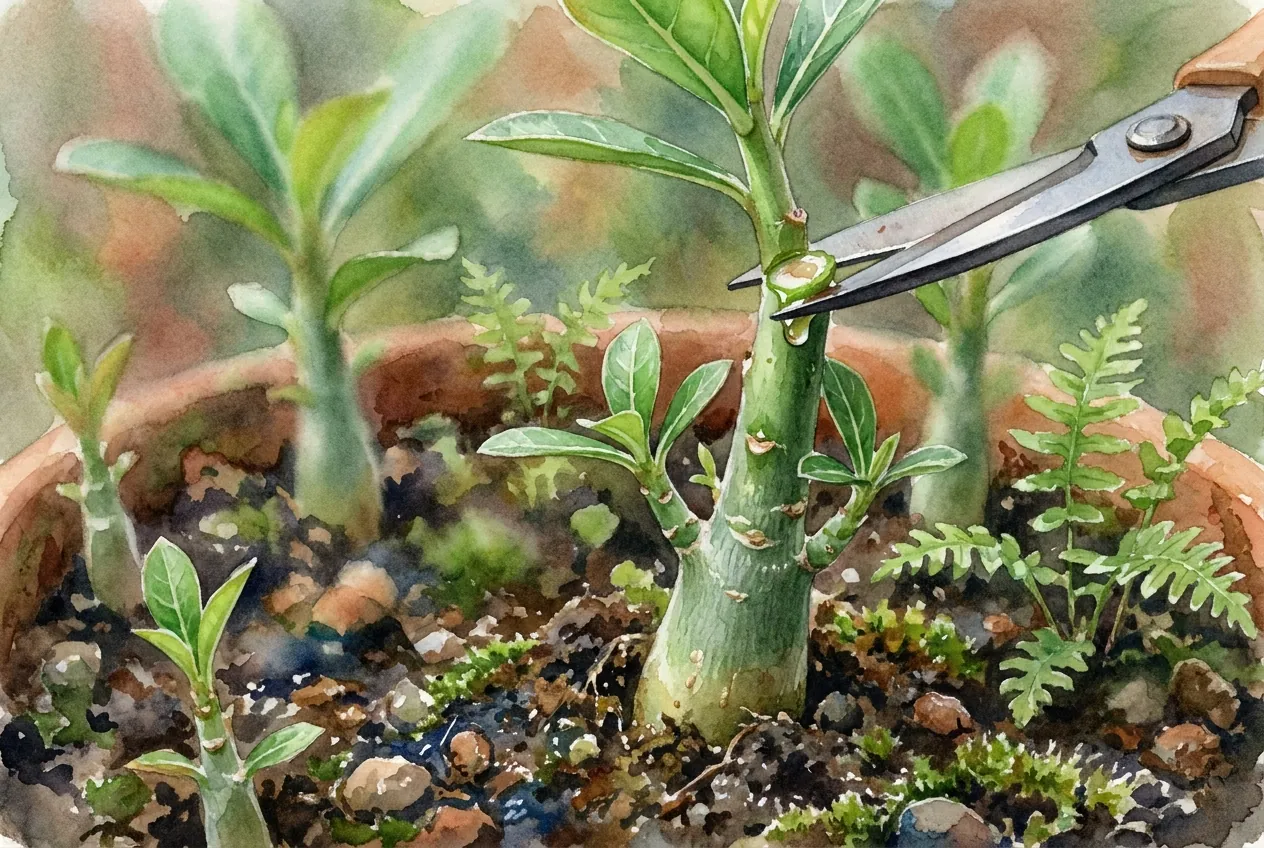
Key Takeaways
- Pinch only firm, actively growing Adenium seedlings with usable lower nodes. A vigorous but skinny seedling can recover. A soft, cool, or leafless one often answers the cut with dieback.
- The cut changes branch structure, not caudex girth. Any caudex benefit is indirect and unproven, so pinch to shape the plant rather than to force a fatter base.
- Leave several live nodes below the cut as a safety margin. This is a rule of thumb, not a validated number, so when unsure cut higher.
- After cutting, keep the wound dry, bright, warm, and airy. Water only when the mix is near dry and the caudex is still firm.
- Weak, soft, leafless, or newly repotted seedlings should wait. Fix light, roots, and drainage first, then pinch once active growth returns.
Pinch an Adenium seedling only when it is actively growing, firm at the caudex, and carrying enough live nodes to restart from below the cut. The pinch does not magically inflate the caudex. It redirects the young plant from one tall leader into a lower, wider branch framework that can feed a better caudex later.
The mistake is cutting because the seedling looks skinny. A skinny but vigorous seedling can recover. A soft, cool, recently repotted, or leafless seedling often answers the same cut with dieback.
When is an Adenium seedling ready to pinch?
Wait for active growth and usable nodes
An Adenium seedling is ready to pinch when it is in active growth, not merely when it is tall enough to annoy you. The safe candidate has a firm caudex, new leaf movement, and enough lower nodes to replace the leader without cutting into storage tissue.
This is the stage where impatience does the most damage. The goal is to cut a plant that can answer with buds, not a plant that is still negotiating with its roots.
What is the quickest readiness test?
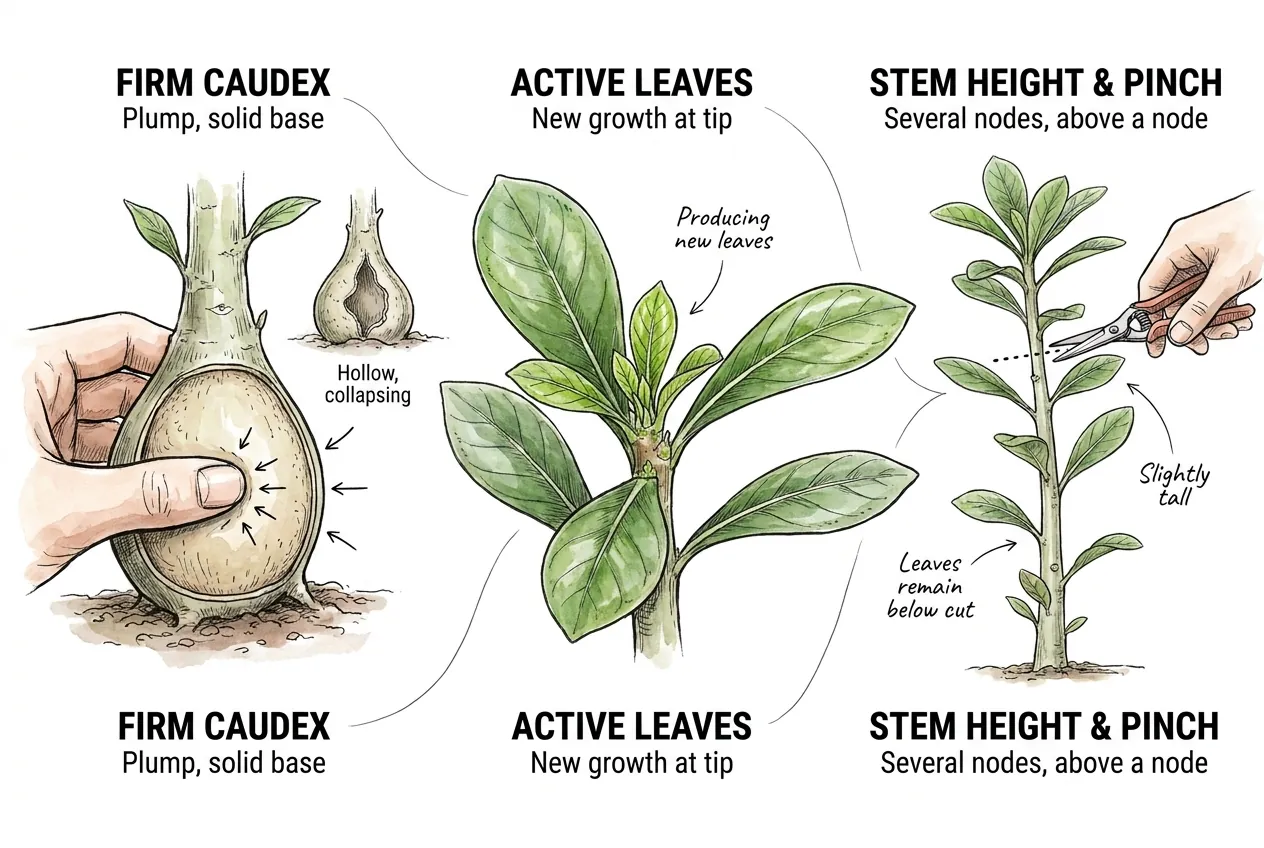
Use firmness and new leaves as the readiness test
The seedling is ready when the caudex is firm, the top is pushing new leaves, and the stem has several usable nodes below the intended cut. Leave a conservative number of live nodes below the pinch as a safety margin. The useful count depends on stem length, cultivar, and remaining leaf area rather than a validated threshold.
Do not use age alone. A warm shelf seedling can reach cuttable vigor while a cool windowsill seedling of the same age is still living on a tiny root system.
Use the fingernail test gently. The caudex should feel pressurized, not rubbery or hollow. The stem above it should cut cleanly rather than collapse.
Which seedlings should you not cut yet?
Do not cut a stressed seedling
Do not pinch a seedling that is soft at the base, newly repotted, leafless from stress, or stretching under weak light. Those plants need root recovery and better culture before they need surgery.
If the internodes are long because the seedling is hunting for light, cutting only makes a shorter weak plant. Move it to brighter light first and let the next nodes form closer together.
If the plant recently lost roots, wait for new leaves before cutting. New leaves are the cheap signal that the root system is moving water again.
How does season change the decision?
Use the growth season as the window
Warm-season growth gives a seedling the best chance to seal the cut and restart buds. In cool weather, the same cut sits open longer and the plant spends its reserves slowly.
For indoor growers, the useful question is not the month. It is whether the shelf behaves like growth season. New leaves, warm daytime roots, and steady light matter more than the calendar.
If the plant is waking after dormancy, wait until the first flush has hardened slightly. Cutting the first soft push can leave the seedling with less photosynthetic area than it needs.
How should you read a stretched seedling?
Correct light before pruning stretch
A stretched Adenium seedling is usually asking for light before it asks for pruning. Long internodes mean the plant spent energy reaching upward instead of building compact lower structure.
Move it into brighter light gradually, then watch the newest nodes. If new growth tightens, the plant is improving. If it keeps stretching, cutting will only reset the same problem at a lower height.
The better sequence is light first, pinch second. A short weak seedling is not better than a tall weak seedling.
What does a strong seedling look like before the cut?
Read strength from recent momentum
A strong seedling looks a little boring. The caudex is firm, the newest leaves are not shrinking, and the stem does not wobble at the soil line.
Look at the newest growth rather than the oldest leaves. Old leaves can be scarred or sun-marked and still belong to a healthy plant.
The most useful sign is momentum. If the seedling has pushed a new leaf pair recently and the pot dries on a predictable rhythm, it has enough root activity to handle a small top cut.
What does a weak seedling look like before the cut?
Let mixed signals delay the cut
A weak seedling gives mixed signals. It may be tall, but the caudex feels soft after watering or the newest leaves arrive smaller than the previous ones.
That plant is not asking to be shortened. It is asking for a better root zone, stronger light, or a smaller wet mass of soil.
If you pinch it anyway, the cut becomes one more demand on a plant that already has a budget problem. Wait until the next growth flush proves the correction worked.
Does pinching really make the caudex fatter?
Separate branch architecture from caudex growth
Pinching helps caudex design indirectly. It creates lower branches that can carry more leaves, and those leaves feed the storage tissues over time.
The cut itself is not a caudex-thickening treatment. It is a branch-placement decision that pays off only if aftercare keeps the seedling growing.
What does the pinch actually change?
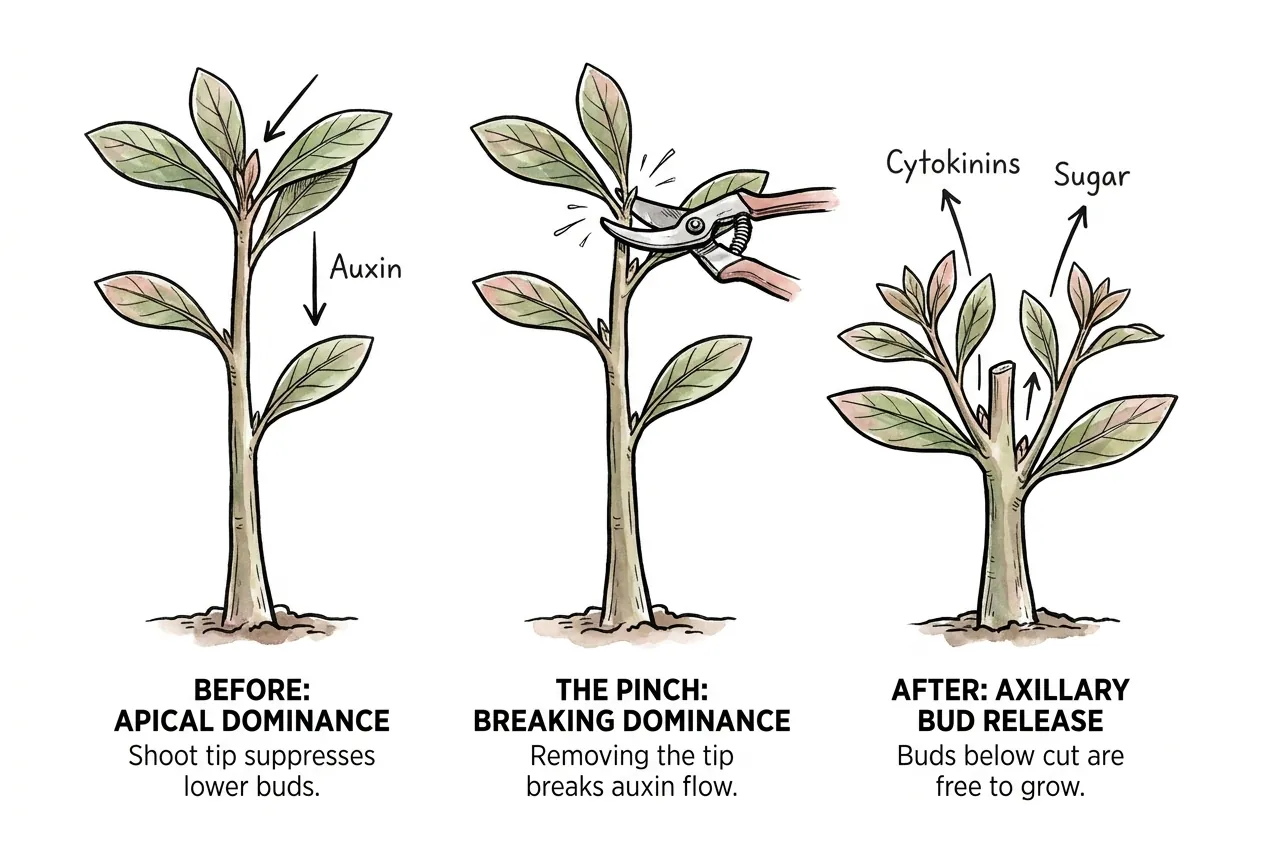
Understand what the pinch actually changes
Pinching removes the dominant growing tip, so buds below the cut get a better chance to grow. In plant physiology, that is the release of apical dominance.
For Adenium seedlings, the visible result is usually lower branching first. Caudex thickness follows later if those branches keep making leaves and feeding storage tissue.
Think of the pinch as architecture, not fertilizer. It changes where growth starts. It does not add stored energy by itself.
Why can a pinched seedling stall?
Keep the cut proportional to leaf area
A pinched seedling stalls when the cut removes more leaf area than the roots can replace. The plant must seal the wound, activate buds, and rebuild its canopy from stored reserves.
That is why the best pinch is modest. Remove the soft leader above a node cluster. Do not cut down into the swelling caudex or below the lowest healthy leaves.
Sugar allocation matters as much as hormones. A growing main stem can outcompete buds for resources, but buds still need light and stored energy after release.
How many branches should you expect?
Expect a variable branch response
Expect a variable response, not a guaranteed crown. A strong seedling may push several lower buds, while a marginal seedling may choose one replacement shoot and ignore the rest.
That does not mean the cut failed. It means the plant allocated its reserves conservatively. Your job is to keep the new shoot compact, not to keep cutting until the plant obeys.
If only one bud breaks, let it grow until the seedling is strong again. A second pinch can happen later, but repeating cuts on a weak plant turns training into depletion.
Why does root health decide the branch response?
Keep roots healthy before pruning
Roots decide whether released buds become real branches or tiny stalled nubs. A pinched seedling needs water movement, minerals, and stored carbohydrates to turn a dormant bud into a growing shoot.
This is why a recently repotted seedling often sulks after pruning. The top was cut at the same moment the root system was asked to reattach to a new mix.
Separate those stresses. Repot when the plant needs a root reset, then wait for fresh top growth before pruning the leader.
Why does leaf area matter after the pinch?
Protect enough leaf area to pay for recovery
Leaves are the engine that pays for caudex gain. A pinch removes some of that engine, so the remaining leaves and stored reserves must carry wound sealing and bud activation.
This is why a taller seedling with healthy leaves can be safer to pinch than a shorter seedling with poor roots. Height alone is cosmetic. Stored energy and leaf function are the real budget.
Once new branches begin expanding, the caudex has more future feeding points. That is when the design begins to work.
Where should you cut an Adenium seedling?
Place the cut above a healthy node cluster
Cut above living nodes, not at an arbitrary height. The right cut keeps enough stem below the wound to carry backup buds and avoids the swelling caudex tissue that the plant cannot afford to lose.
If you are unsure, cut higher. You can always refine structure later, but you cannot put removed nodes back.
How high should the cut be?
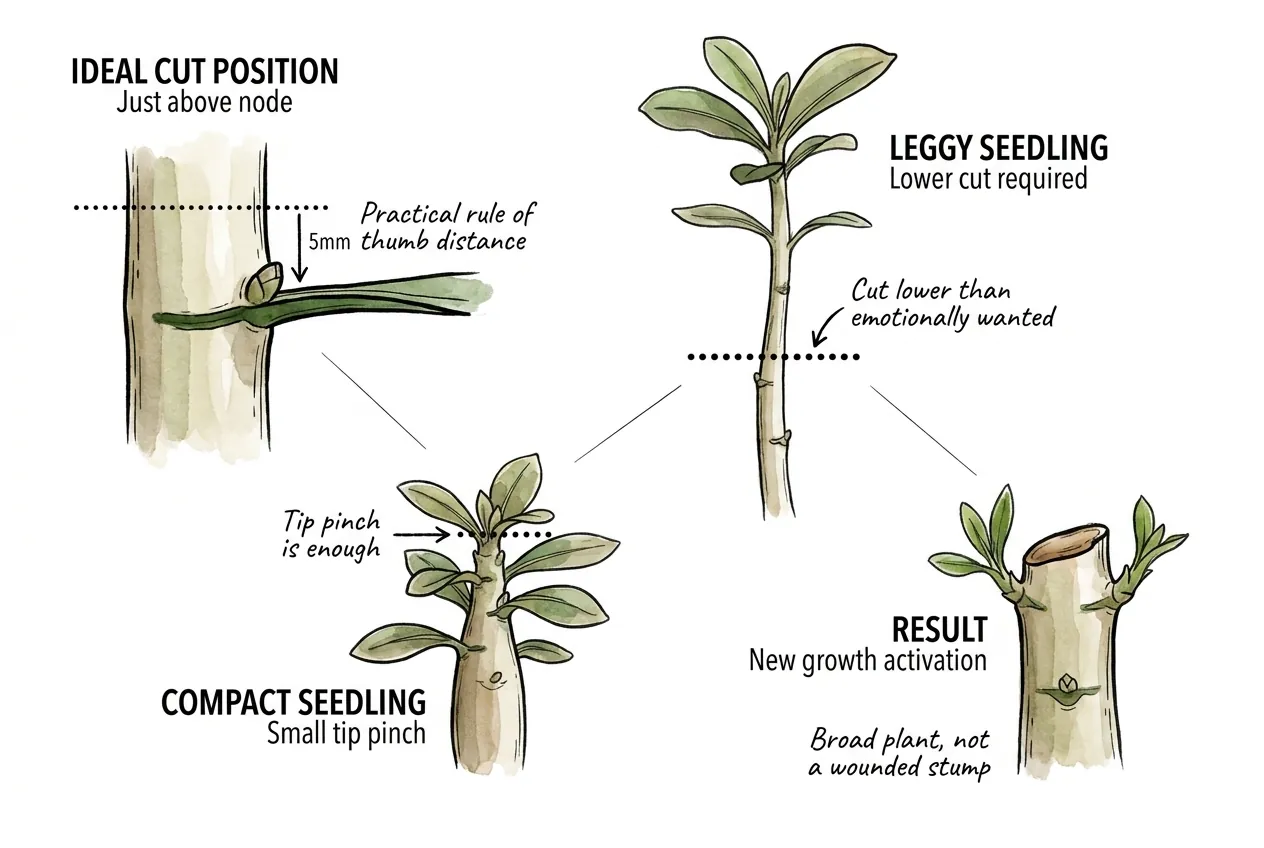
Cut above a healthy node cluster, leaving enough live nodes below the wound for the seedling to restart. Choose the margin conservatively because controlled Adenium trials do not establish one universal node count.
For a very young seedling, a soft pinch of the newest tip is safer than a hard trunk chop. The lower the cut, the fewer chances the plant has to push a replacement shoot.
Make the cut flat or slightly angled with a clean blade. Avoid crushing the stem because crushed succulent tissue dries unevenly and invites dieback.
For seedling pruning, exact cut height is mostly grower practice rather than controlled Adenium research. Treat the node rule as a safety margin, not a laboratory threshold.
What tool should you use for the pinch?
Choose a tool that fits the seedling stem
Use small, sharp snips for seedlings because the target stem is narrow and soft. A bulky bypass pruner is easy to oversteer on a thin Adenium stem.
Because the sap is toxic and irritating, wear gloves and eye protection, cut away from your body, and keep the sap off your skin and eyes.
Choose a narrow stainless blade that reaches between seedling leaves without scraping the caudex. The blade should cut to the tip, close cleanly, and leave no crushed crescent on the stem.
Use heavier tools as the stem matures
Seedling snips are not the right tool for woody mature branches. Use a heavier disinfected pruner once the stem is pencil-thick or harder.
How do you disinfect without overcomplicating it?
Disinfect before and after the cut
Clean the blades before the cut and again after sap contacts the tool. A simple wipe-down is enough for routine pruning if the plant is healthy.
If you are cutting a suspicious stem, treat it like a disease job. Make one cut, clean the blade, and do not drag sap from the questionable tissue onto other seedlings.
Let the tool dry before storing it. Sticky Adenium sap on a closed blade is an easy way to make the next cut ragged.
What should the cut look like when you finish?
The finished cut should be small, clean, and placed above a node rather than buried inside the node itself. Leave enough stem above the node that the bud area is not gouged.
Do not carve a bowl, notch the caudex, or make decorative cuts on a seedling. Those moves increase wound area without improving the odds of useful branching.
If the blade slips, stop and inspect the tissue. A ragged cut can often be cleaned once, but repeated trimming turns a small wound into a large one.
How do you keep the seedling safe after cutting?
Keep the wound dry while the seedling recovers
After cutting, give the seedling bright light, moving air, and restrained water. The plant needs to dry and seal the wound before it needs a celebration drink.
The first week is about not creating a rot path. Strong aftercare looks calm because most of the work is done by the plant.
What should you do in the first week?
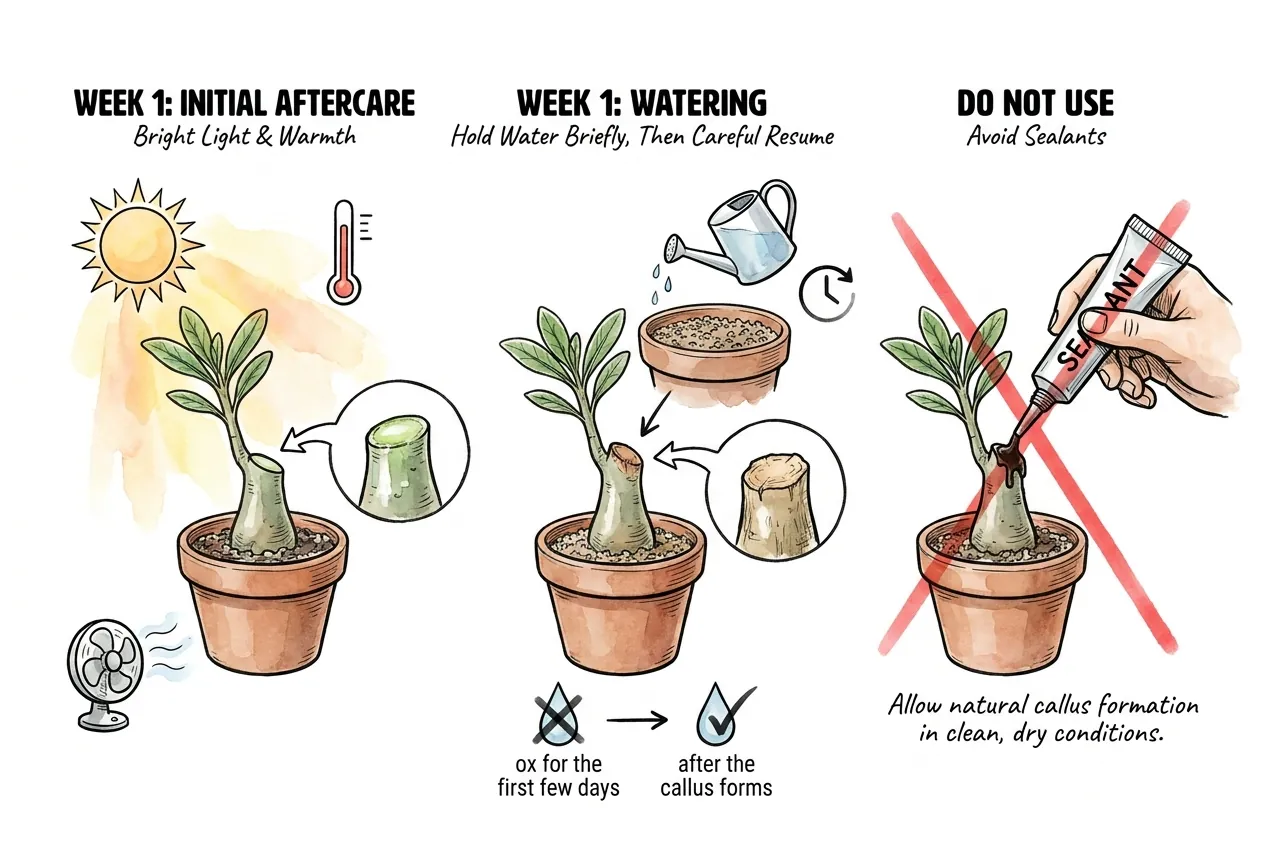
Keep the plant bright, warm, and dry at the wound. Water only when the mix is already approaching dry and the caudex still feels firm.
Do not soak the pot just because you cut the top. The seedling has less leaf area after pruning, so water demand drops before new buds begin working.
If sap appears, keep it off your skin and away from pets. Adenium sap contains cardiac glycosides, so gloves and tool cleaning are normal safety, not drama.
When does bottom heat help?
Bottom heat is most useful when the shelf is cool and the seedling is otherwise healthy. It is a root-zone stability tool, not a cure for rot.
If your room is already warm, skip the mat and spend your attention on light and airflow. Overheating can damage roots faster than added warmth helps recovery.
Use a seedling heat mat sized to fit the tray and pair it with a thermostat. The cited heat-mat combo advertises 68 to 86 °F (20 to 30 °C) as a general seed-and-cutting propagation range, which is a product claim, not an Adenium-specific target or a hard biological ceiling.
Use bottom heat only when measurements show that a cool shelf is limiting recovery, then set and adjust the controller from the actual root-zone temperature and seedling response. If you are weighing which setup to get, you can choose a heat mat by measured soil temperature.
Use it under a tray when a winter shelf sits below comfortable Adenium recovery temperatures.
Use a GFCI-protected outlet, keep cords and plug connections dry, and keep the mat out of standing water. Do not use a cracked, kinked, or damaged mat.
Prevent mat overheating
A mat without checking pot temperature can overheat black nursery pots. Use the thermostat probe near the pots and leave air space around the tray.
How should watering change after a pinch?
Reduce watering until new growth returns
Watering should become slightly more conservative until new growth is visible. A seedling with less foliage uses less water, even when the pot still looks familiar.
Use pot weight and caudex firmness together. A light pot with a firm caudex can be watered. A heavy pot with a firm caudex should be left alone.
If the caudex wrinkles slightly but the pot is still damp, do not chase the wrinkle with more water. Improve warmth and airflow first because wet roots cannot fix poor oxygen.
What should you do if the pot stays wet too long?
If the pot stays wet for days after the pinch, increase airflow and warmth before you water again. The seedling has reduced leaf demand, so the old watering interval may be too aggressive.
Do not yank the seedling out of the pot just because the surface looks damp. Unpot only if the caudex softens, the stem base darkens, or the mix smells sour.
A smaller, faster-draining container is often a better fix for a small seedling in an oversized pot than partial watering.
When you do water, wet the whole root ball and let it drain, then simply water less often. Watering only one part of the pot leaves dry pockets and can let salts build up, so match the frequency to how fast the mix dries rather than soaking only a corner.
What should light do during recovery?
Keep recovery light steady and acclimated
Light should be bright enough to keep new internodes compact, but not so abrupt that it burns a freshly stressed plant. Keep the seedling in its normal strong-light position if it was already adapted.
If the plant was grown dim, step light up gradually before or after the cut. A sudden move from a weak shelf to harsh outdoor sun can damage leaves just when the seedling needs them.
The best recovery light is boringly steady. Big swings in sun, water, and temperature create more problems than the cut itself.
What if the cut turns dark or buds do not break?
Read healing by spread and firmness
A dark cut is not automatically rot. The danger sign is spreading softness below the wound, especially when the caudex loses pressure at the same time.
Slow bud break is also normal on a cautious seedling. Judge the whole plant before you recut.
What does normal healing look like?
Normal healing looks dry, firm, and slightly corky at the cut surface. The top may look ugly for a while, but the tissue below stays firm.
Watch the line between dry callus and live green stem. A stable dry cap is fine. A spreading soft patch is not.
If the cut stays wet, move the plant into stronger airflow and stop misting. Adenium wounds need drying time more than cosmetic treatment.
When should you intervene?
Intervene when darkness spreads downward, the stem softens below the cut, or the caudex loses pressure. Wearing gloves, trim back to firm tissue with a clean blade if the rot line is moving, then keep the wound dry and airy while it seals.
Do not keep shaving a seedling that has already lost most of its stem. At that point, the priority is dry warmth and root survival.
The most useful steps for this kind of rot are removing soft tissue and fixing the wet, poorly-aerated conditions that caused it, not relying on a spray. Garden sulfur fungicides are labeled for surface foliar diseases (rust, leaf spot, powdery mildew) on ornamentals, not as a dressing for fresh pruning wounds or stem soft rot.
Treating a cut with sulfur would be an off-label use, so skip it here. Drainage, airflow, and clean cutting are the practical tools.
What if no buds break?
Give a firm seedling time before recutting
If no buds break but the caudex stays firm, wait. The plant may be rebuilding roots or sealing the cut before it commits to shoots.
Do not repot, fertilize hard, and recut in the same week. Stacking interventions makes it impossible to know which stress caused the next problem.
Give the plant stable light and a normal dry-down cycle. If the stem below the cut remains firm, time is usually safer than another wound.
What if one side grows and the other stays blank?
One-sided regrowth can occur because buds do not wake evenly. Let the strong side produce leaves first, then decide whether a later correction is worth it.
Rotate indoor seedlings gently if they lean toward a window. For outdoor sun-hardened plants, avoid sudden orientation changes that expose shaded tissue to harsh sun.
If one shoot dominates again, you can shorten that shoot later after the seedling has rebuilt strength. The first pinch sets the structure, but it does not have to finish the whole plant.
What if the seedling flowers instead of branching?
Some Adenium seedlings try to flower before they build the structure you want. On a small plant, flowers are a heavy demand for a small reward.
If the seedling is still tiny, remove early buds and let the plant keep growing leaves. You are training a future caudex, not judging a flower show.
If the plant is already sturdy, a small bloom is not a crisis. Just do not combine flowering, pruning, repotting, and heavy feeding in the same recovery window.
What is the no-cut alternative for weak seedlings?
Build a better candidate before cutting
The no-cut alternative is to grow the seedling into a better candidate. Improve light, drainage, pot fit, and drying rhythm until the plant has the energy to respond.
Waiting is not failure. For a caudex plant, stored strength is part of the design.
How do you build a better shape without pinching?
Build vigor first with brighter light, a gritty mix, and a pot that dries predictably. A stronger seedling gives you more nodes and a safer cut later.
Rotate the pot if the plant leans toward one side. Do not rotate a sun-hardened outdoor plant abruptly if one side is already adapted to harsh sun.
If the seedling is thin because it is overpotted, move it to a smaller, faster-drying pot at the next safe repotting window. Root oxygen often fixes more shape problems than a knife.
How do you decide cut, wait, or skip?
Use the decision as a plant-health call, not a bravery contest. A conservative grower may skip more cuts than a beginner expects.
| Seedling state | Suggested next step | Why |
|---|---|---|
| Firm caudex, active leaves, several nodes | Consider a pinch | Buds have reserves and places to break |
| Tall and pale under weak light | Wait | Fix light before removing leaf area |
| Recently repotted | Wait | Roots need to resume water uptake |
| Leafless from stress | Do not pinch yet | No active canopy means poor recovery |
| Soft caudex | Investigate before pruning | Pruning hides the real problem |
Keep the training decision modest
A defensible Adenium seedling stem pinch is deliberately modest. Cut a vigorous plant, leave nodes, dry the wound, and let the new branches earn the caudex mass.
How should you handle a whole tray of seedlings?
Choose seedlings individually, not by batch
Treat a tray as a selection exercise, not a synchronized haircut. The strongest seedlings can be pinched first, while the smaller ones keep growing until they show the same vigor.
This matters because seed-raised Adenium seedlings vary heavily. Two seedlings from the same sowing can have different caudex pressure, root mass, and leaf speed.
Pick a small test group if you are unsure. Pinch the most vigorous few, leave the weak few alone, and compare structure after the next growth flush.
Do not cut every plant just because one plant is ready. Batch pruning is convenient for the grower, but the seedlings do not share one root system or one energy budget.
How do you compare pinched and unpinched seedlings fairly?
Compare pinched and unpinched plants fairly
Compare siblings by vigor class, not by the calendar. A pinched strong seedling should be compared with an unpinched strong seedling, not with the smallest plant in the tray.
Use the same light, pot size, and mix for both groups if you are learning your own conditions. Otherwise you will blame the cut for differences caused by culture.
Judge the result after the next full growth flush. The first week tells you whether the wound stayed safe. The next flush tells you whether the training choice improved the plant.
Before cutting, I photograph the seedling from two opposite sides with a small ruler behind the stem and number every usable node on a duplicate image from the caudex upward. I circle the intended cut and identify the leaves that will remain. This prevents a low cut made from memory after the plant has been turned in my hand.
For a tray, I assign identifiers and measure basal diameter 5 mm above the mix, newest fully expanded leaf length, and 24-hour mass loss from a 30-minute post-drain weight. I accept a pair only when all three differ by no more than 10%, limiting pre-cut differences that could masquerade as a pinch response. Within each accepted pair, I flip a coin to choose the pinched seedling, then keep both in matching pots, mix, and light.
The numbered-node record begins with which bud swells first, which nodes stay inactive, and when the first replacement shoot unfolds a leaf. If the control also slows or stretches, I investigate the shared environment before blaming the pinch.
What should you do after the first new shoots harden?
After the first new shoots harden, return to normal growth culture rather than babying the plant forever. The wound has done its job once the seedling is actively feeding through new leaves.
Watch internode length on the replacement shoots. Tight growth means the light level is working. Long soft shoots mean the plant is stretching again.
If the new branches crowd each other, resist immediate pruning. Let the seedling build leaf area first, then make a second structure decision after it has gained strength.
Fertilizer should stay gentle during this phase. A weak dose during active growth is safer than a hard push on a recently cut succulent seedling.
What should you write on the plant tag?
Write the cut date and the reason for the cut. That small note stops you from recutting a plant that has only had a short recovery window.
Add one plain observation each week. Use simple terms such as firm, soft, buds swelling, or new shoot active.
You do not need a spreadsheet for one seedling, but you do need memory that is better than optimism.
If the plant fails, the tag still helps. You can see whether the problem was timing, root stress, low light, or too much water after pruning.