
Fockea edulis Caudex Shriveling: Weigh It Before Watering
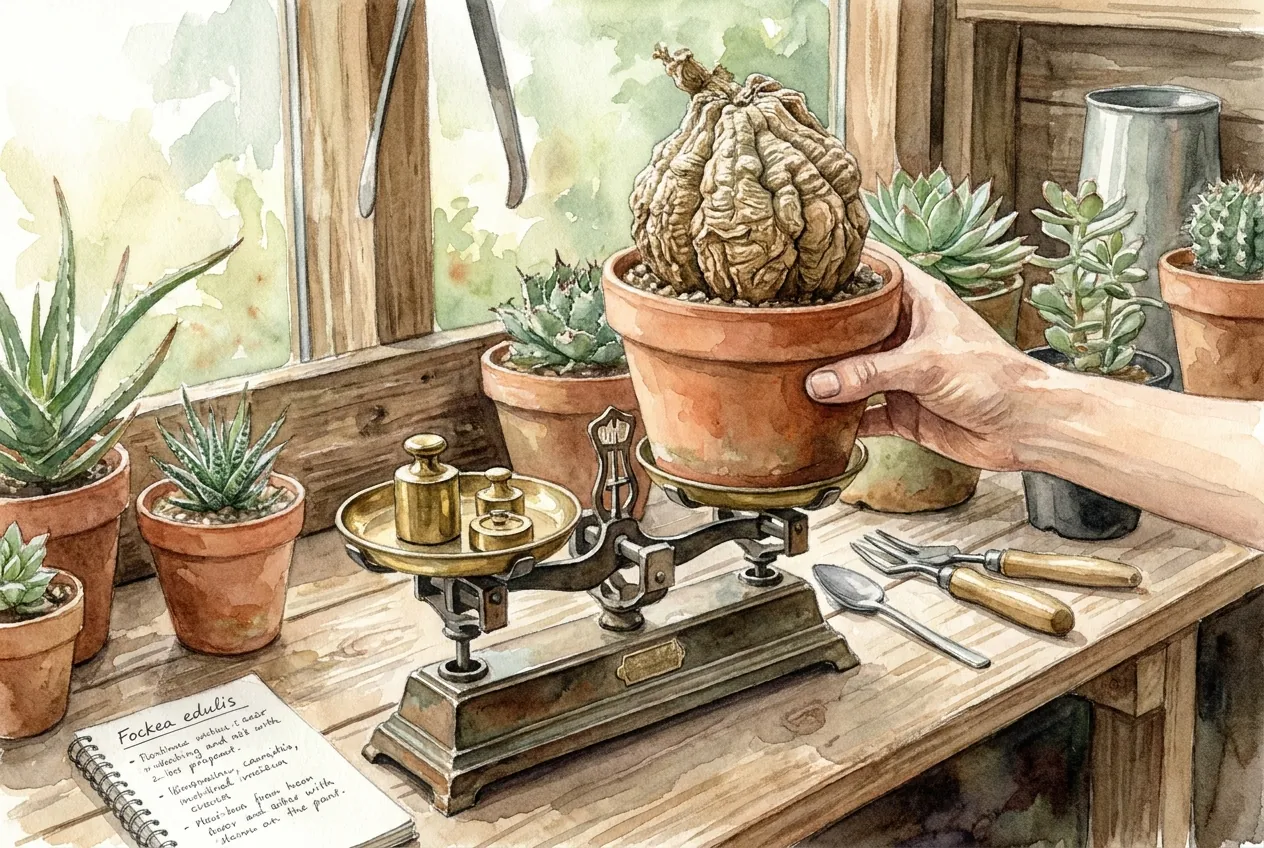
A shriveling Fockea edulis caudex is a signal to measure, not to water. Weigh the pot, read growth and root-zone condition, and let a heavy pot overrule the calendar.
Derek Kim · 2026-07-15 · Updated 2026-08-06 · 14 min read
Key Takeaways
- A wrinkled Fockea edulis caudex is a signal to measure, not automatic permission to water. The same shrunken surface appears from spent reserves, a heat-slowed canopy, or wet, damaged roots.
- Weigh the same assembled pot at the same time of day and compare the mass trend with growth and root-zone condition. A scale tells you whether water has actually left the container.
- A light pot with a dry profile supports one thorough watering. A heavy pot with a shrinking caudex points to waiting or root investigation. Read mass, canopy, and roots together, not one symptom alone.
- Build the wet and dry references from the exact plant, pot, mix, support, and saucer you keep measuring. A percentage copied from another grower does not transfer.
- Never let a dramatic wrinkle skip straight to the watering can. Adding water to a container that has not dried leaves the root zone wetter without helping the plant.
Why can a Fockea edulis caudex shrink while the pot is still wet?
The caudex shrinks whenever stored tissues lose volume faster than roots replace it. That imbalance can happen in a dry pot, but it can also happen in a wet pot with oxygen-starved or diseased roots.
Fockea edulis has an enlarged basal stem formed through cortex and pith thickening, plus a swollen tap root rich in xylem parenchyma. These tissues store water and carbohydrates while also supporting transport and structure.
What does normal storage-tissue contraction look like?
Normal contraction is gradual, broadly distributed, and paired with a falling pot-mass trend. The caudex becomes less taut as thin-walled storage cells lose water and turgor, but it does not develop a spreading dark lesion, foul odor, or collapsing wet tissue.
Succulent tissues contain highly vacuolated parenchyma cells with elastic primary walls, so wall folding during dehydration can change volume without catastrophic tearing. Press only lightly, compare the same area each time, and record a photograph beside the scale reading rather than relying on memory.
Which signs make root failure more likely than thirst?
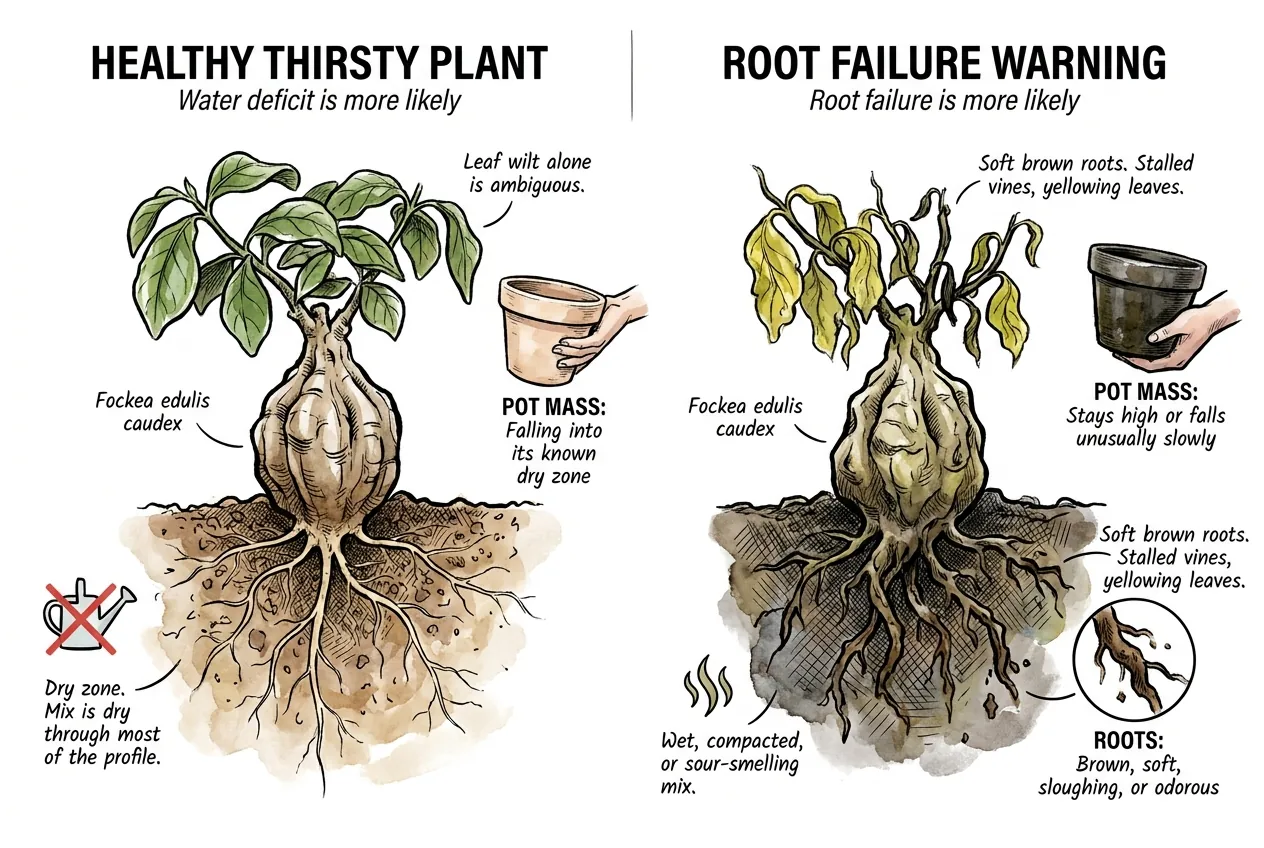
A heavy pot plus a shrinking caudex makes root failure more likely than simple thirst. Wet mix, stalled vines, yellowing leaves, sour odor, or soft brown roots strengthen that diagnosis.
Roots require oxygen for respiration, and when water fills the pore space for too long, oxygen supply falls and root function declines. Wet conditions also favor organisms such as Rhizoctonia, Fusarium, Pythium, and Phytophthora.
Visible symptoms cannot identify one organism without laboratory work, but the broad response is to let the mix dry, inspect, and remove affected tissue. Use the combination rather than one symptom, because leaf wilt alone is ambiguous.
| Evidence | Water deficit is more likely | Root failure is more likely |
|---|---|---|
| Pot mass | Falling into its known dry zone | Stays high or falls unusually slowly |
| Mix | Dry through most of the profile | Wet, compacted, or sour-smelling |
| Roots | Firm and attached | Brown, soft, sloughing, or odorous |
| Canopy | Active or gradually less firm | Stalled, yellowing, or collapsing |
| Next move | Consider one thorough watering and drain | Hold water and investigate |
How do you build a useful pot-weight baseline?
A useful baseline comes from the exact plant, pot, mix, support, and saucer you will keep measuring.
A percentage copied from another grower is less reliable because container materials and substrates hold different amounts of water and air.
What does a weight reading actually measure?
The method is based on simple mass balance. Over short periods, most change in an unchanged container is water leaving through evaporation and transpiration, but dropped leaves, runoff, standing saucer water, and spilled substrate also shift the number. A scale cannot tell you where remaining water sits or whether roots can reach it.
What are the limits of the weighing evidence?
The gravimetric studies cited here were done on crops such as vinca, lettuce, and wheat rather than Fockea.
Use weighing as a helpful relative gauge, not as a validated Fockea diagnostic.
Plant growth and substrate breakdown add slower drift, so the baseline must be reset after meaningful physical changes.
How do you record wet and dry reference masses?
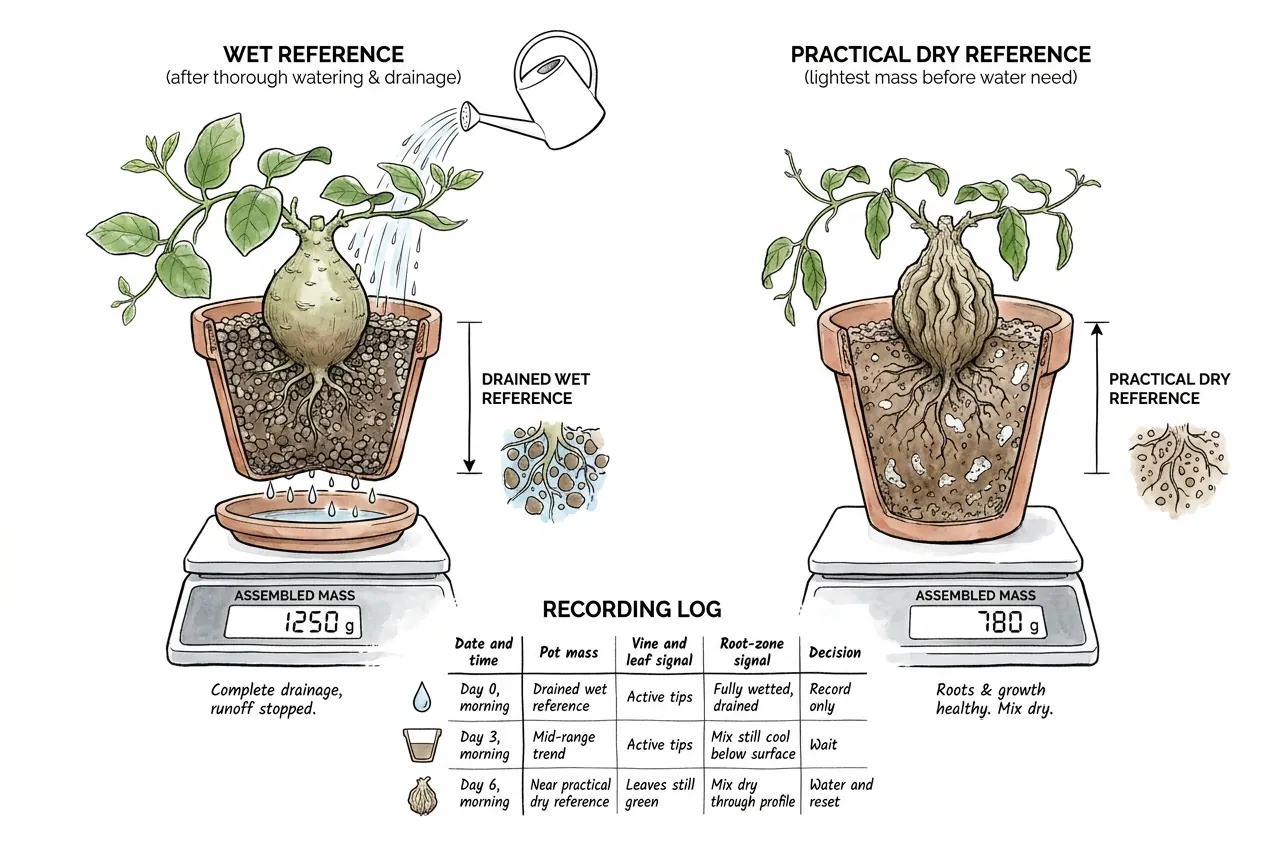
Create the wet reference after a normal thorough watering and complete drainage. Keep every non-water item in place, empty the saucer, and record the assembled mass once dripping stops. Do not weigh the pot while it sits in standing drainage water because that distorts the reading and invites root rot.
Next, weigh at the same time of day during a healthy dry-down. Do not chase oven-dry substrate. The practical dry reference is the lightest mass a healthy plant reaches during a safe dry-down, anchored to a cycle the plant completed without visible distress.
What can a useful log entry contain?
Use a log with the date, time, mass, leaf activity, caudex appearance, and any environmental change. The table below shows one possible entry.
| Date and time | Pot mass | Vine and leaf signal | Root-zone signal | Decision |
|---|---|---|---|---|
| Day 0, morning | Drained wet reference | Active tips | Fully wetted, drained | Record only |
| Day 3, morning | Mid-range trend | Active tips | Mix still cool below surface | Wait |
| Day 6, morning | Near practical dry reference | Leaves still green | Mix dry through profile | Water and reset |
These day labels are an example log, not a Fockea schedule.
Your plant might cross the range faster or slower because pot size, light, humidity, temperature, and root mass differ.
To keep both baselines attached to the right pot, I write the drained-wet mass, practical-dry mass, and date on the back of the plant tag. Keeping the two numbers on the plant prevents a phone note or spreadsheet row from becoming separated from the exact pot it describes.
I also put one small orientation mark on the pot rim, never on the caudex, and use that mark as the camera side. At each scheduled weighing, I photograph the scale display and the caudex face aligned with that mark. The fixed angle exposes gradual wrinkle changes that my memory and casual photographs would miss.
After repotting, changing the support, or replacing top dressing, I cross out the old pair without erasing it and add a new dated pair. That short history tells me whether a jump came from water loss or from changing the assembled pot.
What scale is precise enough for a caudex pot?
A scale’s displayed increment is only a practical starting point.
Weigh the unchanged pot several times, lifting it fully between placements, and act only on changes clearly larger than the observed scatter.
A kitchen scale in the 5,000-gram capacity class suits many smaller caudex pots when the fully watered pot remains comfortably below that limit.
Record the full assembled mass rather than taring away the baseline so accidental setup changes remain visible.
What are the tradeoffs of a kitchen scale?
A small platform can hide the display or let a wide pot overhang the weighing surface. A kitchen scale is also not waterproof.
Weigh on a dry, flat, stable surface and keep spills away.
If a pot approaches the capacity limit, choose a higher-capacity scale rather than trusting an overloaded kitchen model.
Precision claims mean little outside the rated range.
How should summer heat change the diagnosis?
Summer heat changes how fast water moves, but it does not reverse the evidence in a heavy pot. High temperature, bright light, low humidity, and airflow can increase atmospheric demand, while extreme stress can close stomata and slow growth.
A plant can therefore look stressed on a hot afternoon even though its root ball still contains plenty of water. Adding water would treat the appearance while ignoring the measured container state.
Why is summer not a fixed watering schedule?
Fockea edulis spans the southwestern and southern Cape provinces to KwaZulu-Natal.
That native range crosses contrasting seasonal-rainfall patterns, so a single species-wide July schedule is a weak inference.
Read the plant’s active growth instead.
Extending vines and expanding leaves, paired with a repeatable fall in pot mass, support current water demand.
Mass alone cannot separate evaporation from transpiration.
Leaf drop, stalled tips, and stable mass show that demand has slowed, regardless of the calendar.
A new location, pot material, or support can change the old mass trend, so reset the baseline after those changes.
Do not force a label such as summer-active or dormant onto contradictory evidence.
Cultivated plants also experience indoor lights, air conditioning, heated greenhouses, and container root temperatures that do not match outdoor seasons.
What should you do during a hot afternoon collapse?
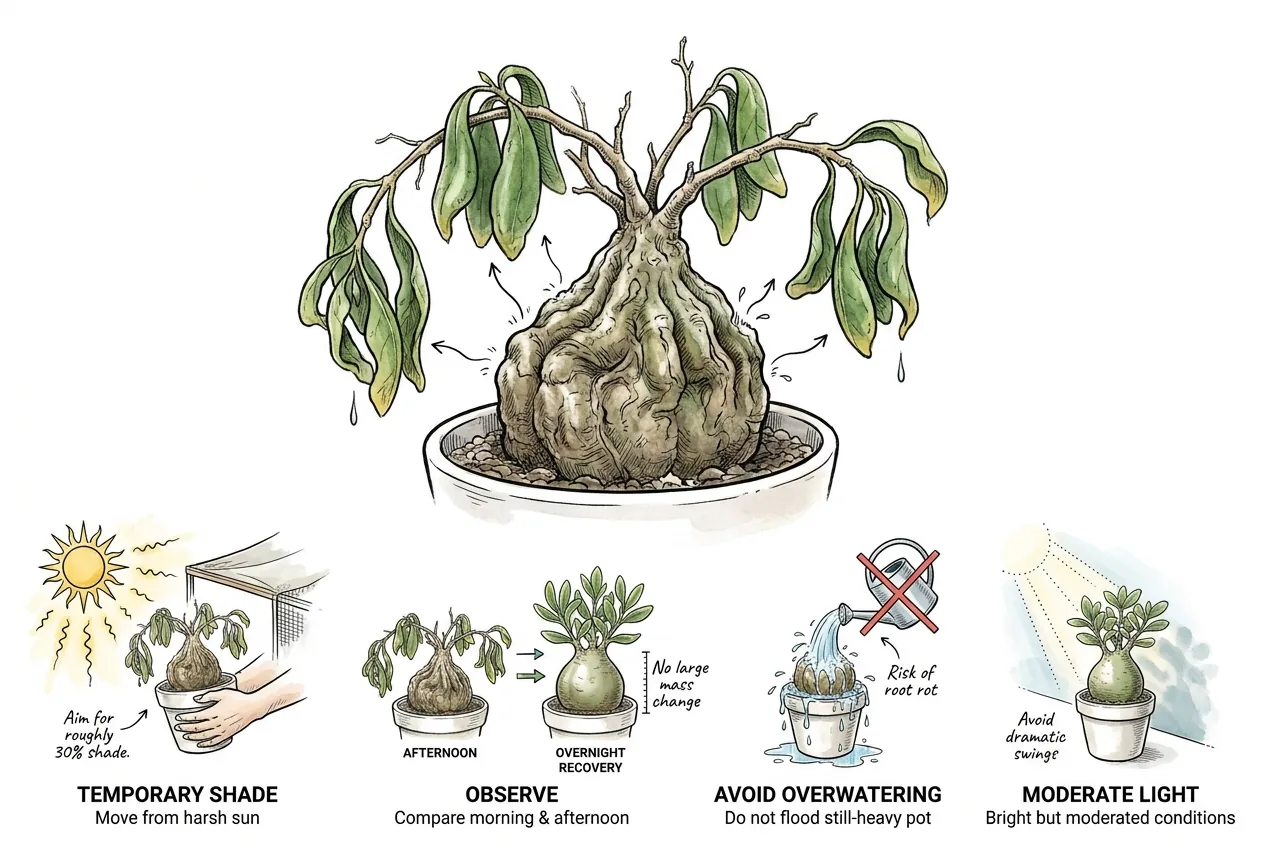
Move the plant out of harsh afternoon sun, keep normal air movement, and recheck near the next cool morning. Do not flood a still-heavy pot to fix temporary heat-driven flagging.
Compare morning and afternoon observations. Overnight recovery without a large mass change supports heat or light stress more than true container depletion, while continued decline with a high mass strengthens the case for root-zone investigation.
Temporary shade may be safer than reflex watering during an extreme event. Extension guidance for cacti and succulents can help as a local starting point, but avoid dramatic swings because sudden deep shade can reduce water use and keep the mix wet longer.
What is the weigh-before-you-water decision protocol?
The protocol is a sequence, not a magic number. Confirm the system mass, compare the trend, read current growth, inspect the root zone, and then choose water, wait, cool, or inspect. Using the same order prevents a dramatic wrinkle from skipping straight to the watering can.
When should you water, wait, or unpot?
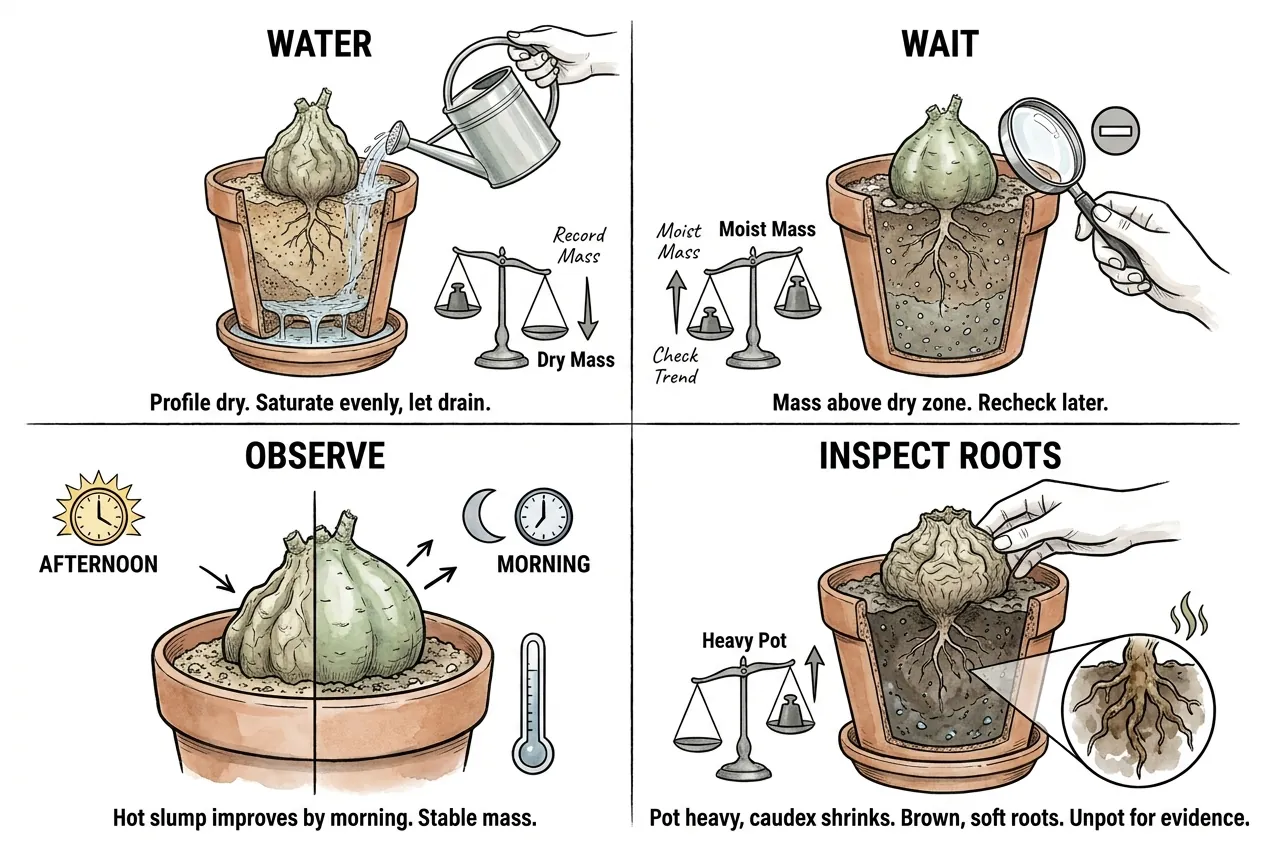
Water once when the pot reaches its established dry zone, the profile is dry, and no root-failure signs are present. Saturate the mix evenly, let it drain completely, record the mass, and stop.
Wait when mass remains above the dry zone or the trend is unclear. Recheck under comparable conditions rather than adding a small insurance sip that wets only part of the profile.
Cool and observe when a hot-afternoon slump improves by morning while mass remains stable. Inspect roots when the pot stays heavy while the caudex shrinks, or when odor, instability, soft brown roots, or spreading tissue damage appears. Unpotting is disruptive, so use it as an evidence-based escalation rather than a weekly test.
What safety steps matter during root inspection?
Wear nitrile gloves and eye protection when unpotting or handling damaged tissue, and support the plant rather than gripping the caudex or roots with bare hands.
Fockea is in the Apocynaceae and exudes a milky latex. If sap appears, avoid skin and eye contact, wash exposed skin promptly, clean tools, and keep the plant and debris away from children and pets.
Fast runoff can hide a dry central root ball when water channels along the pot edge.
During one justified watering, apply water gradually and confirm the profile wets evenly before recording the drained reference.
How do you prevent measurement mistakes?
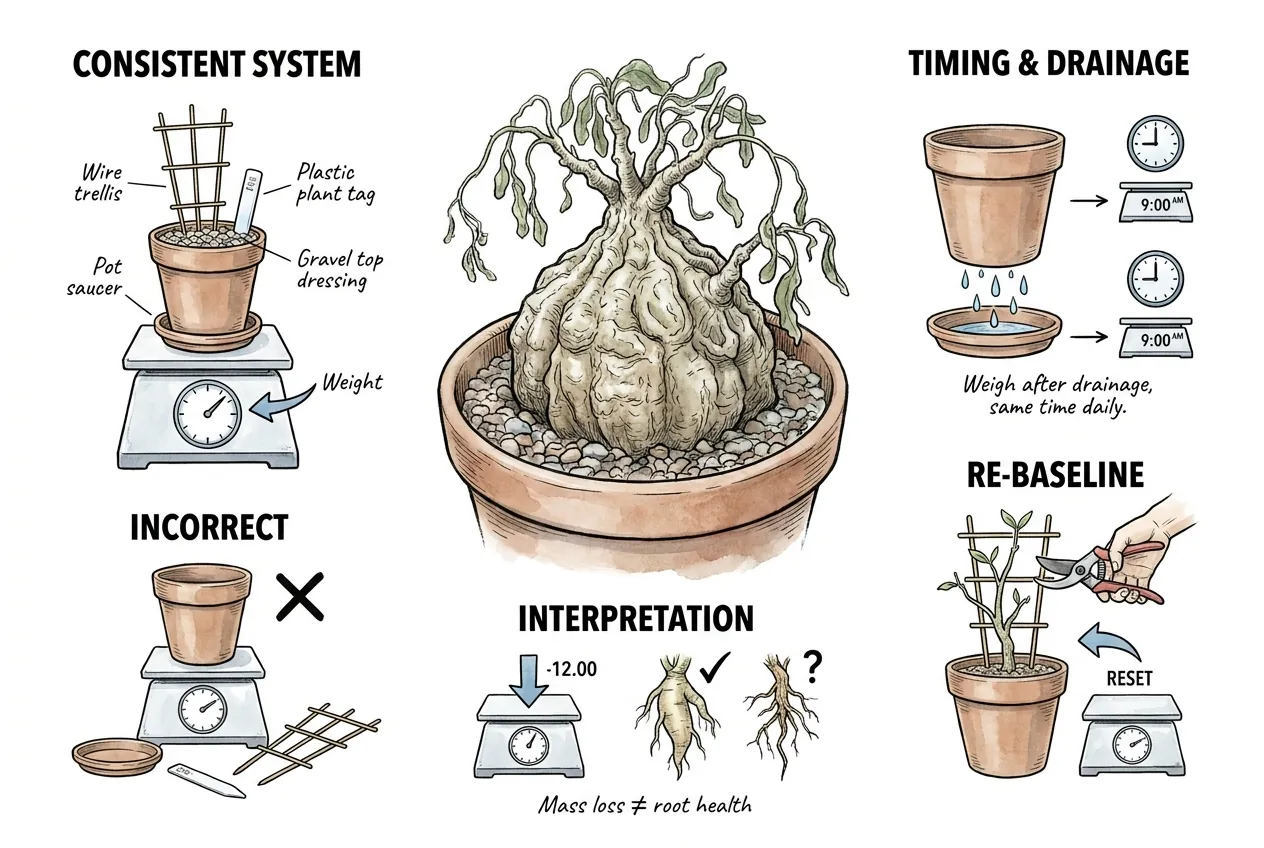
Keep the pot system unchanged between readings. The same saucer, trellis, clips, tag, and top dressing must stay on the scale because every added gram looks like retained water. Weigh after drainage, read at roughly the same time of day, and re-baseline after repotting, major pruning, a new support, or substantial seasonal growth.
Use mass as one sensor rather than the judge and jury. A falling mass proves that mass left the system, but it does not prove that roots are healthy or that every lost gram came from root-accessible water.
What should happen after you water a genuinely dry Fockea?
After a justified watering, look for direction rather than an exact deadline. The pot should drain and resume losing mass, while the plant should stop worsening before the caudex slowly regains tension.
Wrinkles may not disappear overnight because caudex geometry, root health, temperature, and canopy demand change the response. Repeated watering before the pot has lost the first dose removes your best diagnostic signal and raises root-zone risk.
What if the caudex keeps shrinking after one thorough watering?
If mass remains high and shrinkage continues, stop adding water and investigate uptake.
Persistent wetness, declining foliage, odor, or an unstable plant justify root inspection.
Scale up only when capacity requires it
For a heavier specimen that exceeds a small kitchen scale, a higher-capacity countertop scale keeps the same method usable.
A countertop scale rated around 22 pounds, or 10 kilograms, with a 1-gram increment covers most mid-sized caudex pots while preserving fine resolution. If you are choosing one, you can match watering tools to a measured dry-down.
When is a higher-capacity scale justified?
Weigh or estimate the fully watered pot before buying. A 10-kilogram countertop scale is suitable only when the pot fits securely on its platform and remains below the rated capacity with room for normal handling. If the pot overhangs badly or approaches the limit, use a platform scale instead. Higher capacity is not an upgrade if the measurement increment is too coarse to show the pot’s normal water loss.
No scale repairs roots. If mass stays high, the tool has delivered a useful warning that the container has not lost much mass.
Confirm root access and moisture distribution before watering again.
What is the simplest rule to remember?
Weigh before you water, then check that the plant and root zone agree with the number.
A light pot, dry profile, and otherwise functional plant support one thorough watering.
A heavy pot and shrinking caudex support waiting, cooling, or root investigation.
What does the scale clarify?
The scale does not replace observation.
It removes one major ambiguity by showing whether the container actually lost water.
That evidence can prevent a common summer mistake. Adding water to a container that has not dried enough may leave the root zone wetter without helping the plant.
Treat published capacity and increment figures as comparison points, then confirm they match the needs of the actual pot.