
Dioscorea elephantipes Dormancy: Interpreting a July Wake-Up
How to assess an off-season Dioscorea elephantipes shoot using growth, moisture, temperature, light, and root condition rather than assuming that a July wake-up is automatically normal.
Maya Ellison · 2026-07-20 · Updated 2026-07-23 · 27 min read
Key Takeaways
- Read the plant, not the month. A July wake-up can be compatible with cultivation, but recent moisture, heat, light, root health, and growth progression still need checking.
- A firm caudex and persistent, proportionate green growth support continued observation, but they do not prove that roots are healthy. Support the observed growth without forcing dormancy.
- Do not force dormancy by abruptly cutting water from a plant that is visibly active. Check the root zone first and adjust gradually.
- Match watering to the actual pot and growth stage. Warm, wet conditions raise rot risk, while an active plant can also suffer if its roots are left dry.
- Weak indoor light produces pale, elongated growth that never recovers its form. Root damage, nutrition, salts, and normal young-tissue color can overlap, so measure and compare before changing one variable.
Dioscorea elephantipes is generally a winter-growing, summer-resting caudiciform, yet individual plants can respond to their cultivated environment at different times, so a July shoot needs observation rather than an automatic verdict.
Check the caudex, recent watering, root-zone moisture, temperature, light, and the progression of the new growth together. If the plant is firm and the shoot is developing normally, support it. If the caudex softens, the pot stays wet, or growth is weak and worsening, pause and investigate.
What is the normal cycle of Dioscorea elephantipes, and why does it grow in winter?
Read the Normal Cycle
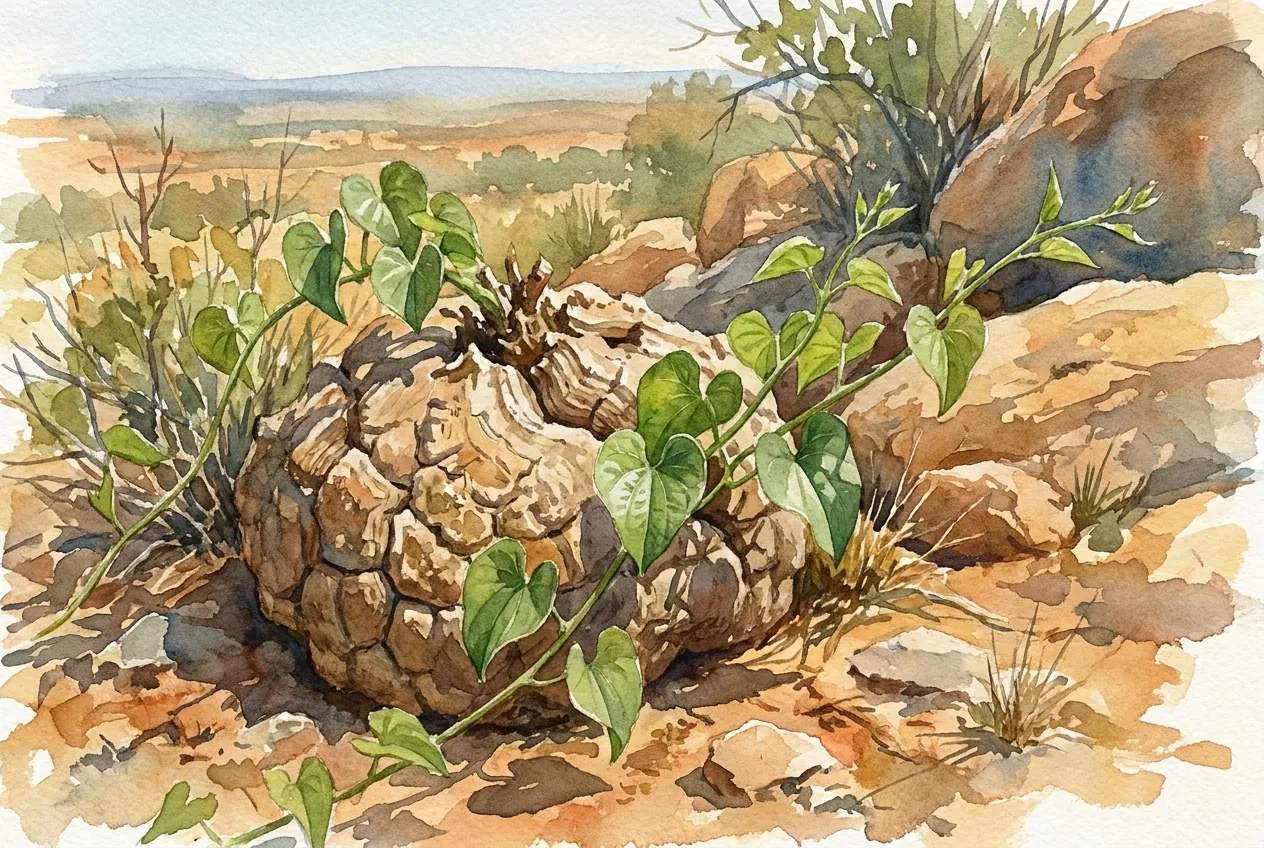
Dioscorea elephantipes is a winter-growing, summer-dormant caudiciform. Its wiry vines flush from autumn through spring, then die back for a hot-season rest.
Separate caudex and vine lifespans
The permanent part of the plant is the massive, partly above-ground caudex, armored in polygonal corky plates. The vines and heart-shaped leaves are annual and disposable.
Interpret vine dieback as seasonal
This is the first fact that dissolves most July panic. The plant is built to throw away its leafy apparatus every cycle and rebuild it from the tuber.
Use the persistent tuber as evidence
A peer-reviewed study of the Africa clade of Dioscorea states that the pachycaul taxa annually replace their photosynthetic tissues (stems and leaves) from the persistent tuber. Vine dieback can therefore be normal seasonal senescence rather than damage. It is the plant discarding a structure it can regrow.
Keep growth figures as context
The caudex itself is the multi-decade organ. It grows only about 10 mm across in its first year and reaches roughly 120 mm by year five, according to South Africa’s national biodiversity authority (SANBI).
Treat the caudex as a reserve
In habitat it can eventually reach over 3 m in height and weigh up to 365 kg, with cultivated lifespans cited around 70 years. Think of that corky tuber as a starch-and-water bank the plant lives from while its cheap leaves are gone.
Where does the winter-growing habit come from?
Match the winter-rainfall climate
The habit comes straight from the plant’s home climate. It grows in the winter-rainfall Succulent Karoo of South Africa’s Cape. That region gets just 20 to 290 mm of rain a year, almost all of it in the cool winter months, with summer temperatures above 40°C.
Read seasonal water cues
In that world, water arrives in the cool season and vanishes in the hot one. The plant evolved to grow when it is cool and wet, then retreat into its water-filled caudex when heat and drought arrive.
SANBI states the plant is adapted to growing in areas with seasonal rainfall, by going dormant in the dry season.
Treat heat as a rest cue
This is why the temperature cue is flipped for this species compared with most houseplants. For a tomato, warmth means grow. For this Cape yam, sustained heat means sleep.
The Monaco Nature Encyclopedia describes the trigger directly. During the vegetative period, rising temperature can push the plant toward dormancy and loss of aerial buds.
How does the plant signal that it is entering or leaving dormancy?
Use visible phase signals
The plant tells you which phase it is in through visible signs, so use those signs as the primary cue for this decision rather than the calendar alone.
Separate dormancy from wake signs
Entering dormancy looks like leaves yellowing and thinning, vines browning and collapsing, and no new buds at the crown. Leaving dormancy looks like plump buds or a fresh green shoot pushing from the top of the caudex.
Treat a fresh shoot as a cue
A fresh shoot is a useful cue that growth may be returning, but it is not a complete watering prescription. Confirm that the pot is not already wet and that the root zone and plant condition support a measured reintroduction of water. The species-specific cultivation account should be separated from general geophyte physiology.
Keep general geophyte mechanisms bounded
Underneath the corky skin, dormancy is meristem-controlled. Research on the crop relative Dioscorea rotundata defines tuber dormancy as the temporary growth arrest of the continuous underlying meristematic cells beneath the dead brown skin of the tuber.
Confirm persistence and root condition
Sprouting reflects reactivation of those cells. A green nub at the crown supports a growth interpretation, but persistence, leaf development, and root-zone condition still matter.
I record the first crown bud, the first completely unfurled leaf, and two vine-length readings taken seven days apart. Vine length runs from the crown to the terminal tip along its support. I call a restart only when the leaf opens and the vine length increases across those seven days.
Each stage is photographed from the same pot-rim mark at the same local time. I record pot mass, days since watering, and root-zone temperature halfway between the caudex and pot wall at half the mix depth. Those fixed positions reduce daily heating, evaporation, and camera-angle noise.
For off-season growth, I compare days from crown bud to open leaf and the seven-day vine extension with the previous cycle. Continued extension with a firm caudex supports active growth. A tip that stops extending across two weekly checks, yellowing foliage, or new softness prompts root-zone inspection instead of a calendar reset.
Why can a plant that should sleep in July grow anyway?
Separate Weather from Causation
Dormancy in this species is influenced by environmental conditions rather than a calendar alone. Moisture and temperature are relevant context, but a single weather spell does not establish why a particular plant woke.
Resume support cautiously
Moisture and temperature can influence geophyte dormancy, but the evidence here does not establish that one watering caused this species to wake. Treat a fresh shoot as a cue to inspect the pot and resume support cautiously, not as proof of a universal trigger.
Use hormone background as context
The general hormonal picture comes from research on geophytes and crop yams rather than direct measurements in this species. Dormancy is held partly by growth-suppressing hormones such as ABA, while rehydration and warming can shift the balance toward hormones that promote sprouting. Treat this as helpful background rather than an exact mechanism for D. elephantipes.
Keep the review general
An Oxford geophyte review summarizes the broader pattern. ABA, auxin, and ethylene can promote or maintain dormancy, while GA and cytokinins can promote sprouting.
Do not assign a single trigger
Water availability is relevant to many geophyte sprouting systems, but this does not show that a single watering caused a D. elephantipes shoot or weakened a species-specific dormancy signal.
Does a mild or air-conditioned spell really count as a grow signal?
Treat mild weather as coincidence
A mild spell can coincide with renewed growth, but the current evidence does not make a temperature or watering event a guaranteed signal for this species.
Compare the current setup
Compare the plant’s actual light, temperature, moisture, and root condition. Two plants in the same month can respond differently without either response proving health by itself.
Can indoor grow lights cause year-round growth?
Keep light causation bounded
Indoor lights can change the balance of light, temperature, and moisture cues, but a controlled year-round schedule has not been tested as a universal cause of off-cycle growth in this species.
Measure before changing photoperiod
Compare the plant’s growth, light level, root-zone moisture, and temperature before changing the schedule. A fixed photoperiod may support continued growth in one setup and stress another.
Adjust cues gradually
If the goal is a seasonal rest, adjust environmental cues gradually and keep the root zone from staying wet. If the plant continues active growth, manage it as active growth rather than forcing a calendar-based dormancy.
Is my plant on the wrong clock, or a different clock?
Accept Individual Seasonal Timing
Two plants side by side, watered identically, can drop leaves weeks apart. That is normal opportunistic behavior, not a care failure.
Check transport and root history
Imported or recently moved plants may retain effects from their previous conditions, but origin alone cannot explain a July flush. Check recent transport, light, temperature, watering, and root-zone history together.
Read setup cues together
Seasonal cues are environmental rather than a fixed internal schedule. A plant can respond to its current setup before it fully matches a new local season.
How long does imported stock take to re-sync?
Avoid a fixed resynchronization timeline
No reliable published timeline establishes how long a cultivated plant takes to respond to a new seasonal setup. Avoid promising a fixed number of months or seasons.
Record the response
Support the growth the plant is actually showing, keep changes gradual, and record the response. This makes the uncertainty visible instead of turning it into an anthropomorphic reset schedule.
Do all caudex plants sleep in summer like this one?
Do not generalize caudex seasons
No, and assuming they do is an easy over-generalization in the hobby. Many textbook caudiciforms are the reverse of Dioscorea.
Keep genus cues separate
Adenium (desert rose) and many Pachypodium are commonly grown as warm-season growers with cooler-season rest, but species and provenance vary. Do not transfer a fixed night-temperature or photoperiod threshold from one genus to another.
Match care to native rainfall
Dioscorea, from the winter-rainfall Cape, does the opposite and leans on moisture plus moderate temperature. Match care to each plant’s native rainfall season rather than to a generic caudex rule.
| Plant | Growth season | Dormant season | Dominant cue |
|---|---|---|---|
| Dioscorea elephantipes | Cool season (winter) | Hot, dry summer | Seasonal moisture and temperature context |
| Adenium (desert rose) | Summer | Winter | Species- and setup-dependent cues |
| Most Pachypodium | Summer | Winter | Species- and setup-dependent cues |
Is my plant really waking up, or is it stressed?
Judge Growth Quality with Caudex Firmness
This is the diagnostic heart of the whole question. Read the quality of the new growth together with the firmness of the caudex.
Separate healthy wake from stress
Sturdy, green, proportionate growth plus a firm caudex supports a genuine wake. Pale, thin, stretched growth raises a light or root-zone question, and a soft or spongy caudex is a warning that needs investigation rather than an instant diagnosis.
What does healthy new growth look like versus etiolation?
Read healthy new growth
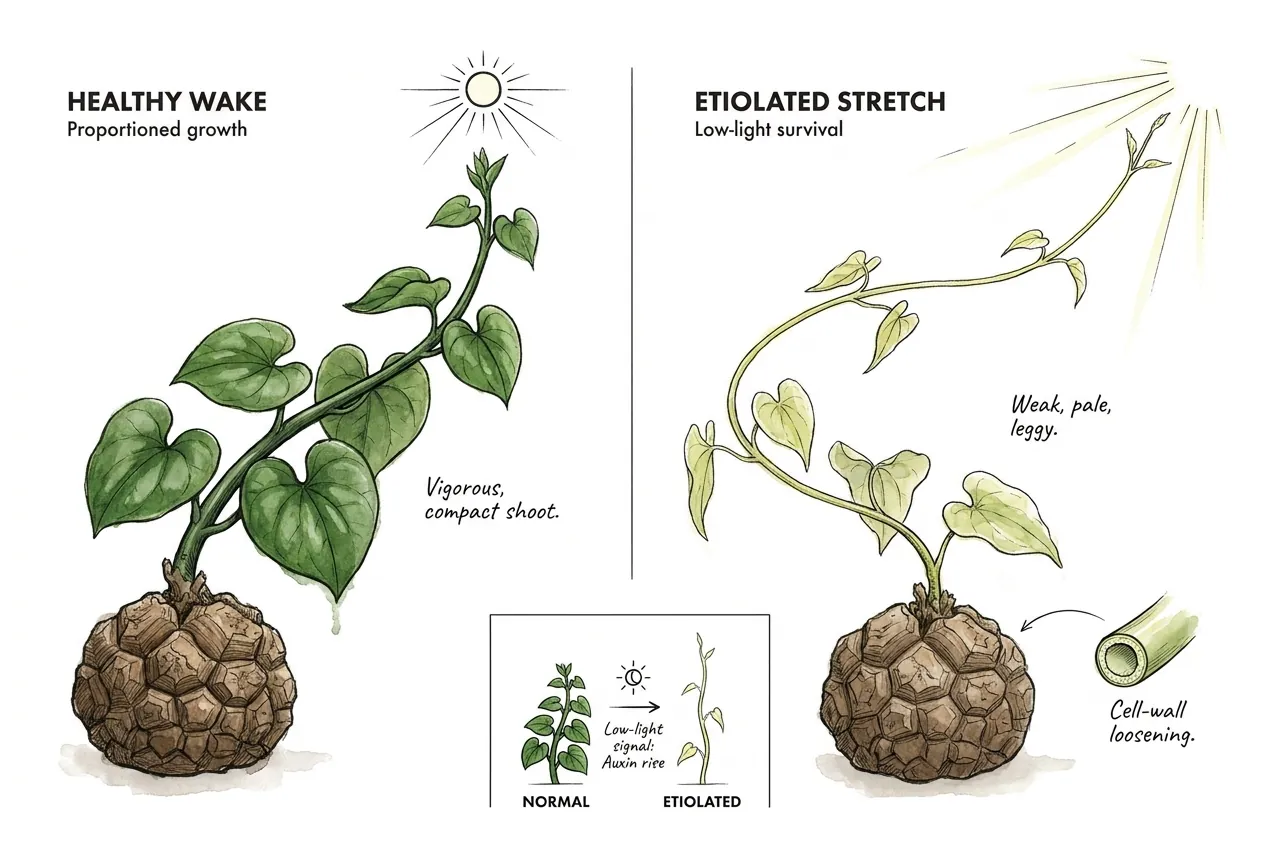
A genuine wake pushes proportionate growth. Look for a reasonably thick vine, normal green leaf color, leaves at normal intervals, and only a modest reach toward the light. New green shoots are one of the clearest positive signals that dormancy may have ended.
Recognize etiolation
Etiolation is the opposite. Pale, stretched, leggy growth is the plant’s low-light survival program.
Check other causes before increasing light
Fast stem extension is not proof of health. Low light can produce pale, weak growth, but root damage, salts, nutrition, and normal young tissue can overlap.
Use the hormone mechanism as background
The mechanism is broadly hormonal. In low or shaded light, auxin-driven cell-wall loosening promotes stem elongation while chlorophyll production drops, giving pale, stretched growth. A precise auxin increase reported in shade-avoidance studies of other plants illustrates the general effect, not a measured value for this plant under dim light.
Adjust light only after checking roots
Pale color, wide leaf spacing, and a thin vine support a low-light hypothesis. Increase light gradually only after checking roots, salts, nutrition, and heat, and do not assume that more light alone explains every weak shoot.
| Signal | Healthy wake | Etiolated stretch |
|---|---|---|
| Leaf color | True green | Pale, washed out |
| Vine | Thick, sturdy | Thread-thin, floppy |
| Internodes | Normal spacing | Long gaps |
| Direction | Modest reach to light | Dramatic lunge at light |
| Fix | None needed, support it | Add light |
What does the caudex firmness test tell me?
Use firmness as context
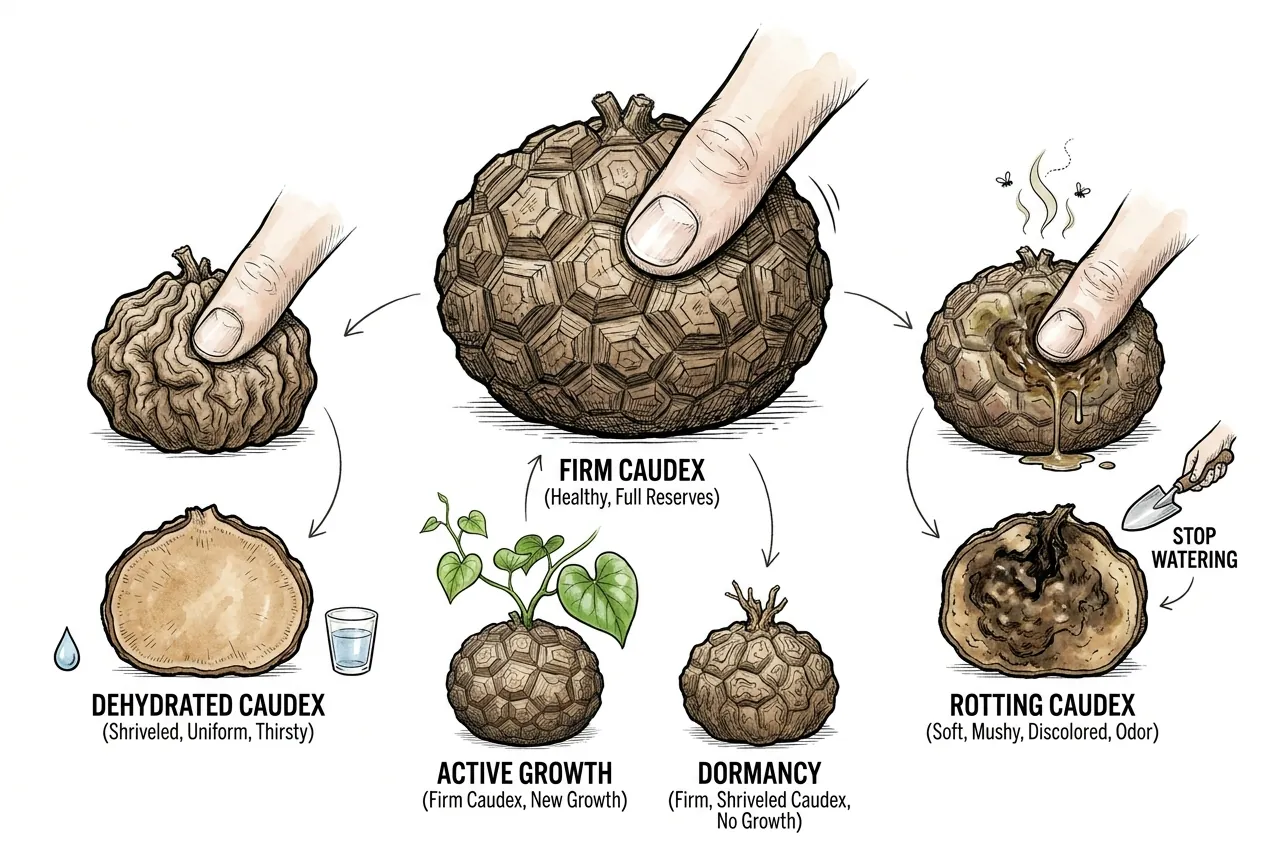
The caudex stores water and other reserves, and a gentle firmness check can add context. It cannot reveal the full root or internal condition. Use clean hands, light pressure, and avoid repeated probing.
Treat firmness as reassurance, not proof
A firm, uniform caudex with persistent green growth is reassuring but does not prove that storage cells are full or roots are healthy.
Separate water status from rot signs
Wrinkling or gradual shrinkage can reflect water status or reserve use, while softness, discoloration, odor, or rapid progression raises concern. None of these signs alone identifies the cause.
Escalate when progression appears
If the plant is worsening or the root zone remains wet, isolate it and obtain experienced diagnostic help before adding water or making major cuts.
What if the caudex is soft AND there is new growth?
Treat softness as a progression question
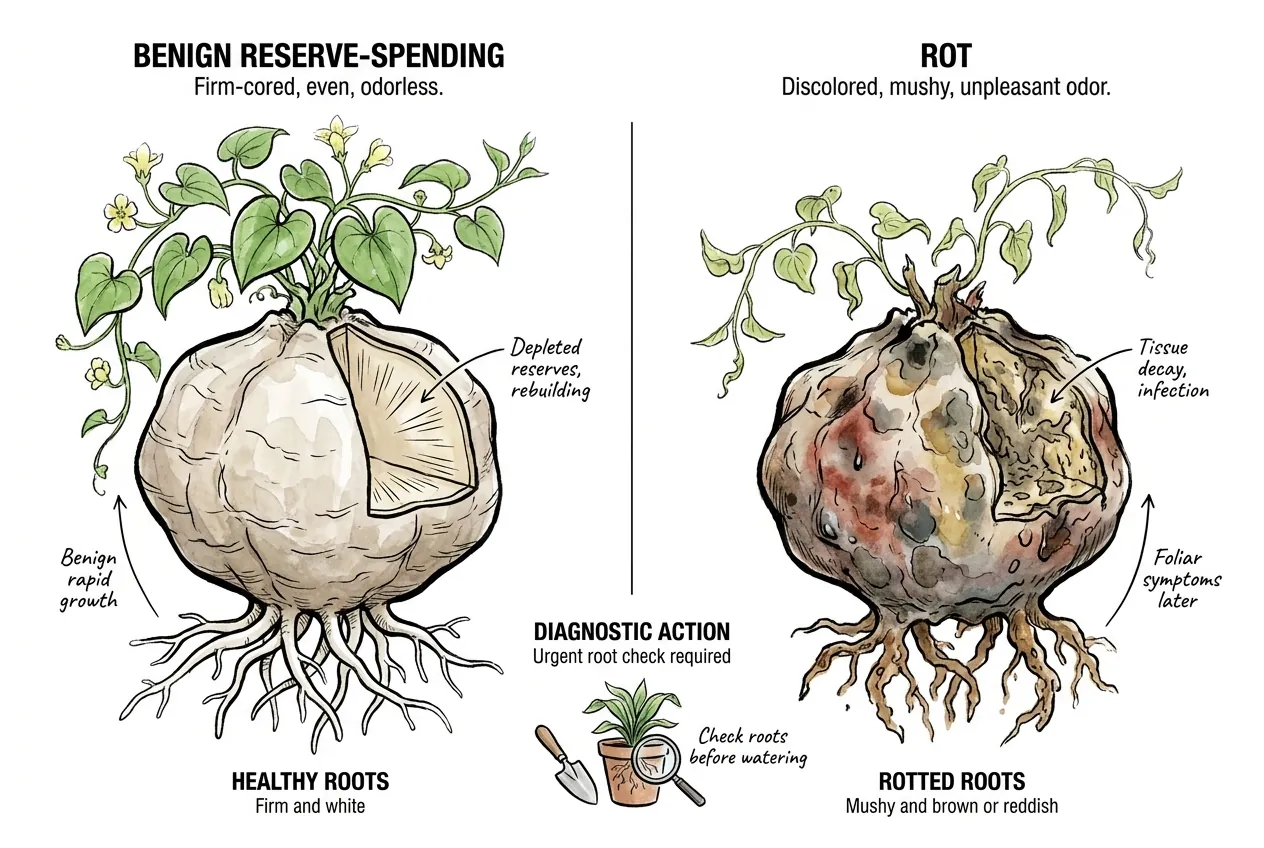
This is the trickiest and most urgent reading, and you settle it by the quality of the softness, not merely its presence.
A growth flush can coincide with changing firmness, but a brief softening cannot be classified as benign without tracking the plant, pot moisture, roots, and progression.
Inspect before watering or cutting
Softness with discoloration, odor, expanding damage, or a wet pot raises the need for isolation and diagnosis. Do not use touch alone to decide whether to water or cut.
Root color and texture provide clues that vary with species, age, and medium. Preserve sound roots and avoid unpotting repeatedly just to confirm a hunch.
Should I support the wake or force it back to sleep?
Support Active Growth
Support the wake when the plant and root zone support active growth.
Feed the observed wake
When a Dioscorea elephantipes genuinely wakes and pushes leaves in July, give it adequate light, measured watering, and airflow rather than starving it back to dormancy.
Understand the cost of forcing dormancy
Here is why forcing dormancy is a genuine gamble, not a harmless reset. A leafed-out plant is transpiring, pulling water through the caudex and out through open stomata to run photosynthesis.
Avoid abrupt water cutoffs
If you abruptly cut water, you may not send it cleanly to sleep. You can instead add drought stress while the leaves are still active.
A peer-reviewed Frontiers review explains that under drought stress, ABA accumulation can close stomata to conserve water. Closed stomata limit CO2 intake and photosynthesis, so the plant may draw on stored caudex reserves while still carrying a canopy of leaves.
Keep the water decision evidence-based
Stopping water entirely to reset the season can stress a plant that is still actively growing. Use root-zone moisture and growth progression to decide whether a longer dry-down is appropriate.
When is it reasonable to ease a plant back toward dormancy?
Taper toward dormancy only when needed
Consider it only when you have a real reason, such as imported off-clock stock in conditions that genuinely cannot support summer growth, and use a gentle taper rather than an abrupt cutoff.
Let leaf yellowing set the timing
Keep the plant cool and bright, and gradually stretch the interval between waterings as the current leaves mature. Let dormancy arrive on the plant’s own leaf-yellowing signal, then reduce to occasional light watering.
A gradual dry-down can let the plant reabsorb resources from aging leaves during senescence. An abrupt cutoff can stress still-green leaves and alter reserve use. Taper changes rather than imposing a sudden stop.
What light prevents an indoor wake from going leggy?
Prevent leggy indoor growth
The real danger of an off-season wake is rarely the wake itself. It is that off-season indoor light is weak, so new growth stretches into pale, floppy vines that never recover their form.
Treat light ranges as reference
Some succulent light-intensity guidance places stretching risk below roughly 35 µmol/m²/s and compact growth around 75 to 150 µmol/m²/s. Those figures are reference ranges rather than a Dioscorea-specific prescription. Stems that are already elongated will not shorten back even with more light, so treat that growth as permanent.
Use window light before buying
A bright, unobstructed south or east window in a good season is often enough, and it is free. But for a north-facing room, a short winter day, or any wake where vines are already reaching and pale, a modest full-spectrum LED earns its place.
A reasonable starting specification is even canopy PPFD in roughly the 75 to 200 µmol/m²/s band, then adjust for heat, acclimation, and the plant’s response rather than treating the band as a guarantee.
Compare bar-light fit
The Barrina 144W is listed by its manufacturer at roughly 210 µmol/m²/s at 8 inches. Treat that as a setup-dependent specification. Measure the actual canopy, manage heat, and adjust height and runtime for the plant’s response. The linkable strip may spread light more evenly over a sprawling vine than a single spotlight. A six-pack is more than one plant needs, and it is a fixture you have to mount.
If a bright south window already delivers strong light, you may not need it at all. The performance figures above are manufacturer specifications, so measure your own setup before buying.
Use a small bulb for one plant
For one waking caudex without a mounted fixture, a screw-in bulb is simpler. The GE BR30 fits a standard lamp or clip socket. Verify the actual PPFD and heat at the crown before setting a height or runtime. A single BR30 covers a small footprint rather than a shelf, and its output may be lower than a dedicated bar.
A bright window can beat it outright, so buy it only if your light is genuinely weak.
How should I water and pot an off-season summer grower?
Water on Plant Signals
Water on the plant's signals, not the date, and let a fast-draining mineral mix be your safety net.
Balance active growth and rot risk
An actively growing caudex in summer heat sits at the intersection of two rot risks. You are watering a plant that is outside its usual seasonal pattern, and warm wet media can favor some root pathogens.
Engineer fast re-aeration
The answer is not to withhold water, which starves a transpiring plant. It is to engineer the substrate so it drains and re-aerates quickly.
Use signal-driven watering
The watering rule is signal-driven. When new caudex growth appears, confirm that the root zone is not already wet, then support growth with measured watering and a substantial dry-down between drinks. Do not use wilting as a routine endpoint.
Avoid calendar watering
There is no validated one-to-two-week or monthly schedule for every container. During active growth, use the actual dry-down, root condition, and temperature. During true dormancy, watering may become infrequent or stop for a period, with exceptions for recently rooted or severely shriveled plants.
Why is summer the rot danger zone?
Keep warm-wet pathogen evidence bounded
Some pathogens become more active in warm, wet media. UC IPM reports that soil moisture at 70% or higher of available water capacity is conducive to Pythium infection, and that P. aphanidermatum is pathogenic only above 25°C in the cited setting. Treat those as organism- and study-specific context, not as a universal July rule.
Protect root oxygen
Constantly wet media can become low in oxygen, stressing roots and creating a high-moisture niche that some water-mold pathogens exploit. Warm temperatures may then accelerate activity.
Let the medium re-aerate
The same watering that is fine in a cool spring becomes dangerous in a hot July unless the media re-aerates quickly. Water in the morning so the mix is not warm and soggy overnight, make sure the pot drains freely, and never let it sit in a saucer of water.
What substrate keeps a summer-watered caudex safe?
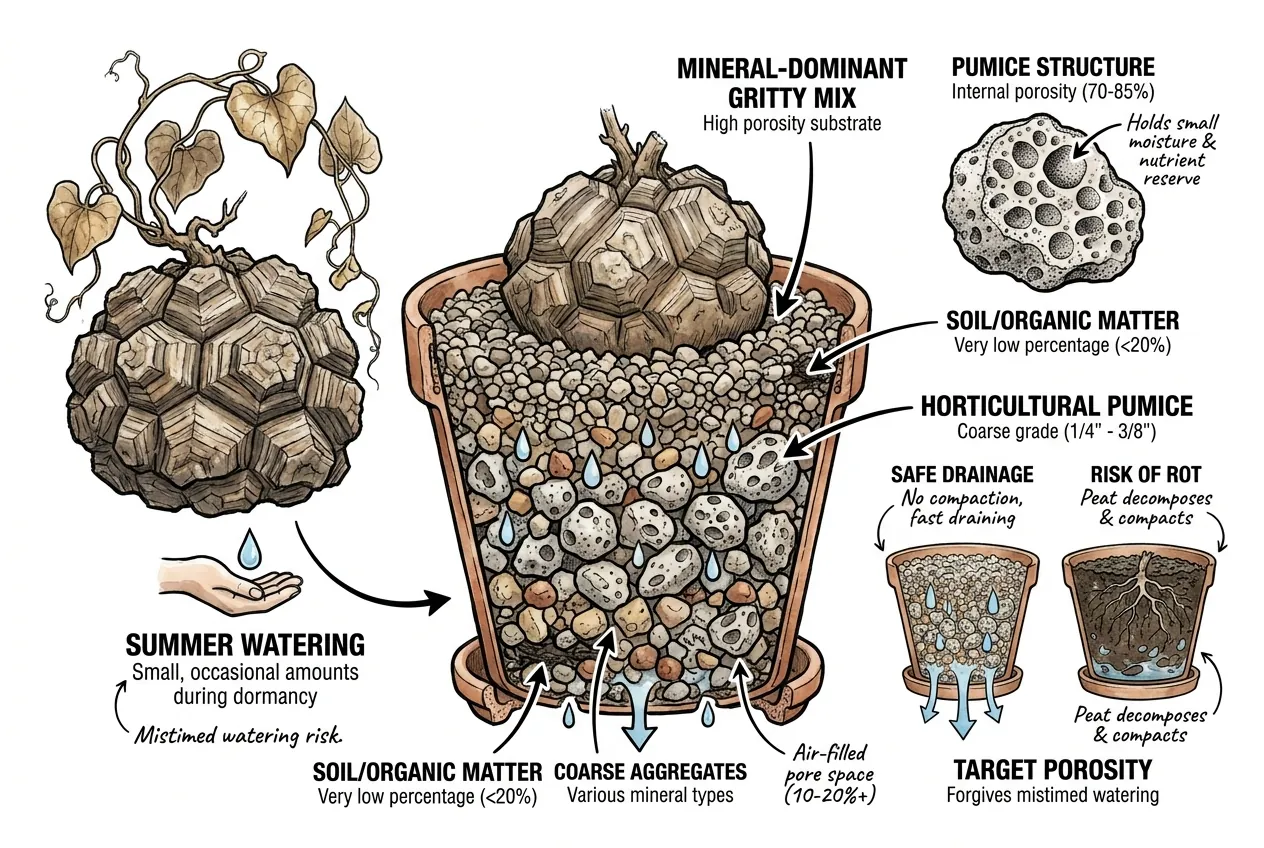
Choose porosity by finished pot
A mineral-dominant gritty mix can increase drainage and aeration, but the finished porosity depends on particle sizes, fines, pot geometry, and watering method. University substrate guidance cites 10 to 20% air-filled pore space for containerized crops. Use that as context rather than a Dioscorea-specific target.
Use pumice as an adjustable component
The standout component is horticultural pumice. Coarse pumice (roughly 1/4 to 3/8 inch grade) is one useful amendment for moving a mix toward higher air-filled porosity. It can hold a modest moisture and nutrient reserve in internal pores, although the performance depends on the grade and source.
Avoid fixed mix recipes
Unlike perlite it is less likely to float into surface drifts, and unlike peat it does not decompose in the same way. No fixed soil-to-pumice ratio is validated for this species. Start with a screened grade, then characterize how the finished pot wets and dries.
Compare screened pumice
GARDENWISE pumice is one screened mineral option to compare for particle size and bag volume. Use it as part of a tested mix rather than as a fixed recipe.
Pumice is heavier and pricier than perlite, and particle quality varies by supplier, so buy a screened horticultural grade rather than decorative dust.
Changing the mix can alter dry-down, but no fixed pumice-to-soil ratio or two-to-three-day schedule is validated for this species. Characterize the finished pot, keep the caudex surface out of prolonged wetness, and adjust watering to the observed roots and container.
How do I know when a deep gritty pot is actually dry?
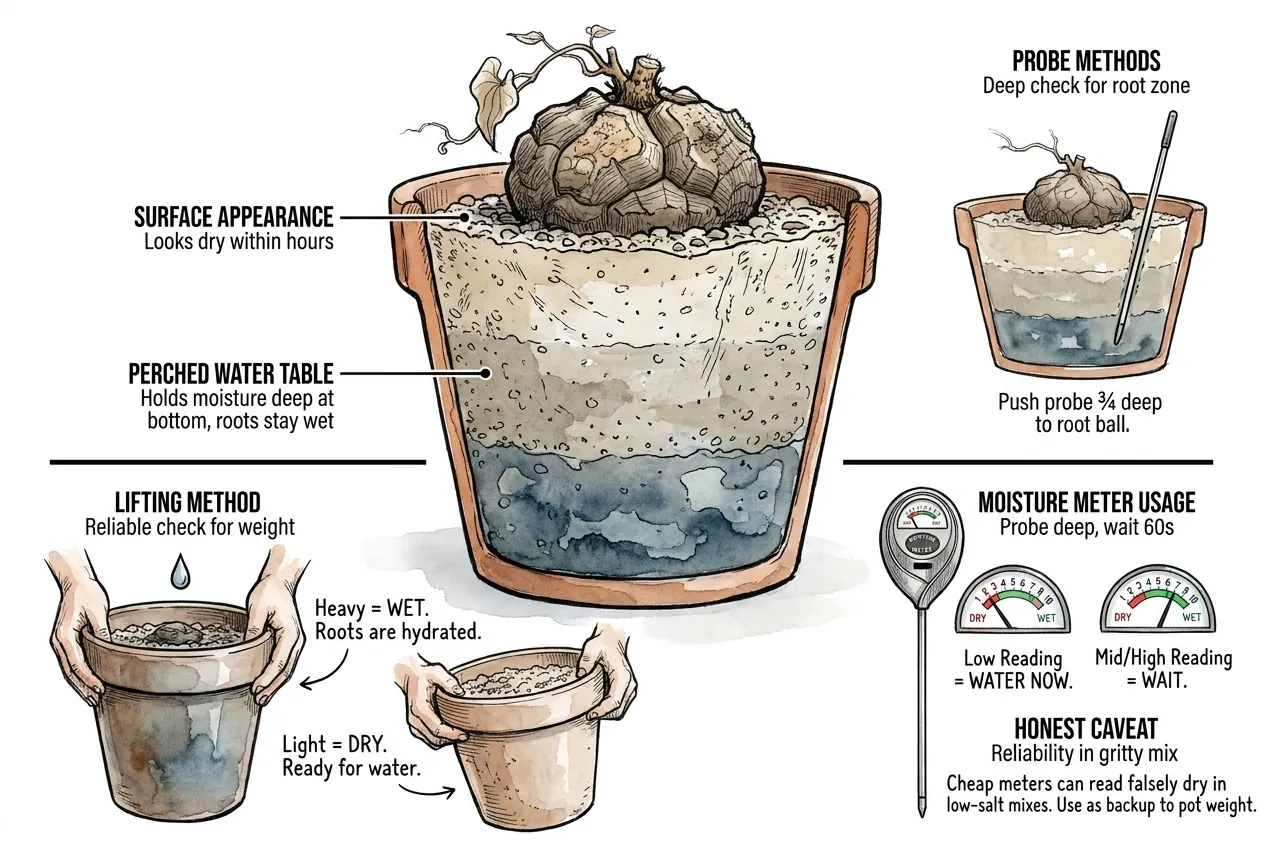
Read moisture at root depth
Read moisture where it counts, because a gritty surface can dry before the deeper root zone. Deep containers may retain water at depth, but the profile depends on particle size, pot geometry, and drainage.
Combine three dryness clues
Lifting the pot, checking a repeatable depth, and observing dry-down are useful combined clues. No single cue proves that the root zone is ready for water.
Keep meter readings relative
A soil moisture meter is optional and method-dependent. Use the product’s instructions, compare repeated readings at the same depth with pot weight and plant condition, and do not turn a low or high dial into a universal water-now rule.
Compare an analog moisture meter
XLUX meter is one analog option for comparing moisture at a repeatable depth. Use it as a relative backup to pot weight because low-salt mineral mixes can make resistive readings unreliable.
Cheap analog resistive meters can read falsely dry in low-salt mineral mixes because they need dissolved salts to conduct. Treat the meter as a relative backup to the pot-weight method rather than a final water decision.
A capacitance-type meter may respond differently in gritty media, but calibration and probe placement still matter. A grower confident with repeatable pot-weight observations may not need one at all.
Leach when salt builds up
If a white salt crust appears on the soil or pot rim, or new leaf tips brown, leach the pot. Flushing with 15 to 20% more low-mineral water than the container holds carries accumulated soluble salts out the bottom, which a free-draining gritty mix makes easy.
What mistakes turn an off-season wake into a disaster?
Do Not Let the Calendar Decide
A common error is treating the calendar as decisive while ignoring the plant’s current signals and pot conditions.
Change one variable at a time
That happens in two ways. You can dump water on a plant you assume is still dormant, or yank water from one that is visibly active. Water on the plant’s growth cue and change only one variable at a time.
Why does just stop watering it backfire?
Match water to root function
An actively growing plant can need water, but the amount and interval depend on root function, substrate, temperature, and light. Abrupt withholding can stress new tissue. Adding water to an already wet pot can do the same.
Use root-zone progression as the check
Use the root zone and observed progression to decide whether a dry-down is a problem or an expected transition.
Keep the two watering errors separate
SANBI cautions that out-of-phase overwatering can shorten a plant’s life. Treat that as an observational warning rather than a measured universal percentage. The mirror mistake of drought-stressing active growth also needs to be avoided.
What about overwatering a plant I have misread as dormant?
Avoid wet resting pots
Calendar watering during a genuine rest can leave the pot wet longer than intended. A leafless appearance does not prove that uptake is zero, so inspect the plant, roots, substrate, and temperature together.
Interpret pathogen risk by context
Prolonged saturation can weaken roots and favor some pathogens, but Fusarium, Pythium, and Phytophthora do not share one universal temperature or moisture requirement.
Treat wet media as a risk signal
Wet media during dormancy can raise risk. Apply that extension guidance as a risk signal rather than a species-wide never-water command. Severe shriveling or a recently rooted plant needs separate judgment.
Which interventions should I delay?
Delay stacked interventions
Delay anything that stacks a second stress on a plant that just woke off-cycle. Do not simultaneously repot, move to full sun, and fertilize.
Weigh inspection against disturbance
Repotting can disturb new roots, but delaying an inspection is also risky when the pot is waterlogged, the plant is collapsing, or rot is progressing. Base the decision on severity and drainage rather than a fixed season.
Acclimate light in steps
Acclimate a shade-grown plant to stronger light in measured steps and pause when heat or bleaching appears. Do not transfer a one-to-two-week or one-to-two-hour schedule to every window and climate.
Feed only with functioning roots
Feed only when growth and roots are functioning and the current label fits the plant and medium. Avoid copying a quarter- or half-strength rule without considering formulation, source-water EC, and observed response.
How do I build a year-round setup that prevents off-season confusion?
Log the Actual Environment
Keep a log of light, temperature, moisture, and growth instead of assuming that one calendar matches every plant. Day length and temperature can influence dormancy, but the relative weight of each cue remains species- and setup-dependent.
Do not promise year-round patterns
Flat indoor conditions may change the timing of growth, yet there is no direct trial here that predicts a random wake or a guaranteed year-round pattern for this species.
Change one cue at a time
Change one environmental variable at a time and let the plant’s response guide the next adjustment. Avoid designing a fixed seasonal schedule from another taxon’s dormancy study.
When does a grow light genuinely help versus add cost?
Buy light only for measured shortfall
A grow light helps when winter light is too weak to prevent etiolation, and it is needless when a bright window already suffices.
Measure canopy light
A grow light helps when measured light is insufficient for compact growth. Use canopy measurements, acclimation, heat, and plant response rather than a universal DLI target borrowed from other high-light plants.
Fit spectrum to the shelf
Position and spectrum should be chosen for the actual shelf and vine. More light is not automatically safer if the plant is not acclimated.
When does a heat mat earn its place?
Use heat only for measured need
Consider a heat mat only when a measured root-zone shortfall is limiting active growth and the setup can be controlled safely. No Dioscorea-specific intervention threshold is established here.
Measure the pot, not room air
Cold roots can slow uptake and growth, but the effect depends on the plant, medium, and duration. Measure the actual pot rather than inferring it from room air.
Keep cucumber evidence bounded
A controlled root-zone-warming study in cucumber seedlings shows a possible direction. Lifting root-zone temperature from 13°C to 19°C raised relative growth rate by about 18% and restored near-normal photosynthesis in cold-stressed plants. That is directional evidence for warming cold roots, not a Dioscorea-specific measurement. The key specification is a thermostatically controlled mat.
Check the heat-mat setup
The VIVOSUN heat mat is relevant only as controlled root-zone hardware. Place the probe where it represents the medium, verify the actual temperature with an independent reading, keep electrical connections dry, and skip it when the room already meets the plant’s needs. The cucumber study provides direction, not a Dioscorea set point.
Record off-cycle responses
For imported or off-cycle stock, support the growth it is showing and nudge cues gradually. Keep a simple log of light, room and pot temperature, watering, leaf-out, and dieback instead of promising a one- or two-season reset.
Affiliate Disclosure
This article contains Amazon affiliate links. As an Amazon Associate I earn from qualifying purchases. If you use these links, the site may earn a commission at no extra cost to you. Product availability, price, and specifications can change. Check the current listing before buying.