
Adenium Grafting Supplies: Blade, Sterilant, Wrap, and Fixation by Graft-Union Risk
Choose adenium grafting supplies by failure mode. Why a single-bevel blade, 70% isopropyl, self-sealing wrap, and clips decide whether the graft union knits or rots.
Rachel Torres · 2026-08-13 · 14 min read
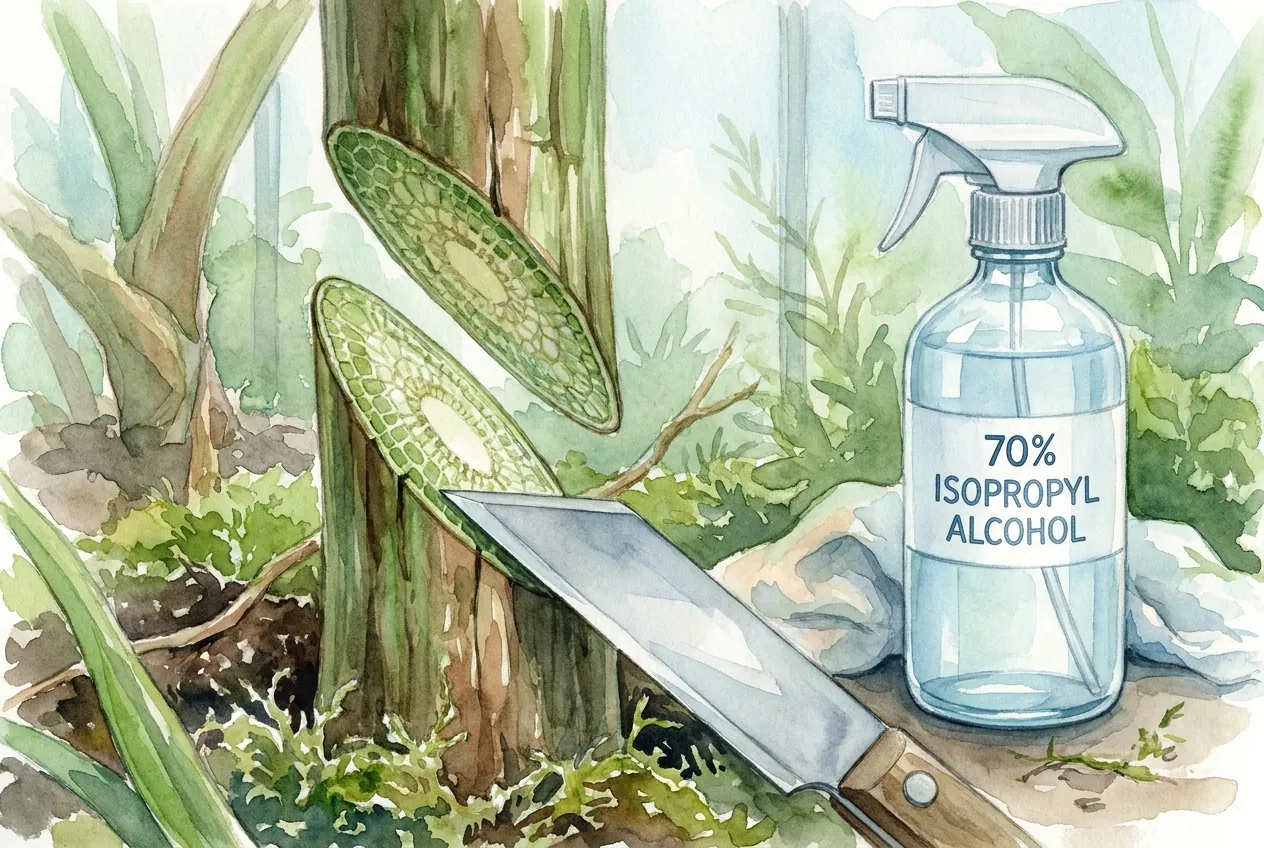
Key Takeaways
- A razor-sharp single-bevel blade sets the ceiling on graft success. A flat, uncrushed cut face keeps the cambial cells alive so the union can knit.
- Buy 70% isopropyl, not 99%. The water content drives protein denaturation and slows evaporation so the sterilant stays wet on the wound long enough to act.
- Self-sealing wrap of the Parafilm-M or Buddy-Tape type blocks desiccation during the callus window. It fuses to itself without adhesive and seals the exposed cut face against drying.
- Reusable clips or rubber strips hold steady, moderate pressure so the cambia touch without crushing. Over-tight ties damage the tissue as surely as a bad cut.
- Warmth near 21 to 27 °C speeds vascular reconnection. A cold winter sill can stall a graft that would knit in a week on a warm bench.
A desirable adenium graft lives or dies at a layer of cells a fraction of a millimeter thick.
The cambium at each cut face must survive the cut, sit flush against its partner, and stay both moist and warm long enough to bridge. Every tool you buy either protects that layer or damages it.
This is a buying guide organized by failure mode, not by brand. Four purchases decide most graft outcomes on a thick caudex. Those are the blade that makes the cut, the sterilant that keeps the wound clean, the wrap that blocks desiccation, and the fixation that holds cambial contact.
The buying verdict in one screen
Buy a thin, rigid grafting knife ground on a single bevel that takes a razor edge.
A flat, uncrushed cut face keeps the cambial cells alive so the union can knit. Ragged or crushing cuts kill that layer before healing starts.
Buy 70% isopropyl alcohol, not 99%. The water in a 70% solution is what lets it denature microbial proteins and penetrate the open wound.
Higher-percentage alcohol evaporates faster and denatures surface proteins so quickly that penetration suffers.
Buy a self-sealing stretch wrap of the Parafilm-M or Buddy-Tape type. It holds contact pressure and seals the union against drying during the days-to-weeks callus window. Buy reusable grafting clips or rubber strips to keep the two cambia touching under steady, moderate pressure.
An optional fifth purchase is a soil or probe thermometer to confirm the callus zone stays in a warm band. Warmth speeds vascular reconnection, and a cold bench stalls healing.
Why the cut face, not the tool brand, sets the ceiling
Graft healing follows a fixed biological order. The cut first forms a thin brown necrotic isolation layer, then callus cells proliferate across the gap, then plasmodesmata form, and finally the vascular tissues reconnect.
A 2024 review in Horticulture Research describes this sequence and notes that success depends on adhesion of rootstock and scion cambium tissue.
Two facts from that literature shape what you buy. Phloem generally reconnects before xylem, so a graft can look joined while water transport is still forming.
Cambial contact area and alignment govern whether the callus bridge ever forms at all.
The blade matters more than any accessory because it decides whether those cambial cells survive the cut. A knife that crushes or tears the cut face destroys the very cells that must divide and bridge. A knife that leaves a flat, mirror-clean face preserves them.
Where the cambial layers must meet
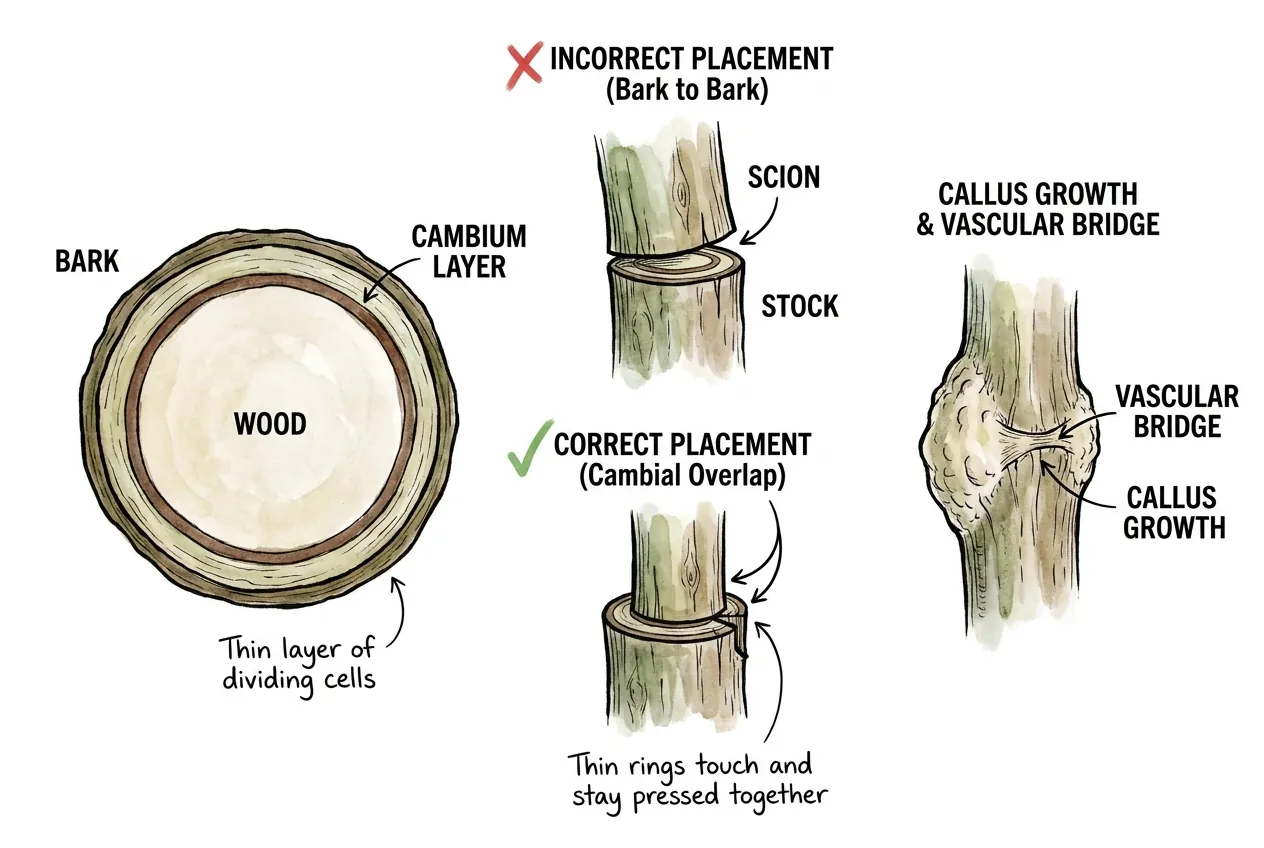
The cambium is a thin cylinder of dividing cells just under the bark, between wood and phloem.
On a flat or cleft graft, the scion cambium must overlap the stock cambium on at least one side, not merely rest bark to bark.
When those two thin rings touch and stay pressed together, callus grows across the seam and forms the vascular bridge.
Clean cut versus crushed cut
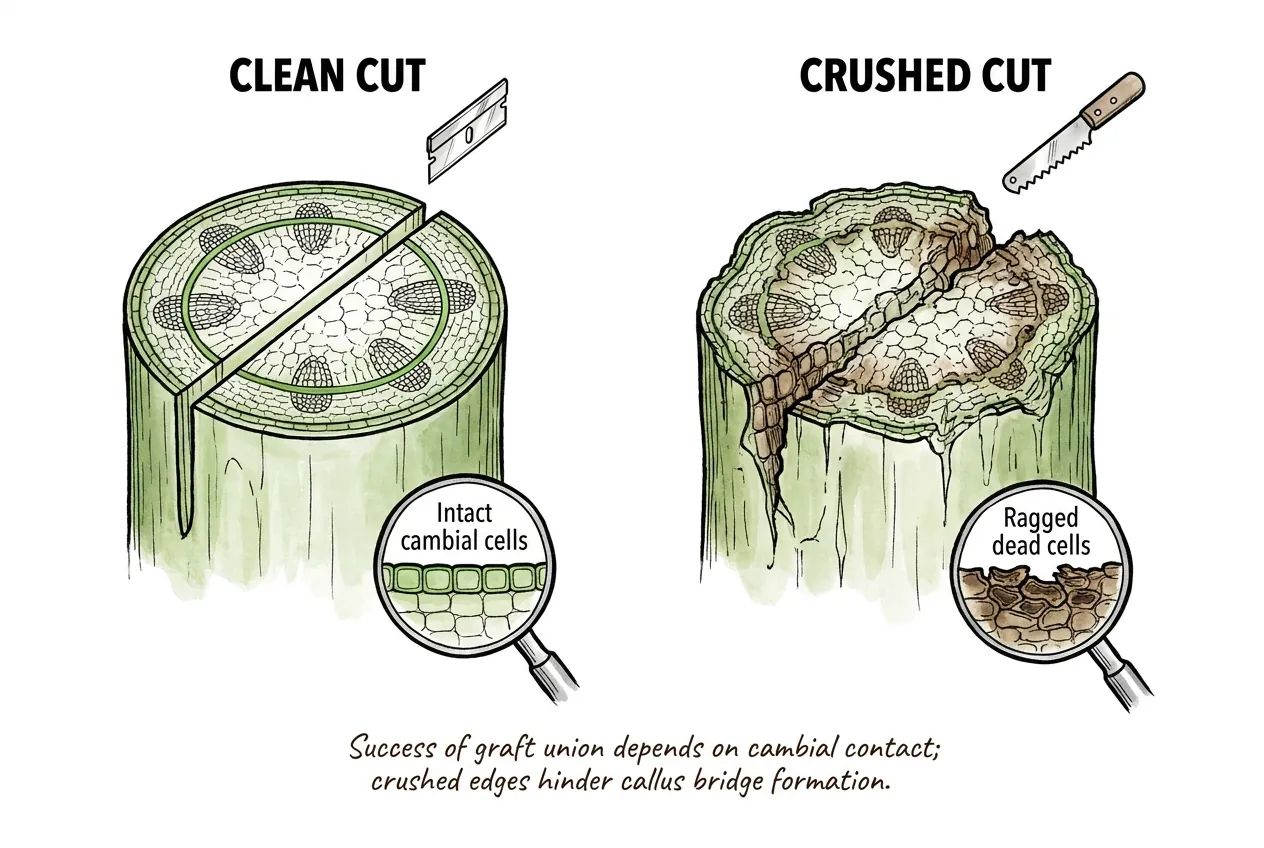
A razor-clean slice leaves the cambial cells at the surface intact and flat, ready to divide.
A dull or sawing blade tears and compresses that surface, leaving a ragged margin of dead cells the callus cannot cross.
The visible difference is subtle, yet it separates a union that knits from one that browns and fails.
The thresholds that turn into a shopping list
Three numbers convert the biology above into concrete specs you can buy against. Each one maps to one purchase, so you shop against a threshold instead of a marketing claim.
Disinfectant concentration: why 70% beats 99%
The CDC chemical-disinfectant guidance states the optimum bactericidal concentration for alcohol is 60 to 90 percent in water.
Cidal activity drops sharply once alcohol is diluted below 50 percent. The same guidance explains that absolute alcohol is less bactericidal than alcohol-water mixtures because proteins denature faster in the presence of water.
For an open graft wound, that makes 70% isopropyl the correct spec, not a preference. It stays wet on the surface long enough to act, and the water content drives the protein denaturation that kills contaminants.
One boundary is that alcohols are not sporicidal, so alcohol reduces the microbial load at the wound without sterilizing soil or tools against every organism.
Wound entry matters on adenium specifically. Basal stem rot on Adenium obesum has been attributed to Neocosmospora ipomoeae, and physical injury raises infection severity for this class of pathogen.
A clean blade and a wiped wound cut one of the entry routes that ends in rot.
Wrap stretch and seal: the desiccation number
A self-sealing wrap has to do two jobs at once. It must stretch enough to conform and self-fuse without adhesive, and it must seal against water loss while the callus forms.
Parafilm-M-type film is documented to stretch up to about 200 percent of its length and is made from polyolefins and paraffin wax, which is what gives the waterproof, self-sealing behavior.
Buddy-Tape-type wrap sits at the other end of the stretch range. Its manufacturer states it can stretch to roughly eight times its length and becomes self-adhesive only when stretched, staying non-tacky in the roll.
Both classes seal the union so the exposed cambium does not dry before it bridges.
Callus temperature: the healing-speed number
Healing is temperature-dependent. Across temperate grafts the practical callus band sits near 21 to 27 degrees Celsius, and warmer conditions inside that band tend to speed vascular reconnection.
A cold windowsill in winter can stall a graft that would knit in a week on a warm bench.
This is where the optional thermometer earns its place. You are not buying it for the graft directly. You are buying it to confirm the callus zone holds a warm, steady temperature during the first weeks.
Selection criteria at a glance
Buy against the spec column, then confirm identity on the product page. The table below states the measurable spec for each role and the failure it prevents.
| Role | Measurable spec to demand | Failure it prevents |
|---|---|---|
| Cutting blade | Thin, rigid, single-bevel. Takes a razor edge | Crushed or ragged cut face killing cambial cells |
| Surface sterilant | 70% isopropyl in water (60 to 90 percent band) | Wound-borne infection. Poor penetration from 99% |
| Self-sealing wrap | Stretch about 200 percent or up to 8x. Self-fusing. Waterproof | Desiccation of the union during the callus window |
| Union fixation | Steady, moderate clamp tension. Reusable and sterilizable | Cambial slippage. Or crushing from over-tight ties |
| Callus warmth (optional) | Reads the 21 to 27 °C callus band | Cold-stalled healing on a winter bench |
The cutting blade: preserve the cambium you are trying to join
Edge geometry and sharpness, not price, decide whether the blade delivers a flat cut face. The blade is the one purchase that can quietly cap your success rate, because its job is a flat, uncrushed cut face on both scion and stock so the cambial layers meet cleanly.
A knife ground on one face only is the standard shape for this reason. The flat back rides against the cut plane for a straight, controlled slice, while the lone ground face concentrates the edge.
The Single-Bevel Grafting Knife is a stainless one-face-ground blade with a rosewood handle, sold with grafting tape and built to leave the flat cut that maximizes cambial contact.
A folding razor-tip knife suits growers who want a compact edge they resharpen often. The Zenport K106F Grafting Knife is a 2.25-inch single-edge stainless Japanese-steel blade in a folding body.
Use this when you graft occasionally and prefer a pocketable knife you can strop before each session.
Skip a dedicated grafting knife if you already own a truly sharp, thin, single-bevel blade you keep sterile and stropped.
The tool is a means to the flat cut, not a talisman. A dull grafting knife is worse than a fresh razor, because a dragging edge crushes the cambium it is supposed to preserve.
The surface sterilant: 70% isopropyl, wiped on the wound and the blade
Buy the concentration, and treat the brand as interchangeable. A 70% Isopropyl Alcohol USP is a 16-ounce, USP-grade rubbing alcohol at the exact 70 percent concentration the CDC band favors.
It meets the spec because the roughly 30 percent water content is what drives protein denaturation and slows evaporation.
Use it to wipe the blade between cuts and to swab the cut surfaces before you join them.
That reduces the microbial load at the open wound, which is one documented entry route for basal stem rot on adenium.
Reach for it again to wipe reusable clips before the next graft.
Do not upgrade to 99% isopropyl expecting a stronger result. The higher concentration evaporates faster and denatures surface proteins so quickly that penetration and contact time both suffer.
Skip alcohol entirely as your only defense against soilborne rot, because alcohol is not sporicidal and does not replace clean media and sound watering.
The self-sealing wrap: hold contact and block drying
Once the cut faces meet, the wrap decides whether they stay moist and pressed together. A self-sealing stretch tape fuses to itself without adhesive and seals the union against water loss.
The Parafilm Nursery Grafting Tape is a one-inch genuine Parafilm roll documented to stretch up to about 200 percent and self-seal from its polyolefin and paraffin composition.
Wrap it under light stretch so it conforms and fuses, spiraling to cover the union without gaps.
The seal blocks desiccation during the days-to-weeks callus window, which is when an exposed cut face is most likely to dry out and fail.
A Buddy-Tape-type wrap is an alternative class that stretches far more, up to about eight times, and turns tacky only when stretched.
Skip a heavy, non-stretch electrical or duct tape for the union itself. Those do not conform to the contour, do not breathe, and can trap water against the wound or girdle the stem.
Reserve rigid tape, if you use it at all, for anchoring above and below the wrap rather than sealing the union.
The union fixation: steady pressure without crushing
On a thick caudex, the wrap alone may not hold the cambia aligned under load. Fixation supplies steady, moderate axial pressure so the two cut faces cannot slip apart. The Plastic Grafting Clips are a 50-pack of reusable plastic clips that hold a graft closed while the callus forms.
The spec that matters here is tension, not part count. Clamp pressure must be firm enough to keep the cambia touching, yet gentle enough that it does not crush the tissue it is meant to join.
Rubber grafting strips are the flat-graft alternative, spreading tension across the joint on wide cleft or flat grafts.
Skip fixation only on small, well-matched grafts that the wrap already holds motionless. Skip a hard metal clamp entirely on soft adenium tissue, since over-tight pressure crushes cambium as surely as a bad cut.
Wipe reusable clips with the same 70% isopropyl before the next graft so they do not carry pathogens between plants.
The optional callus thermometer: confirm the healing band
Warmth is a lever on healing speed, and a thermometer turns guesswork into a reading. The Luster Leaf Soil Thermometer is a digital probe thermometer that reads the temperature of soil or a warm callus zone.
It meets the need because it lets you confirm the graft is sitting inside the roughly 21 to 27 degree band rather than on a cold sill.
Use it to spot-check the shelf, mat, or propagator where healing grafts sit through the first weeks.
Skip it if your bench already holds a stable, warm room temperature you can trust. It earns its place mainly in winter, when a cold window can quietly stall an otherwise sound graft.
The setup sequence, in the order the tissue needs
On my grafting bench, I keep unopened supplies separate from anything that has touched exposed tissue. I keep the recovery pot outside both zones until the union is secured. That layout prevents a clip or wrap from silently returning from a cut surface to a clean graft.
For each plant, I use one small label that stays with the scion, rootstock, and any reusable fixation. I clear the used zone before starting another plant. This simple boundary does not sterilize a home workspace, but it makes the handling sequence visible and helps me avoid cross-contact when I am concentrating on alignment.
Order matters as much as the tools. The following sequence keeps the cambium alive, clean, aligned, sealed, and warm, in that order.
- Strop and wipe the blade with 70% isopropyl so the first cut is clean and sharp.
- Make one flat, decisive cut on scion and stock so the faces are smooth, not sawn.
- Swab both cut faces with 70% isopropyl, then align the cambia flush on at least one side.
- Wrap the union under light stretch with self-sealing tape to seal and hold it.
- Add a clip or rubber strip on a thick caudex to keep steady, moderate pressure.
- Hold the graft warm and out of direct blast heat, confirming the callus band with a thermometer.
For the underlying cut-and-align technique on a caudex, see the companion guide on adenium caudex grafting.
For the disease side of wound care, the Neocosmospora basal stem rot breakdown explains why a clean wound is not optional.
Who should not buy each class
Not every grower needs every item, and forcing a purchase can waste money or harm plants.
Skip the dedicated grafting knife if you already keep a thin, sharp, single-bevel blade sterile and stropped.
Skip the extra sterilant only if you truly maintain a clean bench by other validated means, remembering alcohol is a wound wipe, not a soil treatment.
Skip fixation on small, tightly matched grafts the wrap holds on its own.
Skip the thermometer if your propagation space already holds a steady, warm temperature you can vouch for.
Skip any heavy, non-conforming tape for the union, and skip hard metal clamps on soft adenium tissue entirely.
The goal is the flat, clean, held, sealed, warm union, and any item that does not serve that goal is optional.
Maintenance, failure modes, and replacement intervals
A degraded tool reintroduces the failures you bought it to prevent. A blade dulls with use and must be stropped or the edge replaced, because a dragging edge crushes cambium. Store it clean and dry so the steel does not pit.
Alcohol is consumable and evaporative, so cap the bottle and replace it once it is old or contaminated.
Grafting tape is single-use on a given union and is removed or left to weather off once the graft has knit and thickened.
Watch for girdling as the stem grows, and free any wrap that starts to constrict.
Reusable clips and strips last many grafts if wiped with 70% isopropyl between plants and inspected for cracks or lost spring.
Retire a clip that no longer holds firm, moderate tension, since a weak clip lets the cambia slip.
For the wider bench context that makes these grafts thrive afterward, see the adenium caudex-building guide.
Frequently asked questions
Do I really need 70% isopropyl, or is 99% fine because it is stronger?
Use 70%, because stronger is not better here. The water in a 70% solution is required for the protein denaturation that kills contaminants, and it slows evaporation so contact time is adequate.
The CDC band for alcohol disinfection is 60 to 90 percent in water, and 99% falls outside the practical sweet spot for wiping an open wound.
Can I skip the wrap if I use a grafting clip?
No, because the clip and the wrap do different jobs. The clip supplies alignment pressure, while the self-sealing wrap blocks desiccation of the exposed cut face.
An unwrapped union can dry and fail during the callus window even while a clip holds it perfectly aligned.
Will alcohol on the wound stop basal stem rot?
It reduces one risk, not all of them. Wiping the blade and wound lowers the microbial load at an open entry point, and physical injury is a documented aggravator for Neocosmospora rot on adenium.
Alcohol is not sporicidal, though, so clean media and correct watering still carry most of the rot-prevention load.
How warm does the graft need to be?
Aim for a warm, steady band near 21 to 27 degrees Celsius for temperate-style healing. Warmer conditions inside that band tend to speed vascular reconnection, and a cold winter sill can stall an otherwise sound graft.
A soil or probe thermometer confirms the zone rather than leaving it to guesswork.
Which single purchase matters most?
The blade, because it sets the ceiling nothing else can raise. A crushed or ragged cut face kills the cambial cells that must divide and bridge, and no wrap, clip, or warmth recovers dead tissue.
Buy the thin, rigid, single-bevel edge first, then the sterilant, wrap, and fixation that protect the clean cut it makes.
Affiliate Disclosure
This article contains Amazon affiliate links. As an Amazon Associate I earn from qualifying purchases. If you use these links, the site may earn a commission at no extra cost to you. Product availability, price, and specifications can change. Check the current listing before buying.