
Scale vs Corking on Caudex? A Safe One-Bump Check
Brown bumps on a caudex? Check one bump without forcing it, then use the exposed body, honeydew, texture, and location to separate scale from corking and edema.
Nathan Brooks · 2026-08-25 · 10 min read
Key Takeaways
- Check one isolated bump gently. A thin cover with a body beneath supports armored scale. A whole dome that flips with honeydew supports soft scale.
- Corking stays fused and hard, starts at the base, climbs slowly, and needs no treatment.
- Edema stays fused but feels soft and water-soaked, and you fix it with watering and light not sprays.
- Soft scale leaves sticky honeydew and sooty mold, a sign the infestation is mature and spreading.
- A soft mushy darkening spreading brown zone is rot, so act fast instead of assuming corking.
A brown bump appears on your prized adenium or pachypodium, and your first instinct is to attack it. Stop. Three very different things make brown bumps on a caudex, and the correct response to one is the worst response to another.
Scale is a living pest that spreads. Corking is normal woody aging that needs nothing. Edema is a watering problem that a spray cannot fix.
You must classify the bump before you touch it, because scrubbing off natural corking scars the plant and ignoring live scale lets an infestation take your whole shelf.
A one-bump check that does not force a diagnosis
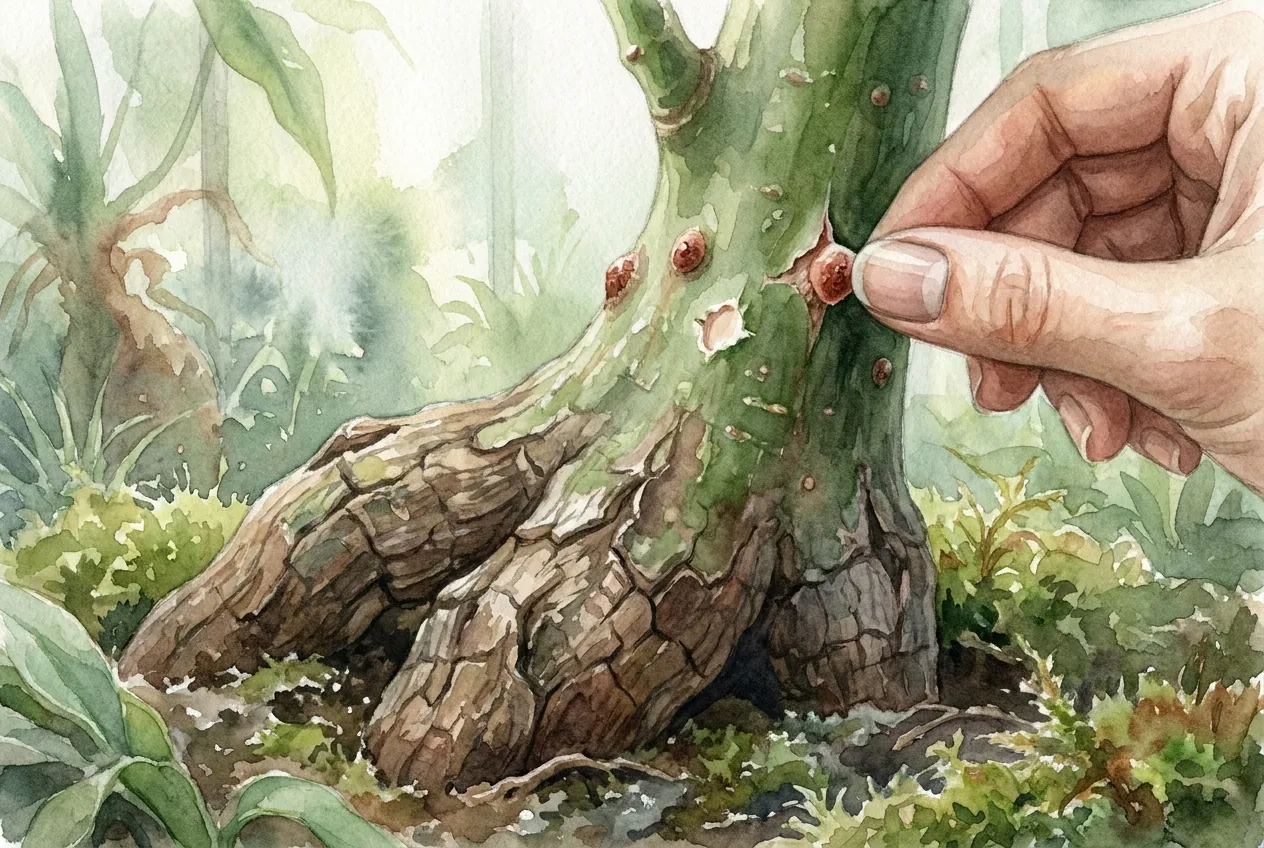
Use a wooden toothpick on one isolated bump instead of scraping a whole patch. Push from the side once with the toothpick nearly parallel to the surface. Stop if the plant tissue dimples or the bump resists.
A thin plate that lifts while a soft body remains attached supports armored scale. A whole rounded dome that flips with its underside supports soft scale, especially when honeydew or sooty mold is present. A fused bump proves only that the cover did not separate.
I photograph the bump before touching it, then repeat the same angle after the single pass. Under a 10x loupe, I look for a body beneath a loose plate or an entire soft-scale body on the toothpick. If neither pattern appears, I leave it unclassified and compare its location, firmness, and change over seven days.
Movement identifies a removable cover or body. A scar alone does not diagnose scale. Confirm the insect from the exposed body, the lifted soft-scale body, honeydew, or crawler activity.
Scale insects, the bump that fights back
Scale is a sap-feeding insect that clamps onto the surface and hides under a shell. It is the only one of the three that multiplies and moves to your other plants, so it is the one you cannot leave alone.
Armored scale versus soft scale
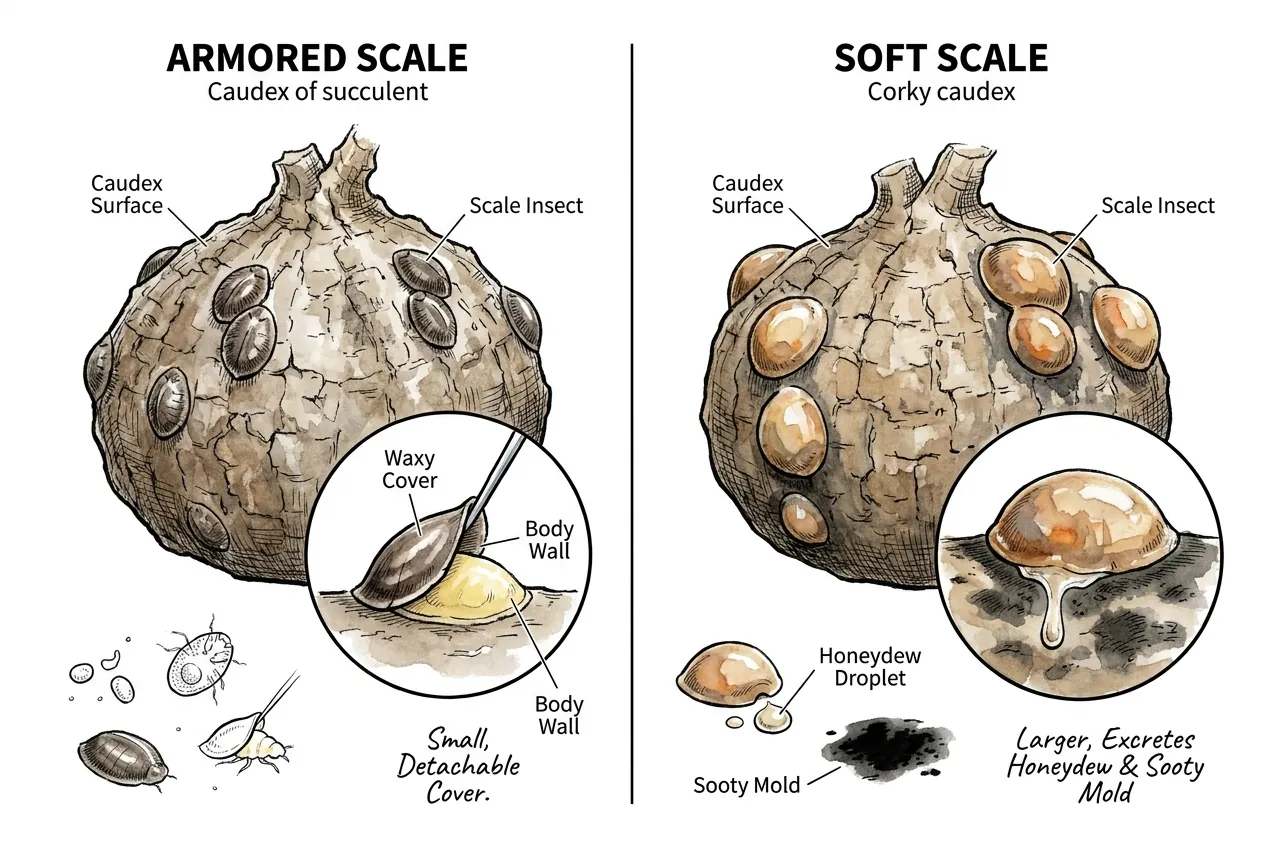
Armored scale is small, under one eighth of an inch, and its waxy cover is not attached to the body.
The insect lives and feeds under that separate cover, and armored scale does not produce honeydew.
Soft scale is larger, up to about one quarter inch, and its surface is the actual body wall.
Soft scale excretes sticky honeydew that drips below and grows blackish sooty mold. A sticky sheen or sooty film on lower tissue points to soft scale with a colony already established.
Honeydew and sooty mold are a soft-scale signature, so a sticky, blackened patch means the infestation is mature and probably spreading.
Where scale hides on a caudex
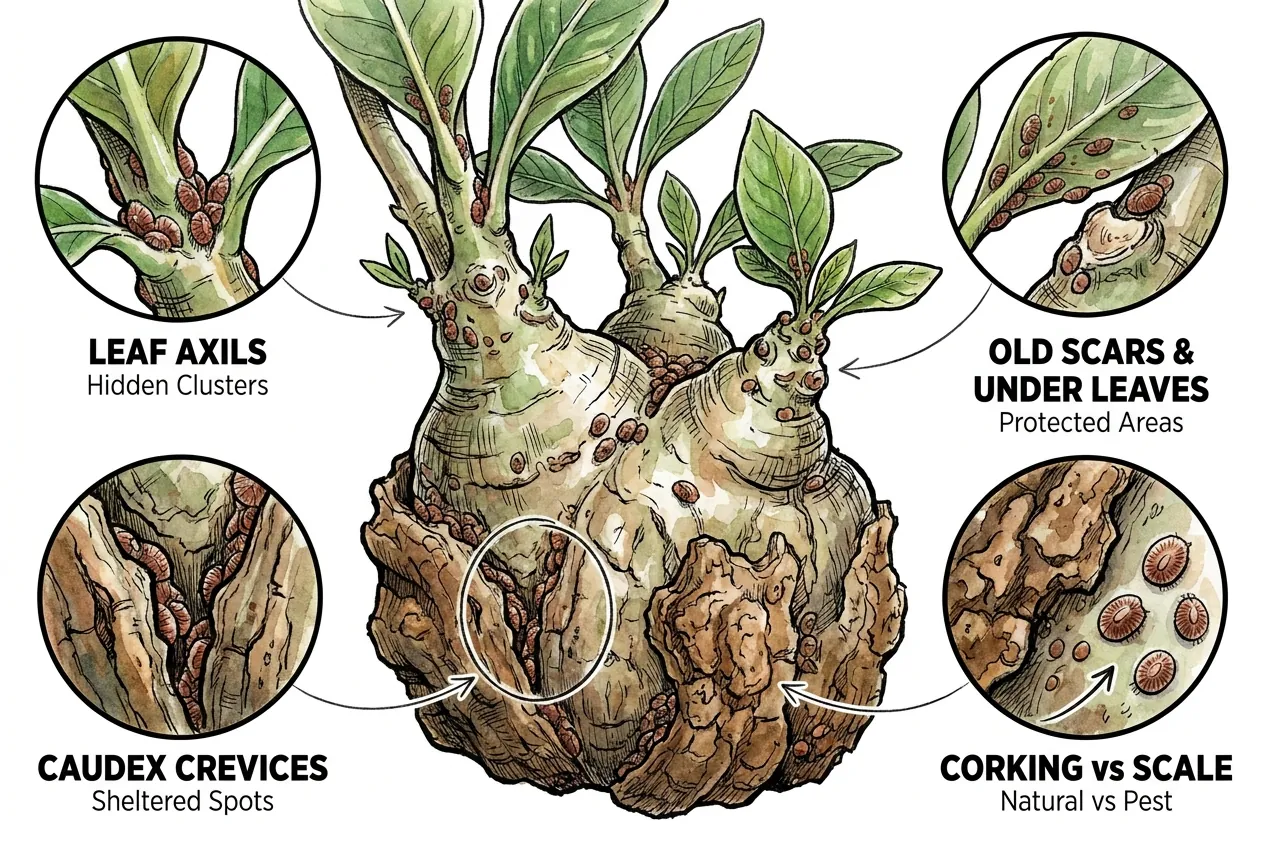
Scale clusters in leaf axils, along ribs, around old scars, on lower leaf surfaces, and inside caudex crevices.
It favors sheltered spots near new growth, which is exactly where a quick glance misses it.
Check the shaded underside of the caudex shoulder and the folds where leaves meet stem. A hand lens helps, because early armored scale reads as tiny fixed dots rather than obvious bumps.
How to remove scale without wrecking the plant
Start by isolating the plant so crawlers cannot walk to neighbors. Then physically remove every confirmed scale by dabbing, rolling, or lifting with a soft brush, toothpick, or cotton swab. Do not scrub.
Spot-treat what remains with a cotton swab of seventy percent isopropyl alcohol. For farina-coated or sensitive species, dilute to half alcohol and half water, and never use dish soap solutions, which strip the protective wax and invite sun scald.
Repeat the inspection every six to seven days and remove only confirmed live scale. Test alcohol on one hidden spot first, and stop if the tissue discolors or softens. Watering continues from the plant’s normal root-zone and pot-mass cues because no reliable 72-hour delay applies to a small alcohol spot treatment.
Armored scale is the stubborn case. Its hard cover blocks most contact sprays and oils from reaching the insect, so physical removal matters more, and any spray should be timed to the vulnerable crawler stage.
For the actual treatment products and a spray-versus-manual decision, see the caudex pest walkthrough at why sprays fail on caudex pests. Physical removal plus repeated alcohol rounds beats a single heavy spray, because scale hides under a cover that most sprays never penetrate.
Before treatment, I mark three hiding sites on a duplicate photograph and inspect the entire plant under 10x magnification every seven days. I count live bodies, crawlers, and fresh honeydew separately, while empty covers stay in their own column. The last live body or crawler starts a 16-week isolation clock, and any new one resets it.
I use 16 weeks when the species is unknown because indoor soft scale can take two to four months to complete a generation. The upper end covers more than the crawler-release period and avoids releasing a plant during a slow settled stage. A confirmed species or pesticide label can require a longer interval.
Corking, the woody armor you should leave alone
Corking is the plant building firm, brown, bark-like tissue on its surface as it matures. It is a sign of age and strength, not disease, and it needs no treatment at all.
What corking actually is
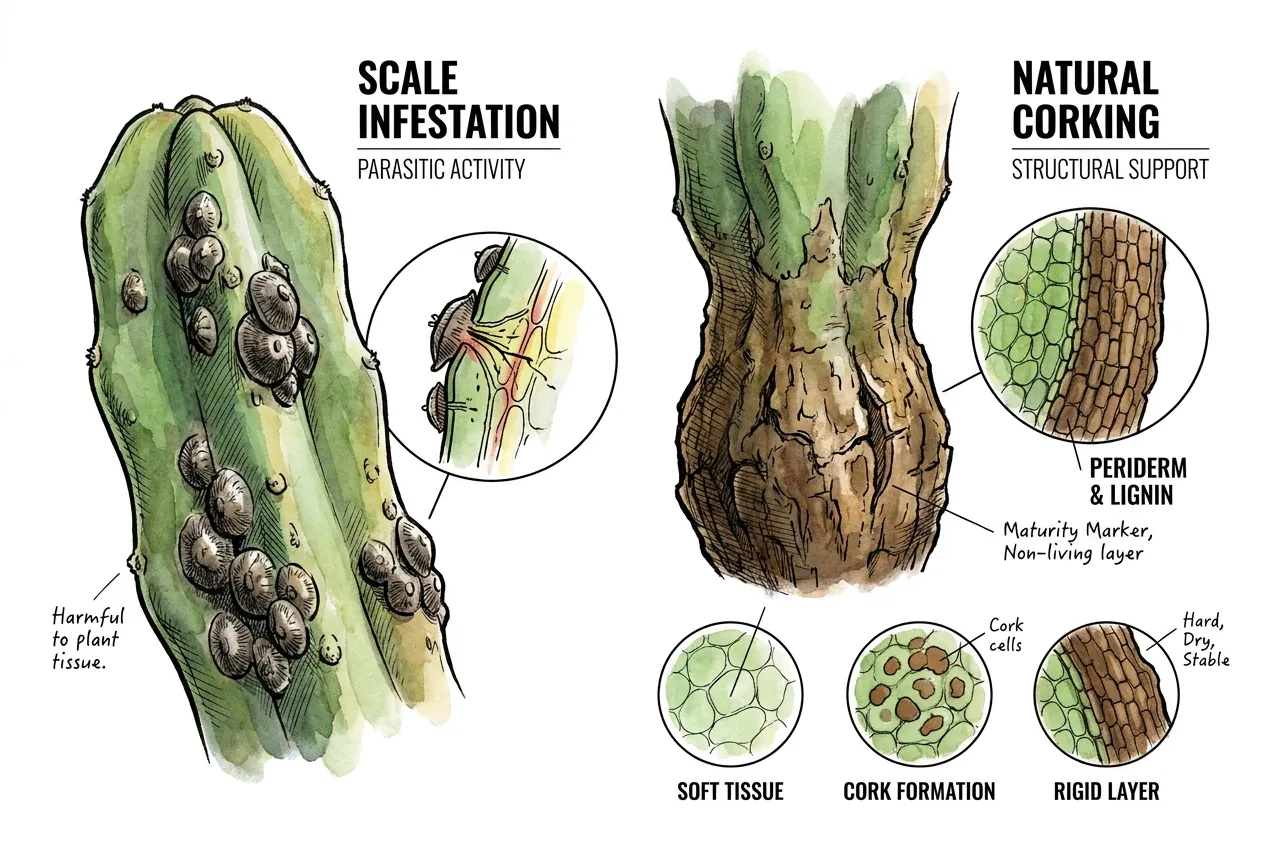
As a caudex gains weight, its fleshy outer tissue can no longer carry the load. The plant lays down cork cells and, at the base, woody lignin, producing a rigid protective layer known as periderm. The result is hard, dry, and stable.
This is the same family of processes that gives old cactus trunks their bark. On euphorbia, pachypodium, and thick-stemmed caudiciforms, a roughened brown base is a maturity marker rather than a warning.
Why corking starts low and climbs
Corking begins at the oldest, most load-bearing tissue at the base and moves upward with age. A gradual, base-up, hard brown zone is the classic benign pattern.
This direction is your best confirmation. Browning that starts at the top, or shows up as random spots on the side, is not corking and points to sunburn, mites, or rot instead.
Corking that begins at the base, stays hard, and climbs slowly is normal aging, so the right action is to leave it completely alone.
Edema, the watering problem in disguise
Edema is a physiological disorder, not a pest and not a pathogen. It shows up as corky bumps that can fool you, but the cause is water balance and the fix is care, never a spray.
What causes edema
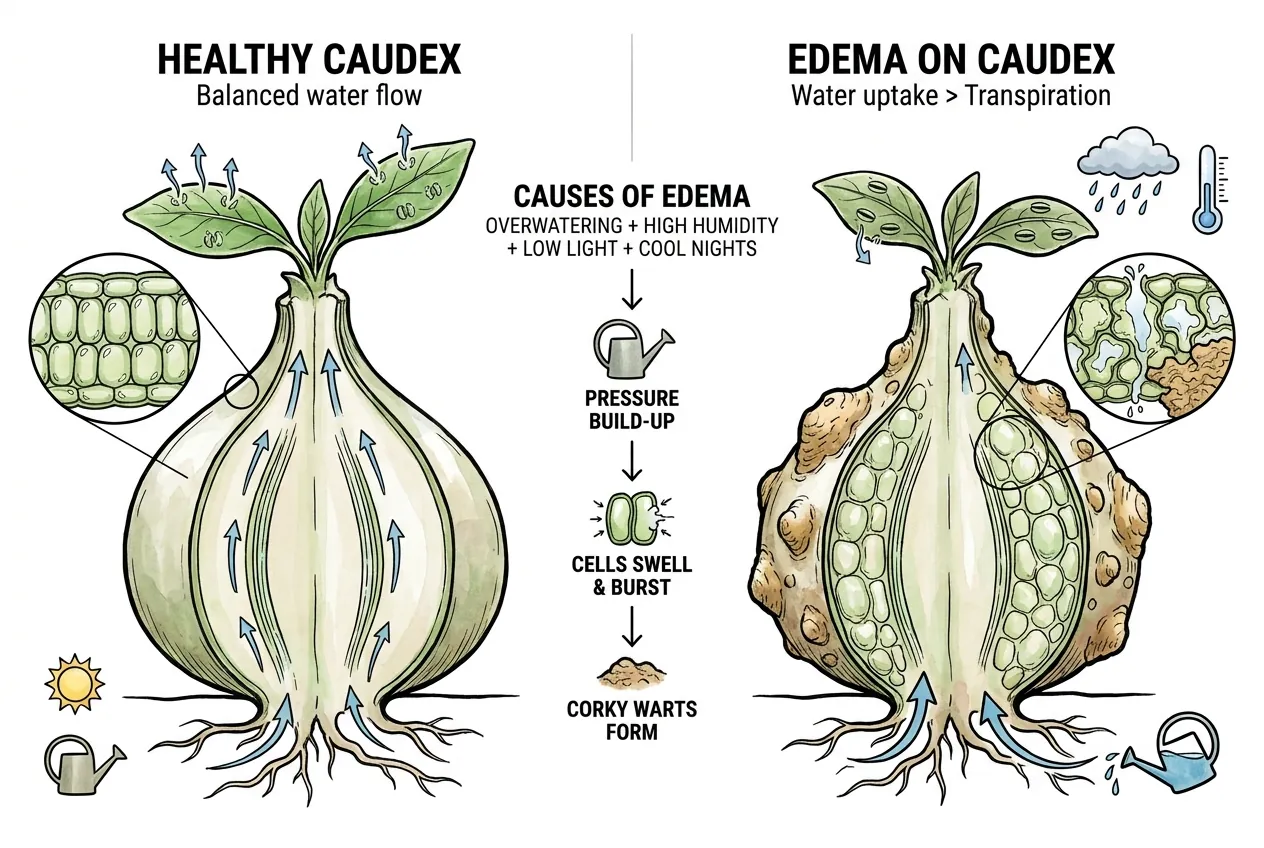
Edema happens when roots take up water faster than the leaves can transpire it away. Pressure builds inside the mesophyll cells until they swell and burst, forming water-soaked spots that harden into tan or brown corky warts, mostly on lower leaf surfaces.
The conditions that drive it are overwatering, high humidity, low light, and cool nights that slow transpiration.
Utah State University advises keeping winter relative humidity below seventy percent to reduce it.
Telling early edema from a permanent scar
Press one bump lightly with a clean fingertip and compare it with the firm skin beside it.
A soft, spongy, water-soaked feel on lower or newer tissue means edema is active right now.
For the next two watering cycles, I wait until the top 2.5 cm is dry and keep overnight humidity below 70%. I photograph one marked bump and the youngest leaf every seven days. Each entry includes whole-pot mass immediately before watering and the overnight maximum humidity at canopy height.
I count the correction as working only when no new soft spot appears and the next leaf opens clean. The old bump is not the target because a hardened wart cannot uncork. Any new water-soaked spot restarts the two-cycle observation period.
Soft and water-soaked means act on watering now, while a hardened wart means the damage is already done and only new growth will show recovery.
How to fix edema
Cut watering during cool, low-light spells and keep the plant slightly dry. Raise light levels, improve air circulation, and improve drainage so water moves through instead of pooling.
Do not remove the affected leaves, and do not reach for a fungicide or insecticide, because neither addresses a water-balance problem.
Plants usually recover as conditions improve into spring, especially once they can go back outside.
The discipline behind edema prevention is simply better watering, which the caudex watering method guide covers at top versus bottom watering for caudex.
The full triage map at a glance
Use the cover response, exposed body, location, texture, and progression together. No single scrape result classifies every bump.
| Signal | Scale | Corking | Edema |
|---|---|---|---|
| One-bump check | Plate lifts with body beneath, or whole dome flips | Stays fused, hard and dry | Stays fused, soft then hard |
| Main location | Axils, ribs, scars, leaf undersides | Base of caudex, climbing up | Lower leaf surfaces, soft new tissue |
| Texture | Shell over soft body | Hard, dry, firm | Soft and spongy early, corky later |
| Color and pattern | Tan to brown discrete dots | Uniform brown, bark-like zone | Water-soaked spots to brown warts |
| Over time | Grows, spreads, honeydew | Slow, steady, base upward | Flares in cool damp spells, new growth clean |
| Correct action | Isolate and remove physically | Leave it alone | Fix watering, light, airflow |
Cover response plus body, location, firmness, and progression narrows the diagnosis without turning one scrape into proof.
Look-alikes you must not misfile
A few other marks masquerade as these three. Most are harmless, but one is an emergency, so rule them out before you relax.
Mealybugs
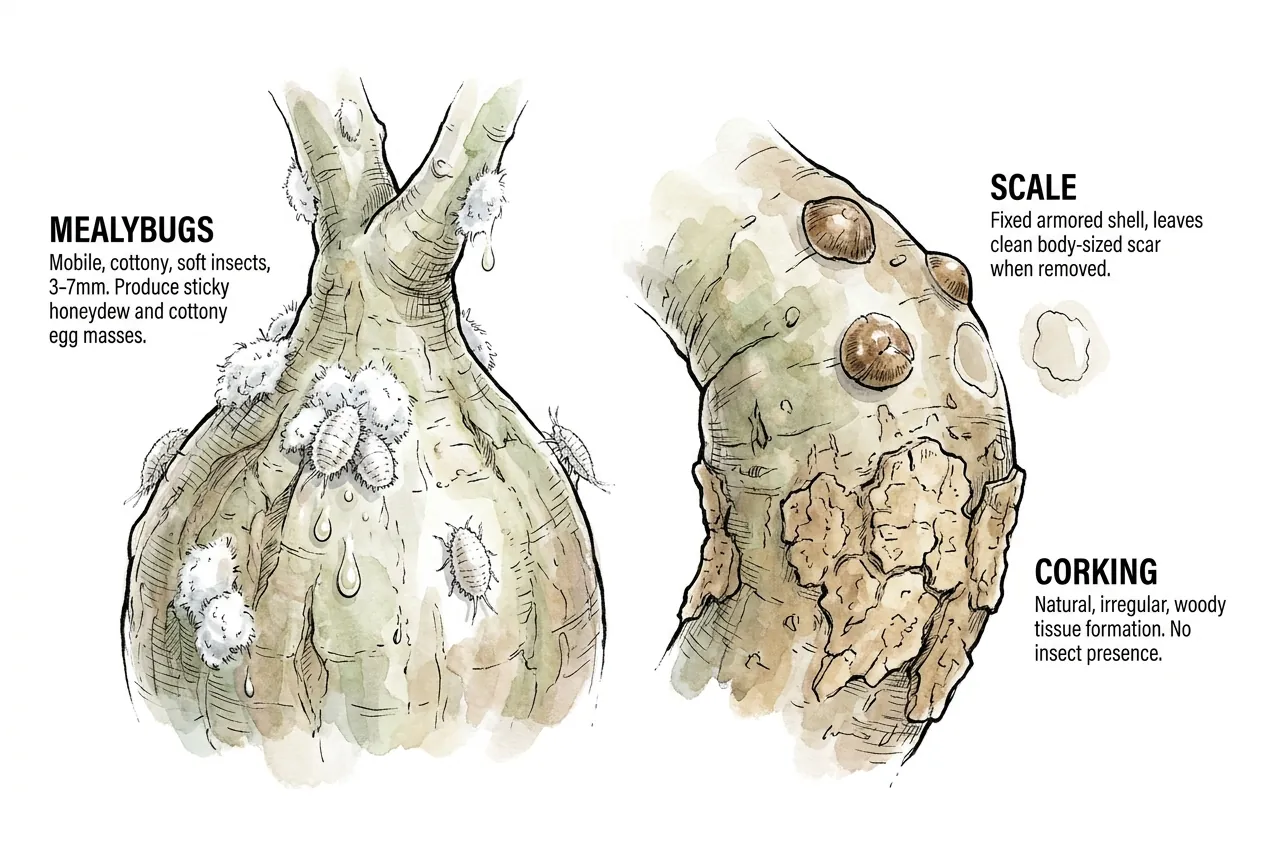
Mealybugs are white, cottony, and mobile, roughly three to six millimeters, with sticky honeydew and cottony egg masses.
Unlike a settled scale, a mealybug has a visible soft body, moves when disturbed, and does not hide beneath a detachable plate.
Sunburn scars and old wounds
Sunburn leaves flat tan or brown patches on the sun-facing side after a sudden move to strong light.
Old prune or graft scars are isolated, hard, fused, and have a known history. Both are flat or fused and non-spreading, so neither behaves like live scale or base-up corking.
Rot, the emergency
Soft, mushy, darkening, sometimes foul-smelling tissue that spreads from the soil line or a wound is rot, and it is the dangerous look-alike. The divider is firmness. A hard, dry brown zone can be corking or a healed edema scar, but a soft, darkening, spreading zone is not benign and needs fast action.
If a soft caudex has you unsure whether to cut, walk through the firmness decision at soft caudex rot or dormancy.
Never file a soft, mushy, spreading brown zone as harmless corking, because that mistake lets rot advance while you wait.
Key Takeaways
- Check one isolated bump gently. A thin cover with a body beneath supports armored scale. A whole dome that flips with honeydew supports soft scale.
- Corking stays fused and hard, starts at the base, climbs slowly, and needs no treatment.
- Edema stays fused but feels soft and water-soaked, and you fix it with watering and light, not sprays.
- Soft scale leaves sticky honeydew and sooty mold, which flags a mature spreading infestation.
- A soft, mushy, darkening, spreading brown zone is rot, so act fast instead of assuming corking.