
Gritty Caudex Mix Repels Water? The 20-Minute Rewet Fix
Your dry gritty caudex mix beads water and channels it down the pot. Here is why it turns hydrophobic and a slow 20-minute rewet that fixes it.
Rachel Torres · 2026-09-13 · 12 min read
Key Takeaways
- A gritty mix that beads and channels went hydrophobic, not just dry. Pouring harder only feeds the channels.
- Time a water drop first. A bead lasting many seconds means repellent, so switch to the staged rewet.
- Rewet slowly by bottom-watering or light top-trickle passes so the coating flips and small pores fill.
- Verify with pot weight, not the surface, because a channeling pot hides a dust-dry core.
- On a dormant or cold caudex, rewet only on real need and drain hard, since cold plus wet causes rot.
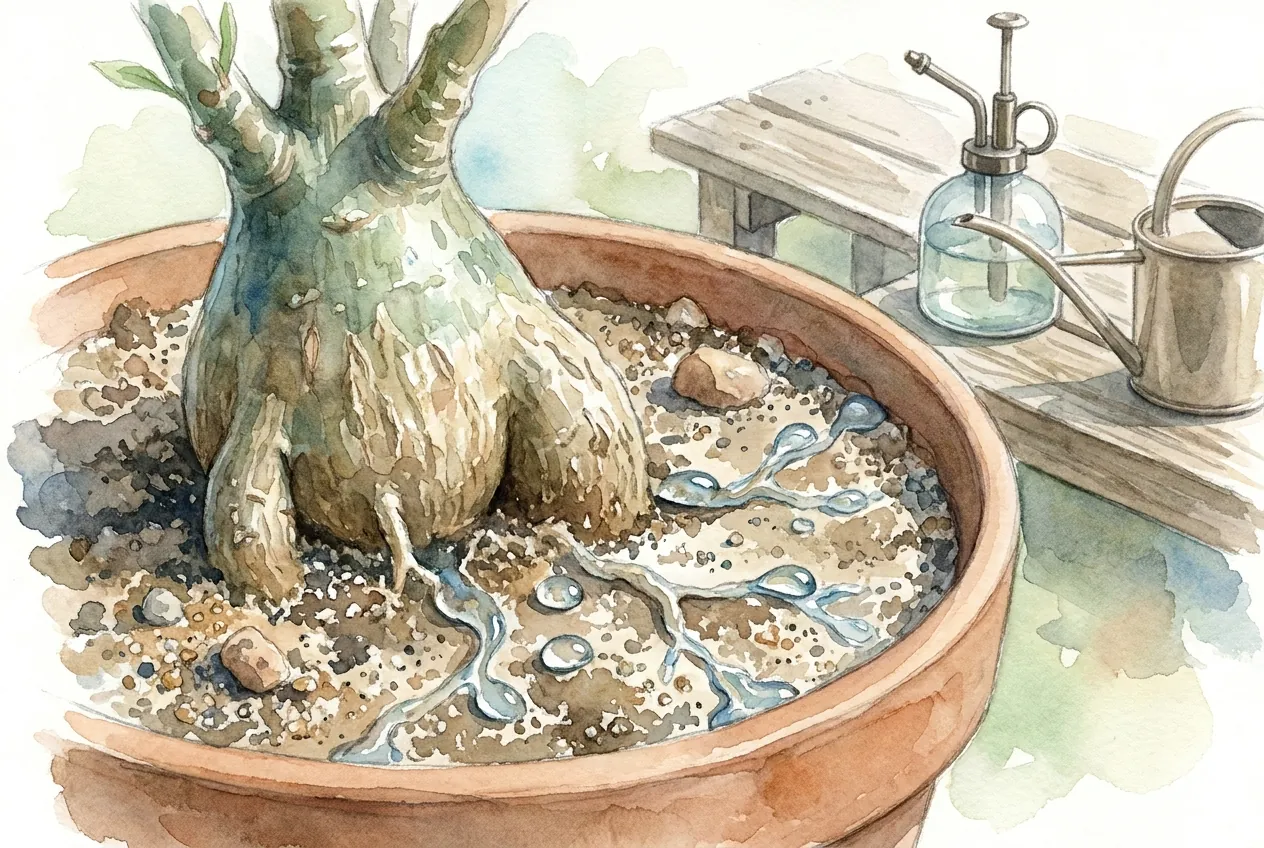
You watered all summer and the pot drank it right up. Now the same gritty mix beads water on top, sends it down the pot wall, and spits it out the drain hole in seconds. The core stays dust-dry.
Your mix did not just get dry. It went water-repellent. Below is why that happens and a slow, staged 20-minute rewet that gets water back into the rootball without rotting a dormant caudex.
What Actually Changed Is That Your Mix Turned Hydrophobic
The mix crossed from wettable to water-repellent as it dried. That is a real, measurable change in how the surfaces meet water, not a sign the plant simply needs more.
Wettability is set by the soil-water contact angle. A wettable surface pulls water into its pores. Once the contact angle passes 90 degrees, the same pores start pushing water out instead of drawing it in.
A repellent mix cannot wick water into its core no matter how much you pour on top. That single fact explains the beading, the side-channeling, and the fast empty drain.
The dryness itself sharpens the effect. A drier starting surface shows a higher apparent contact angle, so the mix that hit its driest state of the year is now the most stubborn it has ever been.
Why Gritty Mix Repels Water When Dry
The culprit is a thin organic film on the grit, not the pumice or lava itself.
Roots, soil microbes, and any organic fines leave behind waxes and fatty acids that coat particle surfaces over a season.
These coating molecules are amphiphilic. One end likes water and one end hates it. When the mix is moist, the water-liking ends face outward and everything wets normally.
When the mix dries hard, those molecules flip. The water-hating ends rotate outward and the coated grit turns repellent. The grit did not change, but its invisible coating reoriented into a water-shedding skin.
This is why even a nearly all-mineral gritty mix can repel water. It does not take much root exudate or microbial residue to build a repellent film across a season of growth.
There is good news buried in the mechanism. Rewetting flips the coating back toward its water-liking orientation. That reorientation takes time, which is the whole reason a slow rewet beats a fast pour.
Confirm It Is Repellent, Not Just Dry
Before you treat it, prove it. A merely dry mix still drinks water. A repellent one beads it, and the fix for each is different.
The Home Water-Drop Timer Test
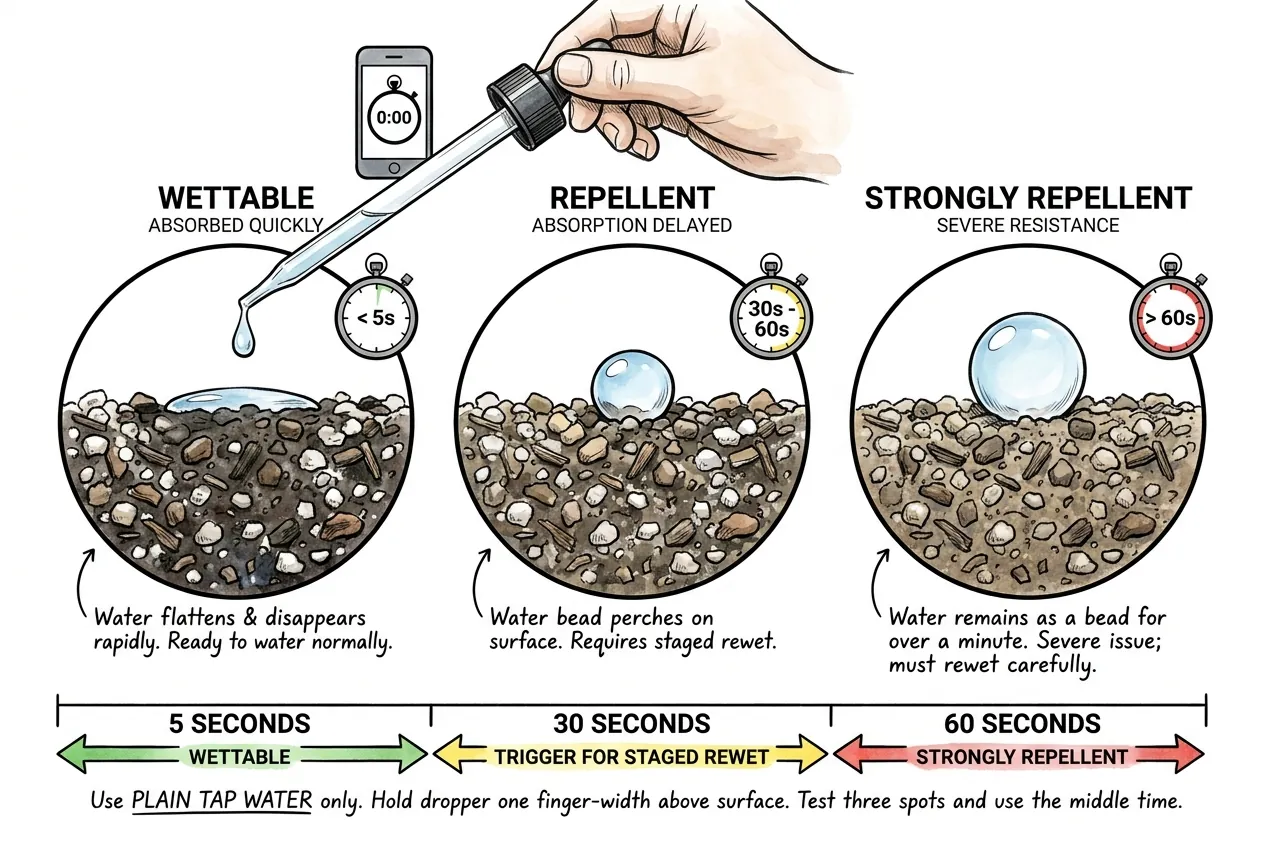
Level the surface grit so it is flat. Hold a plain-water dropper about one finger-width above the surface and release a single drop. Start a phone timer the instant it lands and stop when the bead flattens and disappears.
Repeat on three spots and take the middle time. This is a home version of the water drop penetration time test that soil scientists use to grade repellency.
The research boundaries are clear. Under about 5 seconds means the mix is still wettable. Longer than 60 seconds means it is strongly repellent, and past an hour means severe.
I treat a median around 30 seconds as my trigger to switch from normal watering to the staged rewet below.
That 30-second cutoff is my own conservative working rule, not a published standard. I picked the midpoint between the 5-second wettable line and the 60-second strongly-repellent line so I act before the problem gets bad.
Use plain tap water only for this. There is nothing to inhale, touch, or mix.
Why Water Channels Down the Side Instead of Soaking In
Repellency explains the beading, and a second effect explains where the water goes. Gritty mixes are coarse by design, and coarse media channel water.
A coarse mix has pores of very different sizes. Water races through the biggest open pores, which drain freely and offer little resistance. The small dry pores get bypassed, so only part of the profile wets.
Soil scientists call this preferential flow, and it is worst when the substrate is dry. As the mix takes on moisture, channeling eases and water spreads more evenly.
A pot that drains instantly is not proof the rootball got wet. It is often proof the water found a shortcut.
Fine material would help here. Smaller particles raise the mix’s ability to move water sideways through connected pores, which spreads moisture instead of letting it bolt straight down.
An all-coarse mix gives up that safety net for the sake of fast drainage.
The 20-Minute Staged Rewet
The goal is simple. Get water into contact with the grit long enough for the coating to flip and for the small pores to fill, instead of feeding the channels. Slow and patient beats fast and forceful.
Bottom-Watering for Small Caudex Pots
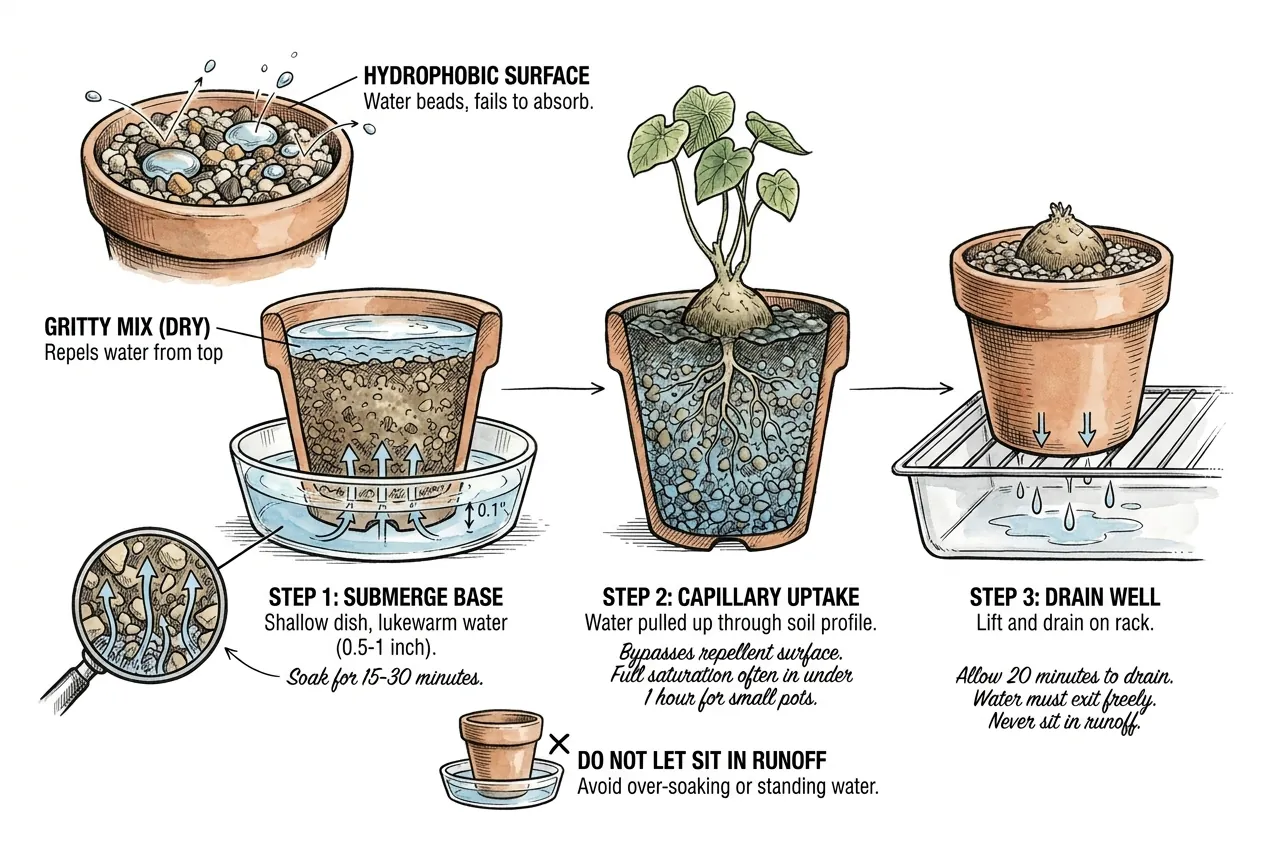
Set the pot in a shallow dish of lukewarm water so the bottom half-inch to one inch sits in the water.
Leave it to draw water up from the base for 15 to 30 minutes. Capillary uptake pulls water up through the profile and bypasses the repellent top surface.
Full-size pots need longer than small ones, but small caudex pots usually need far less. Do not let anything soak more than an hour or two.
Then lift the pot out and let it drain on a rack for about 20 minutes.
Water must exit freely, and the pot must never sit in its own runoff.
Slow Top-Trickle for Large or Heavy Pots
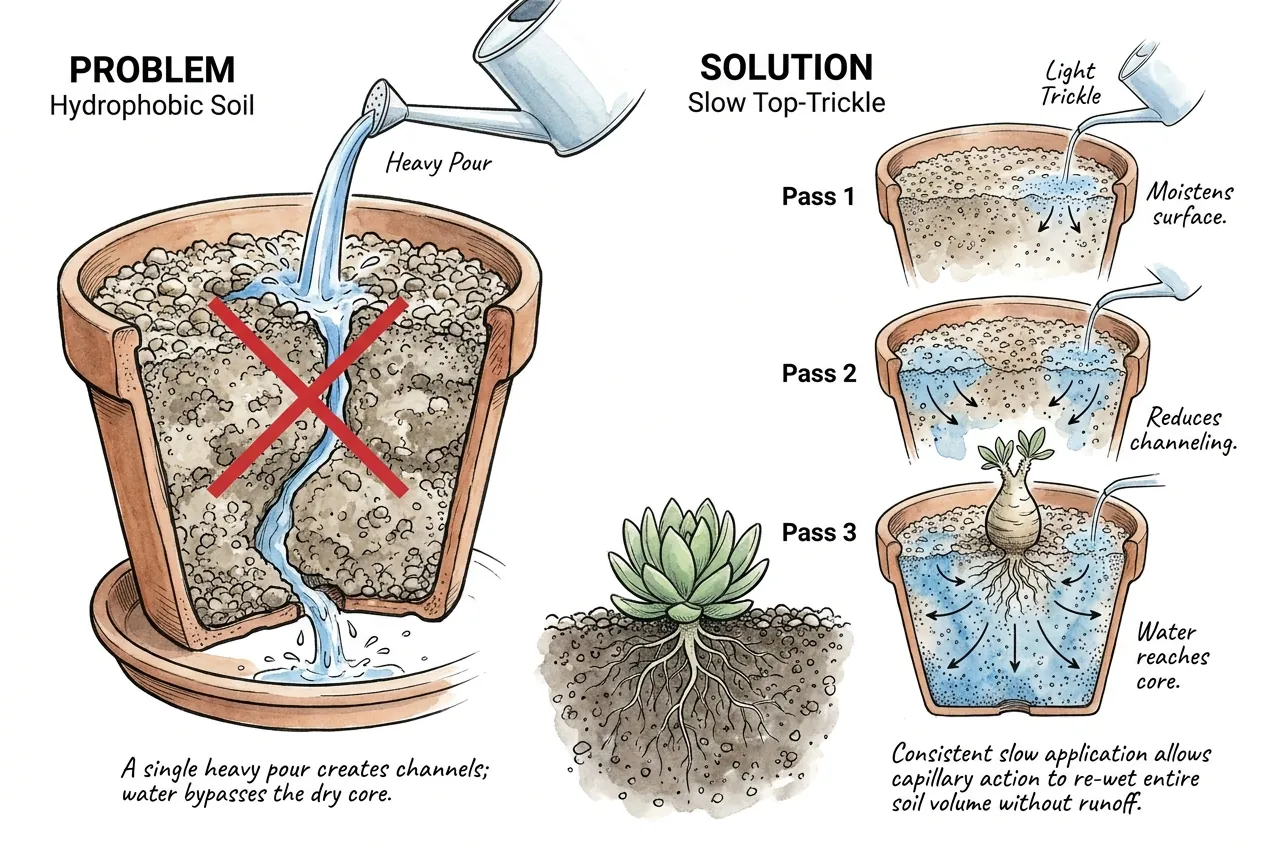
For a pot too big to lift into a dish, water from the top very slowly instead.
Apply a thin trickle in three or four light passes a few minutes apart, stopping before any runoff appears.
Each pass raises the moisture in the outer grit a little. That reduces channeling for the next pass, so water finally reaches the core. This is the same reorientation-plus-capillary logic, done from the top.
Never rely on one heavy pour to rescue a repellent pot, because a single blast just feeds the channels and runs out the bottom.
Full submersion until the air bubbles stop is an option for houseplants, but keep it brief for a caudex. Long saturation is exactly what a dormant tuber cannot tolerate.
Verify It Worked With Weight, Not Your Finger
Here is the trap. On a channeling pot the surface can feel damp and the drain hole can run wet while the core stays bone-dry. The finger test and the drain hole both lie.
Weight tells the truth. A pot holding water is noticeably heavier than the same dry pot, and water is the only big thing that changed.
The Pot-Weight Check
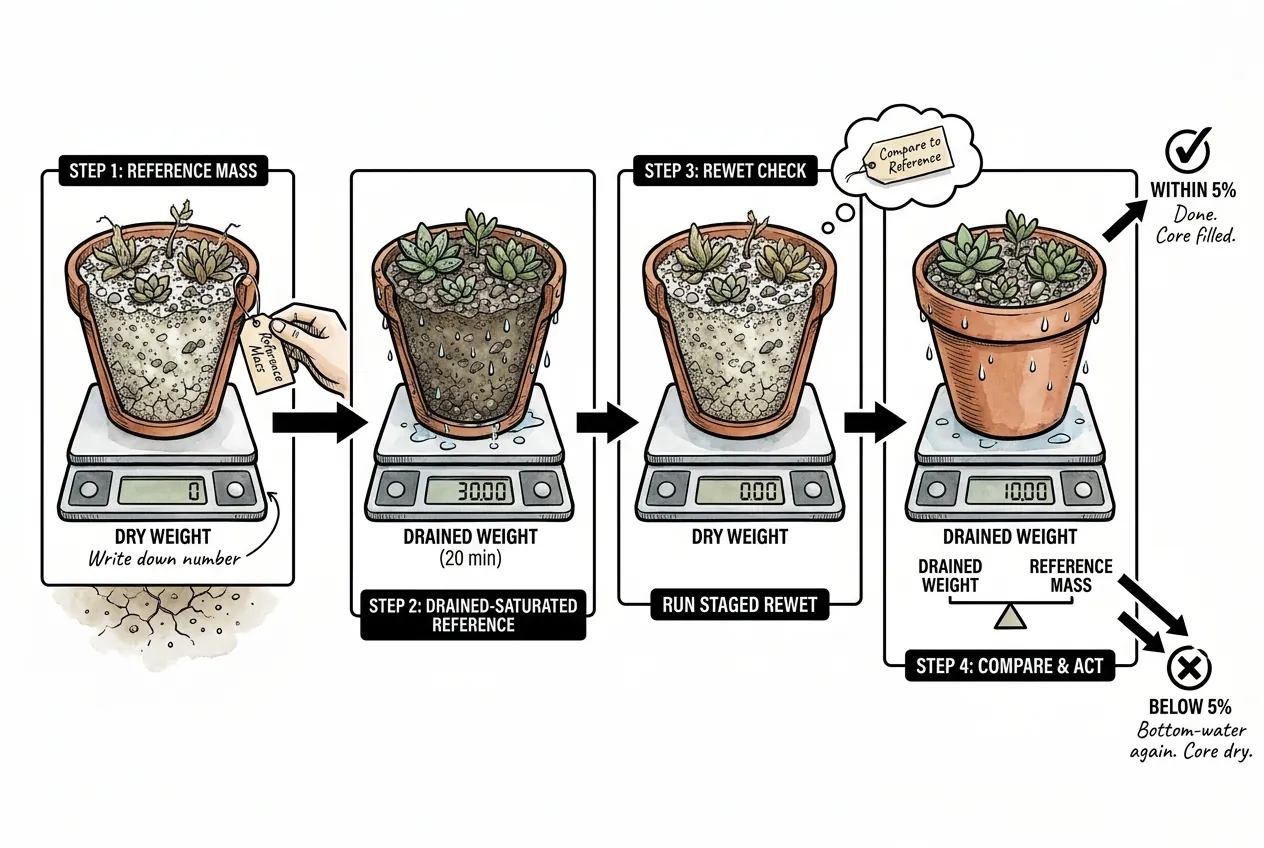
The first time your mix wets evenly and healthily, weigh the pot on a kitchen or luggage scale right after it has drained for 20 minutes.
Write that number on the pot or in a note. That is your drained-saturated reference for this exact pot.
To check a rewet, weigh the pot dry, run the staged rewet, let it drain 20 minutes, and weigh again. Compare the new drained weight to your reference.
I call the rewet done only when the drained weight comes back within about 5 percent of that reference mass.
If it is still lighter, the core did not fill and I bottom-water again. The 5 percent tolerance is my own working margin, chosen to clear normal scale and drainage noise while still catching a half-wet core.
If you are submerging, a second honest signal is the bubbles. When air stops escaping from the mix, water has displaced the air in the pores. Trust the scale and the bubble endpoint over a damp-looking surface every time.
Why the Problem Keeps Coming Back
If the same pot goes repellent after every dry-down, the drying itself is the driver. Hard drying leaves a lasting mark that a single rewet does not fully erase.
Rewetted oven-dried peat held less water than field-moist peat even after two weeks of rewetting with mixing.
That stubborn memory is called hysteresis, and it is strongest in the least-decomposed organic matter. Repellency also intensifies as a mix dries below the point where a plant could still pull water from it.
There is no single magic moisture number. Reported thresholds that separate wettable from repellent range widely by material, and in some soils repellency does not even fully reset after the soil is rewetted and dried again. Prevention beats rescue, so the real fix is to stop letting the mix bake bone-dry between waterings.
What About Wetting Agents and Surfactants
A wetting agent is the chemical shortcut, and it genuinely works. Nonionic wetting agents bind to particle surfaces and lower water’s surface tension, so water penetrates repellent peat and bark and channeling drops.
Commercial growers add them to peat and bark media at mixing for exactly this reason.
The catch matters. Applied at too high a rate, a wetting agent can cause membrane-permeability problems and toxicities that kill roots and leaves. Over-treated media can leave plants disfigured, off-color, and slow.
For a home grower, start with the mechanical staged rewet and treat a wetting agent as a considered upgrade, not a casual splash. Rate is everything, and repeated surfactant use can even contribute to repellency over time.
If you do reach the point of choosing a product, that decision belongs in a maintained buying guide, not here.
See the site’s caudex watering tools guide and the pumice, akadama, and gritty mix comparison for how to pick one.
Do This Safely on a Dormant Caudex
Everything above assumes the plant actually wants water. A dormant or cool caudex often does not, and this is where an eager rewet turns dangerous.
A cold, wet caudex is the classic rot trap. Caudiciforms like Adenium are very prone to rot when cold, and overwatering a dormant plant is the fastest route to root rot.
Their water use drops sharply as dormancy sets in near the low 50s Fahrenheit.
So judge need by the plant, not by the dry mix. A firm, leafless caudex in dry grit is usually fine to leave alone. Wait until the caudex feels slightly soft or starts to shrivel before you rewet.
When a dormant plant does need it, keep it gentle. Bottom-water briefly on a mild, sunny morning, drain hard, and return it to a warm, bright spot. For a fully dormant caudex in a cold room, the safest rewet is often no rewet at all until growth resumes.
Key Takeaways
- A gritty mix that beads and channels went hydrophobic, not just dry, and pouring harder only feeds the channels.
- Time a water drop first. A bead lasting many seconds means repellent, so switch to the staged rewet.
- Rewet slowly by bottom-watering or light top-trickle passes so the coating flips and small pores fill.
- Verify with pot weight, not the surface, because a channeling pot hides a dry core.
- On a dormant or cold caudex, rewet only on real need and drain hard, since cold plus wet causes rot.