
Lithops Care Science: Keeping Living Stones Alive
Science-based Lithops care explains the leaf window, CAM night watering, the splitting cycle, oxygen-rich inorganic soil, and practical light needs.
Rachel Torres · 2026-01-02 · Updated 2026-05-07 · 24 min read

Key Takeaways
- The Lithops window manages light and is not captured by a simple magnifier-or-diffuser slogan. Use bright, acclimated light, and treat specific DLI and UV numbers as rough guidance.
- Lithops use CAM and take up carbon dioxide mainly at night, but evening watering is fine when the plant is active and the medium can dry. The claim that morning water boils the roots is unsupported.
- During the annual leaf split, water and mobile resources move from old leaves into new ones, so reduce routine watering while the old leaves stay substantial. Reassess the plant rather than following a fixed date.
- Overwatering in a dense, poorly aerated mix injures roots and raises disease risk. Use a gritty mix only to achieve an appropriate drying and air profile.
- Do not rely on misting to hydrate a mature Lithops through its leaf. The cited research concerns internal recycling, not validated foliar uptake from fog or spray.
Introduction
Lithops care depends on seasonal growth, light, roots, and the drying behavior of the pot.
They are not interchangeable with every other succulent, and a dense, wet mix or abrupt light change can cause losses.
Keep supported biology separate from hobby rules that need to remain conditional.
1. How the epidermal window manages light
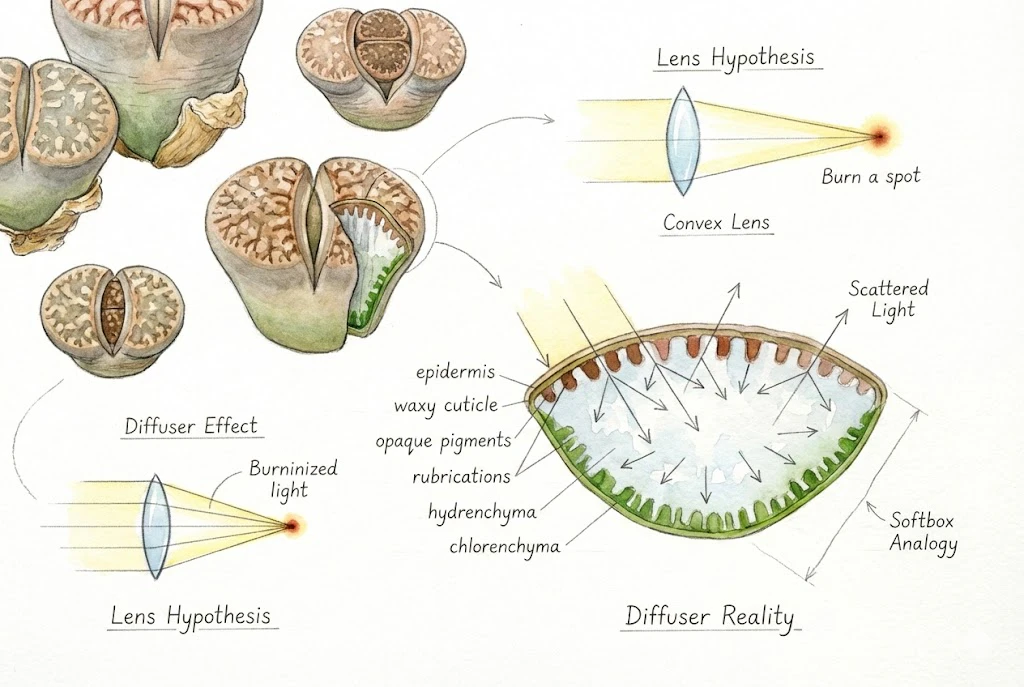
The visible face is a specialized leaf surface that manages light and heat while much of the photosynthetic tissue stays below the window.
That structure helps explain why light intensity, acclimation, and temperature influence compactness and scorch risk indoors.
How the leaf window modifies light
Older explanations often emphasized a simple lens model.
The idea was that the translucent cells on the top of the leaf acted like convex lenses, focusing dim light down into the plant body.
The plant is partly buried, so efficient light capture matters, but recent research describes a more complex combination of scattering and focusing.
Studies utilizing scanning electron microscopy and optical tracing describe an epidermis with both scattering and focusing behavior. A fiber-optic diffuser is only an analogy.
The outer skin (epidermis) and the waxy cuticle act as a selective filter.
They do more than let light in. They also influence the quality and quantity reaching internal tissue.
A perfect-lens model would not account for how the tissue moderates intense sunlight before it reaches the chlorenchyma.
The most relevant study examined six windowed succulents, including one Lithops species.
It found both scattering and some focusing, with no consistent correlation between window size, growth habit, and the light inside the leaf.
The window clearly manages light, but a purely diffuser-based explanation would overstate a nuanced result.
What's fair to say is that the leaf's structure spreads and moderates light rather than acting as a simple burning lens.
It can help distribute light through the clear, water-storage tissue (hydrenchyma) before it reaches photosynthetic tissue lining the inside of the leaf.
A diffuser is a useful analogy, but the measured balance varies by species and growing conditions.
How should window size be interpreted?
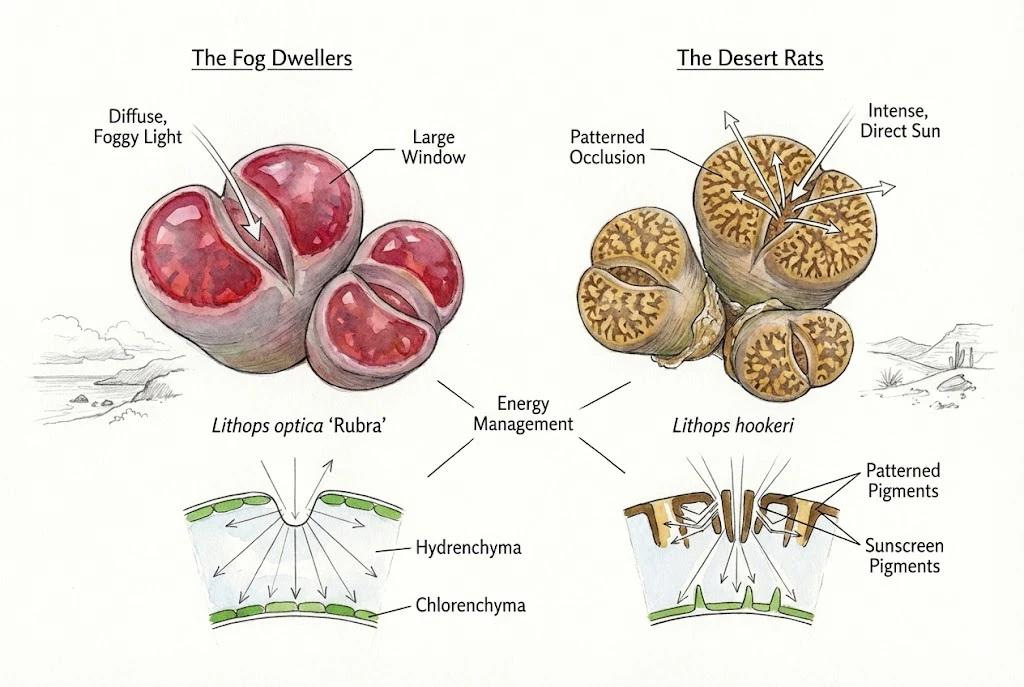
Window size and habitat brightness do not form a simple care rule.
The claim that coastal or cloudy species have larger windows is often repeated, but the cited study found no correlation between window size and the light quantity or quality inside the leaf. Treat it as an untested hypothesis rather than a care rule.
What the cited evidence shows
Window structure can influence how much and what quality of light reaches internal tissue, but the cited study did not establish a universal window-size-to-habitat rule.
Practical application
Species and populations can respond differently on a windowsill, so use provenance and the plant's response to set light and acclimation.
Coastal and inland forms
Species and populations differ in habitat and window structure. Use provenance and the plant's response to set light, and acclimate any plant before increasing intensity.
Color and pattern
Pattern and color can fade in low light, but genetics, temperature, hydration, and development also contribute.
Subterranean photosynthesis
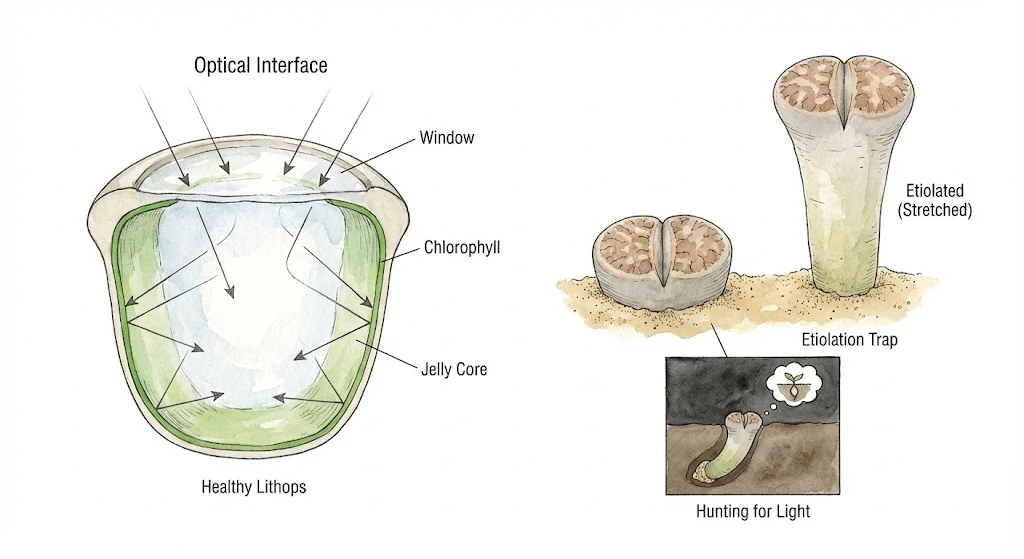
Unlike many common houseplants, Lithops place much of their chlorophyll below the visible window.
The green photosynthetic tissue lines the sides and bottom of the plant body, buried deep in the soil.
The light enters the window and travels through clear, water-storage tissue before reaching the green photosynthetic walls.
The tissue may attenuate some wavelengths, but it should not be treated as a guaranteed cooling system.
Backlighting can make the water-storage tissue appear to glow as light moves through the body.
When low light causes stretch
Low light can promote elongation indoors. Habitat observations suggest buried plants may also respond to reduced light, but the exact mechanism varies.
In a dim room, the plant can elongate and lose its compact form.
It elongates, pushing the body up, exposing the delicate sides that have no UV protection.
Treat stretching as a cue to review light, temperature, and acclimation rather than as a diagnosis of one mechanism.
2. Crassulacean acid metabolism and watering timing
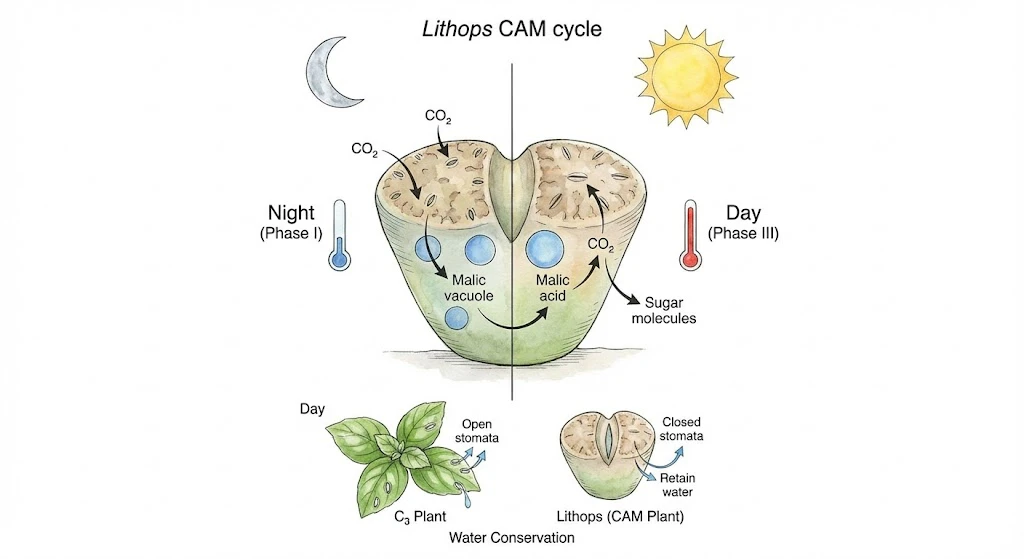
The time of day is less important than the plant's active cycle, root-zone temperature, and ability of the pot to dry.
CAM explains nocturnal gas exchange, but it does not turn morning watering into a universal hazard.
Lithops use a metabolic pathway called Crassulacean Acid Metabolism (CAM).
This is an adaptation to arid environments that shifts the timing of gas exchange.
How CAM shifts gas exchange
Most plants (C3 plants like roses or basil) open their breathing pores (stomata) during the day.
They take in Carbon Dioxide (CO2) and use sunlight to immediately turn it into sugar (photosynthesis).
The problem with this method in a desert is that when you open your stomata during the day, water escapes.
Hot, dry conditions increase water-loss pressure, although the rate depends on species, airflow, and tissue condition.
Lithops shift much of their gas exchange toward the night.
Phase I (Night)
The air is cooler and humid.
The Lithops opens its stomata.
It takes in CO2.
But there is no sun to process it.
So, it converts the CO2 into Malic Acid and stores it in the vacuoles (cellular storage tanks).
Organic-acid levels rise at night as carbon is stored for daytime use.
The phrase becomes acidic is only a shorthand for that internal shift.
Phase II (Dawn)
The sun rises.
The heat builds.
The Lithops largely closes its stomata to conserve water.
Real CAM includes transitional phases. Stomata can remain open for a while at dawn and reopen at dusk, so a completely sealed daytime state is an oversimplification.
Phase III (Day)
The plant breaks down the stored Malic Acid back into CO2 and uses the sunlight to process it into sugars behind closed doors.
Phase IV (Dusk)
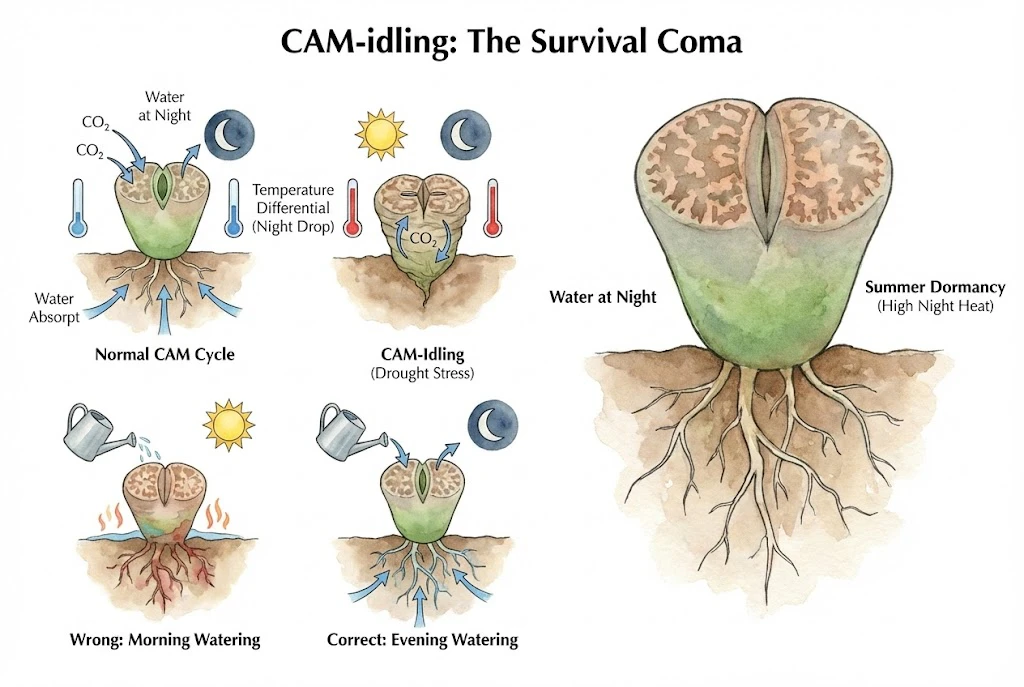
The acid is depleted, and the plant prepares to open up again.
CAM-idling under severe drought
Here is where the research gets critical for hobbyists.
Some CAM plants show a drought-related CAM-idling response in which stomatal opening and external carbon dioxide uptake are greatly reduced while internally respired carbon dioxide is recycled.
The cited stress-memory study used Aptenia, not Lithops, so treat the mechanism as context rather than a Lithops care diagnosis.
Why This Matters for Your Watering Schedule
Water timing
The stomata (leaf pores) are open mainly at night, but that governs gas exchange, not root water uptake. Roots can absorb available water when tissue, temperature, and substrate conditions permit.
Evening watering is fine and often convenient. The claim that morning water boils the roots is a myth because closed leaf pores do not make soil water cook the roots.
What actually matters is substrate temperature, drainage, and whether the plant is in its active or resting phase. Water when the mix has dried and the plant is in growth, at whatever time of day suits you.
Night temperature change
Cooler nights generally suit CAM plants, and a day-to-night temperature drop can be beneficial.
Treat a specific 15 to 20°F drop as a general preference rather than a hard rule tested on Lithops.
The drought-memory and threshold numbers sometimes cited come from a different plant, Aptenia, not Lithops.
A moderate night cooldown is reasonable, while a perfectly constant temperature is not ideal but is not an instant killer.
Possible summer rest
Warm nights can reduce nocturnal gas exchange in some CAM plants, but there is no single Lithops threshold that switches dormancy on.
During a hot season, growth may slow and the pot may dry differently.
Watering a resting plant can increase rot risk when uptake is low and the mix stays wet, but inspect firmness, roots, and dry-down rather than assuming all water is unusable.
3. Leaf renewal and the splitting cycle
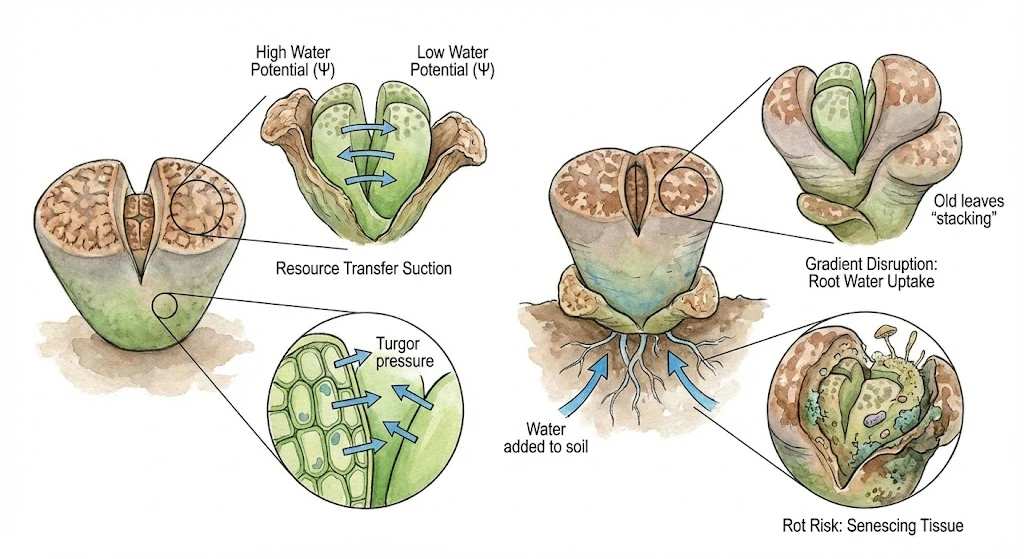
The life cycle of a Lithops includes an annual leaf renewal process often called splitting.
This is a renewal stage in which stored water and nutrients can move from older tissue into the developing pair.
Turgor Pressure and Water Potential Gradients
Water potential helps explain the conservative reduce-watering rule during splitting.
Measurements show the developing pair can have a lower water potential than the older pair, supporting movement of water and mobile resources into the new tissue.
The old leaves therefore may shrivel from internal transfer as well as surface water loss.
The exact gradient and timing vary with species and stage.
What external watering can and cannot show
Watering during this process introduces external moisture while uptake may be limited.
Root response
Roots can respond to available water and begin uptake, depending on tissue condition and temperature.
Limits of a gradient model
External water can change the balance between root uptake and internal transfer, but the proposed gradient-break mechanism is a simplification rather than a universal observation.
Possible stacking
Old leaves may remain substantial or rehydrate, contributing to stacking and trapped moisture in some plants.
Why persistent moisture matters
Senescing tissue can be more vulnerable to persistent moisture and pathogens, especially in a poorly ventilated mix.
Practical interpretation
A conservative practical takeaway is to hold off routine watering during the split and let the new leaves draw down the old ones until the old leaves are dry, papery husks.
Just treat it as a well-founded rule of thumb rather than an ironclad law of physics (individual plants, hemispheres, and offset cycles vary, so watch the plant).
If the old leaves are fully dry and the new body is genuinely shriveling, a little water is reasonable.
Leaf exchange is easier to follow when I photograph each Lithops from above every 14 days at the same hour. With a millimeter rule held above the fissure without touching it, I record the widest split and classify the old pair as fleshy, wrinkled, papery, or fully dry. The two-week interval follows a yearly change without turning daily surface movement into a watering signal.
I inspect sooner only if the base softens, one area changes color, or the split widens while the old pair remains fleshy. Those named changes separate possible damage from the normal sequence of old-leaf drying and new-pair emergence.
4. Root Hypoxia in Water-Retentive Soil
Root rot is a vague, unhelpful term.
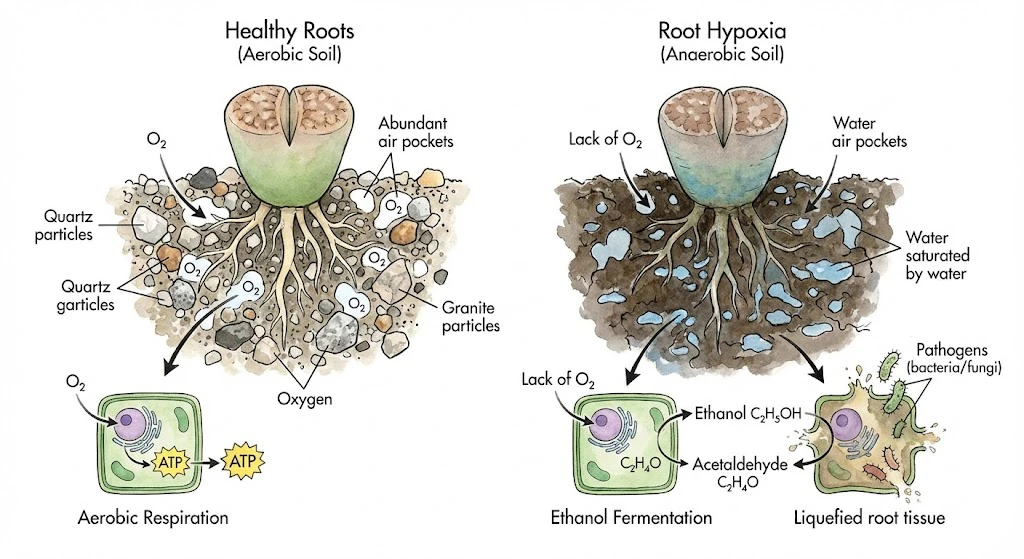
The relevant mechanisms are root hypoxia and low-oxygen fermentation, which can precede secondary rot in a saturated mix.
Why roots need air
Roots are living organs that respire.
They need Oxygen (O2) to convert sugars into energy (ATP) to drive the pumps that absorb water and nutrients.
In some habitats, Lithops grow in coarse, gritty soils with substantial pore spaces. Local texture and mineral composition vary across the genus.
Dense, water-retentive potting mixes are risky for Lithops because they can stay wet and low in air.
A peat- or coir-based mix can still hold enough air when its structure and watering are appropriate, while a mineral mix can also go airless if it is compacted or kept saturated.
The reliable principle is simple. Use a fast-draining, airy mix and do not keep it soggy.
Hypoxia (Low Oxygen)
In a saturated, poorly structured mix, oxygen around roots can fall quickly as water displaces air.
Anoxia (No Oxygen)
Root respiration can become severely oxygen-limited.
Metabolic Shift
With too little oxygen, root cells may be unable to sustain normal aerobic respiration.
They can shift toward fermentation and other stress responses.
Low-oxygen injury
Under low oxygen, root cells can shift toward fermentation and accumulate stress-related metabolites.
Be accurate about the damage. Ethanol is not established here as a solvent that simply dissolves cell membranes.
The injury can involve energy shortage, acidification, reactive oxygen species, loss of membrane function, and toxic-metabolite buildup.
The care implication is still to prevent roots from remaining airless and wet. Avoid a brewing-vodka explanation that implies a single mechanism.
Pathogen Entry
Low-oxygen injury can make roots more vulnerable to opportunistic pathogens such as Pythium and Fusarium, although pathogen presence and temperature also matter.
Aerenchyma and Lithops
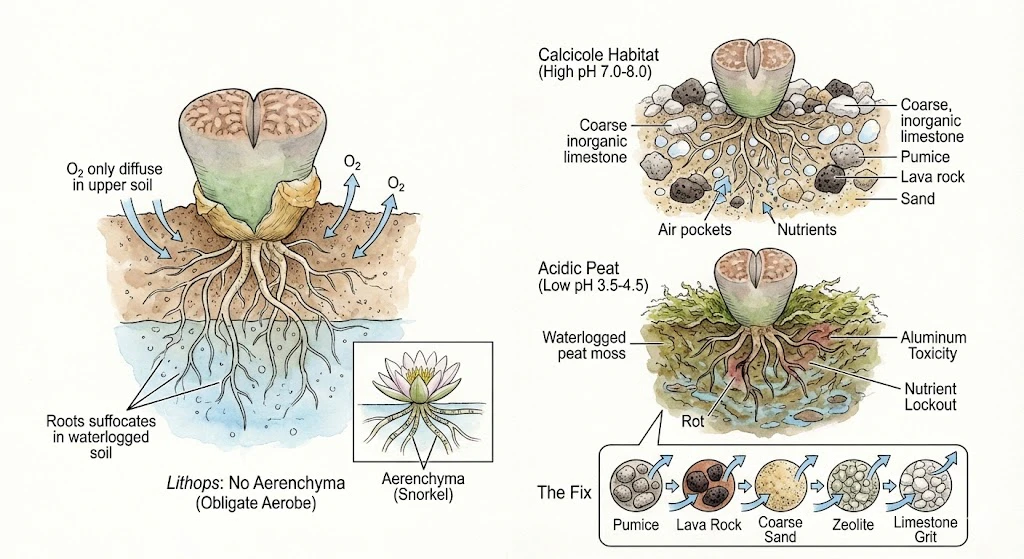
Some wetland plants, such as rice or lilies, have specialized tissues called aerenchyma that can move gases through the plant.
This can improve tolerance of periodically waterlogged conditions, but does not make every wetland plant safe in stagnant water.
Lithops are not wetland plants, and prolonged waterlogging is a risk. Keep their roots airy and avoid a permanently soggy mix.
Do not turn that guidance into an unsupported comparison with every other houseplant.
Soil chemistry and calcicole species
Water is not the only consideration. Soil chemistry also matters.
Many Lithops species are Calcicoles (calcium-lovers).
Some species occur in limestone or calcrete terrain, but habitat chemistry varies across the genus.
Aluminum Toxicity
In acidic soils, Aluminum ions become soluble and toxic to calcicole roots, inhibiting cell division.
Nutrient Lockout
Calcicoles are efficient at extracting Iron in high-pH soils.
If you put them in low-pH soil, their uptake mechanisms go haywire, potentially leading to micronutrient toxicity or deficiency paradoxes.
A practical mix starting point
A mostly mineral, open substrate is a reasonable starting point for many collections.
Use pumice, lava rock, coarse sand, or zeolite as appropriate to pot size and dry-down, and add limestone only when the species and water chemistry justify it.
5. Fog, dew, and what they do not prove
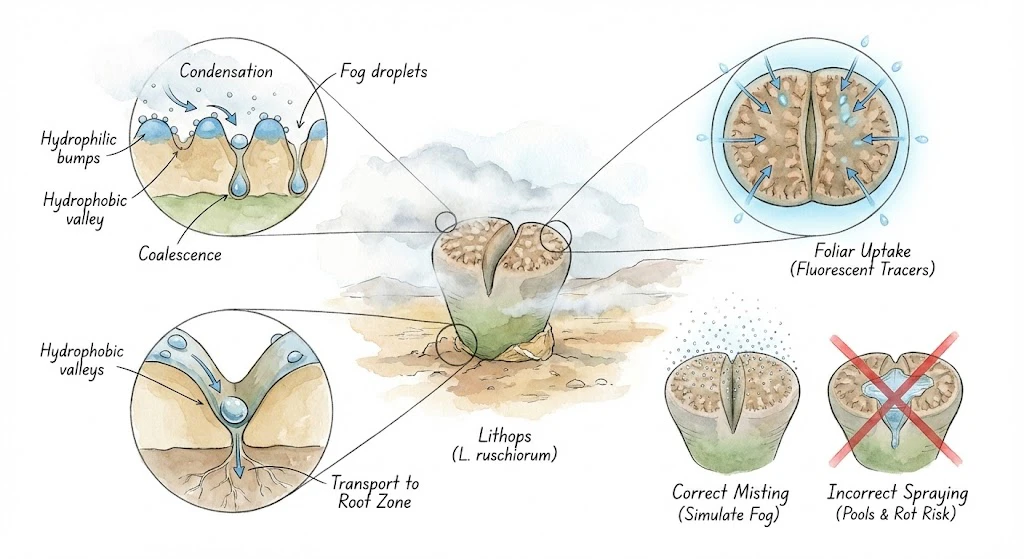
Some coastal Lithops populations experience fog and little rainfall, but local moisture sources and soil contact vary by habitat.
What fog and dew do not prove
Fog and dew can matter in some coastal Namib habitats, and moisture that reaches the soil may contribute to water availability.
The cited Janus fog-capturing surface is not established as a Lithops structure.
The paper usually cited for the hydrophilic-bump and hydrophobic-valley surface concerns an engineered slippery copper surface inspired by desert beetles. It is not a study of Lithops. There is no good evidence that the Lithops epidermis is a documented fog-harvesting structure.
What the tracer studies actually show
Fluorescent-tracer studies do not establish that Lithops absorb external water through the epidermal window while bypassing the roots.
The Lithops tracer work documents water moving from old leaves into new ones internally. That is a recycling process, not validated foliar uptake.
Practical application
Do not treat just mist it as a validated shortcut. Misting has not been shown to hydrate a mature Lithops through its leaf, and the cited tracer work concerns internal leaf recycling rather than external foliar uptake.
Heavy spraying that leaves water pooled in the fissure can be hazardous because trapped moisture and stagnant air increase disease risk.
If a severely shriveled plant is active, water the soil appropriately rather than relying on misting. Misting is at most a humidity measure around seedlings, not a proven root substitute.
6. Light intensity and acclimation
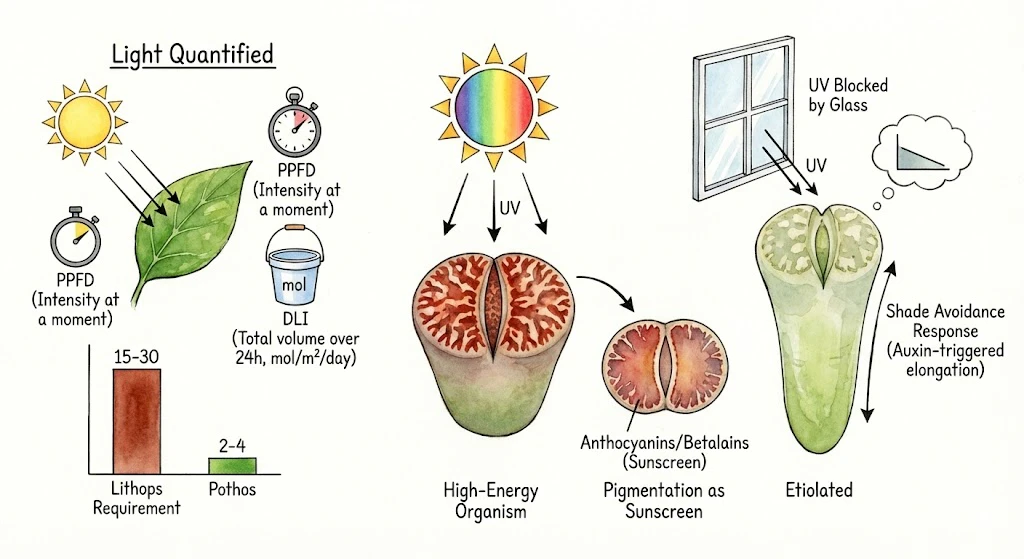
Bright indirect is too vague to guide a Lithops setup. Use measured or observed light, acclimation history, and plant response instead.
PPFD and DLI
PPFD (Photosynthetic Photon Flux Density) measures the intensity of light at a single moment.
DLI measures the total volume of light received over 24 hours.
It is measured in moles of photons per square meter per day (mol/m²/day).
Lithops generally needs a brighter, more stable exposure than low-light foliage plants, but no Lithops-specific study establishes one required DLI range.
Treat any estimate as a guide and judge compactness, color, heat, and scorch together.
Context
Compared with low-light foliage plants, Lithops generally needs a brighter, more stable exposure.
A windowsill estimate can be misleading because glass, season, orientation, and cloud cover change the daily total. Measure at plant level when possible.
Interpreting the result
Low light can promote shade-avoidance elongation and fading. Treat stretch as a cue to review light, temperature, water, and acclimation. The visible form will not instantly reverse.
How spectrum and pigments should be read
Keep pigment claims taxonomically accurate
Lithops are in the Aizoaceae, a betalain-producing lineage rather than an anthocyanin-based one. Their reds and browns should not be described as a confirmed combination of anthocyanins and betalains.
Color also depends on genetics, temperature, hydration, development, and overall light. UV alone is not a complete explanation.
Bright light can help preserve color, and indoor plants in dim light often fade.
Ordinary window glass blocks most UVB, although some UVA can pass depending on the glass.
Extra UV may influence color in some setups, but it is not a proven requirement.
If UV is tested
Manage eye and skin exposure, shielding, and dose because UV fixtures are hazardous to people.
7. Hormonal regulation during renewal
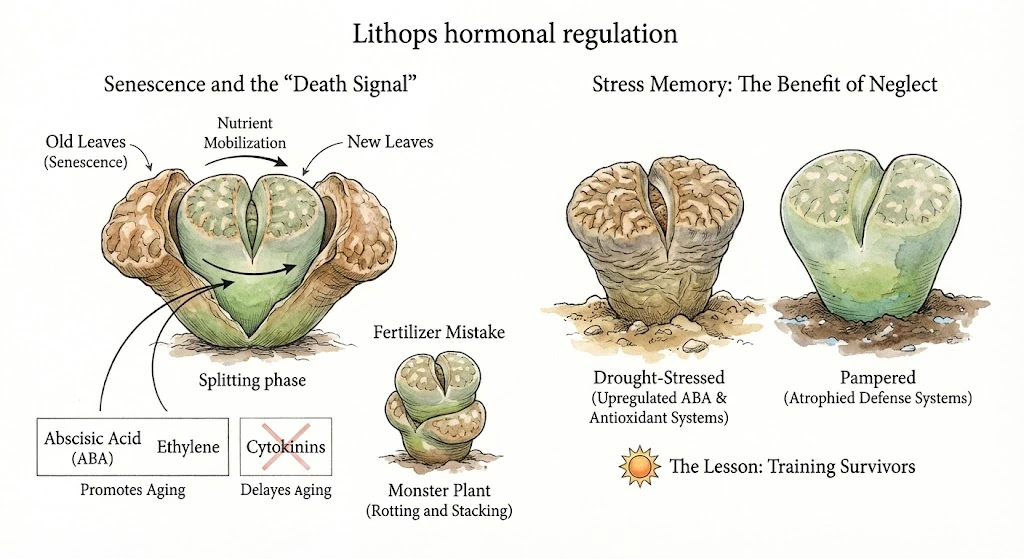
Seasonal flowering and old-leaf senescence involve interacting hormonal and environmental signals.
Senescence signals
Old-leaf drying is a senescence process influenced by cytokinins, abscisic acid, ethylene, photoperiod, temperature, and the plant's internal cycle.
Research on other species helps explain the signaling framework but does not provide a Lithops fertilizer threshold.
Fertilizer during renewal
Heavy feeding during splitting can prolong soft, substantial old leaves or push growth at an unsuitable time, but the exact hormonal response is not a simple switch.
Avoid routine high-nitrogen feeding during renewal and follow the plant's active-cycle needs.
Stress memory and care limits
Stress memory is a real research topic, but the cited studies are not on Lithops. Extending them into a deliberate-neglect protocol is unsupported.
Lithops are drought-adapted and should not remain constantly wet, but chronic under-watering can also weaken a plant, especially indoors. Water according to the active cycle, root condition, and actual dry-down.
8. Taxonomy and collection-level variation
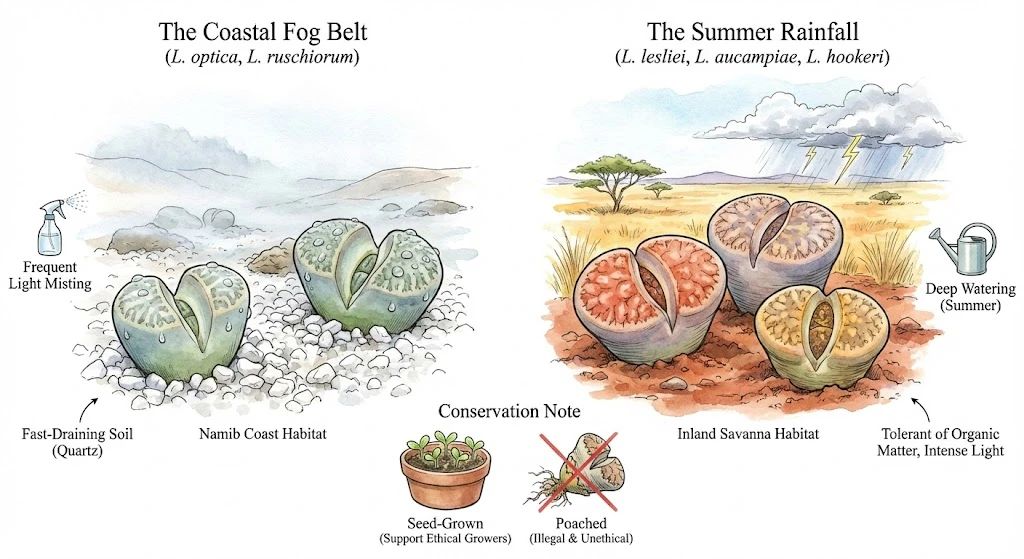
Lithops species and populations come from varied habitats, and cultivation responses can differ with provenance and acclimation.
How habitat differences should be used
Coastal and fog-influenced populations
Some populations occur near the Namib coast with quartz-rich ground, limited rainfall, and episodic fog.
Local conditions vary, so fog exposure does not prove that foliar misting is preferred.
Use a fast-draining mix and adjust watering to the observed seasonal response of the individual plant.
Inland and summer-rainfall populations
Some inland populations occur in savannas or grasslands with seasonal storms and varied soil chemistry. Summer-rainfall habitat does not create a universal deep-watering or organic-matter recipe.
Choose light, substrate, and watering from the individual pot, provenance, and acclimation response.
Conservation Note
Wild collection and habitat loss can threaten some Lithops populations, while genetic diversity and isolation vary by species.
When you buy, favor clearly seed-grown plants and reputable sellers who can speak to provenance.
Poaching of wild Lithops is a serious, documented problem (large seizures have been reported), and wild-collected, slow-growing succulents are vulnerable to extinction.
Wild-collected material is not automatically illegal in every jurisdiction. Legality depends on harvest, export, and import documentation. Buying seed-grown stock reduces provenance uncertainty and supports ethical growers.
9. A condition-based care framework
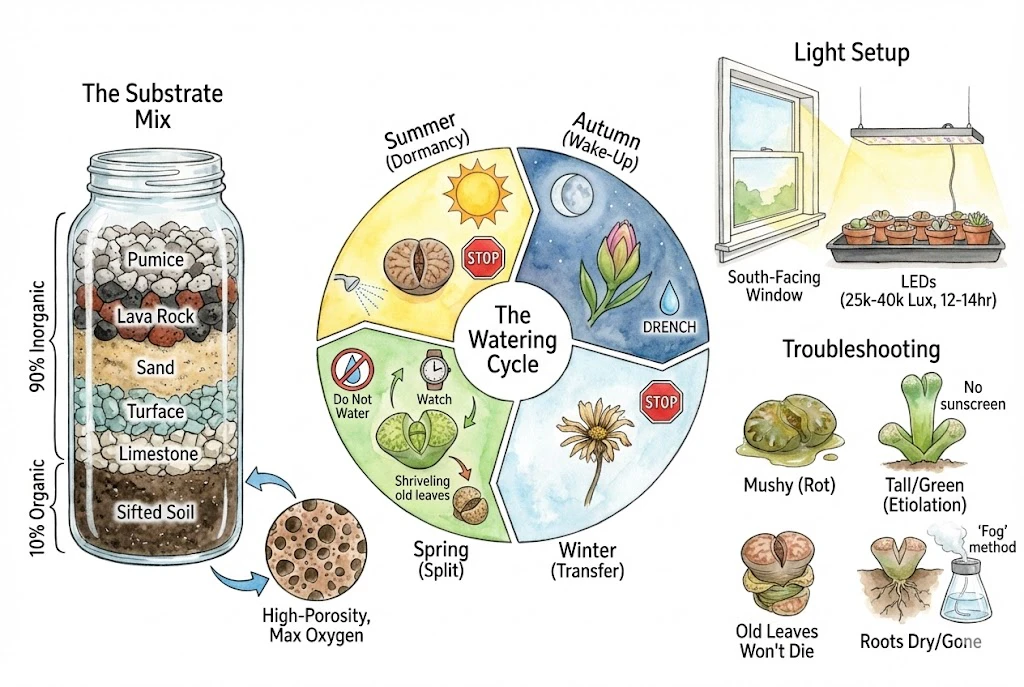
The evidence above can be translated into a condition-based care framework for indoor cultivation.
The Substrate Mix
Choose a substrate that remains open after watering. A commercial mix may work if its dry-down and particle structure suit the pot.
How to choose a ratio
A mostly mineral, open mix is a reasonable starting point. Choose the ratio from particle size, pot depth, and dry-down rather than a universal 90/10 formula.
Inorganic components
Use pumice, lava rock, coarse sharp sand, or calcined clay in a particle size suited to the pot and roots.
Limestone grit is optional and should be used only when the species and water chemistry justify it.
Organic fraction
If an organic component is used, choose a stable, sifted material and keep its fraction consistent with the desired dry-down.
Why the structure matters
It can provide drainage and air space when the actual mix remains open after watering, but no recipe guarantees oxygen or prevents hypoxia in every container.
Horticultural pumice is one accessible inorganic base. Check the particle size, since a coarse 1/4-inch grade drains and aerates differently from a fine one.
Use a particle size suited to the pot and roots, and adjust the organic fraction after observing dry-down.
Pumice holds few nutrients, so active plants may still need appropriately labeled feeding.
The watering cycle during possible dormancy
Ignore the calendar and read the plant, the roots, and the drying behavior of the pot.
Summer: signs of a possible rest
Growth slows in the actual light and temperature conditions.
How to respond
Reduce watering while checking for severe dehydration, pests, and root problems. Do not use foliar misting as a substitute for soil moisture.
Autumn: signs of renewed activity
Cooler nights, shorter days, a spreading fissure, or a flower bud can accompany renewed activity.
How to respond
Water when the plant is entering active growth and the pot has dried appropriately, then observe the response before repeating.
Winter: signs of leaf transfer
A spent flower and drying petals can coincide with resource transfer into the new leaves.
How to respond
Reduce or stop water while the old leaves are transferring resources, unless the plant shows a separate dehydration or root problem.
Spring: signs of the split
New leaves emerge from the fissure while the old leaves begin to shrivel.
How to respond
Watch the old-to-new leaf transfer and avoid routine watering while the old leaves remain substantial.
If the old leaves are dry and the new body is clearly dehydrated, resume cautiously rather than following a calendar rule.
Light Setup
Window light
The brightest suitable window you have, often south-facing in the Northern Hemisphere, is a useful starting point.
Give direct light only after gradual acclimation so a new or previously dim-grown plant does not scorch.
Grow Lights
If the available window cannot provide enough light, a measured LED setup is one option.
Spectrum
Choose a spectrum and fixture that can be measured at plant level. No single color temperature is required.
Intensity
Measure at the plant and increase gradually. No universal Lithops PPFD is established.
Duration
Use a consistent timer appropriate to the fixture and room.
Distance and heat
Set the fixture from measured intensity and heat rather than a fixed inch distance. Watch the plant and nearby surfaces for heat buildup.
A moderate-wattage LED grow bulb is one fixture option for a small tray. If you are unsure what to buy, it helps to choose a grow light by measured PPFD and DLI rather than wattage alone.
Check the current specification, run it on a timer, and measure the actual light and heat at plant level rather than assuming a fixed intensity. One bulb covers a small footprint, so use several or a panel for a wider collection. Most ordinary glass and standard LEDs supply little UV.
Troubleshooting Common Failure Patterns
The plant is mushy
Widespread mushiness can indicate rot from overwatering or a heavy mix, but it is not a complete diagnosis.
Check where the softness is, whether firm tissue remains, and whether discoloration or odor is spreading.
Compare possible rot with harmless wrinkling, dehydration, cold damage, pests, and physical injury.
If a firm core and meristem remain, unpotting and a cautious salvage attempt may be possible.
The plant is tall or green
Low light is one possible cause of fading and stretch. Temperature, water, and genetics also matter, so move the plant to better light gradually to avoid sunburn.
The old leaves remain substantial
Watering during renewal, heavy feeding, or a mismatched season can all contribute.
Reduce interventions, keep the plant bright but acclimated, and reassess over the next growth cycle.
Roots are dry or missing
Root loss can follow prolonged dryness, rot, pests, or repotting damage. Inspect the meristem and roots, provide an airy medium, and reintroduce moisture only when the plant shows active recovery.
Follow the Plant's Cycle, Not Recipes
Lithops care is most reliable when light, acclimation, substrate aeration, and watering follow the plant's observed cycle.
The window manages light, old leaves can supply the developing pair, and waterlogged roots are a major rot risk.
Fog harvesting through the window, time-of-day boiling, and deliberate neglect are not substitutes for those fundamentals.
Use bright but acclimated light, an open mix, and condition-based watering rather than a fixed recipe.