Key Takeaways
- Buy a system, not a gadget: a full-spectrum LED with published PPF, a PPFD meter, a timer, and a hanger.
- No caudex-specific number exists; map onto the sourced high-light band (~15-25 mol/m²/day), then acclimate up.
- Measure, don’t guess: confirm canopy PPFD with an Apogee MQ-500 or a configured Photone app, not watts or lux.
- Run a fixed 12-14 hour photoperiod on a timer; the dark period is required for these CAM plants, never 24/7.
- UV-B is a hazardous cosmetic adjunct, never a growth light and never the fix for a stretching caudex.
A caudex that only grows taller and thinner is not a slow plant. It is a starving plant, reading its own weak light as shade and stretching to escape it.
The fix is almost never a fancier gadget. It is enough photosynthetically active light, at a canopy intensity you can measure, for a fixed number of hours, at a height you can adjust.
This guide names the gear that hits that target and the gear that wastes your money.
What should I actually buy to grow a fat, compact caudex indoors?
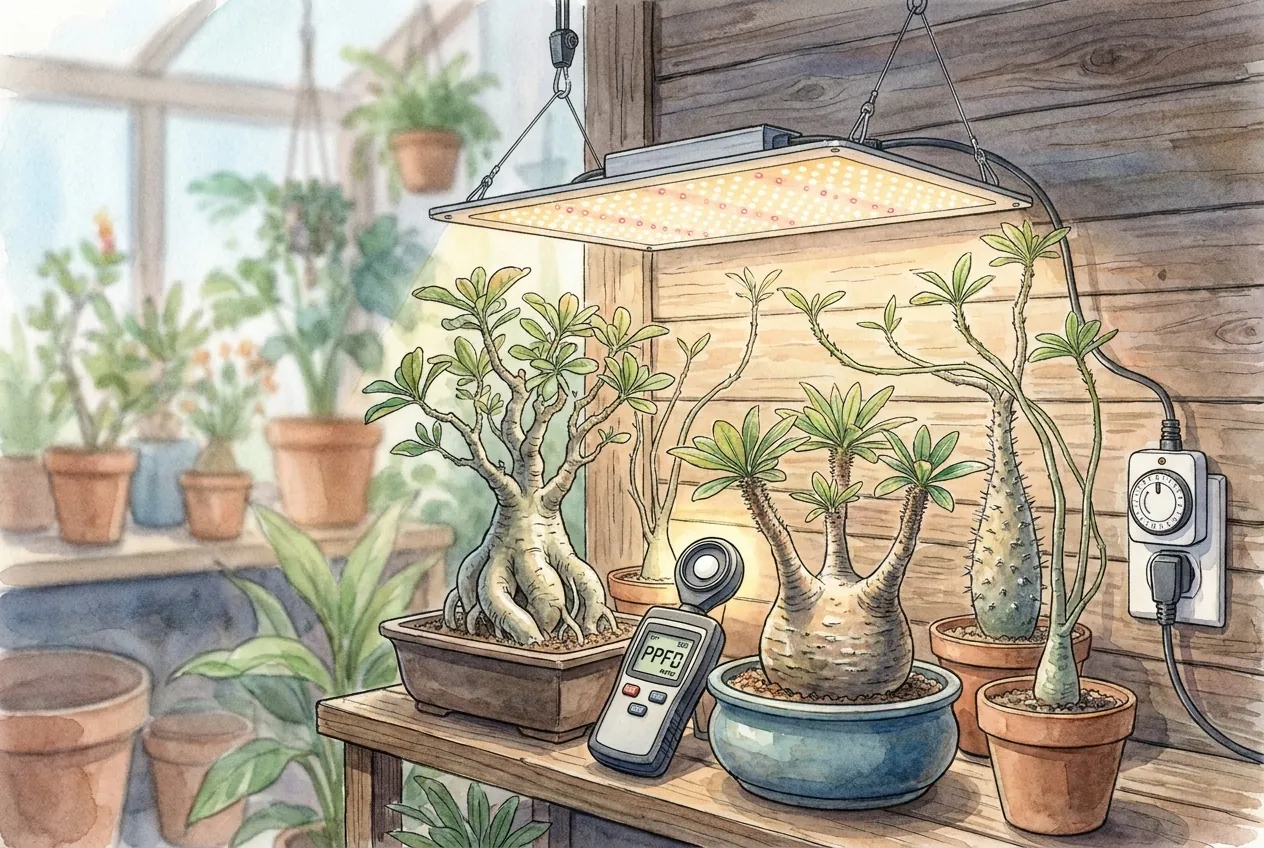
Buy four things as a system: a full-spectrum LED that publishes its photon output, a way to measure light at the plant, a timer, and an adjustable hanger.
The light without the meter is a guess. The meter without an adjustable mount gives you a number you cannot act on.
Here is the working shortlist for a typical single-plant or small-shelf indoor caudex setup.
The light
A full-spectrum LED that publishes its PPF in µmol/s and either a coverage area or a PPFD-at-distance map. For one prized plant, a SANSI BR30 36W bulb (PPF 65.6 µmol/s) screws into a normal socket. For a 2×2 shelf, the Spider Farmer SF1000 (PPF 249.21 µmol/s) or Mars Hydro TS1000 (PPF 343 µmol/s) give you headroom.
The meter
A full-spectrum quantum meter (Apogee MQ-500, ±5% calibration) if you run a collection under LEDs, or the free Photone phone app for a single plant on a budget.
The timer
A BN-LINK 7-day digital timer or a Kasa smart plug, set to a fixed 12 to 14 hour daily block. This is the cheapest and highest-leverage part of the whole kit.
The hanger
A VIVOSUN or iPower rope ratchet so you can raise and lower the fixture in small steps, or an LBW tripod stand if you have no ceiling anchor.
The rest of this guide explains why that shape works. Every number below traces to a university-extension, peer-reviewed, or manufacturer source, because the fastest way to kill a caudex is to trust an invented light target.
Why does weak light make a caudex stretch instead of fatten?
A caudex fattens only when the plant fixes more carbon by photosynthesis than it burns by respiration, and banks the surplus. That surplus exists only above the light compensation point.
The light compensation point is the intensity where photosynthesis exactly matches respiration. Below it, net gas exchange is zero and the plant runs at a loss, consuming stored biomass instead of building it. The caudex cannot enlarge.
Above that point, net photosynthesis rises with intensity until it plateaus at light saturation.
High-light desert caudiciforms evolved under open, unshaded sun. They carry comparatively high compensation and saturation points. That is why they starve for carbon in an indoor spot a low-light foliage plant would happily tolerate.
Is my plant etiolating or just growing slowly?

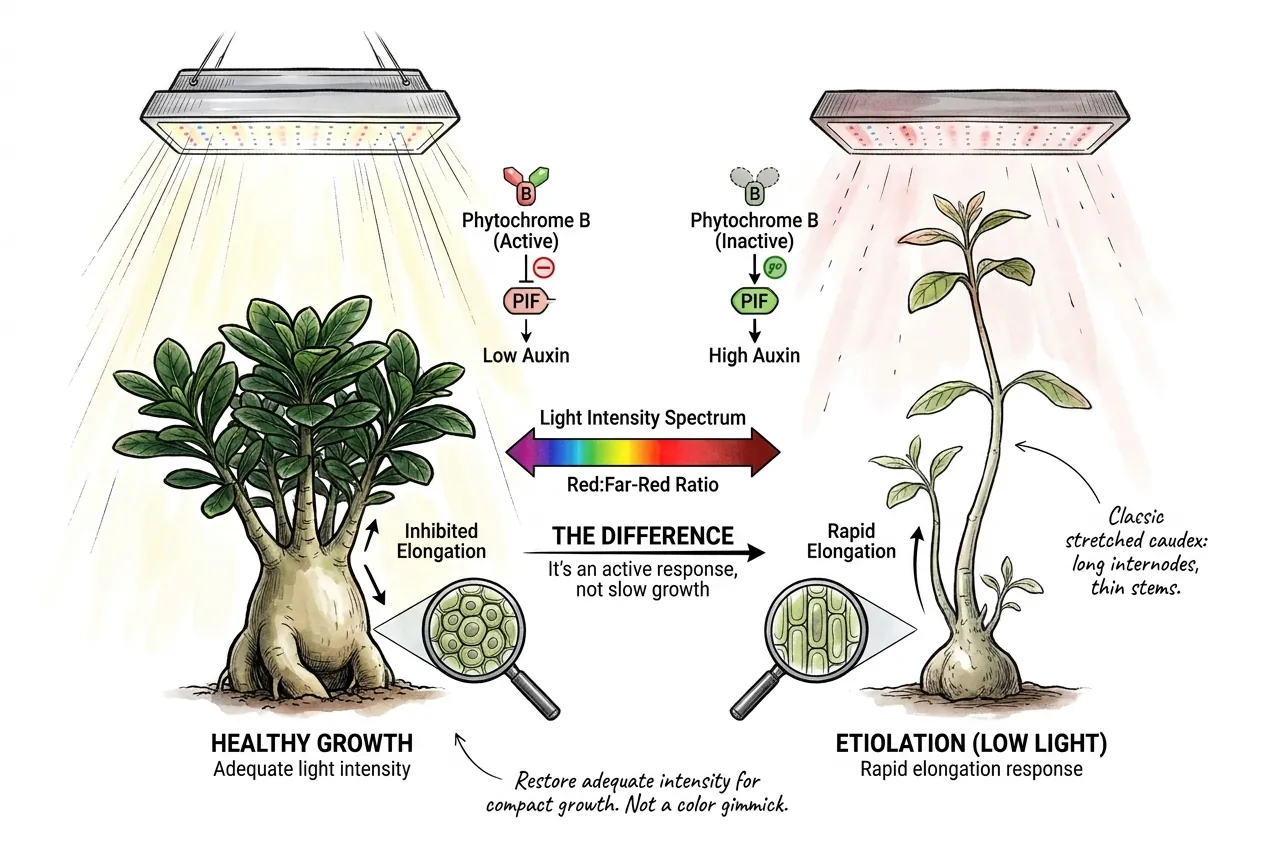
Etiolation is not slow growth. It is an active elongation program the plant switches on when it reads low light.
Under dim light or a low red-to-far-red ratio, phytochrome B shifts to its inactive form. That lets PIF transcription factors accumulate, which switch on auxin biosynthesis. In one study, free auxin rose more than 50% within an hour of a shade signal, driving cell elongation in stems and petioles.
The visible result is the classic stretched caudex: long internodes, thin weak stems, pale color, and leaves spaced far apart. The cure is more photosynthetically active light, not a color gimmick.
Restore adequate intensity and phytochrome goes active again, elongation brakes, and new growth comes in compact. That is the mechanism behind caudexology’s own LED PPFD for caudex compactness guide.
Do CAM caudex plants need less light because they work at night?
No. Many caudex genera, including Pachypodium and Cyphostemma, run Crassulacean acid metabolism. But that changes when CO2 is captured, not whether daytime light is needed.
In CAM, PEP carboxylase fixes CO2 at night into malic acid stored in the vacuole. The next day, behind closed stomata, that malate is decarboxylated and the released CO2 is refixed using ATP and NADPH from the light reactions. Daytime light is still the engine of net carbon gain.
CAM buys water thrift, not freedom from a light requirement. A CAM Pachypodium under weak indoor light still etiolates, because the light reactions that fix the night-banked carbon are photon-limited.
What is the difference between etiolation and bleaching?

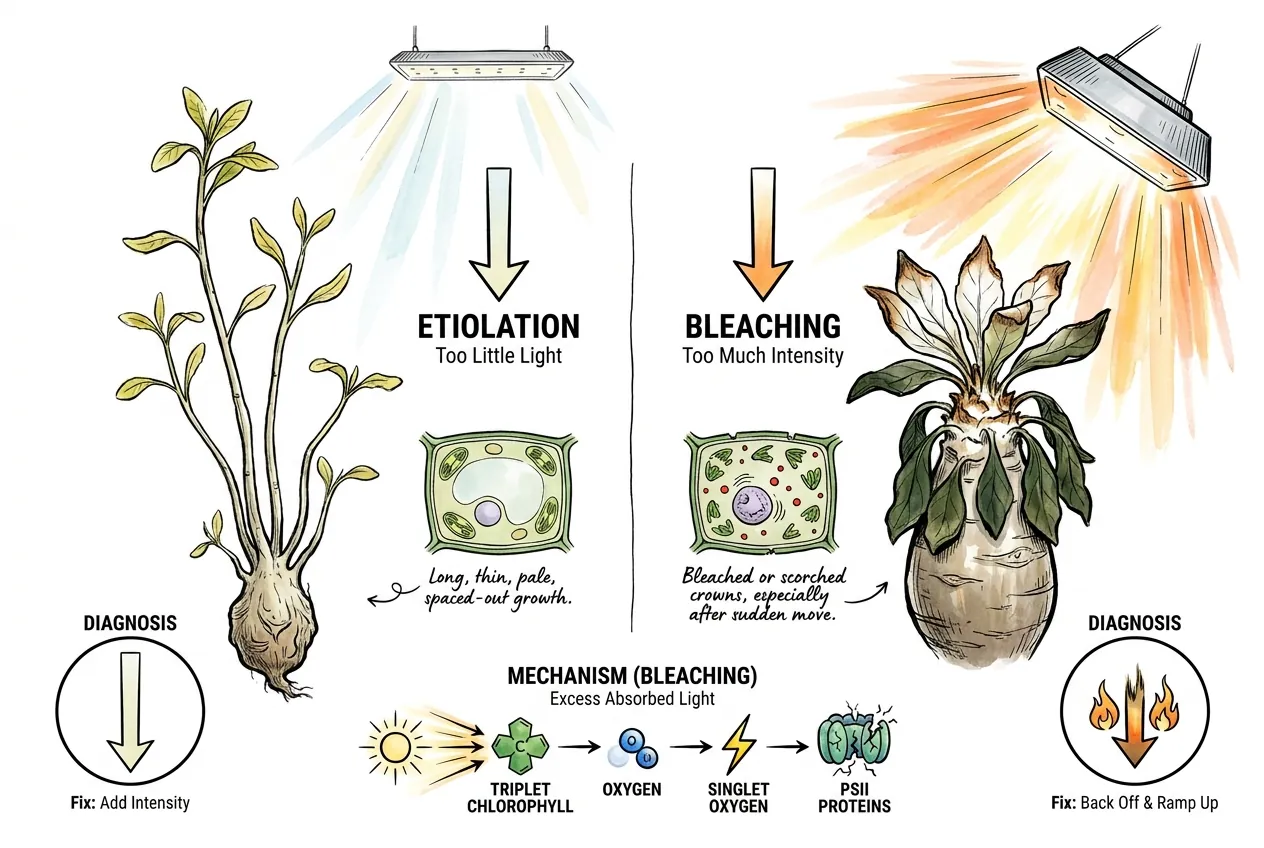
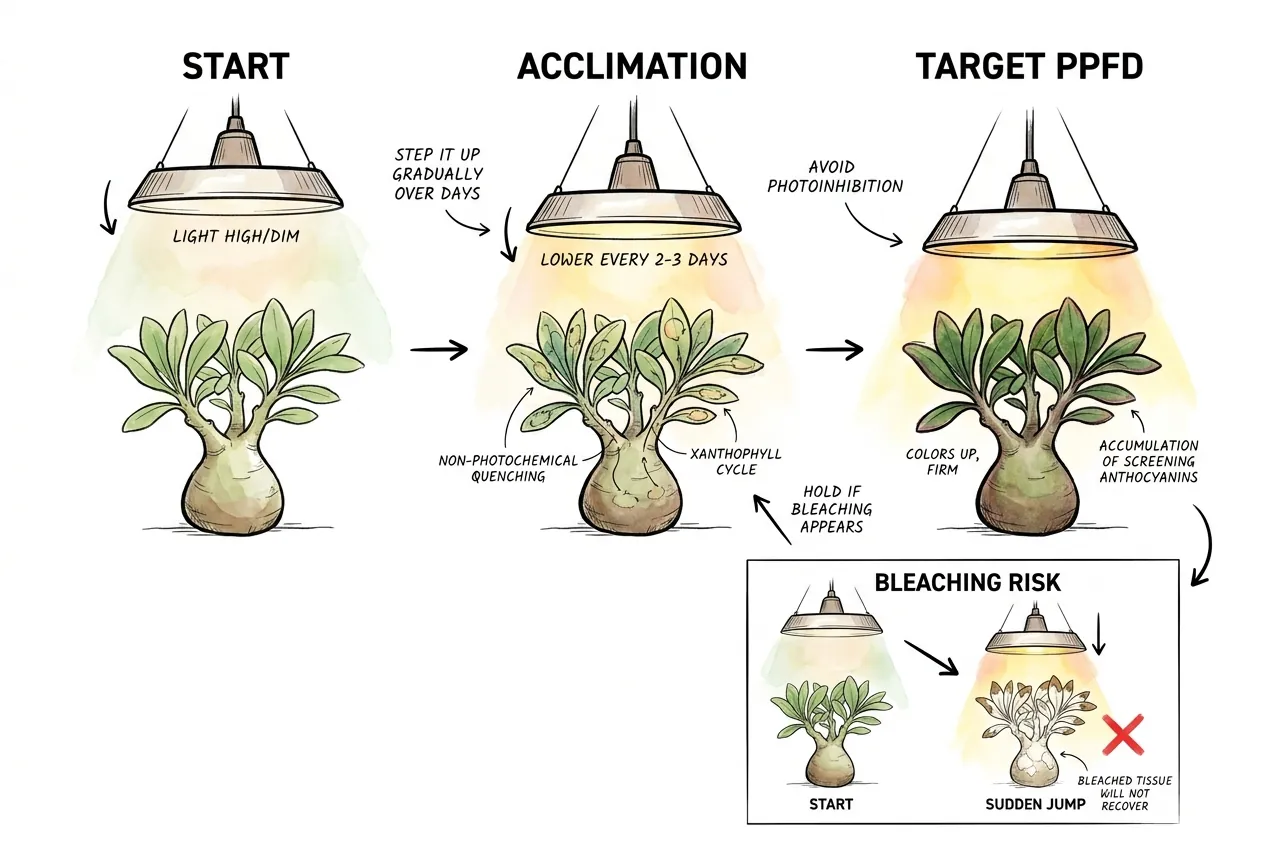
Etiolation is too little light. Bleaching is too much intensity, especially an abrupt increase. They are mechanistically opposite failures, and the fix for one is the opposite of the fix for the other.
When absorbed light exceeds photosynthetic capacity, PSII photochemistry declines. Excess energy transfers from triplet chlorophyll to oxygen to form singlet oxygen. That reactive oxygen damages PSII proteins and triggers lipid peroxidation faster than repair, visible as bleached or scorched tissue.
Diagnose by symptom direction. Long, thin, pale, spaced-out growth means too little light, so add intensity. Bleached or scorched crowns, especially days after a sudden move closer to the lamp, mean too much intensity, so back off and ramp up gradually.
What PPFD and DLI should a caudex actually get?
No extension or peer-reviewed source publishes a caudex-specific or Pachypodium-specific PPFD or DLI threshold. Anyone who quotes you a precise caudex number is inventing it.
What is sourced is the band for high-light plants in general, and caudiciforms are high-light plants. Here are the published numbers you map onto.
| Plant category | DLI (mol/m²/day) | Named example crops | Source |
|---|---|---|---|
| Low-light | 5 to 12 | seedlings, cuttings, impatiens | Virginia Tech SPES-720 |
| Medium-light | 12 to 20 | lettuce, begonia, geranium | Virginia Tech SPES-720 |
| High-light | 20 to 30 | tomato, cucumber, zucchini | Virginia Tech SPES-720 |
| Runkle floor | 10 to 12 | general moderate-quality minimum | Runkle, MSU/GPN 2006 |
| Shade crops | 4 to 6 | African violet, phalaenopsis | Runkle, MSU/GPN 2006 |
| Runkle top categories | 15+ | cut flowers, fruiting vegetables | Runkle, MSU/GPN 2019 |
Keep the two quantities separate, because conflating them is this site’s known failure mode. PPFD is instantaneous intensity in µmol/m²/s, the brightness right now. DLI is the total collected over a day in mol/m²/day.
Runkle’s analogy is the clearest one. PPFD is the rain rate; DLI is the total in the gauge at the end of the day.
So what number do I aim for?

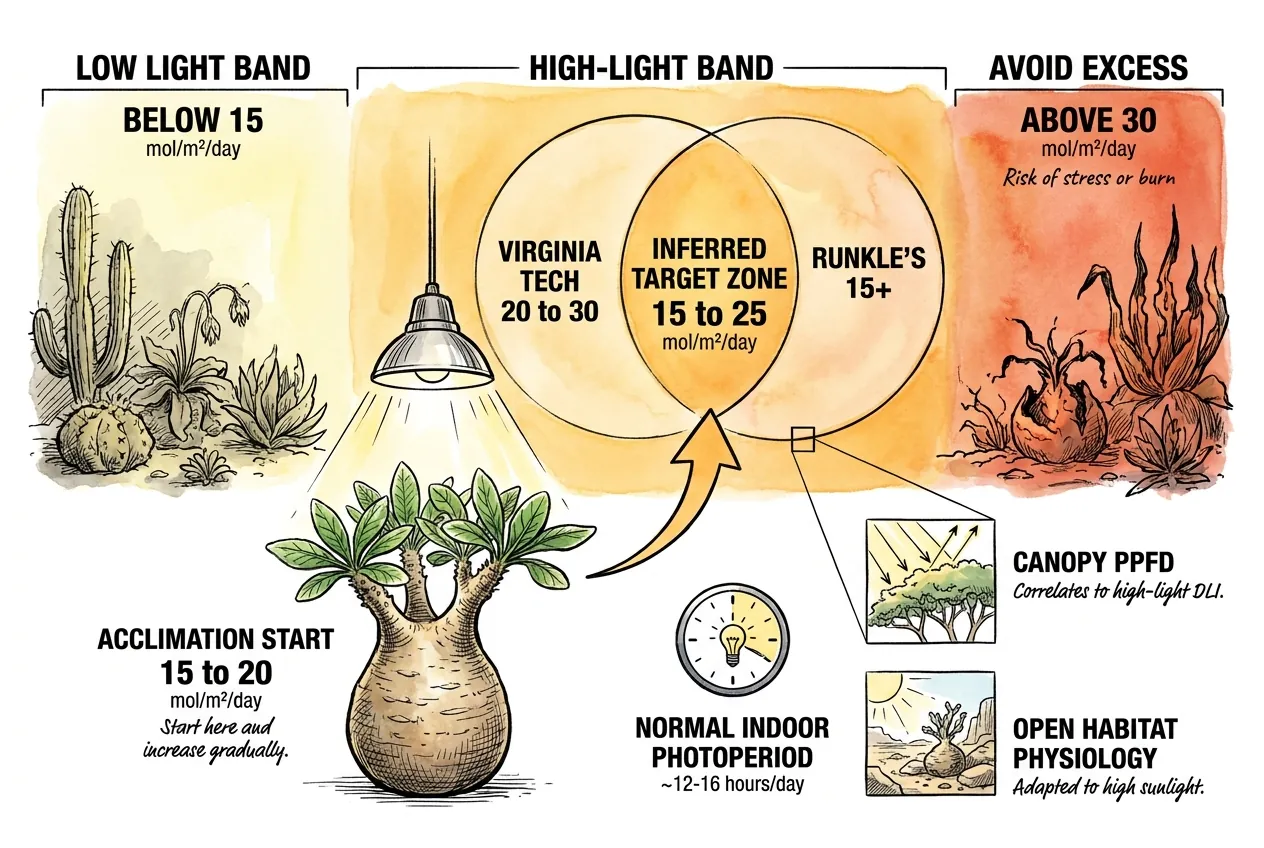
Aim for the high-light band, treated as an inference, not a published caudex figure. Virginia Tech places high-light crops at 20 to 30 mol/m²/day, and Runkle’s most sun-loving categories sit at 15+. Those two extension sources overlap at roughly 15 to 25 mol/m²/day, a defensible starting target for a caudiciform.
This is a mapping from the high-light-plant category onto a desert succulent, because caudiciforms share that open-habitat, high-light physiology. It is not a species-specific measured value, so do not mistake it for one.
Start near the lower end, around 15 to 20 mol/m²/day, and let the plant acclimate upward rather than targeting 30 from day one.
For reference, the Pachypodium brevicaule PPFD threshold post on this site works to a sustained canopy PPFD in the several-hundred µmol/m²/s range, which lands inside that same high-light DLI band at a normal indoor photoperiod.
Where you must NOT sit is the 4 to 10 mol/m²/day zone. That is the shade and foliage band, and parking a Pachypodium there is lighting it like an orchid, the recipe for a stretched, thin-stemmed plant.
How do I turn a DLI target into a canopy PPFD number?
Use the sourced arithmetic. DLI (mol/m²/day) = PPFD (µmol/m²/s) × 3,600 × operating hours ÷ 1,000,000.
The extension source’s own worked example: an LED at 200 µmol/m²/s for 16 hours a day yields a DLI of 11.5 mol/m²/day. Check: 200 × 3,600 × 16 ÷ 1,000,000 = 11.5.
Rearranged, PPFD = DLI × 1,000,000 ÷ (3,600 × hours). To hit 15 mol/m²/day at a 14-hour photoperiod you need roughly 298 µmol/m²/s at the canopy. To hit 20 mol/m²/day at 14 hours you need roughly 397 µmol/m²/s.
Those two PPFD figures are arithmetic outputs of the sourced formula and sourced DLI targets, not published succulent thresholds.
No affordable indoor LED reproduces full-sun intensity of roughly 2,000 µmol/m²/s over a canopy. The honest indoor game is hitting a DLI band with a modest PPFD run for a long photoperiod, not matching desert noon.
How do I read a grow-light spec sheet without getting fooled?
Shop by four published PAR specs, never by wattage, lumens, or lux. Lumens and lux are weighted to the human eye’s peak green sensitivity near 555 nm, so they systematically undercount the red and blue photons plants use most.
The four numbers that decide the purchase are PPF (total µmol/s of PAR the fixture emits), a PPFD-at-distance map or rated coverage area, spectrum with meaningful red content, and efficacy in µmol/J. A fixture can post a big lux number and still leave a Pachypodium in the etiolation band.
| Spec | What it tells you | Why it beats the alternative |
|---|---|---|
| PPF (µmol/s) | total PAR photon budget | replaces watts, which measure only electricity |
| PPFD-at-distance | photons reaching the leaf per m² | replaces coverage marketing |
| Spectrum with red | usable photosynthetic bands | replaces the vague phrase full-spectrum |
| Efficacy (µmol/J) | PAR photons per watt | replaces lumens per watt |
PPF is the source total; PPFD is what actually reaches the leaf. Spread the same PPF over a bigger area or hang it higher and per-m² PPFD drops, which is why a coverage area or distance map is mandatory. PPF alone cannot tell you canopy intensity.
Which LED should I buy for one plant versus a small shelf?
Match PPF to your plant count and footprint, then confirm canopy PPFD with a meter. Do not put a 4×4 flowering fixture over a single 4-inch caudex.
For one prized caudex, you want a compact fixture that publishes both a PPF and a PPFD at a stated distance, so you can right-size instead of over-buying.
SANSI BR30 36W Full-Spectrum LED Grow Light Bulb publishes PPF 65.6 µmol/s and PPFD 265.58 µmol/m²/s at 1 ft, full spectrum 400 to 780 nm, E26 base, 25,000 hour rated life. Buy on Amazon (B07BRKG7X1) Use it when you have one plant and a normal lamp socket. Because the PPFD is published at 1 ft, you can hang close and know the canopy number before you even meter. Honest tradeoff — the small footprint and modest PPF are inadequate for a collection, and PPFD drops fast past 1 ft, so it must be mounted close.
For a tight 2×2 shelf of three to eight caudiciforms, step up to a dimmable panel.
Mars Hydro TS600 100W Full-Spectrum Dimmable LED publishes PPF 190 µmol/s, efficacy 2.0 µmol/J, spectrum with red 650 to 660 nm plus far-red 730 to 735 nm, and a veg footprint of 2×2 ft. Buy on Amazon (B07VL8FZS1) Use it as the right-sized don’t-over-buy pick that concentrates a modest photon budget over a small footprint. Honest tradeoff — at 2.0 µmol/J it has the lowest efficacy of the panels here, so it costs a little more per photon over months. It also publishes no PPFD-at-distance map, so confirm canopy PPFD with a meter.
Spider Farmer SF1000 100W Full-Spectrum Dimmable LED publishes PPF 249.21 µmol/s, efficacy 2.5 µmol/J, and a spectrum with red 650 to 665 nm plus far-red 730 to 740 nm. Core coverage is 2×2 ft, and, unusually, it ships an actual PPFD map tested at 12 in and 14 in. Buy on Amazon (B07TS82HWB) Use it when you want a published distance map plus dimming to back intensity off while acclimating. Honest tradeoff — the map assumes reflective tent walls, so a shelf grower without them should verify canopy PPFD with a meter, and it is overkill for a single bulb-sized plant.
For more headroom or a slightly larger cluster, the highest-PPF option here is the Mars Hydro TS1000 at PPF 343 µmol/s, 2.3 µmol/J, veg 2.5×2.5 ft (https://www.amazon.com/dp/B07RSRX1RS?tag=ariumology-20). Its tradeoff is the mirror image of the bulb: at 150W over one small caudex hung close it can over-light the crown, so use the dimmer and raise the fixture.
Between two fixtures with similar PPF, prefer the higher µmol/J. A 2.5 µmol/J SF1000 delivers roughly 25% more PAR per watt than a 2.0 µmol/J TS600, which runs cooler at the canopy and costs less over a months-long photoperiod.
How do I measure the light my caudex is actually getting?
Measure PPFD in µmol/m²/s at the crown of the plant, not the pot rim, and never trust the box’s coverage claim. A measured canopy number is the only honest read on whether you sit in the etiolation, target, or bleaching band.
There are two routes, and they trade accuracy against cost.
| Tool | Accuracy | Cost | Best for |
|---|---|---|---|
| Apogee MQ-500 quantum meter | ±5%, full-spectrum 389 to 692 nm | several hundred USD | a collection under LEDs |
| Photone phone app | spectrum- and device-dependent | free tier | one plant on a budget |
| Lux meter or phone-lux | misleads under LEDs | low | not recommended |
Which quantum meter reads LEDs correctly?
The full-spectrum Apogee MQ-500, not the older silicon MQ-100. Under red-rich horticulture LEDs the difference is a real buyer trap.
Apogee Instruments MQ-500 Full-Spectrum Quantum PAR Meter measures all photons from 400 to 700 nm to within ±5% calibration uncertainty, with drift under 2% per year, and a 0 to 4,000 µmol/m²/s range. Buy on Amazon (B09YXQL8QD) Use it to read PPFD at each crown across a collection, where the ±5% accuracy and low drift make readings trustworthy over years. Honest tradeoff — it is expensive, several hundred dollars, and overkill for a single plant.
The cheaper MQ-100 (https://www.amazon.com/dp/B081Y4R487?tag=ariumology-20) is accurate to ±5% for sunlight and broadband lamps. But Apogee itself warns that its original silicon sensor shows larger errors under LEDs, and that fixtures with heavy output above 660 nm read very low. If your caudex is under a typical red-rich LED, the MQ-100 will under-read, and the full-spectrum MQ-500 is the correct choice.
Is a phone app good enough?
For a single plant on a budget, yes, if you configure it honestly. The Photone app uses the phone camera to estimate PPFD and DLI.
Its accuracy is entirely conditional on telling the app which light it is looking at. The camera is fundamentally a lux-like device, and the app back-calculates PPFD by assuming a spectrum.
Pick the wrong light-source setting and the number is wrong.
Photone is linked here to its official site rather than Amazon: https://growlightmeter.com/
Build the recommended white-paper diffuser over the lens, select the exact LED sub-type, and read at the crown. Treat it as a good relative guide for comparing hanging heights, not a lab number.
Whatever you do, never convert a plain lux reading to PPFD with a fixed multiplier. Apogee’s own table shows that factor ranges from about 54 for sunlight to 82 for high-pressure sodium, so a single number produces errors of tens of percent under an LED.
How to read canopy PPFD, then compute DLI
Turn the fixture on and let it stabilize. Lay the sensor or phone-plus-diffuser flat and face-up at the exact height of the caudex crown, level and shadow-free. Take the reading in µmol/m²/s, sampling a few spots across a wide plant.
Then convert with the sourced arithmetic. DLI (mol/m²/day) = PPFD (µmol/m²/s) × photoperiod-seconds ÷ 1,000,000. Worked example: 300 µmol/m²/s × 12 h (43,200 s) ÷ 1,000,000 = 12.96 mol/m²/day.
How long should the light run, and why does the dark period matter?
Run the light for a fixed 12 to 14 hours a day, and never above 16. Because DLI is intensity multiplied by duration, photoperiod is a free dial: you can hit a target DLI with a modest light run longer instead of a hot light run short.
Iowa State Extension puts the practical indoor supplemental photoperiod at 12 to 14 hours, with 10 hours as a floor and 16 as a hard ceiling. Adding hours adds daily photons without adding heat or bleaching risk, which is why duration is the cheapest lever you have.
A worked example makes it concrete. A measured canopy of 250 µmol/m²/s for 14 hours gives 250 × 50,400 ÷ 1,000,000 = 12.6 mol/m²/day. The same 12.6 mol could come from a hotter 350 µmol/m²/s in only 10 hours, but the longer, cooler run is safer for an acclimating plant.
Why can’t I just leave the light on 24/7?
Because a genuine dark period is not optional for these plants. Caudiciforms are overwhelmingly CAM plants that take up most of their CO2 at night through open stomata.
PEP carboxylase fixes CO2 in the dark into malic acid stored in the vacuole, which is released and refixed the next day behind closed stomata. Remove the dark and you remove the window when stomata open to take up carbon.
Continuous light also causes documented injury in sensitive species, including chlorosis, necrosis, and down-regulated photosynthesis, partly by desynchronizing the internal clock from the external light-dark cycle. A timer is not just convenience. It guarantees the CAM night the plant physiologically needs.
Which timer should I buy?
For a no-Wi-Fi, set-and-forget schedule, buy a standalone digital timer. For app or voice scheduling, buy a smart plug. Nobody should skip this part.
BN-LINK Indoor Digital Timer Outlet, Dual Outlet 7-Day supports 8 on/off programs, dual grounded outlets, rated 15A/1875W, ETL listed. Buy on Amazon (B073DGGHD7) Use it to set one fixed 12 to 14 hour block that runs the same photoperiod daily with no app, cloud, or network, which also guarantees the dark period. Honest tradeoff — no remote control or energy monitoring. It only does scheduled on/off, but that is all the physiology requires, and its independence from Wi-Fi is a reliability advantage on a grow shelf.
Kasa Smart Plug Mini EP25 runs on 2.4 GHz Wi-Fi, rated 15A/1.8 kW, with app and voice scheduling, remote control, and energy monitoring. Buy on Amazon (B0B14C719T) Use it when you want to adjust the photoperiod from your phone or tie it to a voice assistant. Honest tradeoff — it needs a working 2.4 GHz network and the Kasa app. If Wi-Fi is flaky at the grow shelf, the BN-LINK timer is more reliable and cheaper.
A single-plug Govee smart plug (https://www.amazon.com/dp/B08X448XHR?tag=ariumology-20) covers the same role at a lower per-unit entry cost for buyers already in that ecosystem.
How far should the light be from the plant?
Mounting height is your primary intensity dial after purchase, because PPFD decreases rapidly with increasing distance from the source. Raising or lowering the lamp is a free PPFD control, which is why an adjustable hanger is not a luxury.
Once a fixture is bought, its total photon output is fixed. What you can still change for free is canopy PPFD, and the lever for that is distance. University of Maryland Extension states the relationship plainly: intensity depends on distance and decreases rapidly with it.
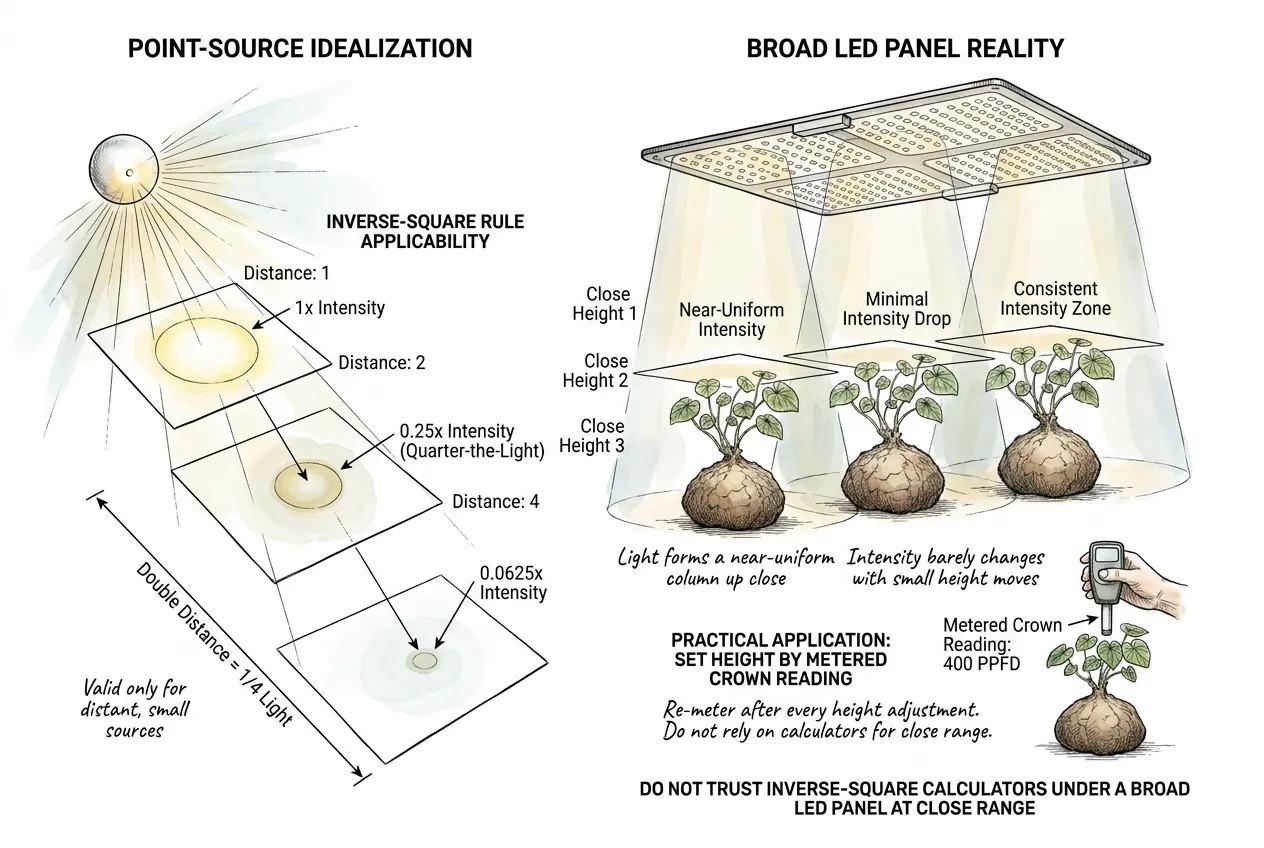
Does the inverse-square rule actually work up close?

Not under a broad LED panel. The popular double-the-distance-quarter-the-light rule is a point-source idealization, and a real panel is an extended area source.
Near a wide panel, the overlapping light cones from hundreds of diodes produce a near-uniform column whose intensity barely changes with a small height move. A physics-education study measured exactly this. For flat sources, intensity remains nearly constant as long as the distance is smaller than the source size.
It only starts obeying inverse-square once you back off past roughly the panel’s own width.
The practical upshot is blunt. Do not trust an inverse-square calculator under a broad panel at close range, because it over-predicts the falloff. Set height by the metered crown reading, and re-meter after every move.
How do I raise a plant into higher light without bleaching it?

Step it up gradually over days, never in one move. A sudden jump over-reduces the electron-transport chain, spikes reactive oxygen species, and photoinhibits the tissue before the plant can build its defenses.
Given days, plants up-regulate non-photochemical quenching, run the xanthophyll cycle, and accumulate screening anthocyanins. This protective machinery is induced, not instantaneous, so a dim-grown plant slammed to target PPFD bleaches, while the same plant stepped up slowly colors up and stays firm.
Keep the protocol simple. Start the light higher or dimmer than target, then lower it a little every 2 to 3 days over 1 to 2 weeks, checking the crown for pale patches after each step.
If bleaching appears, ratchet the light back up and hold. Bleached tissue will not recover, but you can stop further damage.
Which mount should I buy?
Buy a rope ratchet if you have an overhead anchor, or a tripod stand if you do not. A gooseneck clamp works for a single bulb-style light.
VIVOSUN 2-Pair 1/8-Inch Adjustable Rope Ratchet Hanger offers 8 ft of braided rope, reinforced metal internal gears, galvanized-steel carabiners, and a 150 lb per pair capacity with a self-locking design. Buy on Amazon (B088R9ZJMT) Use it to raise and lower a hung panel in small, repeatable increments to dial canopy PPFD and to step-acclimate a plant. Honest tradeoff — it needs a ceiling hook or tent bar overhead and gives coarse detented steps of roughly half an inch to an inch, not micro-fine positioning. A single-pair iPower GLROPE ratchet (https://www.amazon.com/dp/B005CY100I?tag=ariumology-20) does the same job cheaper for one small panel.
LBW Tri-Head LED Grow Light with Adjustable Tripod Stand adjusts from 15 to 63 inches on a free-standing tripod, with gooseneck arms and a built-in 3/6/12 hour timer. Buy on Amazon (B09ZNX2NDB) Use it when you have no ceiling anchor and want a floor unit you can raise and lower over a plant. Honest tradeoff — the light is an integrated, generally un-PPFD-mapped gooseneck fixture, so it is a mounting-plus-light convenience buy, not a substitute for a spec’d, PPFD-mapped panel if your caudex needs the full high-light band. For a single bulb on a desk, a Bonlux E26 gooseneck clamp (https://www.amazon.com/dp/B0D8S9YDBC?tag=ariumology-20) aims a screw-in grow bulb at one plant, though its height control is coarse and can sag under a heavy bulb.
Do caudex plants need a UV-B grow light?
No. UV-B is an optional cosmetic adjunct for color and compactness in a few genera, never a growth light, never required for healthy growth, and never the fix for etiolation. It is also a genuine human hazard, so read the safety gate before you even consider it.
The cleanest study makes the tradeoff undeniable. End-of-production UV-B on red-leaf lettuce raised anthocyanin by 147% to 314%, but at the cost of biomass, cutting shoot fresh weight by 8.9% to 49%. The same UVR8 signal that reddens the plant also inhibits leaf expansion, which is why UV-B reads as more color, more compact, and less bulk.
Standard full-spectrum LED grow lights emit essentially no UV-B, so this is always a separate, dedicated fixture, typically a reptile-grade fluorescent tube. There is also no robust peer-reviewed dataset for UV-B-induced anthocyanin in caudiciform succulents specifically, so any color response in a Euphorbia or Adenium is a reasonable extrapolation from the conserved pathway, not a guarantee.
What are the UV-B safety rules?
Treat UV-B exactly like a reptile keeper treats a basking tube: barrier, distance, timer, and never look at the lamp. This is not theoretical caution.
The WHO states that photokeratitis is a sunburn of the very sensitive skin-like tissues of the eyeball and eyelids, appearing within hours of exposure, and that up to 10% of cataracts may be caused by UV overexposure. The EPA adds that UV-B rays cause sunburn, skin cancer, skin aging, and snow blindness.
The mandatory protocol has five parts.
- Never look directly at a lit UV-B lamp.
- Shield or enclose the beam and run it in an unoccupied space.
- Keep at least 18 inches of distance, with short starting windows of 2 to 4 hours on a timer.
- Cover skin or wear UV-blocking eyewear if you must be near it.
- Replace the tube on schedule, because reptile UV-B tubes fade below useful output in about 12 months while still lighting.
The safe-exposure approach is detailed in caudexology’s UV-B grow lights for Euphorbia guide.
Who should NOT buy a UV-B lamp?
Most people. Specifically, do not buy UV-B if your plant is stretching, because that is a PAR deficit and UV-B will not fix it and may slow bulk further. Do not buy it if you are a beginner or just want healthy growth or bloom, because UV-B is not required for either.
Do not buy it if you cannot guarantee controlled, shielded exposure, meaning open shelves, shared rooms, kids or pets, or no timer. And do not buy it before you have dialed in PAR, PPFD, and DLI. UV-B is the last thing to add, not the first.
If, and only if, all of that is satisfied and you specifically want deeper pigment on an already well-lit plant, two page-verified fixtures fit. The Zoo Med ReptiSun 10.0 T5 HO runs roughly 10% UV-B at 15 W, 12 in (https://www.amazon.com/dp/B00N1DY82E?tag=ariumology-20). The Arcadia D3 12% Desert runs roughly 12% UV-B at 24 W, 22 in (https://www.amazon.com/dp/B004XVIIRE?tag=ariumology-20).
A higher UV-B percentage means more human risk, not a better plant, so the shielding, distance, timer, and no-direct-viewing rules are non-negotiable for both. Neither fixture is an evidence source: the color claim rests on the academic papers, the safety claim on WHO and EPA. This is why a green plant that is stretching, like the classic Stephania that will not wake up, is a PAR and dormancy question, not a UV-B one.
How do I set up the whole system in the right order?
Work in one sequence: buy right-sized, measure, set height, set photoperiod, then acclimate. Doing it out of order is how people bleach a plant on day one.
Step 1 — Right-size the fixture
Pick the smallest fixture whose published PPFD-at-distance still clears the high-light band at a realistic hang height. One plant does not need a flowering-tent light.
Step 2 — Measure the crown
Read PPFD at the caudex crown with the MQ-500 or a configured Photone app. Compute DLI with PPFD × photoperiod-seconds ÷ 1,000,000.
Step 3 — Set the height
Raise or lower the fixture on the ratchet or stand until the metered crown reading lands in your target band. Trust the meter over any calculator.
Step 4 — Set the photoperiod
Program the timer for a fixed 12 to 14 hour block, leaving a real dark period. Recompute DLI to confirm you are in the target range.
Step 5 — Acclimate
If the plant was dim-grown, start below target and step intensity up over 1 to 2 weeks, watching for bleaching. Back off at the first pale patch.
Who should NOT buy each part of this kit?
Not every product suits every grower, and matching the tool to the situation is what prevents wasted money.
| Product class | Who should NOT buy it | Buy instead |
|---|---|---|
| Oversized bloom fixture | anyone growing one or a few caudices on a shelf | a right-sized bar or panel plus a timer |
| Silicon MQ-100 meter | anyone growing under red-rich LEDs | the full-spectrum MQ-500, or a configured app |
| Fixed non-adjustable mount | anyone acclimating plants or dialing intensity | a rope ratchet or height-adjustable stand |
| UV-B lamp | beginners, growth-seekers, etiolation-fixers, anyone who cannot control exposure | nothing; fix PAR first |
| No timer | essentially nobody should skip it | a digital timer or smart plug |
When does a grow light wear out, and how do I know?
LEDs fade, they do not die like a filament bulb, so rate a fixture by its photon-maintenance horizon rather than a headline hour count. The industry replace-it line is L70, the hours until output falls to 70% of new, with L80 and L90 for stricter uses.
For plants, the correct metric is photon flux maintenance, not lumen maintenance. A fixture certified by the DesignLights Consortium must keep photosynthetic photon output at or above 90% of initial for at least 36,000 hours, its Q90. Run 12 hours a day, that is roughly 8 years to a mere 10% drop.
Prefer a fixture that publishes a Q90 or a PPF-based maintenance figure over one that publishes nothing.
What makes a light die early?
Heat. A peer-reviewed thermal study found LED lifetime falls exponentially with junction temperature, and that dropping a test LED from 60°C to 40°C more than doubled its projected life, from 13,552 to 30,304 hours.
Buy fixtures with real heat sinking, and do not cram a high-wattage board into a hot, closed shelf.
In real fixtures the driver’s electrolytic capacitors are heat-sensitive and often fail before the diodes show meaningful depreciation. Good airflow is a lifespan purchase.
What ongoing maintenance keeps a plant in the band?
Re-measure PPFD as the fixture ages, keep the optics clean, and re-check after any move. When a caudex that used to stay compact starts stretching under the same light at the same height and hours, aging photon output is a prime suspect, so re-measure the crown before assuming the plant changed.
If PPFD has dropped, lower the fixture to compensate, clean the lens, and if you are near or past the L70 or Q90 horizon, plan a replacement.
This maintenance loop, height and photoperiod as free dials before buying more hardware, is what keeps a plant in-band over the fixture’s whole life.
Some links in this post are Amazon affiliate links. If you buy through them, the site receives a small commission at no extra cost to you. We only recommend products that meet the technical specs discussed above.


Leave a Reply