
Wild-Collected vs Nursery-Grown Caudex Buying Guide
Learn which signs can raise concern but never prove origin, then check provenance, CITES documents, seller answers, and care needs before buying a caudex.
Derek Kim · 2026-02-03 · Updated 2026-08-17 · 12 min read
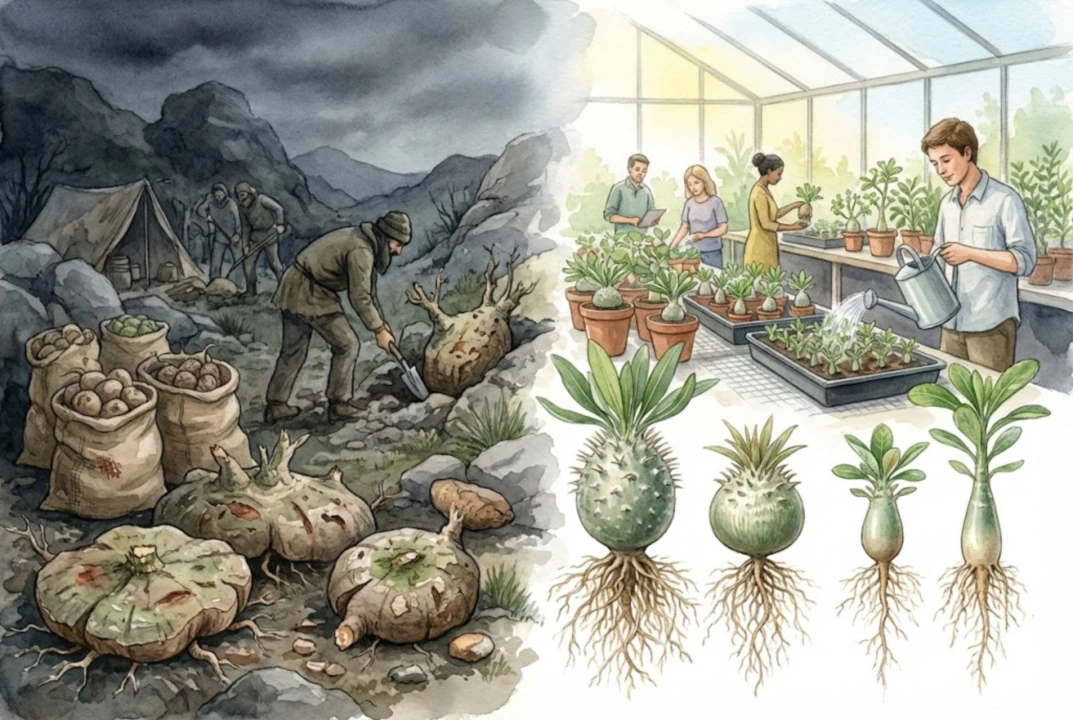
Key Takeaways
- You cannot prove a caudex was wild-collected or poached from its shape, scars, price, or a photo alone. Large, weathered, asymmetrical plants and mixed-size bulk lots are reasons to ask for provenance, not verdicts.
- Ask for a checkable provenance record before buying. Request the accepted scientific name, propagation method, origin nursery or collector, acquisition trail, and any CITES and plant-health documents for the shipment.
- On a CITES permit, source code
Wmeans wild andAmeans artificially propagated. Wild does not by itself mean illegal, and either letter matters only on a valid document tied to that shipment.- Read clues in clusters, never as single verdicts. Deep corking, a large basal cut with few feeder roots, mixed-age lots, and a commodity price for a slow-growing plant all have innocent explanations too.
- Walk away when answers stay vague and warning signs accumulate. You do not need to prove poaching to decline a purchase or to report a credible concern to the proper authority.
You cannot prove that a caudex was wild-collected or illegally poached from its shape, scars, price, or a listing photo alone. Large irregular specimens, natural weathering, mixed-size bulk lots, and heavily cut roots are reasons to ask for provenance. Request the accepted scientific name, propagation method, nursery or collector of origin, acquisition trail, and any CITES and plant-health documents required for the cross-border shipment. On a CITES permit, source code W means wild. It does not by itself mean illegal. Code A identifies qualifying artificially propagated plants. If the answers stay vague and several warning signs accumulate, leave the plant with the seller.
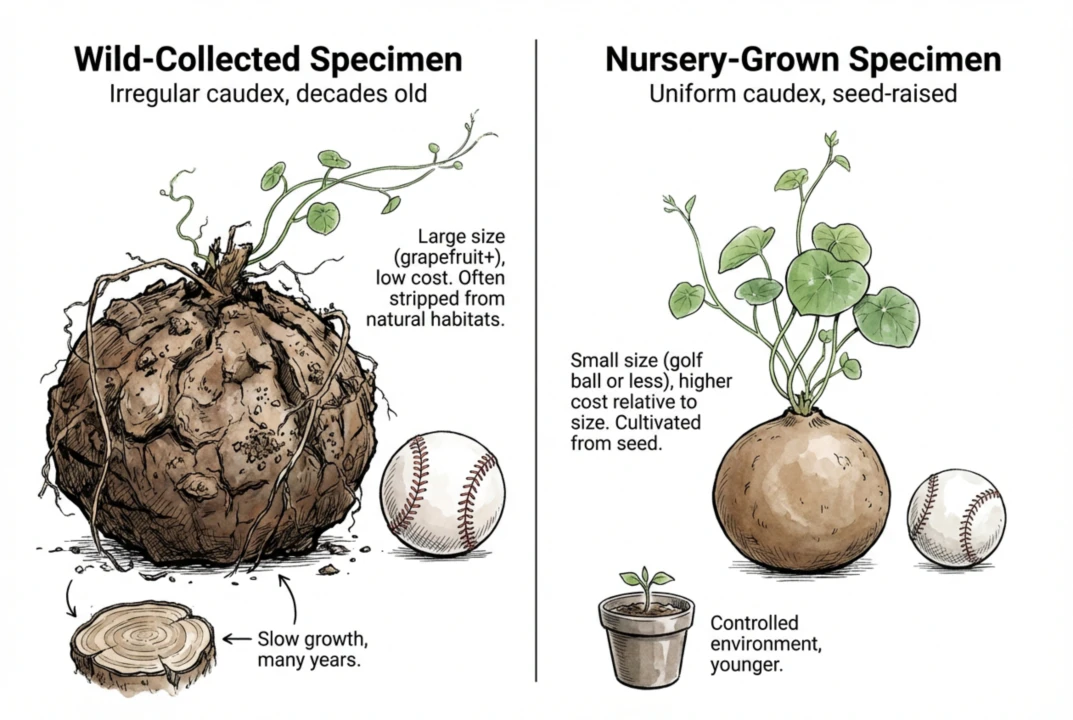
The most tempting caudex in a listing is often broad, scarred, asymmetrical, and far larger than the nursery seedlings beside it. Those features can be the result of decades in habitat. They can also come from field production, bonsai work, rot surgery, hard cultivation, or a legally documented rescue.
Do not ignore appearance, but let it lead to questions rather than public accusations. A purchase becomes more defensible when the seller’s story, records, plant, and price make sense together.
Can a Photo Prove a Caudex Was Wild-Collected?
Use Morphology as a Question Prompt
No. SANBI's identification guide gives border and enforcement staff a set of traits associated with wild-collected and artificially propagated succulents, then warns that the guide cannot guarantee the origin of an individual plant. Even trained inspectors may need a botanical expert and shipment documents.
Request a wider provenance record
A photo is still useful for deciding what to ask next. Request the whole plant, base, roots, old wounds, label, potting medium, and several plants from the same batch. One dramatic close-up can hide the uniform nursery lot behind it, or hide a tarp full of unrelated old specimens.
Keep the terms separate
- Wild-collected describes origin in a natural environment.
- Legally wild-sourced material may enter trade under permits and applicable harvest laws.
- Poached means the collection or trade broke the law.
- Nursery-grown describes cultivation, but a nursery label alone does not explain where the parent material or propagules came from.
Which Visual Clues Justify More Questions?
Look for Clusters Rather Than Verdicts
No single clue settles origin. A cluster of clues bears more weight than any one trait. This is especially true across a shipment, where the combined evidence makes the seller's documentation more important.
| What you notice | Why it can raise concern | Other plausible explanations |
|---|---|---|
| Deep corking, one-sided weathering, broken spines, old grazing or fire marks | Natural habitats leave long, uneven exposure histories | Field-grown stock, hard nursery culture, age, sunburn, pests, or mechanical damage |
| A compressed, rock-imprinted, or highly irregular caudex | Restricted habitat and slow growth can shape a plant around rock or soil | Genetics, shallow containers, root training, or deliberate hard growing |
| A large basal cut and few fine feeder roots | Extraction may require cutting an extensive wild root system | Field lifting, bonsai work, legal translocation, division, or rot removal |
| One lot with many ages, shapes, scars, and fresh wounds | A wild population naturally contains varied individuals and harvest damage | A wholesaler may consolidate legitimate stock from several growers |
| An unusually large slow-growing plant at a commodity price | The years of nursery space and labor are not obvious in the price | Old nursery closure, estate stock, local field production, or distressed sale |
End with a documentation question
Do not turn an old-looking plant into proof of poaching. Ask the seller to reconcile what you see with how the plant was produced and moved.
What Should You Ask the Seller?
Ask for Checkable History
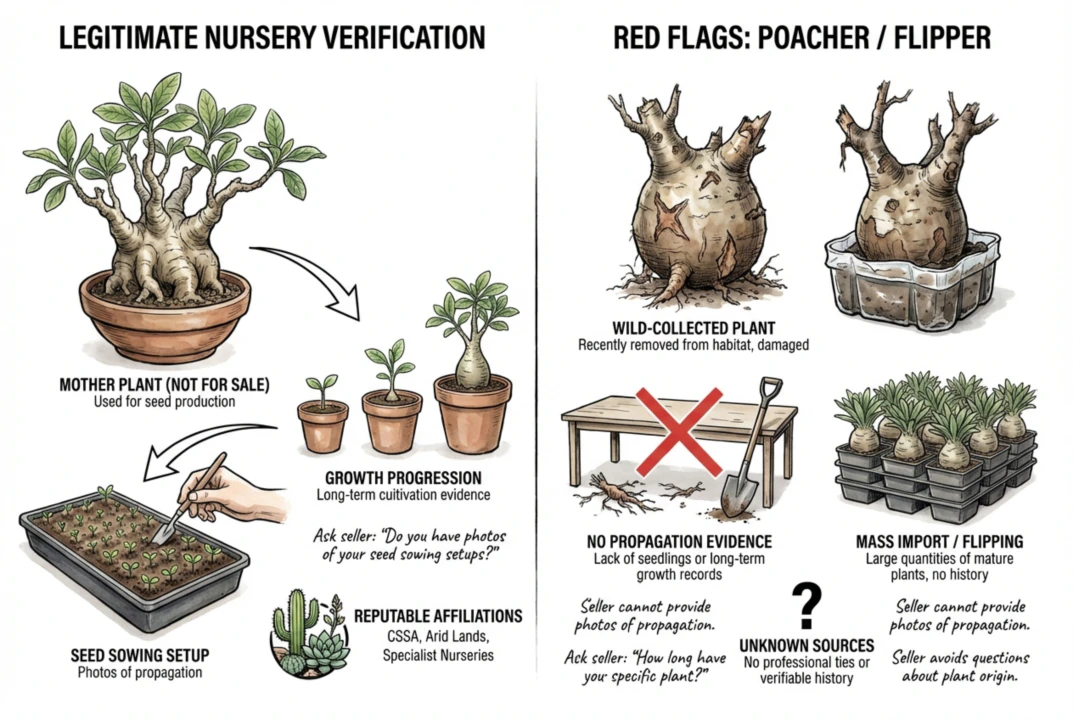
Use questions that can produce specific, checkable answers. A friendly seller and a greenhouse photo are reassuring, but neither belongs to the individual plant unless the chain can be explained.
- Ask for the accepted scientific name and any synonyms used on the invoice or permit.
- Ask whether this individual was seed-grown, cutting-grown, divided, field-grown, legally wild-sourced, or acquired as old stock. A nursery-established label only says where it is now.
- Ask who propagated or supplied it and in which country. Request the nursery name, batch, acquisition date, and previous invoice where practical.
- If it was seed-grown, ask where the seed came from. Seed can also be collected from wild populations, so from seed is not a complete provenance statement.
- Ask whether the plant crossed a border. If so, ask which CITES, export, import, phytosanitary, or protected-plant documents applied to that shipment.
- Ask whether the seller can connect the offered plant to those records. A permit for a different species, quantity, exporter, or date does not answer the question.
Accept equivalent records
For a domestic resale, the original CITES document may have been retained at the border and may not travel with every later retail plant. That does not make the plant illegal. Ask for a copy, permit reference, importer invoice, or another traceable link to the legal shipment instead of demanding one particular piece of paper in every situation.
What Do CITES Documents Prove?
Separate Trade Paperwork From Local Law
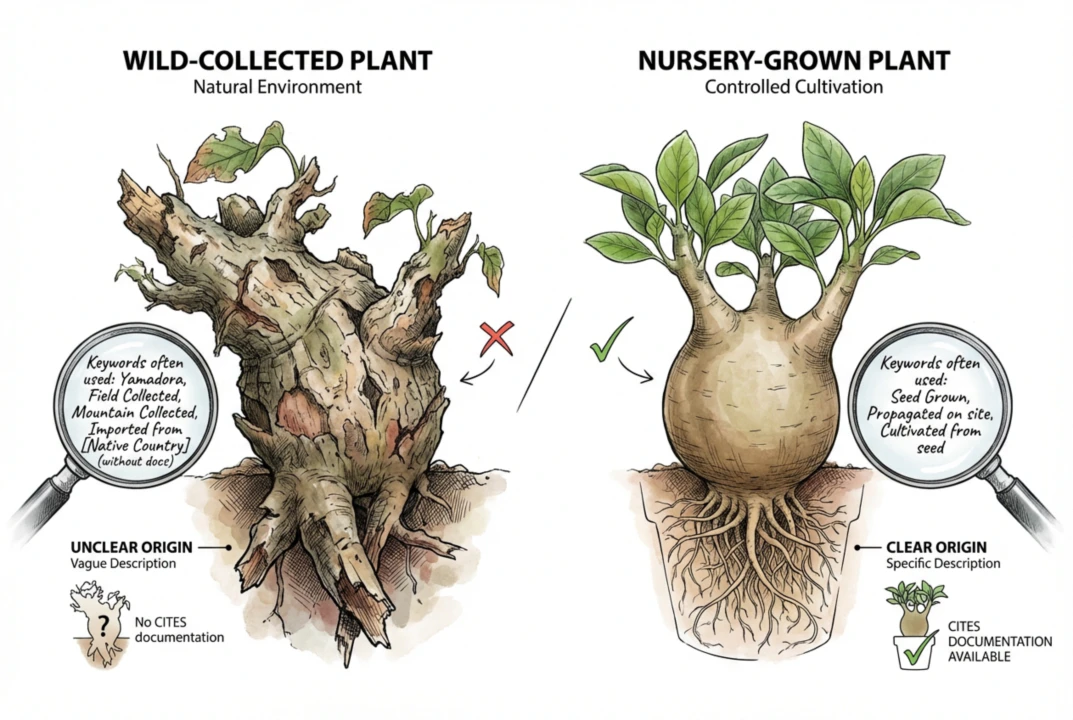
CITES regulates international trade in listed species. It is not a visual certification program and it does not replace national or local laws. Check the accepted name in Species+ at the time of purchase because listings, annotations, quotas, suspensions, and taxonomy can change.
Read the source code on the permit
| Code | Meaning relevant to plants | What a buyer should not assume |
|---|---|---|
W |
Specimen taken from the wild | Wild does not automatically mean illegally collected. Verify the permit and harvest authority |
A |
Plant artificially propagated under the CITES definition | The letter is meaningful only on a valid document tied to the shipment |
D |
Appendix-I plant artificially propagated for commercial purposes | A generic nursery-grown listing is not a substitute for the applicable documentation |
Y |
Plant meeting the CITES definition for assisted production | Assisted production is not the same source category as ordinary artificial propagation |
Read the actual permit
Appendix II generally requires an export permit for international trade, while Appendix I is more restrictive and generally involves both export and import authorization. Countries can impose stricter domestic rules. In the United States, APHIS also applies plant-health and protected-plant requirements, including permits and designated ports in relevant cases.
The current CITES checklist places the genus Pachypodium in Appendix II except P. ambongense, P. baronii, P. decaryi, and P. windsorii, which are in Appendix I. Do not infer legality from the appendix alone. Inspect the source, purpose, quantity, parties, dates, and validity of the actual permit.
Are Bare-Root Imports Automatically Suspicious?
Keep Bare-Root Shipping in Context
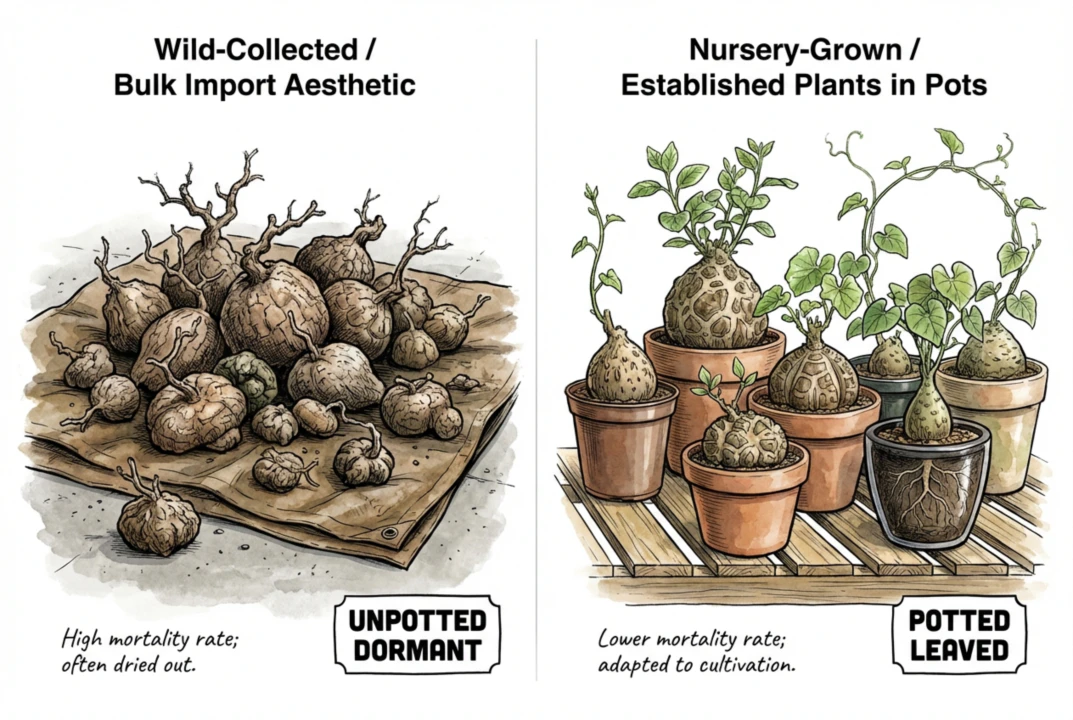
No. Plant-health rules commonly require imported plants to travel without soil, and legitimate wholesalers ship dormant plants bare-root to reduce weight and disease risk. APHIS, for example, requires eligible plants carried by travelers into the United States to be bare-root and accompanied by the applicable phytosanitary documentation.
Read the whole listing
Look at the whole listing. Uniform size, intact compact roots, consistent labels, professional packing, and a coherent nursery record support propagation. Highly varied ages, extensive cut roots, habitat debris, location data, incomplete names, and no documentation increase concern. Neither pattern is conclusive by itself.
Treat seller wording as context
Words are also context, not verdicts. Terms such as field collected, mountain collected, and yamadori invite questions about legal collection. Imported and established import say almost nothing about original source. Seed-grown is useful only when the seller can explain the seed source and production batch.
Which Caudex Taxa Deserve Extra Care?
Use Risk Factors Instead of Rankings
Risk changes with geography, law, market demand, and availability in cultivation, so a permanent most-poached ranking would age badly. Slow growth, a small natural range, high prices for mature form, recent seizure records, and limited nursery supply are better reasons to slow down.
Stephania tubers
Stephania pierrei, commonly sold as Stephania erecta, often appears as a large bare tuber with little production history. Size and price do not prove collection, but a mature cheap tuber deserves a direct propagation and country-of-origin question.
Pachypodium forms
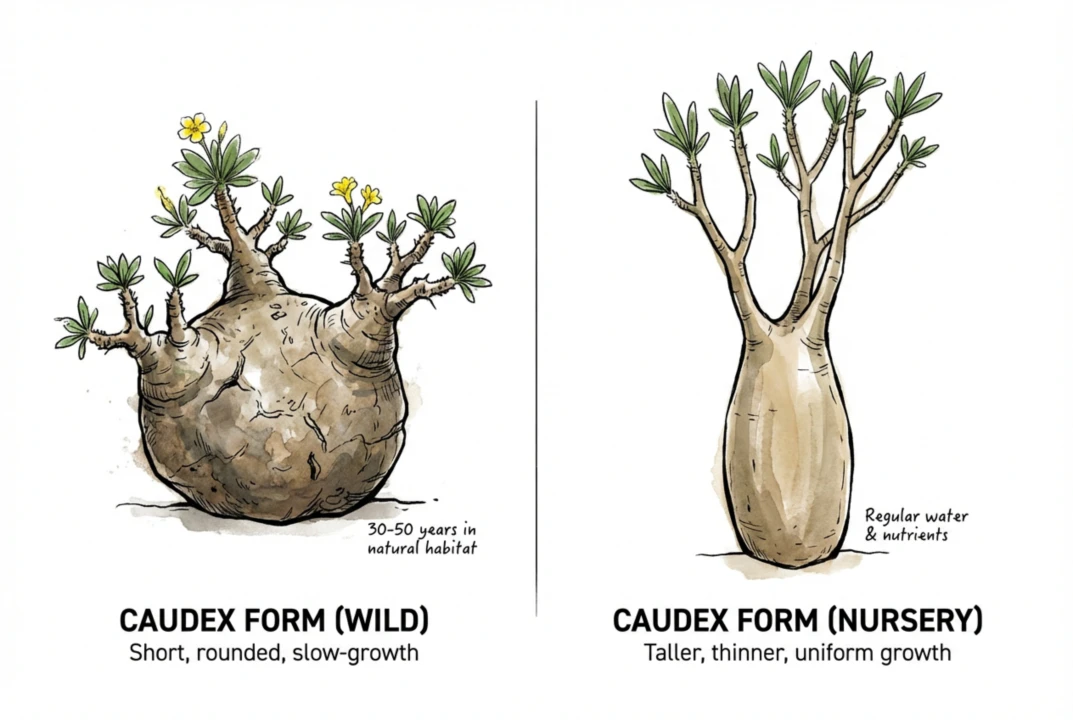
Pachypodium rosulatum subsp. gracilius is valued for compact, old-looking form, yet nursery culture and genetics can also produce squat plants. Its CITES status makes the shipment trail especially relevant. Morphology cannot replace the permit.
Dioscorea trade pressure
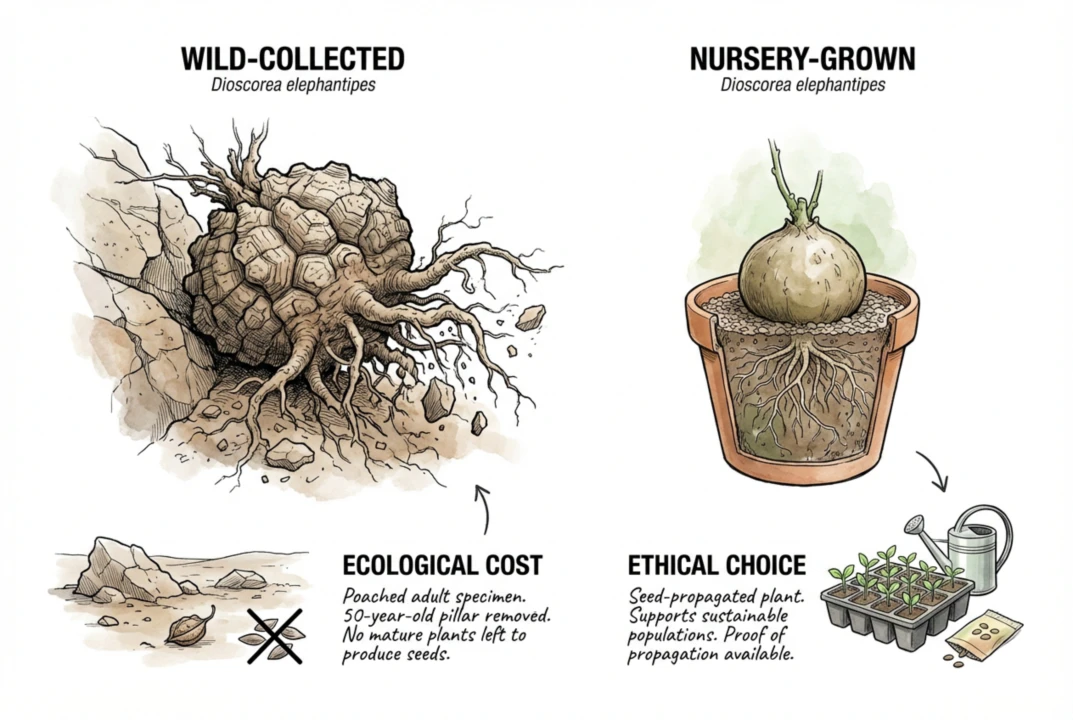
South African authorities have identified Dioscorea elephantipes among caudiciforms affected by current illegal harvesting for ornamental markets. That does not make every specimen suspect. It makes documented nursery production more valuable. Use SANBI, the IUCN Red List, Species+, and the country-of-origin authority for the taxon in front of you rather than borrowing risk from another genus.
Why Does the Plant's Origin Matter?
Consider Ecological Cost
Illegal collection can remove mature reproductive plants, reduce already small populations, damage habitat, and fund a trade chain built around future scarcity. SANBI reports that online demand has driven severe losses in parts of South Africa's Succulent Karoo, while TRAFFIC's 2024 report documents both legal and illegal succulent trade rather than treating all wild use as one category.
Separate legality from impact
Legality and conservation impact are related but not identical. A legally harvested wild plant can still carry more ecological cost than a widely available nursery-propagated alternative. Conversely, a species categorized as Least Concern can still be illegally collected, locally depleted, or protected by national law.
Price establishment risk
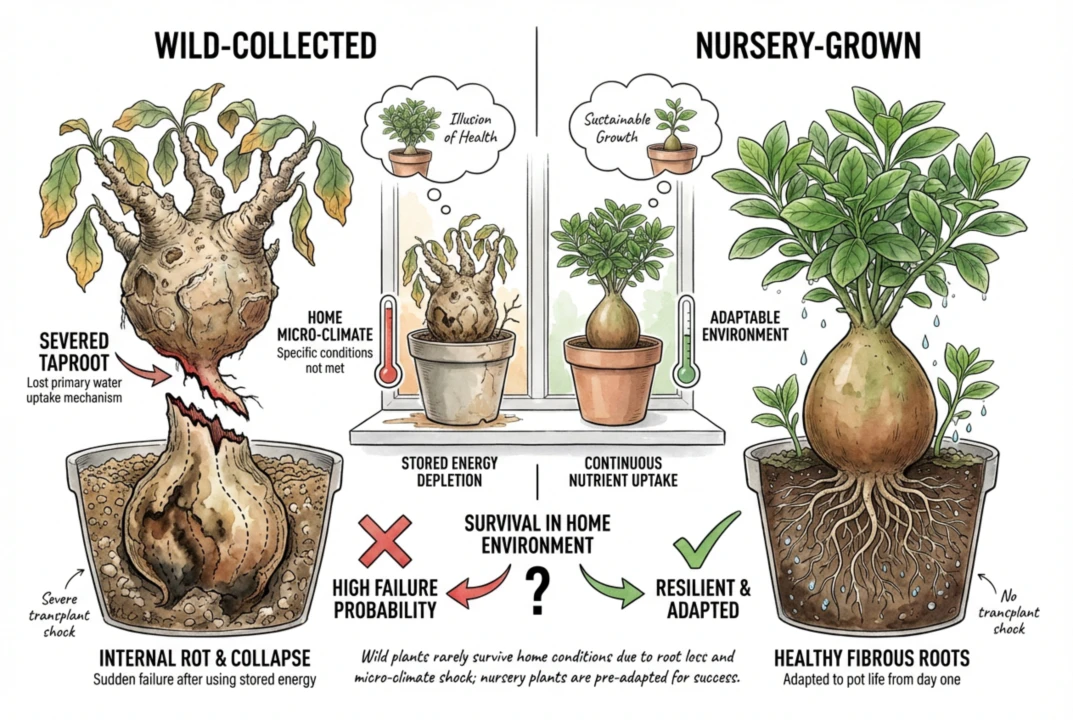
There is also a care risk. A mature plant that lost most of its fine roots can leaf out on stored reserves without having re-established. That does not mean every wild-sourced plant dies or every seedling thrives. It means the buyer should price root condition, quarantine, and establishment uncertainty into the decision.
What Does a Responsible Buying Decision Look Like?
Make the Purchase History Explainable
A good purchase should be explainable in plain terms. You should be able to name the nursery and batch for a seed-grown plant, or identify the documented shipment for a legally wild-sourced specimen. A label that says only import is not that story.
Before I pay, I ask for the exact propagation method, parent-stock source, sowing or rooting date, batch identifier, and one photograph showing other plants from that batch. I save each answer beside the listing, plant label, invoice, and permit reference.
I mark every unanswered item on the same checklist and keep the purchase on hold until the claimed history is traceable. A scar, patina, or low price never substitutes for a batch-linked propagation record. The checklist only tests the seller’s story and never replaces permit verification.
- Confirm the accepted name and current conservation and trade status.
- Prefer a smaller nursery-propagated plant when equivalent material is available.
- Match the individual to the seller's propagation and acquisition records.
- For cross-border material, verify the applicable CITES and plant-health trail.
- Keep the invoice, listing capture, seller response, and document reference with your plant records.
- Walk away when several warning signs remain and the seller will not resolve them.
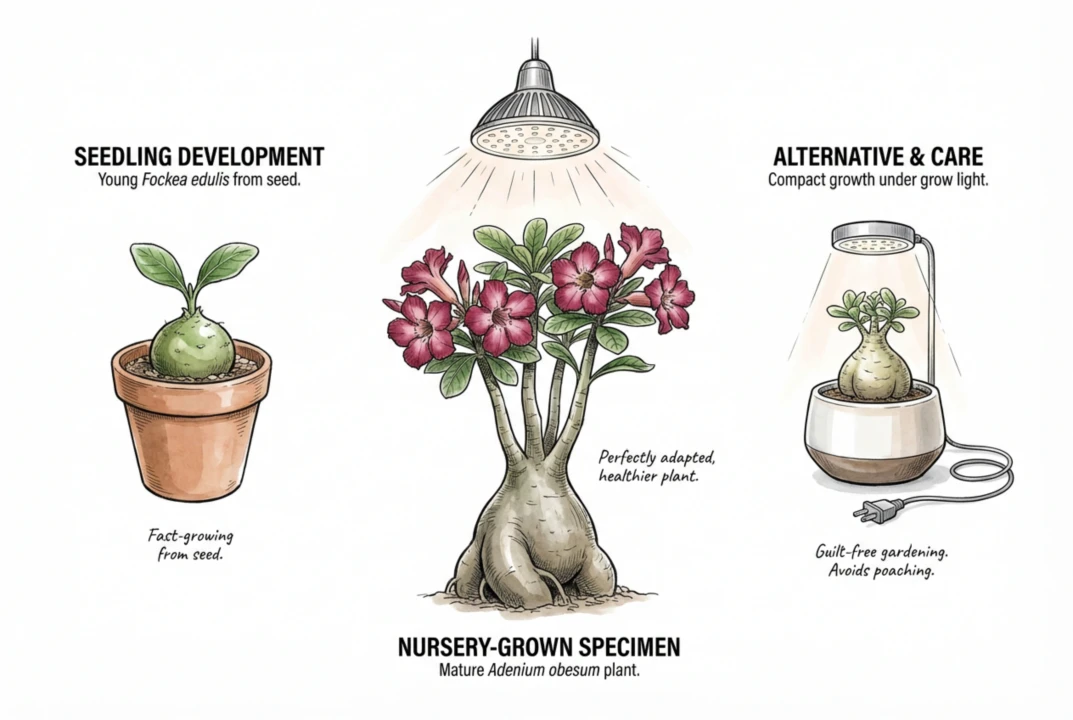
Consider documented young plants
Growing from documented seed or buying a young propagated plant changes the reward. You get to build the form instead of purchasing decades of mystery. Commonly propagated Adenium obesum and Fockea edulis can be satisfying alternatives, but commonness is not provenance. Ask the same source question.
Which Substrate Suits a Documented Nursery Plant?
Match Medium to the Actual Plant
Ethical sourcing and aftercare are separate decisions. Once you have chosen a documented seedling or established nursery plant, keep its existing root condition, species, pot size, and your watering habits in view. Caudex plants do not require one universal mineral mix.
| What you need | Better fit | Why buy it | Reason to skip |
|---|---|---|---|
| A ready-to-use gritty base for a few small pots | A pre-blended gritty mix | Saves buying and screening several separate mineral components | The species or climate needs more moisture retention than the blend provides |
| A mineral component for a custom batch | Horticultural pumice | Lets you tune particle structure and the proportion of water-retentive material | You expect pumice alone to supply nutrition or suit every watering routine |
Choose convenience or control
The pumice, akadama, and gritty-mix comparison explains how the components behave. For a small collection, the pre-blended bag buys convenience. For several species or many pots, separate pumice gives more control and can stretch further once you already stock the other ingredients.
What If the Seller Cannot Document Origin?
Scale Uncertainty to the Actual Risk
Not every old household plant has a perfect paper trail. Treat the gap in proportion to the risk. A young, common, locally propagated plant with a credible nursery history is different from a huge slow-growing import in a mixed bare-root lot.
Ask once more for traceable details
Ask one more time for the supplier, propagation method, date, country, invoice, permit reference, or importer. If the seller changes the story, refuses the accepted name, treats legal paperwork as irrelevant, or pressures you to buy before questions are answered, walk away. You do not need to prove poaching to decline a purchase.
Report credible concerns through the right channel
Do not publish the seller's name as a poacher based on morphology. Save the listing and records, and report a credible legal concern to the relevant wildlife, customs, plant-health, marketplace, or CITES authority. Let the agency with access to permits and enforcement data make the determination.