
Caudex Substrate: Pumice vs Akadama vs Gritty Mix
Compare pumice, akadama, and bagged gritty mixes by particle size, water retention, pot depth, and maintenance. Then choose a mix you can water well.
Derek Kim · 2026-06-19 · Updated 2026-07-22 · 13 min read
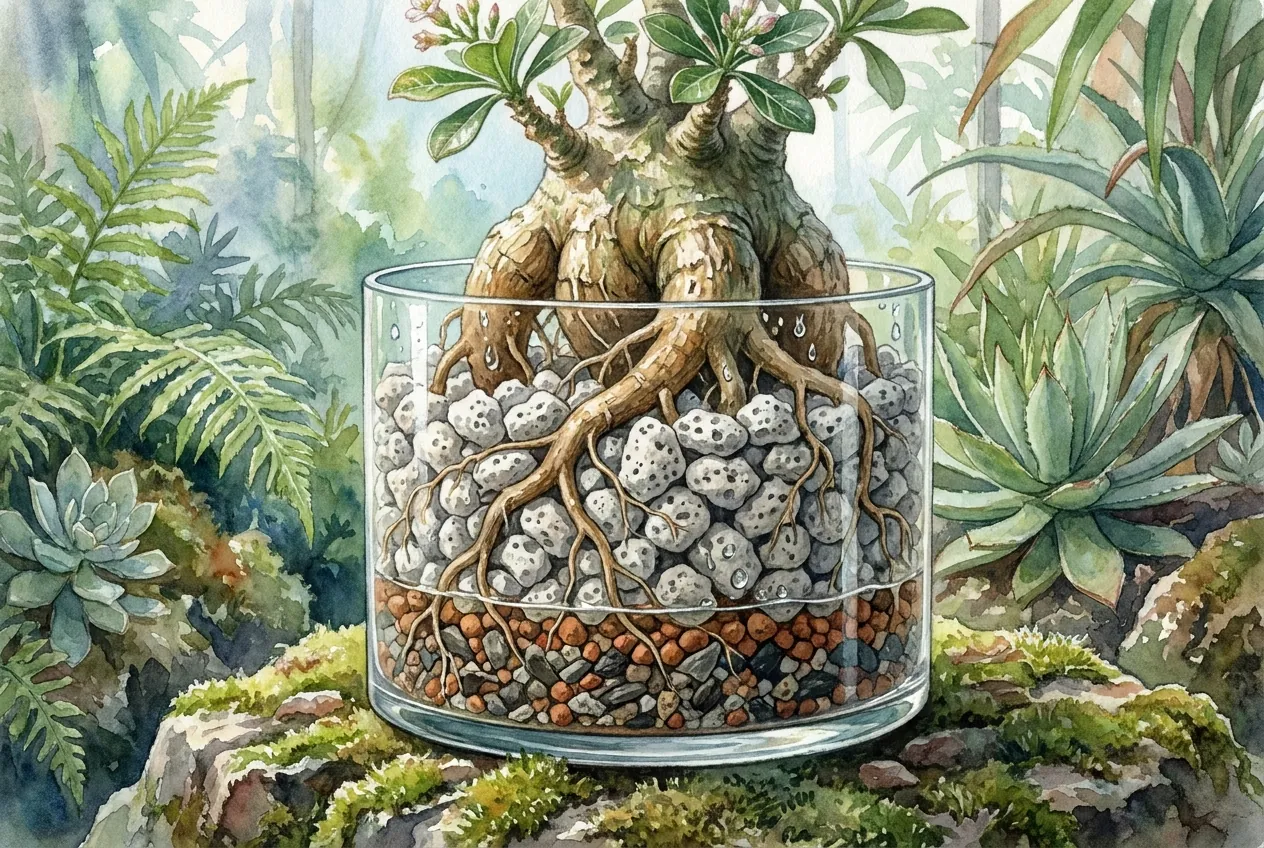
Key Takeaways
- There is no universal best caudex mix. Match the material to the problem in your pot. Pumice suits pots that stay wet too long, akadama adds usable water plus a wet-to-dry color cue, and a bagged gritty mix buys convenience for a small collection.
- Ask which material makes this particular pot easier to water correctly, not which ratio a recipe prescribes. A blend copied from another grower cannot account for your pot depth, root mass, temperature, light, or watering rhythm.
- Test a small batch and time how long a fully watered pot takes to become light before changing anything. Then change one component at the next repot.
- A good mix accepts a thorough watering, drains without a long stagnant period, and still leaves moisture for active roots. Fast-draining does not mean always dry.
- An all-mineral label does not guarantee the right balance. Grade, particle distribution, and pot geometry decide the outcome, not the word "inorganic."
Do not buy a shelf full of substrate because a recipe says every caudex needs three equal parts. The useful question is which material makes this pot easier for you to water correctly.
What should most caudex growers buy?
Match the Material to the Observed Problem
| Your pot behavior | Best first purchase | Why | When to skip it |
|---|---|---|---|
| The root zone stays wet longer than your watering rhythm allows | A screened horticultural pumice | Adds durable, porous aggregate without imposing a fixed recipe | Skip a large bag if the plant already dries too quickly or has very fine, newly forming roots |
| The pot becomes light before you can water again | A consistent small-grain akadama, tested in a small batch | Adds water-holding aggregate and a visible wet-to-dry color change | Skip it if the grade is unknown, the bag is mostly dust, or you cannot monitor structural change |
| You have only a few plants and do not want leftover components | A clearly labeled bagged gritty mix | Saves sourcing, measuring, and screening time | Skip a product whose current label does not identify its components and approximate grade |
| Your bulk aggregate contains obvious dust and oversize pieces | A soil sieve | Lets you make the particle distribution more consistent | Skip it for a small, already screened bag. A sieve is not a mandatory caudex tool |
For a small pumice trial, Bonsai Jack horticultural pumice is the more useful option when you specifically want a screened, pre-rinsed 1/8-to-3/8-inch product. The manufacturer currently lists an average particle size of 1/4 inch and a pH of 8.63, so do not treat it as automatically pH-neutral. Skip it if that grade is too coarse for a seedling or if local pumice lets you inspect the same properties before buying.
Tinyroots horticultural pumice is an alternative for someone who wants a modest packaged quantity. Its manufacturer describes the product as a pumice aggregate, but the exact bag size and particle range should be checked on the current listing before purchase. Skip it if the listing does not show the grade you need.
If you want a ready-to-use mix, Bonsai Jack 111 Succulent & Cactus Soil is a convenience purchase, not an all-mineral shortcut. Bonsai Jack's published formula identifies Monto Clay, pine bark fines, and calcined-clay Bonsai Block as its three equal parts. Confirm that formula on the current bag. That organic bark fraction may be useful, but it means the mix should not be described as inorganic. Buy it when a screened blend is worth more to you than custom control. Skip it when you need to tune water retention component by component.
A listing such as this pumice, lava, and calcined-clay blend may suit a grower who wants an all-mineral starting point. Treat the ingredients as a listing claim until the current package confirms them. An all-mineral label still does not tell you the particle distribution, water-holding behavior, or whether the mix suits your pot.
What does well-draining actually mean?
Separate Drainage from Aeration
Drainage is an event. Aeration is a condition. Water can run out of a drainage hole while a dense inner root ball remains wet. Conversely, a porous mix can hold useful water inside particles while the larger spaces between particles refill with air.
Roots need oxygen for respiration. Prolonged saturation can limit oxygen supply and weaken roots, while waterlogged conditions also favor several root-rot organisms. That is one reason container-media research measures both water-filled and air-filled pore space. The figures published for nursery media are production guidelines, however. They are not proof that an unmeasured equal-parts caudex recipe lands in a target range.
Rot is not a substrate diagnosis by itself. Cold injury, damaged tissue, salts, poor sanitation, and pathogens can be involved. If tissue is already soft, discolored, or collapsing, use the diagnostic process in the Pachypodium root-rot guide instead of assuming that adding more grit will cure it.
Use Repeatable Pot Behavior as the Practical Test
Water the whole root ball, allow free drainage, and note the pot's mass or heft. Check it at the same time each day. You are looking for a predictable change from fully watered to ready for the next irrigation, not the fastest possible race to bone-dry.
How do pot height and particle size change water and air?
Match Particle Size to Roots and Pot Geometry
Particle size, pore continuity, particle shape, and the proportion of fine material all affect water and air. Fines can occupy spaces between larger particles, but that does not make every particle below 2 or 3 mm harmful. Small roots and seedlings often need a different distribution from a large, established caudex.
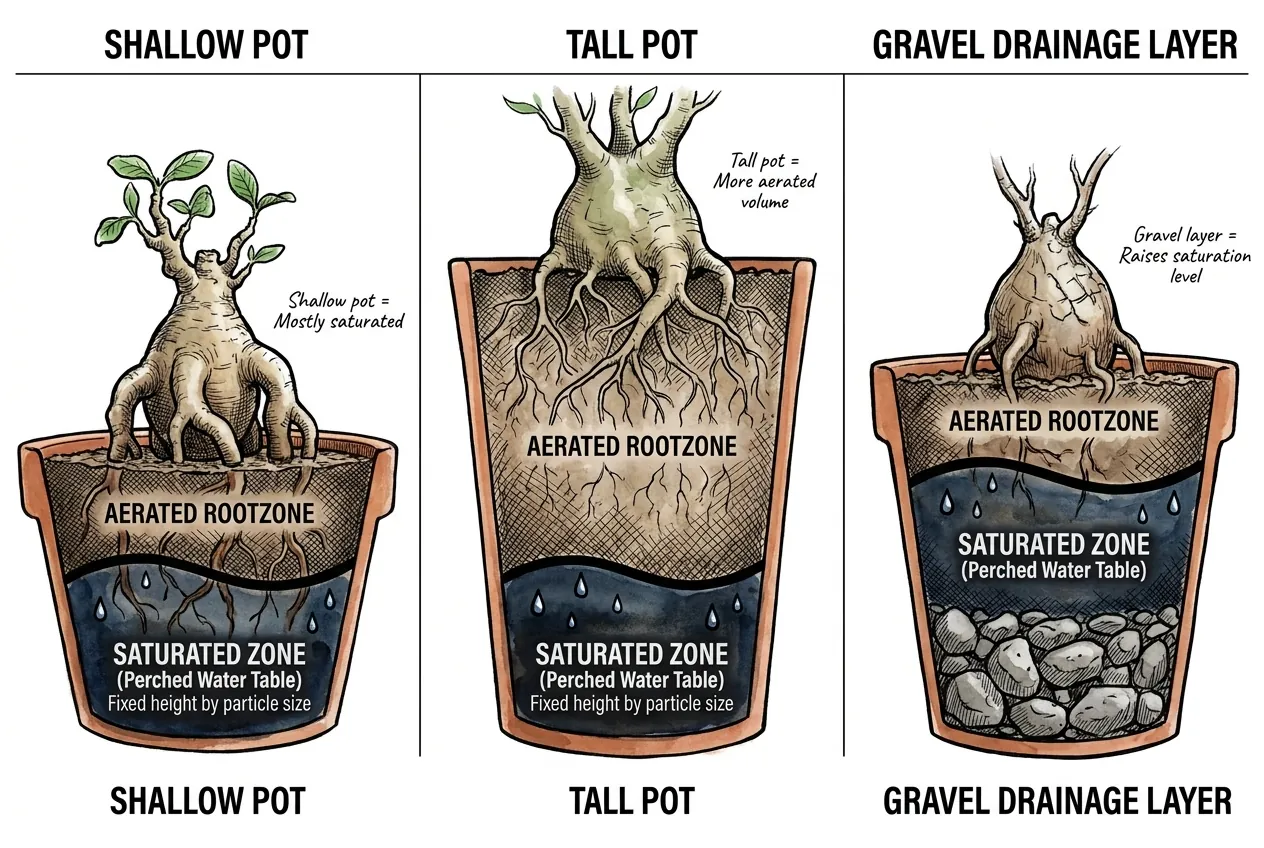
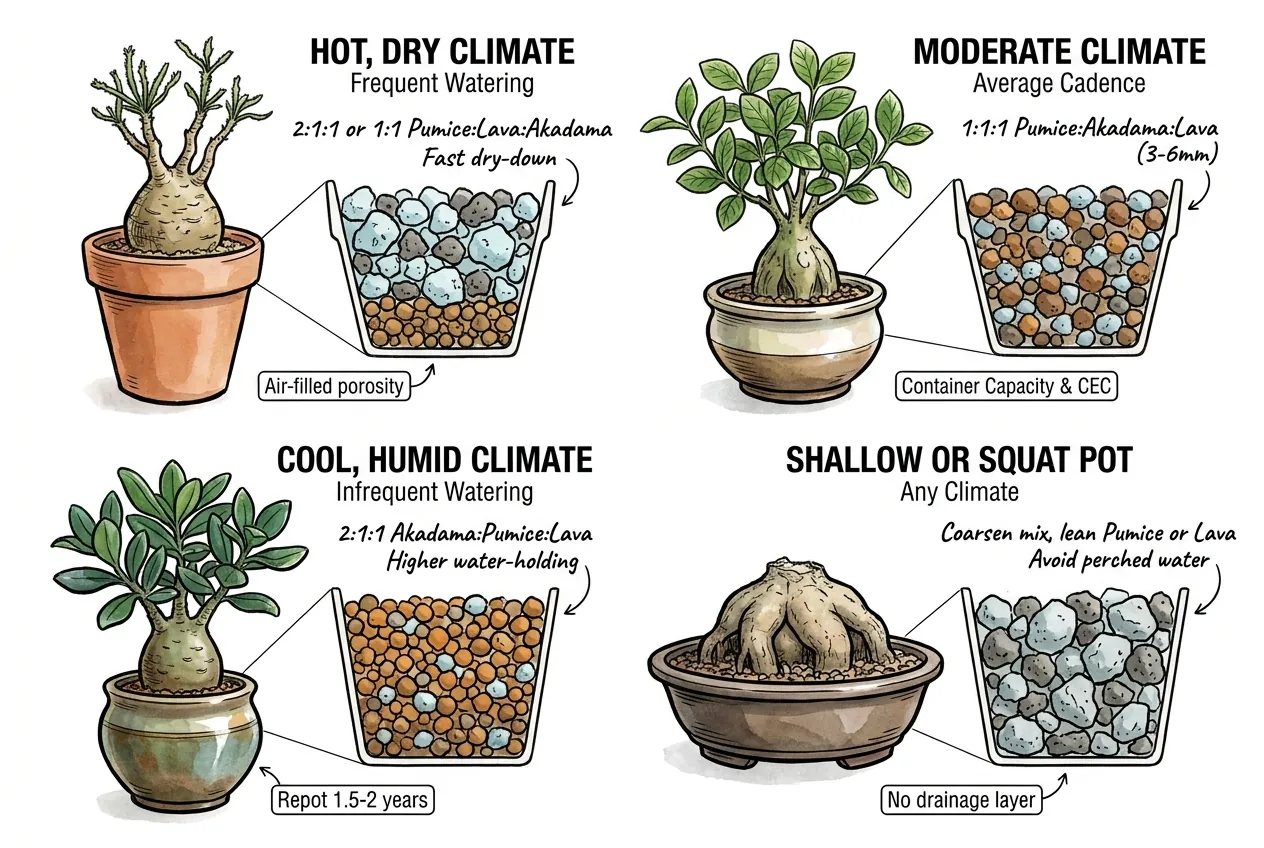
Pot geometry matters too. In the same uniform substrate, a shallow container generally has a larger wet fraction relative to its total height than a taller container after drainage. A coarse layer at the bottom does not automatically pull water out of the finer layer above it. The boundary between different textures can hold water in the upper material until enough pressure develops.
This is why a drainage layer and a coarse mix are not interchangeable. Use a pot with open drainage holes, keep those holes unobstructed, and choose one reasonably consistent root-zone mix. A mesh over a large hole may keep particles inside, but filling the bottom with rocks is not a substitute for fixing the substrate above.
Container-media porosity can be measured, but the number is meaningful only when the actual batch, packing method, pot, saturation, and drainage procedure are controlled. Unless you perform that test, call a recipe a trial, not a measured air-filled-porosity result.
When should you choose pumice?
Use Pumice for Durable Structure
Pumice is a lightweight volcanic aggregate with pores both within and between particles. In a caudex mix it can add durable structure and reduce the share of compressible material. It is useful, but it is not non-negotiable. Lava rock, suitable calcined clay, coarse perlite, and other stable aggregates can serve related roles.
Conditions that support a pumice trial
- An established plant's current root ball stays wet longer than intended.
- You want a component that is slower to compress than peat or fine bark.
- You can buy a particle range appropriate to the roots and pot.
- You are willing to adjust watering after increasing the mineral fraction.
Skip a pumice-heavy mix when a small pot already dries before you can return to it, or when a young plant needs more evenly available moisture. Also inspect the actual product. Source, density, dust content, and chemistry vary. Pumice alone is not a complete specification.
There is no useful universal lifespan to print on the bag. Reuse clean, structurally sound aggregate only when doing so fits your sanitation risk. If a plant had suspected root disease, fresh substrate is usually worth more than salvaging a small volume.
When is akadama worth it?
Use Akadama When a Moisture Cue Helps
Akadama is a naturally aggregated Japanese soil material. In a Chiba University study, its raw material was identified as a subsurface Andosol, and drying changed the aggregate structure. Intact granules can retain water while leaving larger pores between them. The wet granules also darken, which gives the grower a useful, but not infallible, moisture cue.
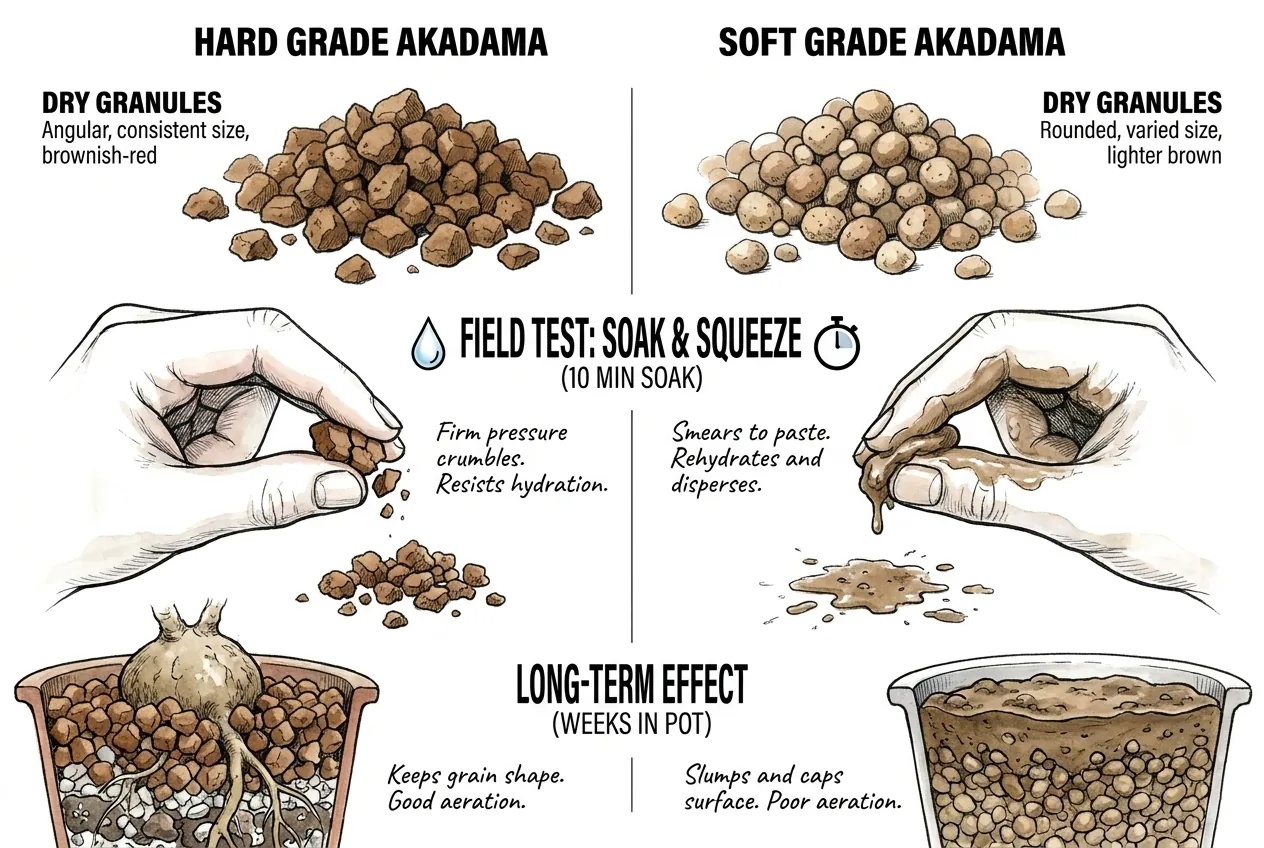
The word hard does not prove one manufacturing process. Iwamoto's Three-Line Hard Akadama is described as naturally selected soil that is sun-dried, while the same producer separately offers a heat-treated grade. Read the named product's processing information instead of assuming all hard akadama is high-fired.
Japanese Hard Ibaraki Akadama is worth considering when the current listing confirms the small-grain grade and bag volume you need. Buy it if your present mix dries too quickly and you value the color change. Skip it when the bag contains substantial crushed material, when freezing and rough handling are likely, or when local substitutes give you more consistent specifications.
Do not repot on a universal one- or two-year timer. Watch the pot instead. Slower drainage, persistent surface crusting, a large increase in fines, or a root system that has filled the container are better reasons to investigate. A few softened granules do not by themselves prove that the whole root zone has failed.
Is a bagged gritty mix worth the price?
Pay for a Bagged Mix Only When Convenience Helps
For one or two plants, often yes. The real value is not that the bag has discovered a perfect ratio. It is that somebody else sourced, screened, and combined the components. For a large collection, separate components provide more control and may reduce waste, but only if you will actually use and store them.
Check four things on the current label
- Read the named components on the label. Premium and professional do not tell you whether bark, peat, or coir is present.
- Check the visible particle distribution. One average size can hide both dust and oversized pieces.
- Compare package volume by usable dry volume, not only bag price or shipping weight.
- Choose a mix you can modify. You should be able to add a little water-holding or coarse material after observing the first trial.
Do not pay extra merely for an all-mineral label. Mineral mixes still require watering, nutrition, salt management, and occasional inspection, and they can dry too quickly in a small, hot pot.
Do you need a sieve?
Use a Sieve for a Real Particle Problem
A sieve is useful when the material in front of you has a problem, not as an automatic upgrade for every bag.
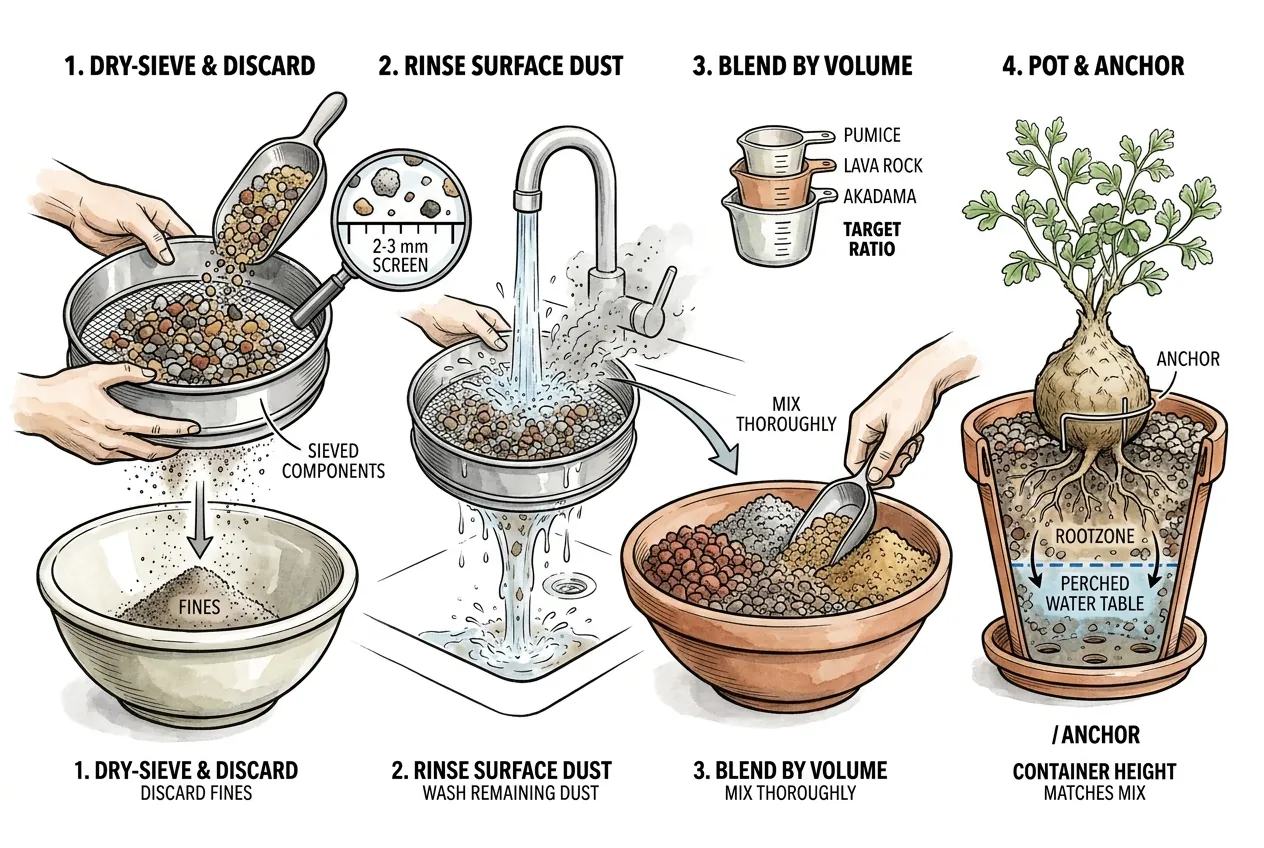
The Practicool garden sieve set makes sense for a grower who routinely buys dusty bulk aggregate and needs several mesh options. Check the current mesh sizes against the particle range you intend to keep. Skip it if your collection is small or the product is already consistently screened.
This interchangeable stainless riddle is the lower-complexity choice when its current inserts cover your needed range. The same warning applies. No single 3 mm cutoff suits every seedling, root size, pot, or component.
Screen only enough to remove the fraction that is genuinely mismatched. Throwing away every small particle can make an already dry mix harder to manage. Handle dusty dry material outdoors or with suitable dust control, then follow the supplier's instructions on whether rinsing is appropriate.
How should you test and adjust a mix?
Change One Variable at a Time
An equal-parts blend of pumice, akadama, and another coarse aggregate can be a starting batch for an established, thick-rooted plant in moderate conditions, but it is not a published caudex standard. Do not move an entire collection into it on faith. Keep the trial small and reversible.
- Record the starting mix. Measure components by volume and note the approximate particle grades.
- Weigh or learn the heft. Record the dry potted plant, then the same pot after thorough watering and free drainage.
- Check at fixed intervals. Note mass, surface condition, pot temperature, and plant response at the same time each day.
- Inspect below the surface. A dry top does not prove the center is dry. Use pot mass and, where safe, a clean probe or root-zone inspection at repot.
- Change one variable. At the next appropriate repot, make a modest change to one component rather than replacing the whole recipe blindly.
Whenever I make a new mix, one small scoop dries completely in a clear container labeled with the date, component ratios, and approximate particle grades. That dry scoop is not a moisture test. It remains in my records only as a visual reference for what entered the pot.
At the next repot I place the unused sample beside the recovered mix on white paper and photograph both after passing them through the same sieve sizes. This shows whether akadama crushed, fines accumulated, bark broke down, or the original mix was already finer than I remembered.
Root condition stays separate from my reference-sample comparison. The stored mix can document changes in particle structure, but it cannot prove why a root died or whether one component caused the problem.
If the pot remains heavy for longer than your plant and conditions tolerate, reduce fine or highly water-retentive material and add an appropriate stable aggregate. If it becomes light too fast and fine roots are declining, do the reverse. The direction of adjustment is more defensible than any universal number.
Watering method still matters. A coarse mix should usually be wetted thoroughly rather than receiving repeated sips that leave part of the root ball dry. The top-down versus bottom-watering guide explains when each method can actually wet the intended volume.
How do you spot substrate failure?
Separate Medium Failure from Root Disease
| What you observe | Likely possibilities | Next check |
|---|---|---|
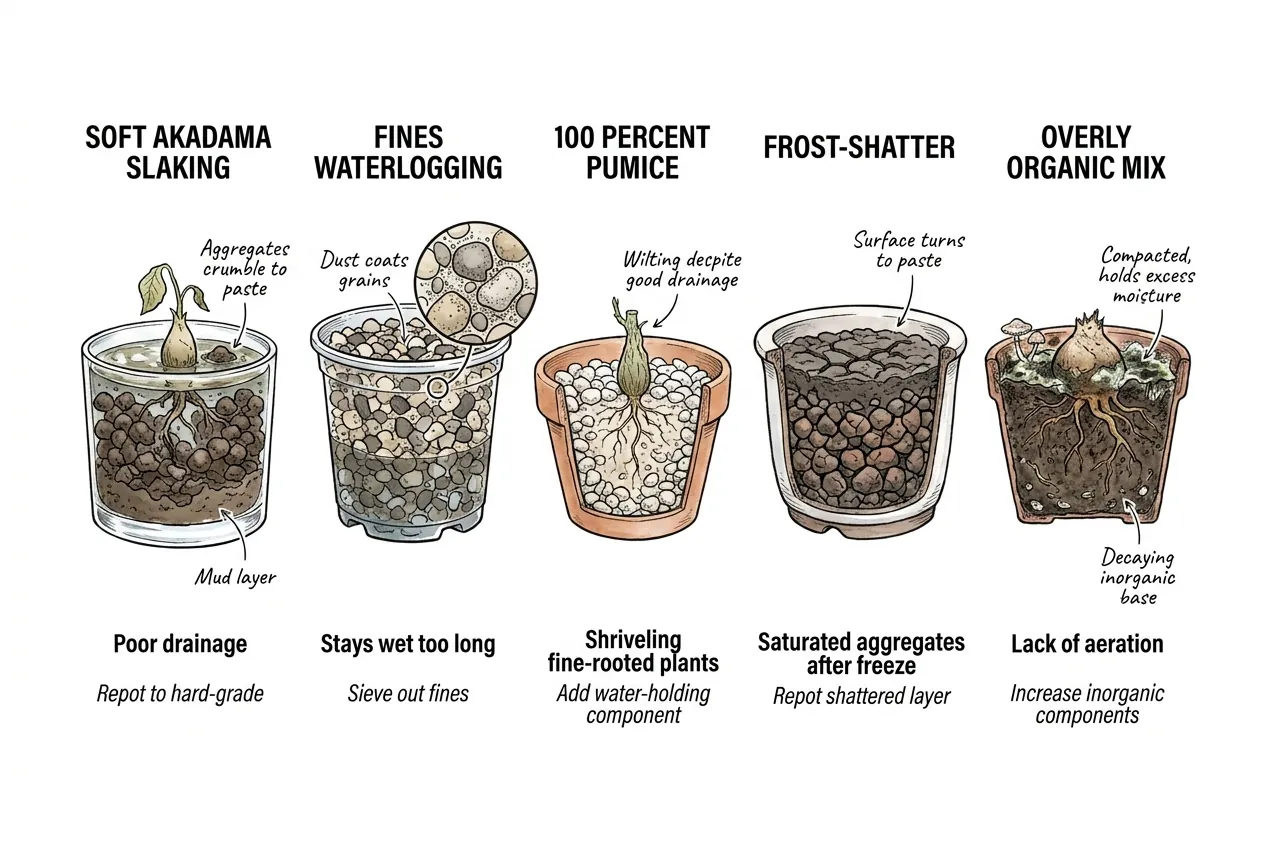
| Water pools on the surface or drains much more slowly than before | Compaction, settled fines, blocked holes, or a dense root mass | Check the drainage path and inspect structure at the next safe root examination |
| The pot becomes light much faster than expected | Too little water-holding material, hydrophobic organic matter, incomplete wetting, or a small root ball | Confirm full wetting before adding finer material |
| A pale crust appears | Fertilizer or hard-water salts | Review water quality and leaching. Do not diagnose substrate breakdown from color alone. |
| Akadama crushes easily and fines are increasing | Grade change, handling, freeze-thaw exposure, or normal weathering | Compare drainage and the condition of the root zone before deciding to repot |
| The caudex or roots are soft and discolored | Rot, injury, or dead tissue, not merely a bad ratio | Isolate, inspect, and diagnose before buying another amendment |
Do not try to repair active rot by layering new pumice on top. For a recently imported plant with few functioning roots, substrate choice is only one part of the process. See the imported Pachypodium rooting guide before potting.
How do you make the final choice?
Buy the Smallest Useful Trial
For a pot that stays wet, start with a small bag of screened pumice and amend a trial batch. For a pot that dries faster than the grower can manage, test a modest akadama fraction. For a small collection where convenience is the real constraint, choose a transparent bagged mix and keep enough single-component aggregate to adjust it.
A risky purchase is a large volume of material chosen from a universal ratio. A more defensible purchase is the smallest one that answers a specific question about your pot.
Affiliate Disclosure
This article contains Amazon affiliate links. As an Amazon Associate I earn from qualifying purchases. If you use these links, the site may earn a commission at no extra cost to you. Product availability, price, and specifications can change. Check the current listing before buying.