
Top vs Bottom Watering for Caudex Plants
Choose top or bottom watering by root-ball wetting, substrate, salts, and plant activity. Learn when to soak, flush, drain, and check pot mass.
Nathan Brooks · 2026-02-09 · Updated 2026-05-26 · 10 min read
Key Takeaways
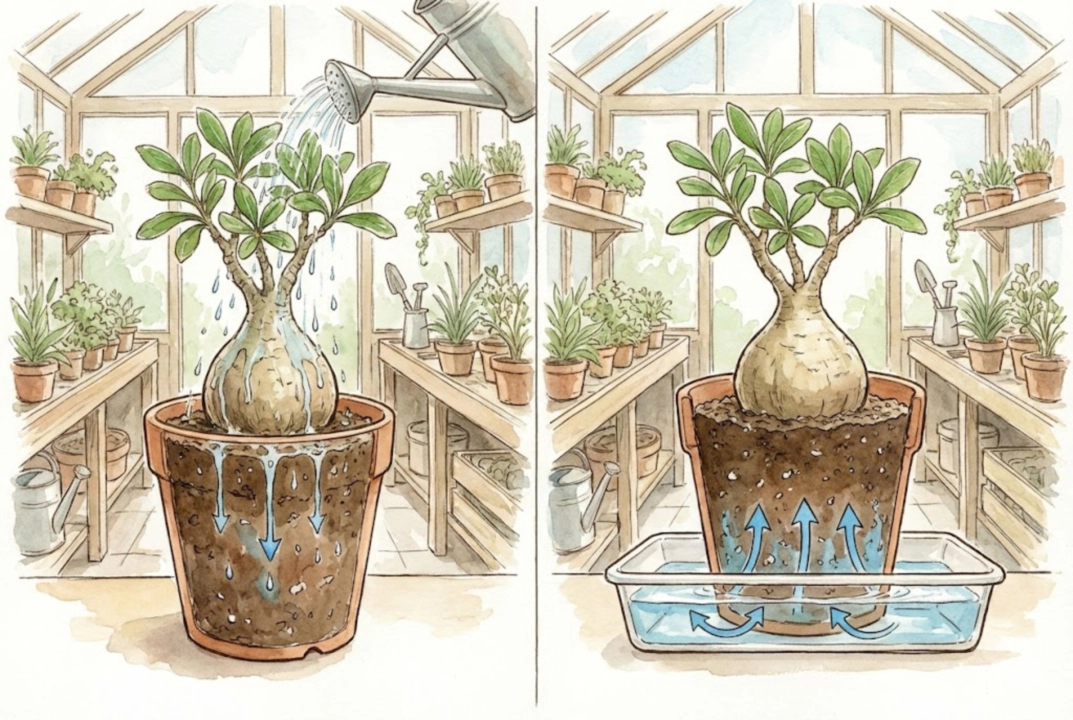
- Use thorough top watering when the mix accepts water evenly. Use a temporary bottom soak only to solve a specific wetting problem. A caudex does not care which direction water entered.
- Top watering is fast, lets you observe drainage, and carries soluble salts out of the pot. Include it whenever your water or fertilizer adds salts, because bottom watering does not leach.
- Bottom soaking helps when a dry root ball repels water, a tiny pot is easily disturbed, or you need slower rewetting. It only works when the substrate wicks through its full height.
- Neither method prevents rot. What matters is whether the whole root ball wetted, whether excess water was removed, and how long the mix stays wet. Never leave a caudex pot standing in a reservoir.
- Confirm the center wetted by pot mass, not runoff, and water by growth and root condition rather than the calendar. No controlled trial makes one schedule universal.
The top-versus-bottom argument often starts with the wrong question. A caudex does not care which direction the water entered. Its roots experience the amount, distribution, chemistry, and duration of moisture that remained afterward.
Which watering method should you use today?
Match the Method to the Current Wetting Problem
| Situation | Use first | Why | Stop condition |
|---|---|---|---|
| The mix wets evenly and the pot drains freely | Top watering | Fast, observable, and able to leach salts when enough water passes through | Stop after full wetting and free drainage. Empty the saucer |
| Water runs down the pot wall while the center stays dry | Short bottom soak, then recheck | Slow capillary uptake can rewet a hydrophobic or uneven root ball | Remove the pot once its mass shows full wetting. Do not wait for a universal number of minutes |
| A seedling or loose small pot is displaced by the stream | Gentle bottom watering or a controlled top stream | Avoids eroding the surface while roots establish | Remove runoff and return to a normal wet-dry cycle |
| You use hard water or frequent fertilizer | Top watering with planned leaching | Bottom watering moves water upward but does not carry accumulated salts out of the drainage holes | Use suitable water and discard the drained solution |
| A very coarse, tall mix will not wick to the upper roots | Top watering in two passes | Bottom soaking only works when the substrate has continuous capillary pathways | Confirm the center is wet by pot mass, not runoff alone |
Do not treat one schedule as a universal rule
A mostly-bottom, occasional-top routine is not a proven scientific winner. There is no controlled caudex trial showing that schedule is superior. Use the method that solves the present wetting problem, and include top leaching when your water and fertilizer add salts.
What actually raises rot risk after watering?
Watering once is not the same as keeping a root zone saturated. Roots require oxygen for respiration. When pore spaces remain water-filled for too long, oxygen replenishment slows and roots can become stressed. Waterlogged conditions also favor several root and crown pathogens.
Check the Whole System
- particle size and the fraction of fine, compressible material
- pot depth, drainage holes, and whether a cachepot holds runoff
- root mass and whether the root ball is alive enough to use water
- temperature, light, air movement, and plant activity
- how soon the next irrigation arrives
- wounds, salts, cold injury, and pathogens already present
That is why neither claim that top watering causes rot nor claim that bottom watering prevents rot is reliable. A saturated pot left in a tray can fail by either method. If the mix is the recurring problem, use the caudex substrate comparison before changing the watering ritual again.
How should you top-water a caudex?
Control the First Pass
Aim a controlled stream at the substrate, not into a hollow crown or tight caudex fold. Apply the first pass slowly, pause briefly if the surface is very dry, then continue until the root ball has gained the expected watered mass and excess water drains. Empty the saucer or cachepot.
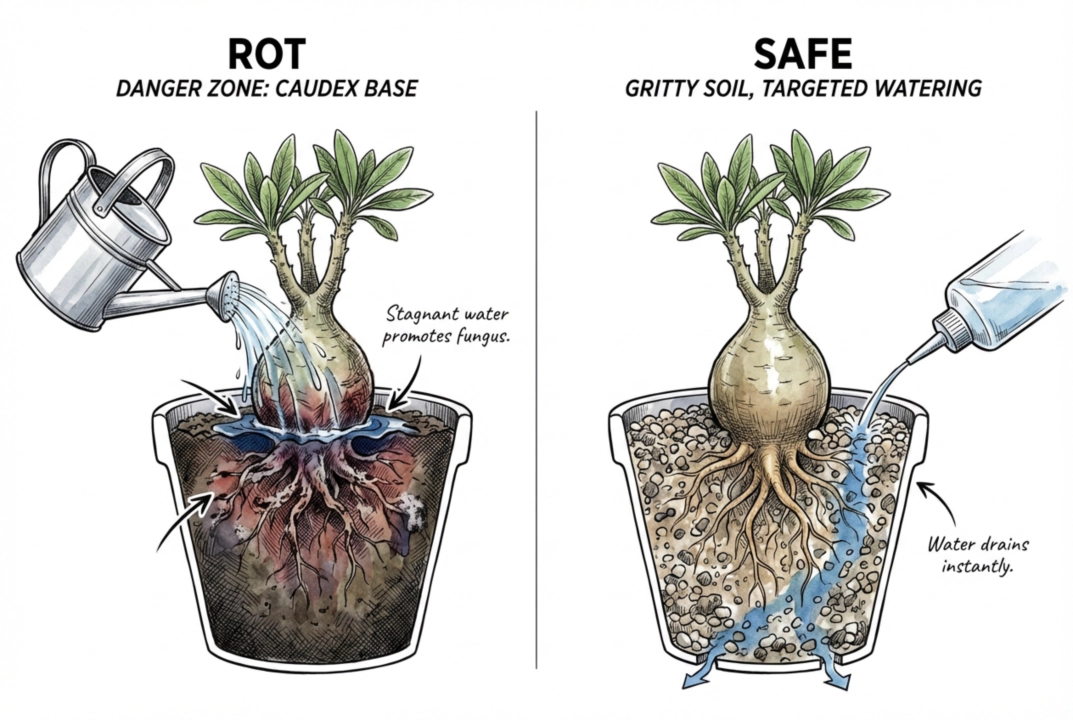
A splash on intact tissue is not a rot diagnosis. The avoidable problem is water trapped for a long period in damaged tissue or a tight, poorly ventilated recess. A narrow stream provides control, but it does not need to be so small that only one corner of the pot receives a sip.
Read runoff together with pot mass
Runoff is useful evidence, but it is not proof of full wetting. Water can channel through a gap along the pot wall. Learn the mass or heft of the fully watered pot and compare it with the dry baseline.
Why does top watering matter for salt leaching?
Use Enough Water to Move Salts Out
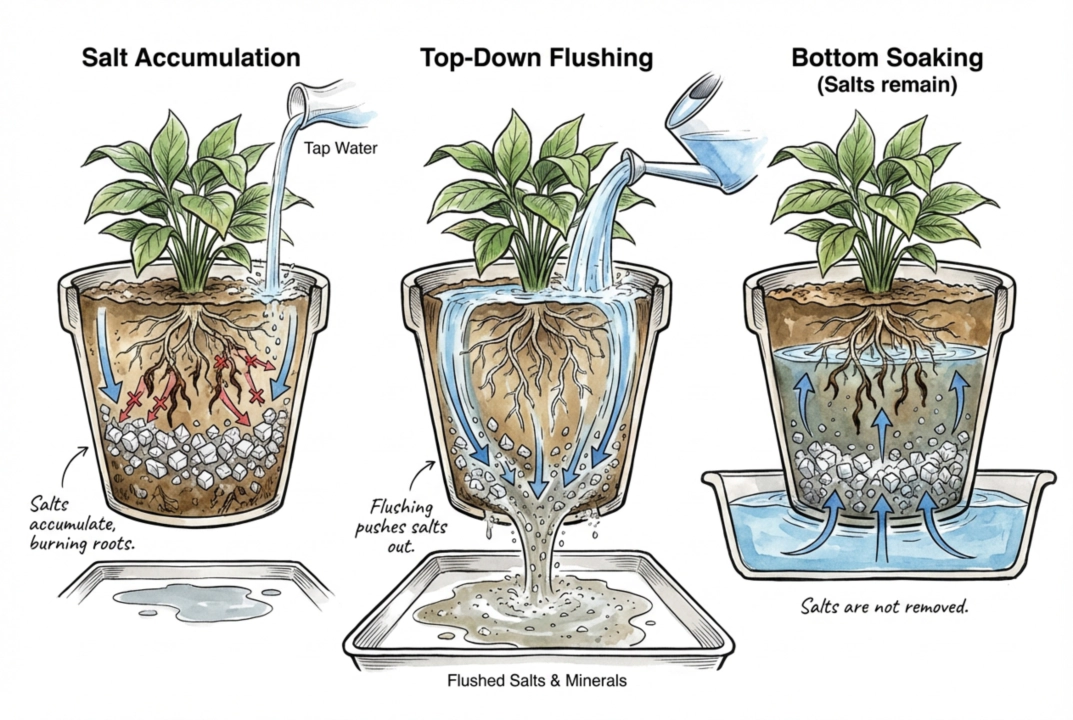
Irrigation water and fertilizer leave dissolved ions behind as plants use water and evaporation removes it. At excessive concentrations, soluble salts make water uptake harder and can injure roots or leaf margins. Sodium and chloride deserve particular attention when household water has been ion-exchange softened.
Leaching means passing suitable low-salt water through the entire root zone and allowing the solution to leave the pot. Pouring off a few drops is not much of a flush, and letting the pot sit in its own runoff lets the salts move back into the mix.
Measure the need before escalating
Do not wait for a white crust as the only trigger. Salts can rise before a deposit is obvious. Base the need on irrigation-water quality, fertilizer rate, pot behavior, and, when the collection justifies it, input and leachate electrical conductivity. The hard-water and salt guide shows how to measure instead of guessing.
When is bottom watering useful?
Understand the Capillary Limit
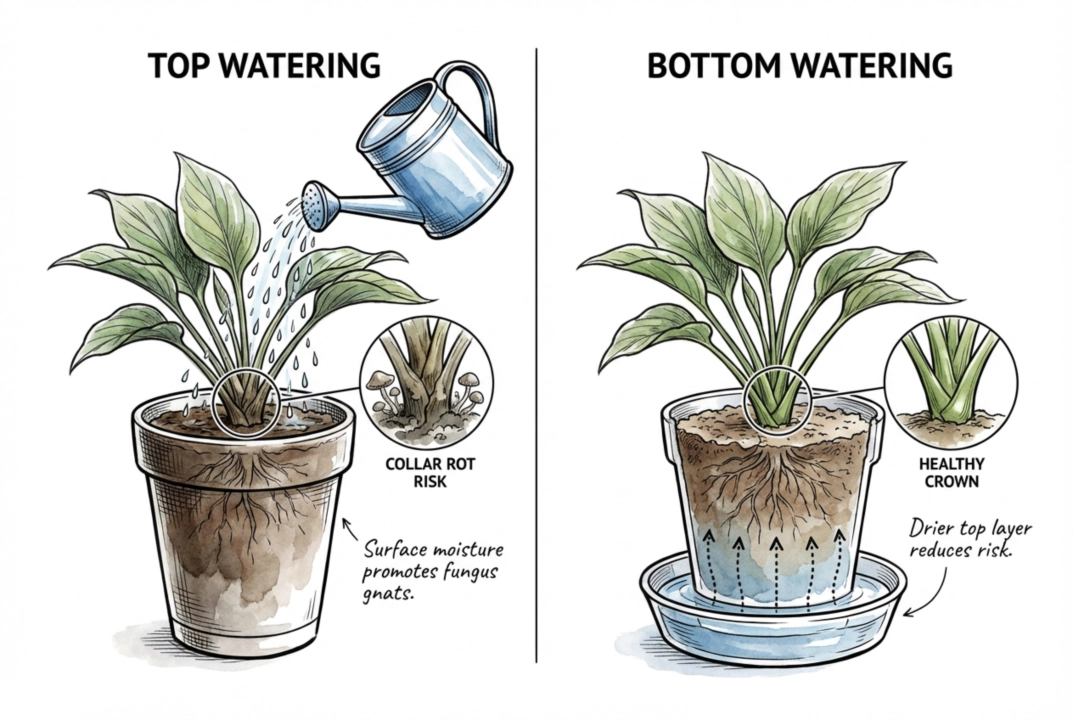
Bottom watering places a drainage-hole pot in shallow water so the substrate can draw water upward by capillary action. The rate and height of that movement depend on the substrate, how dry it is, pot height, and contact with the water. A coarse mix may wick slowly or incompletely.
Use a monitored bottom soak
- Use a clean tray and water appropriate for the plant.
- Set the drainage holes in shallow water.
- Check pot mass and moisture distribution rather than waiting a fixed 15 or 30 minutes.
- Remove the pot as soon as the root ball is adequately wetted.
- Let it drain fully and clean the tray before another plant uses it.
Do not share standing water among plants when pests or root disease may be present. Commercial subirrigation systems can spread root pathogens through recirculated solution. The same sanitation logic applies to a household tray.
Does bottom watering keep the crown dry or prevent fungus gnats?
Keep a Drier Surface Without Overclaiming
Sometimes it leaves the upper surface drier, but not always. If you soak until moisture reaches the top, the top is wet. If a fine mix holds water for days, entering from below does not correct that physical problem.
A drier surface is less attractive to fungus-gnat egg laying, yet bottom watering is not a larvicide and can still maintain a moist root zone. If gnats are already present, use the identification and treatment steps in the caudex fungus-gnat guide.
Protect the collar by controlling where water remains
For a caudex with a deep cup or damaged collar, keeping irrigation out of that recess is sensible. You can do that with bottom watering or with a controlled top stream. The method is less important than where the water remains.
Does bottom watering create deeper roots?
Root Depth Is Not a Method Guarantee
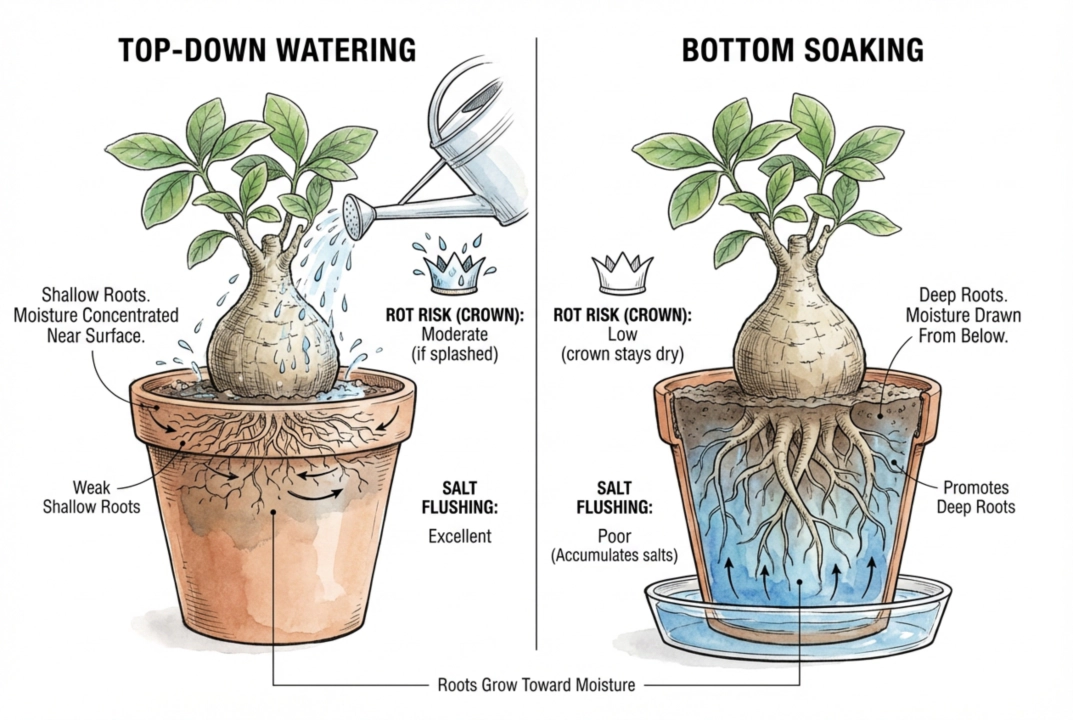
There is no good basis for promising a deeper or more robust caudex root system from occasional tray soaking. Roots respond to gradients of water, oxygen, temperature, and nutrients, while their architecture is strongly species-dependent.
A poorly executed shallow top watering can leave the lower root ball dry. That is a problem with incomplete wetting, not evidence that all top watering makes shallow roots. A thorough top watering and a successful bottom soak can both wet the whole profile.
Judge the wetting profile, not the direction of entry
| Feature | Top watering | Bottom watering |
|---|---|---|
| Whole-pot wetting | Good when applied slowly in more than one pass. Channeling is possible | Good only when the substrate wicks through the full height |
| Salt removal | Can leach salts when enough suitable water drains out | Does not remove salts. Upward movement can concentrate them near the surface |
| Crown control | A narrow stream can avoid the crown | May keep the surface drier if stopped before moisture reaches it |
| Sanitation | Runoff should not contact other pots | Shared or recirculated tray water can move pests and pathogens |
| Best use | Routine irrigation and leaching in a receptive mix | Rewetting a resistant root ball or protecting a loose small surface |
How should plant activity change the decision?
Use Growth Signals Instead of the Calendar
The calendar provides context, but the plant's species, current growth, roots, light, and temperature determine how quickly it can use water. A leafy plant can still have compromised roots. A leafless plant may be dormant, recently shipped, cold-damaged, or in trouble.
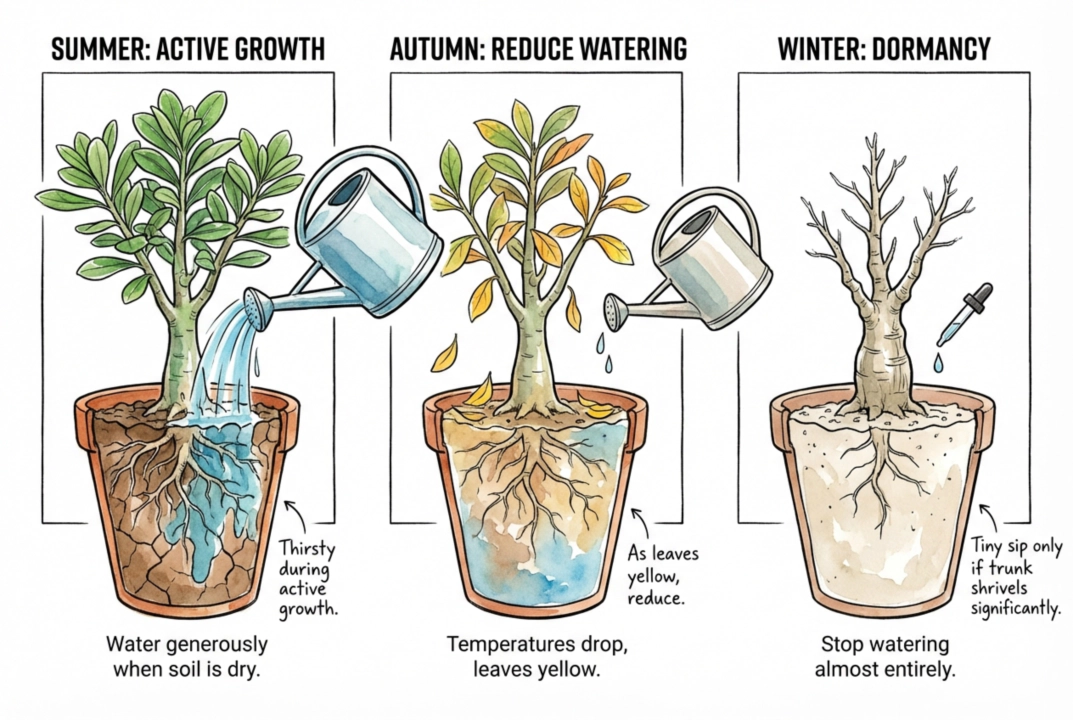
For a known warm-season grower, rising light and temperature plus expanding leaves usually shorten dry-down. Water thoroughly when the root ball reaches the dryness appropriate to that species and pot, then measure how long it takes to become light again. Taper as growth slows. Do not cut water solely because a date arrived.
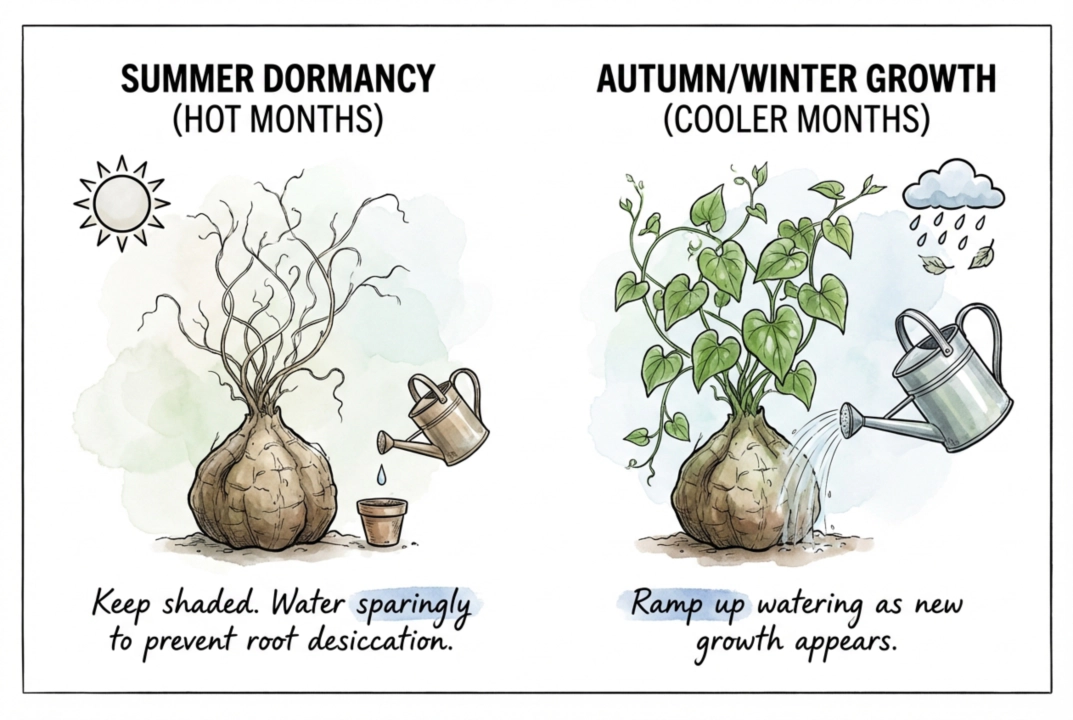
For a winter-growing species, new autumn growth can signal renewed water use while a summer-growing plant nearby is slowing. Confirm the species before borrowing its neighbor's schedule. When roots are inactive, prolonged wetness is especially risky. When a plant is actively growing, repeated tiny sips can leave part of the root system unused.
Do you need special watering equipment?
Choose a Tool for a Specific Constraint
You need a drainage-hole pot, a way to apply water, and a way to recognize wet and dry mass. The two tools below solve narrower problems. Neither is required.
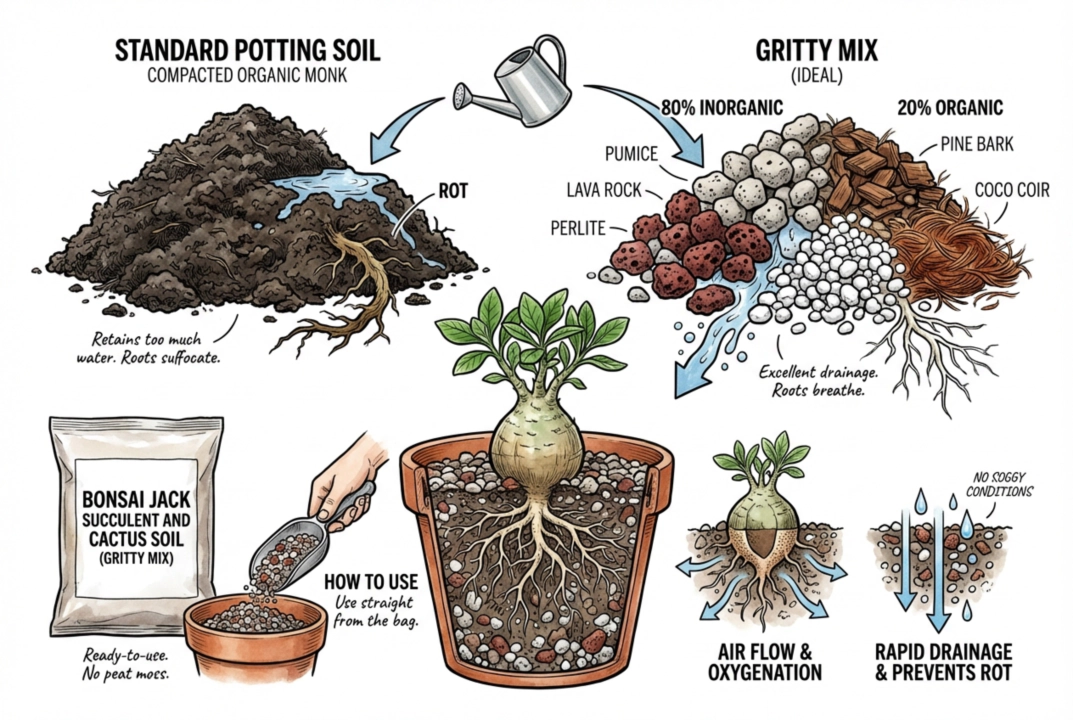
Use pumice only for a measured substrate trial
Horticultural pumice is worth considering when your existing root ball stays wet too long and you want more air-filled porosity. The particle grade is what matters. Match it to the roots rather than the label. A grade too coarse for fine roots leaves large pores that never wet evenly, so buy a small quantity for a measured substrate trial first. Skip it when the present mix already dries predictably. Pumice is an option, not a mandatory backbone.
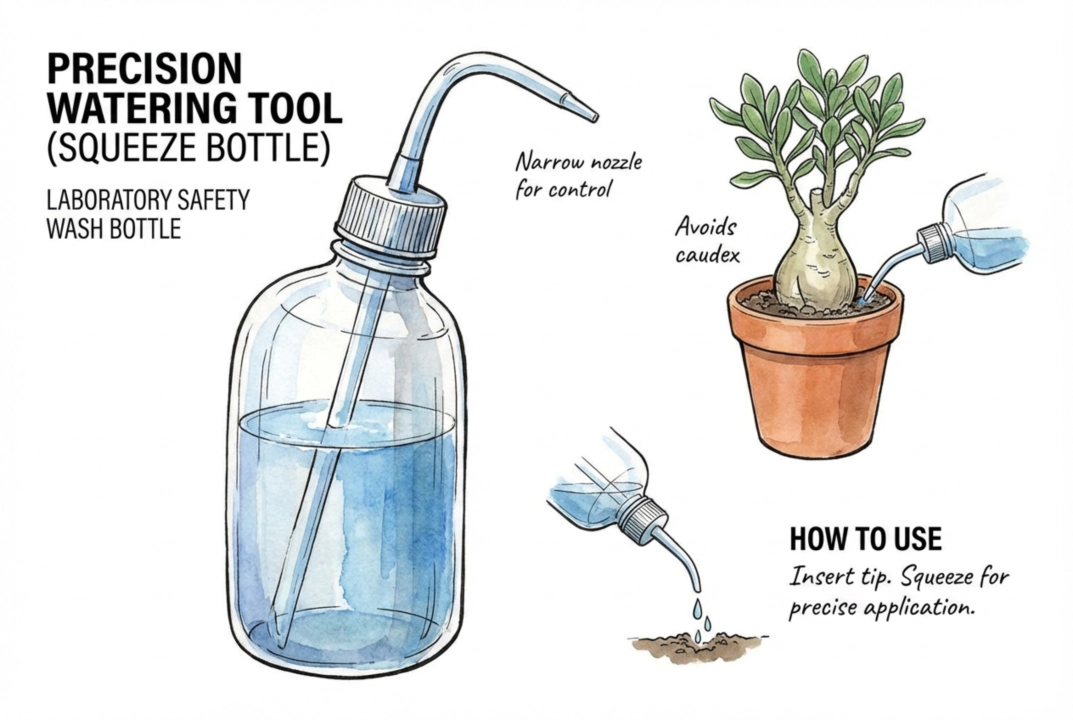
Use a narrow spout for control, not for every pot
A narrow-spout squeeze bottle helps with seedlings, small bonsai pots, and tight caudex folds where a large can is awkward. Skip it for a medium or large pot that needs a thorough flush. Repeatedly refilling a tiny bottle adds work and encourages under-watering. Check the bottle material, capacity, and cap so it delivers a controllable stream.
Is a soft caudex rot or dehydration?
Separate Dehydration Clues from Disease Clues
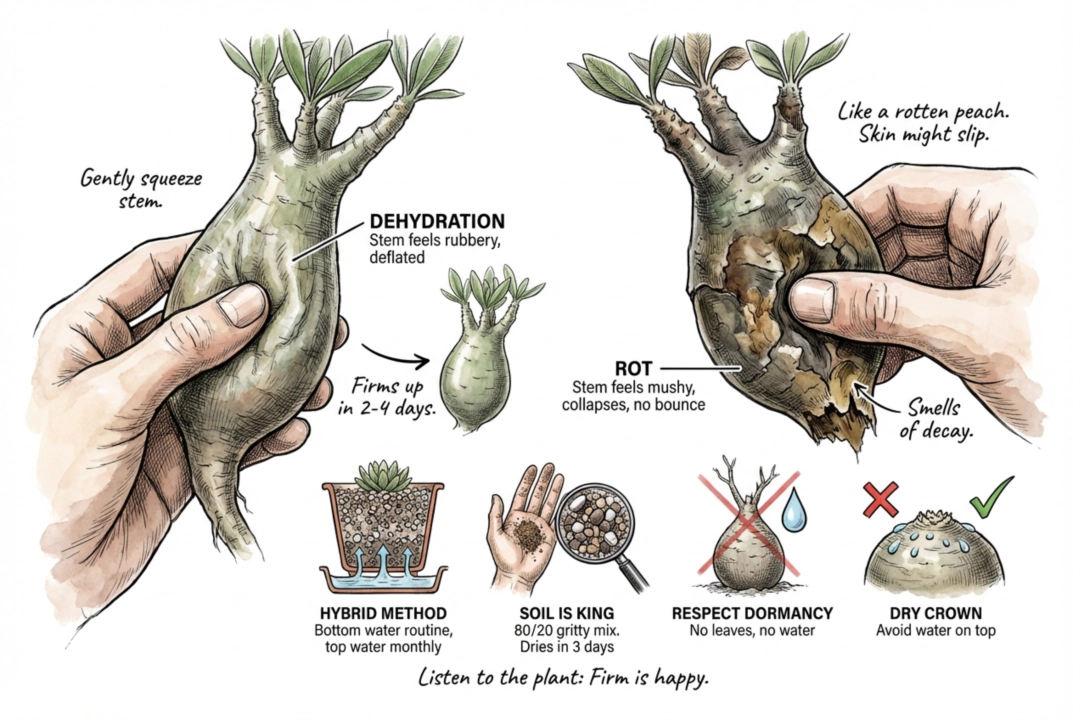
Firmness is one clue. A dry, light pot plus evenly wrinkled but intact tissue can support dehydration as the explanation. Localized collapse, discoloration, slipping skin, a spreading lesion, or damaged roots raises concern for rot or injury. Smell is neither required nor specific.
Inspect before watering or cutting
Do not water automatically because a caudex feels soft, and do not cut automatically because it looks wrinkled. Check pot mass, substrate moisture below the surface, recent temperature, and roots when the evidence warrants unpotting. If diseased tissue is plausible, isolate the plant and use the caudex root-rot diagnostic guide before selecting a treatment.
What watering routine should you use?
Use a Reversible Decision Sequence
- Know whether the plant is actively growing and whether its roots are functioning.
- Lift or weigh the pot before watering.
- Top-water in controlled passes when the mix accepts water. Bottom-soak only when it solves a specific wetting problem.
- Confirm the center of the root ball was wetted, then remove all runoff.
- Record how long the pot takes to return toward its dry mass.
- Do not water again because a weekday arrived.
- Plan leaching according to water and fertilizer inputs, not a universal monthly schedule.
That routine makes the method reversible. If a pot does not wick, top-water it. If top water channels around a dry center, soak it briefly. The successful method is the one that wets the intended root zone and then lets it re-aerate on a predictable schedule.
To compare the methods by result, my log starts with pot mass before watering and after free drainage. When the mix needs inspection, I probe one marked shallow point and one marked deeper point near the same pot edge. The notes state whether water reached the lower zone without leaving the crown or a damaged recess wet.
This is how I decide whether the issue is channeling, incomplete soaking, or simply an inactive plant. I do not push the probe through a dense root ball every time, because repeated disturbance can create its own problem.
Sources and scope
- Semisystematic review of capillary irrigation (benefits, substrate dependence, salt distribution, and disease-transfer limitations of subirrigation systems).
- Oregon State University Extension: soluble salts in houseplants.
- Penn State Extension: drainage holes, waterlogging, and removing cachepot water.
- Clemson Cooperative Extension: waterlogging, oxygen, and root/crown-rot conditions.
No controlled study establishes one top-versus-bottom schedule for all caudex plants. Product details, water chemistry, substrate behavior, and species activity all need to be checked in the actual setup.