
How VPD Shapes Caudex Plant Rot and Shriveling
Learn how VPD combines temperature and humidity, when it matters for caudex shriveling, why humid air differs from root rot, and how to manage airflow.
Nathan Brooks · 2026-02-26 · Updated 2026-07-17 · 8 min read
Key Takeaways
- VPD combines temperature and humidity into one measure of how strongly the air can pull moisture from a plant. The same 60% humidity dries a plant harder at 80°F than at 60°F.
- Do not assume every caudiciform is CAM. Many, including Pachypodium and Adenium, are C3. A water-storing caudex does not identify the photosynthetic pathway.
- Very dry air raises demand, and if roots cannot keep up, turgor drops and the caudex shrivels. That is a demand-and-supply imbalance, not VPD acting alone.
- Humid air slows transpiration and surface drying but does not by itself rot roots. Root rot needs waterlogged, airless substrate (a soil and watering problem).
- Inspect the substrate and roots before blaming VPD or reaching for a humidifier. Manage temperature and humidity together, using your own readings.
Have you ever watered your prized caudex on a regular schedule, only to watch it shrink, soften, or rot out weeks later? Vapor pressure deficit (VPD) is one environmental factor worth understanding, but shriveling and rot can also involve substrate moisture, root health, dormancy, temperature, or watering habits.
Use VPD to assess air-side water demand, then make a separate root-zone diagnosis before changing watering.
What exactly is Vapor Pressure Deficit?
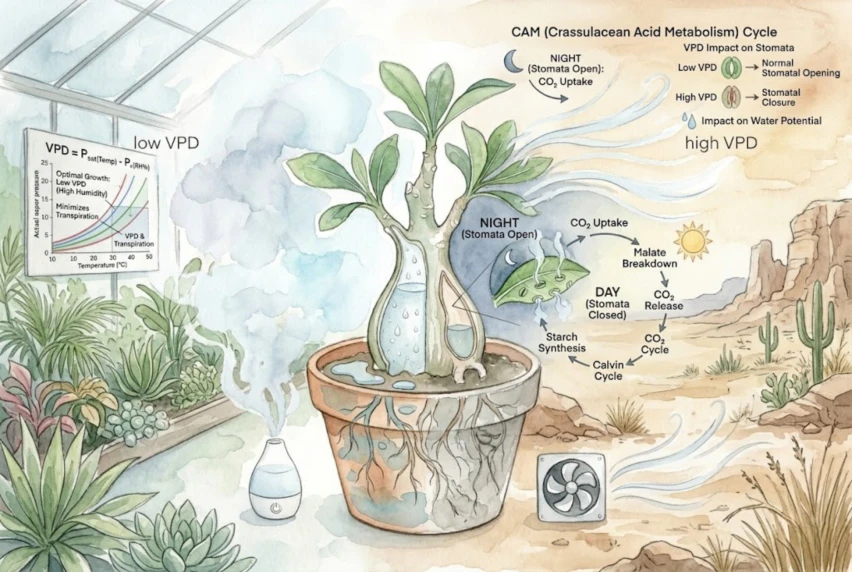
Vapor pressure deficit (VPD) is a measure of the drying power of the air.
It is the gap between how much moisture the air currently holds and the maximum it could hold at its current temperature.
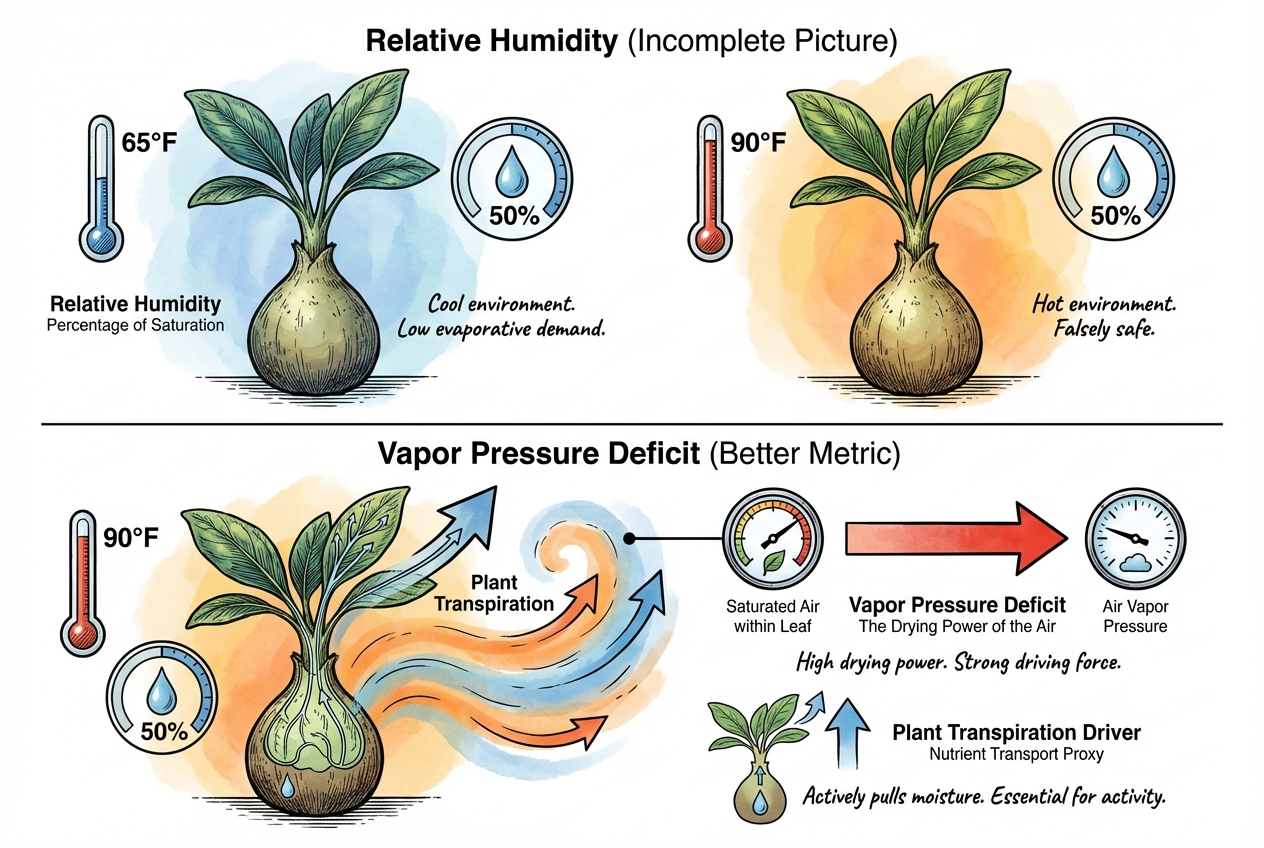
Relative humidity is a temperature-dependent percentage of saturation. VPD combines that humidity with temperature to express atmospheric drying demand.
Warmer air holds far more moisture than cooler air, so 60% humidity at 80°F can create more evaporative demand than 60% humidity at 60°F. Tracking VPD estimates the air-side demand on your caudiciforms.
How should air VPD be estimated?
The air-VPD calculation uses air temperature and relative humidity. A plant-level digital thermometer-hygrometer supplies those two inputs for a chart or app.
This is an air-VPD estimate rather than a direct leaf-to-air measurement. Leaf temperature can differ from air temperature because of light, airflow, and evaporative cooling, so a spot monitor cannot by itself establish the exact demand at every leaf.
Why is Vapor Pressure Deficit a better metric than Relative Humidity alone?
| Feature | Relative Humidity | Vapor Pressure Deficit |
|---|---|---|
| Measures | Percentage of air saturation | The drying power of the air |
| Reflects | Moisture relative to saturation and temperature | Temperature and moisture combined |
| Plant impact | A partial indicator of transpiration context | An indicator of atmospheric evaporative demand |
Relative humidity is an incomplete picture of stress because it is only a percentage of saturation and ignores the temperature side of the equation that drives evaporation. A space at a cool 65°F and 50% humidity has lower evaporative demand than a 90°F space at the same humidity, where water loss can rise if the plant and roots cannot compensate.
That atmospheric pull contributes to transpiration, so VPD can contextualize nutrient transport and plant activity, but it is not a complete proxy for either.
How do caudiciform root systems and stomata differ from regular leafy houseplants?
Caudiciforms rely on water-storing tissue in their swollen bases and on species-specific stomatal responses during drought. Compared with many leafy tropicals, caudex plants can rely more on stored reserves.
The defining feature is the caudex itself, a swollen stem, root, or hypocotyl that can function as a biological water reservoir. During rain or watering the plant may absorb water and swell, then draw that reserve down during dry spells.
Do caudiciforms use CAM photosynthesis or C3?
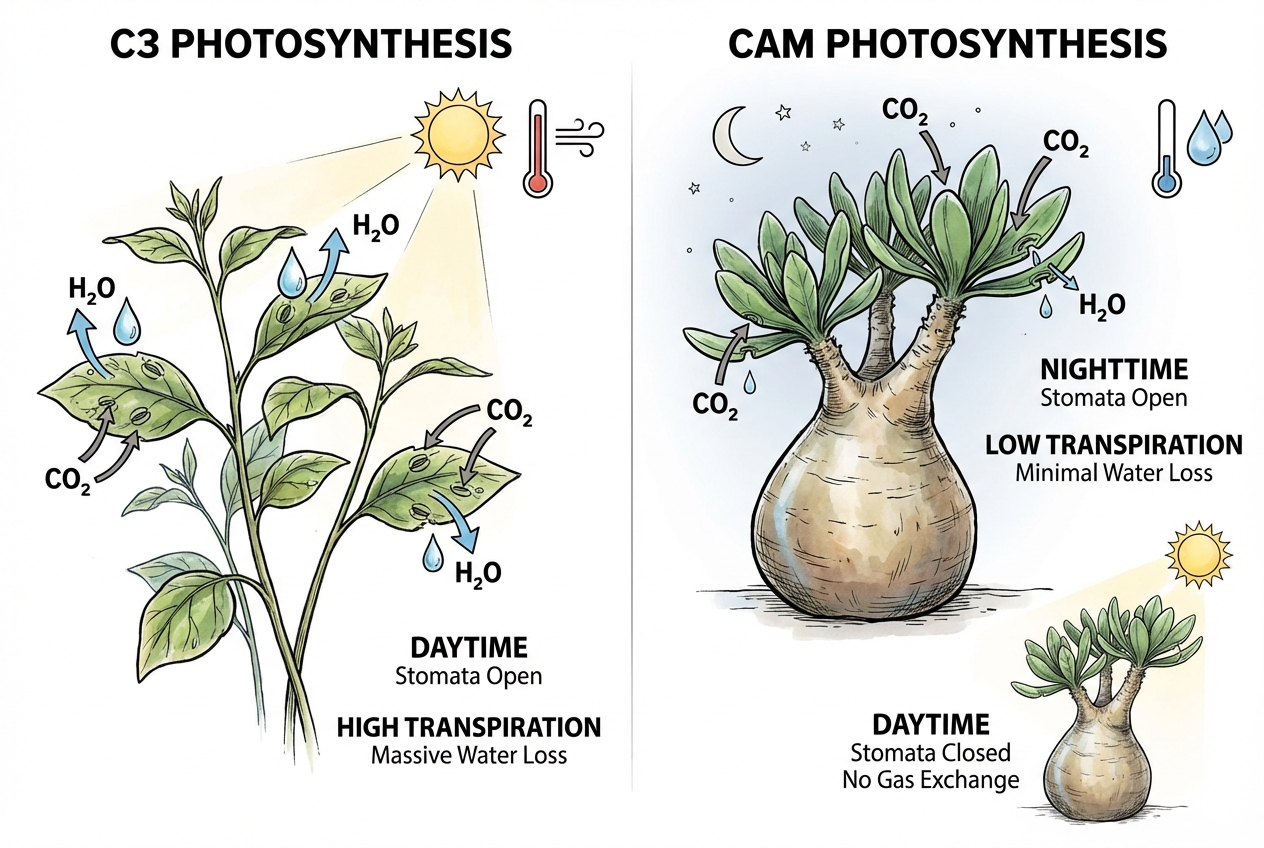
It is a mix, and not all caudiciforms are CAM. Direct measurements found several Pachypodium species to be C3, and Adenium literature also describes daytime gas exchange.
Some stem succulents do use CAM, but a caudex does not reveal a plant's photosynthetic pathway.
CAM plants often shift much of their carbon uptake toward night when evaporative demand is lower. CAM also includes transitional phases and different water-stress states.
A water-storing base can buffer short periods of lower humidity in some species, but pathway and humidity tolerance remain species-specific.
What drives transpiration in a thick-stemmed plant?
Transpiration is part of a passive hydraulic flow shaped by water-potential gradients between the root zone, plant tissues, and atmosphere. When stomata open, water vapor escapes, creating tension at the leaf-air interface.
Because water molecules cohere strongly, that tension pulls on the next molecules in the xylem and hauls water up from the roots like liquid drawn through a straw.
How does high versus low evaporative demand specifically speed up or slow down this water elevator?
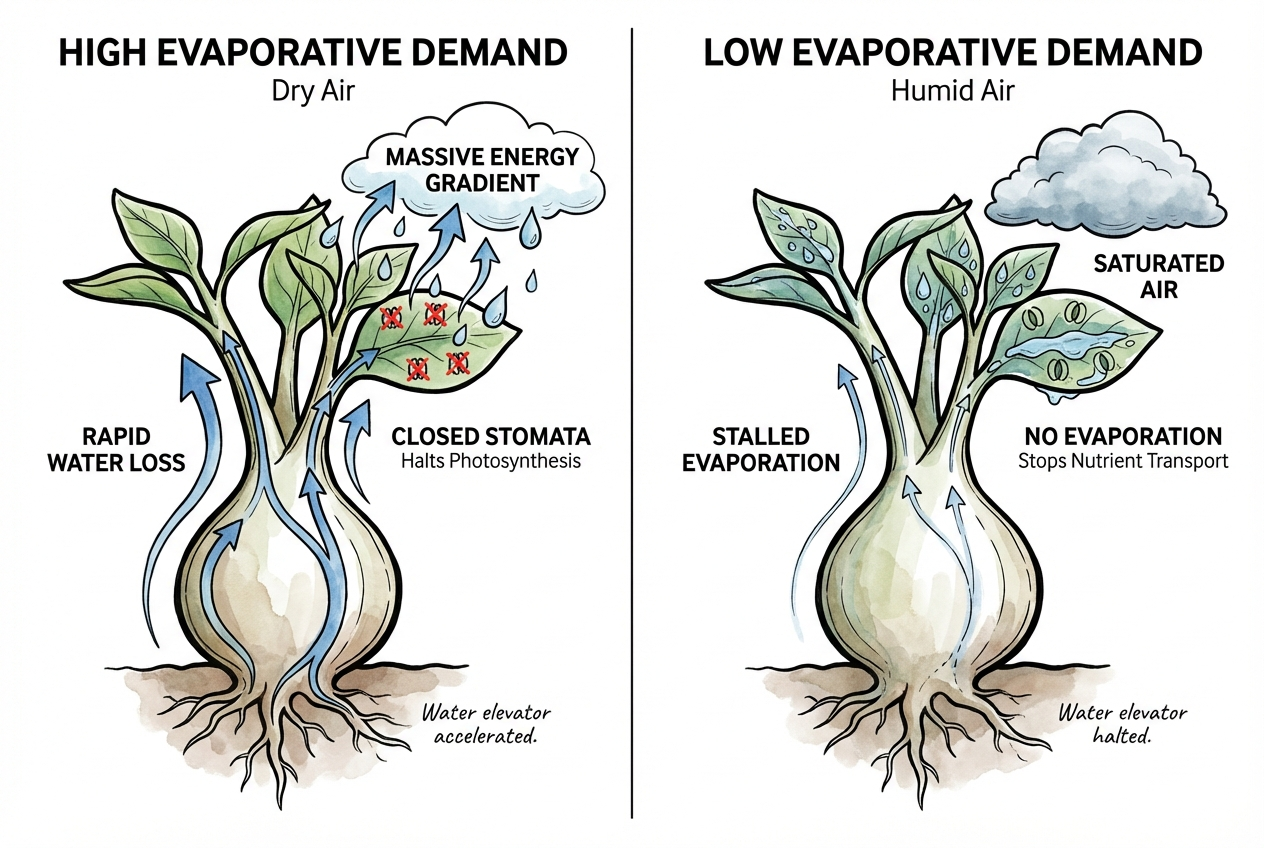
Higher drying power tends to increase evaporative demand, while very low drying power slows it.
As VPD rises, plants may partly close their stomata, so transpiration can rise, level off, or fall depending on species, soil moisture, and hydraulics.
What happens when demand and supply diverge?
When air is very dry and the roots cannot keep up, the plant may lose water faster than it replaces it and turgor can drop.
When air is nearly saturated, evaporation slows substantially. Water and nutrient movement can continue through root pressure, osmotic uptake, and growth-related transport.
How does extremely dry air impact your caudex?
Excessively dry air can prompt partial stomatal closure, reducing carbon uptake and growth while the plant limits water loss.
When the air’s evaporative demand exceeds what the roots can supply, the plant can experience hydraulic stress and more negative tissue water potential.
Stomata may close as one protective response, which limits CO2 entry and can slow growth. The exact response varies with species, temperature, and root condition.
Can high evaporative demand lead directly to a shriveled caudex?
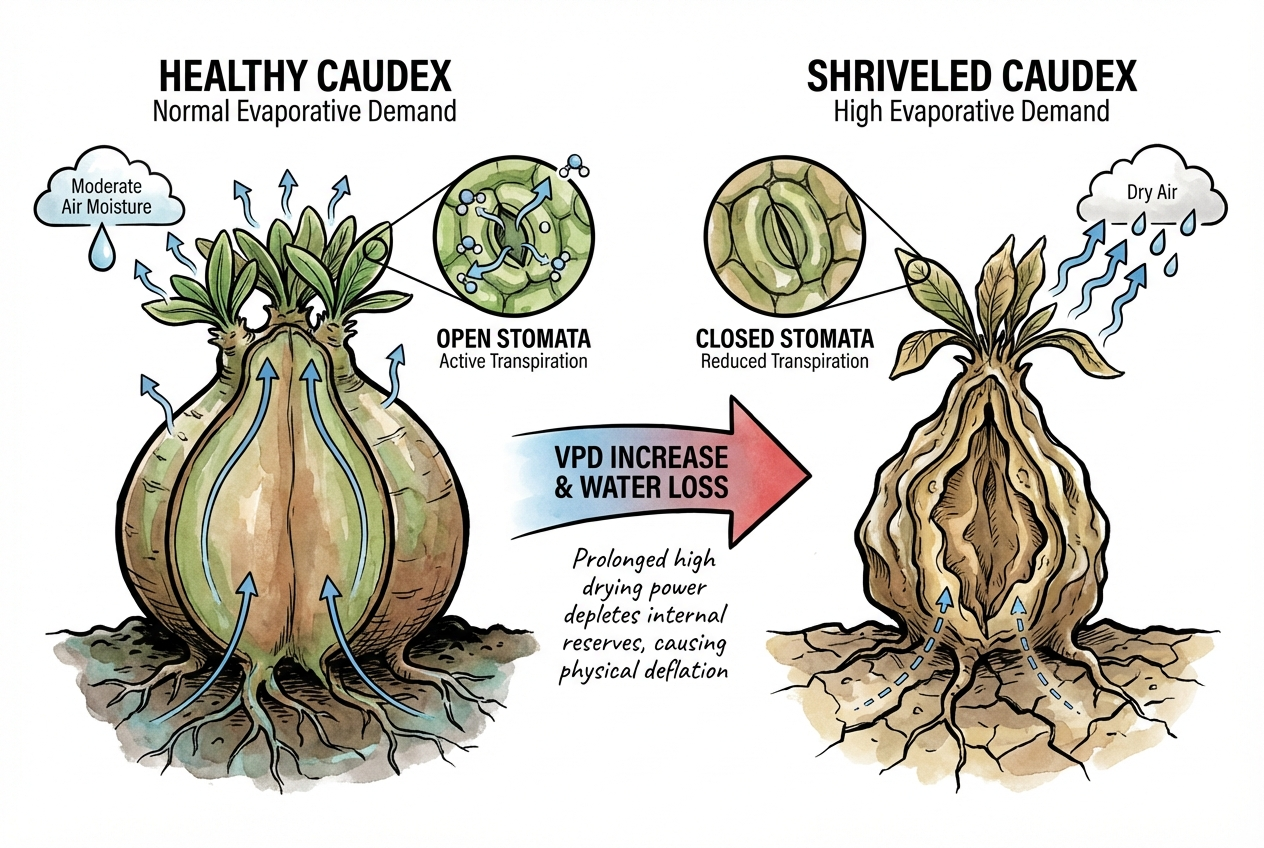
It can contribute when high drying demand occurs together with insufficient water supply from dry substrate or damaged roots.
When demand outruns supply, the caudex may draw down stored water, lose turgor, and shrink or soften.
High VPD alone, with a well-watered plant and healthy roots, is not enough to explain a deflating caudex.
What physically causes shrinkage?
Shrinkage is a loss of tissue water and turgor. Transpiration does not burn through starch. Carbohydrate use is a separate metabolic process, so caudex deflation is primarily a water-balance observation.
Prolonged severe drought can eventually kill roots, but the outcome depends on species, temperature, and duration.
How does highly humid air impact your caudex?
Very humid air slows transpiration and substrate-surface drying, which can keep a pot wet longer when watering is already too frequent. Humid air by itself does not shut down the plant's water or nutrient uptake.
How should low VPD and calcium be interpreted?
High VPD and rapid transpiration can influence calcium delivery, but plants can still take up water and nutrients at low VPD through root pressure and osmotic flow. Some studies report improved transport under moderately reduced VPD.
Separate humid air from an over-wet pot
Persistently damp, still air can let an over-wet pot stay wet. That is a watering and drainage issue, not a direct effect of humidity on the roots.
When VPD seems to conflict with the plant, I keep the sensor at one marked canopy-height position for three consecutive days. I record temperature and relative humidity one hour after lights-on, halfway through the light period, and one hour before lights-off. Each entry adds pot mass, symptom, and whether the root zone is dry, recently watered, or still cool.
Nine readings cover the beginning, middle, and end of three light cycles, so one unusual point does not set my humidity target. I compare the series with plant and medium observations before changing the room.
What are the rot risks associated with stagnant and humid environments?
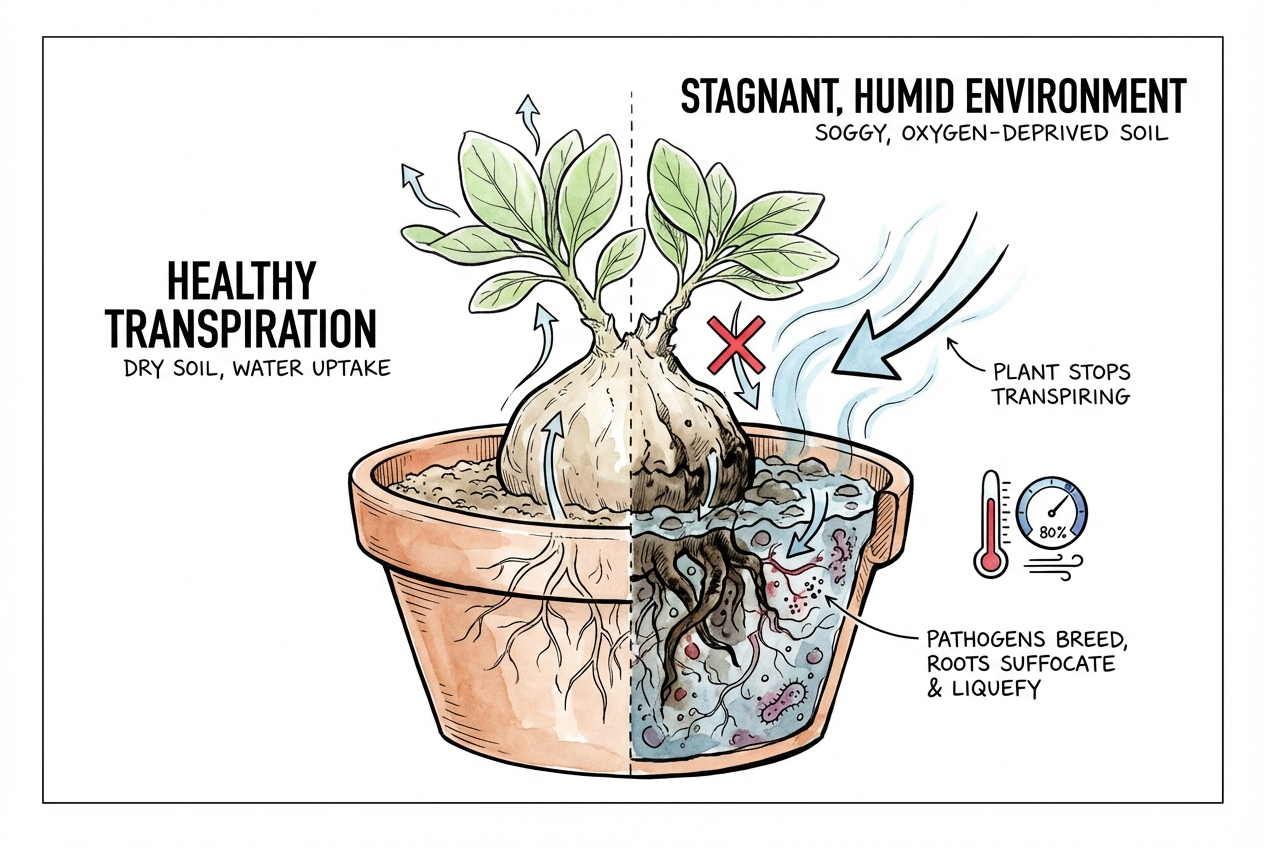
Humid air does not directly cause root rot. Root rot often involves waterlogged, oxygen-poor substrate and the organisms present, while drainage, substrate structure, pot size, and watering frequency determine whether a pot stays soggy.
A well-drained, unsaturated mix does not become anaerobic solely because the air is humid, although stagnant conditions can prolong wetness in an already retentive mix. Start with drainage, watering, airflow, and root inspection rather than treating humidity as the pathogen. Symptoms alone do not identify whether rot involves low-oxygen injury, Pythium, fungi, or bacteria.
Practical Solutions for Adjusting Your Environment
How can you safely add moisture if a room is too hot and dry?
How should a humidifier be used?
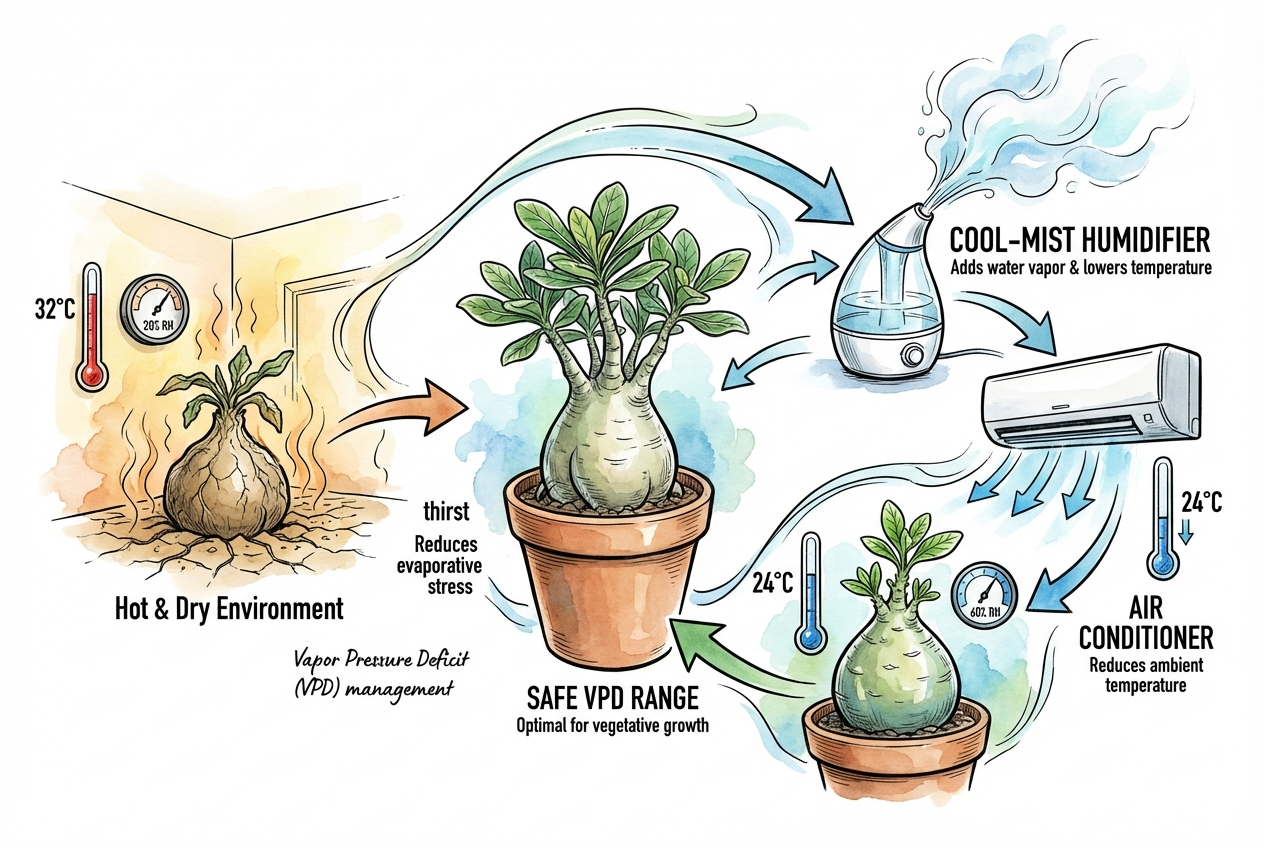
If a room really is too dry, a cool-mist humidifier adds water vapor and can lower VPD. Use it hygienically by following current manufacturer and public-health guidance for emptying, drying, cleaning, and water quality, because cool-mist units can aerosolize tank microorganisms and minerals.
Do not treat one whole-room humidity percentage as universal. Watch for condensation and the needs of the room and plants. A cool-mist humidifier does not reliably lower room temperature.
Control humidity while observing VPD
An air conditioner lowers temperature but also removes humidity, so the two can work against each other (adjust based on your actual readings).
A plug-in humidity controller can switch a humidifier on and off at a set relative humidity, which is handy, but note it controls RH, not VPD directly, so at a fixed RH the VPD still drifts as temperature changes.
Place its sensor in a representative spot (not in the mist plume), keep the controller and outlets out of the wet plume, and confirm your appliance's load is within the controller's rating.
What are practical ways to dry the air if the room is too humid?
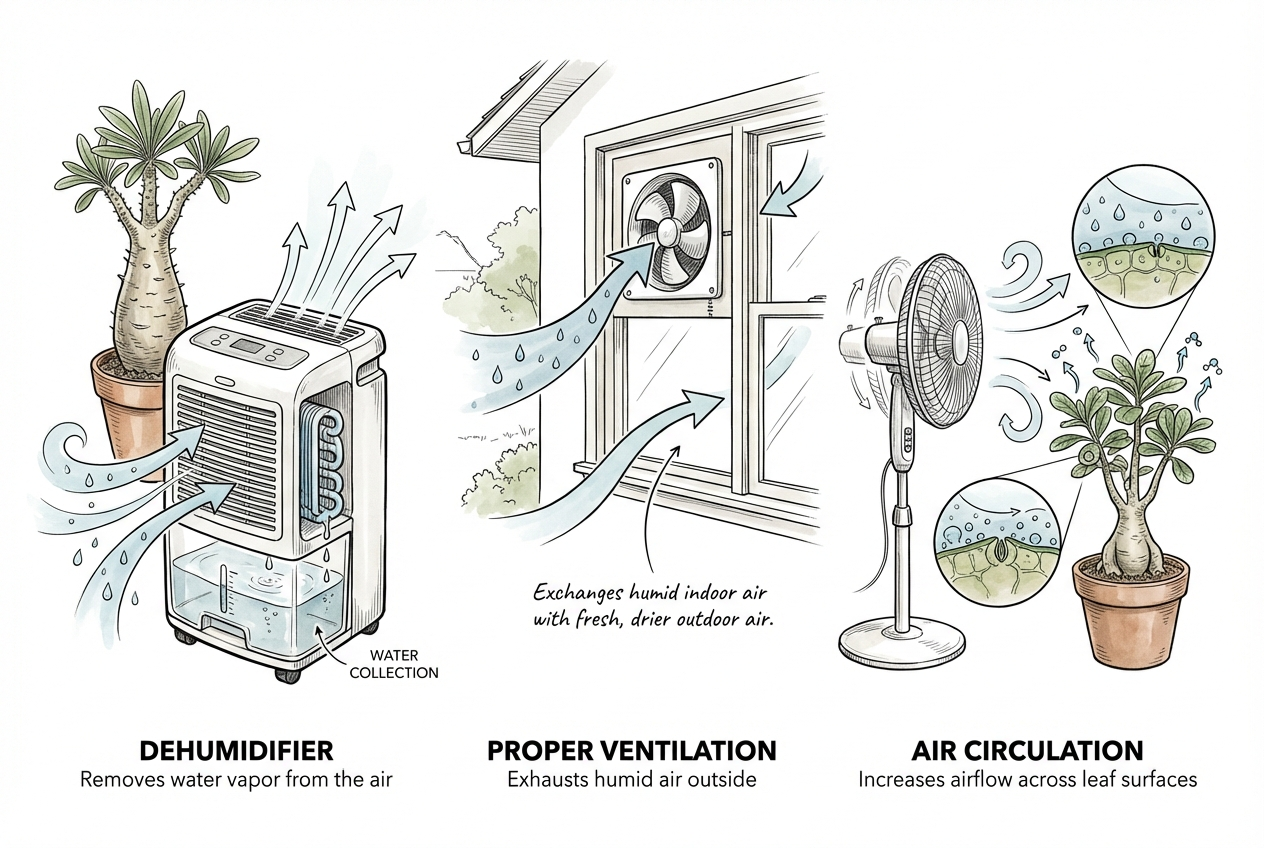
To create a drier space, lower absolute humidity or adjust temperature carefully while continuing to monitor the plants and room.
A dedicated dehumidifier is one direct way to remove moisture.
Ventilation can help only when the outside air has lower absolute humidity or dew point than the room. Fresh air is not automatically drier, and exchanging air on a humid day can add moisture.
Oscillating fans improve air movement.
Fans do not change the room's overall VPD. They thin the still, humid layer at the plant surface and raise local evaporation.
That can help in stagnant conditions, but strong airflow on an already dry-stressed plant can worsen water loss. Use gentle air movement rather than a constant blast.