
Cytokinin Paste for Commiphora: Does It Work?
See what 6-BAP can and cannot do for Commiphora branching, why direct evidence is missing, what a paste label must disclose, and when to skip it.
Nathan Brooks · 2026-02-28 · Updated 2026-06-03 · 9 min read

Key Takeaways
- Cytokinin can help an existing axillary bud grow, but no controlled trial shows that a commercial keiki paste reliably branches a potted Commiphora. The evidence comes from other plants and other application methods.
- Paste may wake a viable bud. It cannot place a branch on bare bark or an unidentified bump. A leaf scar, lenticel, or thorn base is not automatically a bud, and scratching one in only adds a wound.
- Consider a one-bud trial only if the current label names the active ingredient and concentration, permits the ornamental use, and gives handling instructions. If those details are missing, skip the purchase.
- Treat paste only on a vigorous, actively growing plant, and change one variable at a time. Do not stack it with pruning, repotting, or abrupt light changes, or neither success nor injury can be read.
- For most growers, waiting or species-appropriate pruning is lower risk than an incompletely disclosed paste. Commiphora-specific dose, success, and injury data do not exist.
A single-stemmed Commiphora invites intervention, especially when the branch you want seems obvious. Cytokinin paste can sound precise because it appears to turn a bud touch into a branch, but the biology is real while the promise is much tidier than the evidence.
Commiphora is a large and varied genus, and species do not share one branching habit. Kew's Plants of the World Online currently lists 182 accepted species, including trees and shrubs with different seasonal and stem traits. No potted-plant trial establishes a useful paste concentration, application frequency, success rate, or injury rate for Commiphora. Treat paste as an optional experiment, not routine care or a dependable way to design a canopy.
Does cytokinin paste work on Commiphora?
Interpret a Bud Response Cautiously
It might activate a viable dormant bud, but a result on one plant would not prove that the method is reliable. Plant condition, species, bud age, season, product formulation, and dose can all change the outcome. A bud may grow, remain dormant, or respond with growth that is too weak or distorted to keep.
What is the narrow claim?
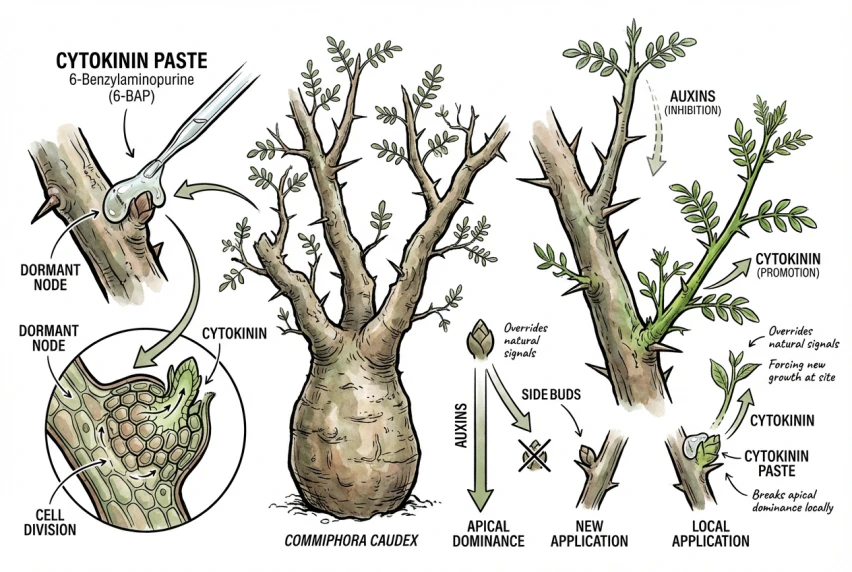
Cytokinin is involved in shoot branching, and 6-benzylaminopurine, also called 6-benzyladenine or BA, has promoted axillary-bud outgrowth in research plants. That makes a response biologically plausible. It does not supply a Commiphora recipe.
What does 6-BAP actually do at a bud?
Use Mechanism Evidence Without Turning It into a Recipe
Side buds do not sit behind a single hormonal switch. Auxin transport, cytokinins, strigolactones, sugars, and branching genes interact to determine whether a bud remains dormant or begins to grow. Cytokinin can shift that balance toward outgrowth at a bud that is already capable of growing.
Separate supporting studies from direct evidence
An Arabidopsis study found that cytokinin promoted shoot branching in part by changing auxin transport. A Jatropha curcas study applied 6-benzyladenine solution to axillary buds and observed bud outgrowth alongside changes in cell-cycle-related genes. Both studies help explain why growers try the method. Neither tested a lanolin paste on a woody Commiphora.
What evidence applies to which question?
| Evidence source | What it supports | What it does not establish |
|---|---|---|
| Arabidopsis branching research | A mechanism linking cytokinin and auxin transport | A topical paste treatment for Commiphora |
| Young Jatropha seedlings | Bud responses to a liquid BA treatment under its tested conditions | A lanolin formulation, dose, or long-term woody-plant result |
| Commiphora wightii tissue culture | Cytokinin responsiveness in excised meristems under sterile culture | A treatment for bark, resin, or a potted adult plant |
| Potted Commiphora topical paste | No direct controlled result was identified | A reliable success rate, safe concentration, or target-placement guarantee |
Can cytokinin paste create a branch on bare wood?
Confirm a Viable Bud Before Treating
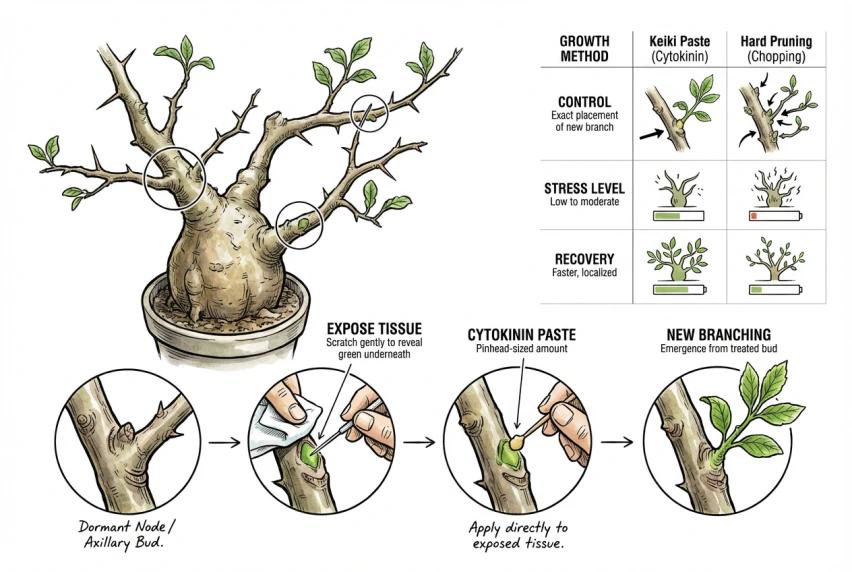
No evidence supports treating an arbitrary patch of Commiphora bark and expecting a new bud to appear there. A leaf scar, lenticel, thorn base, or irregularity is not automatically a viable axillary bud. Paste may encourage an existing bud to grow. It does not give the grower freedom to place a branch anywhere on the trunk.
Do not scratch the bark simply to make a target. If there is no identifiable bud, the scratch adds a wound without solving the underlying problem. On resinous or slow-healing wood, that is a poor trade.
Is a keiki paste suitable for Commiphora?
Read the Current Label Before Considering the Product
Before considering a keiki paste, verify its labeled plant use, active ingredient, concentration, and product-specific safety information. A product marketed as an orchid node activator does not automatically provide enough information to choose a dose for Commiphora.
| Check before buying | Buy only if | Skip if |
|---|---|---|
| Active ingredient | The package identifies the active ingredient | The formulation is described only as a proprietary plant compound |
| Concentration | The current label states its strength | No concentration is disclosed |
| Permitted use | The label covers the plant and application you intend | The directions are limited to another plant or conflict with your use |
| Handling | Directions and product-specific safety information are available | The seller provides neither |
Listings and packaging can change. Inspect the current label to confirm the product is appropriate rather than assuming it from the product name. If the required information is still missing, do not experiment with that product.
How can you limit a one-bud experiment?
Use a Risk-Limiting Checklist
This is not a validated treatment protocol. Apply it only after the product itself passes the label checks above.
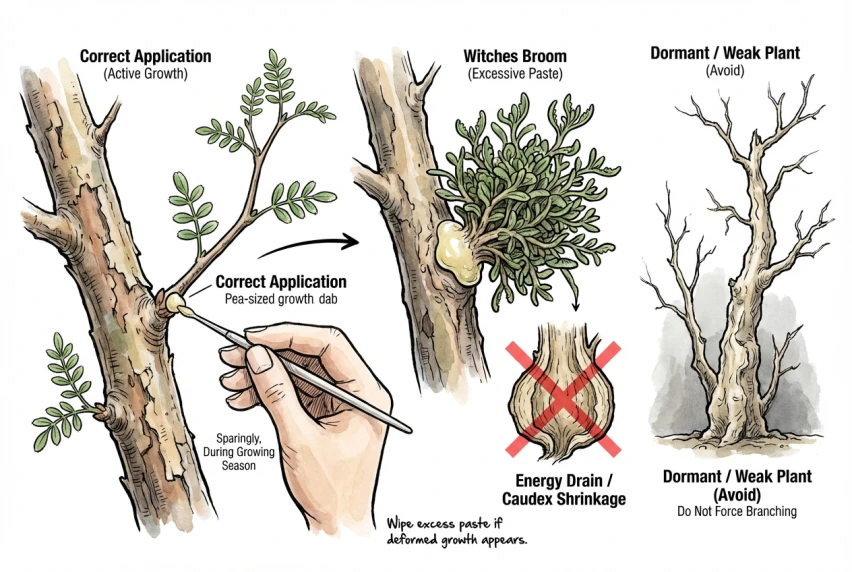
- Wait for active growth. Do not use a hormone treatment to wake a dormant, recently imported, dehydrated, diseased, or declining plant.
- Confirm the target. Choose one clearly identifiable axillary bud. Photograph it and leave a similar bud untreated for a rough comparison.
- Follow the product label exactly. Do not turn a vague small-amount instruction into an improvised dose, and do not make a stronger homemade mixture.
- Avoid a wound unless the label requires one. Use a clean disposable applicator rather than cutting into the bark. Guidance on choosing clean tools and protective equipment is in the caudex protective-gear guide.
- Do not stack treatments. Avoid repeated applications, pruning, repotting, and abrupt light changes at the same time. Otherwise, neither success nor injury can be attributed sensibly.
- Record the outcome. Note the date, product lot, label directions, plant condition, and weekly change. A single treated bud is a conservative experiment, not an established effective dose.
If I decide that a label-supported, one-bud observation is justified, I photograph the whole plant and target-bud face from a fixed pot-rim orientation before beginning. A simple sketch marks the target, and my notes capture every other change that week, including pruning, repotting, watering, and a shift in light.
I then compare the bud with an untreated bud on the same plant without treating the comparison as proof. The map makes a delayed natural flush, a damaged bud, or a second intervention visible before I am tempted to add more product.
What results should make you stop?
Do Not Escalate Because the Response Is Slow
Do not reapply simply because nothing happens quickly. The absence of a published Commiphora response window means there is no evidence-based deadline after which another dose becomes justified.
Stop when tissue or growth becomes abnormal
Stop using the product if the treated area darkens, softens, cracks, leaks abnormally, or develops disorganized or crowded shoots. Separate a possible treatment reaction from pests or infection before making the next cut. Removing excess surface paste may limit further contact, but it cannot reverse material already absorbed. If the stem is deteriorating, prioritize plant health over preserving the experimental branch.
How should a 6-BAP product be handled?
Use the Product-Specific Safety Information
A current Fisher Scientific safety data sheet classifies pure 6-benzylaminopurine as a skin and eye irritant and as capable of causing respiratory irritation. That SDS covers a laboratory chemical, not an unknown concentration in commercial paste, so it cannot tell us the exact hazard of any given product. The paste needs its own label and safety information.
How should tools and wounds be handled?
Keep tools and bark damage separate
Use alcohol to clean and disinfect tools, then let the tool dry before contact with the plant. Do not wipe living bark or a bud with an alcohol pad unless the product label specifically directs it. A scratch is not a neutral step. It can damage cambium, increase resin loss, and create an entry point for pathogens without creating a bud.
Follow label and exposure instructions
At minimum, follow the product instructions, wear suitable gloves and eye protection, work with ventilation, avoid skin and eye contact, wash after handling, and keep the container away from children and pets. If exposure occurs, follow the first-aid directions on that product’s label or SDS. Do not substitute a generic blog instruction for product-specific medical advice.
Does fertilizer make cytokinin paste work?
Keep Nutrition on the Existing Healthy-Growth Plan
Fertilizer does not activate cytokinin signaling by itself, and extra feeding does not repair a weak root system or make an unsuitable plant ready for treatment. Keep the plant on the nutrient program that already supports healthy active growth. Do not increase the dose just because a bud was treated.
Buy fertilizer only for a separate nutrient need
A complete liquid nutrient is relevant only if you need one and its current label fits your water, substrate, and feeding routine. A nitrogen-forward analysis on the label is not a standard requirement for every foliage feed and is not evidence that fertilizer will improve the cytokinin response. Check that the product is complete, then judge its rate against the plant’s active growth, water quality, and existing nutrition. Skip it if you already use an appropriate complete fertilizer, if the plant is dormant or stressed, or if soluble salts are accumulating. The hard-water and salt-buildup guide explains how to diagnose that problem before adding another product.
Is cytokinin paste better than pruning or waiting?
Compare Intervention with the Plant’s Natural Options
They solve different problems, and none guarantees a branch at a precise point. Waiting preserves the plant and lets its natural architecture appear. Pruning removes apical growth and can encourage branching, but only where that species and individual retain buds capable of regrowth. Paste tries to influence one visible bud without removing the tip, yet its success and injury rates in Commiphora are unknown.
| Option | Best fit | Main tradeoff |
|---|---|---|
| Wait | A young, recovering, newly acquired, or naturally sparse plant | The plant may not branch where or when you want |
| Prune | A healthy plant whose species is known to regrow from retained buds | You lose the tip and still cannot guarantee the response |
| One-bud paste trial | A healthy, active plant with a visible bud and a fully disclosed product label | Commiphora-specific dose, success, and injury data are missing |
Should you use cytokinin paste on Commiphora?
Choose the Lower-Risk Path When Evidence Is Incomplete
For most growers, waiting or using species-appropriate pruning may be lower risk than reaching for an incompletely disclosed paste. The experiment becomes reasonable only when the plant is vigorous, the target is unquestionably a bud, the product label supports the intended use, and a failed result is acceptable rather than a designed branch being expected.
Purchase only when the current package answers the active ingredient, concentration, permitted-use, and handling questions. If it does not, the missing information is more important than the convenience of the applicator.