
Ultrasonic Foggers for Desert Caudex Plants: Help or Rot?
Do desert caudex plants need misting? Mostly no. Here is the real science of fog and bark, when an ultrasonic fogger helps, and how airflow keeps it from causing rot.
Nathan Brooks · 2026-02-22 · Updated 2026-07-27 · 9 min read
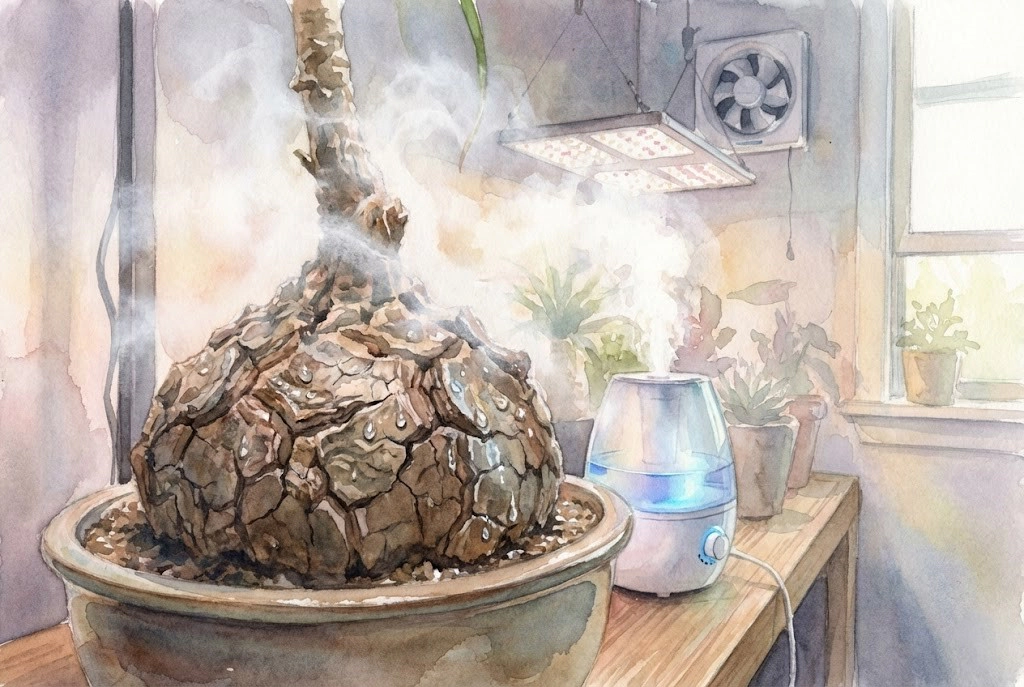
Key Takeaways
- Most caudiciforms in a normal home do not need misting, and routine misting can raise rot risk. Morning fog is a niche technique for unusually dry, controlled setups or fog-adapted species.
- Some desert plants absorb small amounts of dew or fog through above-ground tissue, which may ease bark dehydration. It supplements but does not replace proper root watering.
- Fine mist and airflow are the limiting factors. Keep surface moisture brief, prevent pooling, and allow a dry-down that stops prolonged wetness. Corky bark is not an absorbing leaf.
- Judge the enclosure, not a timer. Run short cycles only when measured humidity and surface drying support them. Long fogging with no exhaust keeps everything damp and invites rot.
- Use low-mineral water, empty and dry the reservoir regularly, and never add hydrogen peroxide or other chemicals to a fogger. Ultrasonic units aerosolize whatever is in the water into the room air.
Most caudiciforms in a normal home do not need misting, and routine misting can raise rot risk.
Morning fog is a niche technique, not a universal requirement.
It may help with a genuinely fog-adapted species or in an unusually dry, controlled grow-tent setup, but the decision should follow measured humidity, surface drying, and plant response.
For other conditions, treat this as background and keep root watering and air movement as the primary controls.
Brief atmospheric uptake is real in some desert plants, but its relevance depends on the species and the enclosure.
Why do desert plants need misting?
Use Atmospheric Moisture Only as a Supplement
Desert plants do not strictly need misting, although some can use brief atmospheric moisture. In a bone-dry indoor environment, a short morning fog can reduce bark dehydration.
In the wild, coastal or radiation fog deposits a film of surface moisture before the sun climbs.
A number of desert plants have been shown to take up small amounts of that dew or fog directly through their above-ground tissue, which helps rehydrate stressed tissue during the cool dawn hours.
This is a documented phenomenon, not a marketing claim, and it’s the legitimate basis for the technique.
Keep root watering primary
Foliar or bark uptake supplements, but does not replace, proper root watering. Any benefit also depends on the surface drying quickly because lingering moisture on a desert plant can increase fungal-rot risk.
How do caudex plants absorb moisture?
Keep bark and growth claims bounded
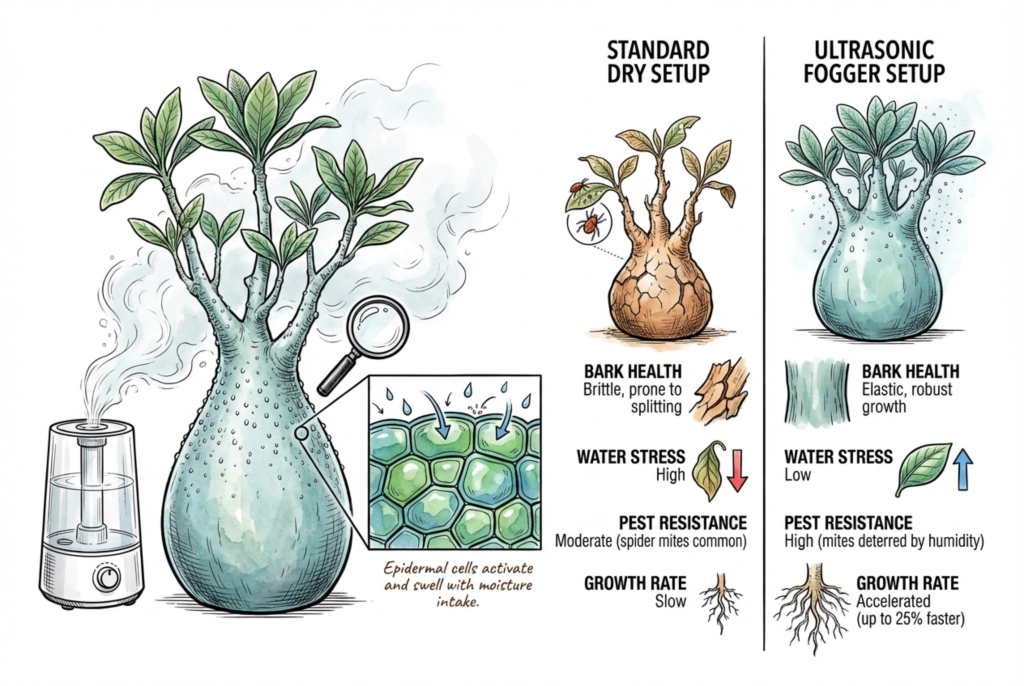
Some tables assert that fogging gives elastic bark, faster growth, or strong pest resistance for caudex plants.
There is no study measuring bark splitting, growth rate, or pest incidence with the fogger on versus off for these plants, so treat those figures as invented, not evidence.
Ordinary room humidity may be sufficient for many caudiciforms, and normal corking is usually secondary growth rather than damage a fogger needs to prevent.
The foliar-uptake research often cited here is real but narrower than it’s made to sound. It shows certain desert trees taking up small amounts of atmospheric water through their green, leaf-like assimilating branches under prolonged high humidity, not that spraying a mature, corky caudex meaningfully hydrates it.
A suberized (corky) periderm is not the same absorbing surface as a leaf, so don’t assume misting the bark rehydrates the plant.
Dry the surface after every fog cycle
A short fog cycle followed by airflow can wet the surface briefly, while a humidifier left running or fog with no exhaust keeps everything damp and increases crown-rot risk. The safe drying interval depends on the enclosure, device, and weather.
The technique depends on the enclosure’s ability to dry surfaces and exchange air.
What are ultrasonic foggers and how do they work?
Understand What the Device Actually Emits
Ultrasonic foggers create a micro-fine mist without heat, using high-frequency vibration.
A piezoelectric ceramic disc vibrates at ultrasonic frequencies and shears water into a cool vapor.
Note the droplets are tiny liquid water aerosol (not true vapor), which is why they hang in the air as visible fog.
Compare ultrasonic and evaporative outputs accurately
An evaporative humidifier disperses far fewer minerals and microbes into the air than an ultrasonic one because it evaporates water off a wick rather than atomizing droplets. The claim that evaporative units throw big wet drops is backwards.
The trade-off with ultrasonic is that whatever is in the water (minerals, microbes) goes into the air too, which is why water quality and reservoir hygiene matter.
Why is micro-fine mist important?
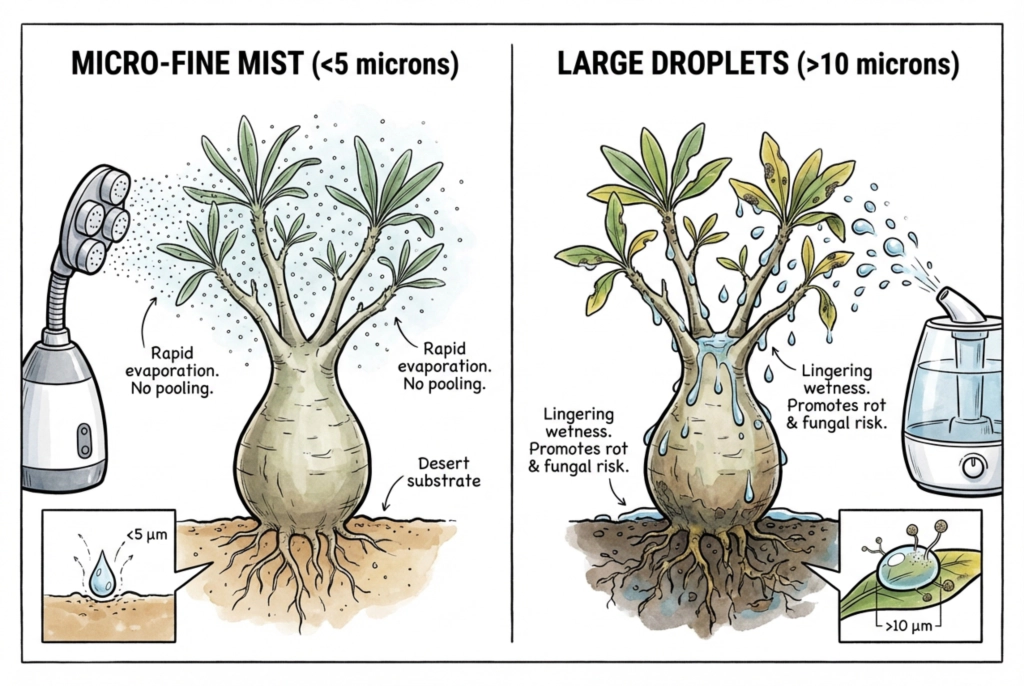
Fine mist matters because it can reduce pooling on the plant, which otherwise prolongs wetness. Droplet size and evaporation vary, so judge the setup by visible condensation, pooling, and how quickly the surface dries rather than by a nominal micron rating.
Some humidifiers can deliver larger droplets that run down the stem and soak into the substrate.
In a desert-plant setup, wet substrate plus poor airflow creates a high-risk rot environment.
How do you set up a desert caudex tent with foggers?
Keep the Fogger Outside the Plant Space When Possible
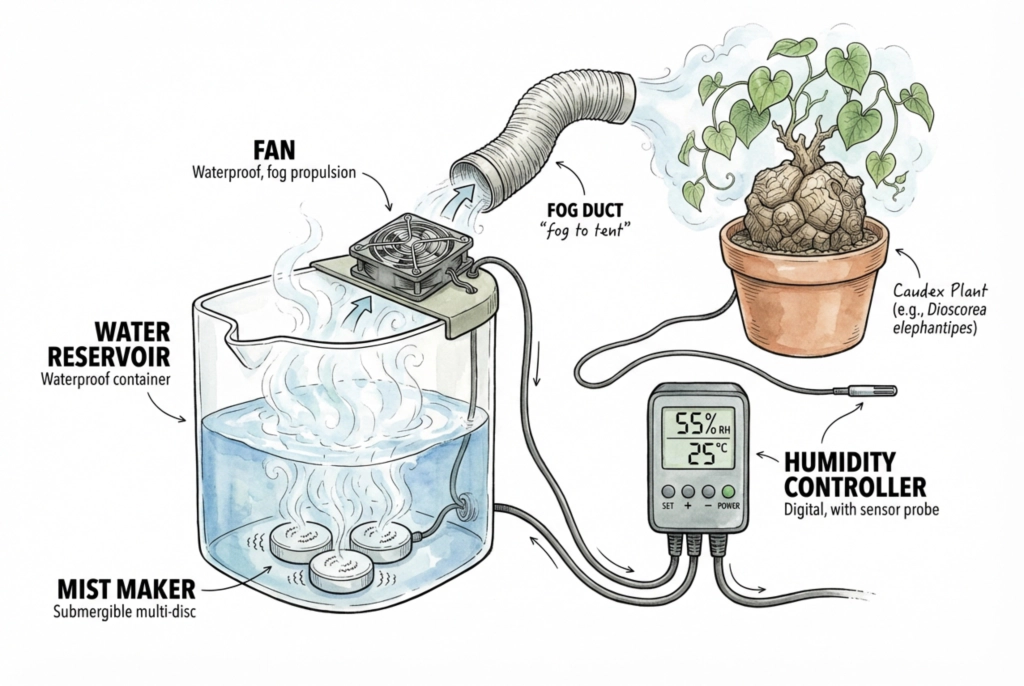
Set up the tent by placing the fogger outside it and piping the mist in through flexible ducting.
That keeps the unit out of your growing footprint and the electrics safer.
If a tent is appropriate for the setup, use moisture-resistant materials and size any ducting to the device output and enclosure.
Introduce the fog where it can disperse without creating direct condensation on plants or substrate.
Low-mineral water can reduce mineral buildup on plants and fogger discs. Choose the water source and cleaning method with the device manual and local water quality in mind.
What components might be useful?
Choose components around airflow and control
Possible components include a multi-disc ultrasonic mist maker, a suitable reservoir, a fan to exchange air, and a humidity controller. The right combination depends on enclosure size and whether fogging is needed at all.
A humidity controller can run the fogger only when humidity drops below a chosen threshold, while a separate timer can provide a short dawn-like cycle.
Neither replaces checks of condensation, surface drying, and plant response.
Check suitability and electrical safety before building
An important safety and suitability caveat applies before you build this. Some multi-head mist makers are sold for ponds, fountains, and decorative fog rather than as plant humidifiers. Verify the intended use on the current specification sheet. Their output can be much higher than a small enclosure needs, so a long cycle can quickly create condensation, dripping, and soaked substrate. Treat the device description as hardware information, not as a validated plant protocol.
Electrical safety matters even more. Sitting a mains-connected fogger and fan over an open bucket of water is genuinely hazardous.
If you build anything like this, keep all mains-powered controllers and power supplies well away from the water in a dry location, use equipment rated for wet/damp use, protect the circuit with a GFCI, add drip loops and strain relief, and never improvise open-water electrical rigs.
When in doubt, use a purpose-built, sealed plant humidifier instead of a DIY bucket system.
A dedicated humidity controller can switch a humidifier and an exhaust fan on humidity setpoints, which helps avoid staying damp too long. Note a humidity controller is not a timer. It doesn’t run a dawn schedule on its own, and an air-humidity sensor doesn’t tell you whether leaves, bark, or soil are actually wet.
What Mist Schedule Fits the Setup?
Drive the Schedule by Surface Drying
If you fog, keep it brief and driven by conditions, not a fixed clock. A pre-dawn cycle is only a starting concept. The right length depends on device output, enclosure size and leakage, ambient conditions, and surface-drying speed.
High-output units can approach saturation quickly, so watch actual humidity and any pooling or dripping and stop well before condensation accumulates.
By lights-on, any fog should be clearing as the enclosure warms, allowing surfaces to dry rather than stay wet all day.
Use the linked acclimation guidance alongside humidity readings and plant response. There is no universal daytime percentage for every enclosure.
For a new setting, I start with one 30-second fog pulse and place a plain card near the plant outside the direct stream. I record starting and peak relative humidity from a sensor at plant height, then check the card, plant, and pot surface at 5, 15, and 30 minutes. The short first pulse limits the test dose because fogger output and enclosure volume vary widely.
I keep the setting only when no droplets or pooling appear and every checked surface is dry by 30 minutes. That drying limit is my conservative household cutoff, not a disease threshold, because longer free-water periods generally increase disease opportunity. Persistent moisture makes me shorten the pulse or increase exhaust before another recorded trial.
How do you balance humidity and airflow?
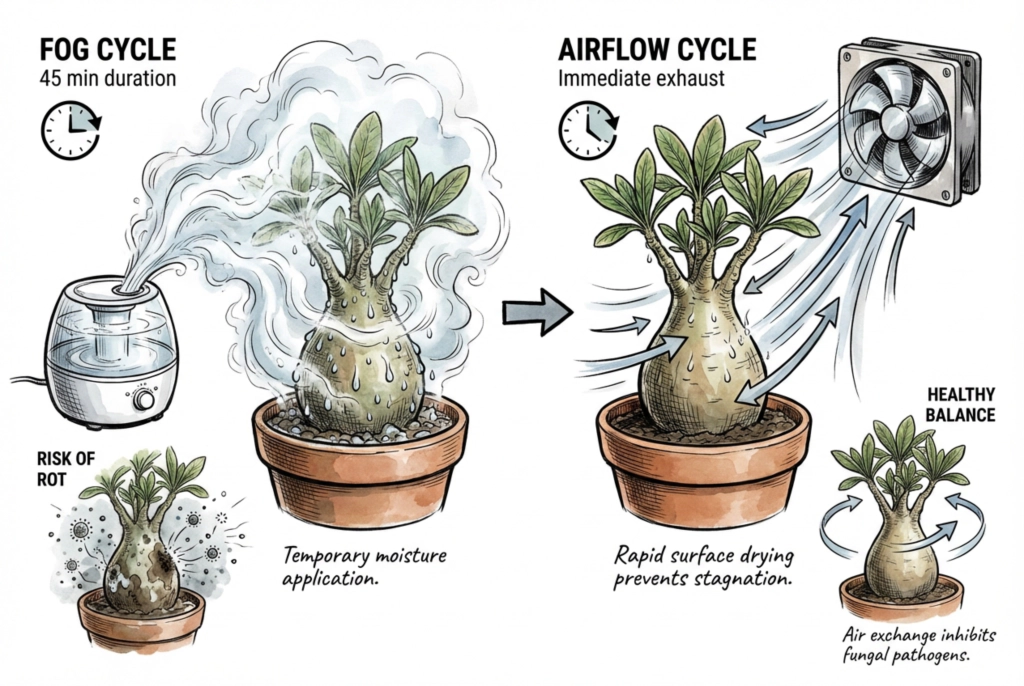
Use airflow to close the fog cycle
Balance it by exchanging air after the fog cycle ends.
Airflow helps surfaces dry and can lower the time available for fungal pathogens to colonize damp bark, but it does not guarantee disease prevention.
Once the cycle finishes, run exhaust long enough to clear visible condensation and return the enclosure toward its normal range.
Moving air dries the plant’s surface so moisture stays temporary.
Without that airflow, stagnant humid air increases rot risk and is a common way this technique backfires.
What are common mistakes when misting desert plants?
Over-fogging the tent
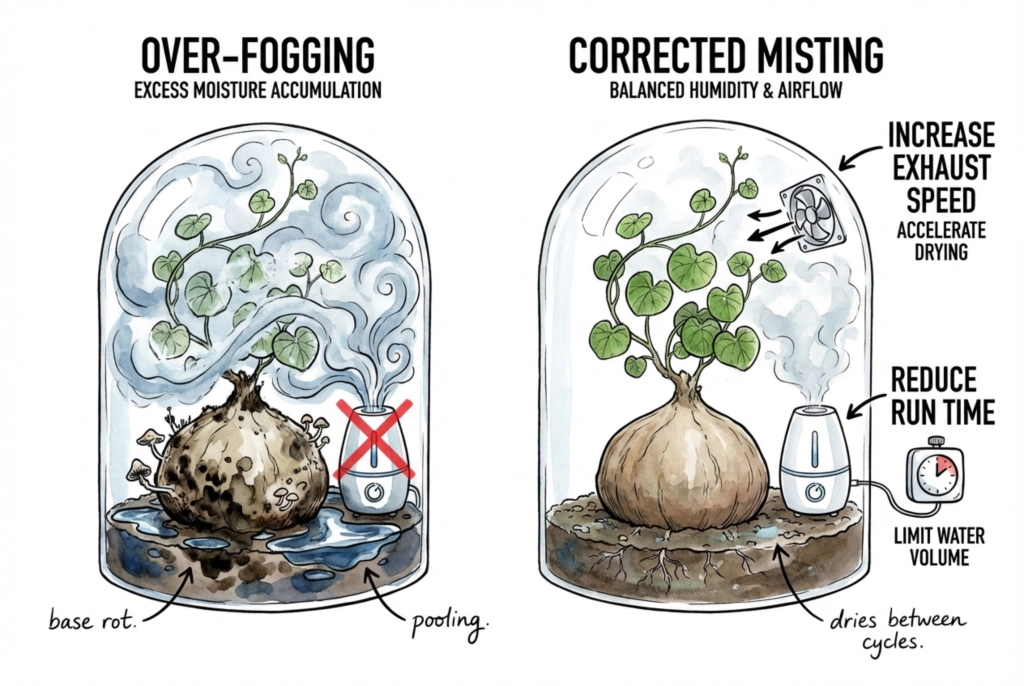
What to look for
Small pools of water on the soil surface, or rot at the base of the caudex.
How to fix it
Shorten the cycle, increase exhaust, and reassess the device output until pooling and dripping stop.
Why this may help
Shorter cycles add less total water, and faster exhaust can dry the topsoil more quickly, reducing base-rot risk.
Using tap water
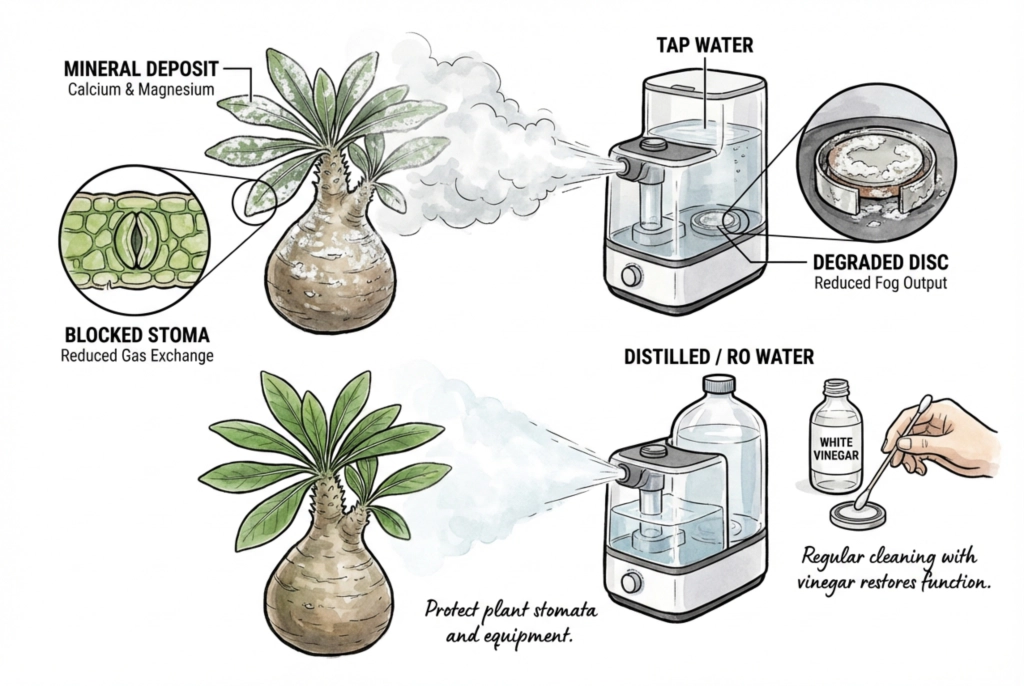
What to look for
A white, crusty film on the leaves and bark, plus dropping fog output.
How to fix it
Consider distilled or RO water where mineral deposits are a problem, and clean the fogger discs with a method approved by the device manual.
Why it can help
an ultrasonic fogger atomizes whatever is dissolved in the water, so hard tap water throws minerals into the air that settle as white dust and can foul the discs.
White mineral dust is a nuisance and an inhalation concern for people in the room. Evidence that it blocks plant stomata is weak, but using low-mineral water is still a practical way to reduce the residue.
How do you maintain the ultrasonic fogger for longevity?
Keep the Reservoir Fresh and Dry Between Uses
Clean it frequently. Public-health guidance for humidifiers is to empty the reservoir, wipe it dry, and refill with fresh water at a frequency suited to use, because standing water grows bacteria and biofilm. Follow the device manual and relevant public-health guidance for the detailed interval.
This matters for you, not just the plants. An ultrasonic unit disperses reservoir microbes into the room air, and breathing contaminated mist is linked to respiratory irritation (humidifier fever).
Because of that, don’t add hydrogen peroxide (or other chemicals) to the water to keep it clean. You’d be aerosolizing the chemical into the air you breathe, and many manufacturers explicitly say to use no chemicals.
Rely on fresh water and regular cleaning instead, and if the fog vents into a living space, consider who and what is breathing it.
When should you replace the ceramic discs?
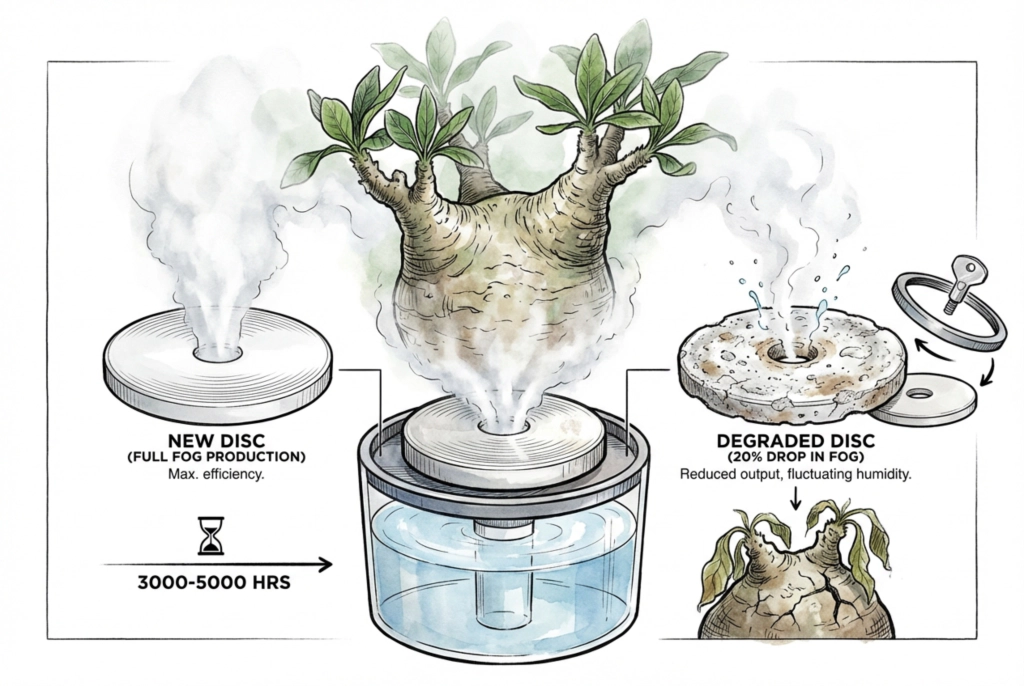
Replace worn ceramic discs before output drifts
Replace the discs when fog output falls noticeably or the manual reaches its service interval, since high-frequency vibration gradually wears the ceramic.
Most units include a key to unscrew the retaining ring, so swapping discs can be straightforward when the part is compatible.
Keeping output predictable matters because an aging unit can introduce unplanned environmental swings.