
Hydrogen Peroxide Seed Soak: Germinate Old Caudex
Does a dilute hydrogen peroxide soak help old caudex seed? Learn its limits, which seeds may benefit, and why it cannot revive dead seed.
Rachel Torres · 2026-02-20 · Updated 2026-08-10 · 7 min read

Key Takeaways
- Old seed usually fails because it has aged and lost viability, and no soak reverses that. A stored seed should not be treated as alive but trapped without a viability check.
- Adenium and Pachypodium seed are not established as the hard, water-impermeable case this method assumes. Fresh seed imbibes water readily, while storage age reduces viability.
- A dilute hydrogen peroxide soak may modestly help some seed through surface sanitation or signaling, but it does not sterilize, guarantee results, or revive dead seed. Treat it as a minor aid, not a rescue.
- Keep any soak short and dilute, then rinse. Peroxide is an oxidizer, and over-exposure can damage the embryo.
- GA3 is a separate, potent hormone that helps only some physiologically dormant seed. It is difficult to dose accurately at home and should not be treated as a default follow-up.
Old caudex seed often refuses to sprout, so start with viability rather than a rescue recipe.
Storage aging can damage membranes, mitochondria, and DNA, and no soak brings a dead embryo back.
A dilute hydrogen peroxide soak may give a modest response in some living seed through surface sanitation or signaling, but fresh, well-stored seed is the more reliable starting point.
How to germinate old caudex seeds?
What should be checked before a soak?
Check whether the seed is viable, and use fresh seed when possible.
A caudex plant is not a seed-biology category. Caudiciforms come from many families, and a swollen base tells you nothing about the seed coat.
Available Adenium and Pachypodium evidence does not establish a water-impermeable, physically dormant coat as the default.
Their seed can take up water readily when fresh, so old lots should not automatically be diagnosed as blocked by a hardened coat.
What prevents old caudex seeds from germinating normally?
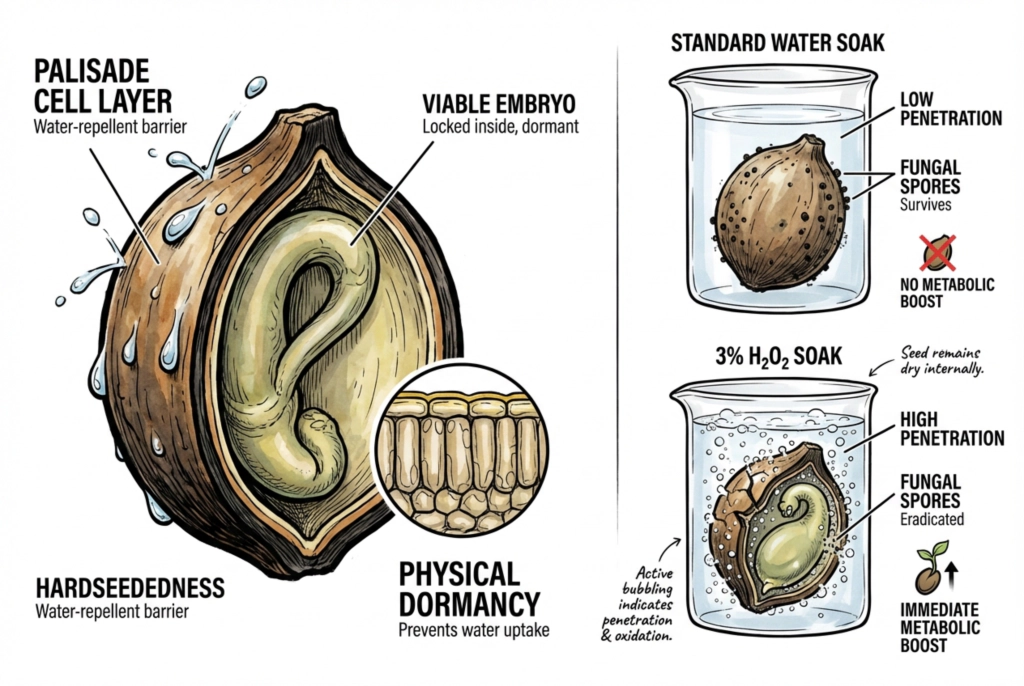
Separate dormancy from age-related loss
For seeds that genuinely have physical dormancy (a water-impermeable coat that forms as the seed matures and dries) a hardened coat can block water uptake.
But that's a specific seed type, not something you can assume from a seed just being old or from the plant being a caudiciform.
Age alone doesn't create physical dormancy, and it doesn't tell you the embryo is alive.
Some arid-climate seeds do wait for strong triggers before germinating.
Separate a truly water-impermeable coat, mechanical resistance, slow germination, and loss of viability.
Confirm viability with a suitable cut test or small germination trial before treating old seed as merely dormant.
What is an oxygen burst and how does it help?
What does the fizzing actually show?
Read the fizz as a reaction, not proof
The visible fizzing is oxygen release. In species where peroxide helps at all, proposed effects include modest surface sanitation or signaling.
Fizzing does not show that a coat has weakened or that dormancy has changed.
Hydrogen peroxide decomposes when it meets enzymes such as catalase in seed tissue or microbes, releasing oxygen at the surface.
Any effect on coat or endosperm depends on the seed and exposure.
Keep the oxygen story bounded
The popular idea that peroxide floods the embryo with oxygen for energy is incomplete.
Reviews discuss possible effects on coat or endosperm restraint, surface microbes, and signaling involving ABA and gibberellin. Those mechanisms are conditional on seed type, concentration, exposure, and tissue tolerance.
Why do old seeds struggle to absorb enough oxygen naturally?
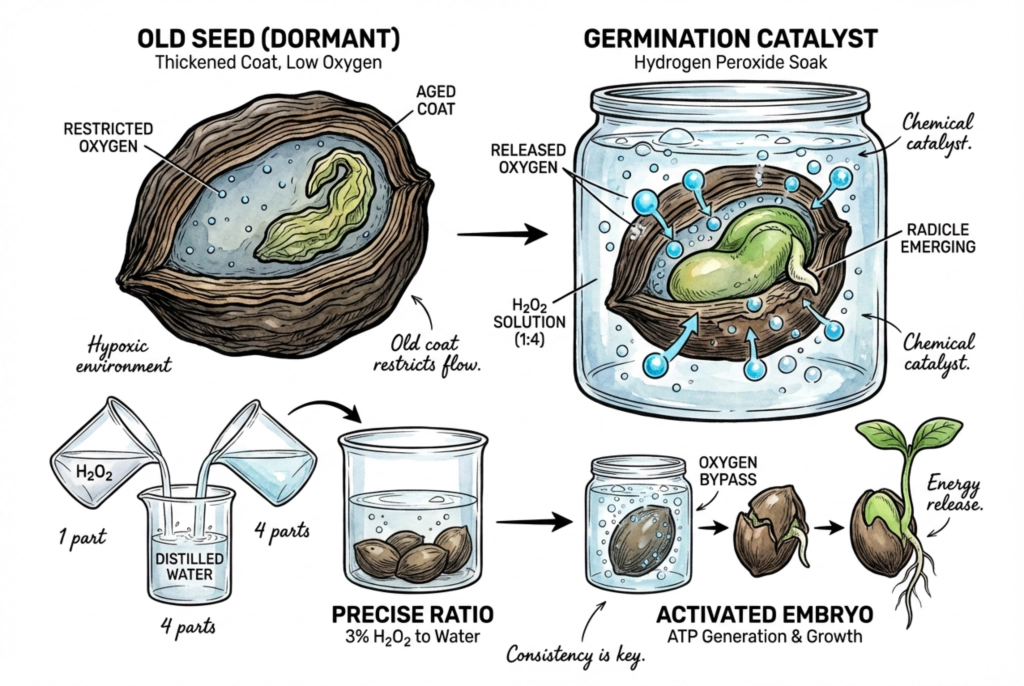
A thick coat that limits gas exchange applies at most to a genuinely hard-coated seed. It should not be assumed for Adenium or Pachypodium.
For those genera, an old seed that does not germinate may be dead or low-vigor rather than barrier-blocked but alive.
Where a peroxide soak helps at all, the effect is likely to be conditional and modest rather than a reliable way to dissolve a barrier.
Confirm the seed is viable before assuming a coat is the obstacle.
How should a peroxide experiment be framed?
Do Not Infer a Universal Dose
There is no caudex-seed dose-response evidence that identifies a concentration and exposure that selectively weakens a coat while protecting an embryo.
The available evidence is species- and protocol-specific, and Adenium or Pachypodium seed is not established as a hard-coated case by age alone.
What handling precautions apply?
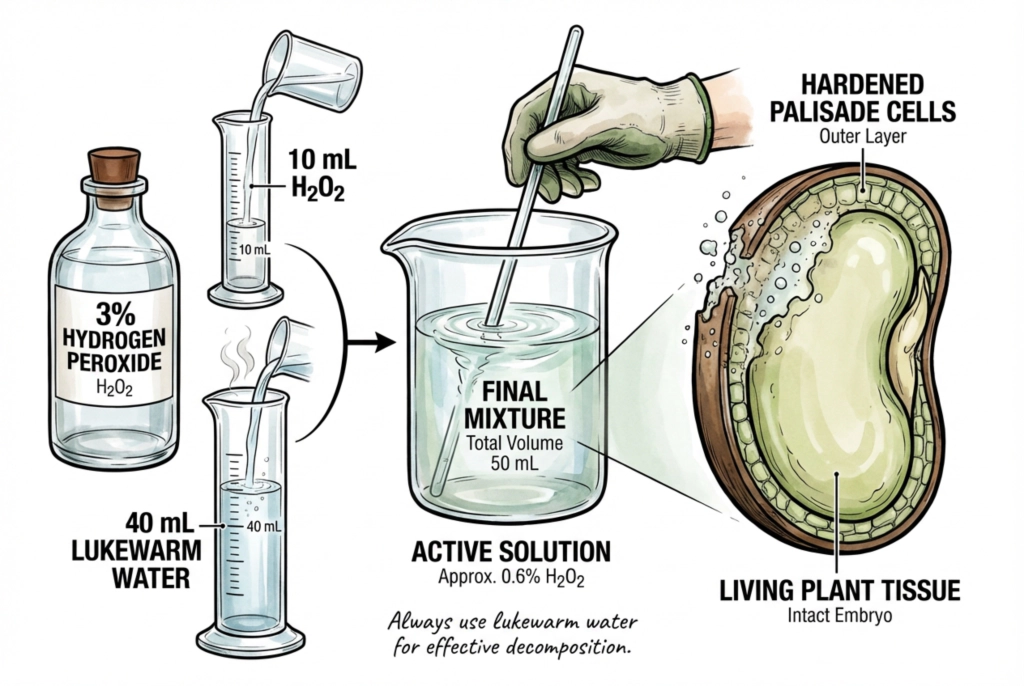
Hydrogen peroxide is an oxidizer. Household 3% products can irritate eyes, skin, and airways. Keep the bottle in its original opaque container, use eye protection and gloves, avoid splashes, work in a ventilated area, keep it away from children and pets, do not ingest it or mix it with cleaners, and follow the current product label.
Set a stop condition before soaking
Water temperature changes decomposition and exposure, but it does not create a validated caudex-seed treatment.
Because rare seed is difficult to replace, any observation should use the equal untreated split below and a visible stop condition for tissue damage.
Before handling an old lot, I record the accepted name, source, known harvest or purchase date, storage history, seed count, and any visible damage. When a fact is unknown, I write unknown rather than inventing a storage age. This separates a low-information lot from a lot whose real viability history is documented.
I number every apparently intact seed, shuffle matching number slips, and divide the draw equally between untreated and test groups. When the total is odd, the extra seed remains untreated. Equal allocation gives a small lot the strongest direct comparison and keeps at least half the seeds outside the test condition.
If any tested seed develops new discoloration, softness, or exposed damaged tissue, I stop the approved trial under its safety instructions. I do not add a second treatment to explain the first result. The unchanged control keeps a poor lot from being confused with handling injury.
How do you end the soak safely?
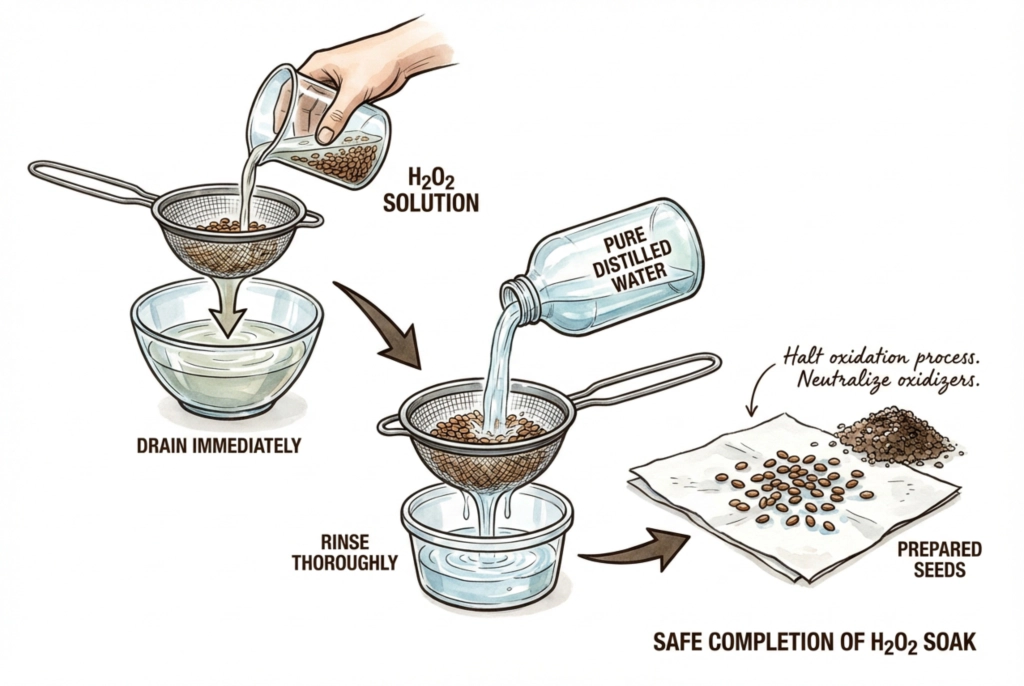
If a labelled or approved experiment is stopped, drain and rinse the seeds with clean water to dilute and remove residual peroxide.
Rinsing does not chemically neutralize peroxide or reverse oxidation that has already happened. Use a fine enough strainer that small seeds are not lost.
Sow promptly into clean, fresh, fast-draining medium. Home sowing medium is not sterile. Damping-off risk also comes from the medium, pots, tools, water, and air, not just the seed surface.
Does hydrogen peroxide help old seeds germinate?
Use Non-Caudex Studies Only as Context
Some peroxide studies report improved germination in particular species, but the often-cited bean study used mung bean, cowpea, and red bean rather than caudex plants. It also used a different concentration and exposure, with a separate bleach sanitation step.
Its reported gains mix germination percentage and germination rate, so they do not support a blanket improvement for caudex seed. A low result on old seed may indicate lost viability rather than a trapped embryo.
When does GA3 belong in the discussion?
For seed with genuine physiological dormancy, gibberellic acid can sometimes help. It does not solve physical dormancy or dead seed, and its dose depends on species, seed lot, formulation, purity, and exposure.
Measure GA3 by mass
If you use GA3 powder, do not measure it by a pinch or an included volume scoop.
A target concentration requires a calibrated mass measurement and a verified formulation.
Consumer packaging, purity, regulatory status, and seed-treatment directions must be checked before any use.
What is the difference between sterilization and oxygenation?
Separate Sanitation from Dormancy
Surface sanitation and seed physiology are separate questions. Peroxide may affect both in some protocols, but it does not fully sterilize or eradicate spores, and a surface treatment does not remove damping-off sources in the medium, pots, water, and air.
Dilute bleach and peroxide are both used as seed sanitizers in different protocols.
Which is appropriate depends on species, pathogen, concentration, exposure, and label. The bean study cited above used bleach and peroxide together, so it cannot show that peroxide is generally better. Treat sanitation as separate from a germination trigger.
Why is the metabolic boost more important?
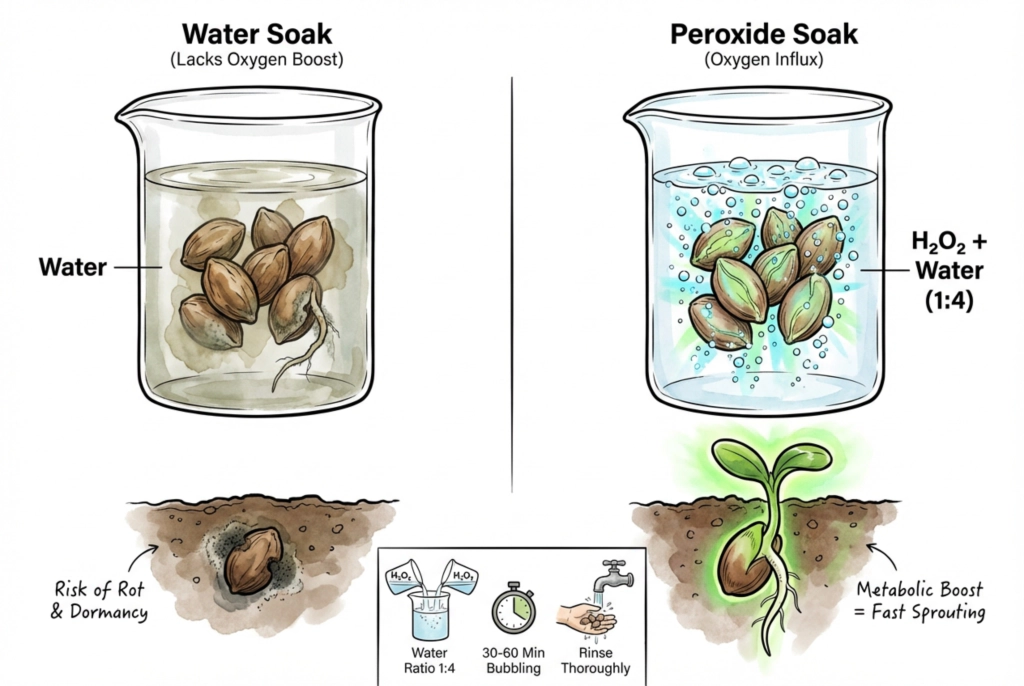
A clean but still-dormant or dead seed will not sprout just because its surface is sanitized.
Where peroxide might affect physiology, the effect is modest and not guaranteed. Keep sanitation and dormancy diagnosis as separate questions.
Whatever you sow, give emerging seedlings good light promptly so they grow compact rather than stretched, but bright, not harsh, and ramped up gradually, since tender new seedlings can scorch in sudden strong light.
Give seedlings light after emergence
A small LED grow light can supplement a tray, but check its published output at the mounting distance you will actually use. A center PPFD figure does not describe the dimmer edges of the tray, and intensity falls as the fixture is raised. To match a fixture to your tray, it helps to choose a grow light by measured PPFD and DLI.
Run it on a timer for a normal photoperiod, mount it at a distance that suits the seedlings, and keep electrics away from water.