
Baobab Tree Care: Growing Adansonia Indoors
Grow a baobab indoors with strong light, an airy mix, growth-stage watering, a careful dry rest, and a safer seed-scarification method.
Maya Ellison · 2025-12-31 · Updated 2026-05-25 · 13 min read

Key Takeaways
- A leafing baobab needs acclimated light, warmth, and a full watering only after the root zone has approached dry. Water the whole pot and let it drain rather than giving frequent surface sips.
- Stop feeding and lengthen the dry interval as growth slows and leaves yellow. A cool, leafless plant should not get routine full soakings.
- A leafless baobab needs monitoring, not a calendar ritual. Rule out rot first, then give maintenance water only if a rooted, warm, fully dry plant is progressively losing firmness.
- Build the mix around its drying time, not a fixed recipe. It must wet evenly, hold air after watering, and dry at a pace the plant can use.
- Scarify hard seed gently by filing one spot on the coat, and skip acid or uncontrolled heat. Sow the swollen seeds in a warm, airy medium with only a shallow cover.
| Plant state | Check before acting | Next step |
|---|---|---|
| Leafing and extending | Canopy light, dry pot weight, roots, and temperature | Water thoroughly after the mix approaches dry. Feed modestly during sustained growth. |
| Yellowing or slowing | Seasonal change versus cold, wet roots, or pests | Stop feeding and lengthen the dry interval. Inspect abnormal softness or odor. |
| Leafless | Temperature, residual pot moisture, root status, and shrinkage trend | Avoid routine soaking. Use the condition of the plant and its roots to decide whether maintenance water is warranted. |
| Newly germinated | Warmth, airflow, medium moisture, and damping-off | Keep the medium more even than an adult mix, then increase light and dry intervals gradually. |
The care problem with an indoor baobab is not that it is delicate. Its water demand changes sharply between a warm, leafing plant and a cool, leafless one. Treating both states as a generic drought-tolerant tree is how roots stay wet at the wrong time.
These care decisions center on Adansonia digitata, the African baobab most often raised from seed. Kew currently accepts eight species in the genus, native across tropical and southern Africa, Madagascar, the southern Arabian Peninsula, and northwestern Australia. An A. gregorii seedling or a Malagasy species may not follow every response described for A. digitata, so keep the label that came with the seed or plant.
Know Which Baobab You Have
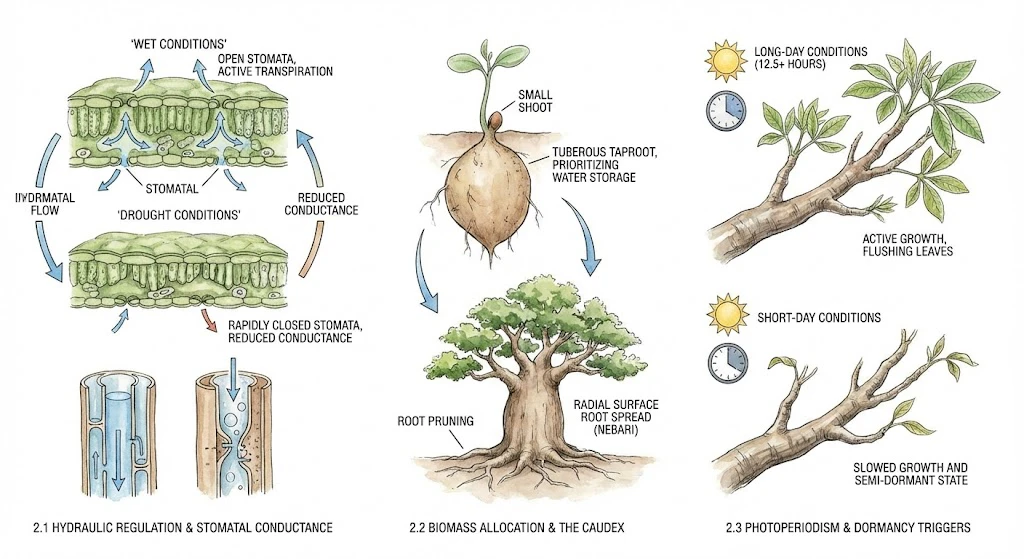
Use stored water as a buffer, not a watering rule
A baobab stores water in its stem and roots, but stored water is a buffer, not permission to ignore the root zone. The tree still needs working roots, light, and leaves to turn that reserve into new growth.
Seedlings also put substantial growth below the soil. A nursery study of A. digitata found strong investment in root tubers, with wide variation among plants and growing conditions. That explains why a young seedling may look modest above ground while building a thick root below it. It does not prove that root restriction or drought will make the visible trunk swell faster.
What Drought Actually Changes
Read drought evidence within its limits
Drought studies are useful here, but only within their limits. Research on seedlings of three Malagasy Adansonia species found that water stress reduced growth, carbon assimilation, stomatal conductance, and transpiration. The species differed in their responses, with those from more arid habitats generally handling the treatment better.
When uptake and transpiration fall, the pot takes longer to dry. Repeating the active-growth watering routine under those conditions can leave roots short of air. The research does not support the idea that chronic drought is a shortcut to a better caudex.
Dormancy Is Not a Fixed Date
In a greenhouse experiment with seedlings from thirteen A. digitata origins, both daylength and water availability affected leaf behavior. Longer days generally supported more leaf activity, while water stress changed leaf number and plants responded quickly when weekly watering resumed. Origins also differed in their response to water.
That makes a fixed winter schedule a poor tool indoors. Shorter days, lower light, cooler roots, and reduced water can all push a plant toward rest, but a warm baobab under useful artificial light may stay leafy longer. Follow the plant’s state and the pot’s drying rate rather than forcing dormancy on a particular date.
Light and Warmth While It Is Leafing
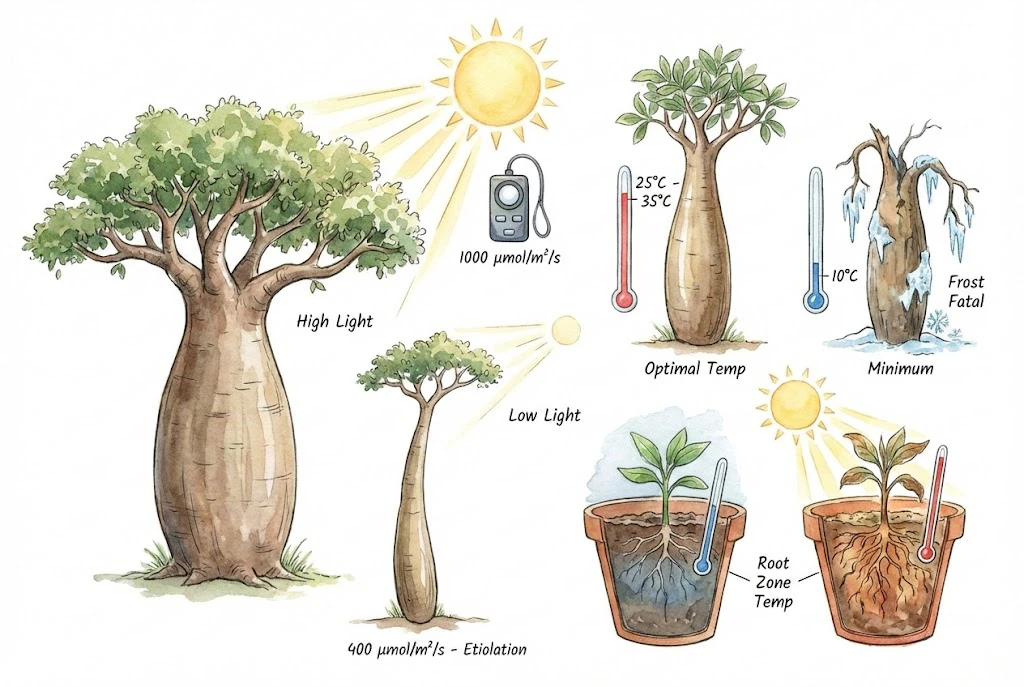
A sunny window is a useful start, but glass, season, and distance from the pane can reduce the light reaching the canopy. Judge the setup by the light measured at the newest leaves and by the next section of growth. Long internodes, a thin leaning stem, and steadily smaller new leaves are reasons to check light before adding fertilizer.
Increase exposure in stages. A leaf formed indoors can scorch when moved directly into open midday sun, even though the species ultimately prefers strong light. The measured caudex grow-light setup explains how to choose a starting level and adjust from the plant’s response.
When a Supplemental Lamp Helps
A compact LED grow lamp can supplement a bright window or cover one small plant. Its practical value depends on the light measured at the canopy, not the wattage alone. Check coverage, current PPFD information, and heat output before treating it as a complete lighting plan.
Keep Warmth and Pot Heat Separate
Keep a leafing baobab warm and protect it from frost and cold glass. There is no well-supported lethal minimum for every species and pot condition. A cool, wet root zone is the combination to avoid. At the other extreme, a dark nursery pot in direct sun can run much hotter than the room or air. The caudex heat-protection setup covers root-zone measurement and pot shading.
How Often Should You Water an Indoor Baobab?
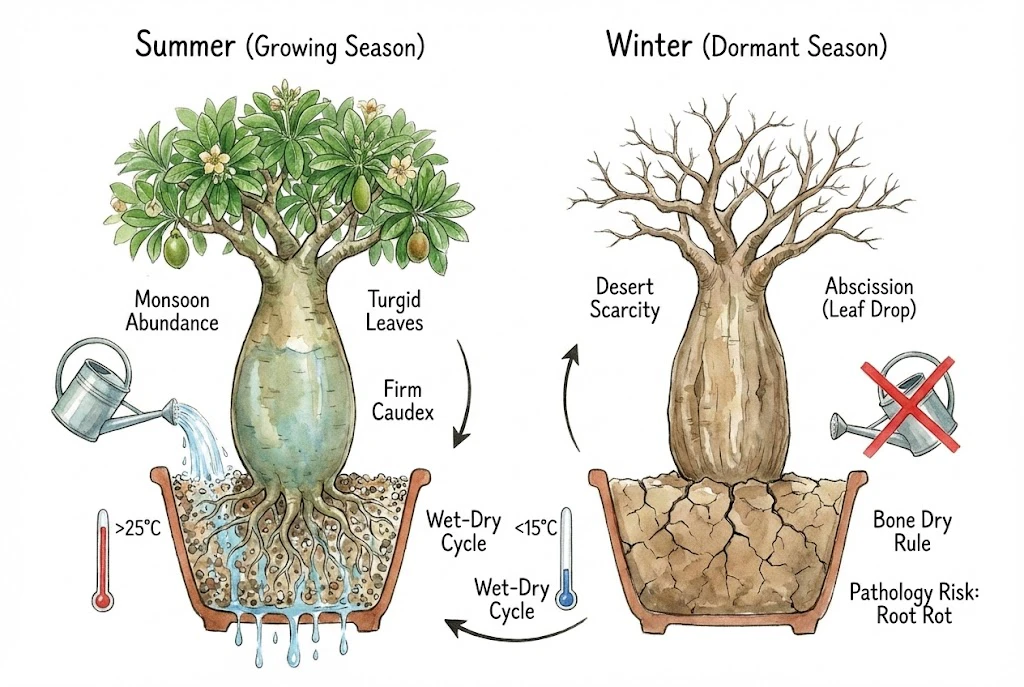
Let pot drying set the interval
There is no useful every-few-days answer. A small plant in coarse mix under strong summer light can dry quickly. The same plant in a large plastic pot during a cool spell may stay wet for much longer.
During Active Growth
Water the full usable root zone
When leaves are expanding and the roots are sound, water the whole usable root zone after the mix approaches dry. Let excess water leave through the drainage hole. Repeated surface sips wet an uncertain fraction of the roots and make salt management harder.
Use dry pot weight as the baseline, then cross-check the lower mix with a skewer or moisture reading while learning a new pot. The caudex watering measurement guide shows how to keep a simple weight log and distinguish a thirsty plant from one whose roots have stopped taking up water.
When Growth Slows or Leaves Drop
Reduce inputs as uptake slows
Stop feeding and lengthen the dry interval as leaves yellow and the pot takes longer to lose weight. A cool, leafless baobab should not receive routine full soakings. Keep it bright, dry enough to preserve air around the roots, and away from cold drafts.
Leafless does not mean lifeless. If a rooted plant remains warm, the mix is fully dry, and the stem is progressively losing firmness, maintenance water may be warranted. First rule out rot. A soft area spreading from the soil line, wet mix, collapsed roots, or a bad smell is not ordinary dormancy shrinkage.
When buds swell, do not jump immediately to the peak-summer schedule. Resume cautiously as leaves open and the pot begins to dry faster, then restart fertilizer only after sustained extension is visible.
Before seasonal yellowing, I loosely tag three reference twigs at the outer, middle, and inner canopy. Every seven days at the same hour, I count retained leaves and extending buds on those twigs, then record pot mass and root-zone temperature. Three fixed samples show whether change is canopy-wide or isolated without making every yellow leaf a calendar instruction.
I move toward active care only after two weekly checks show leaf expansion and a firm stem. I also require faster 24-hour mass loss from a weight taken after 30 minutes of free drainage. Repetition matters because one swollen bud can stall, while a wet pot with progressive softness needs inspection rather than more water.
Build the Mix Around Its Drying Time
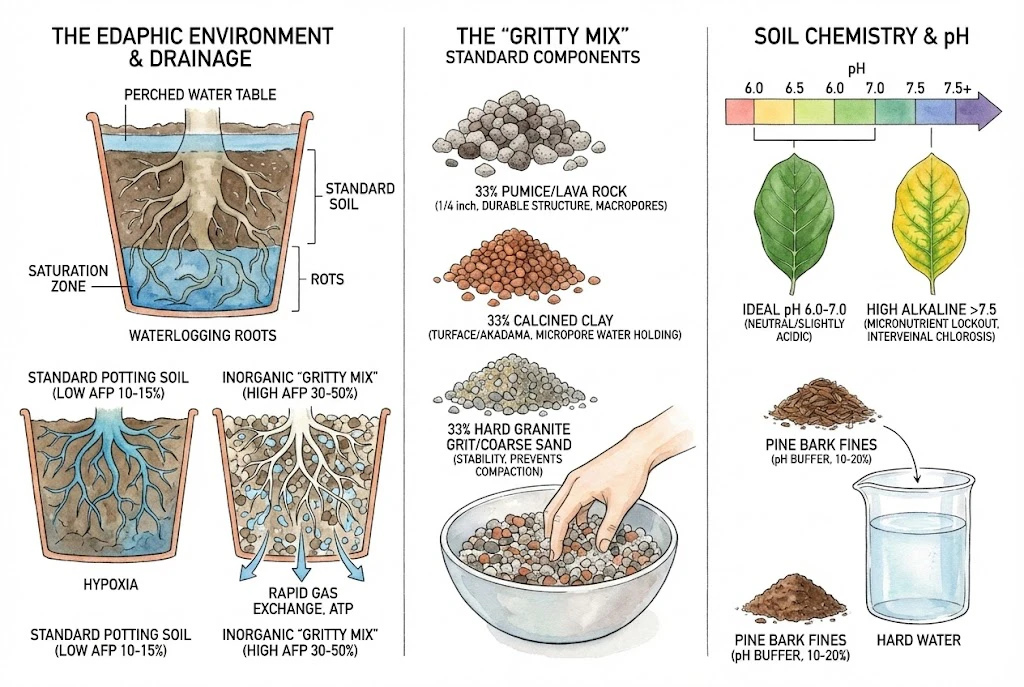
Build a mix that preserves air
An indoor baobab needs a mix that wets evenly, keeps air after watering, and dries at a pace the plant can use. Fast draining is not just how quickly water exits the hole. Fine peat can drain at first and still hold a dense, wet core for days.
A workable starting blend uses stable coarse particles such as pumice or lava rock, a water-holding mineral such as calcined clay, and a smaller fraction of coarse bark or coco chips. Screen out dust and adjust the water-holding fraction to the room.
Use a Test Pot Before Repotting
| What the test pot does | Adjustment to try |
|---|---|
| Stays heavy well after an active plant should be using water | Use a smaller pot, remove fines, or increase stable coarse material. |
| Turns hydrophobic and sheds water down the sides | Improve wetting and replace degraded peat rather than watering more often. |
| Dries too quickly in hot, dry air | Retain a little more bark or coir, or use glazed ceramic or plastic. |
| Compacts after several cycles | Replace broken-down material and avoid pressing the mix tightly around the roots. |
The caudex substrate comparison covers particle stability and climate tradeoffs.
What a Pumice Product Can and Cannot Do
Horticultural pumice can add stable air space when a mix stays wet, but it is not a complete mix and it does not make overwatering impossible. Screen excess dust and compare the current particle size with the pot and room before using it as one part of a blend.
Choose a pot only modestly larger than the functioning roots and keep the drainage hole clear. If crusts build on the pot or the runoff changes, diagnose the irrigation water and accumulated salts before adding lime or supplements. The hard-water and salt-buildup guide provides that check.
How Do You Germinate Baobab Seeds Safely?
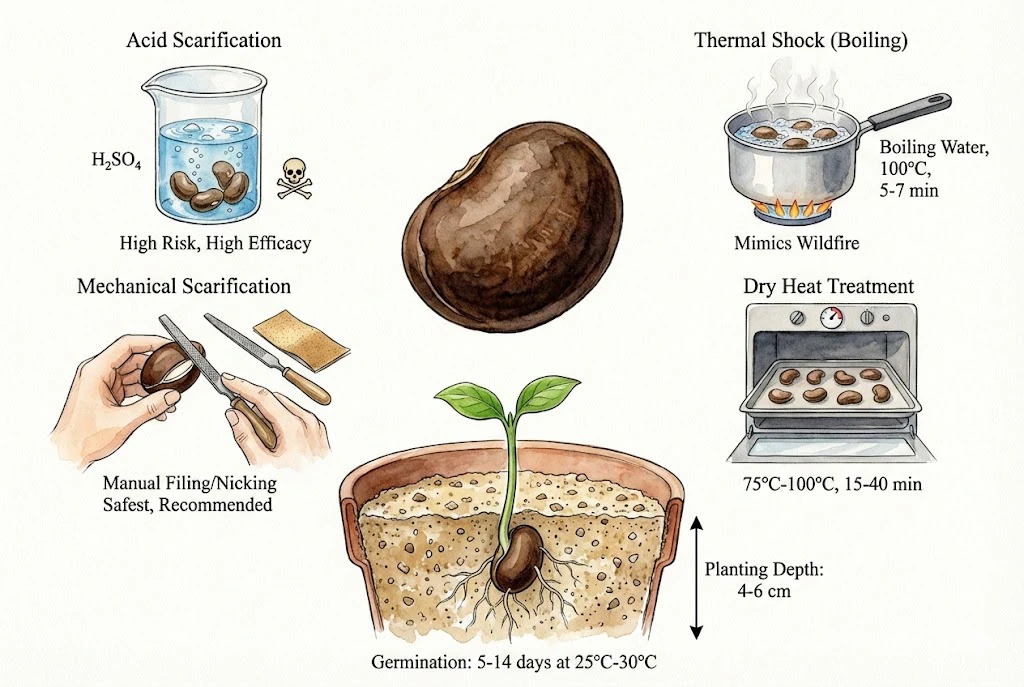
Prepare a hard-coated seed gently
A. digitata has a thick, water-resistant seed coat. Untreated seed can remain sound without taking up enough water to germinate, which is why some form of scarification is commonly used.
Choose the Gentlest Scarification Method
| Method | Use at home? | Main tradeoff |
|---|---|---|
| Mechanical abrasion | Preferred for a small batch | Controllable seed by seed, but cutting too deeply can injure the embryo. |
| Plain-water soak only | Low hazard | The intact coat may remain impermeable, so swelling can be slow or uneven. |
| Hot-water or dry-heat treatment | Use caution at home | Research results depend closely on temperature, time, moisture, and seed lot. The margin between opening the coat and damaging the embryo is difficult to reproduce in a kitchen. |
| Concentrated acid | No | It is a laboratory method with serious burn and disposal hazards, and published results are not consistent enough to justify home use. |
For a small batch, rub one area of each coat with a file or coarse sandpaper until it visibly thins, stopping before you reach the pale tissue beneath. Let the treated seeds hydrate only long enough to show that the lot is taking up water, then sow the swollen seeds in a clean, airy medium with only a shallow cover.
Do not treat an overnight soak as a universal requirement. Compare a small treated and untreated subset, and stop if seed softens or develops a sour odor. If a seed remains hard and unchanged, inspect the abraded patch rather than extending hydration indefinitely.
The goal is a warm, moist seed zone with fresh air, not an adult-style dry cycle. Check daily for sour odor, collapsed tissue, or a seed coat that traps the opening leaves. Record the seed source, treatment, medium temperature, and emergence date so a poor batch is not mistaken for a failed method.
The First Months
Keep seedlings evenly moist while roots establish
A seedling is not a miniature dormant adult. Keep the medium lightly and evenly moist while roots establish, without leaving the container waterlogged. Give good airflow and bright filtered light, then increase intensity as the stem firms and the next leaves remain compact.
Use a small container that lets you observe drying and root development. Do not force the first dry rest by age alone. The caudex seed-germination setup provides a repeatable tray, heat, ventilation, and record-keeping workflow.
Feed Only Active Growth
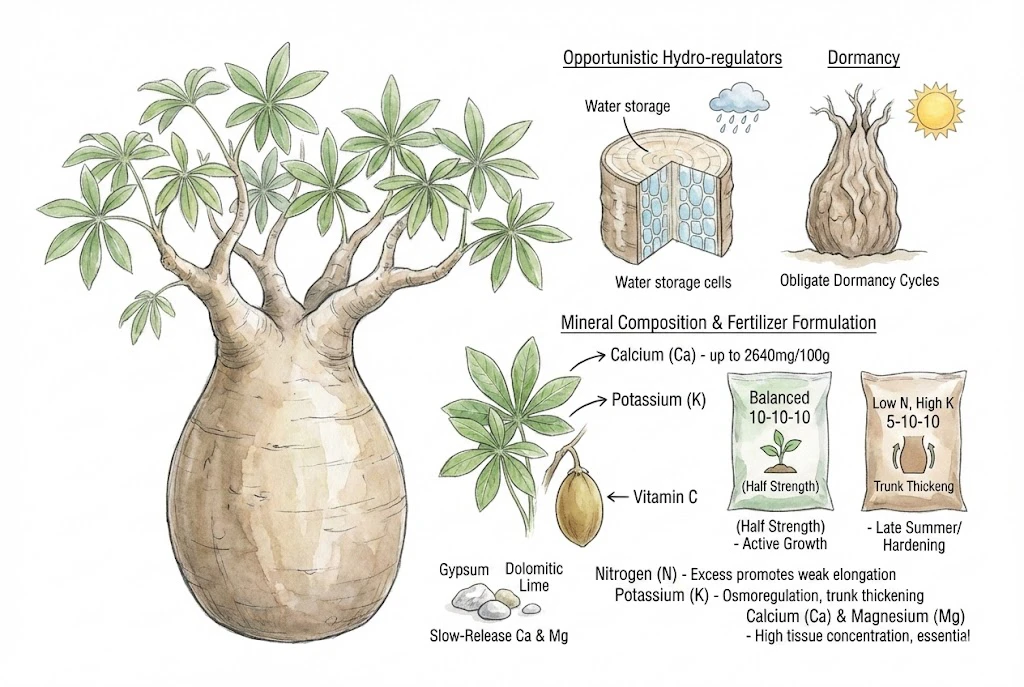
Match fertilizer to visible growth
The mineral content of baobab fruit or leaves is not a fertilizer recipe for a potted tree. Use a complete fertilizer while the plant is producing leaves and extension, beginning at the conservative end of the product label. The nutrients already present in the mix, irrigation water, and salt accumulation all affect the appropriate dose.
Do not choose a high-potassium product on the promise that it will redirect growth into the trunk. Light and total healthy growth set the raw material for thickening. Stop feeding when extension slows or leaves begin seasonal yellowing, and do not add calcium, magnesium, or pH amendments without a measured reason. The caudex fertilizer guide explains how to match concentration and timing to the substrate.
Decide Whether You Are Growing or Styling
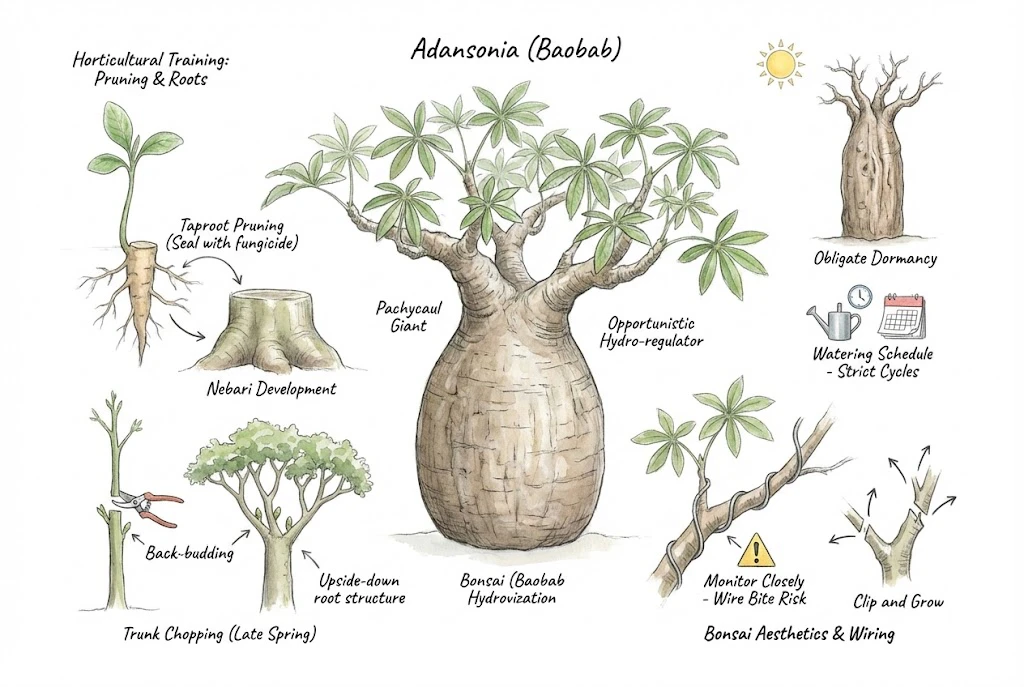
Separate natural structure from bonsai styling
A young baobab naturally invests in a strong downward root and an upright leader. Those traits help establish a tree. They do not automatically produce the shallow radial roots and low branching expected in bonsai.
Taproot Decisions
Make root work a recovery decision
Shortening the dominant root is a shaping technique, not a proven trunk-thickening treatment. Make that decision only after unpotting during active growth and confirming that the seedling has enough lateral roots to support recovery. Removing the only functioning root can kill a plant, while waiting too long can leave a large wound and fewer placement options.
Use a clean sharp tool, retain sound lateral roots, and let the cut begin to callus before fully wetting the mix. Once recovery starts, do not subject the seedling to prolonged drought. There is no single age at which every plant is ready.
Branches and Wire
If the goal is a low canopy, prune the leader while the plant is warm, rooted, and actively growing rather than by a fixed spring date. Confirm the likely bud positions before making a large cut. Back-budding varies with vigor, species, and remaining foliage.
Wire can mark the soft expanding bark quickly. Check contact points often and remove the wire before it bites. Clip-and-grow shaping is slower but avoids leaving wire unattended through a fast flush. Avoid combining major root work and a severe trunk cut unless the plant is vigorous enough to absorb both losses.
Troubleshoot the Symptom, Not the Plant’s Reputation
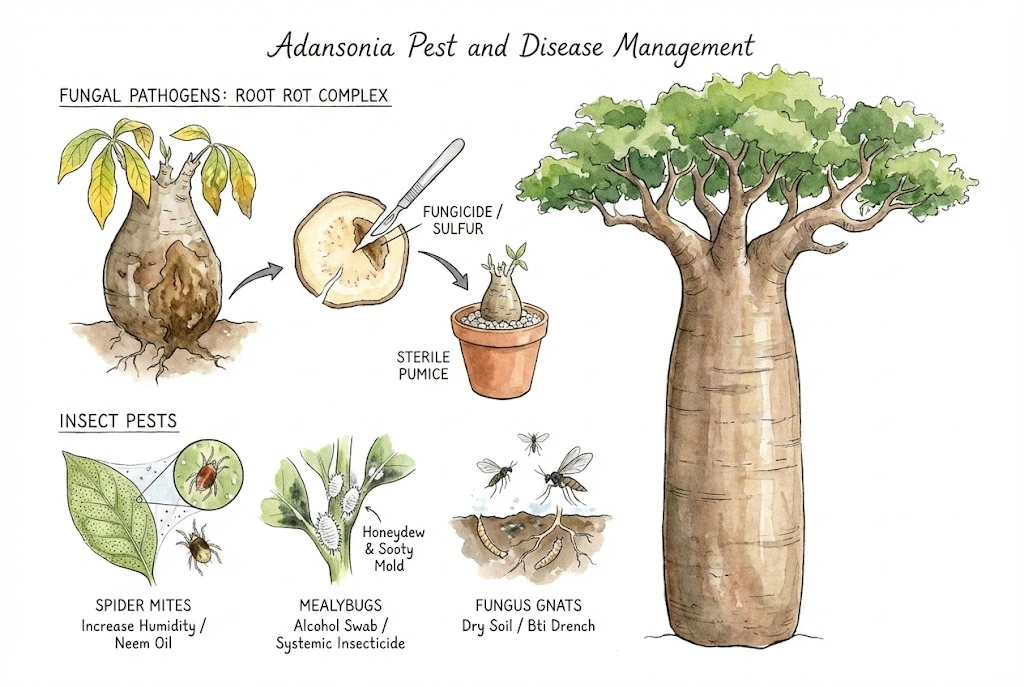
| Symptom | Confirm | Response |
|---|---|---|
| Softness at the soil line | Wet mix, spreading discoloration, collapsed roots, or odor | Isolate and unpot. Remove confirmed rot with a disinfected tool. Choose any fungicide only by diagnosis and label. |
| Fine stippling or webbing | Look for moving mites with magnification | Isolate, rinse where tolerated, and use a labeled soap, oil, or miticide with follow-up inspections. |
| White wax or cottony clusters | Check leaf axils, bark crevices, and the root zone | Remove visible insects and select a labeled treatment for the plant, pest, and growing location. |
| Small flies around the pot | Use sticky cards and inspect the persistently damp upper mix | Correct the moisture source and use a labeled larval treatment when needed. |
Diagnose the symptom before naming a pathogen
Root decline can involve water molds, true fungi, bacteria, or non-infectious damage, so a list of pathogen names does not diagnose the plant. The root-rot treatment chooser separates sanitation, cutting, and labeled pesticide uses.
For pests, use the spider-mite guide, root-mealybug guide, or fungus-gnat guide after confirming what is present. A treatment that is legal for an outdoor ornamental may not be labeled for indoor use where you live.
A Routine That Follows the Plant
Keep a short record of the actual plant
At each watering, note five things. Record whether the plant is making leaves, the pot’s dry weight, how long the pot took to return near dry after the last watering, the root-zone temperature, and whether new growth is compact. Those observations are more useful than a summer/winter calendar copied from another climate.
When the signals agree, warm roots, active leaves, strong light, and a pot near dry, water thoroughly. When they separate, investigate before compensating with more water or fertilizer. That habit gives you a clearer basis for adjusting indoor care.