
Operculicarya Decaryi Dropping Leaves: Dormancy or Death?
Is your Operculicarya decaryi dropping leaves from seasonal rest, dehydration, cold stress, or root trouble? Use low-damage observations, substrate checks, and a cautious recovery path before intervening.
Nathan Brooks · 2026-05-30 · Updated 2026-06-03 · 21 min read

Key Takeaways
- Operculicarya decaryi is drought-deciduous, so leaf drop is often benign and reversible. Do not panic or over-treat a healthy plant.
- Use low-damage checks first. Compare the mix, caudex firmness, and overall pattern before deciding the plant is failing. A small scratch adds context but cannot give a precise diagnosis.
- Let the substrate guide the first branch: dry mix supports a drought cue, while a softening caudex in soggy mix points to root trouble. Inspect before watering a wet pot.
- Keep the differential broad. Cold, low light, abrupt changes, transplant shock, salt buildup, and pests can also drop leaves. Match the response to the whole plant.
- Prefer the least invasive fix: correct the supported cause and give the plant time to releaf. Patience is safer than repeated interventions.
Leaf drop on Operculicarya decaryi is commonly benign, caused by drought-cued abscission or normal dormancy, but it can also signal trouble such as root problems from soggy, airless soil or a canker on woody tissue.
A few simple observations can show which explanation is more likely, although they remain clues rather than a clinical test that identifies a cause or pathogen. Getting that rough read before acting matters because the wrong intervention on a healthy plant can do more harm than the original problem. When in doubt, do less rather than more.
What kind of plant is Operculicarya decaryi, really?
Start with the Diagnosis
Operculicarya decaryi is a drought-deciduous caudiciform tree in the Anacardiaceae family, associated with dry forests of Madagascar. Leaf drop can respond to moisture, temperature, light, root condition, and the plant's history. Do not force every specimen onto a fixed Southern-Hemisphere calendar.
Why the family matters for diagnosis
The species sits inside the same family as mango (Mangifera indica), pistachio (Pistacia vera), and cashew (Anacardium occidentale). This is useful context because little pathology work is specific to Operculicarya, so growers sometimes look to relatives for possible disease patterns. That is a reasonable starting point, but keep it loose. Botryosphaeriaceae fungi are documented on those crops, yet host range and susceptibility vary by fungal species and host, so family membership does not guarantee the same disease behavior here. Treat the comparison as background awareness rather than a diagnosis.
Regional rainfall is seasonal, but local habitats vary. Use the cited climate data as context rather than a universal monthly watering schedule. Trees in this ecoregion drop leaves during the dry winter to reduce evapotranspiration, and mature plants can reach substantial size while their small pinnate leaves emerge after rains rather than on a clock.
What this means for your bonsai
The plant’s primary cue is water, not daylength. A specimen sitting in dry substrate at any point in the calendar can drop leaves and remain healthy, while the same symptom in saturated substrate can reflect root stress or disease.
Substrate moisture is often one of the fastest useful discriminators, but it is not a diagnosis by itself.
| Native Madagascar | Northern Hemisphere cultivation |
|---|---|
| Seasonal wet period in the cited region | Adjust to local conditions and active growth |
| Seasonal dry period in the cited region | Reduce water when the plant and pot show reduced demand |
| Leaf-out follows rain | Leaf-out follows observed growth cues. Timing varies |
Does hemisphere transfer scramble its internal clock?
Plants moved across the equator encounter different daylength, temperature, and moisture patterns, but the timing and degree of adjustment are not established for every Operculicarya specimen. Treat the first seasons as an observation period, not a fixed rephasing timetable.
What Community Evidence Actually Documents
Grower reports describe leaf loss during cold spells and delayed recovery, but those observations do not establish a universal temperature trigger. Compare night temperature, moisture, light, and the plant's prior pattern.
When to expect first-year weirdness
Imported or recently moved specimens may show an unfamiliar timing in the first seasons. Record the plant's own leaf-drop and leaf-out pattern instead of assuming that a second event or a fixed calendar drift is normal.
When leaf fall begins, I record the canopy, root flare, and plant position. The same card carries pot mass measured before watering at a fixed local time, hours since irrigation, and overnight minimum air temperature from a shielded logger at caudex height. I also record whether loss began at older inner leaves or newest tips, creating a baseline without repeated scratching, squeezing, or rocking.
I update the existing card after each 24-hour pot-mass check or when the leaf-loss zone changes. A firm caudex supports waiting when mass loss remains inside its pre-leaf-fall range and shedding stays confined to older inner leaves.
New softness, a wet pot that no longer dries, or leaf loss spreading into healthy tips gives me a clearer reason to escalate. The original number of fallen leaves alone tells me less.
How do I actually run the diagnostic protocol?
A few gentle checks help, but keep them minimal and low-damage. Every scratch and hard rock is a small injury and a potential infection site, so do not run a battery of invasive tests on a plant that may just be resting.
Start with non-invasive observations such as whether the mix is wet or dry and whether the caudex is firm. Investigate further only if those observations point to a real problem, and remember that the checks provide a rough read rather than a definitive diagnosis of a cause or pathogen.
Test 1: The cambium scratch
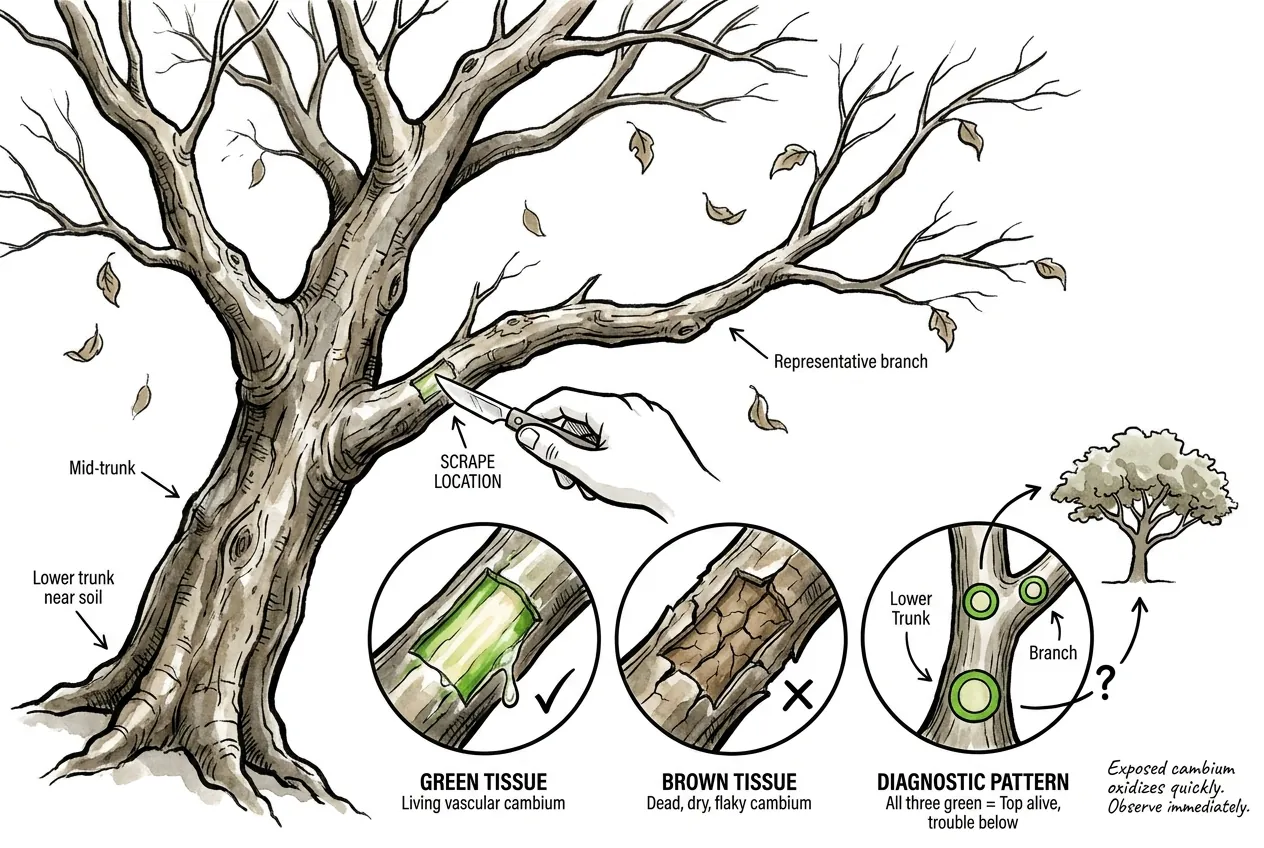
Prefer non-invasive observations first. If a tissue check is necessary, make one minimal, disinfected nick in an inconspicuous area rather than scraping a fixed-size patch. The vascular cambium sits only one to several cells beneath the bark, so you do not need to dig deep.
Look at the color immediately because exposed cambium oxidizes brown within minutes. Green or pale tissue can be encouraging, while brown or dry tissue is concerning, but color varies with depth, moisture, and oxidation. A scratch confirms sap presence at that spot, not whole-plant viability, and cambium can stay green for weeks after roots have died.
Keep scratching to a minimum
A single small scratch in an inconspicuous spot is usually enough. Resist the temptation to scratch the trunk in several places to map the plant. Each scratch is a wound and a possible entry point for infection, while green-versus-brown color is affected by moisture, tissue type, depth, and oxidation and is not a reliable location-by-location diagnostic.
| Scratch pattern | What it suggests |
|---|---|
| All three green | Top tissue appears alive. Inspect the lower plant and roots |
| Lower green, upper brown | May reflect upper dieback. Canker or vascular problems are possibilities |
| All three brown | Concerning pattern that warrants broader inspection |
| Patchy green and brown | Mixed tissue status. Prognosis remains uncertain |
Test 2: The caudex squeeze
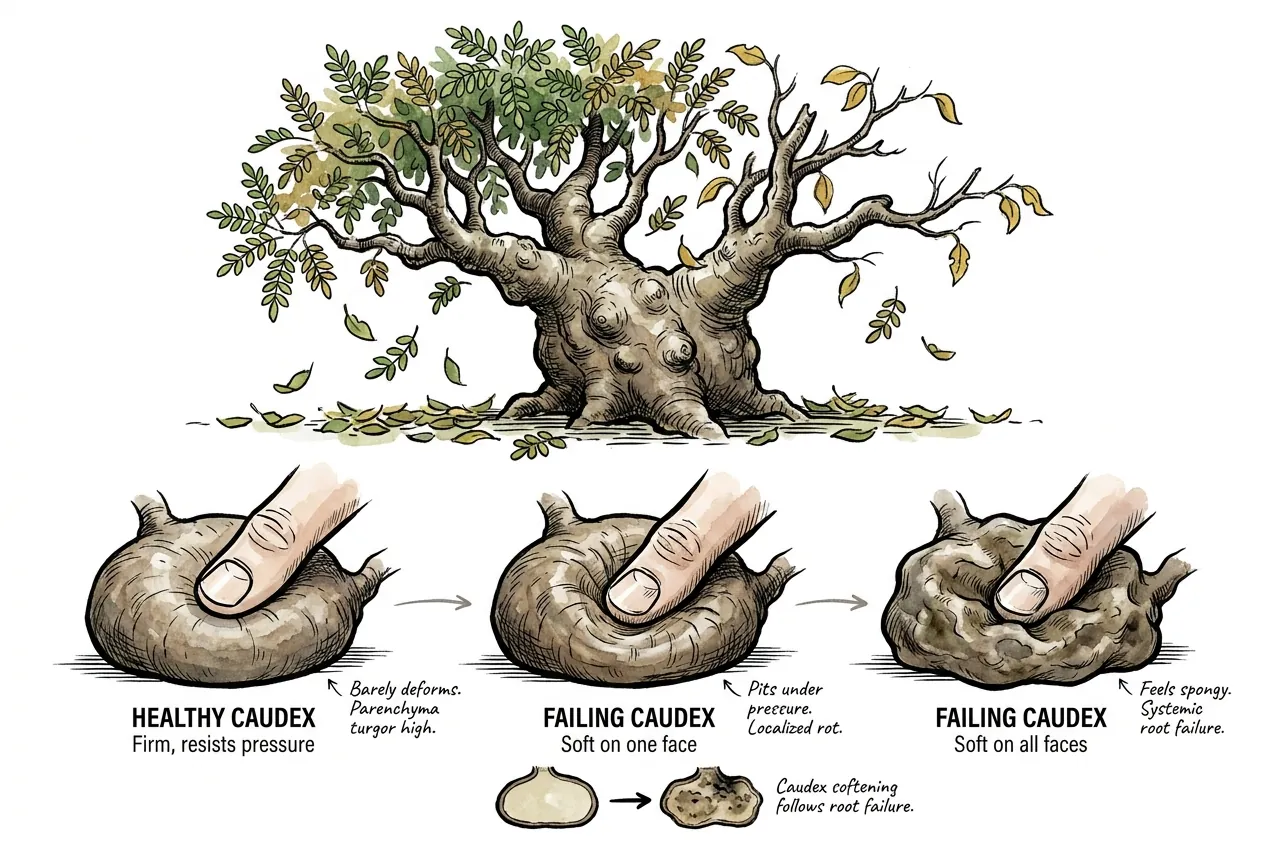
Press gently with a thumb. A firm caudex is reassuring, while one that compresses easily, pits, or feels spongy is a warning sign. Do this lightly and sparingly because repeated hard squeezing bruises tissue.
Firmness is a clue rather than a definitive test of root health. Hydration, dormancy, tissue maturity, temperature, and pressure all affect it, so a dehydrated but living caudex can feel softer without being rotten. Read the result alongside substrate moisture, smell, and overall condition before considering a cut.
Test 3: The root-flare wobble
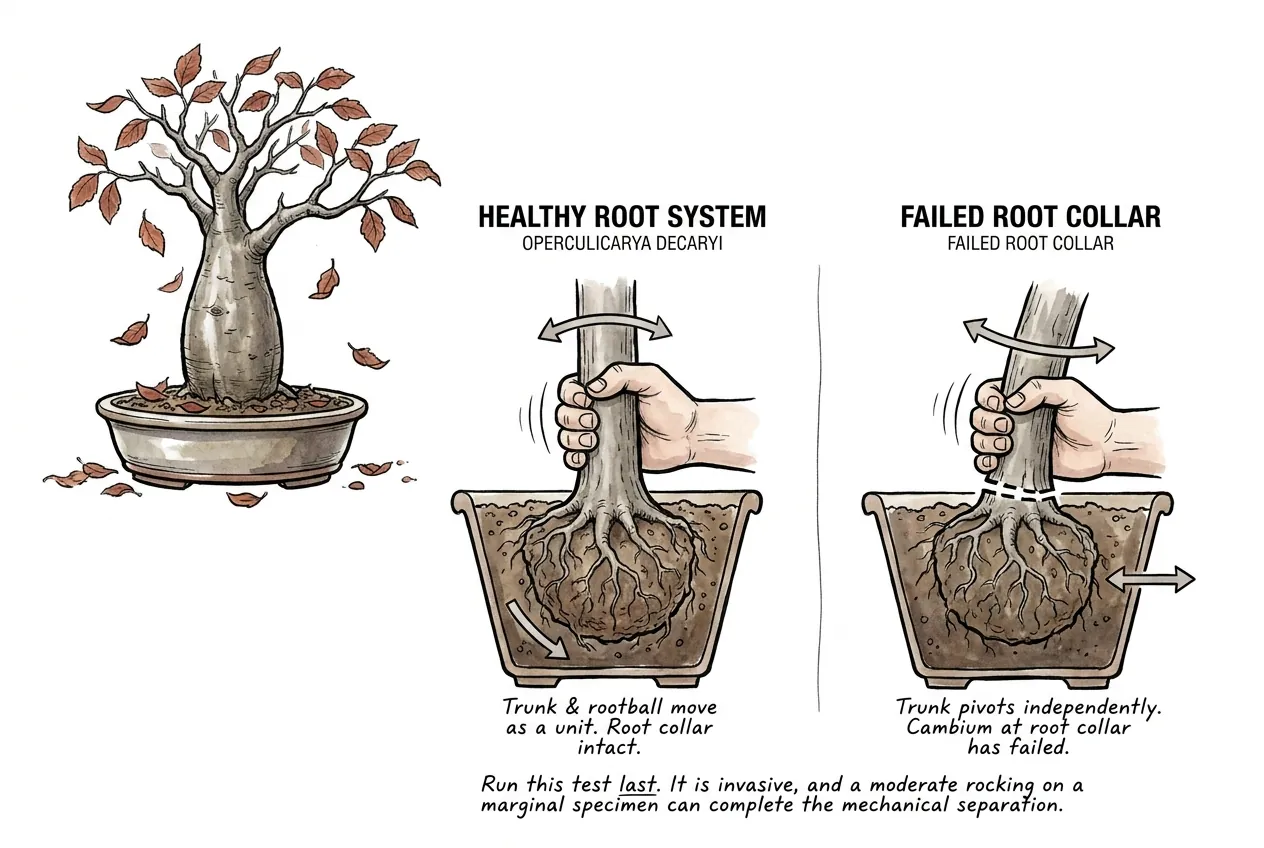
You can very gently check whether the trunk feels anchored, but this is the most invasive check and rocking a stressed plant can break its last root connections. Prefer to observe, and only move the trunk very lightly if at all. A trunk that moves freely while the rootball stays put can indicate root or collar failure, but a recent repot, root pruning, a small or loose rootball, coarse mix, or lack of anchoring wire can also let a healthy trunk wobble. Treat a loose trunk as a reason to look closer, not proof of rot, and do not do this routinely.
Test 4: The substrate moisture check
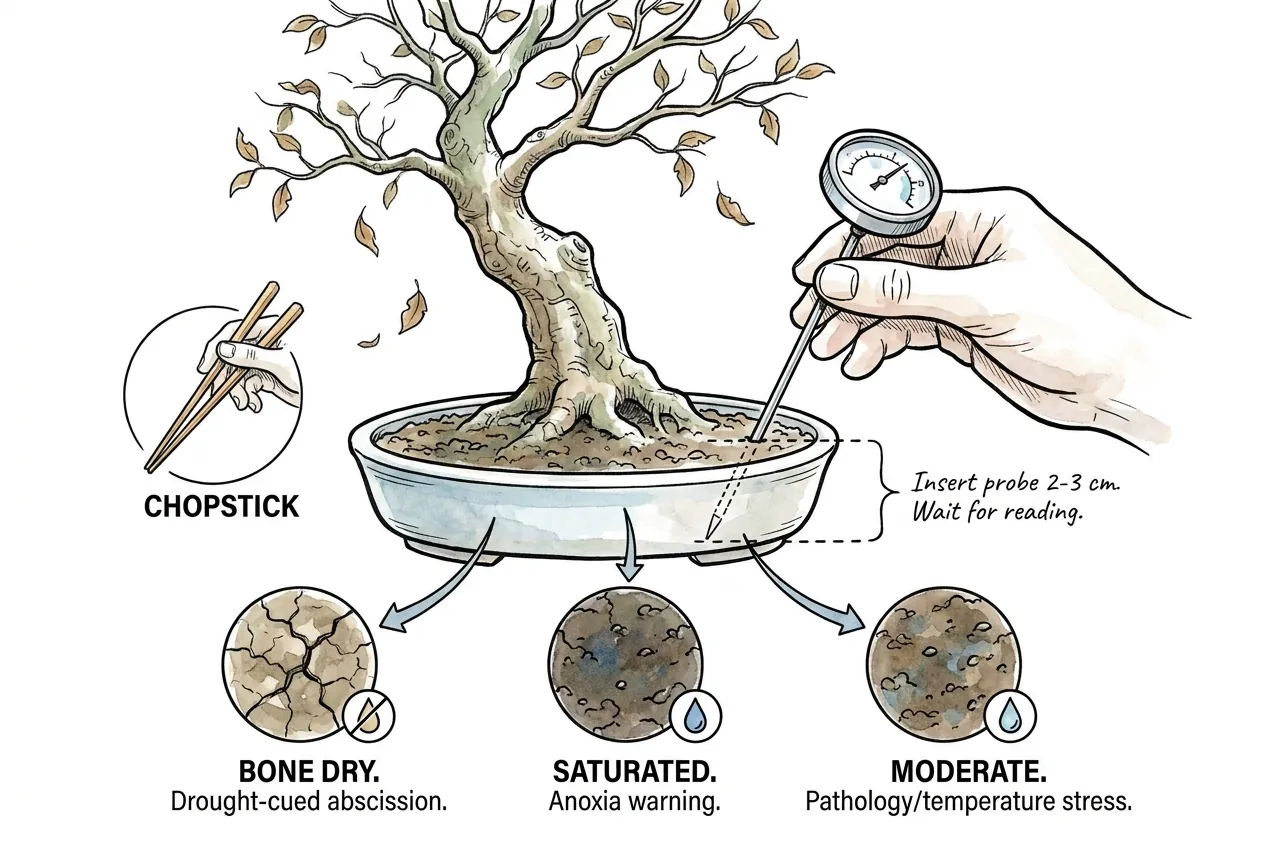
Insert a needle-probe moisture meter or a wooden chopstick to a representative depth for the pot. The reading helps contextualize the likely cause alongside firmness, odor, roots, and the plant's history.
| Substrate state | Possible interpretation |
|---|---|
| Dry relative to the plant's established pattern | Drought-cued abscission is possible. Inspect the whole plant |
| Persistently wet relative to the pot's normal dry-down | Root-zone stress or disease risk. Inspect before watering |
| Draining on its usual pattern | Consider temperature, light, roots, pests, and disease |
Use tools only after manual checks
A simple analog soil meter can help, but check the actual product before assuming it fits a small bonsai pot. The SONKIR 3-in-1 meter, for example, actually has long dual probes (around 20 cm) that its own instructions say to insert several inches deep and let settle, not a short 2–3 cm needle. In a shallow pot with coarse, gritty mix such probes can read poorly (or bend), so don't treat one reading as a precise measurement.
Whatever meter you use, insert it gently and read it as a rough guide alongside the feel and weight of the pot.
And don't hang a big decision like bare-rooting the plant on a single analog reading. These meters give relative moisture, not a calibrated number.
What to do when results are mixed
The common causes can produce overlapping combinations.
| Cambium | Caudex | Wobble | Substrate | Most likely cause |
|---|---|---|---|---|
| Green throughout | Firm | Stable | Dry | Compatible with drought-cued abscission |
| Green | Firm | Stable | Wet | Possible root-zone stress. Inspect before watering |
| Green upper, brown lower | Firm or softening | Wobbles | Variable | Possible basal or root-collar problem |
| Green | Soft | Wobbles | Wet | Concerning for severe root-zone damage |
| Brown throughout | Variable | Variable | Variable | Severe decline. Confirm before discarding if practical |
Why does substrate water-holding capacity decide whether roots live or die?
A fast-draining, airy substrate is one of the most important things you can get right for caudex bonsai because roots need oxygen and a mix that stays saturated starves them.
Be skeptical of exact cutoffs. Numbers claiming roots die below a specific air-filled porosity or that another value prevents rot entirely are more precise than the evidence supports, because actual air content depends on particles, pot, packing, and watering. Aim for a mix that drains quickly and does not stay soggy rather than chasing a figure you cannot easily measure.
What air-filled porosity actually means
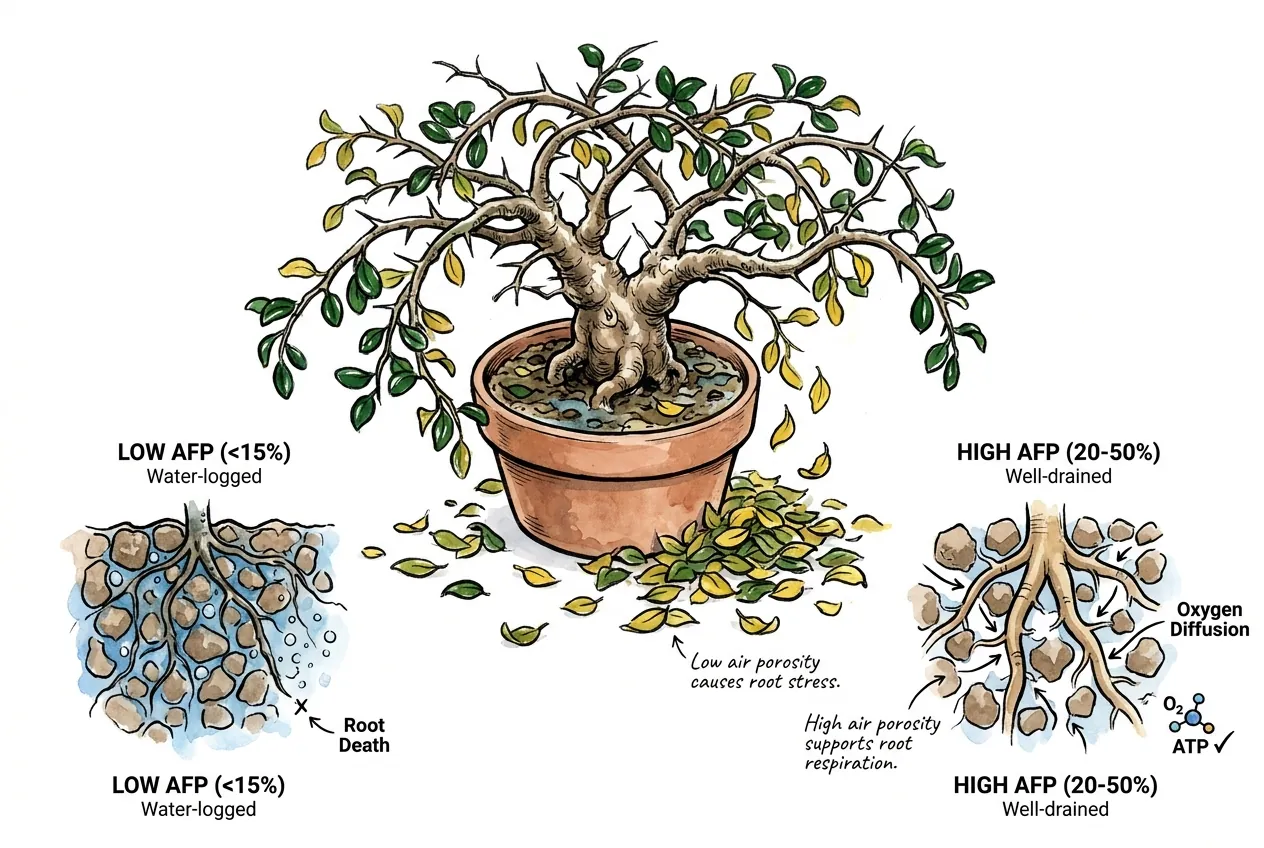
Air-filled porosity (AFP) is the share of substrate volume occupied by air after watering has drained.
General container-media guidance sometimes uses example ranges around 10% to 25%, but requirements vary by plant, and drought-adapted caudiciforms generally do best with a mix on the airier side.
Keep baobab evidence separate from Operculicarya
Adansonia, the baobab, is not a sister caudiciform genus to Operculicarya. They are in different families, Malvaceae and Anacardiaceae, and only share a similar thick-stemmed growth form. Do not treat a baobab AFP target as a validated number for this plant.
The mechanism is straightforward enough. Roots respire and need oxygen, and a waterlogged mix cuts off that oxygen.
But skip the false precision. Roots don't uniformly die within hours to days below 15% AFP.
Different species, temperatures, and tissues tolerate low oxygen differently, plants have some hypoxia responses, and ATP doesn't instantly drop to zero.
Keep the mix airy and unsaturated
Roots need oxygen, so do not let the finished mix stay saturated.
How container shape changes effective AFP
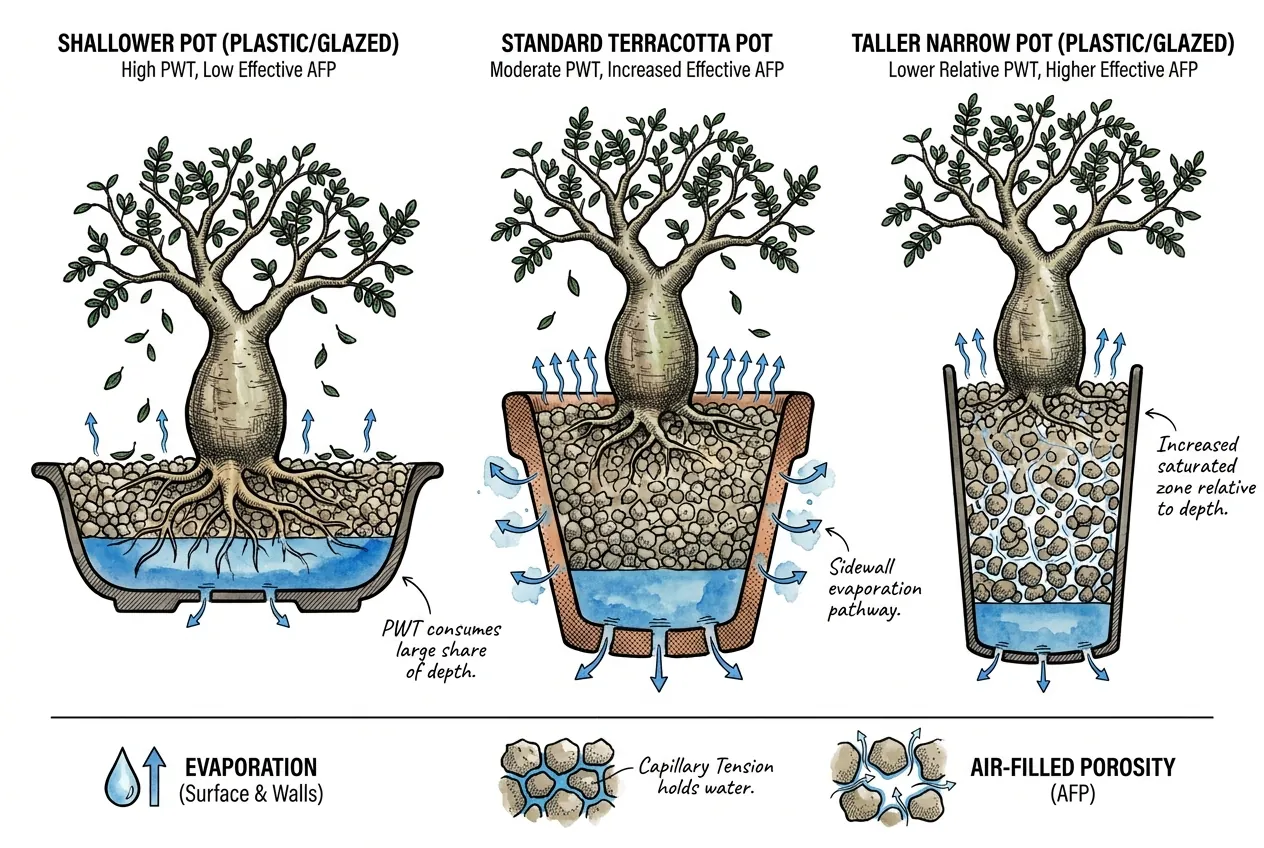
A perched water table forms at the bottom of every container because gravity cannot overcome capillary tension at the container floor.
In a shallow bonsai pot (typically 5 to 8 cm deep), that perched water table consumes a disproportionate share of the substrate depth.
Coarser substrate reduces the capillary fringe height and finer substrate increases it.
A coarse range such as 3 to 6 mm can be a starting point for some caudex bonsai, but the pot and root system determine whether it dries appropriately.
Unglazed terracotta adds a second drying pathway through the pot wall.
The microporous structure lets oxygen diffuse inward and water evaporate outward.
This sidewall pathway is on top of top-surface evaporation and bottom-drain drainage, raising operational AFP versus plastic or glazed ceramic without changing the substrate.
| Container type | Drying pathways | Effective AFP behavior |
|---|---|---|
| Plastic | Top, bottom | Often lower, depending on mix and environment |
| Glazed ceramic | Top, bottom | Often similar to plastic, depending on mix |
| Unglazed terracotta | Top, bottom, sidewall | Often higher, depending on contact and airflow |
Why anoxia kills roots even without pathogens
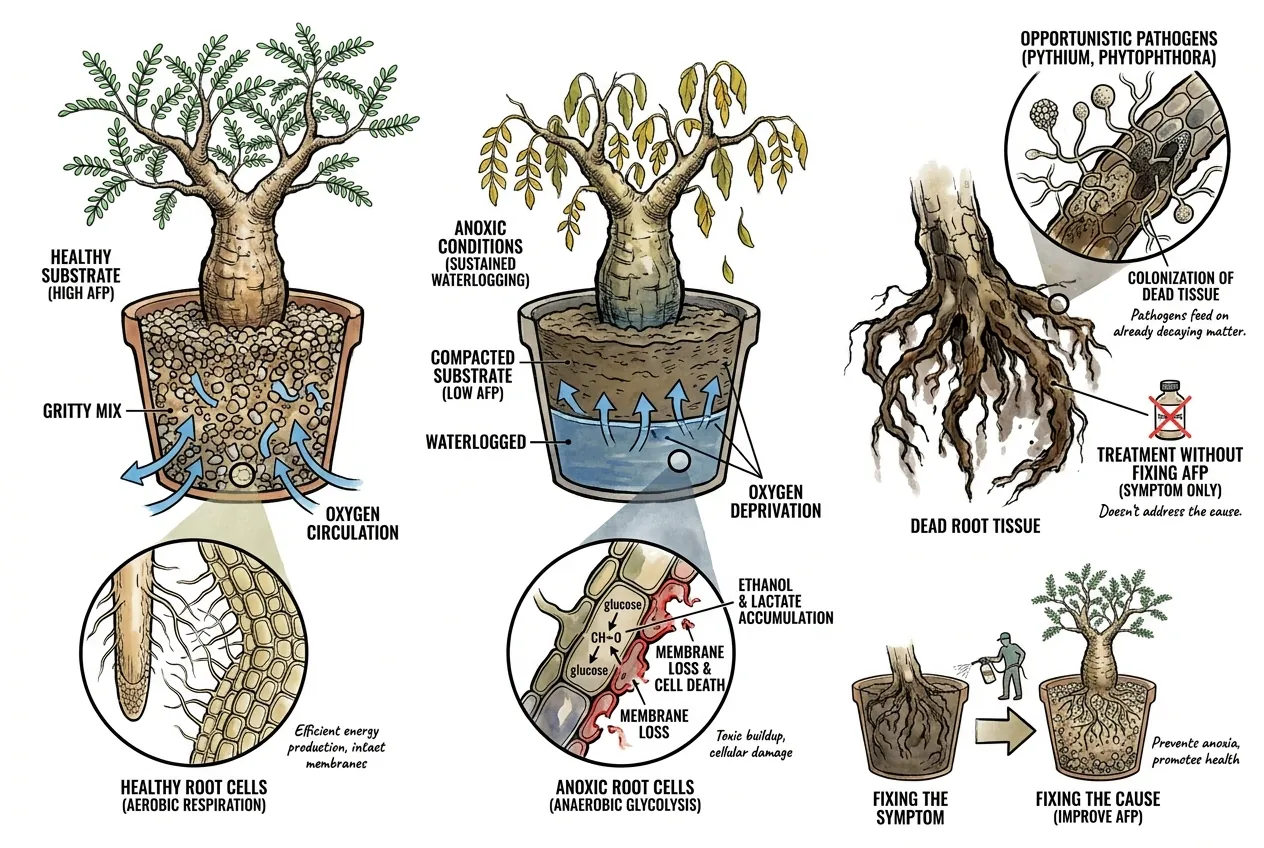
Root rot does not always require a confirmed pathogen. Sustained waterlogging alone can injure roots through low oxygen.
Fixing drainage and watering is therefore a priority, and fungicide alone will not solve a mix that stays soggy.
But don't go too far the other way. The claim that Pythium and Phytophthora are merely opportunists on already-dead tissue is wrong.
These water molds can actively infect living, susceptible roots under wet conditions.
So both non-infectious waterlogging injury and active pathogen infection are real, and they often overlap.
Correcting the wet, airless conditions is the priority either way, and severe or uncertain cases can warrant a lab diagnosis rather than a guess.
Choose substrate by the container
A pre-blended gritty mix is a convenient, fast-draining option. Bonsai Jack Gritty Mix combines equal shares of coarse mineral particles and pine bark fines. Its open structure suits growers who can monitor and water a fast-drying pot, but it may dry too quickly in a small pot or a hot position. Treat it as a starting medium rather than a guarantee against root rot because pot design and watering still determine how long the roots stay wet.
A dense, water-retentive peat-based mix is riskier for these plants because it can stay wet.
But treat big-box peat mixes always fail loosely (the actual air content depends on what's blended in and how it's watered, so judge the mix, not the shelf it came from).
For the container, an unglazed ceramic vessel like the MUZHI bonsai pot provides the sidewall drying pathway and a stable base. Soak new terracotta in water for an hour before first use. Otherwise the dry pot wall wicks aggressively and over-dries a freshly-repotted specimen in its first day.
What pathogens should I actually worry about?
Botryosphaeriaceae and several soil-borne pathogens are useful disease examples for cultivated Operculicarya, not an exhaustive risk list.
Members of Botryosphaeriaceae can produce cankers on woody tissue, while Pythium, Phytophthora, Fusarium, and others may contribute to root or systemic decline.
Botryosphaeriaceae cankers
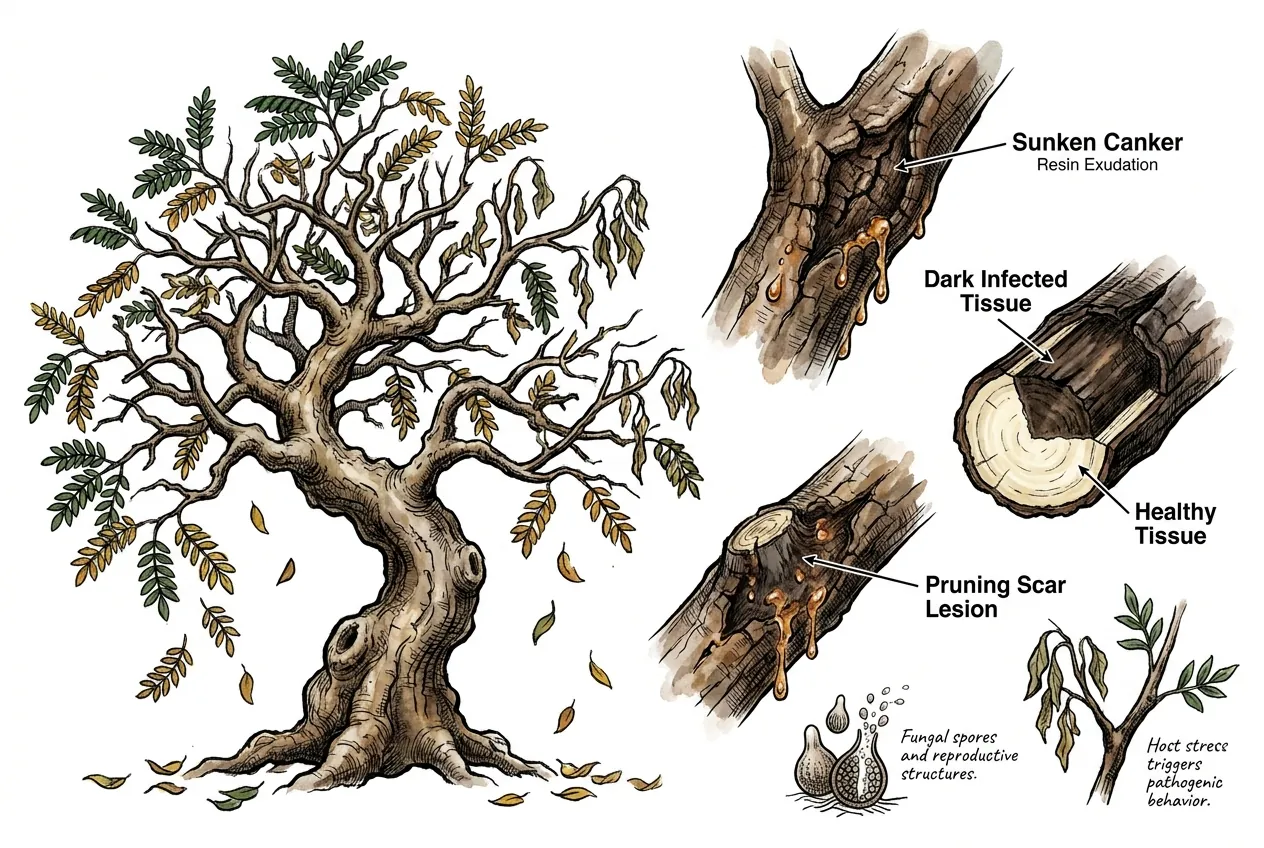
Members of the Botryosphaeriaceae are well-known fungi associated with dieback and canker on Anacardiaceae hosts.
Neofusicoccum mangiferae is specifically documented on mango (Mangifera indica) across Brazil, Iran, Peru, South Africa, Taiwan, and Australia.
Pistachio (Pistacia vera) develops Botryosphaeriaceae cankers as necrotic and sunken lesions on trunks, scaffolds, branches, shoots, and pruning wounds.
This family-level evidence supports awareness for Operculicarya, but does not prove the same susceptibility or disease course.
The visible signature is a sunken, dark bark patch that may exude resin.
Lesions typically center on a wound, branch crotch, or pruning scar.
Inner bark beneath the lesion is dark brown to black, in contrast to the cream-white healthy cambium.
Some Botryosphaeriaceae can persist without visible symptoms and become pathogenic when host tissue is stressed, but the timing and mechanism depend on the fungus and host. A lesion after pruning is therefore a possibility to investigate, not proof of causation.
If you do confirm a canker, mechanical removal back to clean, healthy tissue with a clean, disinfected blade is the approach, cutting a modest margin past the visible lesion.
Don't treat 2 to 3 cm as a fixed rule. Extension guidance for cankers generally says cut back into healthy wood until the cut face shows no discoloration, and if that reaches the main trunk, the plant may not be salvageable.
Note also this is disinfecting the blade, not truly sterilizing it.
Use a clean, sharp tool and disinfect it between cuts. The linked SKINNYBUNNY shears are straight bonsai scissors, so they suit light trimming better than thick woody cuts. Choose a bypass secateur instead when the stem is too thick for scissors to cut cleanly.
Bypass cuts are designed to shear through xylem and phloem, while anvil pruners can crush tissue and leave a rougher wound. Match the tool to the cut and keep the wound clean.
Pythium, Phytophthora, and Fusarium
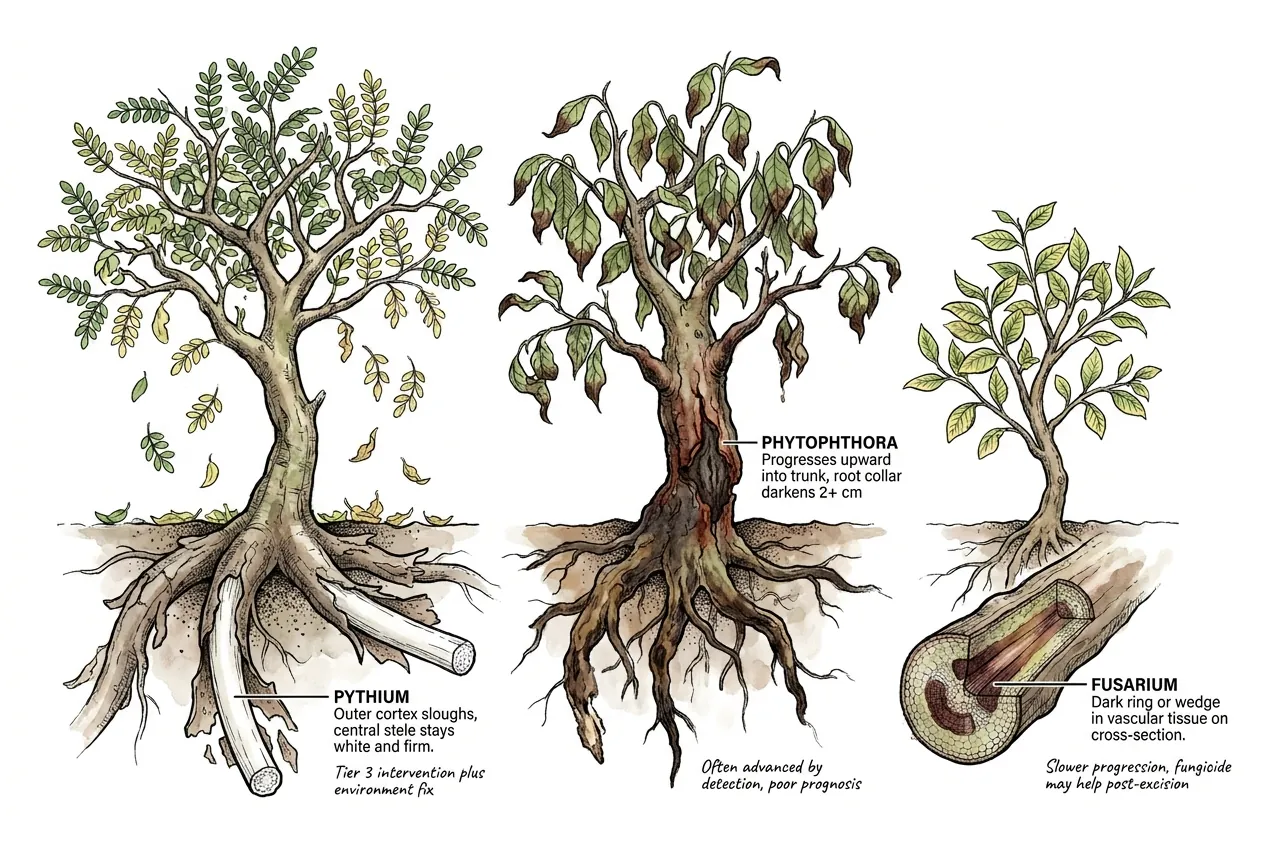
When rot is pathogen-driven, several organisms can be involved (Pythium, Phytophthora, and Fusarium among them, plus others like Rhizoctonia).
Be honest that you generally can't tell them apart by eye (their symptoms overlap with each other and with non-infectious waterlogging injury, so the table below shows tendencies, not a reliable visual key).
Confirming the actual organism takes a lab, and for a valuable plant that's worth it. For most home cases the management (fix drainage, remove clearly dead tissue) is the same regardless.
| Pathogen | Pattern that can occur | How to interpret it |
|---|---|---|
| Pythium | Outer cortex may slough while the central stele remains firmer in some early cases | Use the whole-plant context. Correct the root-zone environment first |
| Phytophthora | Root-collar darkening or upward decline can occur | Appearance alone cannot assign stage or prognosis. Confirmation may be needed |
| Fusarium | Dark vascular discoloration may appear on a cut surface | Do not infer organism or treatment response without broader evidence |
In some Pythium cases the outer cortex is affected before the central stele, but that pattern is not a home diagnosis and can change as damage advances.
Phytophthora can move from roots into the lower trunk and Fusarium can affect vascular tissue, but their visible effects overlap with other causes. A dark ring or a soil-line lesion should therefore prompt broader inspection or testing rather than a confident species call.
Why fungicide drenches are downstream of the real fix
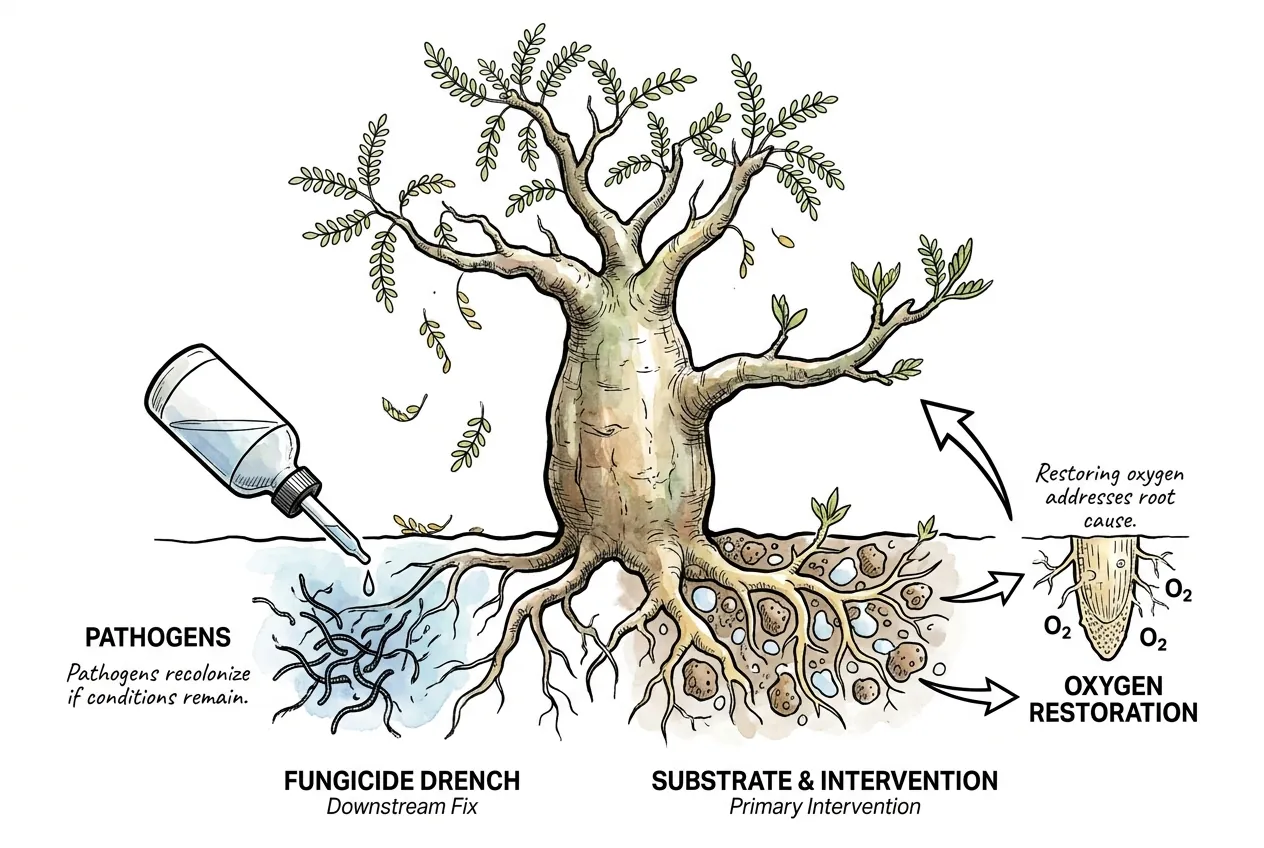
Many root pathogens proliferate under permissive conditions such as excess water and low substrate oxygen. Restoring oxygen and correcting the environment is often more durable than relying on a fungicide while those conditions persist. Address substrate and intervention tier first. A label-appropriate fungicide, where one exists for the confirmed problem, is an add-on rather than a substitute for correcting the environment.
What intervention fits these diagnostic results?
Interventions can be thought of in three tiers. Match the level of intervention to the evidence because over-treating a healthy plant and under-treating a sick one both add risk.
Tier 1: Do nothing physical
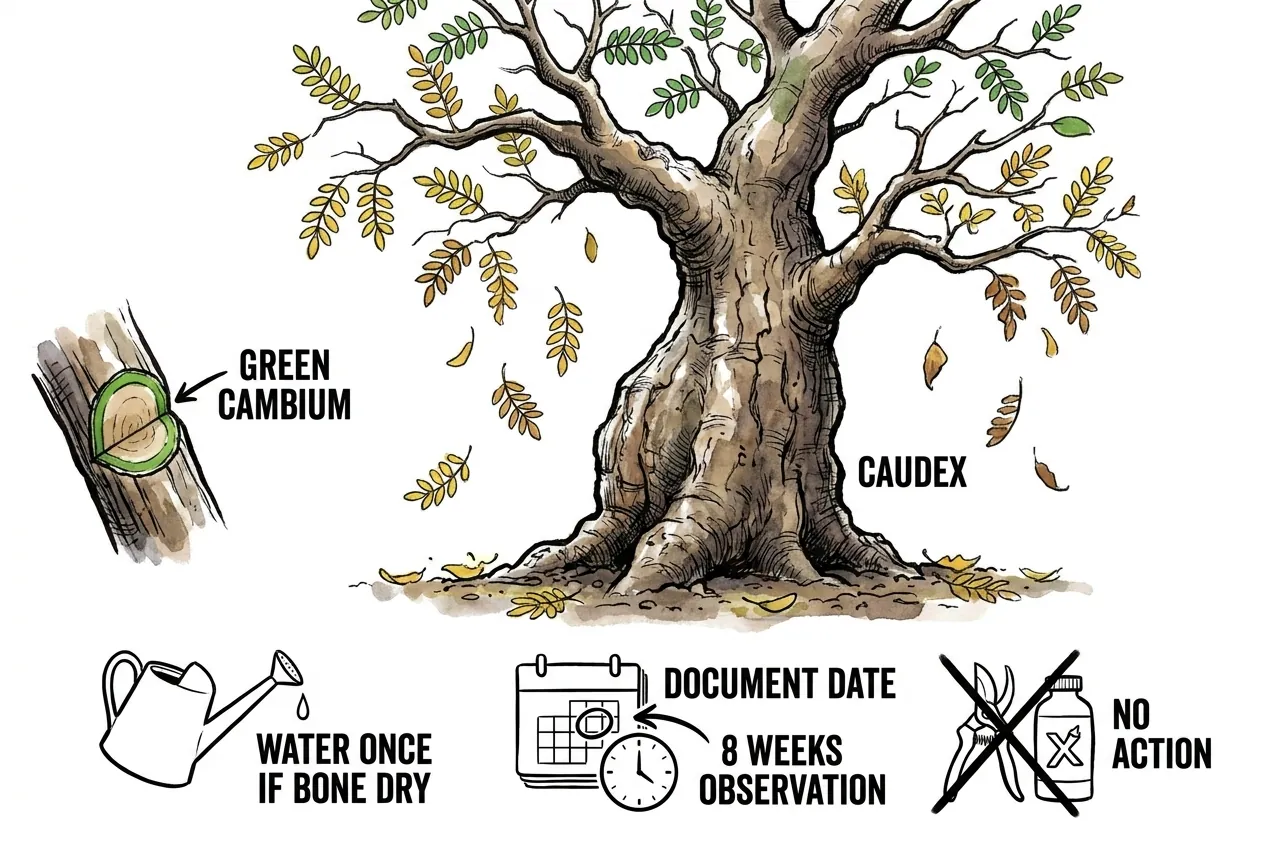
Applies when non-invasive checks are reassuring. The caudex is firm, the pot is drying normally, and there is no progressive discoloration or odor. This pattern is compatible with seasonal leaf drop, but it does not prove metabolic health.
If the mix is genuinely dry, water according to the plant's established cycle, then observe rather than imposing an eight-week no-intervention window.
Grower observations on BonsaiNut document specimens remaining leafless well into spring before recovering completely.
Patience is the correct clinical strategy, not a placeholder for not knowing what to do.
Tier 2: Repot without bare-rooting
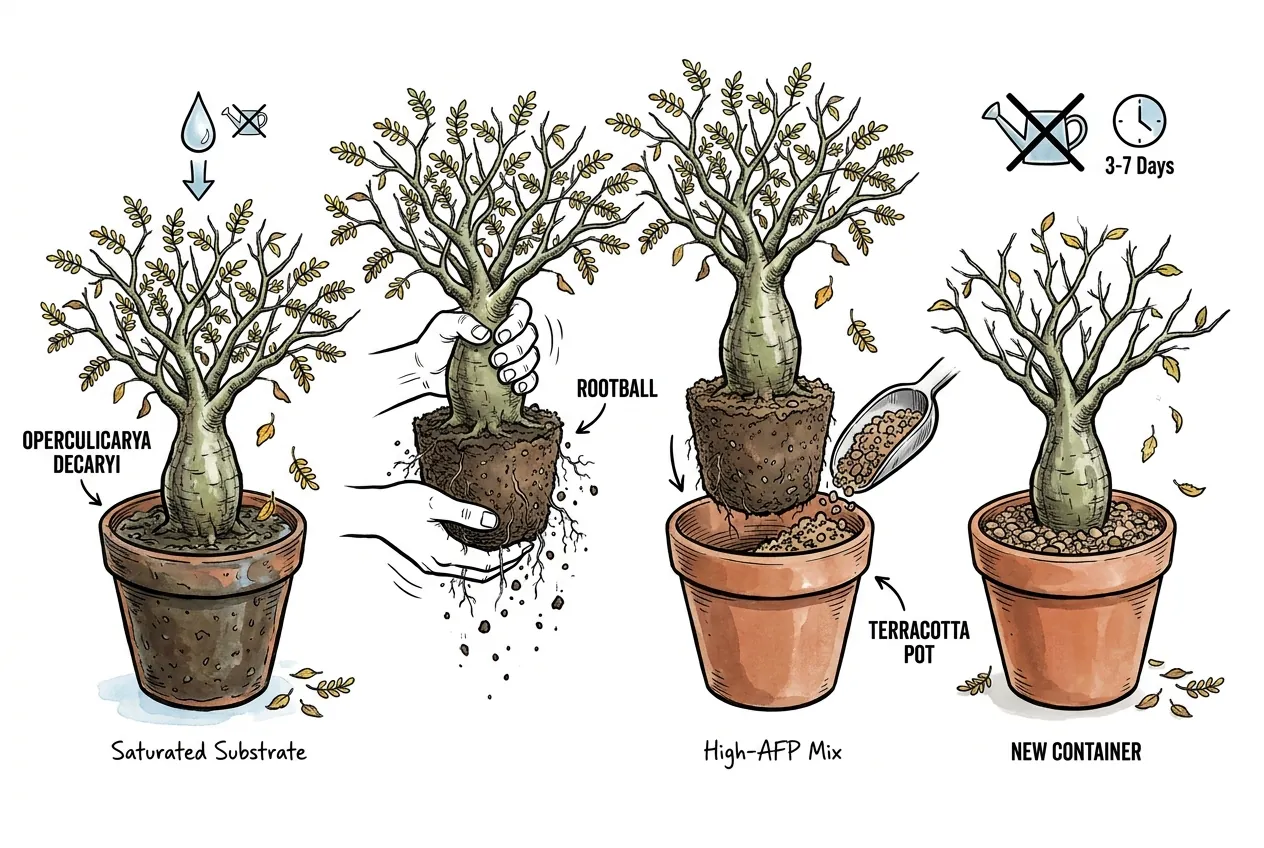
Applies when the caudex is firm but the substrate stays wet beyond its established pattern. Repot into a fresh open mix sized to the roots, disturbing as little healthy root as possible.
Resume water only after the new mix and roots are ready. The pause depends on tissue, damage, humidity, and pot size.
Tier 3: Bare-root with root pruning
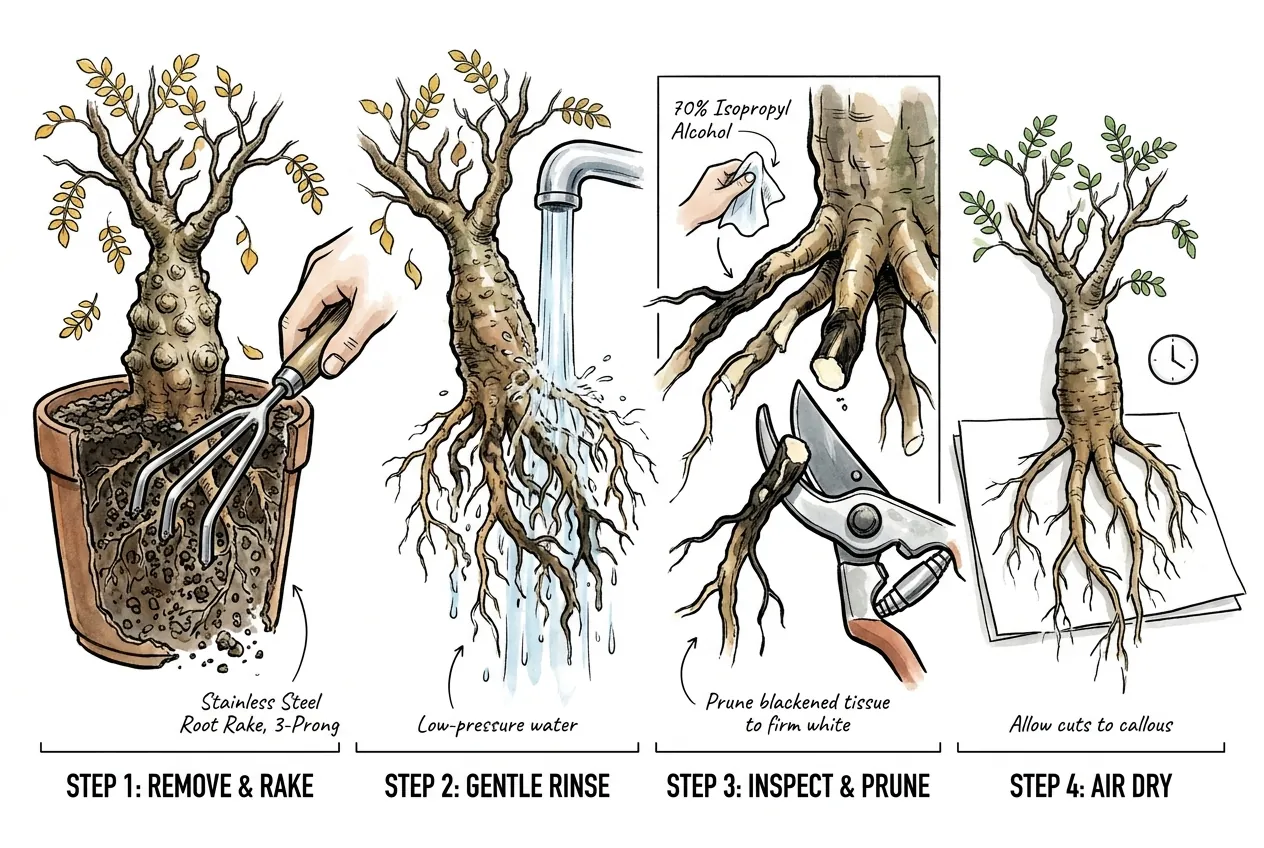
Applies only when progressive softening, foul odor, root loss, or other evidence supports a serious root or caudex problem. Because visual signs overlap, seek a diagnostic opinion before major root pruning when possible.
- Remove specimen from container. Work substrate away with a suitable stainless hand tool. The root rake is one option. Use light strokes parallel to root direction and never lever against a root.
- Rinse with low-pressure water. Do not blast roots.
- Inspect roots and prune only clearly blackened, sloughing, or soft tissue with clean tools and full PPE. Disinfect between cuts using a current, label-appropriate method.
- Let cut surfaces and the new pot follow a monitored drying process. No universal minutes or hours establish safety.
- Repot into a fresh open mix and resume water only when the roots and tissue support it.
The salvage threshold question
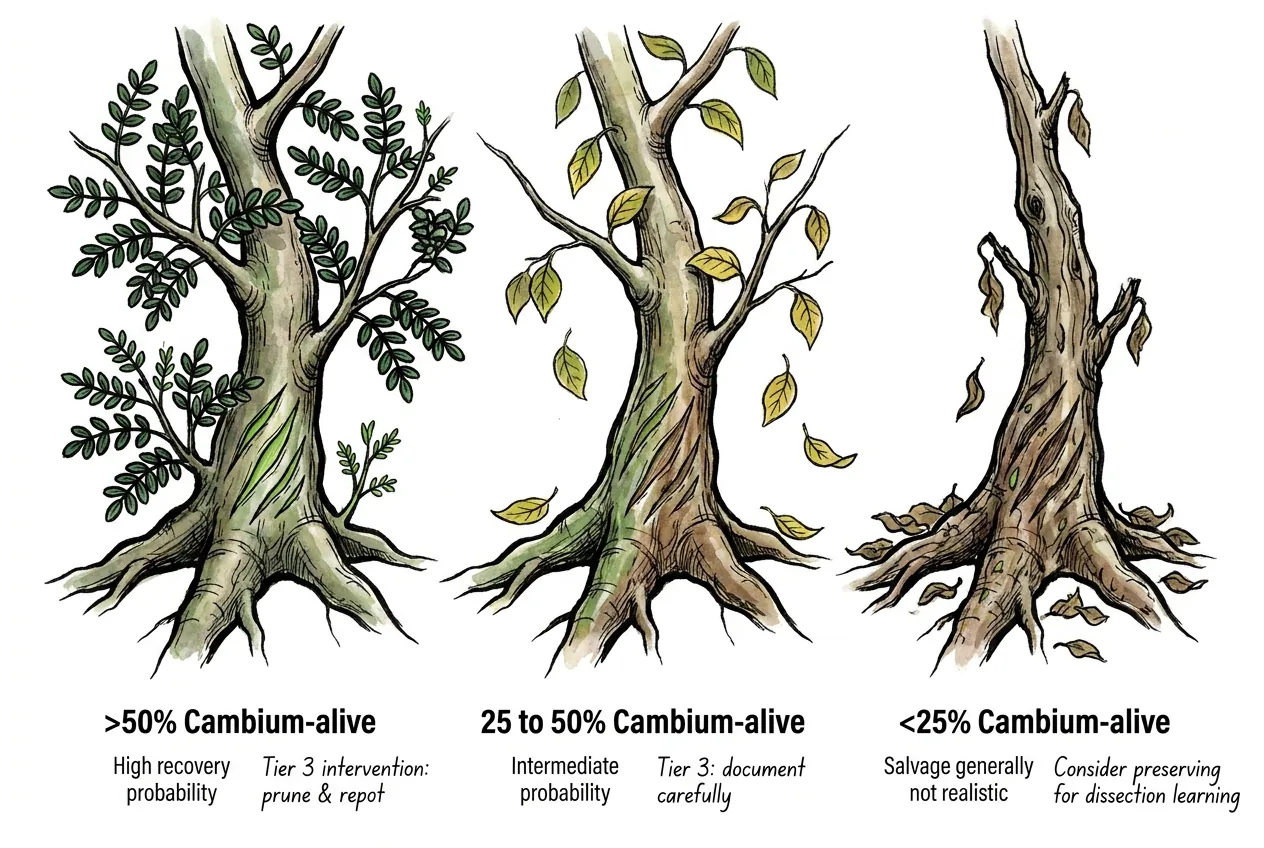
It is tempting to want a number for survival, but resist scoring the plant by scratching its root collar in many places and counting green versus brown. That damages the plant while measuring none of the factors that actually determine recovery, including root viability, infection extent, and intact vascular connections.
Claims such as over 50% survives and under 25% does not are invented thresholds, not prognostic data. A more honest read is that broadly firm, mostly living tissue with some healthy roots is worth trying to save, while a caudex that is soft throughout, foul-smelling, and largely dead is usually lost. Judge the whole plant, not a scratch score.
| Cambium-alive at root collar | Recommended action |
|---|---|
| Firm tissue remains | Consider a conservative intervention after diagnosis. Outcome uncertain |
| Softening is extensive or advancing | Seek expert guidance before major cutting |
| Soft, hollow, foul-smelling throughout | Quarantine and dispose of material safely if no firm tissue remains |
Recovery timeline expectations
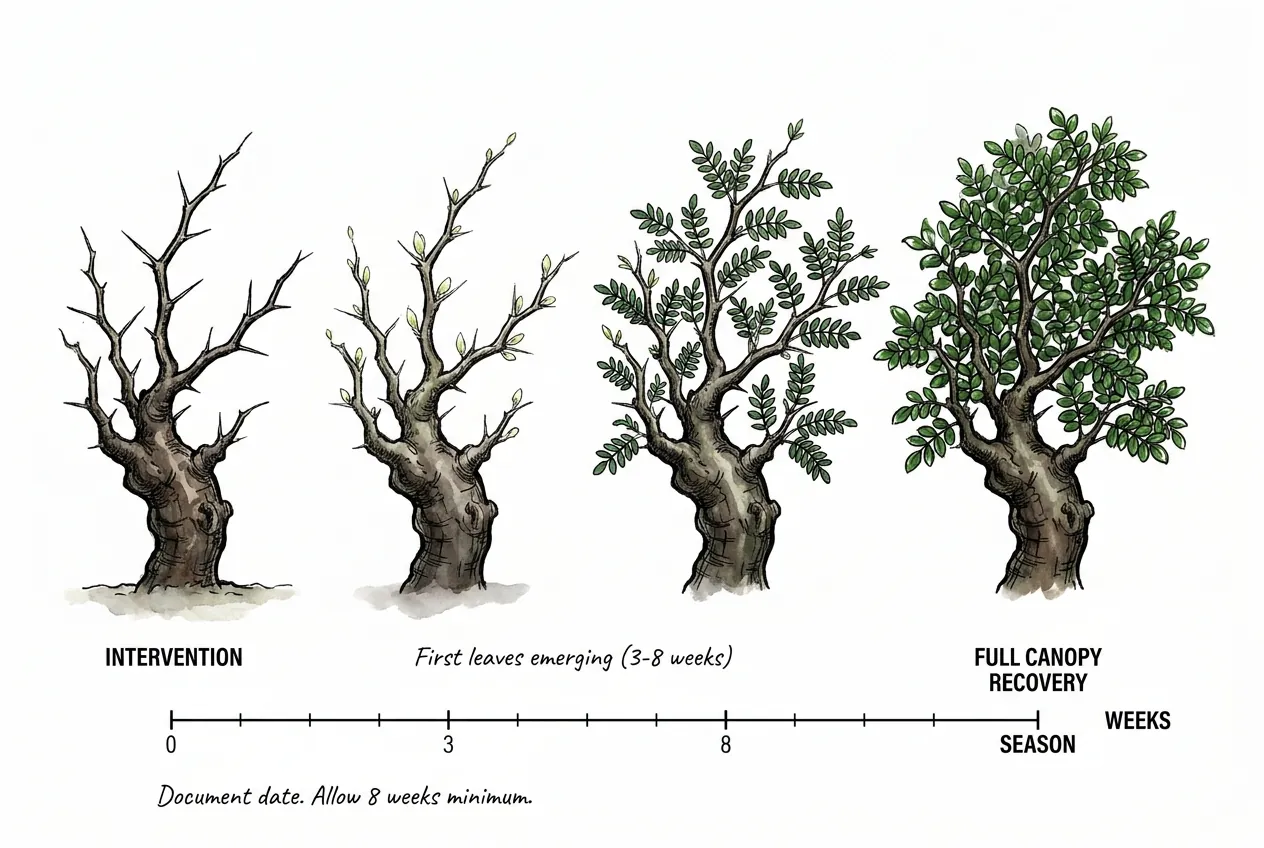
A Henry Shaw CSS report describes re-leaf around three weeks for tuberous-root propagation under its spring conditions. A bare-root intervention can take longer or shorter depending on tissue, roots, temperature, and light, so use new growth and firmness rather than a fixed timetable.
Document the intervention date and reassess trends periodically. Do not declare failure from a single early check.
What does the minimum-viable kit look like?
A basic diagnostic and intervention kit can combine measurement, sanitation, root handling, and an open substrate. The useful items depend on the plant and the work you are prepared to do.
| Item | Spec that matters | Use case |
|---|---|---|
| Needle-probe moisture meter | Galvanic, 2-3 cm read depth | Test 4 of diagnostic protocol |
| Unglazed terracotta pot | Fired 1000-1100°C, drainage hole | Sidewall drying for Tier 2 and Tier 3 repot |
| Stainless steel 3-prong root rake | Stainless, short handle | Tier 3 substrate removal |
| Stainless bypass pruner set | Stainless, bypass geometry, small head | Canker excision and root pruning |
| Label-compatible disinfectant | Current product instructions and safe handling | Sterilization between cuts |
| Screened, airy gritty mix | Particle range and dry-down matched to the pot | Tier 2 and Tier 3 repot substrate |
Prepare suitable tools before you need them. Emergency repotting into an unsuitable vessel can add stress to an already declining caudex. Possible examples include the SONKIR meter for rough moisture comparison, an open gritty mix, and small shears or scissors matched to the cut. A suitable pot and root-handling tool complete the physical-intervention side. A labeled disinfectant is one sanitation option. Follow current guidance and keep it away from heat.
A Note on Tool Material
Stainless steel tools resist rust, which is convenient when tools are cleaned and disinfected often. A quality carbon-steel bonsai tool is also suitable when it is cleaned, dried, and lightly oiled. Disinfecting a blade is not the same as sterilizing it, and isopropyl alcohol is flammable, so use it away from heat and let tools dry.
When should I stop trying?
Consider stopping when multiple checks point to extensive, advancing tissue loss. A soft caudex on several faces, an unstable root collar, and brown or decayed tissue on inspection. A numerical salvage probability is not established, and aggressive intervention can add stress without changing the outcome.
Repeated interventions without any improvement, or a caudex that becomes broadly soft and foul-smelling, are further reasons to seek expert advice or stop.
Do not turn a thumb-pressure threshold or a fixed number of weeks into a universal rule.
A specimen at any of these stop-points still has value as a dissection learning specimen.
If a specimen is beyond recovery, a post-mortem can still be useful. Cut the caudex in cross-section, examine the cambium and vascular tissue, and look at the root system that failed. That evidence can guide the next attempt, while a healthy specimen that simply dropped its leaves on a moisture-cued schedule is a wait-point rather than a stop-point. Do not confuse the two.
Affiliate Disclosure
This article contains Amazon affiliate links. As an Amazon Associate I earn from qualifying purchases. If you use these links, the site may earn a commission at no extra cost to you. Product availability, price, and specifications can change. Check the current listing before buying.