
Madagascar Caudex Plants: Species and Care Guide
Compare light, water, dormancy, potting, propagation, and legal sourcing for Pachypodium, Operculicarya, and other Madagascar caudex plants.
Derek Kim · 2026-02-08 · Updated 2026-07-26 · 19 min read
Key Takeaways
- Identify the plant before assigning any watering or dormancy schedule. Madagascar caudex is a geography, not a care category. A spiny Pachypodium, a vining Adenia, and a woody Operculicarya differ in roots and rhythm.
- An actively growing plant wants strong acclimated light, a thorough soak after the root zone dries, and a pot that does not stay wet. Measure light at the canopy, not by wattage.
- When growth slows, stop feeding and let leaves, roots, temperature, and drying rate set how far you reduce water. A leafless plant uses far less, but leaflessness alone is not the whole diagnosis.
- A stored-water caudex does not make wet roots harmless. Build an airy, mineral mix that dries predictably, and choose a pot only modestly larger than the roots.
- Verify species, provenance, and CITES paperwork before buying or importing. Pachypodium is CITES-listed, and a plant offered for sale is not proof of compliant possession.
| What you see | Check before acting | Reasonable next step |
|---|---|---|
| Firm new leaves and active extension | Light at the canopy, dry pot weight, and root health | Use strong acclimated light and soak the pot after the mix dries. |
| Yellowing or leaf drop | Seasonal slowdown versus damaged roots | Stop feeding and lengthen the dry interval. Inspect if tissue softens or smells. |
| A leafless plant | Species, temperature, roots, and whether shrinkage is progressing | Keep the root zone on the dry side and water only when the condition of a rooted plant warrants it. |
| A new, unidentified plant | Name, provenance, roots, and current growth stage | Quarantine it and avoid abrupt changes until you know what it is. |
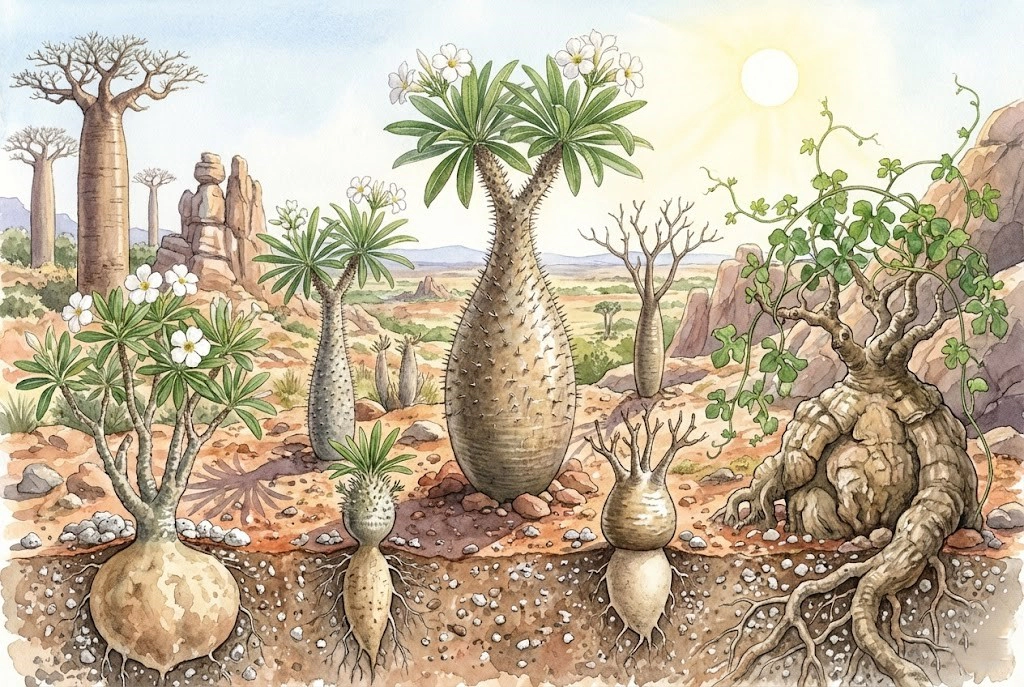
Madagascar caudex plant is a geographic description, not a care category. A spiny Pachypodium, a vining Adenia, and a woody Operculicarya can all store water, yet they differ in root architecture, seasonal rhythm, and tolerance of indoor conditions.
Kew currently accepts 23 species of Pachypodium across Madagascar and southern Africa. That diversity is the first reason to be cautious with universal rules. A routine that suits the widely grown P. lamerei may be a poor fit for a compact habitat specialist.
Why One Madagascar Care Schedule Does Not Work
| Family | Example genus | Useful identifiers | Typical growth form |
|---|---|---|---|
| Apocynaceae | Pachypodium | Irritating milky latex, paired spines, and terminal flowers in many cultivated forms | Upright shrub or small tree |
| Passifloraceae | Adenia | Climbing stems and species-dependent flower and tissue traits | Vining caudiciform |
| Anacardiaceae | Operculicarya | Woody bark and compound leaves | Branched shrub or small tree |
Separate Water Storage from Root Tolerance
A caudex stores water and carbohydrates in swollen stem or root tissue. That reserve helps a plant cross a dry period. It does not make wet roots harmless. Many Malagasy species shed leaves when conditions turn dry, but the timing and depth of that rest depend on the species and growing environment.
Habitat also varies. Limestone outcrops, quartzite, coastal sand, and inland plateaus do not produce the same root conditions. In cultivation, the shared starting point is an aerated root zone. The useful adjustments come after you identify the plant.
A Sensible First Plant
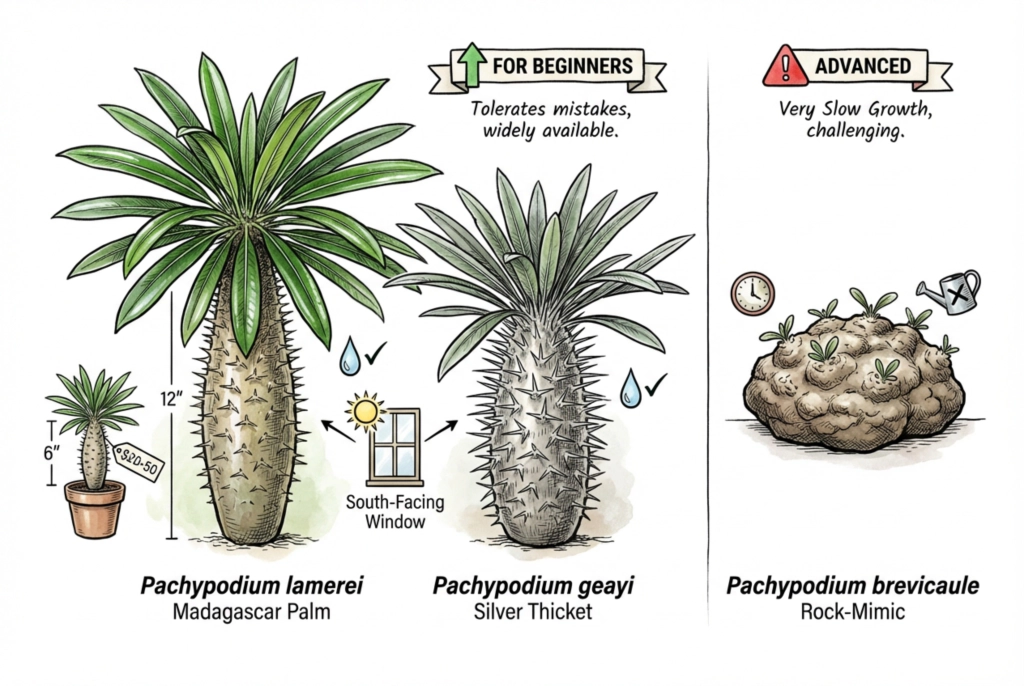
Choose a first plant that fits the room
Pachypodium lamerei, the so-called Madagascar palm, is often a practical first choice in cultivation. It is common in cultivation, and the Royal Horticultural Society recommends full light, standard cactus compost, moderate water during growth, and a dry rest under glass. P. geayi is another widely grown upright species for someone who can provide similar light.
Operculicarya decaryi suits a grower interested in a woody, bonsai-like plant rather than a spiny column. Compact specialists such as P. brevicaule and P. eburneum are less forgiving of a dim room or a mix that dries slowly.
A useful shortlist
- Often easier starting options in a suitable setup include P. lamerei, P. geayi, and Operculicarya decaryi. Suitability still depends on the setup.
- More controlled conditions may be needed for P. densiflorum and forms of P. rosulatum. Match light, temperature, and dry-down before changing the plant.
- Precise light and root-zone control matter for compact, slow habitat specialists such as P. brevicaule and P. eburneum. Ask for clear nursery-propagation records.
Light Beyond a Dim Windowsill
Measure Light at the Canopy
Many cultivated Malagasy Pachypodium need stronger light than an ordinary room provides. P. lamerei is grown in full light under glass, while smaller habitat specialists can respond poorly to a dim windowsill. Adenia and Operculicarya need their own species-level assessment rather than an automatic Pachypodium target.
Indoors, measure light at the canopy instead of relying on a lamp’s wattage or a fixed hanging distance. The caudex grow-light guide explains how to set a starting intensity and then adjust from new growth. If a plant goes outside for summer, increase sun in stages. Leaves formed behind glass are not ready for an abrupt move into open midday sun.
When a Supplemental Lamp Helps
A compact full-spectrum LED lamp is a supplemental option when a bright window still leaves the canopy below the level your plant needs. Its usefulness comes from the measured light reaching the leaves, not the wattage printed on the box. Check distance, coverage, and plant response before choosing a stronger fixture.
Can These Plants Tolerate Shade?
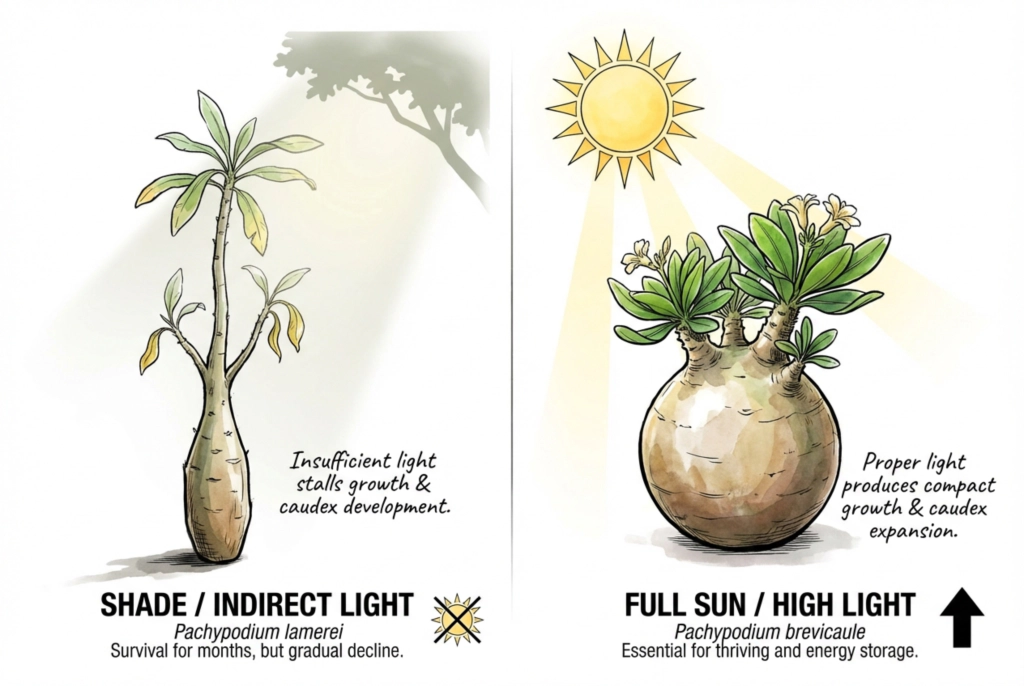
Bright indirect light may keep some species alive, but it often produces weak extension rather than the compact form collectors want. P. lamerei tolerates a wider range than P. brevicaule, so there is no single shade verdict for the whole group.
If new growth lengthens, compare measured light with root health, temperature, and recent feeding before changing exposure. The P. brevicaule light-threshold guide shows why the species and the measurement point both matter.
Water the Root Zone, Not the Calendar
Water by Root-Zone Condition
During active growth, water the usable root zone thoroughly after the mix has dried and the pot has returned close to its dry weight. That interval can be days or weeks. Species, root mass, pot, light, heat, airflow, and particle size all change it, which is why the pot-weight and moisture-check method is more useful than a calendar.
A wooden skewer can show whether the lower half of an unfamiliar pot is still damp, but it is only one reading. Combine it with pot weight and the condition of the roots.
When the plant is due, wet the mix evenly and let excess water leave the drainage holes. Small surface sips make it difficult to know which roots were actually watered.
When a Wet Pot Becomes a Rot Risk
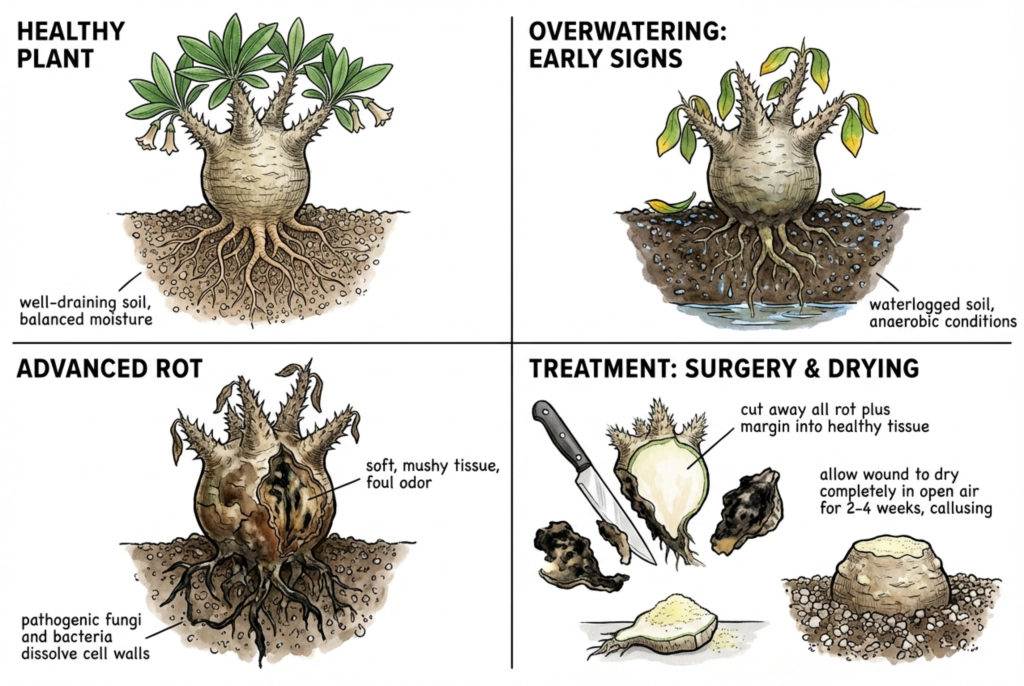
Read wetness as a root-risk signal
Mix that stays wet after uptake has slowed loses air space. Damaged roots then become more vulnerable to decay that can move into the swollen stem. A soft area at the soil line, spreading discoloration, collapsed roots, or a foul smell deserves prompt inspection, but these signs do not identify the pathogen on their own.
Wear gloves and eye protection when handling a damaged Pachypodium because its latex is irritating. Isolate the pot and seek experienced plant-pathology or horticultural advice before any major cut. If removal is judged necessary, use a clean tool, follow the current disinfectant label, and do not treat callusing or re-rooting as a guaranteed protocol.
Sulfur may be labeled for limited disease uses, but it is not a cure for already liquefied tissue and may be unsuitable for a particular wound. Extensive rot that has reached the core may not leave enough healthy tissue to save.
Can I Water During Dormancy?
Read dormancy from more than leaf loss
A leafless plant usually uses far less water, but leaflessness does not answer the whole question. A cool dormant adult, a warm rooted seedling, and a species that retains leaves should not receive the same treatment.
Before giving maintenance water, confirm that the mix is dry, the roots are functional, and the plant is not soft or musty. The Pachypodium seasonal watering guide provides a cycle-based decision path for summer- and winter-active species.
Temperature and Seasonal Slowdown
Warm conditions suit active growth for many cultivated examples, but cold tolerance varies by species and provenance. A single minimum for every Malagasy caudiciform is not defensible. RHS classifies P. lamerei for conditions above 15°C (59°F) under glass, so use the confirmed species rather than that number as a universal limit.
Set a Species-Specific Cold Boundary
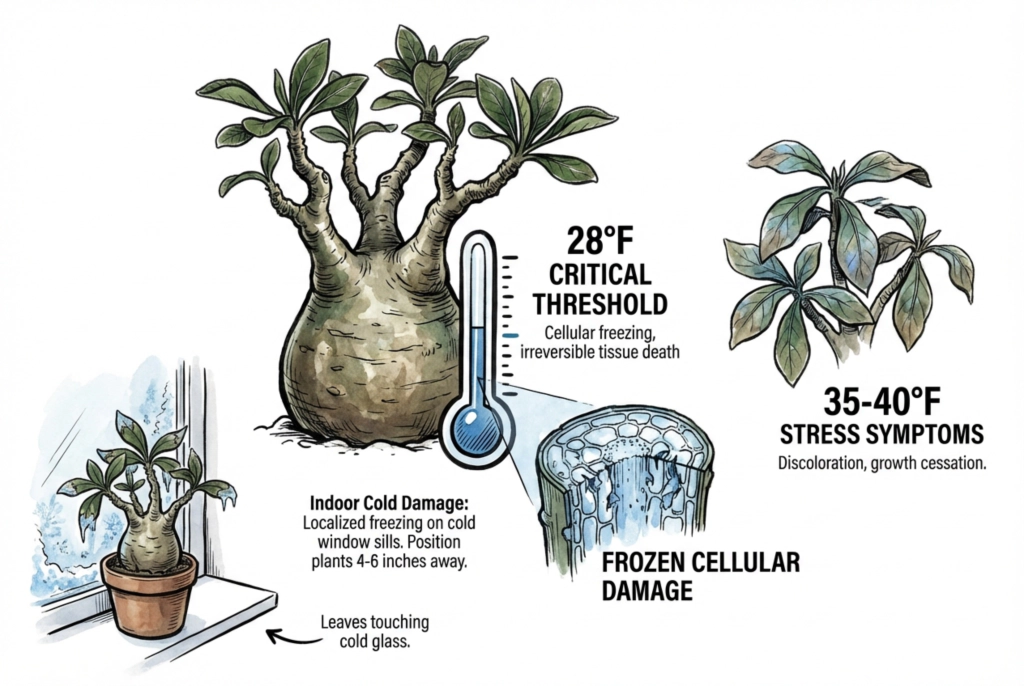
Do not use frost as the only warning line. A tropical plant can suffer chilling injury before the room reaches freezing, especially when wet roots and cold air occur together. Keep leaves off winter glass and move the pot away from cold drafts.
Winter Rest in a Real Room
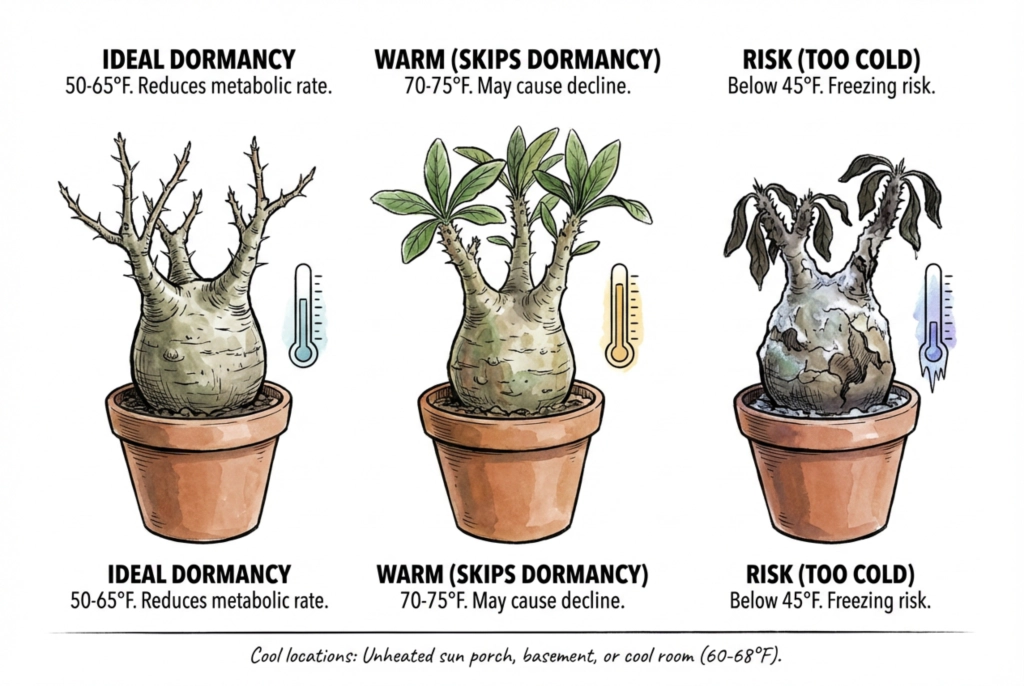
Some Pachypodium rest when days shorten and conditions cool. Others respond differently under warm indoor light. A slightly cooler bright location can slow a leafless plant without exposing it to chilling. Avoid forcing every species into a fixed temperature band.
Use the pot as the practical test
As temperature and uptake fall, drying slows. Water less often enough that the root zone does not remain cold and damp.
Build a Mix That Dries Predictably
Build the Mix Around Predictable Drying
Start with an airy, mineral-rich mix, then tune its water-holding fraction to the species, roots, pot, and room. Dense standard potting soil often remains wet after a caudex plant has slowed its uptake.
The useful mix wets evenly, drains without pooling, and dries at a pace that a healthy active plant can use. No single ratio is proven across these genera, so build a starting blend from measurable properties.
Mix properties to check: stable structure
Choose a stable coarse mineral fraction that leaves air space after watering.
Controlled retention
Add only as much fine or organic material as the species, root mass, pot, and room can dry before the next check.
Verify the dry-down
Water a test pot, record its wet weight, and change one component only after observing how quickly it dries.
Compare particle stability, water retention, and climate tradeoffs in the caudex substrate guide before selecting a starting blend.
What a Mineral Aggregate Actually Does
Horticultural pumice provides durable mineral structure when its particle size suits the pot. Any locally available horticultural aggregate with similar properties can do the same job. The category matters less than the particle size and observed dry-down, so choose by those rather than by a universal mix ratio or a promised biological result.
Drainage Is Also About Air
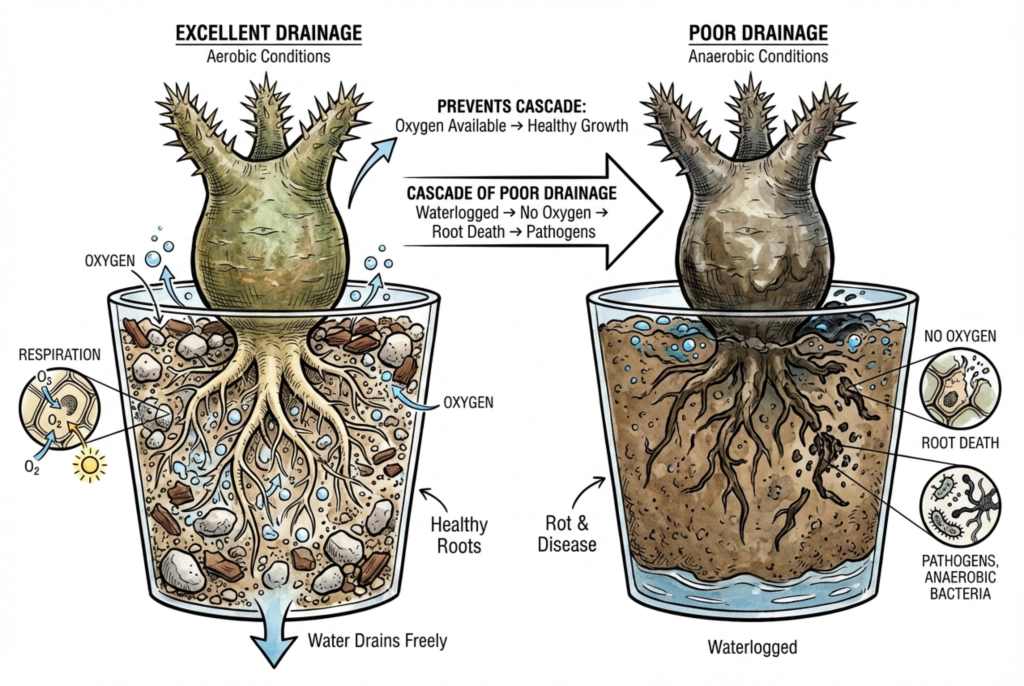
Roots need oxygen as well as water. Once water fills the pore space for too long, gas exchange slows and damaged roots become vulnerable to decay. Coarse particles preserve air space, but they do not excuse an oversized pot or repeated watering before the mix dries.
Can I Use Bagged Cactus Soil?
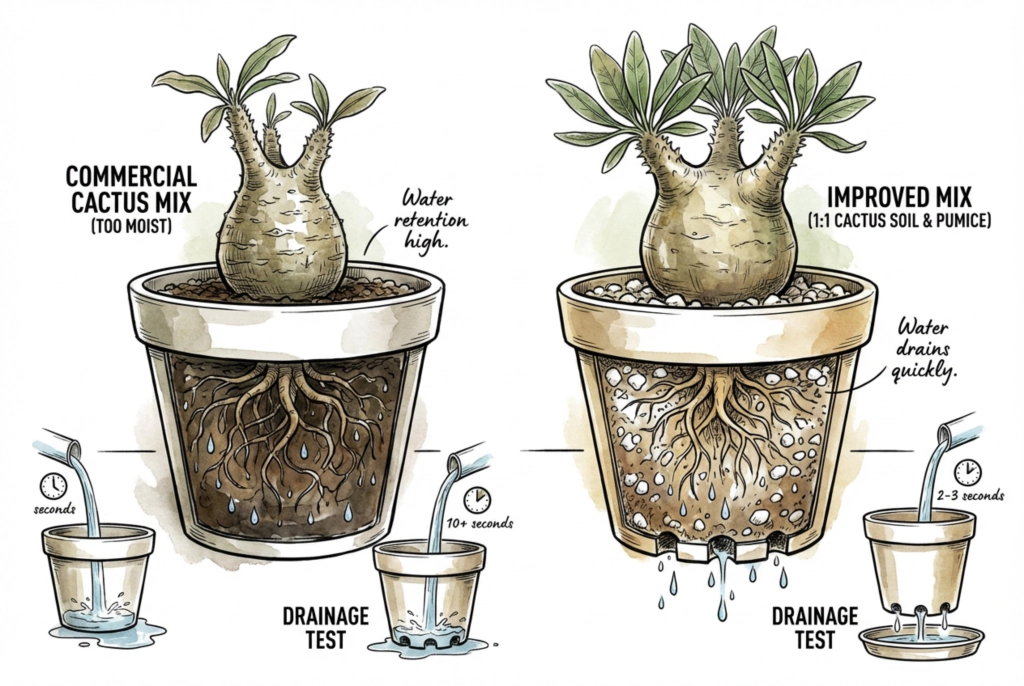
Some commercial cactus mixes work as an organic fraction, but many contain fine peat or compost that collapses around coarse roots. Blend the bagged mix with a stable coarse mineral component according to the actual pot and observed dry-down, then water an empty test pot and watch how long it stays heavy.
If water pools on top, the mix compacts after a few cycles, or the lower pot remains damp long after the plant slows, add more stable coarse material.
Starting Madagascar Caudex Plants from Seed
Keep Seed Trials Small and Observable
Start with correctly identified seed from a seller who provides a harvest date. A paper towel makes germination visible, while direct sowing avoids moving a fragile new root. Neither method is best for every genus.
Check the tray daily and record temperature, moisture, and the date each seed opens. Freshness matters, but germination speed and storage life vary too much among these genera for a single percentage or deadline.
Soak only when reliable guidance for that species calls for it. A long warm soak can also deprive damaged seed of oxygen and spread decay.
For a setup that records seed-lot age, medium temperature, ventilation, and damping-off losses, use the caudex seed-germination protocol.
Seedling Temperature and Light
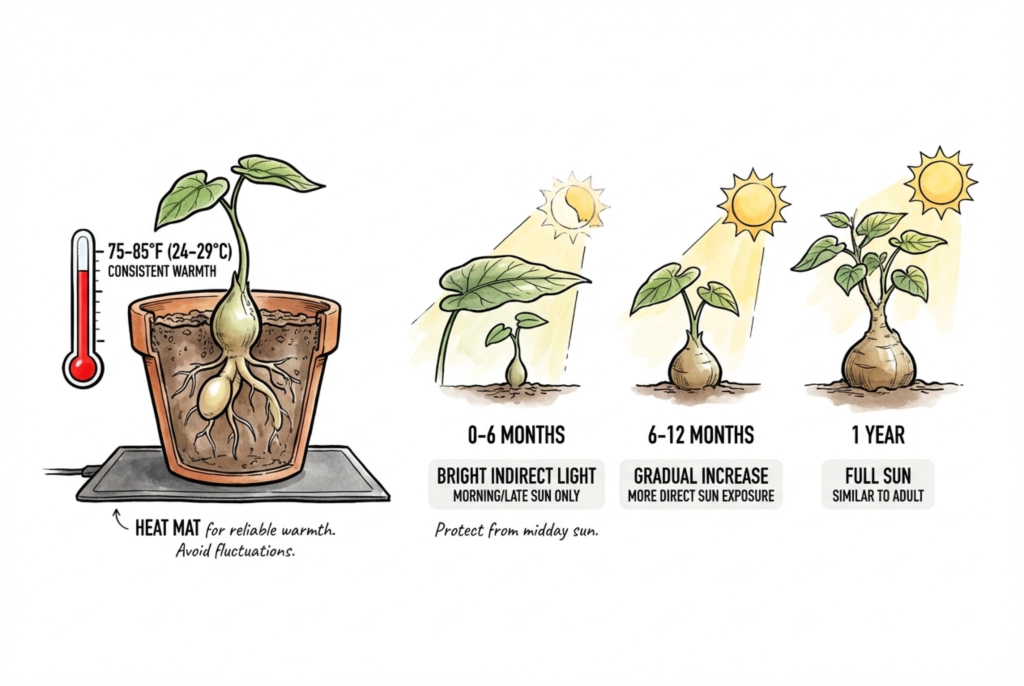
Keep the medium warm rather than hot. For P. lamerei, RHS gives 19–24°C (66–75°F) for propagation by seed. Other species may respond differently, so use that range only as species-specific context. If you use a heat mat, control it with a thermostat and measure the medium rather than the room.
Seedlings need gentler light and more even moisture than established plants. Start with bright filtered light, then increase exposure as the stem hardens and new growth remains compact. A fixed age does not tell you when a seedling is ready for midday sun.
How Long Until a Caudex Appears?
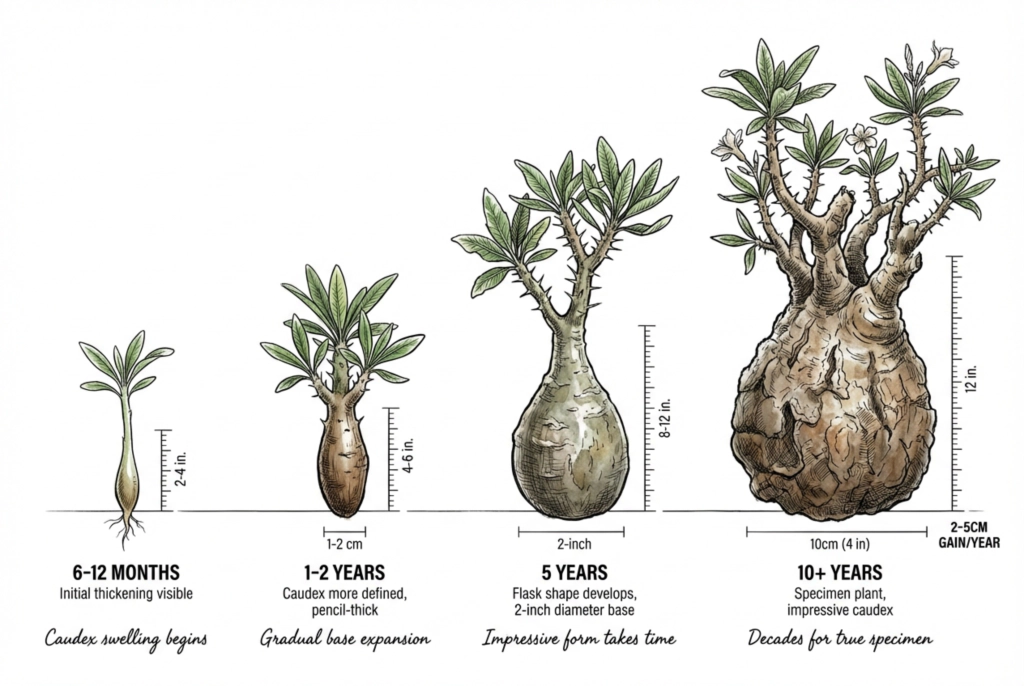
Basal swelling can appear while a plant is still young, but there is no honest species-wide timeline for a specimen caudex. Genetics, species, root room, light, temperature, and the length of each active season all matter.
Judge a seedling by steady compact growth and sound roots. Forcing a young plant through drought or severe restriction reduces the tissue available to build its base.
Feed the Growth You Can See
Feed Only the Growth You Can See
Fertilize only during confirmed active growth. Use a complete fertilizer at a conservative concentration allowed by its label, and apply it to an already moist root zone. Stop when extension slows or leaves begin to yellow.
How to interpret a fertilizer label
There is no magic caudex ratio. Nitrogen, phosphorus, and potassium all support several plant processes. A low first number does not automatically redirect growth into the swollen stem. The amount already present in the mix, water quality, and salt accumulation matter more than a generic half-strength calendar.
The caudex fertilizer guide explains how to base concentration and timing on active growth and the mix rather than marketing ratios.
If You Feed a Dormant Plant by Mistake
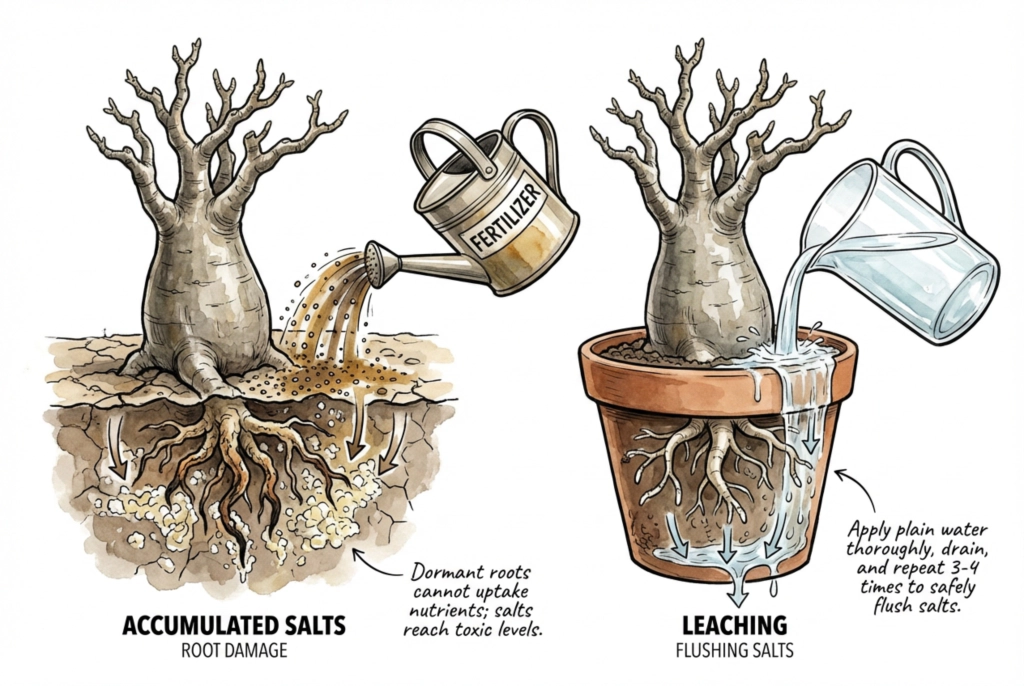
A dormant plant may have little demand for added nutrients while salts remain in the mix. If you feed by mistake, do not add more. When the plant is warm and the pot can dry promptly, a careful plain-water irrigation may carry some soluble salts out of the drainage holes. Avoid repeated saturation in a cold or inactive root zone.
Organic Versus Soluble Fertilizer
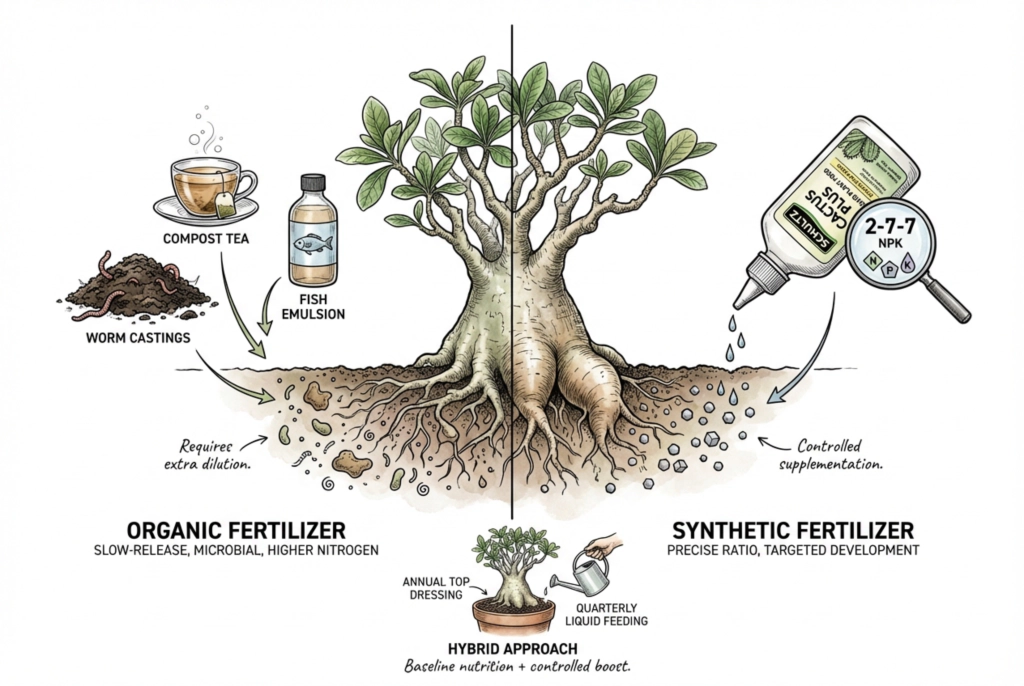
Either can work. A soluble fertilizer makes the dose easier to measure in a mostly mineral mix. Compost or castings release less predictably and also increase the fine, water-holding fraction. Choose by the substrate and label rather than by the idea that one category is inherently safer.
Read Dormancy from the Whole Plant
Use Whole-Plant Signals for Dormancy
Yellowing, leaf drop, shorter extension, and a pot that takes longer to dry can signal dormancy. The timing varies with species and environment.
During normal senescence, older leaves yellow before they fall and the stem may shrink slightly as stored water is used. Yellow leaves paired with wet mix, soft tissue, or a bad smell point instead toward root trouble.
Do not answer a seasonal slowdown with more water or fertilizer. Confirm the identity and condition before imposing a cool, very dry rest.
As Growth Slows
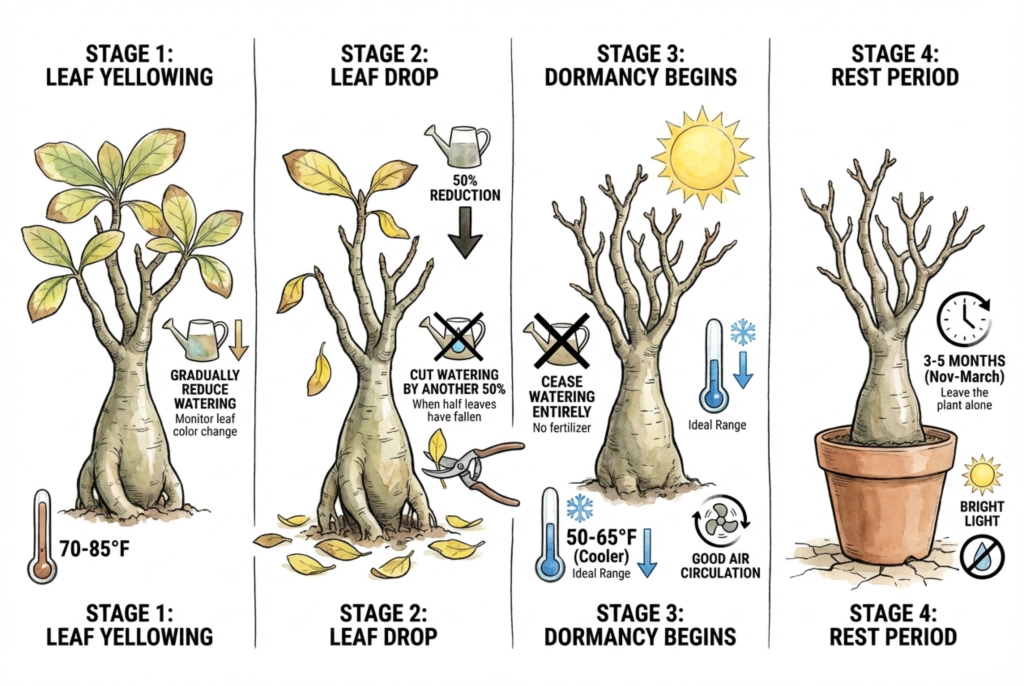
Lengthen the interval as leaves yellow and the pot dries more slowly. Once the plant is leafless, keep it bright, protected from cold, and out of stagnant damp conditions. Pot moisture, root condition, and continuing shrinkage are better signals than repeatedly halving a calendar interval.
Restarting Water and Feed
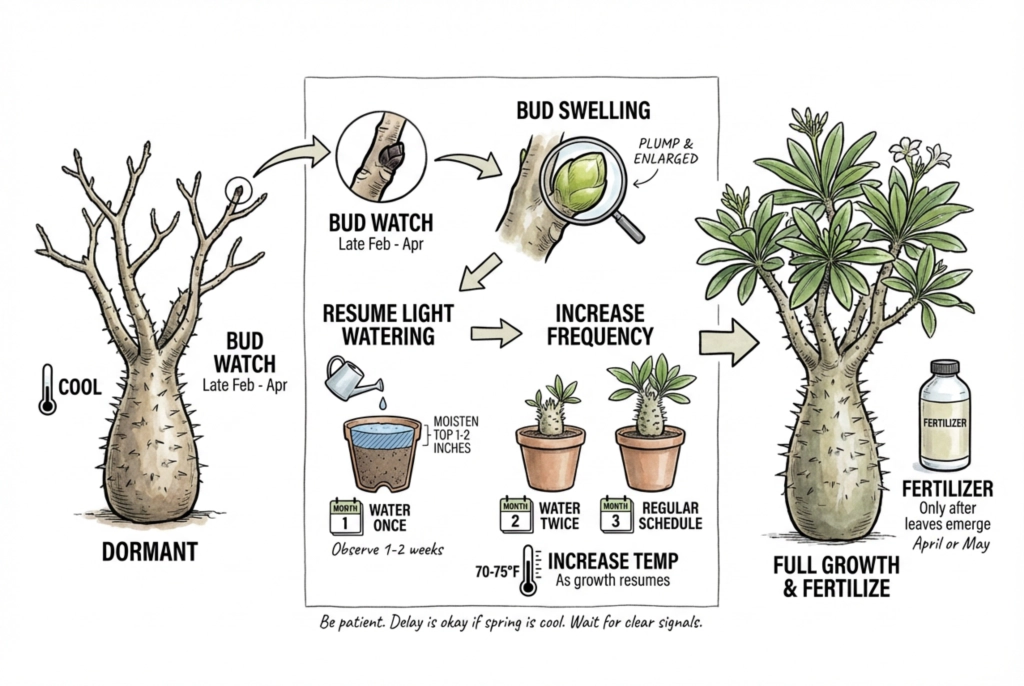
Swelling buds, new leaves, and healthy roots show that uptake is returning. Once those signs are clear, wet the usable root zone evenly and wait for the mix to dry before watering again. Increase frequency only as the pot begins to dry faster.
Start fertilizer after leaves have opened and extension is established. The plant may wake earlier or later than the calendar suggests.
Choose the Pot Around the Roots
Match Container Volume to Functioning Roots
Choose a pot only modestly larger than the functioning root system. Extra unused mix stays wet longer, while severe restriction does not reliably redirect growth into a thicker caudex.
Terracotta can help a humid room dry faster. Glazed ceramic or plastic can slow an overly fast dry-down in arid conditions. Every pot needs an unobstructed drainage hole. Match depth to the roots you actually see rather than to a generic genus label.
Terracotta Versus Plastic
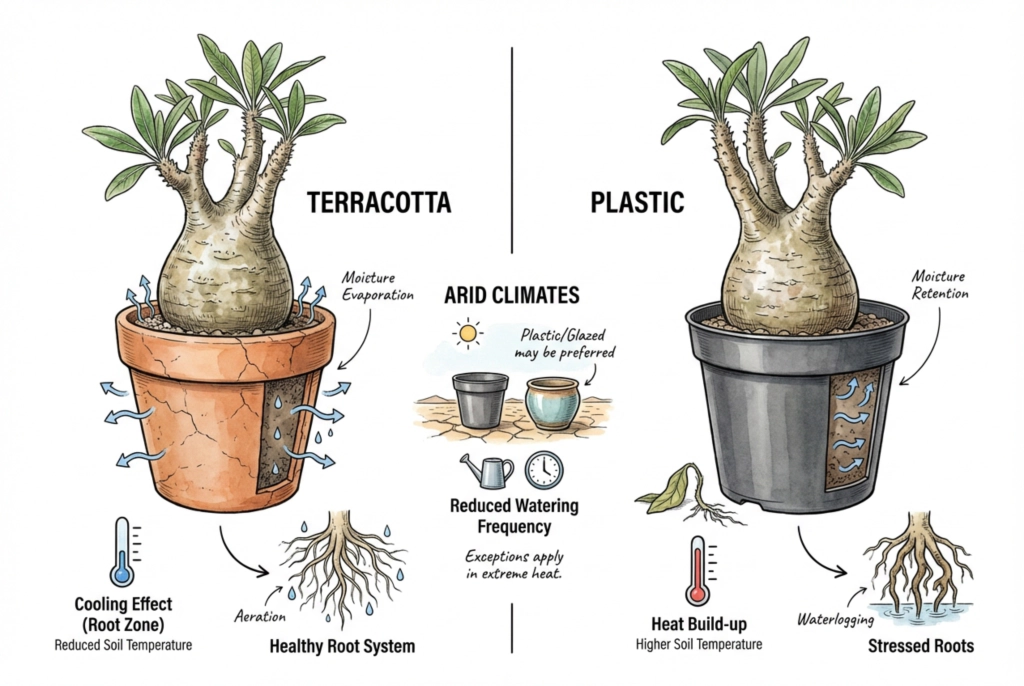
Moisture can evaporate through an unglazed wall, so the same mix generally dries faster in terracotta than in plastic. That is useful only when faster drying solves a real problem.
In hot, dry air the same pot may force unnecessary watering. Plastic or glazed ceramic can be the better choice if the plant is healthy and the mix otherwise dries too quickly.
Repotting Timing
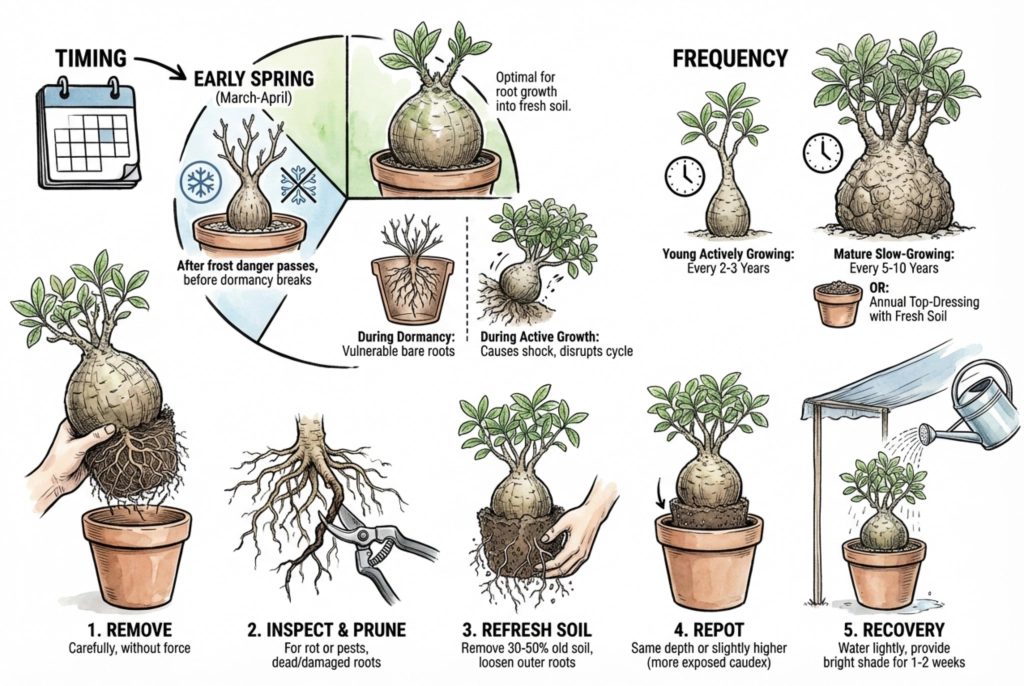
Repot when roots have filled the usable space, the mix has broken down, drainage has changed, or you need to inspect a problem. A warm period near the start of active growth gives damaged roots a better chance to recover than a cold dormant interval.
Remove the plant carefully and trim only dead or damaged roots with a clean tool. Replace degraded mix without stripping sound fine roots merely to meet a percentage. After a clean repot with no root injury, resume water according to the plant and mix. After cuts or tears, wait for the wounds to begin callusing.
Growing a Thicker Base
Build Size Through Healthy Active Seasons
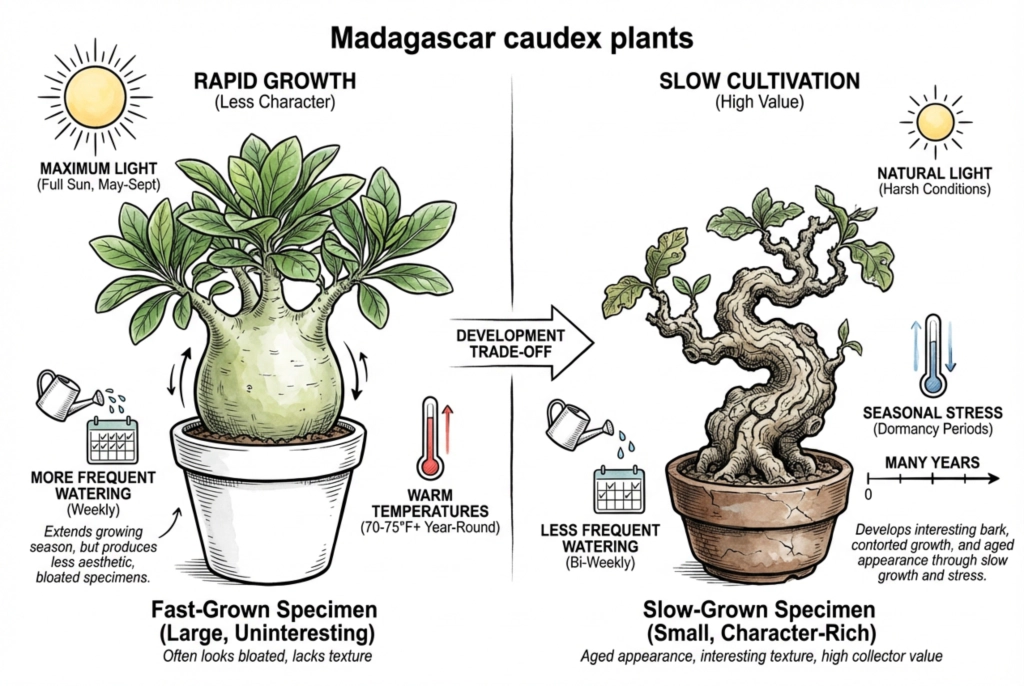
A substantial caudex comes from healthy photosynthesis and repeated active seasons. Give the plant enough light to grow compactly, enough water to use that light, and roots that remain aerated.
Avoiding an oversized wet pot is sensible. Deliberately starving or severely root-binding a plant is not a demonstrated shortcut to a larger base and can reduce total growth.
Pruning is optional and species-dependent. RHS lists P. lamerei as requiring no pruning. If you cut a Pachypodium, protect your skin and eyes from the latex and understand that removing the tip changes its natural form.
Why Deliberate Stress Is a Poor Shortcut
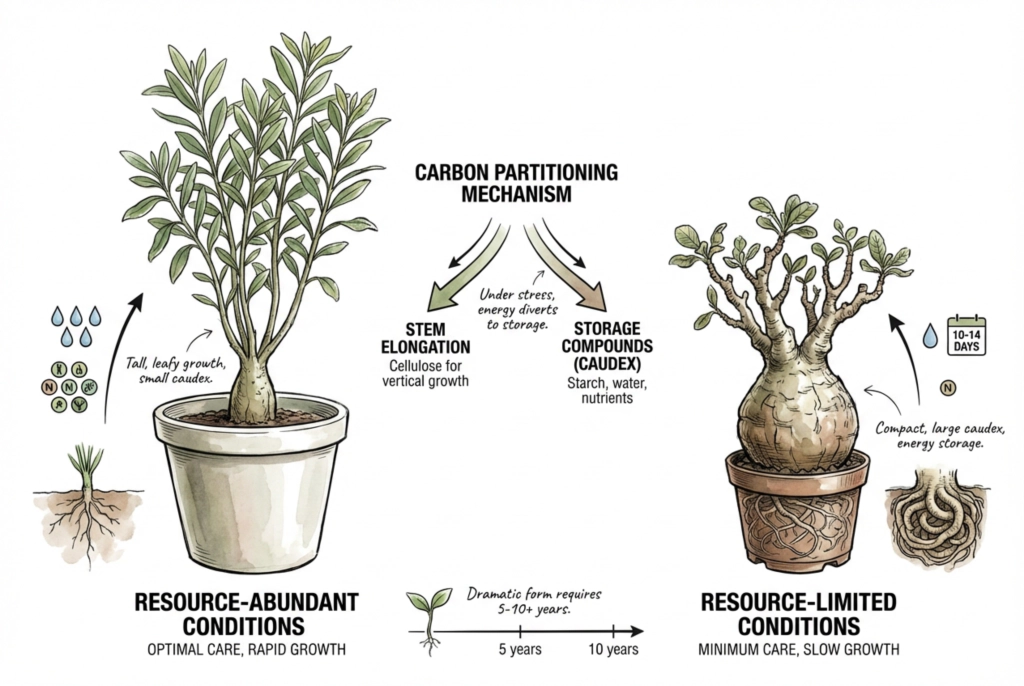
Dim light combined with heavy feeding can produce weak, elongated growth. That does not mean chronic thirst, severe root restriction, or near-zero nutrition will produce a better caudex.
Provide enough light for healthy growth, water when an active plant is dry, feed modestly, avoid an oversized wet pot, and give the plant time.
Remove Avoidable Limits
Avoidable limits
Weak light, dead roots, cold during active growth, exhausted substrate, or long dry periods while the plant is trying to leaf out can all limit progress. None of that turns a naturally slow species into a fast one.
Measure progress in healthy seasons rather than centimeters per year. The shape that makes these plants valuable develops over time and differs sharply by species.
Are These Plants Legal to Buy and Grow?
Verify Provenance Before Purchase or Import
Keeping or importing a plant may be lawful only after the species, provenance, import history, and applicable federal, state, and local rules have been checked. A plant being offered for sale is not, by itself, proof that its paperwork or possession is compliant.
The genus Pachypodium is covered by CITES. The CITES checklist identifies P. ambongense, P. baronii, P. decaryi, and P. windsorii in Appendix I. The remaining species are covered by the Appendix II genus listing and its annotation. International movement therefore requires the documentation that applies to the species and source. No paperwork is not a safe assumption for an imported plant.
Those controls matter because narrow ranges, habitat loss, and collection pressure can converge on the same species. A recent risk assessment also projects higher threat levels for the genus under future climate scenarios. Its projections are a conservation warning, not a forecast for the survival of a plant in cultivation.
Questions to Ask the Seller
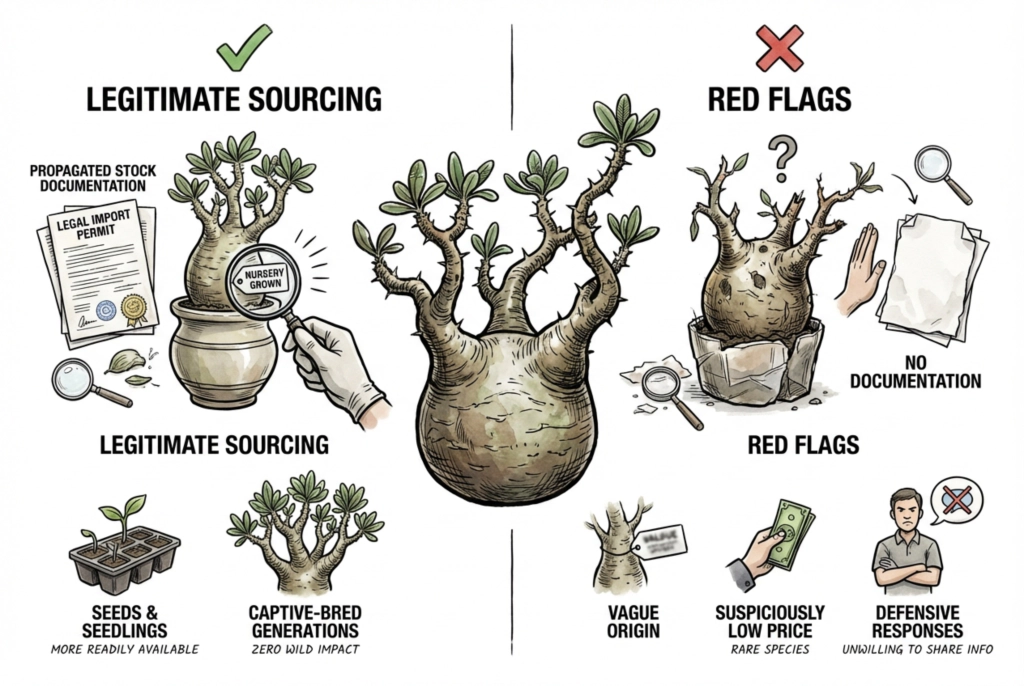
Ask whether the plant was artificially propagated, who grew it, and whether import documents are available if it crossed a border. A seller should be able to explain the chain of custody without relying on the plant’s appearance.
Vague origin stories, fresh-import listings with no documentation, or an unwillingness to answer leave provenance unresolved. Pause the purchase until the seller can provide a credible record. Prefer seed-grown stock with records when that information is available. In CITES terminology, artificially propagated is more useful for plants than the animal-trade phrase captive-bred.
Use the wild-collected versus nursery-grown checklist for seller questions and the limits of visual provenance clues.
Conservation Starts with Records
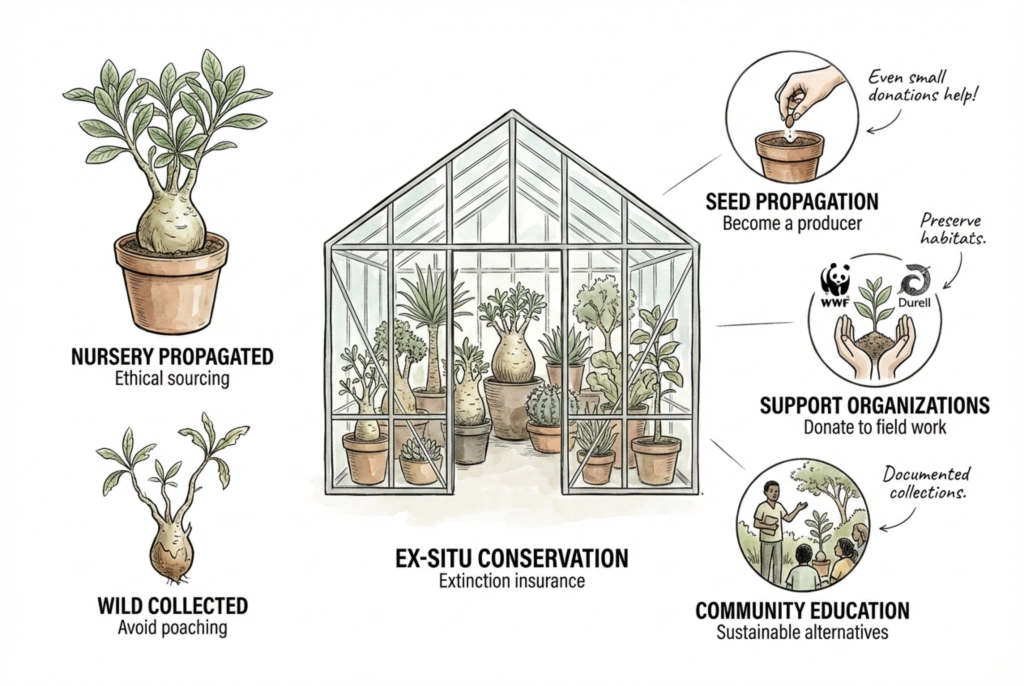
One practical contribution a buyer can make is to choose documented nursery-propagated stock and retain its records. Learning seed propagation also helps move demand toward plants produced in cultivation.
Ex-situ collections have conservation value only when identity and provenance are preserved. An undocumented plant in a private collection may be beautiful, but it is not automatically a useful genetic record.
For long-term provenance, I assign one accession number when a plant arrives. I link the seller name, accepted name, original label, acquisition date, claimed locality, source documents, and first full-plant photograph to that number. A later name change never overwrites the original entry.
I give every seed batch or cutting a child identifier linked to the parent accession and record its propagation date. If it leaves my collection, I add the transfer date and recipient before handoff. This keeps descendants attached to their known source without turning an undocumented locality into a visual guess.
Troubleshooting by Symptom
Root and Stem Rot
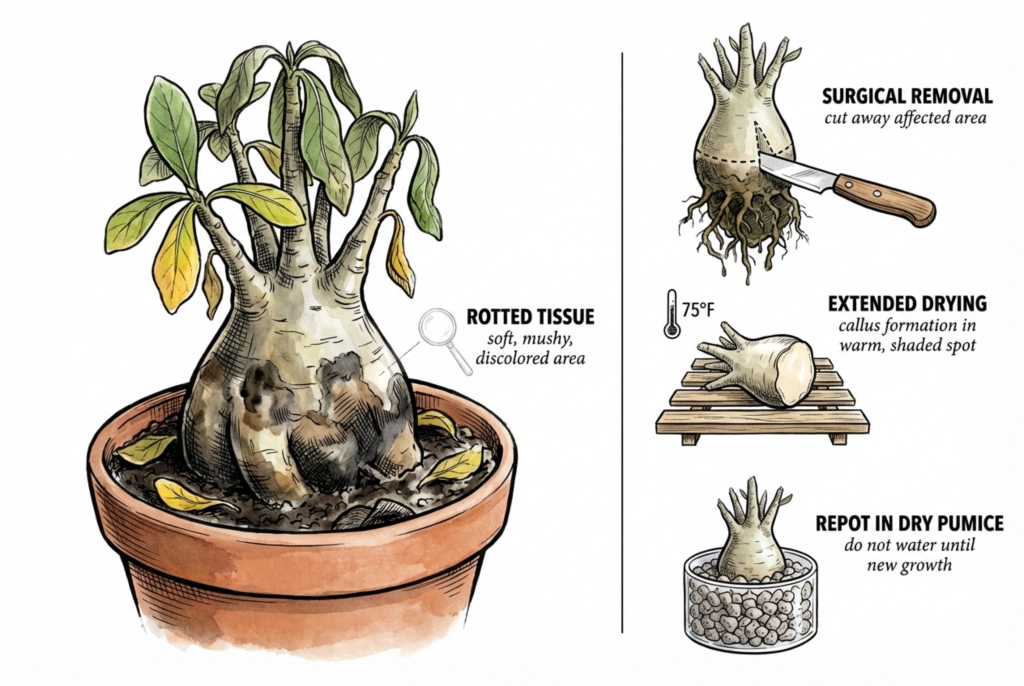
Start troubleshooting at the root zone
Look for spreading softness at the soil line, discolored or collapsed roots, a foul smell, and leaf loss while the mix remains wet. These signs can also have other causes, so inspect the whole plant and root zone.
A cautious response
Isolate the plant and seek a qualified assessment before cutting. If confirmed infected tissue must be removed, use gloves, eye protection, and a clean tool under the current product and sanitation guidance. Keep any wound dry while it calluses. Hydrogen peroxide or sulfur does not replace removal of infected tissue, and neither should be applied to a wound outside its label.
The caudex root-rot treatment guide separates sanitation, cutting, and labeled fungicide uses.
Mealybug Infestation
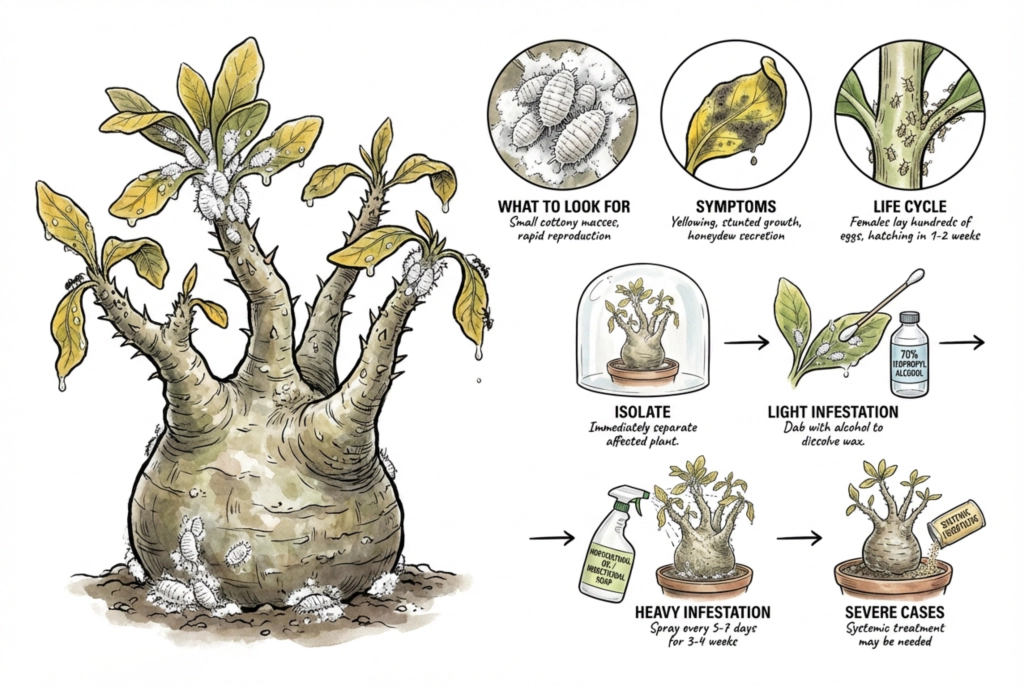
Signs to check
Look for white wax in leaf axils, under leaves, in bark crevices, or around the soil line, often with sticky honeydew.
A cautious response
Isolate the plant. Remove visible insects only with a label-compatible treatment after testing a small area. Reinspect because one pass will not reach every life stage. Use horticultural oil, insecticidal soap, or a systemic only when its label covers the plant, pest, and growing location.
If insects or wax appear below the soil line, follow the root-mealybug confirmation and cleanout guide rather than treating only the leaves.
Spider Mites
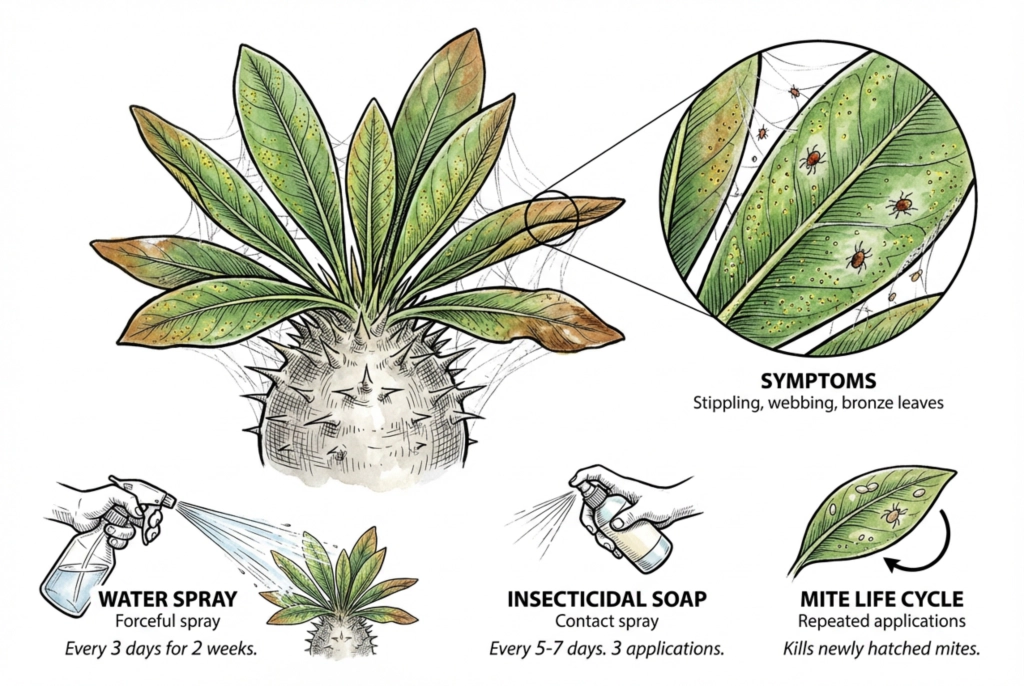
Signs to check
Look for fine stippling, bronzed leaves, and webbing. Confirm mites with magnification before treating, because nutrient or root problems can also pale a leaf.
A cautious response
Isolate the plant and wash foliage only where the species tolerates it. Choose a soap, oil, or miticide after reading its plant and pest label. Eggs and missed mites make follow-up inspections necessary. The spider-mite treatment chooser explains product fit and rotation.
Insufficient Light Causing Etiolation
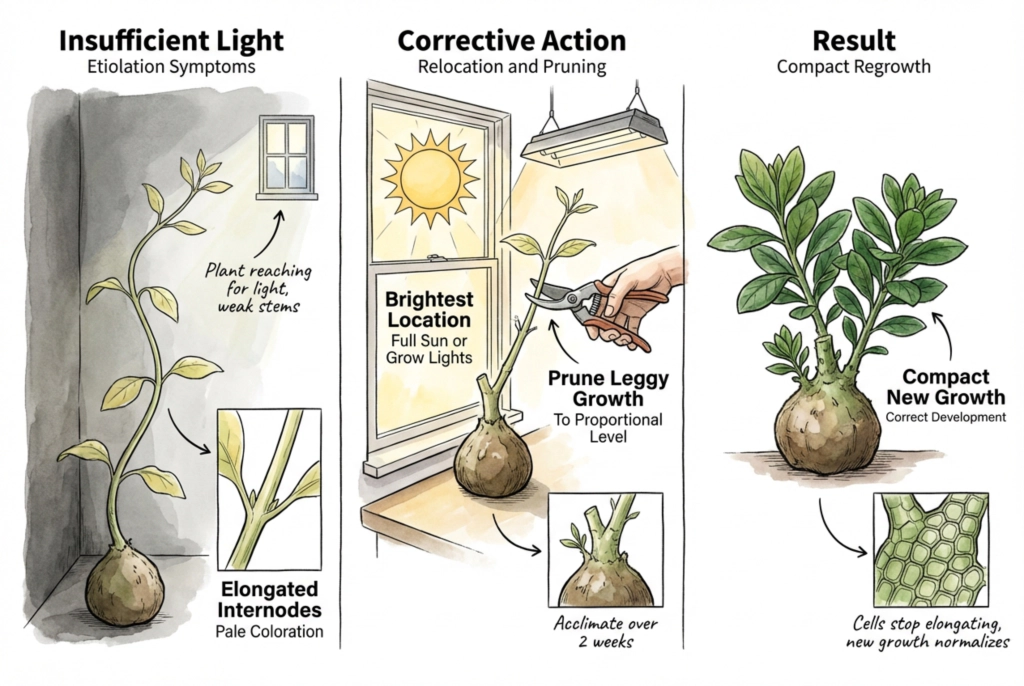
Signs to check
Look for unusually long internodes, a thin pale stem, and new growth leaning toward the brightest side.
A cautious response
Confirm that the roots are healthy, then raise measured canopy light in steps. Old stretched tissue will not shorten, but later thickening and new growth can still vary by species. Pruning is optional and depends on whether cutting suits the species’ natural form.