
Cycas Air Layering: What the 2025 Research Shows
What the 2025 Marler and Cruz Cycas air-layering research found about exposing the vascular cylinder, sealing the wound, and interpreting early results.
Derek Kim · 2026-06-01 · Updated 2026-06-02 · 18 min read
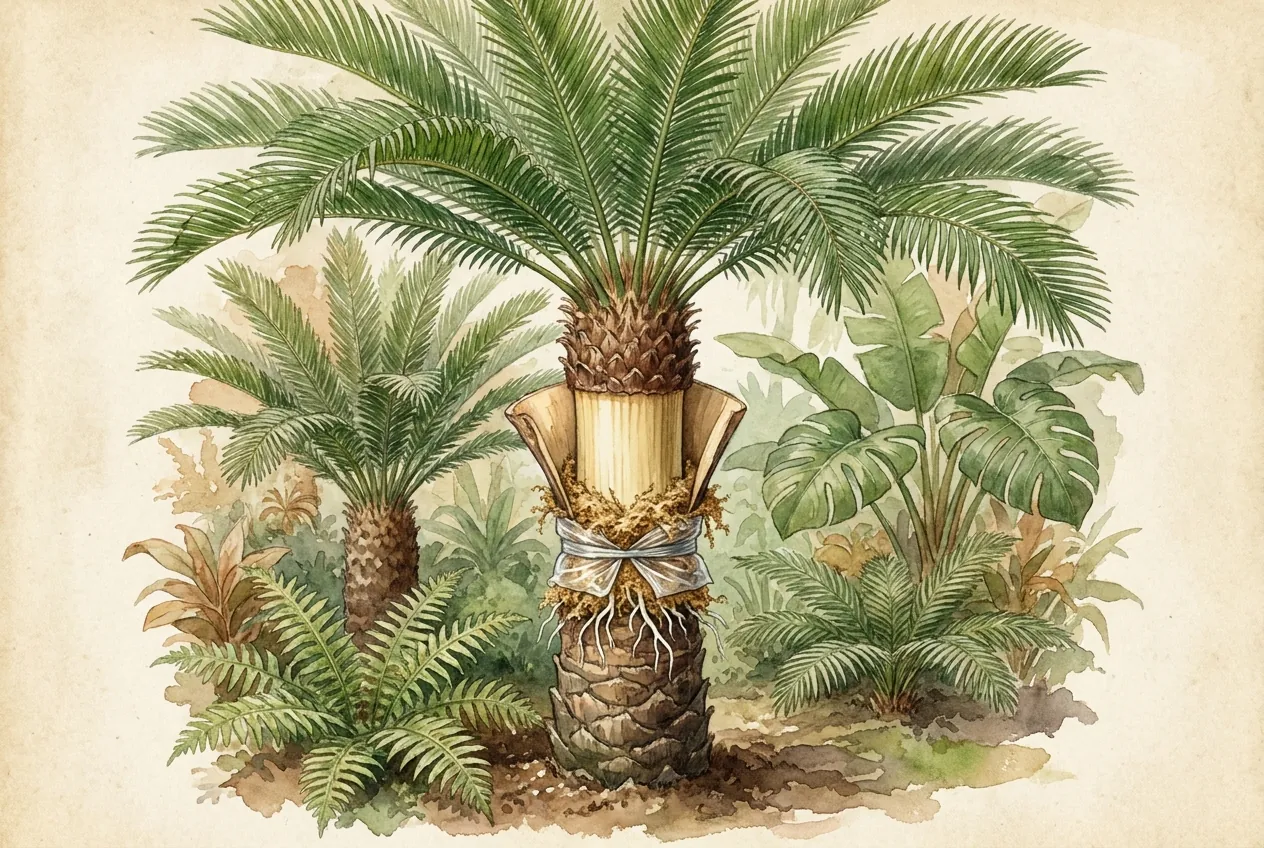
Key Takeaways
- Trunk air layering is not a guaranteed method. It was demonstrated in a small 2025 Marler & Cruz study on healthy, mature Cycas edentata, so the results remain early and species-limited.
- Exposing the outer vascular cylinder is what drove rooting, and more exposure gave more roots. All replicates rooted, and the study saw no canopy death even at a full 360° exposure.
- IBA rooting hormone gave no measurable benefit in the study. Other auxins and doses are untested, so do not extend the finding to every cycad.
- Disinfect and fully seal the wound before wrapping. Follow the paper's current directions and local product labels rather than improvising concentrations.
- Harvesting a main-trunk layer still cuts the stem. It is less destructive than full decapitation but not non-destructive, so treat it as a specialist option and follow the original paper for any rare or ESA-listed cycad.
If you attempt it on a rare or valuable plant, follow the original Marler & Cruz paper directly, including its key steps summarized below and the requirement to disinfect and fully seal the wound before wrapping.
Why are trunked cycads hard to clone from the trunk?
A cycad stem is not a tree stem. The center is starch-loaded parenchyma. Instead of a dicot's single continuous cambium, cycads have several concentric vascular cylinders with xylem and phloem intermixed, and they lack a continuous secondary growth ring.
That architecture helps explain why trunk-based cloning is uncommon, although cycads can still be cloned through basal pups and stem cuttings.
The 2025 work adds published experimental evidence for air-layering trunks, not the first clone method.
What makes the cycad stem anatomically different?
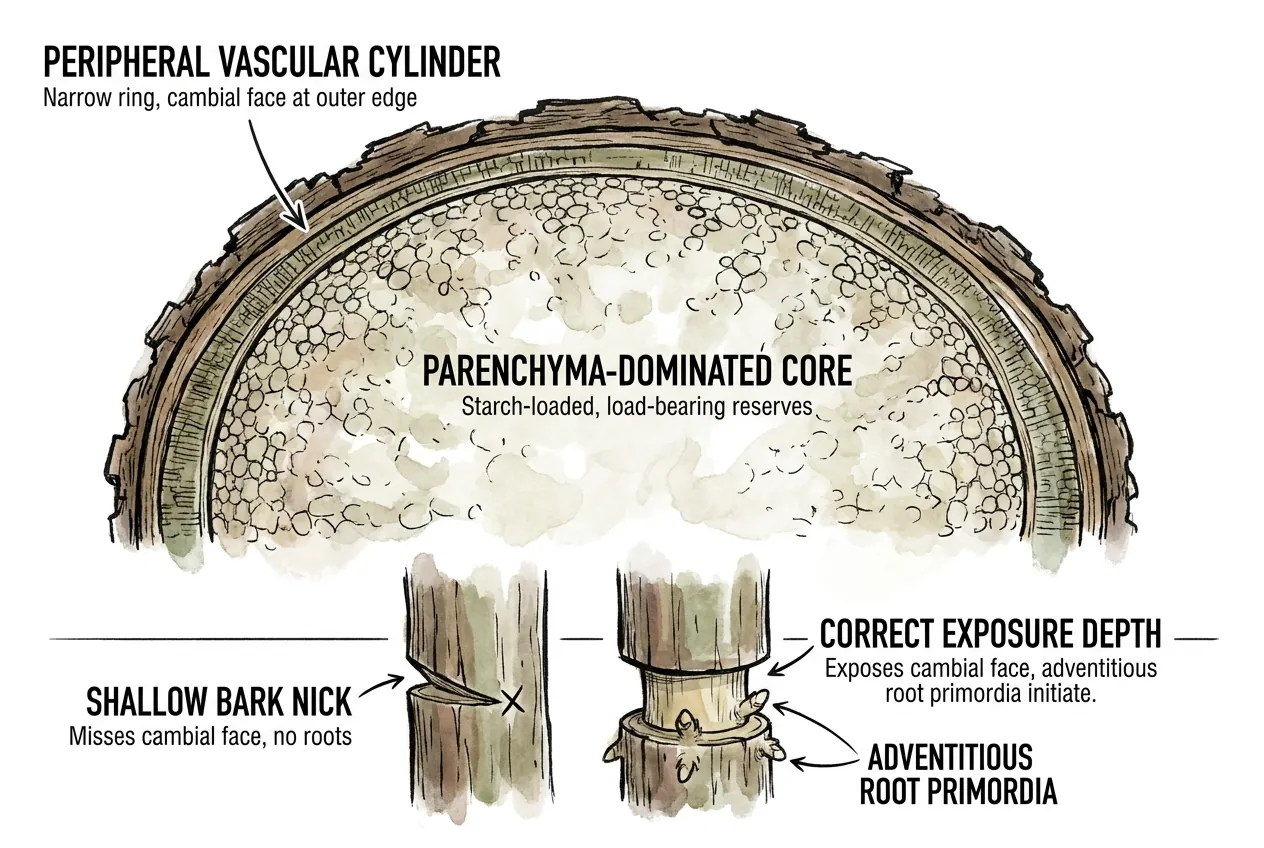
Cycad stems have a parenchyma-dominated core and several concentric vascular cylinders rather than one dicot-style cambium. In the 2025 study, new roots emerged from exposed vascular tissue at the wound surface, specifically the outermost cylinder.
A superficial bark nick would not reproduce that experimental condition, so the depth and tissue response must be evaluated carefully on the target species. How much vascular tissue is exposed matters, which is why the study compared exposure angles.
The starch-loaded parenchyma core also supplies reserves for propagation. Work on Cycas micronesica links stem carbohydrate status with adventitious root formation, but that relationship is not a diagnostic test for an individual plant. Health, season, species, wound quality, and aftercare can all change the result.
Where do adventitious roots actually initiate on a cycad stem?
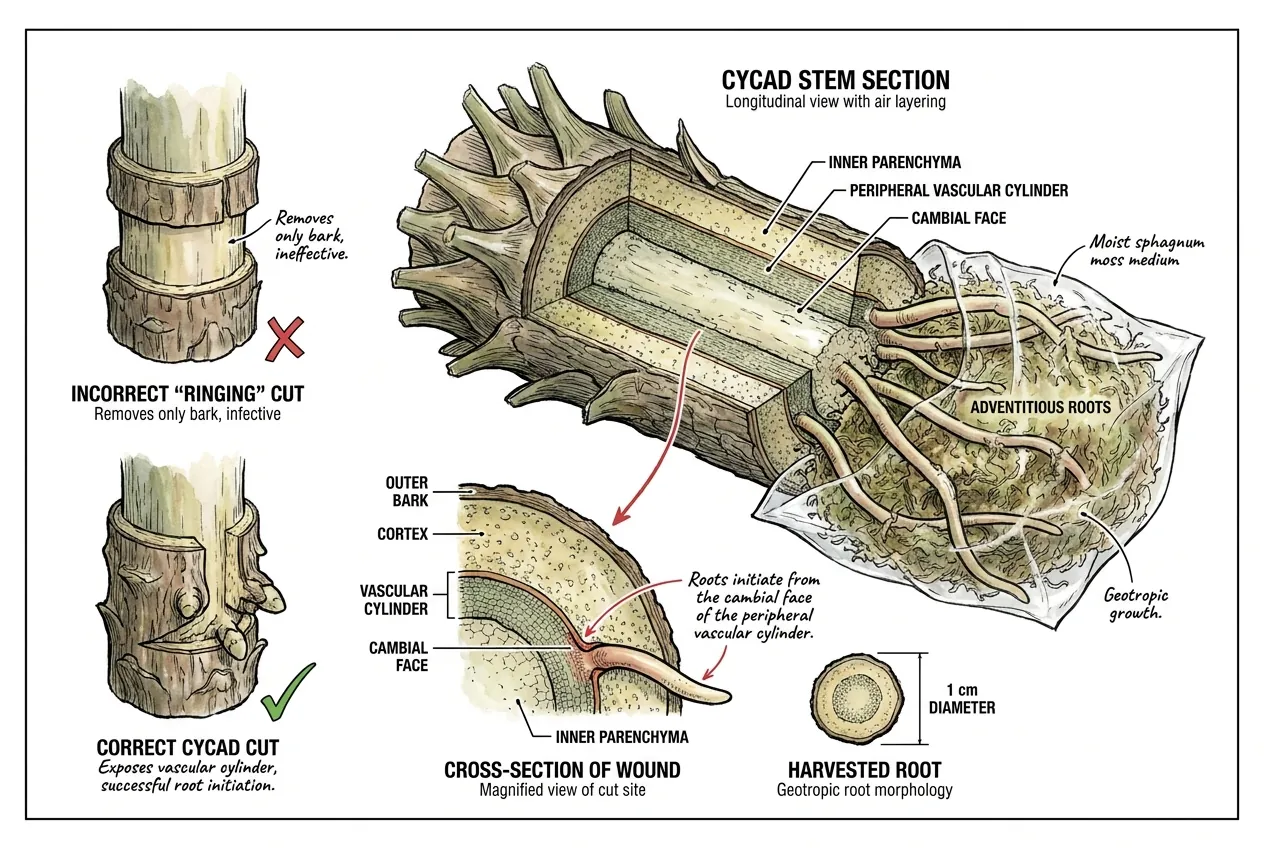
In the Marler and Cruz trial, adventitious roots emerged at the cambial face of the peripheral vascular cylinder rather than from the cortex or inner parenchyma. That explains why a bark-only ring is not equivalent to the tested treatment, but it does not establish a universal depth for every cycad. The reported roots were geotropic and robust in that small study, so treat their size and orientation as observations to verify rather than guaranteed outputs.
How does the 2025 Marler & Cruz wound-exposure protocol actually work?
The 2025 protocol compared four wound-exposure treatments around the trunk circumference at 90°, 180°, 270°, and 360°. All replicates rooted in that small trial, and the widest exposure produced more roots than the narrowest. Under those conditions, exposing the cambial face mattered more than the tested hormone, but the result does not establish a universal cycad response.
What does the wound geometry look like?
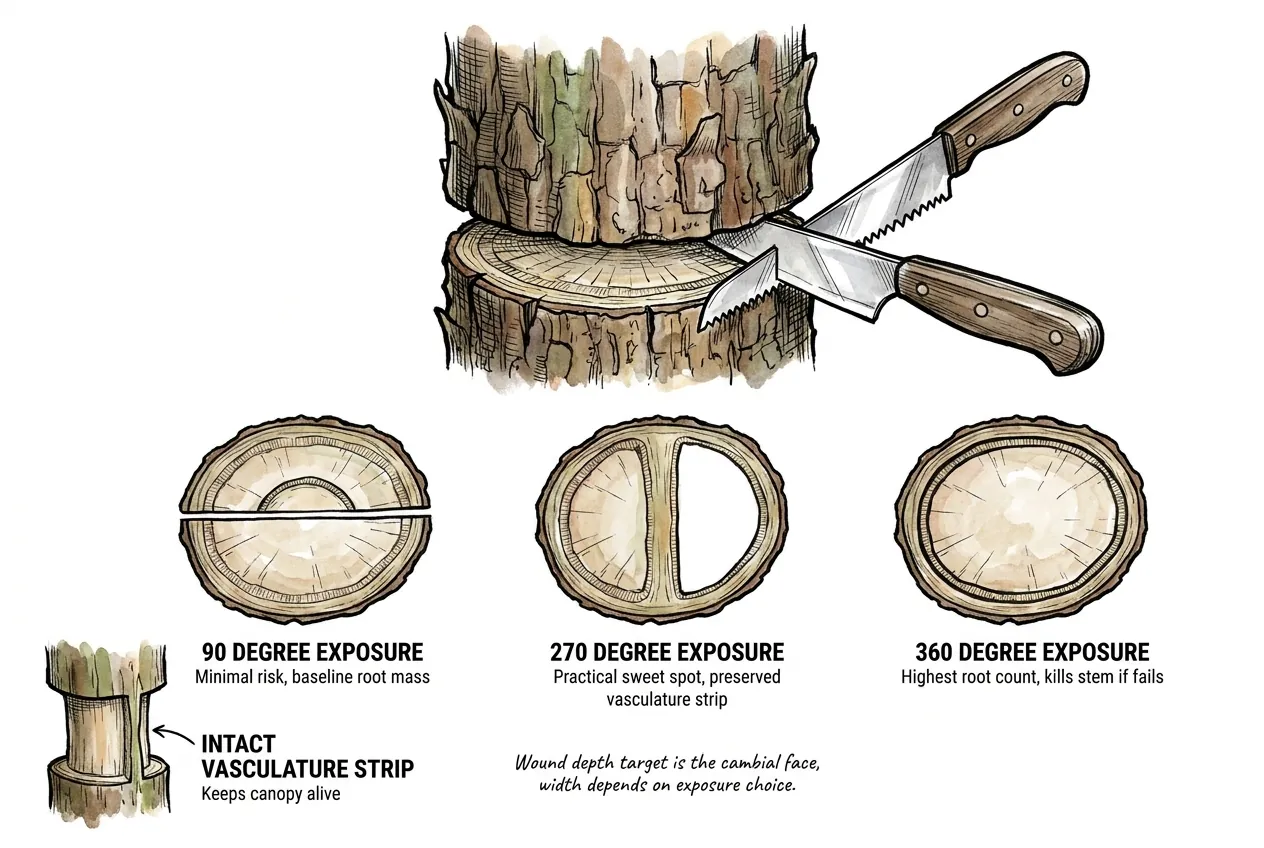
The wound is a horizontal band cut through bark and cortex down to the peripheral vascular cylinder. The source protocol describes using a hand saw and butcher knife to reach the cambial face, while the width depends on the exposure treatment.
Keep the 360-degree result in context
The full 360-degree treatment did not kill the canopy in this study. All treatments rooted successfully, and wider exposures produced more roots while leaving the internal vascular cylinders and pith intact. The researchers therefore did not observe canopy death from a complete exposure.
On a rare or irreplaceable specimen, leaving a strip of intact bark is still a reasonable personal safety margin. It is a precaution rather than a documented requirement, and the study did not test one universally safe strip width.
Wound exposure vs. root yield
| Exposure | Rooted in the study | Root number (approx., per the study) |
|---|---|---|
| 90 deg | Yes | ~3–6 roots |
| 180 deg | Yes | intermediate |
| 270 deg | Yes | intermediate |
| 360 deg | Yes | ~14–19 roots |
The study reported root number, mean length, and diameter rather than a relative root-mass index, with middle exposures falling between the 90° and 360° figures. All exposures rooted in that small trial, but that is not a guarantee for every cycad or condition.
Why does exposure percentage matter so much?
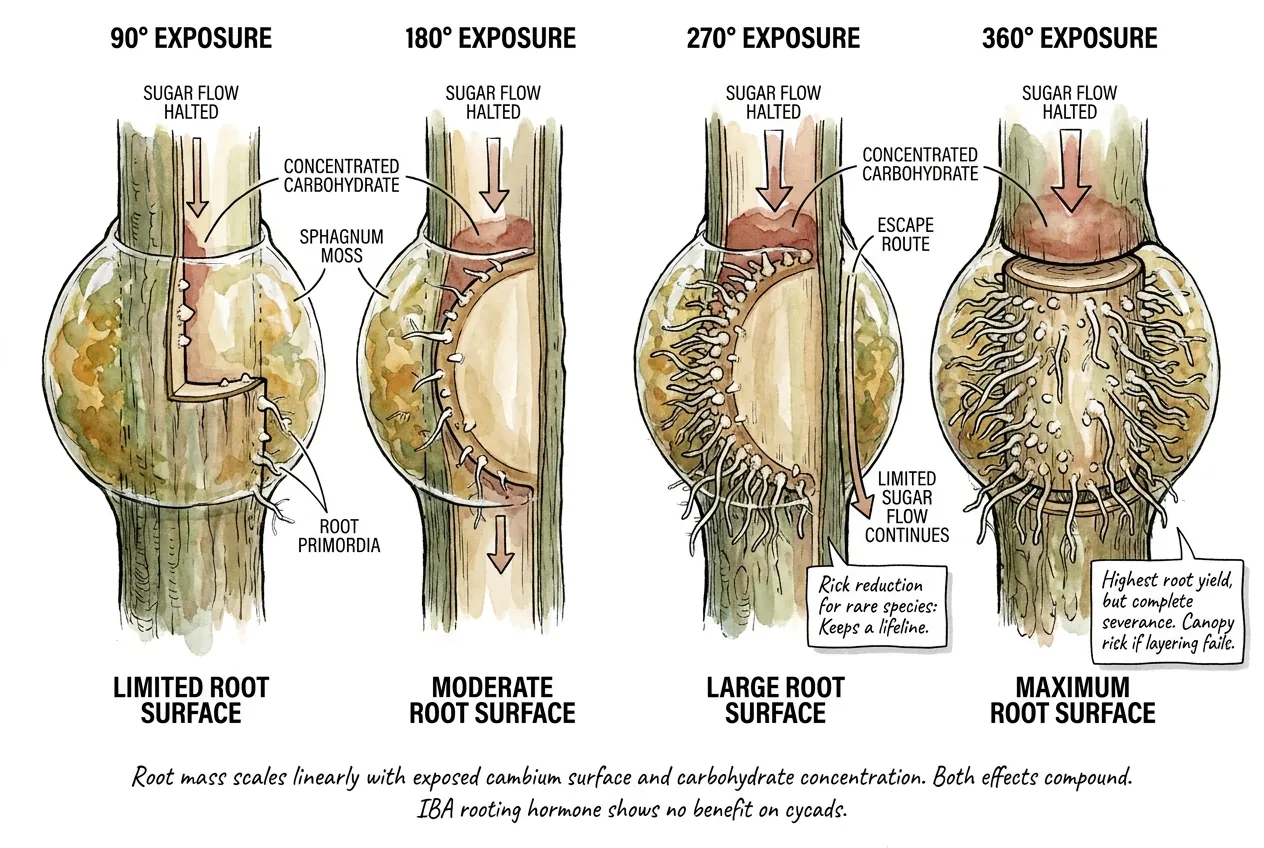
Root primordia can form only along the exposed cambial face. A 90-degree cut places the root-initiating surface in one quadrant, while a 360-degree cut exposes it around the trunk. The available surface therefore scales roughly with exposure angle, matching the observed root-number gradient, although the study did not prove a single causal mechanism.
Caution versus evidence
The 360-degree treatment produced the most roots in the study, and the researchers did not report canopy death because the inner cylinders and pith remained intact.
The results do not support a blanket claim that every complete girdle kills the top.
Even so, if this is your only specimen of a rare cycad, choosing a partial exposure and leaving a strip of intact bark is a sensible personal safety margin. You may trade away some root yield, and this choice is prudence rather than a documented rule.
Did rooting hormone help in the study?
Not measurably. In the 2025 study on Cycas edentata, air layers treated with IBA powder rooted no better than untreated controls, so exposing the vascular tissue mattered more under those conditions. Some earlier cycad cutting work pointed in the same direction.
This was one species at one IBA dose, and the authors noted that other auxin types or concentrations remain worth testing. The fair summary is that IBA was not necessary under these conditions, not that it is ineffective for every cycad.
Why is cycad rooting auxin-insensitive?
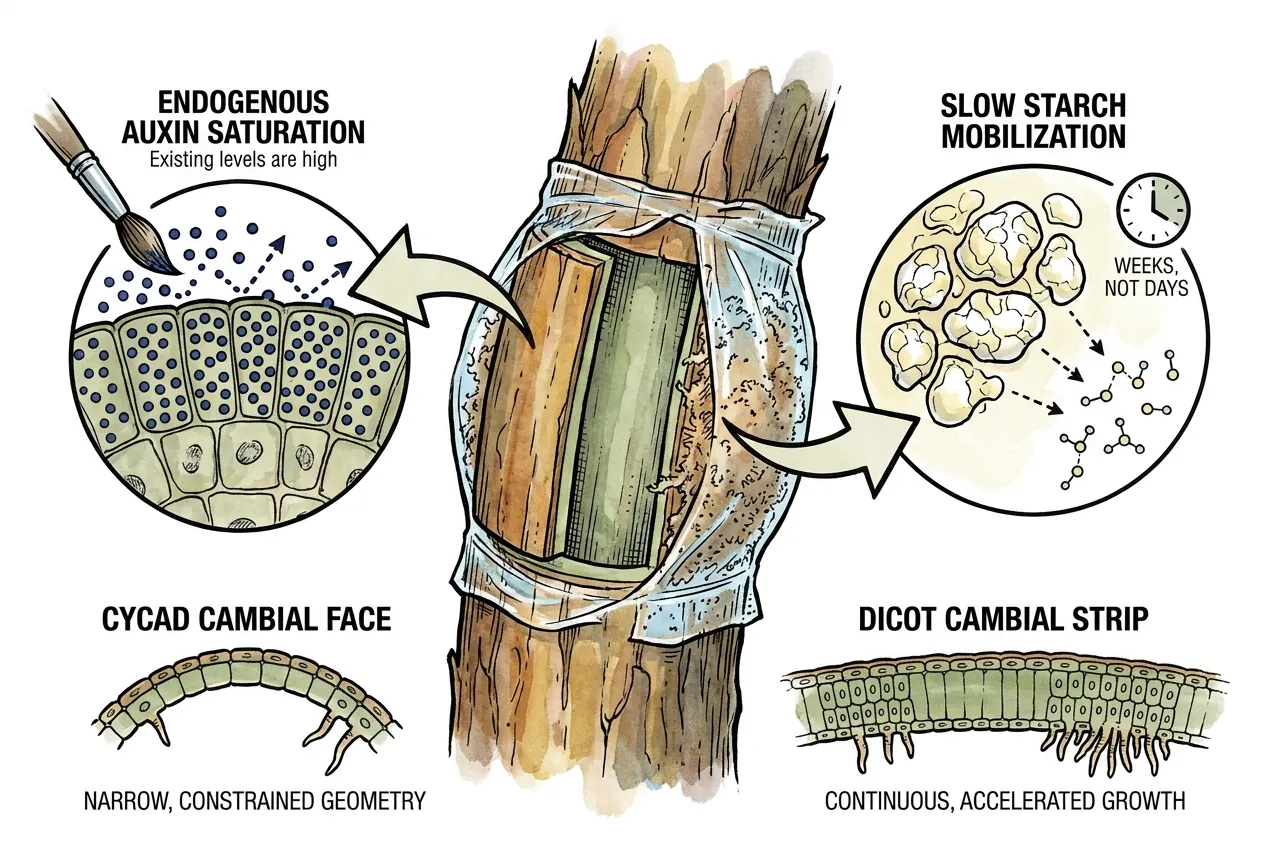
The study does not identify why IBA failed to improve rooting. Possible explanations include endogenous hormone levels, tissue maturity, wound geometry, or the tested formulation, but these remain hypotheses.
Cycad cambial architecture differs from that of many dicot cuttings, so results from conventional rooting protocols should not be transferred without testing.
What should you spend money on instead?
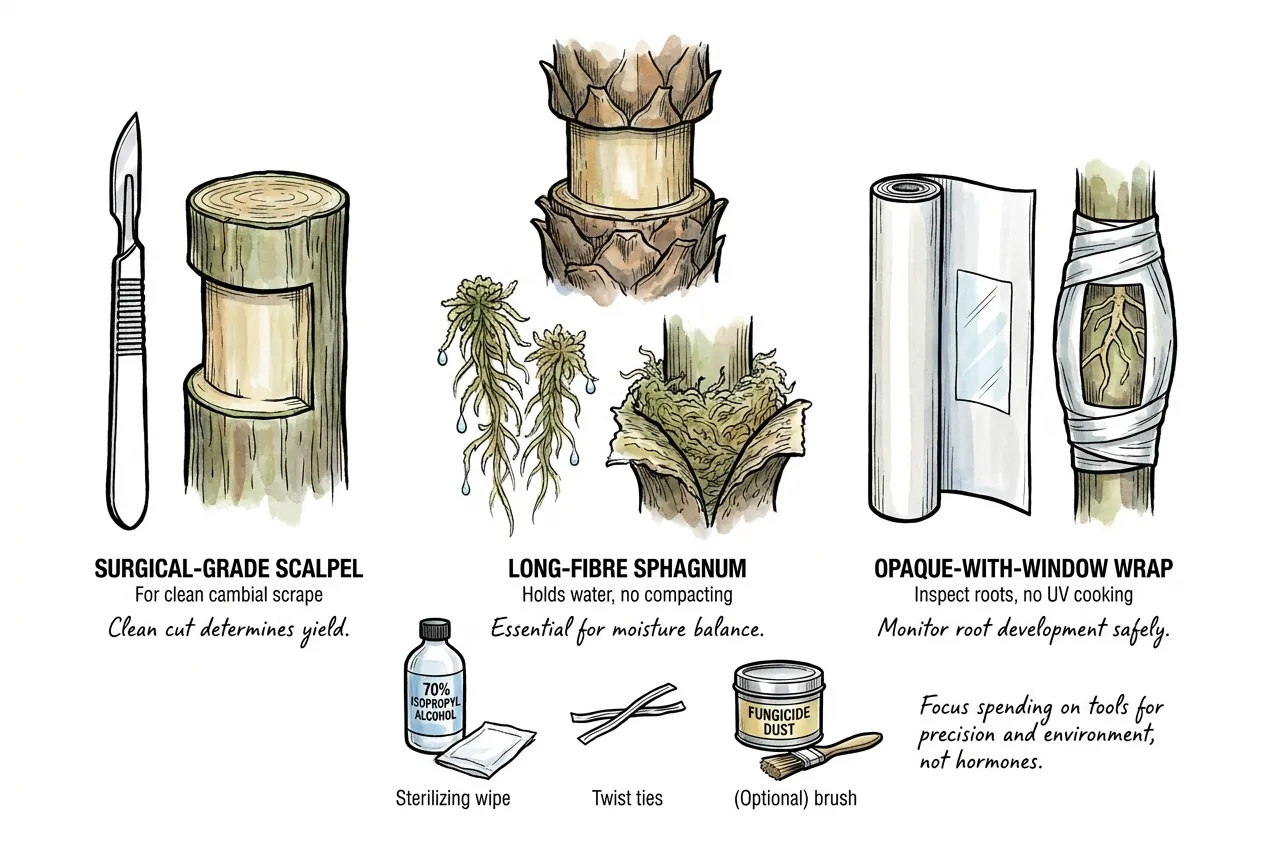
Prioritize clean tools, a stable long-fibre medium, and a wrap that lets you monitor moisture without overheating the wound.
The study did not show a benefit from its tested IBA treatment, but that is not a reason to claim that every hormone or product is ineffective.
What tools and materials do you actually need?
Typical materials include a clean cutting tool, an appropriate disinfectant, long-fibre sphagnum or another tested medium, plastic film, and ties. Any fungicide or sealant must be legal and label-compliant for the intended use, and prices and availability vary, so verify current local options before starting.
Why long-fibre New Zealand sphagnum, not peat moss?
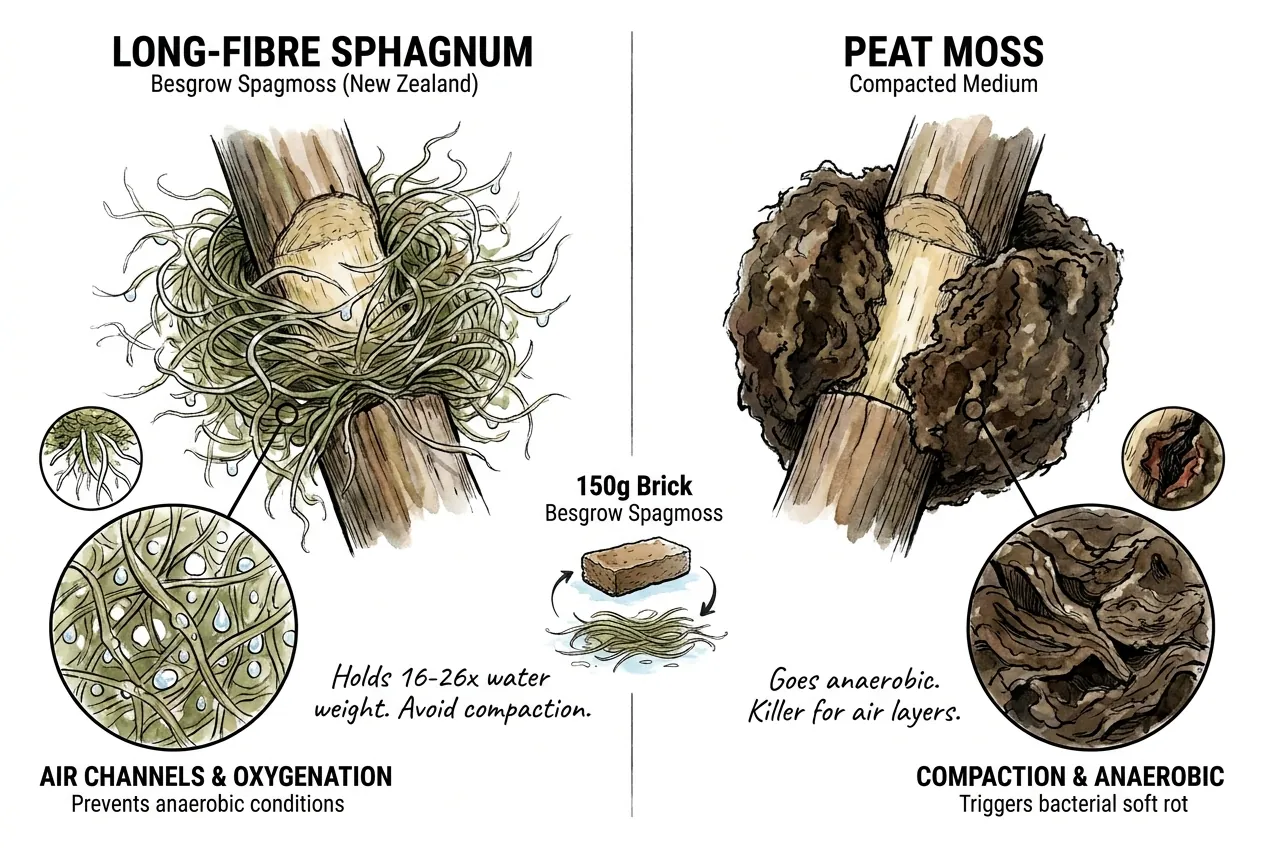
Long-fibre sphagnum can hold substantial water while preserving air spaces, but capacity varies by species, processing, and packing. Compaction and saturation reduce oxygen at the wound and can encourage soft rot, while long fibres help maintain air channels around the cambial scrape.
The water-holding-capacity literature on Sphagnum confirms that retention depends on both species and physical colony structure, so test the actual material rather than assuming every product behaves the same.
A long-fibre New Zealand sphagnum is one option for an air layer, and you should check the current fibre length, packaging, and local availability before buying.
Long-fibre New Zealand sphagnum brick
Compressed bricks expand by different amounts depending on product and hydration. Prepare enough material to surround the wound, then squeeze until it is damp but not dripping and remains open around the stem.
Why the spec matters, not the brand
Look for clean, long fibres with enough resilience to hold a damp air space. Exact porosity and fibre-length specifications are product-dependent.
A milled or compacted medium may behave differently from long-fibre material, so test the mix before using it on a valuable specimen.
What knife should you use for the cambial scrape?
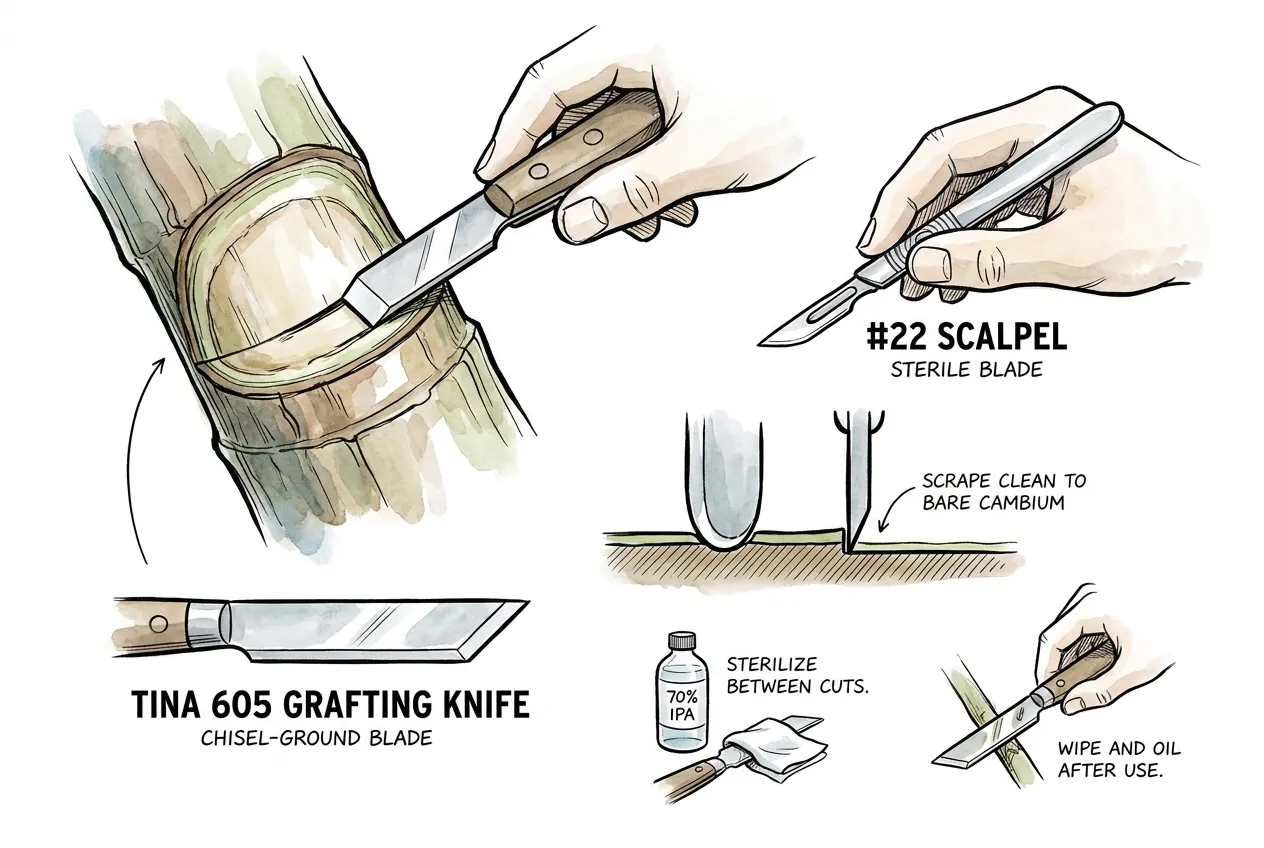
Use a sharp, controllable grafting or pruning tool appropriate to trunk thickness and the original study's safety requirements. The goal is a clean exposure without tearing tissue, but exact blade size is not a universal prescription. Disinfect tools between plants with a method effective for the intended pathogen and safe for the material, following local guidance.
Grafting knife (carbon steel, single-bevel)
A chisel-ground grafting knife can give a controlled scrape, but blade geometry, handling, and local availability vary. Choose a tool you can safely disinfect and control on the trunk. Carbon steel needs drying and maintenance, while stainless alternatives trade some edge feel for easier care. Check current specifications rather than relying on a brand or price.
Tool safety
Use only a tool you can control and disinfect. A slip can ruin the layer or injure the operator, so specialist propagation may be safer than improvisation.
A compact foldable grafting knife is one option to compare. A foldable design may help with storage, but a controllable and disinfectable blade matters more than the brand. Check the current specifications before use.
What is the step-by-step execution recipe?
The paper describes a sequence of site selection, medium preparation, wound exposure, disinfection and sealing, wrapping, and monitoring.
Active time, rooting time, and harvest readiness vary with trunk size, season, species, and aftercare.
Use a period of active growth only when the original paper and local conditions support it. Do not treat a calendar month as a guarantee.
Step 1: Pick the cut location
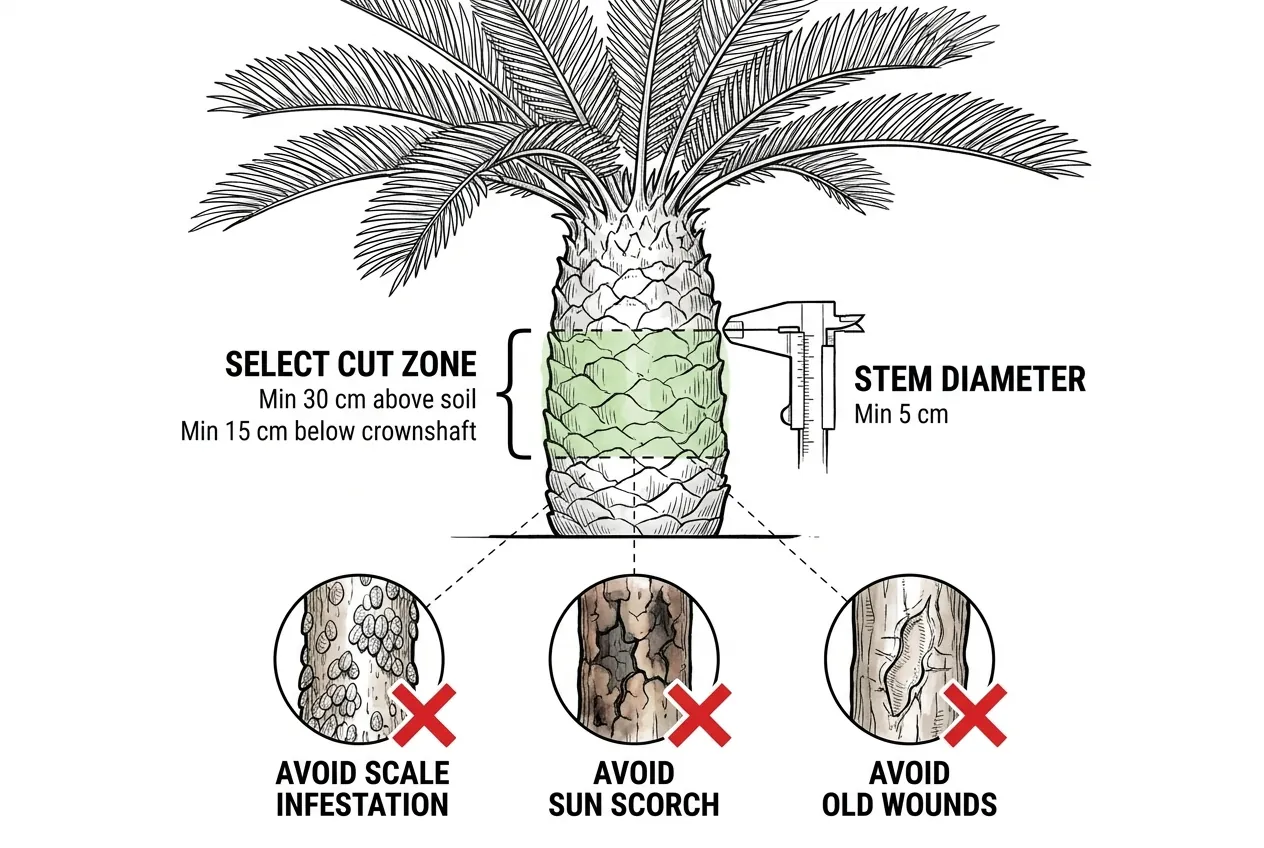
Choose an intact, healthy section with enough room for the wound and wrap, away from scars, sun damage, active scale, or other lesions.
The source study used mature trunks. Its dimensions should not be copied to a different species without expert review.
Before considering the cut, I make a baseline record of the parent canopy, trunk above and below the intended site, root-zone condition, recent growth, and legal provenance. I also write down why the clone is worth the risk and what change would make me stop. This keeps an emerging technique from becoming an automatic project on a valuable plant.
I keep the parent record separate from the layer record after wrapping. If the parent shows progressive decline, I treat protecting it as the priority instead of waiting for a hoped-for rooting milestone. The photographs do not diagnose the cause, but they make a real trend easier to recognize without repeatedly disturbing the wrap.
Step 2: Prep the sphagnum the night before
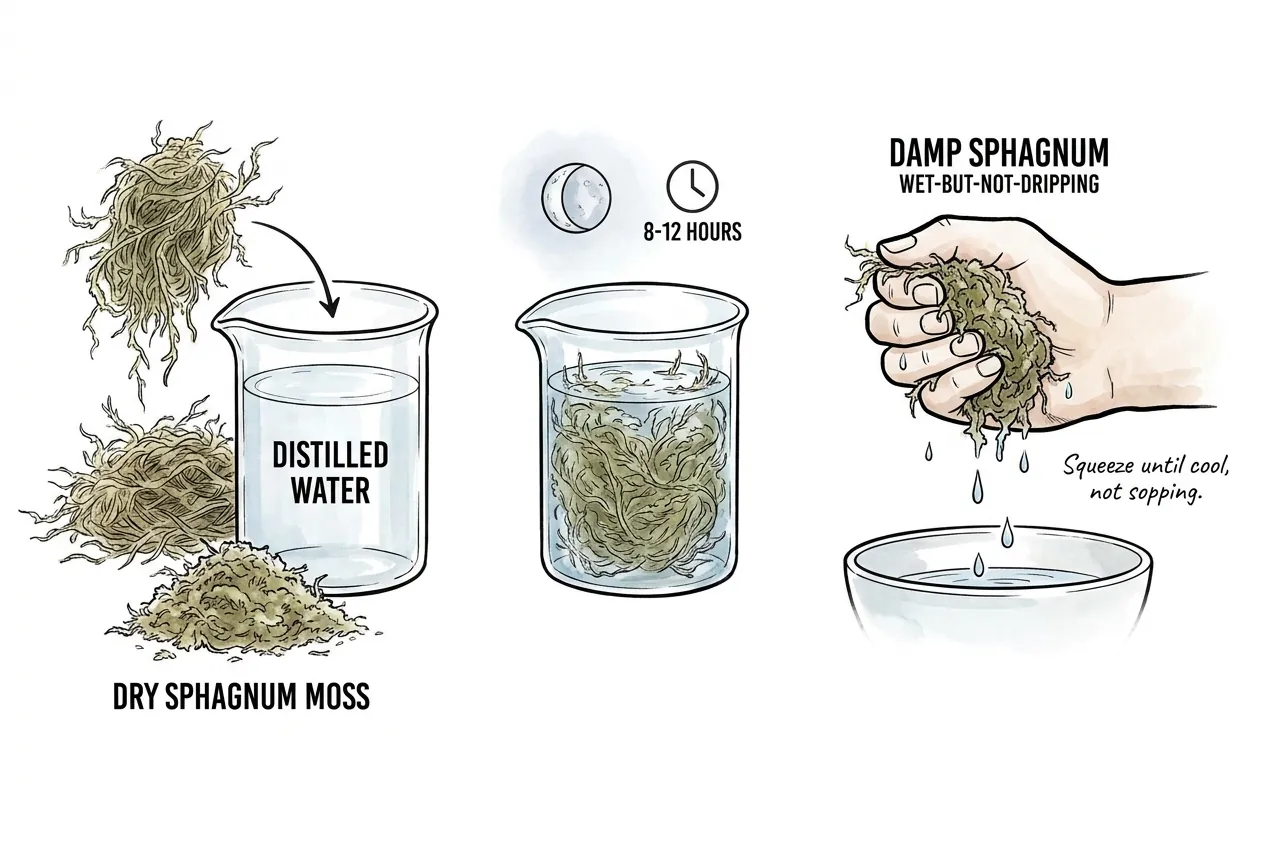
Hydrate enough long-fibre sphagnum to surround the wound, then squeeze it until it is evenly damp and remains open.
Water type and soaking time should follow the product and local sanitation guidance.
Step 3: Mark and score the wound
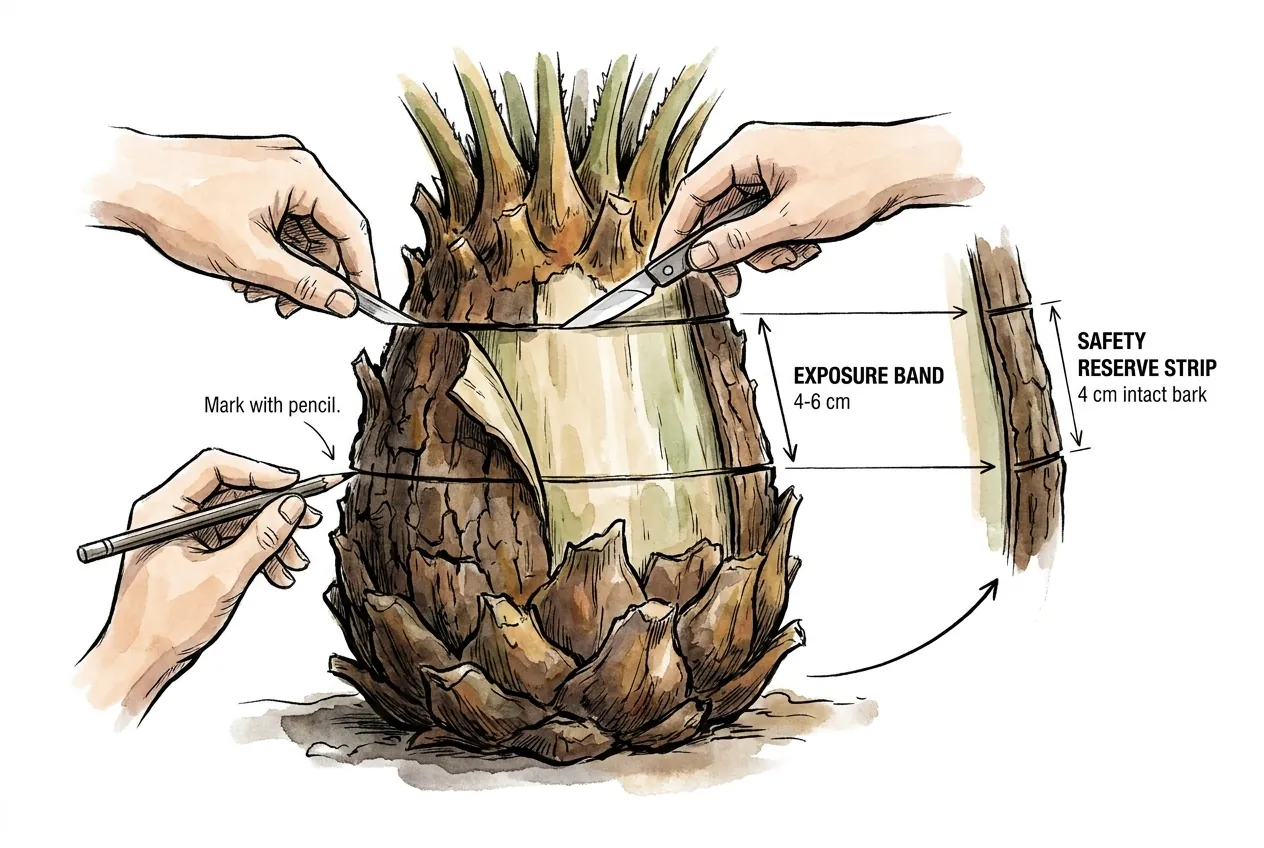
Mark the boundaries of the intended exposure and decide in advance how much intact tissue, if any, will remain as a conservative margin.
The study's exposure angles are experimental conditions, not a universal safety recommendation.
Step 4: Cut and scrape to the cambium
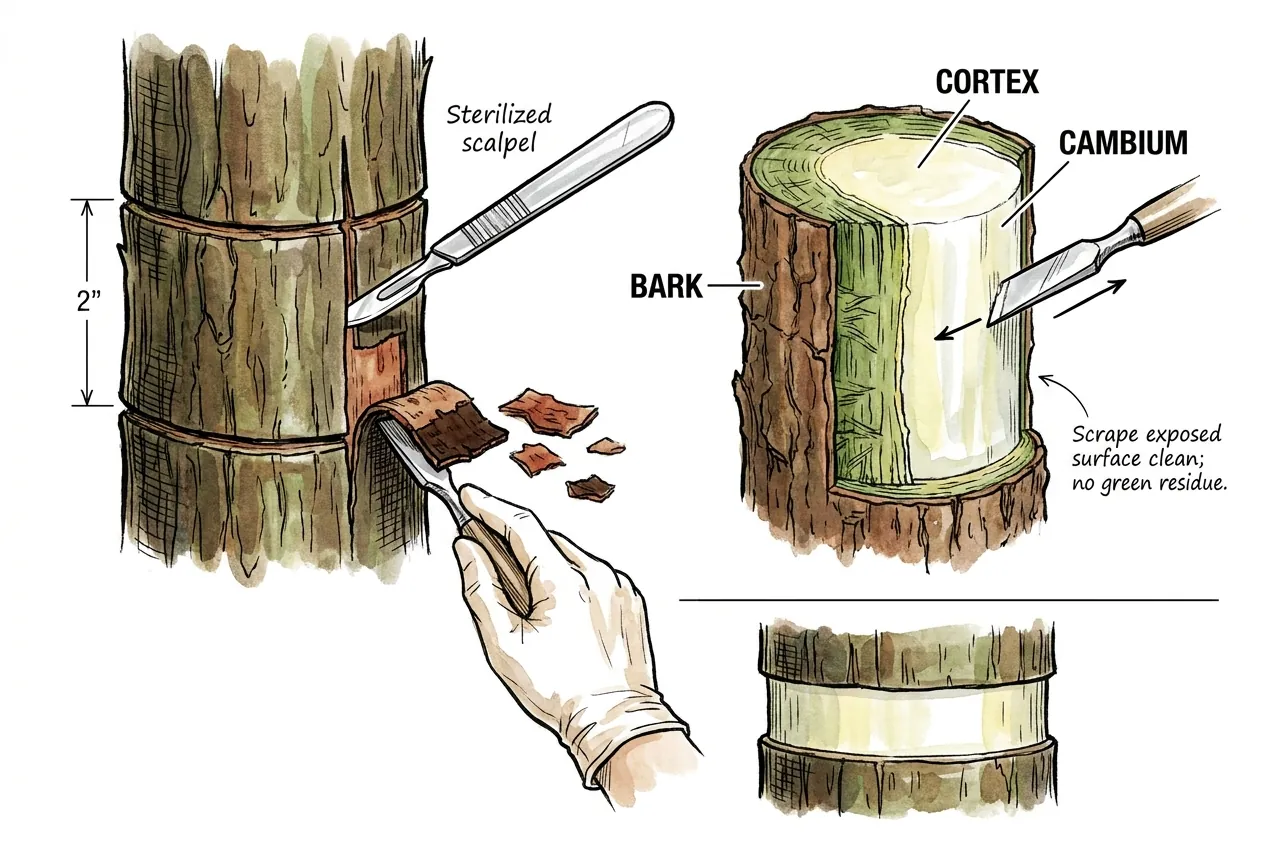
Cut through the bark and cortex along both scored lines down to the vascular tissue, and lift the band off.
The original study used a hand saw and knife to make these cuts, then a clean finishing cut. Heavier tools than a scalpel alone may be needed on a thick trunk.
The surface should look pale, with the vascular tissue exposed.
The original protocol disinfected and fully sealed the wound before wrapping. Follow the paper's current directions and local product labels. Allow the surface to dry before placing moist medium against it.
Do not improvise concentrations or combine chemicals.
Step 5: Apply the sphagnum annulus
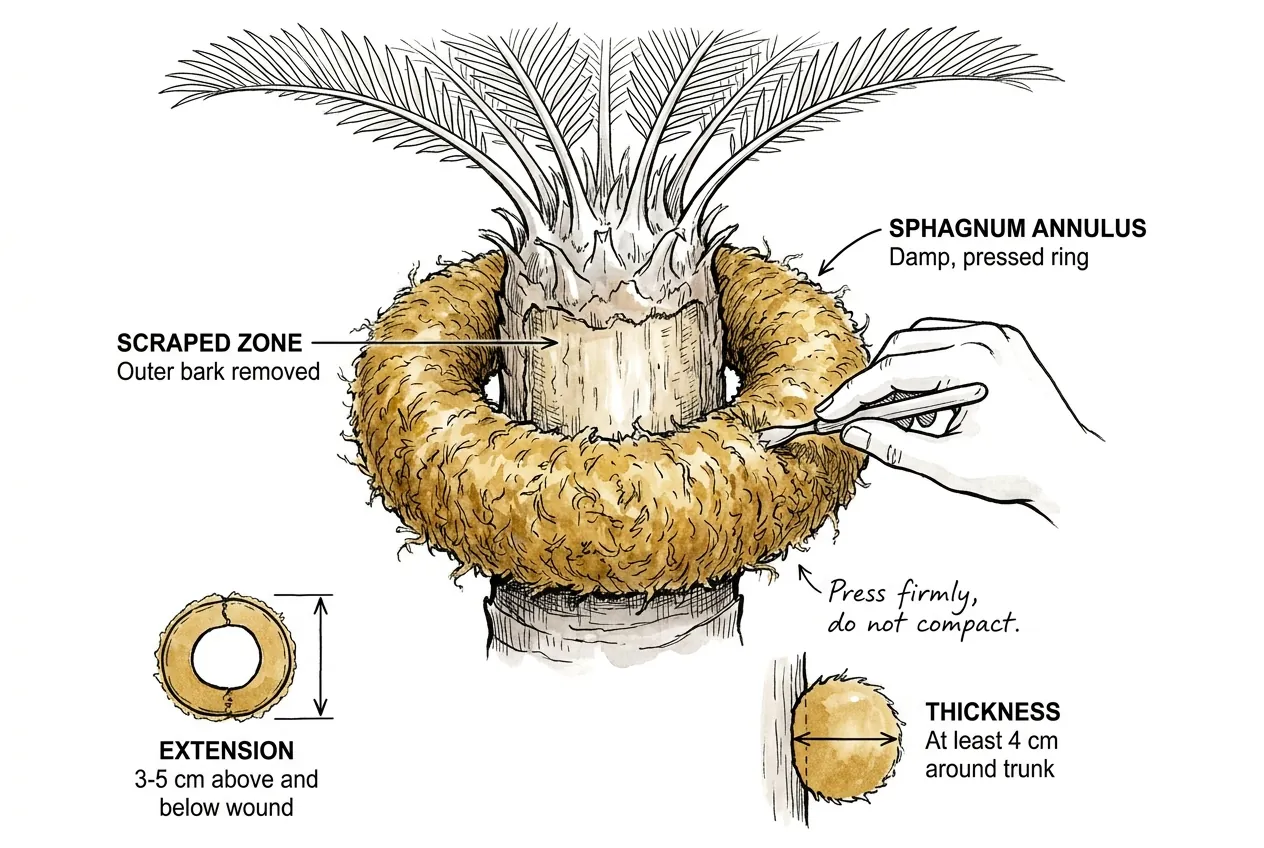
Pack damp sphagnum around the intended wound zone so it contacts the sealed surface without compressing the fibres.
Use enough material to stay in place and leave an air space within the wrap. The amount depends on trunk size.
Compaction and saturation reduce oxygen and increase rot risk.
Step 6: Wrap and tie
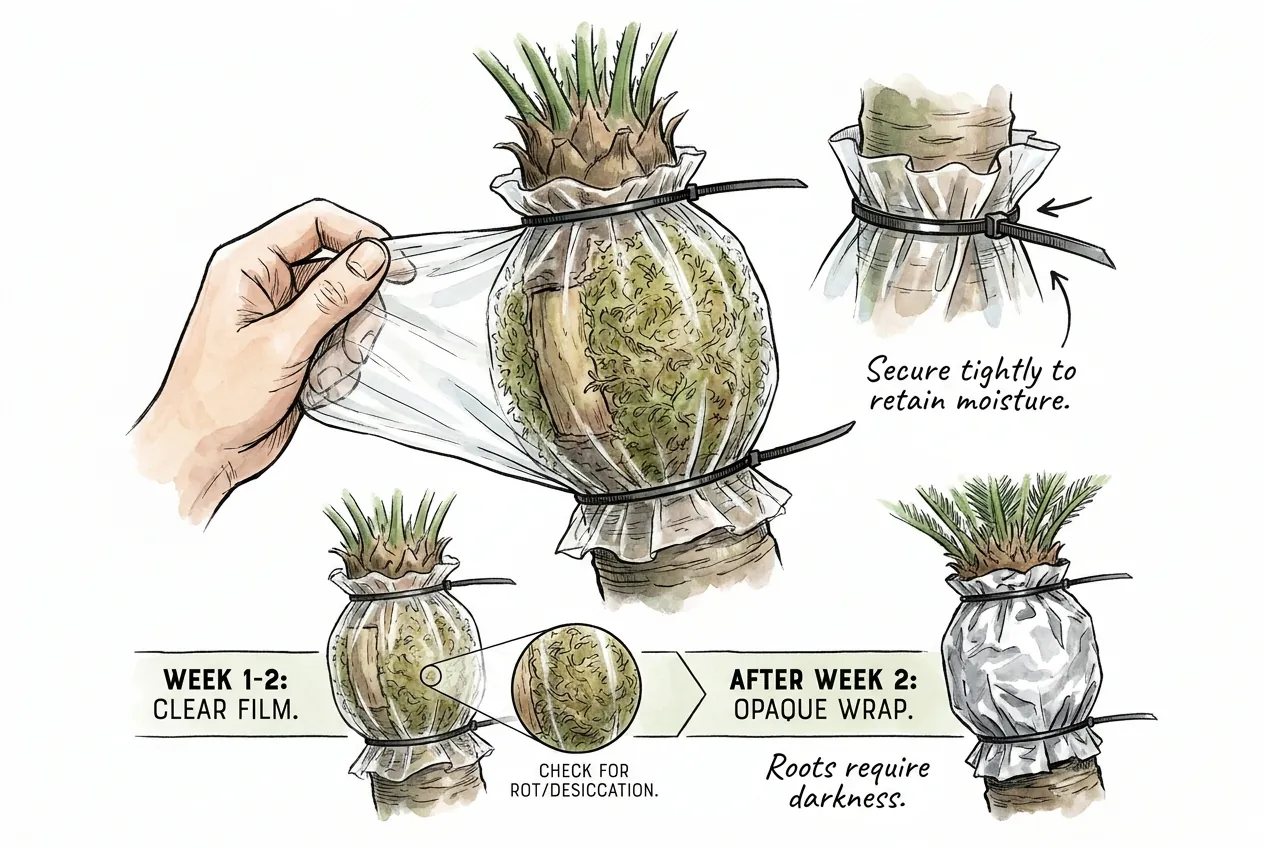
Wrap and secure the medium so moisture can be inspected without trapping excessive heat.
Use an opaque layer or shade when direct radiation would overheat the wound, while keeping enough access for inspection.
Rooting response to light is species- and tissue-dependent. Darkness is not a substitute for sound moisture and temperature control.
Step 7: Monitor at a repeatable interval
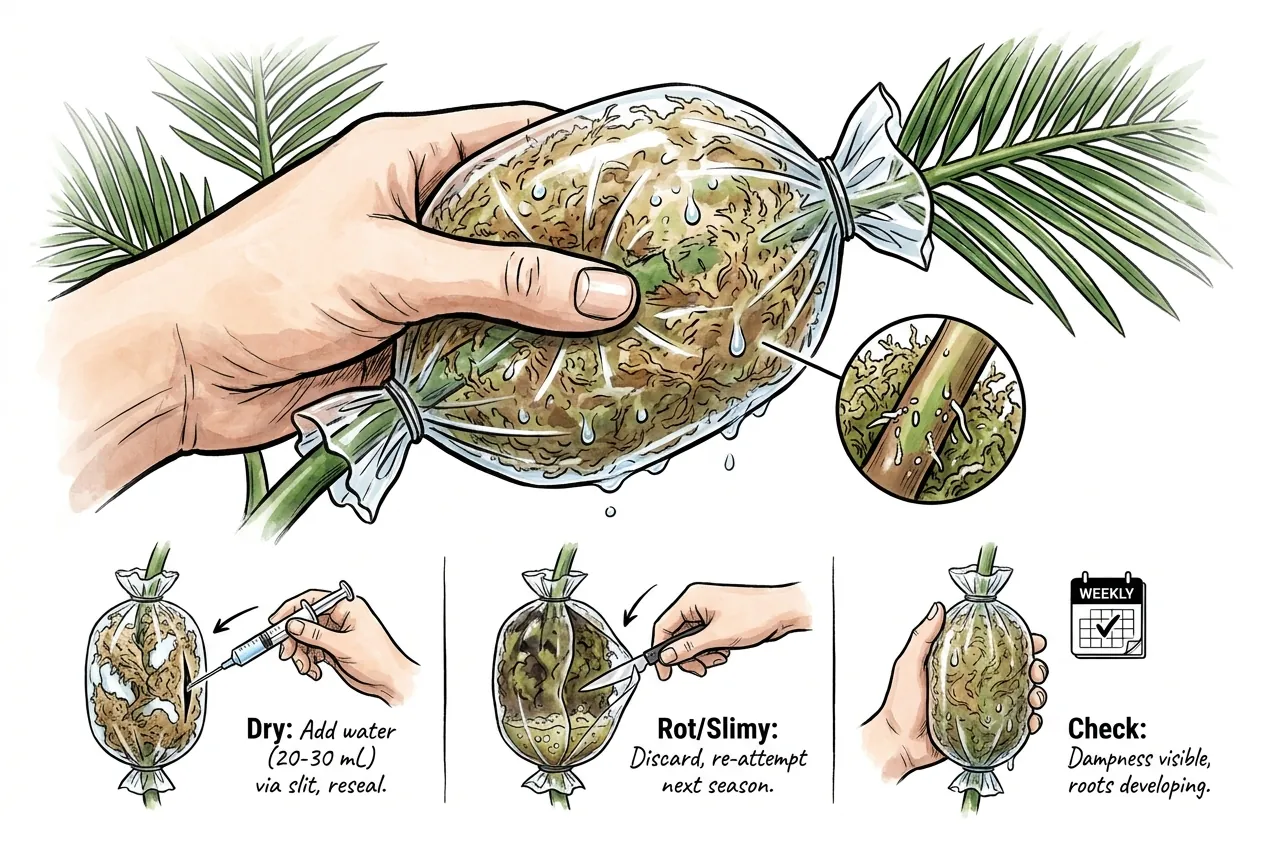
Inspect at a repeatable interval that fits the plant and climate.
The medium should remain evenly damp, not saturated. Correct moisture in small increments using clean water and reseal carefully.
A sour smell, slime, dark liquefaction, or rapid tissue change raises concern for rot.
Stop and reassess rather than assuming the layer can be saved.
What does the timeline look like, and how do you know it is harvest-ready?
The study observed roots during its monitoring period, with larger and more numerous roots in some wider-exposure treatments.
A layer is better considered ready when it has a well-developed cluster of geotropic roots rather than when it reaches an exact count or length.
Timing shifts with temperature, plant reserves, and species. The researchers used destructive inspections, so a fine week-by-week schedule would be illustrative rather than directly observed.
Week-by-week what to expect
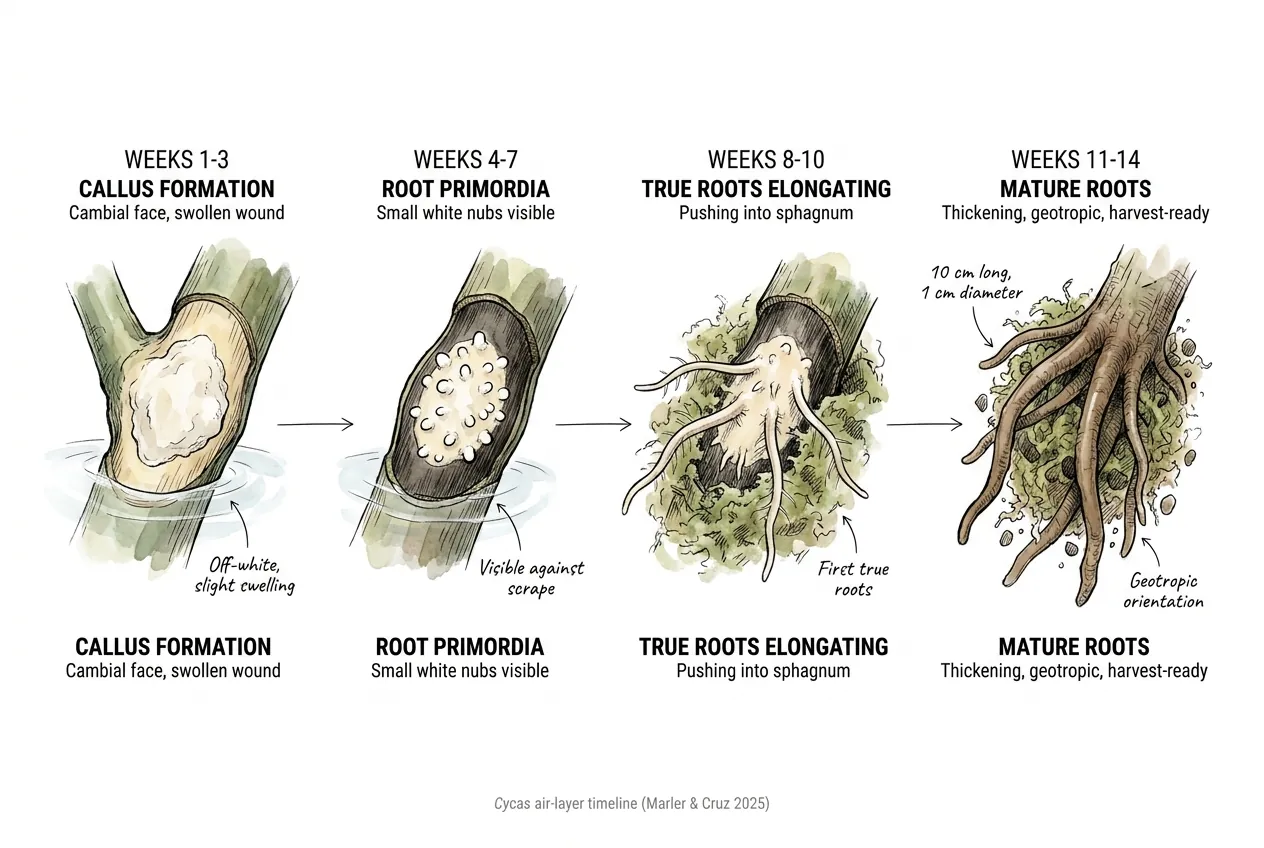
Early observations may include callus at the cambial face, followed by root primordia and elongating roots.
The order is more reliable than a calendar, and the wrap should remain stable while the tissue develops.
Separate only when roots are numerous, firm, and positioned to support the new plant. Defer if tissue is soft, sparse, or declining.
Cycas air-layer timeline
| Stage | What to look for | Status check |
|---|---|---|
| Early | Callus at cambial face, slight wound swelling | Possible early progress |
| Developing | White root primordia visible against scrape | Possible progression |
| Elongating | True roots elongating into sphagnum | Rooting observed |
| Established | Firm roots occupying the medium and supporting separation | Consider harvest when roots support it |
How do you harvest the rooted layer?
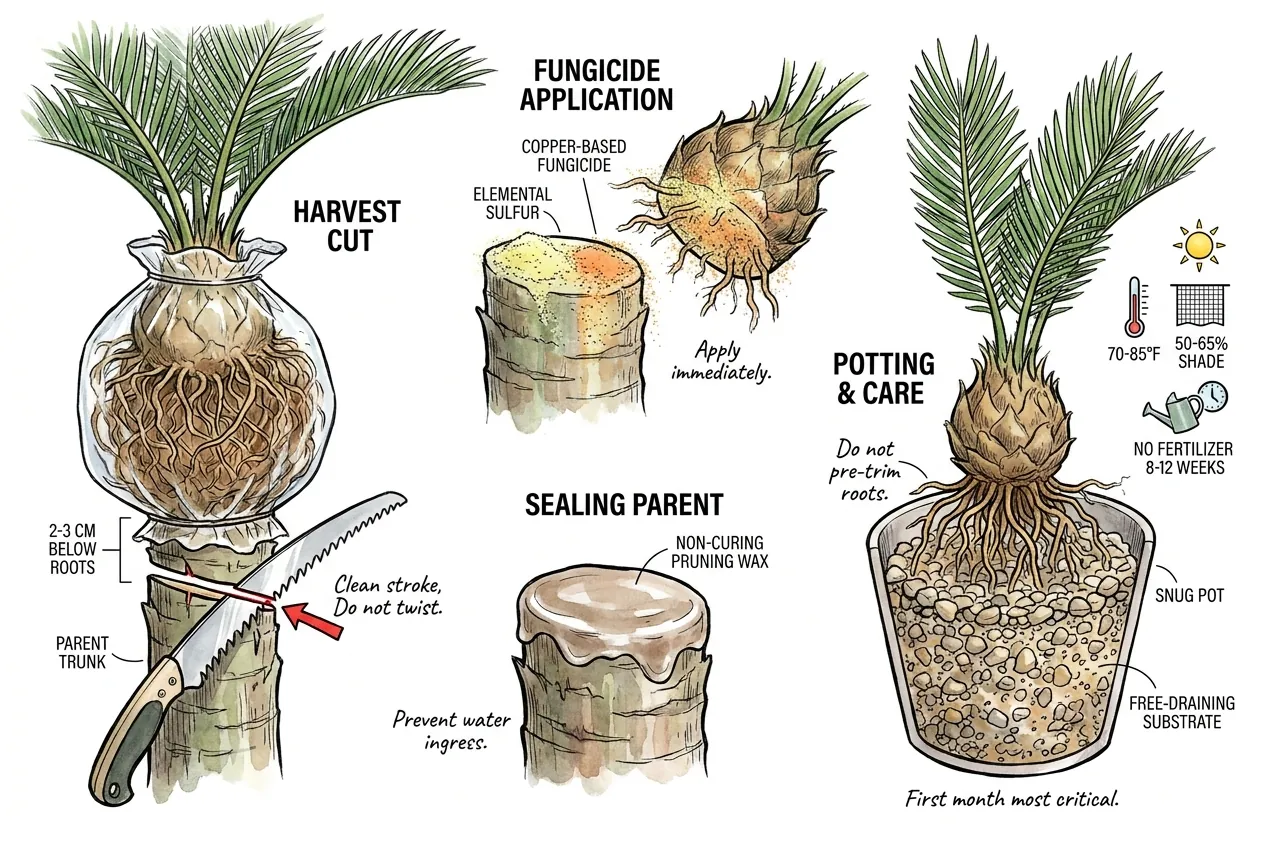
Separate the layer with a clean, controlled cut below the rooted zone, leaving enough tissue to avoid tearing new roots.
The exact distance and tool depend on trunk size and the original protocol.
Seal fresh cut faces with a product intended for that use.
A later Marler follow-up reported that new basal wound tissue contributed substantially to post-separation rooting under its study conditions.
Use the published aftercare as the reference, and expect the plant to need time and stable conditions after transplant.
Pot the harvested layer into a snug pot of free-draining, mostly-mineral substrate, provide stable warmth and filtered shade appropriate to the species, and go easy on watering and fertilizer while it establishes.
The first weeks after harvest can be vulnerable, so monitor moisture, roots, and tissue rather than following a fixed recovery schedule.
What potting mix should the rooted layer go into?
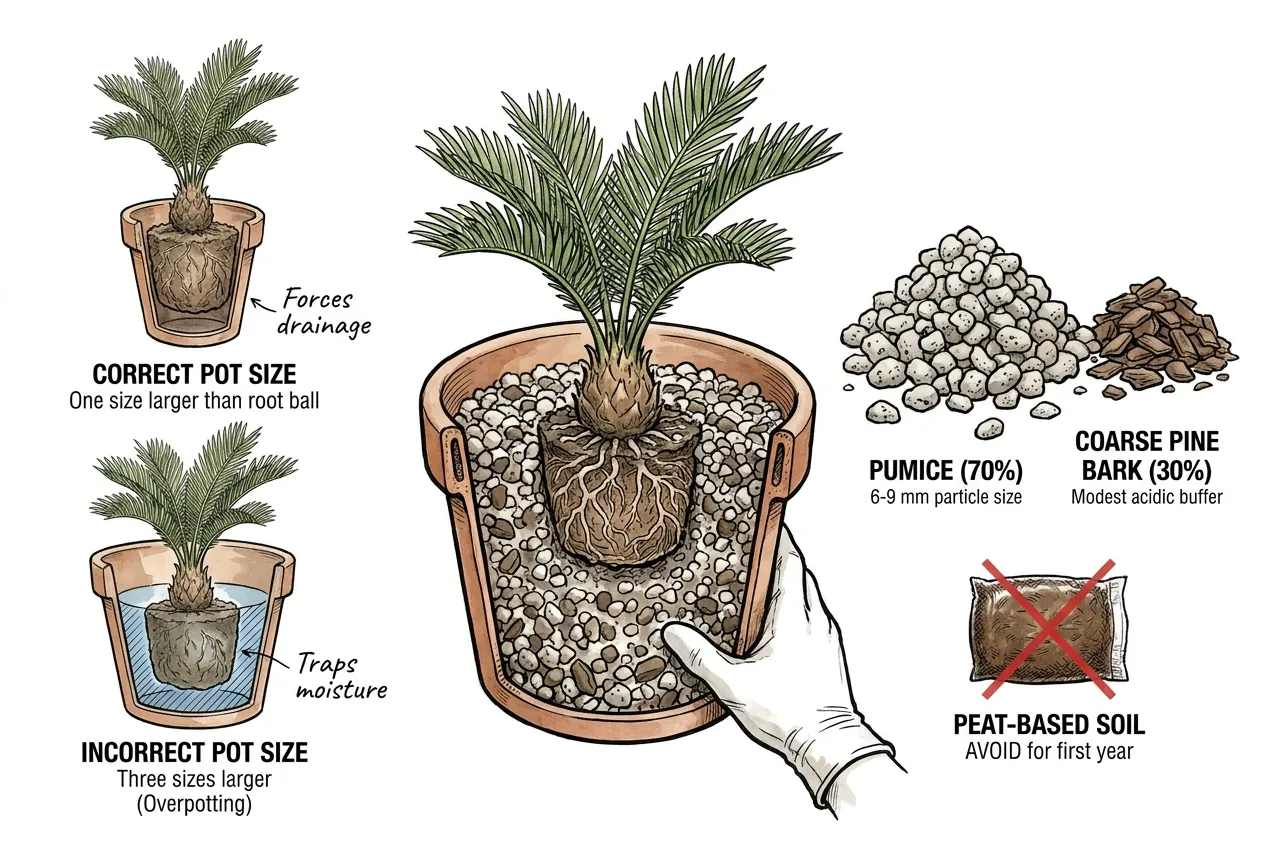
Use a stable, open mix whose particle size and organic fraction suit the new root mass, container, and climate.
A mineral-majority blend may improve drainage, but there is no universal ratio or porosity target for every cycad.
A small bark or other organic fraction can add moisture buffering. Assess any peat-heavy mix by how quickly it dries in the actual pot.
Choose a pot that supports the root ball without leaving a large reservoir of wet media. Adjust watering as new roots establish.
Air layer vs. pup removal vs. full-stem cutting: which method should you choose?
Match the method to the plant, legal context, and tolerance for cutting.
Basal pups avoid a trunk wound but depend on offsets. Full-stem cuttings change the parent plant. Air layering remains an experimental option for a healthy trunk and should be planned from the original study.
What is the basal pup method, and what is its downside?
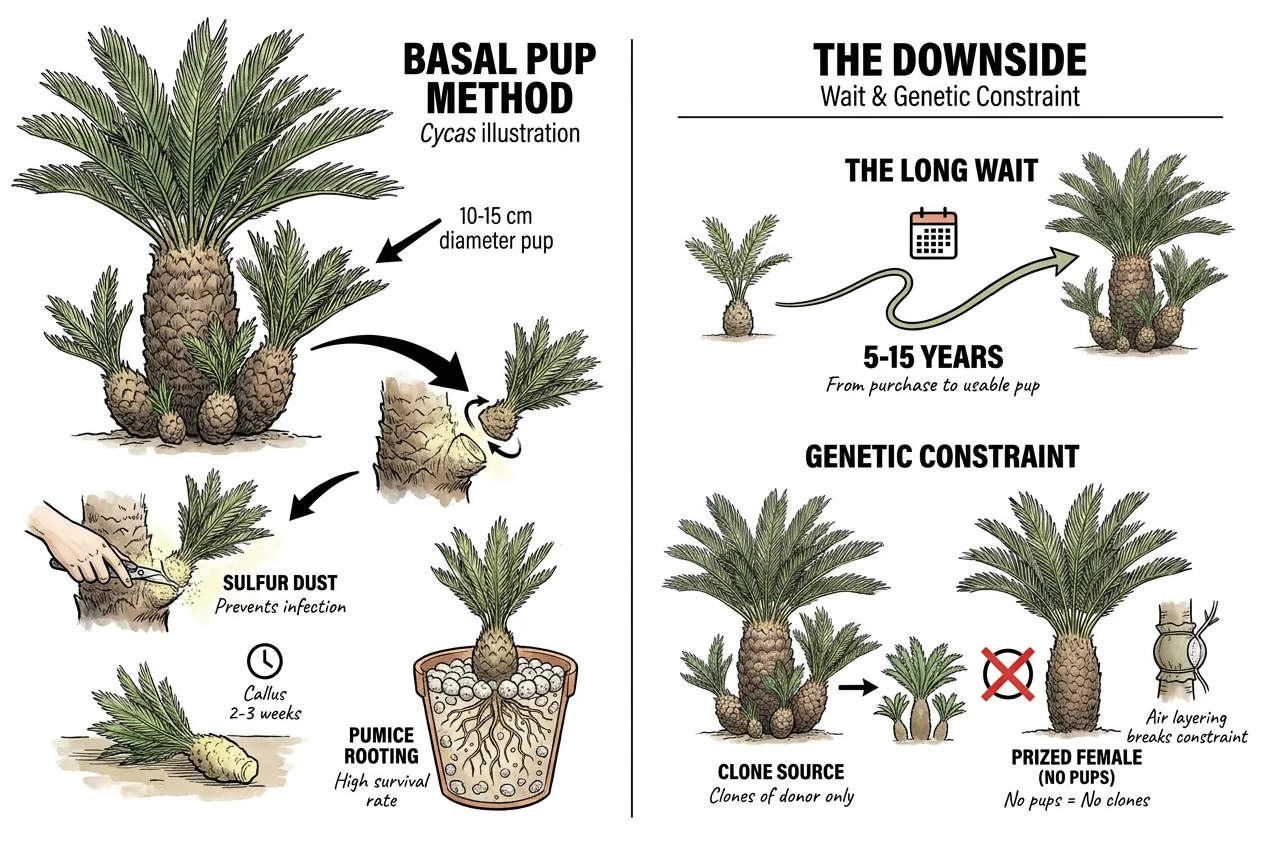
Basal pup removal is the traditional path when a vigorous offset is already present.
Separate and callus it only with clean tools, suitable sanitation, and a medium that matches the species. Timing, rooting duration, and survival vary widely.
The downside is that offsets may take years to appear or reach a useful size.
The deeper downside is genetic because pups are clones of the donor, so this route only reproduces a plant that produces a suitable offset.
If a prized Cycas edentata female never pups, that route cannot clone her.
Air layering may access a trunk section, but the 2025 evidence covers one species and a limited set of conditions. It is not validated for every healthy specimen.
When does full-stem cutting actually make sense?
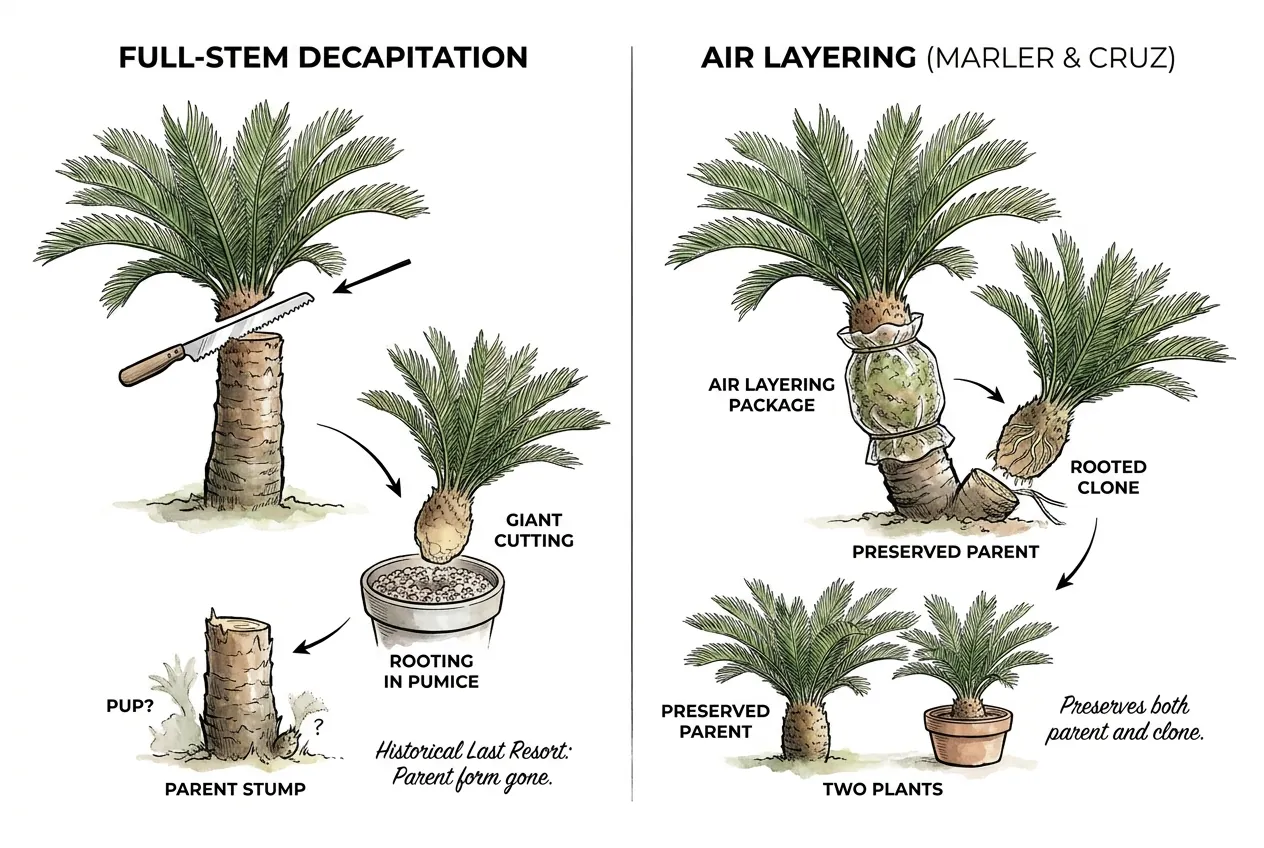
Full-stem cutting removes the crown, so it is a high-consequence choice.
Callusing, rooting, and resprouting vary by species and condition, and the parent stump may not recover.
This method may be considered when the plant is already leggy and shortening is part of the goal, but the parent-stump risk remains.
The advantage is that you get one large clone immediately. The disadvantage is that the parent is gone in its current form.
Air layering is often described as preserving both parent and clone, but harvesting a main-trunk layer still cuts the stem. The section above the wound is removed, leaving the parent as a stump that may or may not resprout.
The method is less destructive when done on a spare offset or where the parent can regrow, but it does not leave the parent untouched.
Weigh that consequence before cutting an irreplaceable plant.
Method comparison: clone a trunked Cycas
| Method | Parent survives | Time to harvestable plant | Clone-from-anywhere | Difficulty |
|---|---|---|---|---|
| Wait for basal pup | Yes | Often multi-year | No (basal only) | Easy |
| Full-stem decapitation cut | Trunk only, no crown | Variable | Yes | Hard |
| Marler & Cruz air layer | Not guaranteed | Study-dependent | Yes | Moderate |
Why does this protocol matter beyond hobbyists?
Cycads are a highly threatened seed-plant group, and conservation assessments document serious losses in several species, including Cycas micronesica on Guam after the introduction of Aulacaspis yasumatsui.
Cloning a specific known-sex founder tree from its trunk, repeatedly, without felling it has historically been difficult (pups only form at the base, and stem cuttings decapitate the plant).
The 2025 air-layering work adds a promising trunk-based option to that toolbox.
What did the Aulacaspis scale do to Cycas micronesica on Guam?
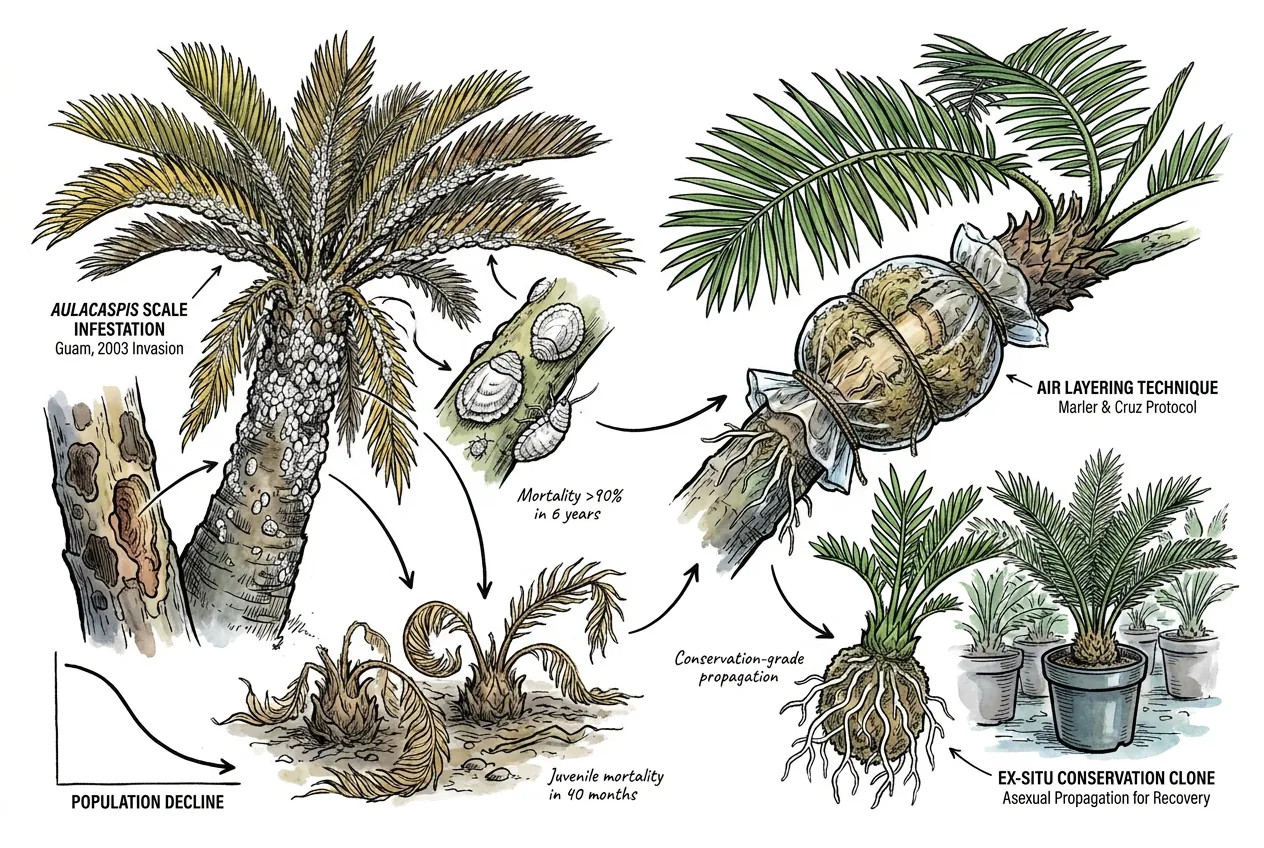
The scale invasion caused severe mortality and reduced recruitment in the documented population.
The extent and timing are specific to that island and species, so they should not be generalized to all cycads.
The Marler & Cruz protocol adds a possible trunk-based option for conservation nurseries, but its value outside the study remains to be tested.
How does the air-layer protocol fit into the conservation toolbox?
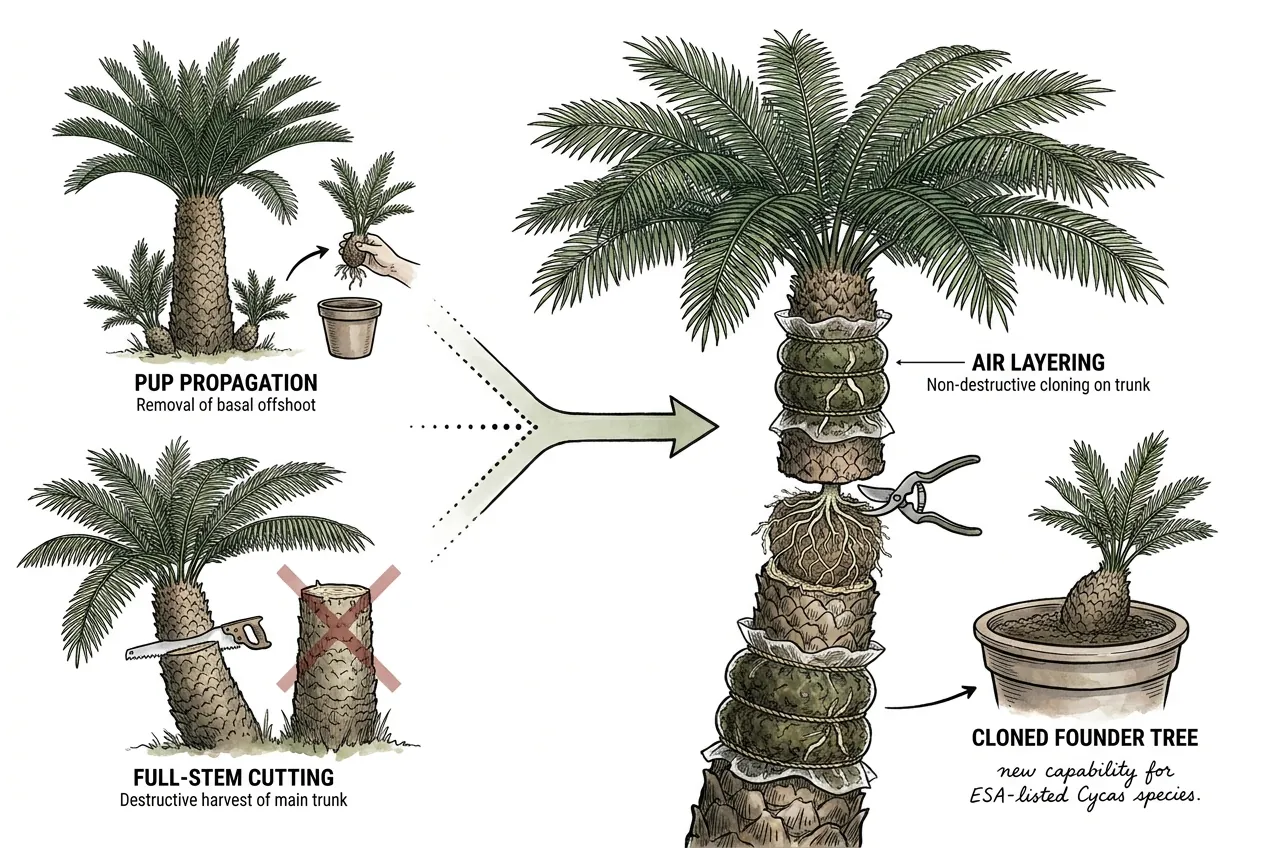
Conservation programs use several propagation methods, including pups and stem cuttings.
Air layering adds a possible third option for cloning known-sex founders from a trunk, but it remains an emerging technique with limited published testing.
For listed or rare species, obtain institutional and legal guidance before any trial.
Why do air layers fail, and how do you diagnose by symptom?
Air-layer failure may involve soft rot, desiccation, stalled callus, or dieback above the wound. Symptoms overlap, and a small controlled study cannot supply a universal intervene-or-abort threshold. Use failure-mode awareness to decide when to stop, seek expert help, or protect the parent plant.
Failure mode 1: bacterial soft rot
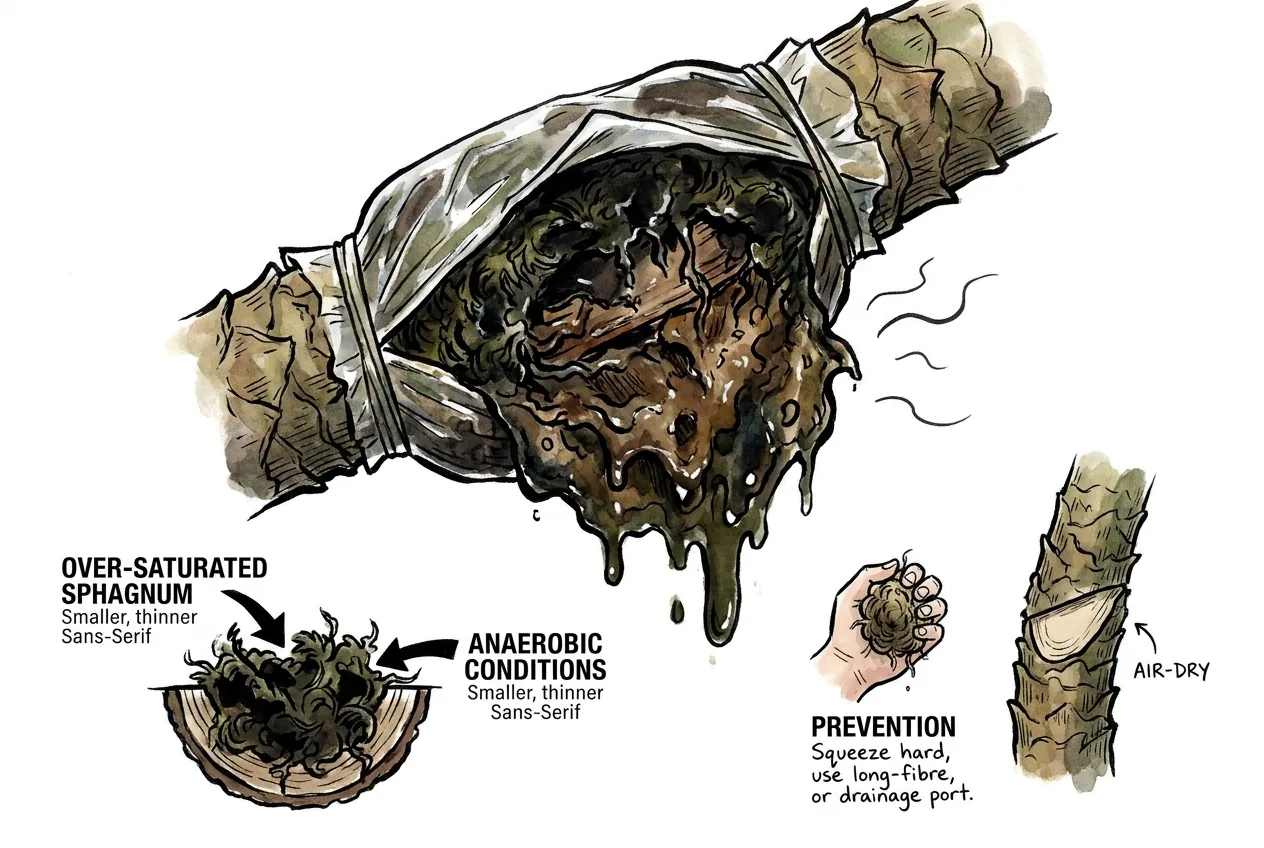
A sour smell, dark liquefaction, or slimy medium raises concern for soft rot, especially when the medium is saturated or compacted.
Open the wrap with protective hygiene, isolate the plant, and consult the original protocol or a plant-health professional before attempting salvage.
Failure mode 2: sphagnum desiccation
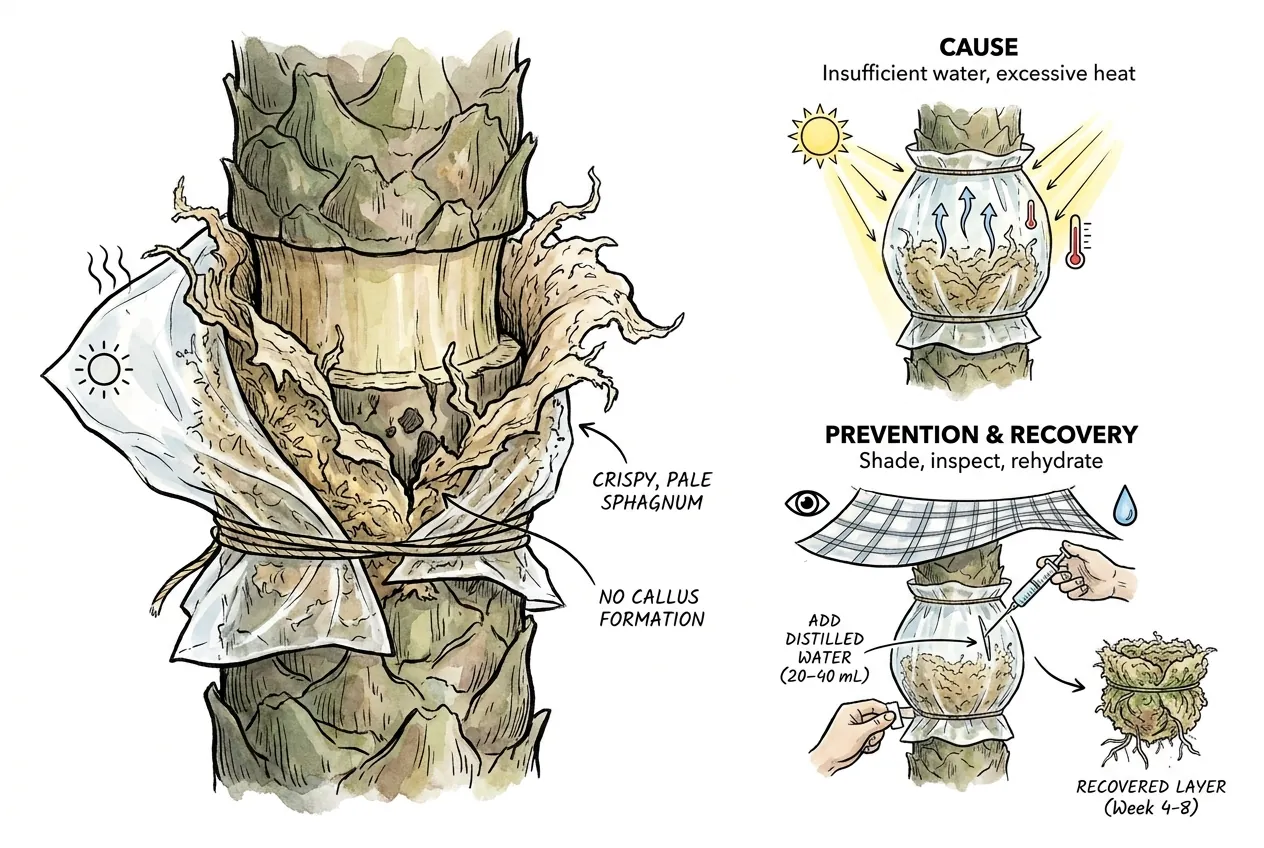
Pale, brittle sphagnum and no visible callus suggest the wrap has dried or overheated.
Reduce direct heat, inspect without tearing new tissue, and restore moisture in small increments only if the wound is otherwise sound.
If the layer remains stalled, protect the parent and reassess the season, species, and wound rather than relying on a fixed week or shade percentage.
Failure mode 3: stalled callus without new root primordia
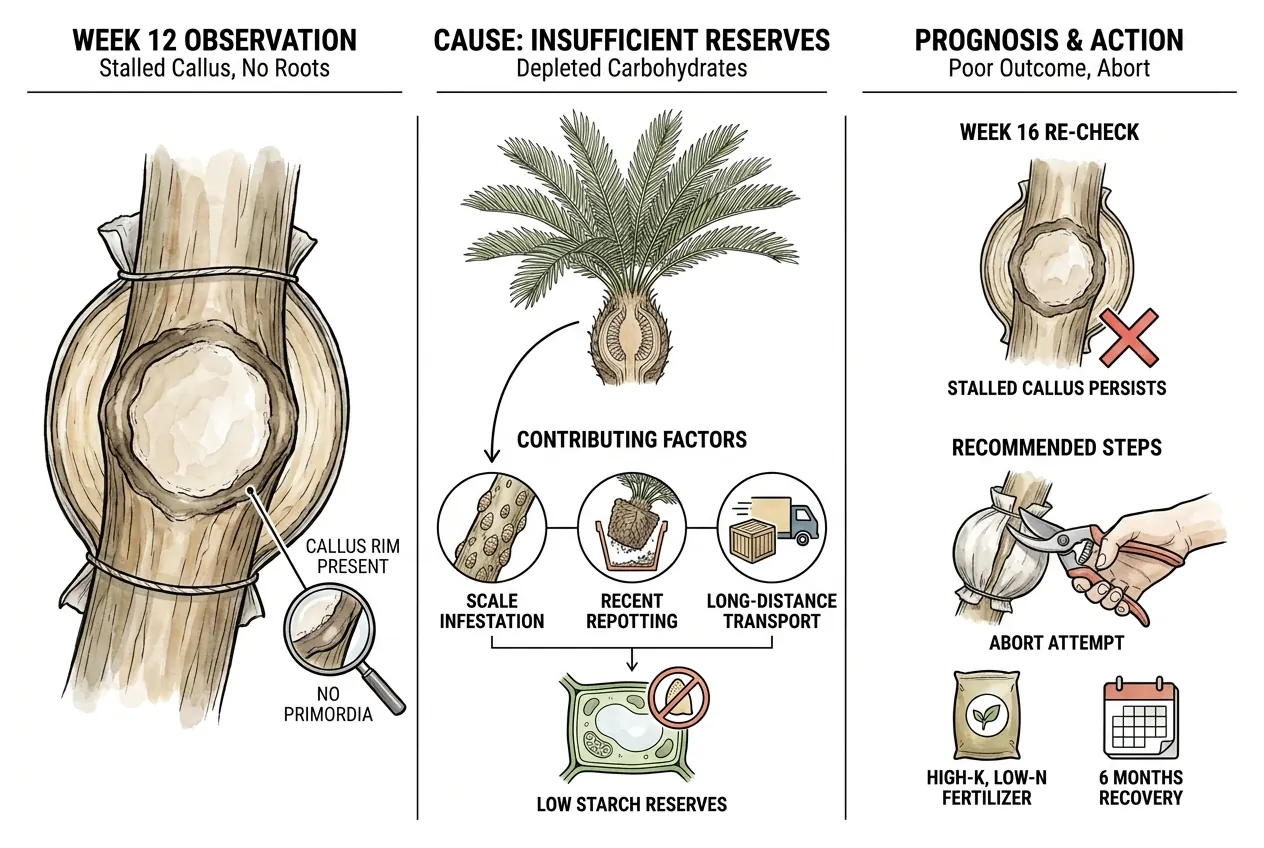
A callus without new roots may reflect plant reserves, wound condition, season, temperature, or species response. It is not diagnostic of one cause.
Continue only while the tissue and parent remain healthy, and if the layer stays stalled, stop rather than forcing a fertilizer schedule or calendar deadline.
Failure mode 4: parent stem dieback above the wound
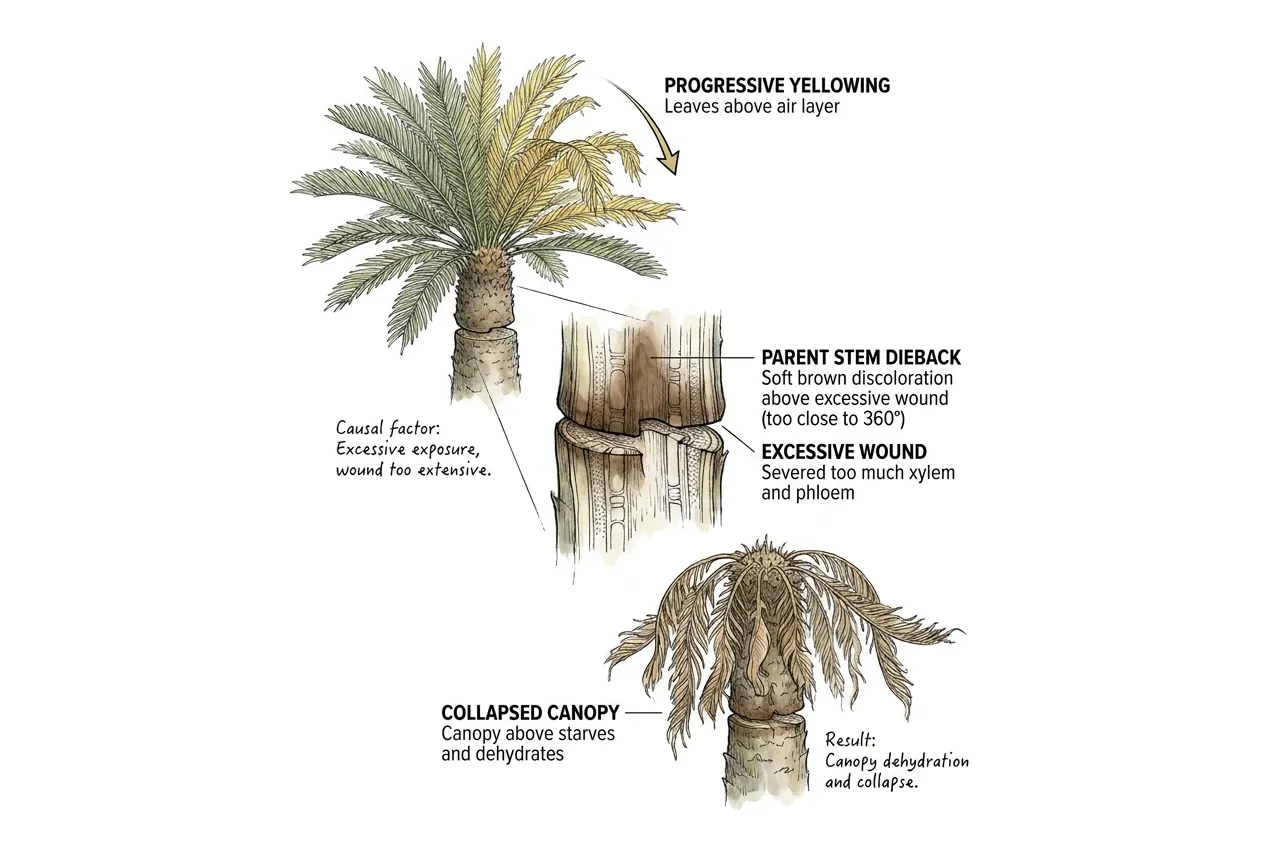
Progressive yellowing, soft tissue, or canopy collapse above the wound may indicate transport disruption, but heat, roots, pests, and water can produce similar symptoms.
If the parent declines, stop the experiment, remove the wrap carefully, and seek species-specific advice.
Do not use a percentage or week threshold as a substitute for inspecting the whole plant.
Cycas air-layer failure-mode reference table
| Symptom | Possible interpretation | Intervention | Abort or continue |
|---|---|---|---|
| Fermented smell, slimy sphagnum | Over-wet, anaerobic, soft rot | Stop, isolate, and reassess with clean handling | Often stop. Do not assume salvage |
| Crispy pale sphagnum, no callus | Desiccation, too much sun | Reduce heat and restore moisture cautiously if tissue is sound | Continue only after inspection |
| Callus rim but no roots after the expected study window | Low reserves, delayed response, or another constraint | Reassess season, reserves, and wound condition | Stop if the parent or tissue declines |
| Yellow leaves above wound | Transport disruption or another stress | Inspect the wound and protect the canopy | Consider stopping if decline continues |