
Pachypodium gracilius Rooting: Evidence Checklist
Assess a bare-root Pachypodium gracilius, separate evidence from ritual, and decide whether akadama, rooting hormone, or bottom heat is justified.
Rachel Torres · 2026-01-01 · Updated 2026-02-25 · 13 min read
Key Takeaways
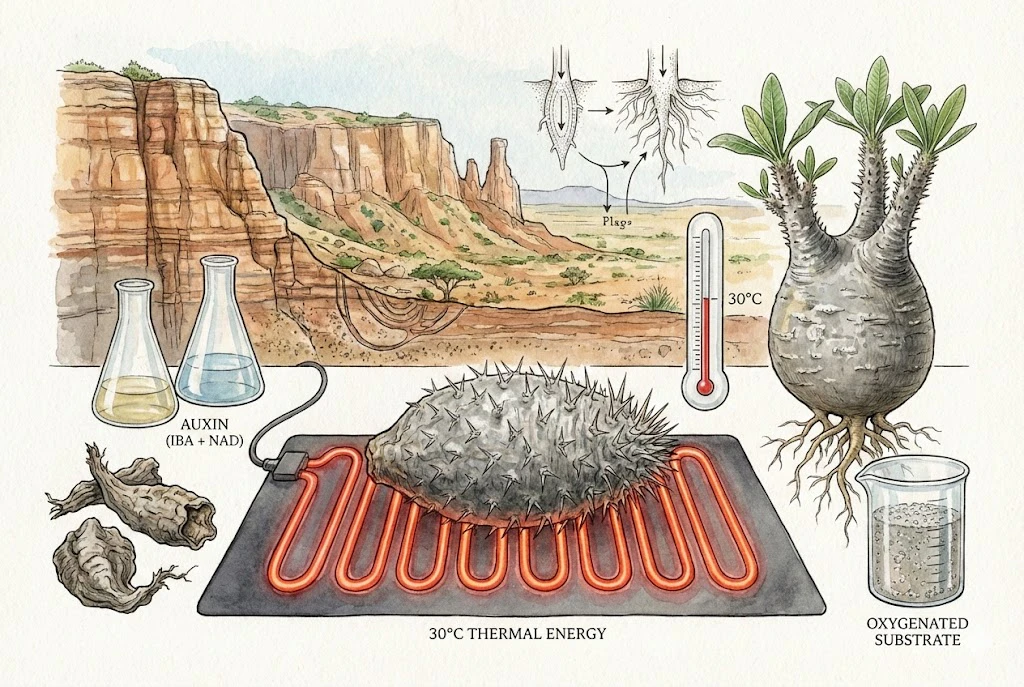
- No controlled, species-specific recipe shows that a bare-root Pachypodium rosulatum subsp. gracilius needs a fixed root-zone temperature, hormone soak, chemical stack, or substrate ratio. Treat any setup as a monitored trial, not an optimized protocol.
- Confirm legal, preferably nursery-propagated provenance first, then classify whether the plant retains roots, has a healed base, or is a true cutting. A stable dry base should not be reopened just because no roots are visible.
- Keep a sound base stable in a clean, airy mix, and do not pull the plant up to check it. A lack of visible roots is not evidence that nothing is happening.
- Add thermostatic bottom heat only when the measured root zone is genuinely cool, and recut only clearly dead or decaying tissue. Heating an already warm room adds drying, electrical, and pathogen risk without proven benefit.
- Use one locally permitted rooting product only when its current label covers the plant and method, and do not stack treatments. Auxin, sulfur, bleach, peroxide, and fungicide are not a validated rescue package.
The practical imported gracilius rooting guide covers the arrival sequence. This evidence review separates claims that come from this taxon, claims from other plants, and grower practices that still need testing.
The accepted name is Pachypodium rosulatum subsp. gracilius. Pachypodium gracilius remains a familiar horticultural synonym, and Kew places the taxon in south-central Madagascar’s seasonally dry tropical biome. That tells us where the plant comes from, but it does not turn a propagation anecdote into a validated treatment.
Is this plant actually a rootless cutting?
What can a bare-root import mean?
A bare-root import can describe several different starting conditions.
- Roots retained means fine roots may be lost, but a functional root crown or thicker roots remain.
- A healed base means roots were removed or died, and the base is dry and stable.
- A freshly cut base means damaged or decayed tissue was recently removed and the wound still needs protection.
- A true stem cutting must form adventitious roots from non-root tissue.
Classify the starting condition before touching it
Do not treat all four as the same dormant potato. Photograph the base and roots on arrival, note firmness without aggressive squeezing, record package time and temperature exposure, and ask the seller what was removed before shipment. A stable dry base should not be reopened simply because no roots are visible.
Before cleaning, trimming, or potting an import, I photograph the shipping label, packaging state, whole plant, base, and every visible root remnant. The same entry records unboxing time, obvious temperature exposure, and the seller’s description. A pot-rim mark then keeps the same base face available for later checks without lifting the plant.
The arrival image stays separate from my later rescue notes. A dry scar that remains the same size in the fixed pot-rim view differs from a soft area expanding past its original boundary. This gives me evidence for a seller or plant-health adviser and separates pre-existing shipping injury from change under the new setup.
Protect yourself before inspection
Wear puncture-resistant handling gloves and eye protection appropriate to the task. Keep sap away from eyes and mouth, and keep children and pets out of the work area. The caudex protective-gear guide explains fit and skip criteria without implying that PPE makes an unnecessary cut safe.
What evidence applies directly to Pachypodium gracilius?
| Source | What it directly supports | What it does not support |
|---|---|---|
| Kew taxonomic record | Accepted name, synonym, range, and growth form | Rooting hormone, substrate ratio, temperature, or success rate |
| CITES Pachypodium listing framework | International trade controls and the need to verify source and documents | That every imported plant is wild-collected or that paperwork alone proves good provenance |
| SANBI Pachypodium propagation profile | Genus-level seed guidance and easy cutting propagation for two named South African species | A direct rooting trial for P. rosulatum subsp. gracilius. Its 27–35°C value is for seed germination |
| Adventitious-root reviews | General roles for wounding, auxin, tissue state, carbohydrates, and environment | A Pachypodium dose, soak time, medium, or root-zone optimum |
| Grower methods | Ideas worth comparing cautiously | Controlled efficacy, failure rate, safety, or a universal protocol |
What is the evidence limit?
Direct evidence is thin, so treat a conservative setup as a monitored trial rather than a scientifically optimized protocol.
Verify provenance before buying
Before buying an import, ask for the botanical name, nursery or propagation source, country of origin, source code where applicable, export and import documents, and phytosanitary records required for the route, then favor seed-grown or otherwise documented artificially propagated stock. If the seller cannot explain how a mature rootless plant entered trade, skip it.
What does adventitious-root science actually tell us?
Understand Adventitious Rooting as a Sequence
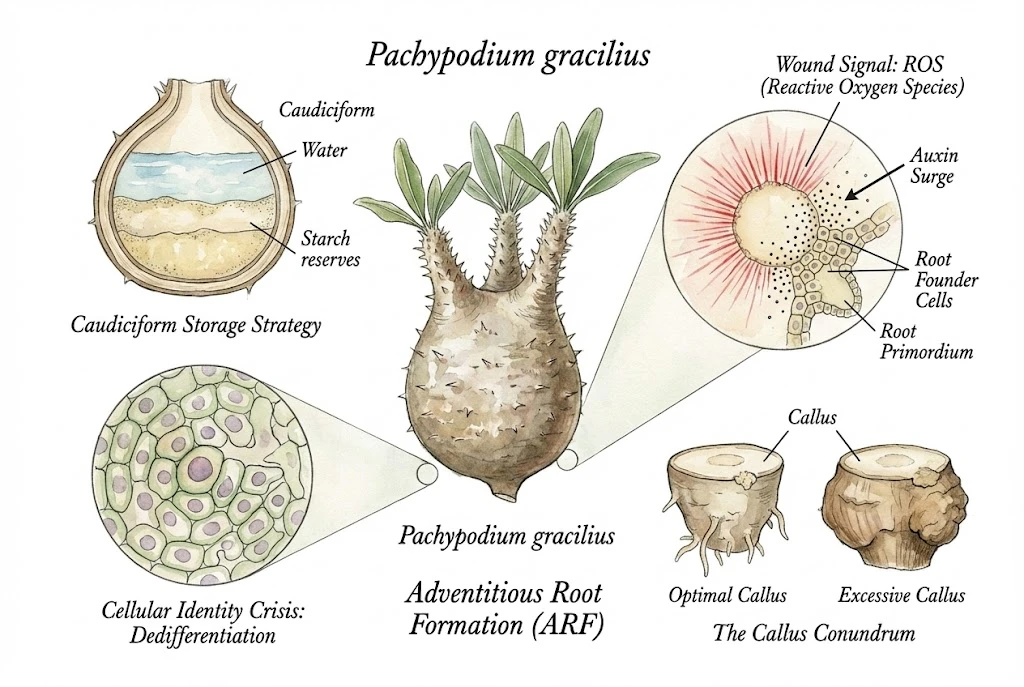
Adventitious roots form from tissue that was not already a root. Research across many species shows a sequence involving wound and stress signals, changes in auxin and other hormones, cellular reprogramming, initiation of root primordia, emergence, and subsequent root growth. The cutting’s carbohydrate, mineral, water, and oxygen status interact with that sequence.
Do not treat callus or hormone as proof
That is enough to reject two simple stories. Callus is not an animal-like tumor that must be minimized. It can be associated with regeneration, although a large dry mass is not proof that roots will form. One hormone does not command passive cells to become roots regardless of genotype, season, wound status, or reserves.
Use noninvasive evidence while the plant stabilizes
A stable plant needs time more than repeated disturbance. Photograph the pot position, mark its orientation, and look for noninvasive evidence such as stable firmness, new leaves, or increasing resistance over time. Do not lift the plant weekly. A lack of visible roots above the substrate is not evidence that nothing is happening.
Should you use rooting hormone?
Use Hormone Only for a True Cutting with Label Coverage
A single locally permitted auxin product may be reasonable for a true cutting when its current label covers the plant category and method. It is less compelling for a plant that retains functioning roots, and reopening a healthy healed base merely to add hormone creates a new wound.
Keep different formulations separate
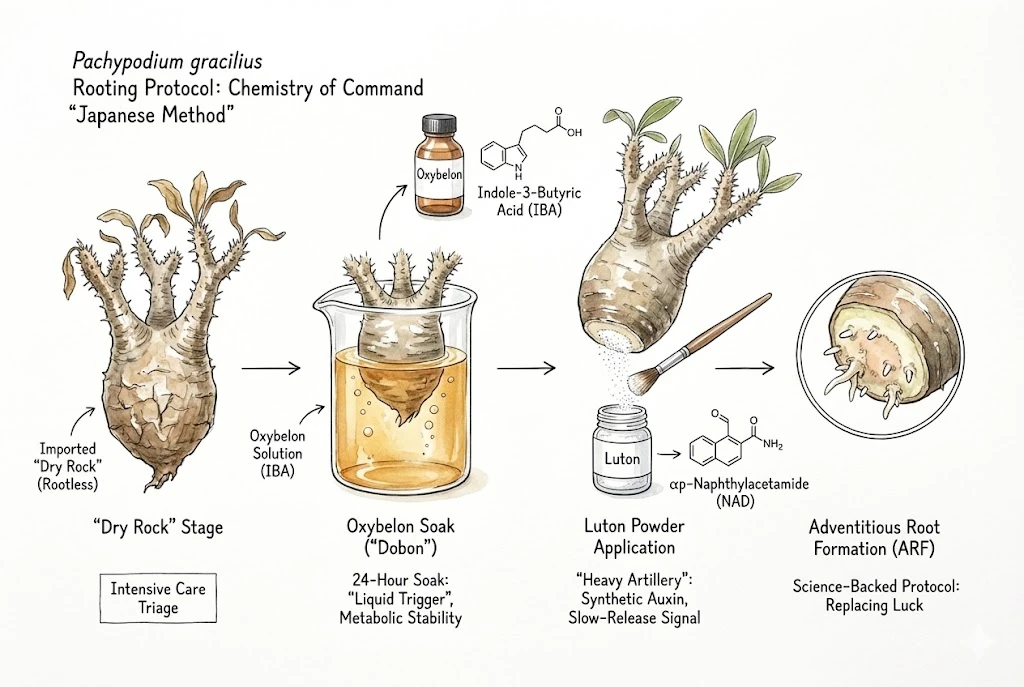
OXYBERON is a Japanese 0.40% IBA liquid. Its current MAFF record shows crop-specific methods ranging from seconds to hours, different dilutions, and different treated portions. The manufacturer warns against mixing it with other pesticides, requires a first-use injury check, and specifies gloves and eye precautions. ROOTONE is a separate Japanese 0.40% 1-naphthaleneacetamide powder with a thin dust or paste method for listed forestry cuttings.
Why do product labels not transfer?
Do not transfer a label or stack
Those labels demonstrate why a 24-hour soak followed by a second powder and sulfur dust is not a transferable protocol. They are not authorization for use in another country, and neither establishes efficacy or safety on P. rosulatum subsp. gracilius. If no current local label clearly covers your plant and method, skip the hormone rather than inventing a dilution.
Does a 50:50 akadama-pumice mix matter?
Judge the Finished Root Zone
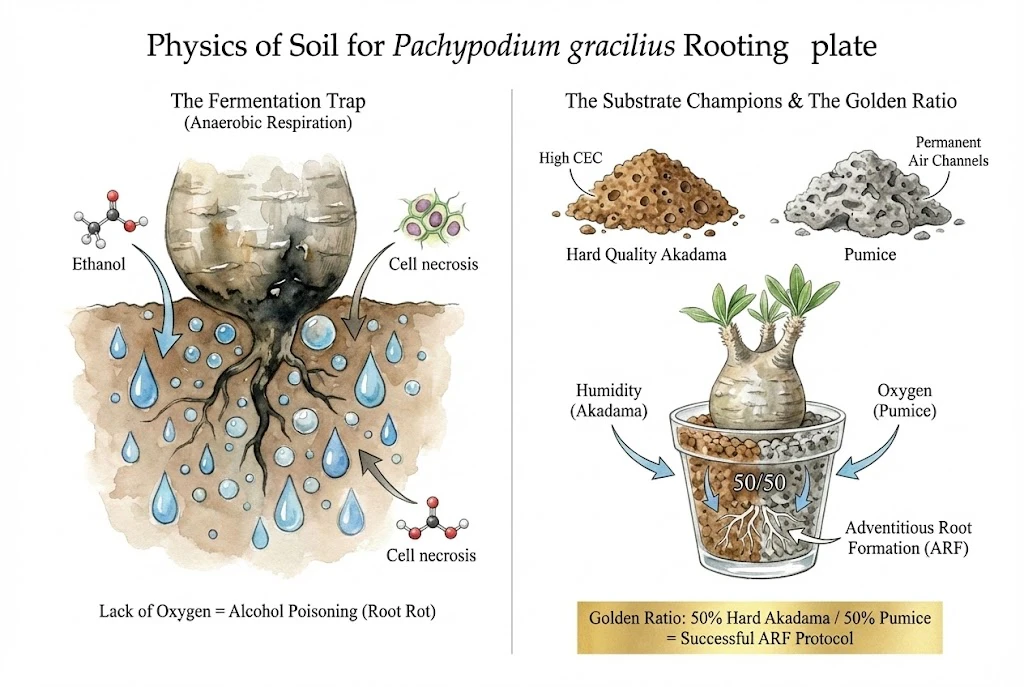
The goal is a finished root zone that stays structurally open, wets evenly, drains, and does not hold the base against prolonged saturation. Pumice, akadama, calcined clay, lava, and other screened components can all contribute. The material name alone does not establish air-filled porosity or a safe watering interval.
What does a 50:50 blend actually mean?
A half-and-half blend is a grower convention, not a golden ratio. Akadama grade, particle size, fines, pot depth, compaction, root volume, and watering change how it behaves. Pumice can also create fines. Screen dusty material, test a small batch, and compare wet and dry pot mass before placing an expensive plant.
Buy akadama only for a defined particle need
A hard akadama in a defined particle range, such as 3–6 mm, can fill a moisture-buffering need, but a bag alone does not independently verify firing temperature, particle-strength distribution, CEC, or long-term breakdown. Buy it only if that particle range fills a real mix need and the current offer, seller, bag condition, and fines are acceptable. Skip it if a local screened aggregate or your current clean mix already produces the dry-down you need.
For a broader material comparison, use the pumice, akadama, and gritty-mix guide. Do not bury an open wound or use dry mineral media as a synonym for sterile media.
What root-zone temperature should you target?
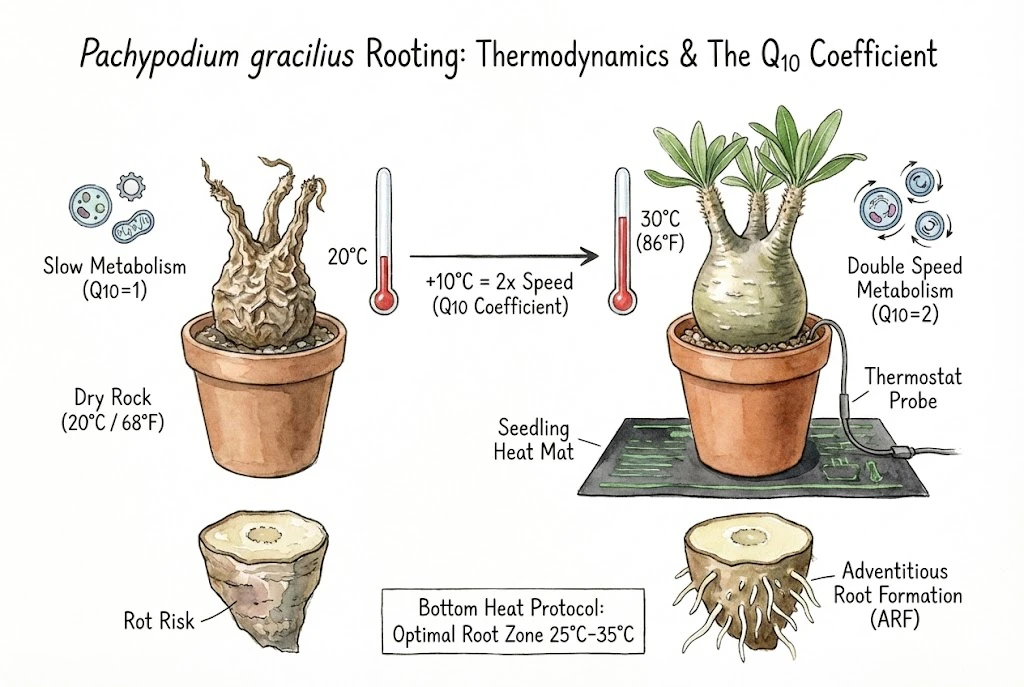
Do Not Turn Seed Guidance into a Rooting Target
No direct study establishes 30°C as the rooting optimum for a bare-root gracilius. SANBI’s often-repeated 27–35°C range is seed-germination guidance for the genus. Root initiation, root elongation, wound repair, respiration, water loss, and pathogen growth do not share one temperature response.
Heat only a measured cold root zone
Use heat only to correct a measured cold root zone. Start with the unheated room as the baseline, place a probe where it represents the base rather than the mat surface, and cross-check with an independent thermometer. If the plant is already in a stable warm environment, more heat can add drying, electrical, and pathogen risk without a proven benefit.
Buy hardware only when the setup can stay dry
A heat mat paired with a thermostatic controller is useful hardware when a real temperature deficit exists, and it helps to choose a heat mat by measured soil temperature. A controller’s broad operating range does not define a biological setpoint. Buy such a set only if it includes both the mat and the controller, you can keep connections dry, and you will verify the actual substrate temperature. Skip it for a warm room or any setup where the controller, probe, or outlet may be exposed to water.
Does CAM change the humidity or watering plan?
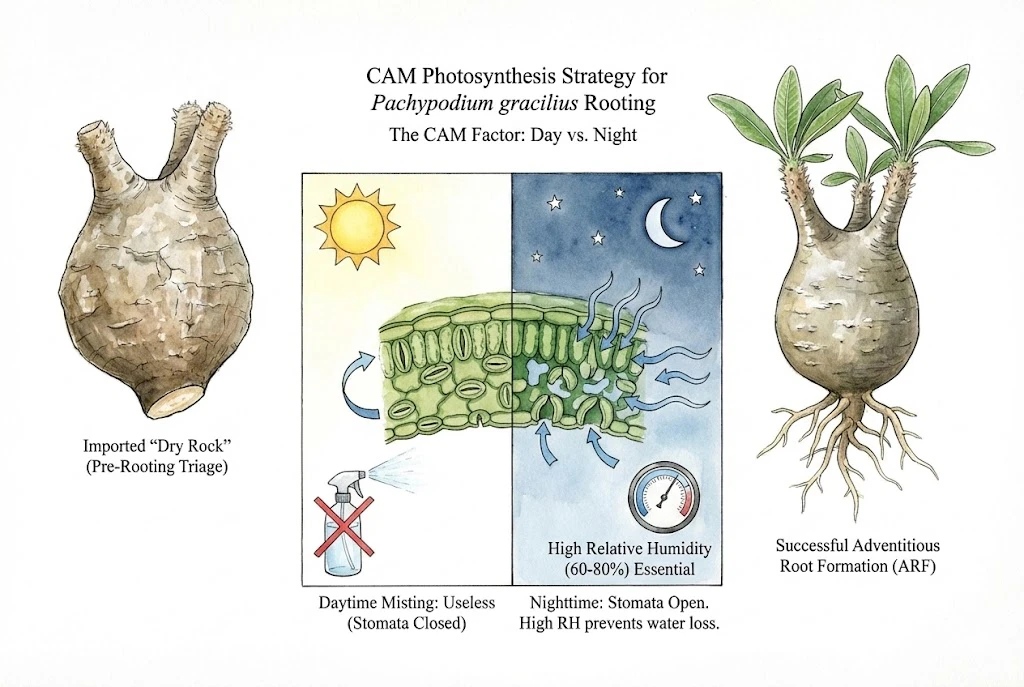
Do Not Assume a CAM Humidity Schedule
No direct evidence for this taxon supports the claim that it opens stomata only at night or needs 60–80% nighttime humidity while rooting. A classic study found C3 carbon fixation in the leaves and stems of three other Pachypodium species. That does not directly measure gracilius, but it is enough to reject the assumption that all Pachypodium are CAM.
Keep air moving around a bare base
Use moderate air movement and avoid keeping the base visibly wet. Humidity that limits extreme dehydration can be useful for leafy cuttings, while stagnant high humidity around a large fresh wound can increase disease pressure. Because a bare caudex may have little or no leaf area, copying a mist-propagation regime from soft leafy cuttings makes little sense.
Should sulfur, bleach, or fungicide touch the base?
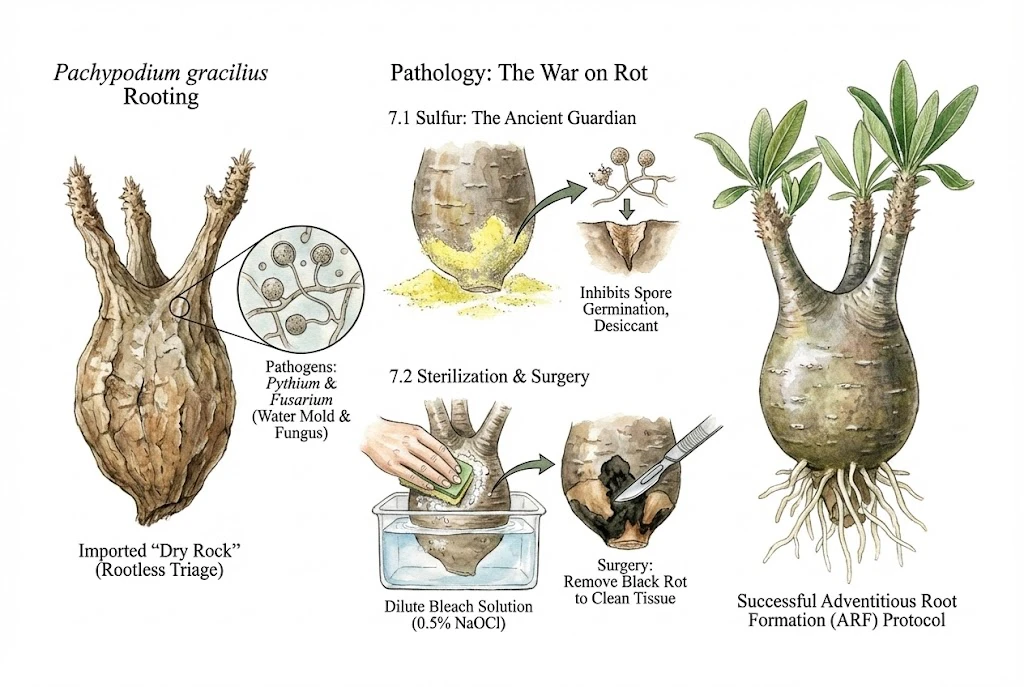
Do Not Medicate an Undiagnosed Base
Not by default. Elemental sulfur is a labeled contact fungicide for particular sites and diseases, not a universal desiccant or broad root-rot shield. Sodium hypochlorite can injure living tissue, and a surface-sterilization concentration from one laboratory protocol is not a home caudex dip. Fungicide is a product category, not a diagnosis.
Preserve a stable base and document change
If the base is dry, intact, and stable, keep it clean and do not reopen it. If tissue is wet, sloughing, foul-smelling, or expanding, isolate the plant and document the boundary. For a valuable specimen, ask a plant clinic or experienced professional how to preserve a diagnostic sample before cutting or applying a chemical.
Cut only clearly dead localized tissue
If removal of localized dead tissue is genuinely necessary, use a sharp tool appropriate to the diameter, clean debris, disinfect between affected areas, protect yourself from spines and sap, and stop if no stable structure remains. Do not assume a pale cut face proves the pathogen is gone. The bare-root Pachypodium decision guide covers cut-versus-wait triage in more detail.
What is a conservative rooting sequence?
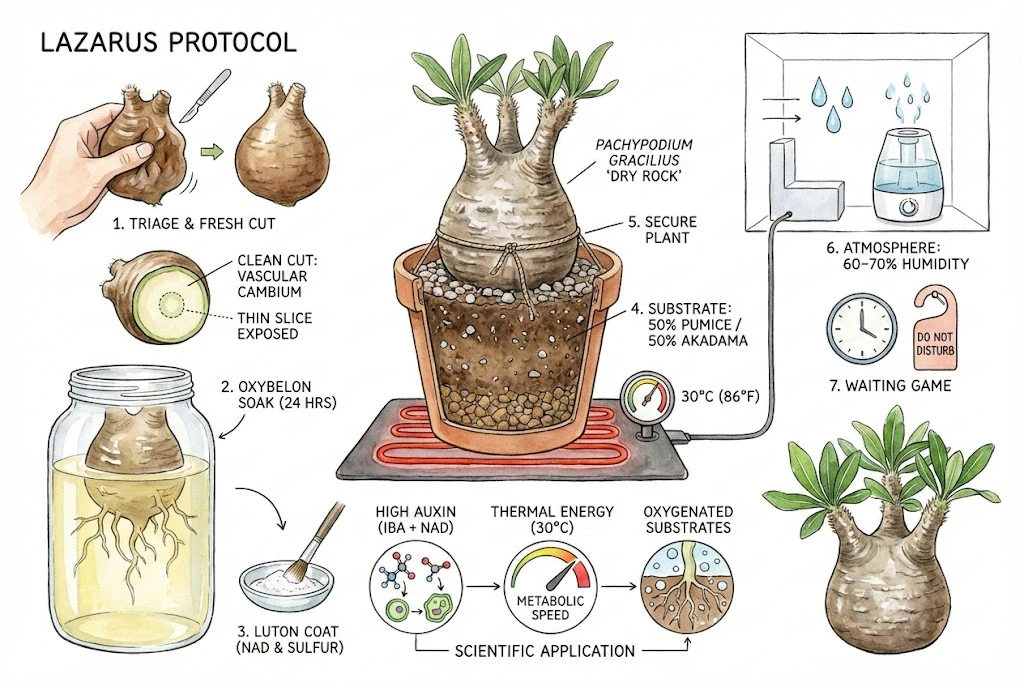
What should each step control?
- Verify the purchase by recording the seller, provenance, propagation claim, CITES and phytosanitary documents, arrival date, and transport conditions.
- Classify the starting material by noting retained roots, healed tissue, fresh wounds, and any active lesion. Photograph before cleaning.
- Do not recut a sound base. Cut only localized tissue that is clearly dead or breaking down and only when the remaining structure can support recovery.
- Choose one chemical decision. If a locally registered rooting product clearly covers the plant and method, follow that exact label. Otherwise skip it. Do not combine auxins, sulfur, bleach, peroxide, or fungicide by ritual.
- Prepare the finished mix with clean screened components, remove excessive fines, test wetting and dry-down, and keep an open wound out of wet media.
- Stabilize without constricting by using padded external support so the plant cannot rock. Check ties as the caudex changes.
- Measure before heating. Add thermostatic bottom heat only when the actual root zone is colder than intended. Keep electrical hardware dry.
- Water from root status. A plant retaining roots and a true rootless cutting do not get the same initial water. Avoid prolonged saturation and automatic misting.
- Track rather than excavate. Log pot mass, base temperature, firmness, leaf or bud activity, and photographs. Do not pull the plant out to search for roots.
- Escalate or stop by seeking diagnostic help if decay progresses. Stop the attempt when no stable base remains or the plant becomes unsafe to handle.
Which products are worth buying?
| Need | Conditional purchase | No-purchase or skip condition |
|---|---|---|
| More moisture-buffering aggregate | Hard akadama in a defined 3–6 mm range only after checking the current offer, seller, bag integrity, and fines | Use a known clean local aggregate or an existing mix that already meets the dry-down target |
| Cold root zone | A heat mat with thermostatic controller only when measurements show a deficit and the electrical setup can stay dry | Skip in an adequately warm room or when probe placement and water separation cannot be controlled |
| Rooting hormone | One locally permitted, label-covered product for the actual plant and method | Skip if the label, crop coverage, concentration, formulation, or local authorization is unclear |
| Rot treatment | Diagnosis-specific action and a current label, preferably after professional guidance | Do not buy sulfur, bleach, peroxide, or generic fungicide as a preventive rooting stack |
What is the safest investment?
Invest in provenance before hardware
The most defensible investment is often the plant itself. Look for documented nursery propagation, intact roots, lawful trade, and a seller who can explain its history. Good hardware can control a real substrate or temperature problem. It cannot convert an unverified import or damaged base into a guaranteed save.