
Pachypodium Namaquanum Not Growing? Dormancy vs Death
Pachypodium namaquanum not growing in summer? For this winter grower that is often normal rest, but rule out rot and root loss. Firmness checks, safe handling, and a counter-seasonal Halfmens watering calendar.
Rachel Torres · 2026-06-16 · Updated 2026-07-15 · 16 min read
Key Takeaways
- P. namaquanum is a winter grower, so a leafless plant in summer often follows its normal rest. Leaflessness alone does not rule out rot, root loss, or cold and heat damage.
- A firm apex, uniform stem, and dry collar are reassuring signs of rest, but they cannot rule out dead roots or hidden internal rot. Read firmness as a clue, not a verdict.
- This species has spines and toxic sap that can seriously injure the eyes, so wear gloves and eye protection. Avoid pressing or jabbing the spiny apex.
- Water when leaves are present in fall and winter, and keep the plant near-dry through summer. Use a gritty mineral mix with strong winter light.
- Growth is characteristically slow, so judge progress over seasons or years rather than weeks. Age and conditions change the rate.
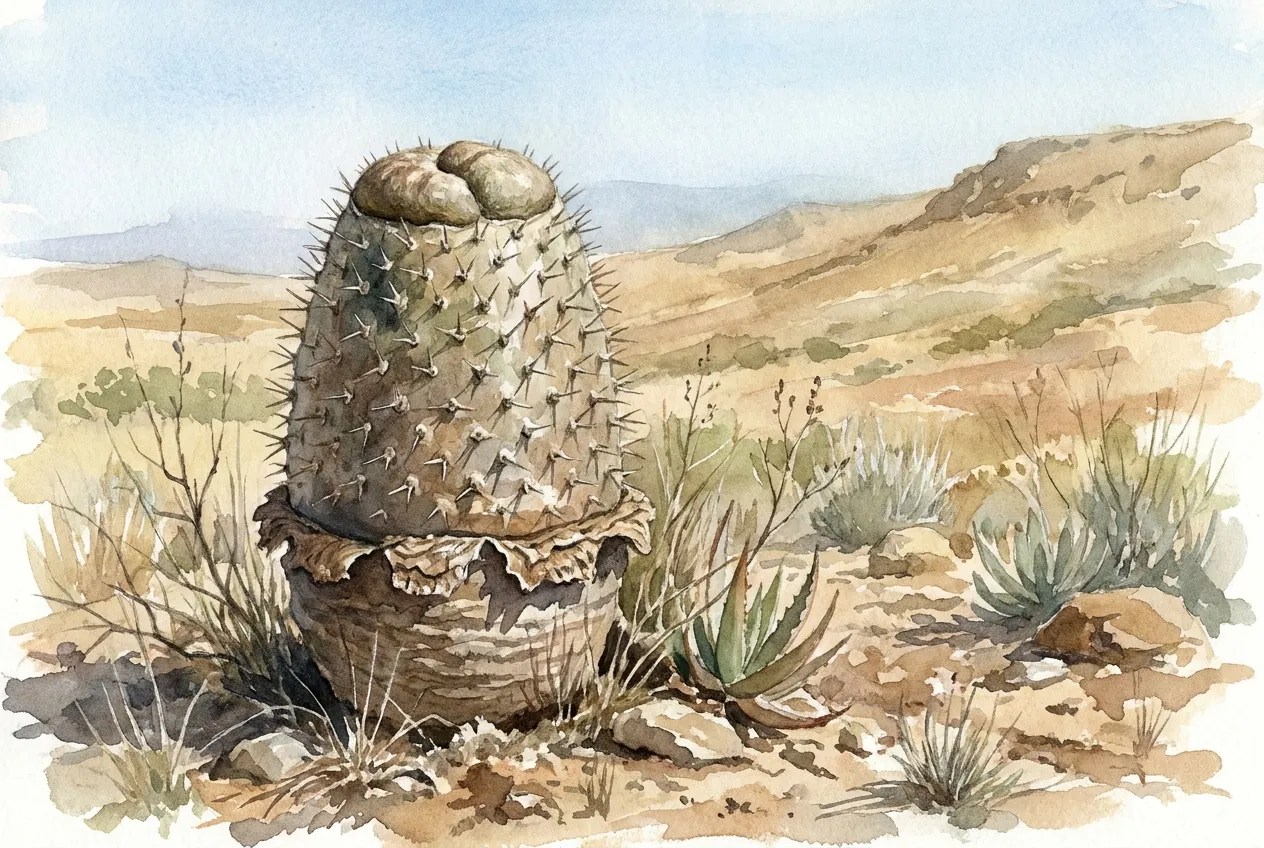
Your Halfmens is leafless and motionless in July, and you assume it is dying. Often it is not. Pachypodium namaquanum is a winter grower, so in the Northern Hemisphere it typically rests through summer. That interpretation still needs a basic check because a resting plant is not automatically healthy. The summer soaking suited to a thriving lamerei can leave a resting namaquanum wet for too long and increase rot risk. Use the hands-on checks, safe handling guidance, and counter-seasonal calendar below as clues rather than a lab diagnosis.
Why does my Pachypodium namaquanum stop growing in summer?
It commonly slows or stops in summer because it is a winter grower from a winter-rainfall desert. The Halfmens produces its leaf whorl in the cool season and drops it for the hot, dry summer. In the Northern Hemisphere, that resting phase often falls around June through August, but local greenhouse conditions can shift it. This is the opposite of the Pachypodiums most collectors know. Lamerei, gracilius, and brevicaule grow in summer heat and rest in winter cold, while namaquanum inverts that calendar by roughly six months.
When does Pachypodium namaquanum actually grow?
It grows in fall and winter, when leaves are present. In its Richtersveld habitat, leaves form in early fall and abscise in early spring, defining a winter-aligned cycle. Translated to the Northern Hemisphere, new velvety leaves often emerge in fall, active growth continues through winter, and leaf drop occurs in spring. A leafless plant from roughly June to August may be on schedule, but inspect firmness and roots before assuming normal rest. The apical leaf tuft at the trunk apex is a useful clue because SANBI documents that it forms during the brief winter growing period and sheds in hot summer.
How is its calendar different from lamerei, gracilius, and brevicaule?
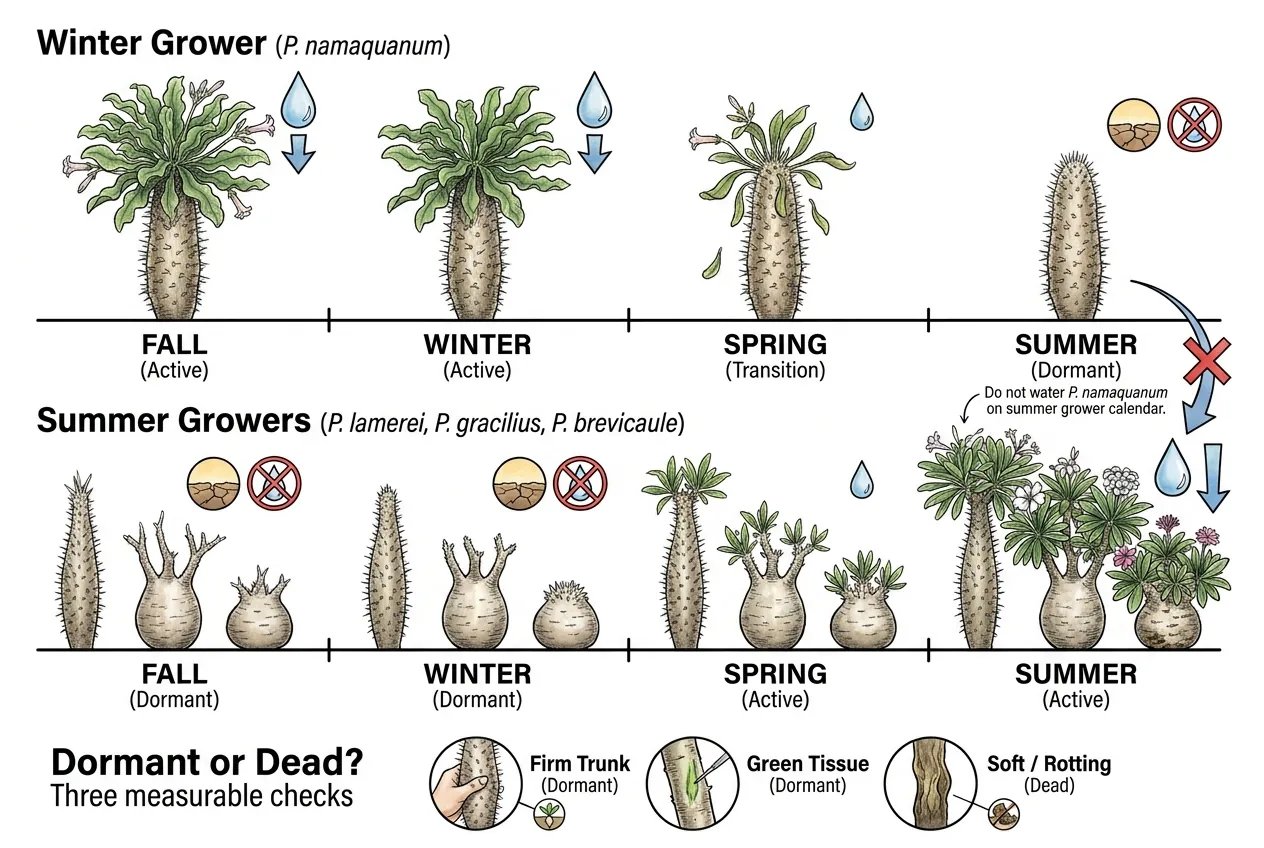
Its active and resting windows are about six months out of phase with the summer-growing species.
The common Madagascan Pachypodiums grow when it is hot and rest when it is cold.
Namaquanum does the reverse.
| Trait | P. namaquanum (winter grower) | Lamerei / gracilius / brevicaule (summer growers) |
|---|---|---|
| Active season | Fall and winter | Spring and summer |
| Dormant season | Summer | Winter |
| Leaves present | Cool months | Warm months |
| Peak water need | Cool months | Warm months |
Keep the seasonal schedule species-specific
If you water your namaquanum on the same calendar as your lamerei, the plant may be resting when the pot is still wet, increasing rot risk.
Is my Halfmens dormant or dead? Three measurable checks
Use Three Checks as Clues
Three simple hands-on checks help. Assess apical-tuft turgor, feel firmness from top to base, and inspect the root collar gently. A resting plant is often firm throughout, while a failing one develops soft or discolored zones. These are clues rather than a validated test, so even three reassuring results cannot confirm living roots or exclude early internal rot.
Safety first
This plant is spiny and its milky sap is toxic, with a documented history of use as arrow poison and a risk of serious eye injury. Wear sturdy gloves and eye protection, press only very gently, avoid getting sap on skin or in eyes, and wash up afterward. Keep the plant and cut material away from children and pets. Do the checks without unpotting first and only dig in if something clearly feels wrong.
How do I read apical-tuft turgor?
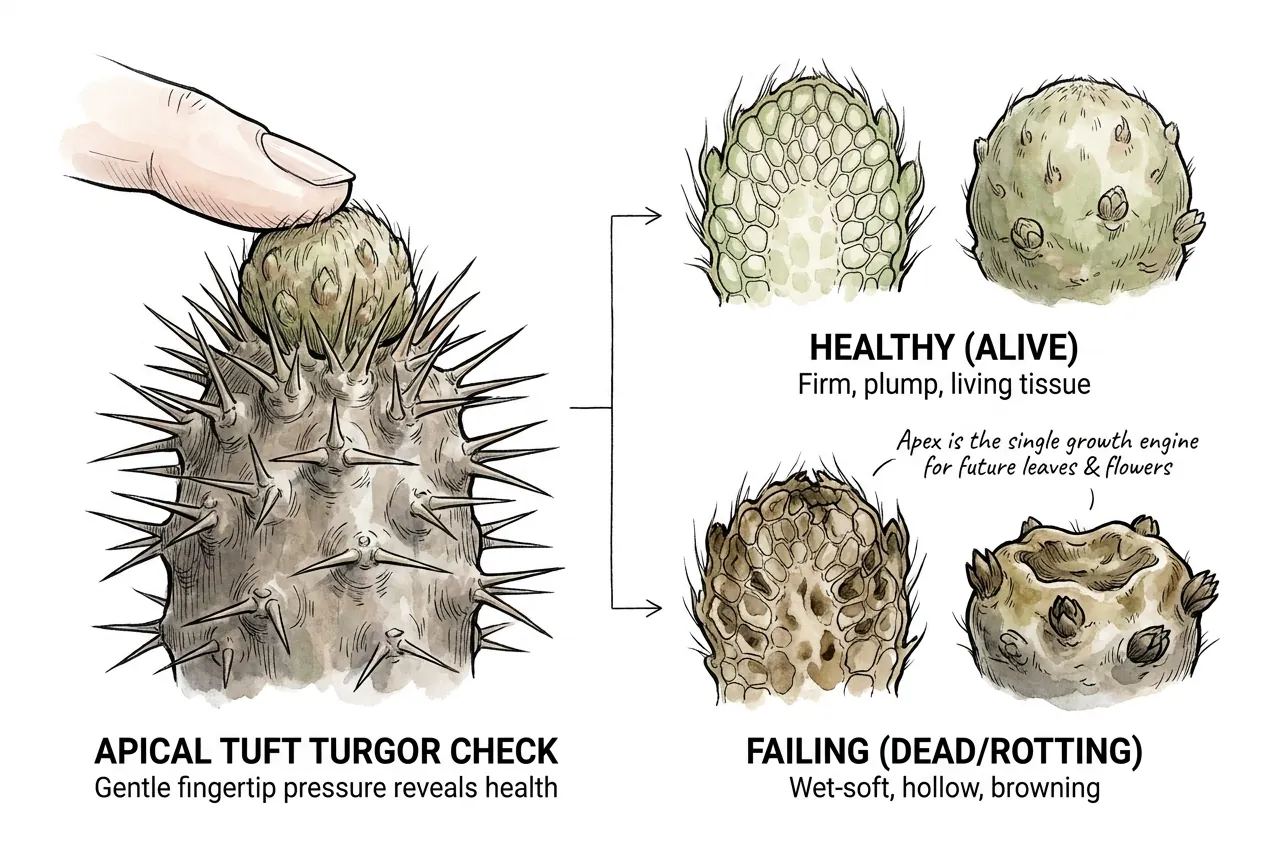
With a gloved fingertip, press the growth point at the apex very gently. Firm and plump suggests that the growth point is alive even when leafless, while wet-soft, hollow, or browning tissue is concerning. The apex matters because the leaf whorl and winter flowers emerge from that single point in this normally unbranched species. A damaged apex is not necessarily the end because SANBI notes that the species can occasionally branch from the base. Do not dismiss the plant, but do not poke hard enough to injure the growth point. Turgor reflects living, water-filled cells, while dead or rotting cells become flaccid and water-soaked.
What does the stem-firmness gradient tell me?
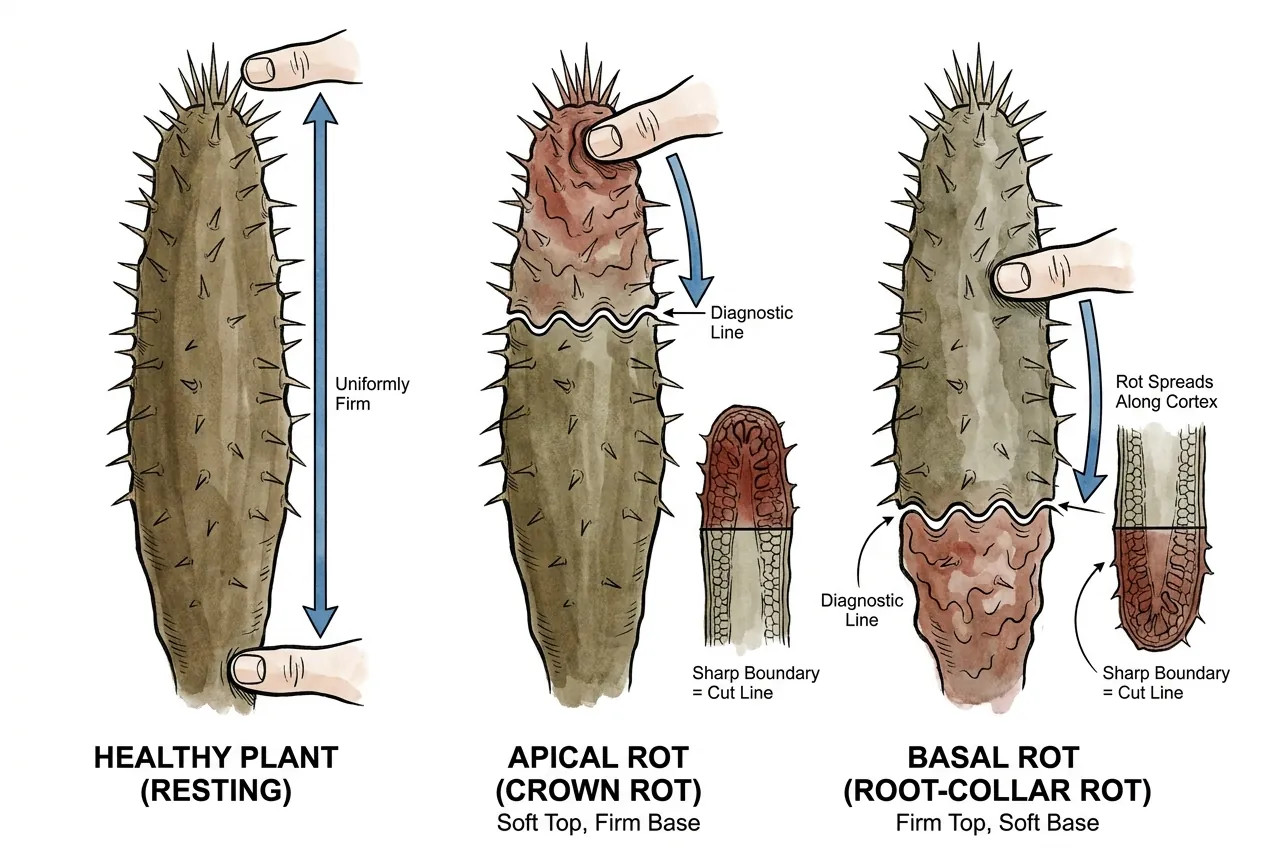
Run a thumb from apex to base and note where firm turns to soft. A resting plant is often uniformly firm, while a discrete soft zone can help locate a problem without establishing its cause or extent. A soft top with a firm base can reflect apical or crown rot, while a soft base with a firm top points toward basal or root-collar trouble. Treat the soft-to-firm step as a clue, not an exact cut line, because internal rot can extend beyond the soft surface and scars, bends, or moisture differences can feel abnormal. If you cut, remove tissue back to clean, firm, evenly colored flesh and re-inspect the cut face rather than trusting surface feel alone.
Why is the root-collar check the most important?
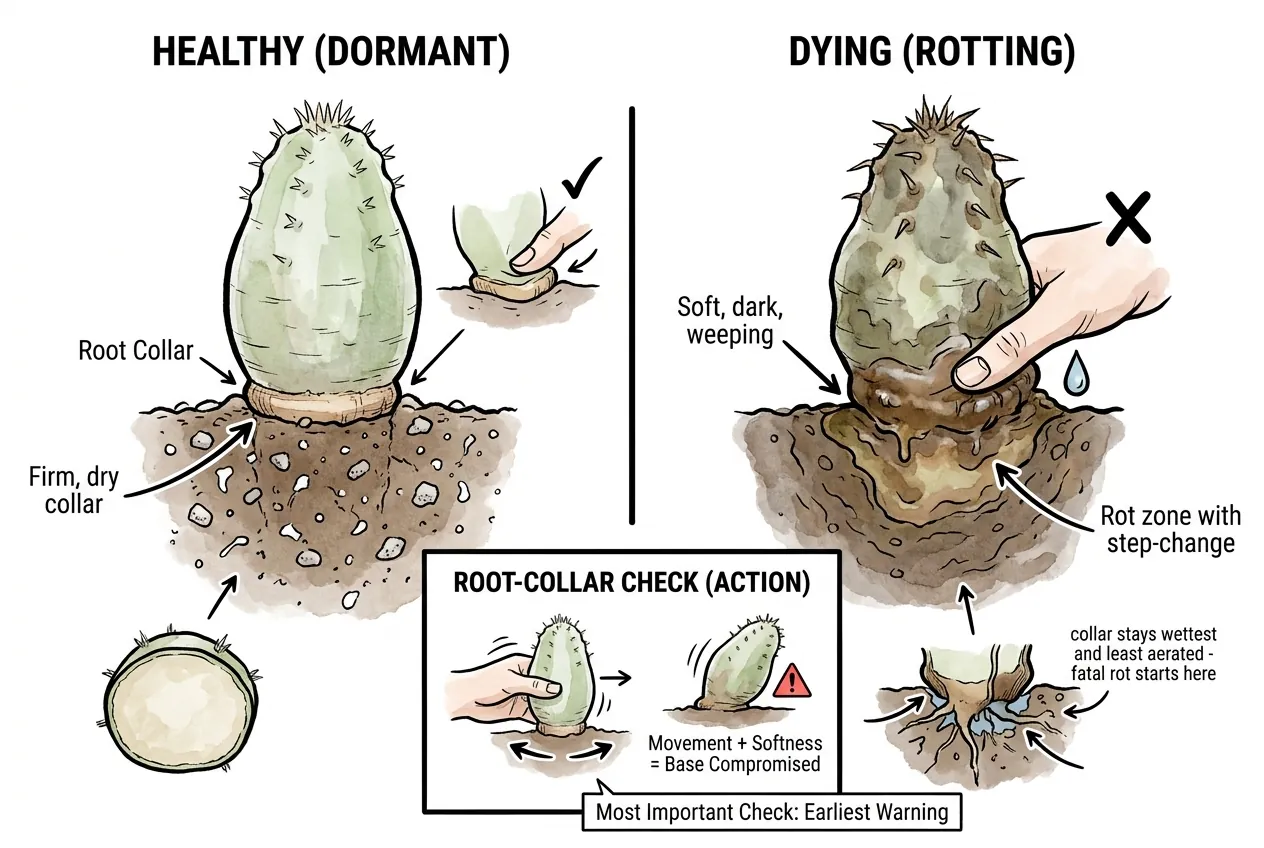
The root-collar area at the soil line is a common place for rot to take hold, so check it gently. A firm, dry collar is reassuring, while a soft, dark, or weeping collar needs prompt attention. The collar is not always the wettest spot because the mix, pot, and watering determine moisture distribution, so inspect the whole plant. A wobble alone is not proof of rot because recent repotting, loose mix, or lost roots can also make a plant move. Read movement together with firmness and color. Prolonged wetness remains a recurring risk, and pumice helps only when particle size, fines, pot shape, and watering produce a genuinely open mix.
| Signal | More consistent with rest | Warning signs |
|---|---|---|
| Apex | Firm, plump | Soft, hollow, browning |
| Firmness gradient | Uniform firm | Soft zone with step-change |
| Root collar | Firm, dry | Soft, dark, weeping |
How do I water Pachypodium namaquanum through the year?
Follow the Leaves When You Water
Water mainly in fall and winter when leaves are present, and keep the plant nearly dry through summer. Water tracks the leaves as a practical cue because a leafless resting plant uses little water and a soaked pot can sit wet and invite rot. This does not mean zero moisture because leafless stems and roots still respire and lose water. Reported habitat rainfall is roughly 50 to 150 mm annually and falls mostly in winter, which provides a cultivation pattern rather than a fixed home schedule.
What is a lower-risk summer-rest watering regime?
Use a dry summer default
Keep the plant mostly dry, with at most an occasional light soak in extreme heat. The useful balance is dry between waterings without allowing a rootless or compromised plant to remain bone-dry for months. Caudiciforms buffer dry spells in the stem, but fine feeder roots can die if the mix bakes completely dry. Use the substrate, caudex firmness, temperature, and root condition to decide because a fixed three-to-four-week calendar is not universal.
How do I handle the spring and fall transitions?
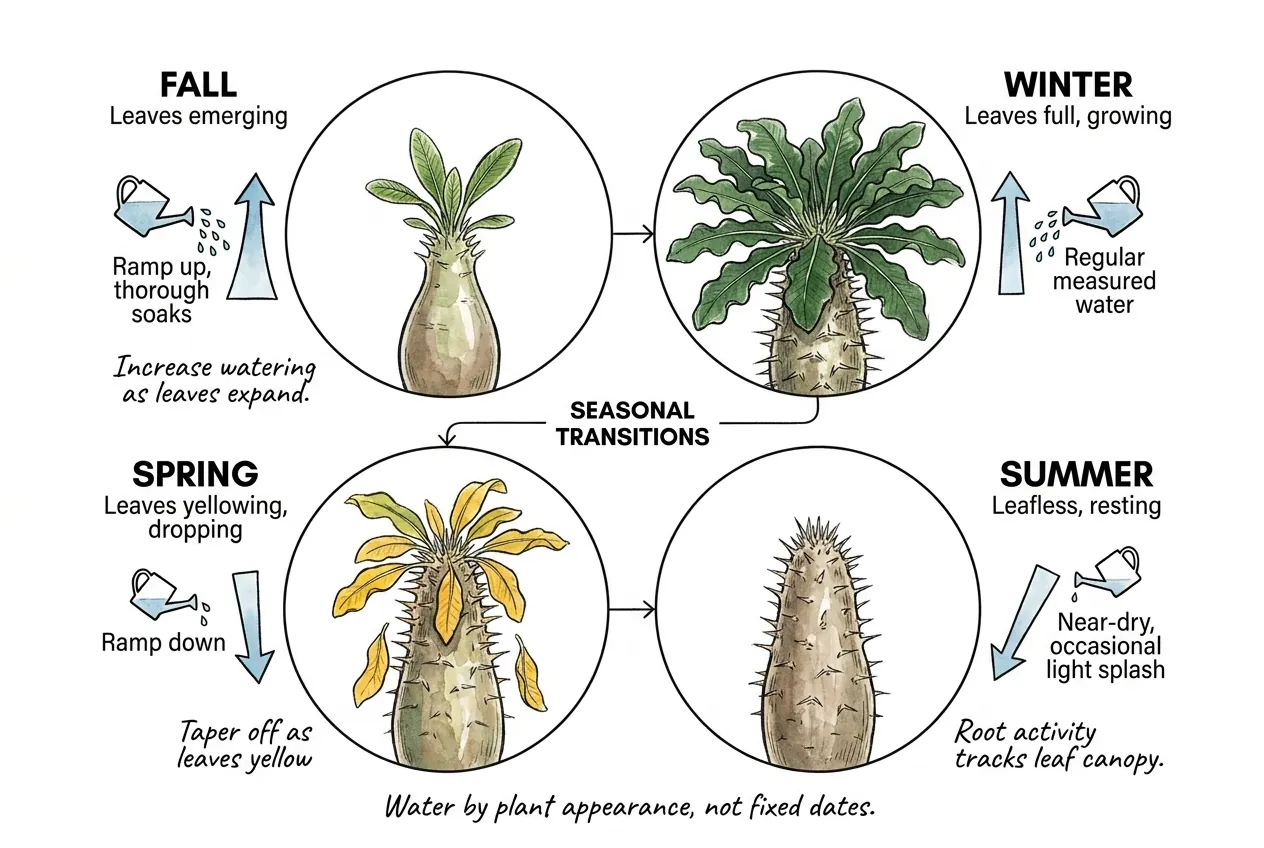
Ramp water up and down gradually rather than flipping a switch. Increase watering as fall leaves expand and taper it as spring leaves yellow and drop because root activity generally follows the leaf canopy. Treat the four to six weeks around leaf-out and leaf-drop as ramps, and water by how the plant looks rather than by a fixed date.
Because its season runs against summer-growing Pachypodiums, I give my namaquanum a separate card. At leaf drop, I photograph the apex and collar, record the pot mass, and mark the plant as resting. That visible tag has stopped a routine collection watering from reaching a leafless Halfmens just because its neighbors were active.
At the other transition, I record each stage of the new leaf whorl before changing the watering pattern. An isolated bud is not enough for me to call the plant active.
I wait for repeated leaf expansion, a firm apex, and a root zone that is responding predictably before increasing water. The card keeps the plant’s own counter-seasonal behavior ahead of the date on the calendar.
| Northern Hemisphere season | Leaf state | Watering |
|---|---|---|
| Fall | Leaves emerging | Ramp up, thorough soaks |
| Winter | Leaves full, growing | Regular measured water |
| Spring | Leaves yellowing, dropping | Ramp down |
| Summer | Leafless, resting | Near-dry, occasional light splash |
What substrate keeps a dormant Halfmens from rotting?
Build the Finished Mix for Air Space
A mineral, high-porosity mix with enough pumice or another stable aggregate to dry predictably is a reasonable starting point. A dormant winter-rainfall plant sitting in warm summer is at greater risk in a water-retentive medium. The goal is high air-filled porosity rather than the vague label of well-draining. A typical cactus mix is about half solids and half pore space by volume, and pushing that pore space toward air helps protect a resting caudex from rot.
Why pumice instead of perlite?
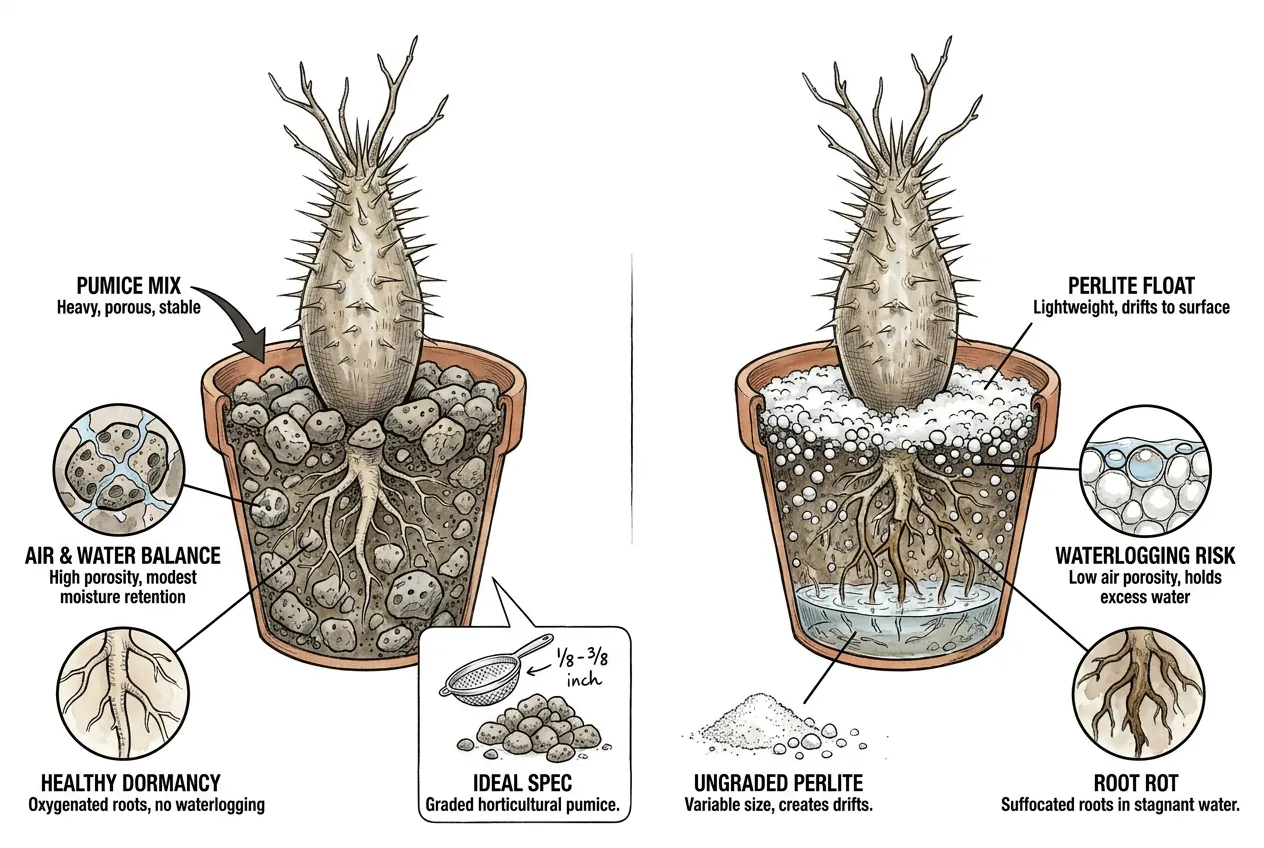
Both pumice and perlite are legitimate aeration aggregates. Perlite is widely used and genuinely raises air-filled porosity.
Choose the aggregate by how the mix behaves
Some growers prefer pumice because it is heavier, stays mixed instead of floating or drifting, and holds a little moisture in its pores while still draining freely. Perlite can form white surface drifts after watering, which is more of a nuisance than a rot risk. In either case, the goal is a mix with plenty of air-filled pore space so roots get oxygen and the medium dries quickly. Waterlogged, poorly aerated soil, not perlite itself, invites rot.
What spec to buy
Look for graded horticultural pumice in roughly the 1/8 to 3/8 inch range, sieved to remove dust. The cited pumice source supports those material specifications but does not establish a species-specific ratio for P. namaquanum. Start with a small, mineral-forward test batch, then adjust the finer or organic fraction from the finished pot’s dry-down during active growth and summer rest. Add more coarse aggregate if the root zone stays wet too long. Add modest moisture retention if a healthy, actively growing plant dries before you can water it reliably.
Small bagged pumice may suit one or two plants. For a larger collection, screened bulk pumice can be more economical when its particle grade is consistent.
How much light and what temperatures does it need?
It benefits from bright, measured light during winter and protection from frost. Because growth happens when the sun sits low, a dim room can leave it short of useful light and make it a poor low-light houseplant. Reported habitat temperatures can approach 48 °C, and established plants may tolerate light frost or brief sub-zero cold in habitat. A potted plant with wet roots or one that is not hardened off is more vulnerable, so keep it comfortably above freezing and move it somewhere sheltered before hard cold, especially when the mix is damp.
Why does the stem lean north and the leaf whorl tilt?
Read the lean as light history
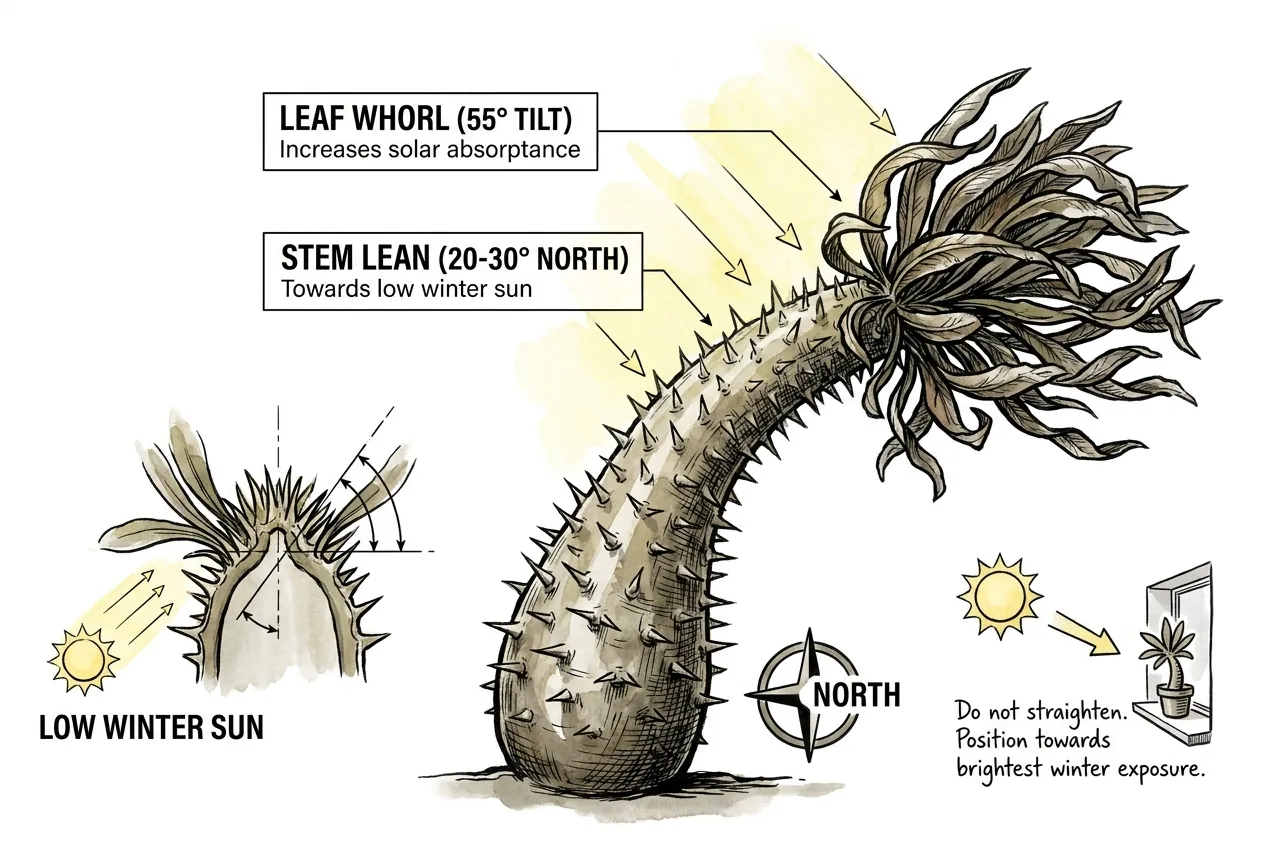
The lean and tilt are consistent with light harvesting in the low winter sun. The terminal leaf whorl and upper stem orient toward available light, although the angle varies among plants and sites. Published field observations describe habitat populations rather than a shaping prescription for a potted specimen. Do not try to straighten the lean. Position the plant so it faces your brightest winter exposure instead.
How do I light it indoors in a dim winter?
Keep winter light measured
Add measured full-spectrum supplemental light during the winter growth window when the room is dim. Weak winter interiors can produce stretched, pale growth or little growth, so use plant response and canopy measurements to set the fixture. The useful specification is a full-spectrum LED delivering strong photosynthetic flux at the canopy through short winter days. Mount it close enough to support growth without scorching. High-output panels raise the electric bill and can bleach the apex, so start farther away, watch for fading, and size the fixture to the shelf rather than buying the biggest panel by default.
What does its desert habitat tell me about care?
The habitat is winter-wet, summer-hot and dry, sharply drained, and bright. The Halfmens grows in the succulent karoo of the Richtersveld and southern Namibia, where rainfall is concentrated in winter with dry rain-shadow pockets and high summer heat. Use those patterns as a starting point, then adjust to the plant and enclosure rather than treating them as a fixed home schedule.
Why does it drop all its leaves in summer?
Dropping leaves reduces water loss when rain is scarce. The plant carries its terminal whorl mainly during the moist, mild winter and sheds it for the hot, dry summer to conserve water stored in the stem. This drought-deciduous strategy is often normal, not automatically a symptom, but a leafless summer plant still needs inspection for rot or root loss. Do not increase watering solely because the leaves have dropped.
How do I recover a plant that has started to rot?
Inspect Before Treating Rot
Early inspection gives the best chance of limiting rot, but recovery is not guaranteed. A typical sequence is to unpot, cut back to firm clean tissue, dry and callus the wound, then re-root in an airy mineral mix. Act promptly because a resting plant has limited new growth to offset damage. Early signals include localized soft, mushy tissue darkening to black or brown, sometimes weeping at the wettest zones near the collar or base.
What is the correct surgery sequence?
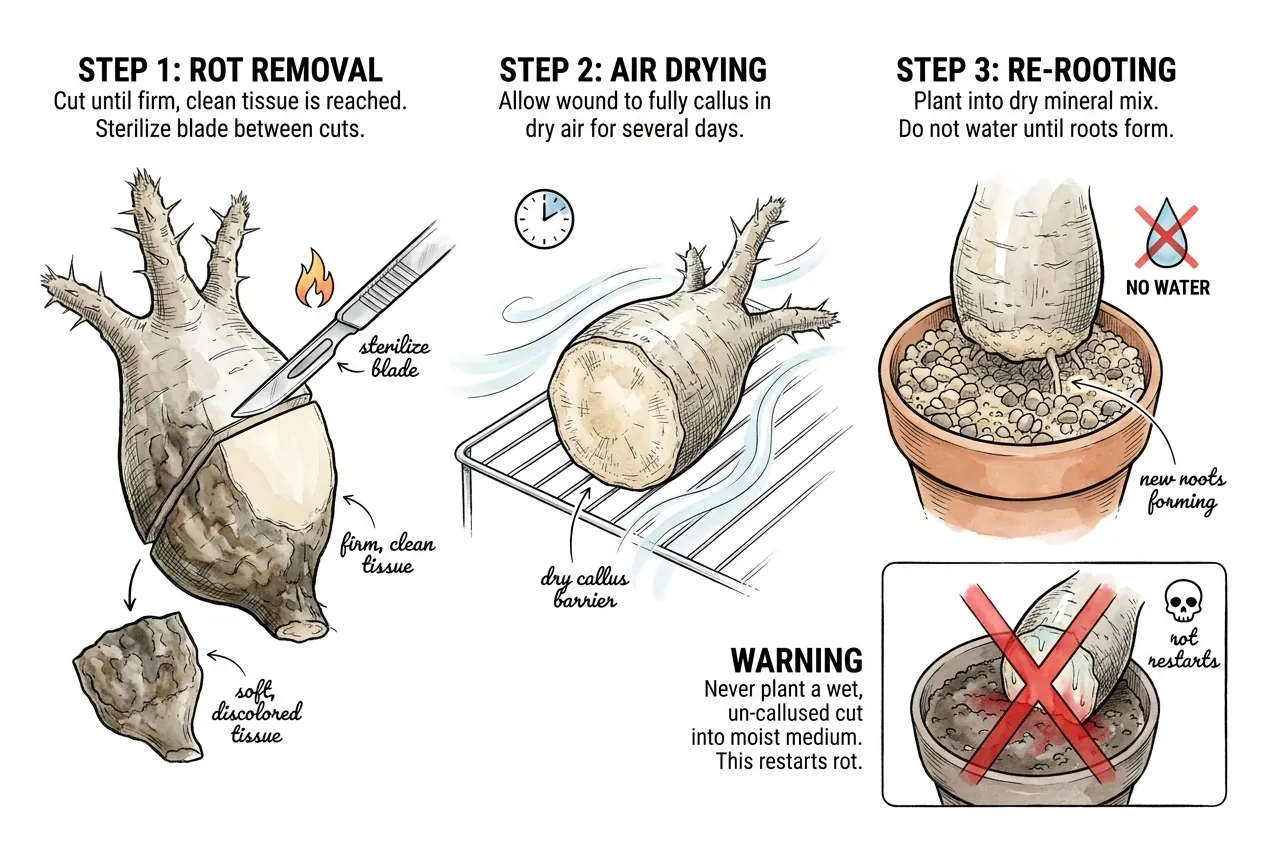
Work safely first with gloves, eye protection, and a sharp disinfected blade that is cleaned between cuts. Keep open flame away from the plant because the sap is toxic and the plant is spiny. Remove soft, discolored tissue until the cut face is firm and evenly colored, re-inspecting if discoloration remains, then let the wound dry and callus in open air. Re-root into a dry, gritty mineral mix and keep it on the dry side while roots form. Do not take withholding water to an extreme because a badly rotted, rootless plant still loses moisture. The key mistake is planting an uncallused wet wound into moist medium, which can restart the rot.
How do I stop overwatering in the first place?
Use a meter as a trend check
Measure root-zone moisture instead of guessing from the dry surface because a gritty mix can look dry while its core remains wet. A probe samples the root zone where rot actually begins.
An inexpensive analog soil-moisture meter reads moisture at the root zone before you decide to water. During summer rest, check the dial first. If the root zone is not clearly dry, skip watering. The honest tradeoff is that analog meters lose accuracy in very pumice-heavy, low-conductivity mixes, so treat the reading as a relative wet-dry trend and confirm by hand. If you want to set up dormant dry-down measurement properly, see how to measure dormant dry-down with caudex watering tools.
What growth rate and timeline should I expect?
Set a Multi-Season Timeline
Expect slow growth and long periods with little visible change.
Rate and lifespan vary with age, climate, and cultivation. Compare the same plant across seasons rather than relying on a fixed centimetres-per-year promise.
Judge progress over years, not weeks.
Track height or stem girth annually.
Slowness here is intrinsic to a desert plant that trades speed for durability and long life.
Should I grow from seed or cuttings?
Seed or an established plant is usually the lower-uncertainty route. Cuttings can be slow and unreliable.
Fresh seed often germinates in a sharp mineral mix, while cutting success depends on tissue condition and technique.
The thick, slow caudex tissue roots poorly, which is why vegetative propagation lags far behind seed.
For most growers, seed-grown or established nursery stock is the realistic path.
| Method | Reliability | Speed |
|---|---|---|
| Seed | Often germinates when fresh and well handled | Typically slower to establish. Batch-dependent |
| Cuttings | Uncertain | Very slow |
How do I acclimate a newly acquired plant?
Follow the plant’s leaves, not the calendar, especially at first.
A plant moved between hemispheres may hold its original schedule for a while.
Whether and how quickly it shifts to local seasons is not guaranteed. Some growers report that this species stubbornly keeps its winter-growing rhythm. Watch what the plant actually does rather than assuming it will reset.
Keep watering conservative during this settling-in period and let leaf presence, not a fixed date, tell you when to water.
If it leafs out off-season, water it then. If it rests, keep it dry. Regardless of what the calendar says.
Verify legal nursery propagation
This is also the moment to confirm ethical sourcing.
This matters a great deal here. P. namaquanum is assessed by SANBI (2022) as Critically Endangered, with wild populations sharply reduced in recent decades by drought, habitat loss, and illegal collection, and it is CITES-listed (Appendix II).
Buy only documented, legally nursery-propagated plants with the appropriate paperwork, never wild-collected stock, since demand for wild plants directly harms an already threatened species.
Practical conclusion
A leafless summer plant is often resting, but confirm that interpretation with the apex, stem, collar, roots, pot moisture, and recent temperature history.
Keep the root zone near-dry during supported summer rest, then increase water as fall leaves and active growth return. Use a gritty mix, strong winter light, and safe handling for spines and toxic sap.
Because the species grows slowly, judge recovery over seasons rather than short deadlines. Documented nursery propagation is the responsible source.