
Euphorbia obesa Splitting in Summer: Hydration Stress or Sun Injury?
Compare a Euphorbia obesa split with sun injury, edema, corking, and pests, then reduce abrupt dry-to-wet changes and protect fresh wounds.
Maya Ellison · 2026-06-11 · Updated 2026-06-26 · 22 min read

Key Takeaways
- A clean slit after a large watering can be consistent with rapid rehydration stress, but it does not prove a hydrostatic burst. The burst model is inferred from fleshy-tissue research, not measured on E. obesa.
- Compare timing, light history, tissue texture, root-zone moisture, and progression before diagnosing. Sun injury, corking, edema, mechanical damage, and pests can all overlap.
- A clean axial slit with latex soon after watering points to hydration shock. A bleached patch on the sun-facing side after brighter light points to sunburn. Weigh both histories when the picture is mixed.
- Rewet gradually after a dry spell, use a gritty mineral mix, and avoid abrupt swings in light and heat. These reduce the dry-to-wet shock but are risk reduction, not a guaranteed fix.
- Keep Euphorbia latex off skin and eyes, and let a clean split callus in dry air. Wear gloves and eye protection, and flush any eye exposure for 15–20 minutes and seek same-day care.
How does a Euphorbia obesa actually split?
What can current evidence show about a split?
Use the burst model with measured uncertainty
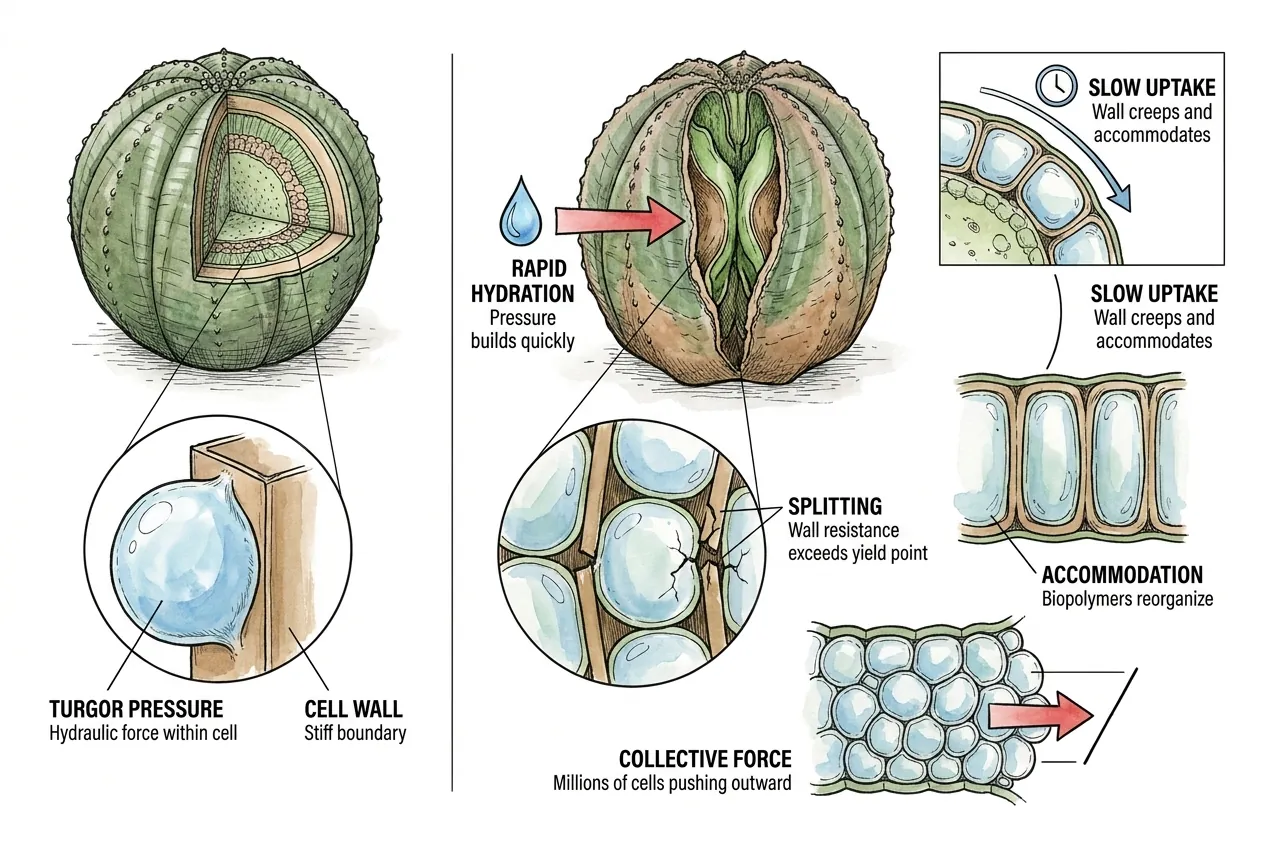
The leading model is that the cortex takes up water faster than the epidermis can stretch, so the skin tears along an inter-rib furrow. Research on fleshy tissues supports this mechanism, but it has not been measured directly on E. obesa stems. Treat it as a useful model rather than a confirmed species-specific rule.
Translate turgor pressure into a practical picture
Plant parenchyma typically operates around 0.3 to 1.0 MPa of turgor pressure. Succulent cell walls also have high water capacitance and pectin-rich structure that can adjust elastically before collapsing under enough stress. The fine details of how this produces a split in a living stem remain partly inferred rather than directly measured.
Apply the burst model cautiously
A dried plant that takes on water very quickly can push the skin beyond its ability to stretch. Thin-skinned fruit shows a comparable rain-cracking process, but that evidence illustrates the principle rather than proving the same response in a caudex succulent.
What is turgor pressure in plain terms?
Picture pressure inside the plant
Turgor pressure is the hydraulic pressure inside a living plant cell pushing outward on its wall. Think of each cell as a tiny balloon held inside a stiff cardboard tube. The balloon presses on the tube while the tube resists, and the tissue can split when that resistance gives way.
Keep the species threshold uncertain
In a hydrated Euphorbia obesa, many cells collectively load the outer tissues. A fast rise in tissue hydration could, in principle, exceed what the surface can accommodate, but the threshold for this species has not been measured.
Reduce abrupt hydration changes
Gradual rewetting is a reasonable risk-reduction measure after a prolonged dry period because it avoids an abrupt change. It is not a tested treatment or guarantee against splitting.
How does pectin chemistry decide whether the skin yields or splits?
Understand why the skin may resist stretching
Pectin’s methylation state helps control cell-wall extensibility. Highly methylated pectin is relatively soft and stretchy, while de-methylesterification by pectin methylesterase followed by calcium crosslinking makes the wall stiffer.
Read gradual and abrupt loading differently
A plant under steady moderate water status fine-tunes this balance daily. A dry-then-soaked plant can have a relatively stiff, calcium-crosslinked epidermis that cannot stretch as quickly as hydration changes.
Separate cortex and epidermis response
When the cortex floods, something has to give. The cortex parenchyma may yield elastically while the epidermis yields more abruptly.
Use fruit studies as an analogy only
This is broadly the same logic studied in grape-skin cracking, where the epidermis is a limited-stretch layer wrapped around a water-filled interior. Those studies are on developing fruit, not succulent stems, so the comparison illustrates the principle rather than proving the numbers carry over to E. obesa.
Is it sunburn, corking, edema, pest damage, or a real hydrostatic split?
Compare the Competing Surface Patterns
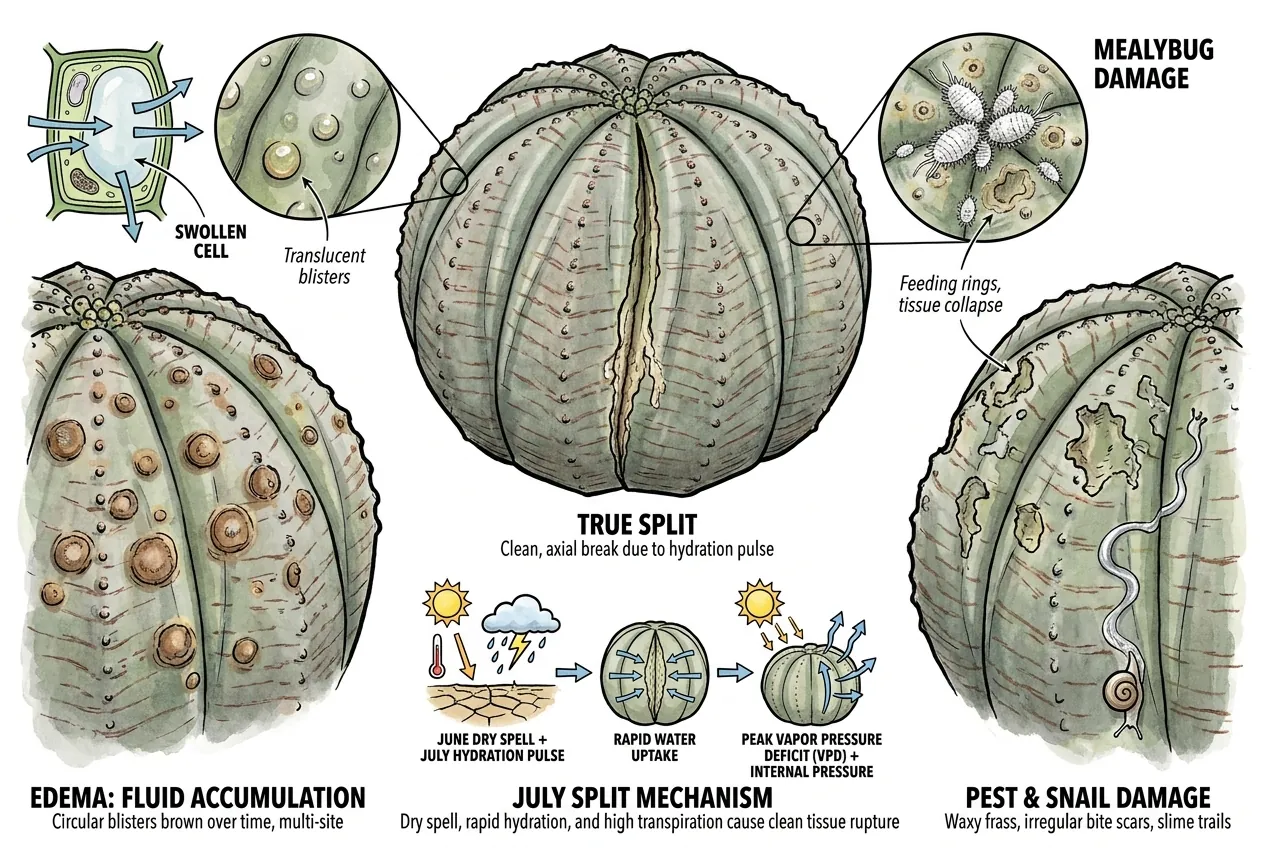
A hydration-shock split is typically an axial linear tear along an inter-rib furrow, often with milky latex within hours. Any fresh Euphorbia wound can also release latex, so latex confirms a fresh tear rather than its cause. The other common causes usually look different, although real cases can overlap. Use the table as a comparison guide rather than treating one clue as a final diagnosis.
Use recent watering as a clue
A clean slit soon after heavy watering points more toward hydration shock than sunburn. Confirm that impression with the plant's recent history and light exposure instead of ruling sunburn out from appearance alone.
| Symptom | Sunburn | Corking | Edema | Pest damage | Hydrostatic split |
|---|---|---|---|---|---|
| Shape | Diffuse patch | Patchy bands | Blisters, bumps | Waxy insects, honeydew | Linear axial slit (usual) |
| Latex | None | None | None | Possible | May weep latex from a fresh wound |
| Onset | Days after move to brighter light | Months, gradual | Hours, multiple sites | Variable | Hours, after watering or rain |
| Color | Yellow-bronze | Brown-tan, woody | Translucent then necrotic | Brown rings | Green walls, white latex |
| Reversible | Cosmetic recovery | No (permanent) | Yes if water corrected | Treat pest | May leave a corked scar |
What does real sunburn on Euphorbia obesa look like?
Recognize sunburn by history and pattern
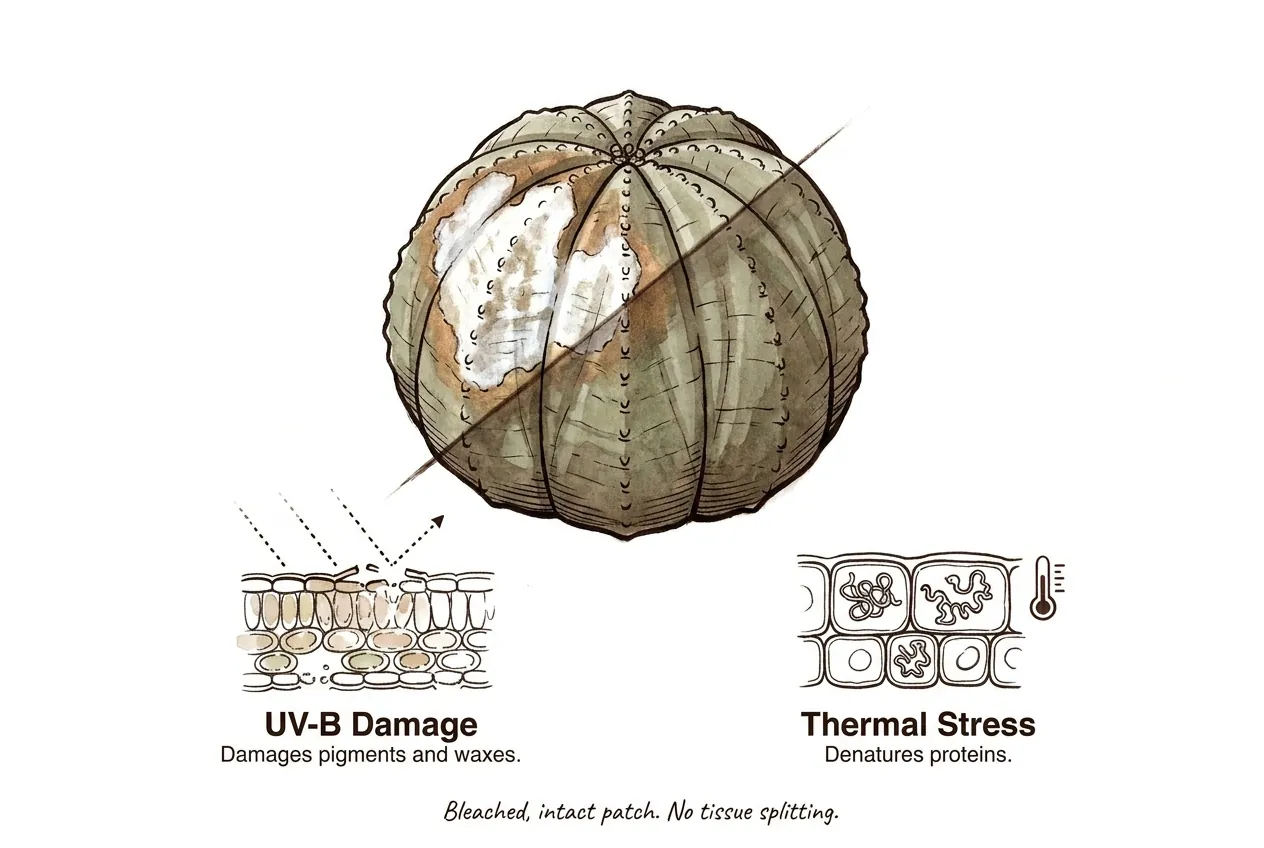
Real sunburn usually starts as a bleached, bronze, or chalky-white patch on the sun-facing hemisphere, often with a shadow line that follows the angle of midday sun. Mild sunburn may leave the texture intact, but severe scorch can dry, crack, sink, or peel succulent tissue. University IPM guidance and SANBI both describe this range, especially when a shade-grown E. obesa moves abruptly into full sun. The useful distinction is that mild sunburn can stay smooth, not that sunburn never damages the surface.
Separate light injury from hydration stress
Sunburn is a photochemical and thermal injury in which UV and heat damage pigments, surface waxes, and membranes. A hydration-driven tear has a different mechanism, but severe sunburn can still break the surface. Use the plant's history to compare a recent move to brighter light with a recent heavy watering.
Which clues point toward sunburn or hydration shock?
A bleached, patchy area on the sun-facing side after increased light supports sunburn. A clean axial slit with latex soon after watering supports hydration shock. When the picture is mixed, weigh both histories and continue monitoring the tissue.
How is corking different from a split?
Separate a healing cork band from a fresh split
Corking is the gradual development of a periderm, a woody suberin-rich tissue that replaces damaged epidermis. It forms in irregular brown bands over weeks to months rather than as a fresh line that appears within hours. A young corking patch is dry, tan, and slightly raised, often following an old scar or chronic mechanical wear. It does not usually weep latex.
Check whether the band is stable
Corking is a common endpoint of a healed surface injury, but not every brown band has the same cause. If a plant healed last year and now shows stable brown banding, compare it with new softening, odor, spread, or other changes before calling it a new problem.
How do edema and pest damage masquerade as splits?
Check for edema and pest damage before cutting
Edema is a non-infectious disorder in which roots take up more water than the plant transpires. Cells swell and burst, producing small water-soaked or corky blisters, bumps, or ridges that may turn brown or necrotic over several days. It tends to appear at multiple sites rather than as one clean tear, although a stem location alone does not rule it out.
Separate mealybug signs from edema
Mealybugs and root mealybugs are a different problem. Their signs include white waxy coating, cottony egg masses, sticky honeydew, and sooty mold. Root mealybugs require a check of the roots and inside of the pot. Damaged tissue may collapse, but it usually does not open into a clean slit.
Check nighttime feeding damage
Slug or snail damage at night leaves silvery slime trails and irregular bite scars. These patterns usually do not resemble the clean slit of a hydration-shock split.
Why is summer the common time for it?
Follow the Dry-to-Wet History, Not the Month
Summer can expose a dry-to-wet mismatch when heat, bright light, and irregular watering coincide, but July has no species-wide causal status. Review the actual dry-down, temperature, light, and watering history instead of the calendar.
Include both rain and grower behavior
A heavy summer downpour or a grower's catch-up watering can then deliver a large, sudden hydration pulse. Summer's high vapor pressure deficit often means the plant has been losing water quickly beforehand, which sharpens the swing.
Adjust the timeline to the local setup
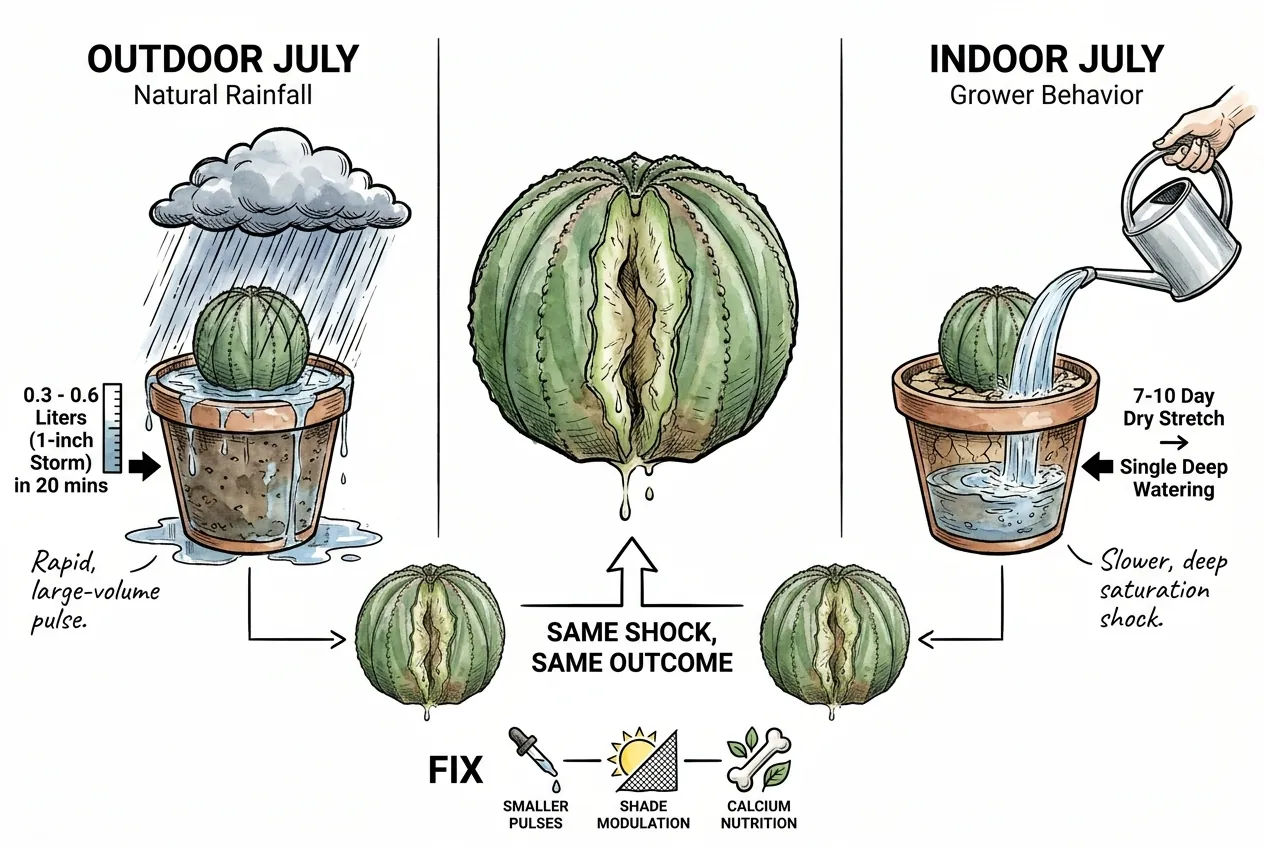
Outdoor specimens meet actual rainfall, while indoor specimens can experience the same pattern when a grower soaks a plant that has gone soft after a hot week without water. The exact months vary by climate, hemisphere, and growing setup, so watch conditions rather than the calendar.
What is VPD and why should a houseplant grower care?
Explain VPD in everyday watering terms
Vapor pressure deficit is the difference between how much water vapor the air is holding and how much it could hold at full saturation. High VPD means the air is dry and pulls water out of leaves and stems hard.
Relate VPD to the hydration pulse
A high-VPD summer day combined with dry substrate and a heavy watering pulse can set up hydration shock. The plant may take up water faster than its epidermis can stretch to match. A rainstorm often raises humidity and lowers VPD afterward, so the relevant swing is the dry-then-wet transition rather than the peak-VPD moment.
Keep fruit analogies bounded
This is broadly the same hydraulic idea behind apple cracking after heavy rain. The fruit-crop literature is far more developed than the caudex literature here, so it is a useful analogy, but the specifics were measured on fruit, not on E. obesa, so treat the transfer as suggestive rather than exact.
How does indoor vs outdoor July differ for this plant?
How do outdoor plants encounter the risk?
Outdoor plants face actual rainfall. A heavy summer downpour can dump a lot of water onto a small pot very quickly, although most of it drains, runs off, or evaporates. What matters is how quickly the roots and substrate deliver water to the plant rather than the raw rainfall total.
How do indoor plants encounter the risk?
Indoor plants face grower behavior. A common pattern is a week or more of dry substrate followed by a single deep, saturating watering to make up for it.
Use observed dry-down in any setup
Either setting can produce an abrupt dry-to-wet change. When the plant is ready for water, a measured rewetting that matches the pot and substrate may reduce that shock. There is no universal pulse schedule.
Use conditions instead of a calendar
Use the observed plant condition and dry-down rather than a fixed catch-up dose or calendar interval.
How do I prevent the split in the first place?
Which prevention habits matter most?
Combine gradual rewetting with stable exposure
Three habits can reduce the risk. Rewet gradually after a dry spell, use a gritty mineral substrate, and avoid extreme swings in light and heat. These measures work together to smooth the dry-then-wet change that can set up a split.
Treat prevention as risk reduction
They are complementary rather than guaranteed fixes. Each addresses a different part of the same problem, which is a plant moving from very dry to very wet too quickly.
What is a practical rewetting sequence after a dry stretch?
Rewet a dry pot in a measured sequence
After a long dry spell, avoid an automatic flood. First confirm that the plant is ready to use water, then choose a volume and method that wets the root zone evenly and drains freely. The aim is to avoid an abrupt jump from a very dry pot to prolonged saturation, not to follow a fixed number of pulses.
Record the actual pot response
Use the gritty-mix comparison to characterize the actual pot. Record moisture and plant response between waterings, and adjust only when the observed dry-down supports it.
After an unusually long dry stretch, I photograph the ribs and note the pot mass before watering. I check the upper and lower parts of the mix separately with the same non-destructive method I use every time. This keeps a dry surface from being mistaken for a uniformly dry root zone.
I weigh after 30 minutes of free drainage, then reweigh and repeat the rib photograph 24 hours later without adding water. I use three safe watering cycles because one cycle can reflect weather or uneven wetting rather than the plant’s response. A gentler pattern means the furrows do not widen while 24-hour mass loss remains repeatable in that pot.
Judge the finished substrate, not its label
A mineral-heavy gritty mix can drain quickly, but particle size, fines, pot geometry, and watering method determine the actual wetting pattern. Do not treat one ingredient ratio as a guarantee against splitting.
Compare organic and coarse behavior
Organic-heavy mixes can retain more water in some setups, while a coarse mix can dry unevenly in others. Characterize the finished pot instead of assuming that the label predicts the epidermal stress.
Consider a prepackaged mix only as a comparison
Prepackaged gritty mixes vary in organic fraction, particle size, and pH. Read the current formula instead of carrying one blend’s particle range or pH across the whole category. Pine bark retains some moisture and gradually breaks down, while calcined clay and other stable coarse particles help preserve air space. Judge the selected blend by how evenly the finished pot wets, drains, and dries.
Check the finished pot
A screened blend is one option to compare when a finished pot needs predictable particle size and drainage. The cited literature does not establish any single blend as an E. obesa optimum.
Run a small trial before scaling up
Reach for such a blend only after checking how the actual container wets and dries. A young plant or a root-poor specimen may need a different structure. Test a small setup instead of assuming that straight use or an added ingredient is universally correct.
What are the tradeoffs of a prepackaged gritty mix?
A packaged gritty mix usually costs more per liter than bulk pumice and lava, and its smaller volumes suit a smaller collection. Any blend that contains pine bark also breaks down faster than a pure mineral mix, so the pot may need repotting after a few years. For a larger collection, bulk components are often more efficient if you can store and screen them consistently.
Measure shade by plant response
A shade cloth can reduce leaf-surface temperature during peak afternoon sun, but the effective amount depends on color, weave, clearance, latitude, and acclimation. Measure the plant’s response rather than treating a calendar window or percentage as a species rule.
Use lower surface temperature as a clue
Lower surface temperature can reduce transpiration. That may reduce the cortex hydraulic gradient associated with hydration stress.
Avoid excessive shade
Some growers start around 40 percent shade based on warm-region vegetable practice, but that is not a caudex-specific target. The right amount depends on your latitude, the cloth's spectrum, and your plant's acclimation, so check the plant rather than treating any single number as correct. Very heavy shade can push soft, etiolated growth, which is its own problem. SANBI notes that E. obesa tolerates full sun to moderate shade when hardened off gradually.
Adapt indoor exposure
For indoor plants, move the pot away from a hot glass surface or filter the exposure while preserving enough light for compact growth. A fixed distance is not transferable between windows, lamps, and seasons.
Why does calcium matter for split resistance?
Treat calcium as a possible contributor, not a cure
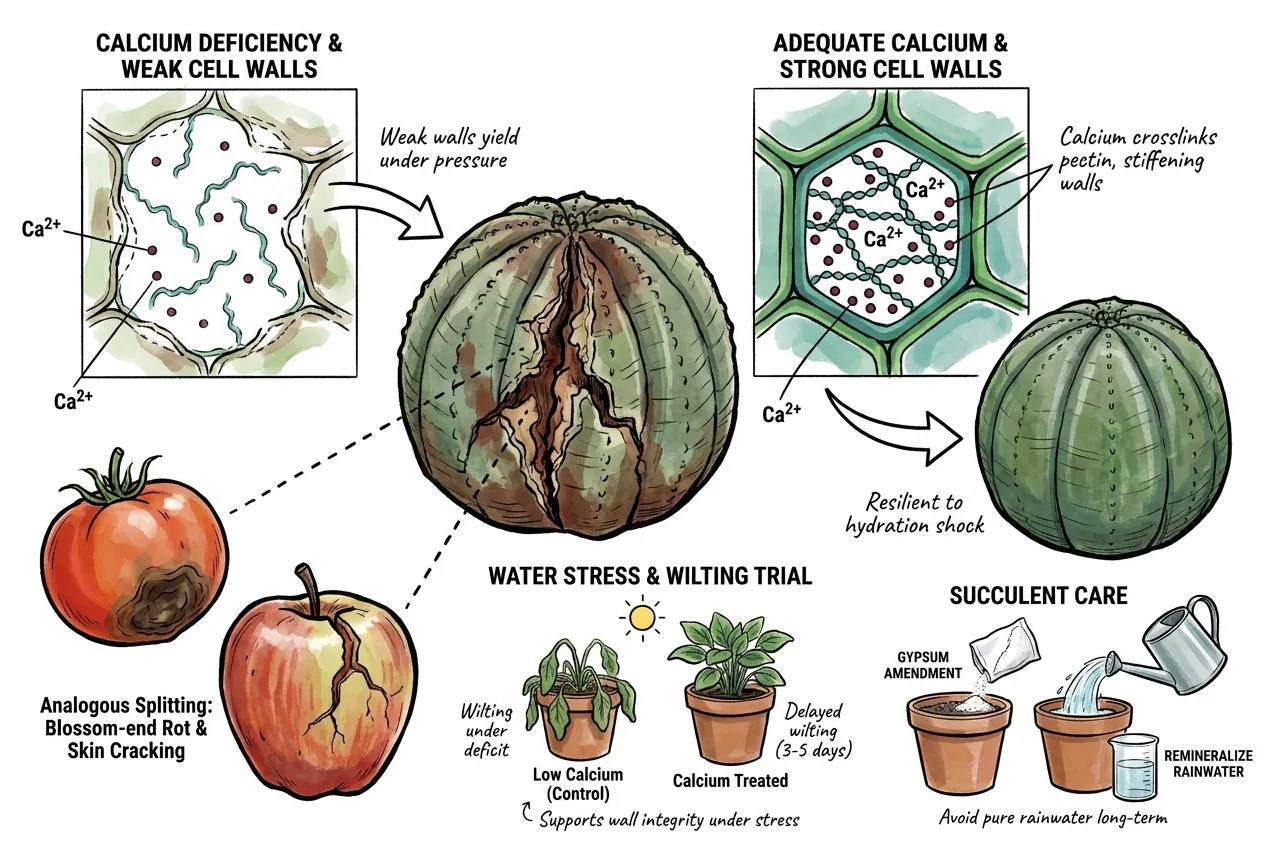
Calcium crosslinks pectin chains and contributes to cell-wall firmness. Calcium-related wall weakness is part of the story in disorders such as tomato blossom-end rot and some fruit cracking. Whether calcium status meaningfully changes splitting in E. obesa has not been tested, so treat it as a plausible contributing factor rather than a proven lever.
What does calcium nutrition support in practice?
A peer-reviewed trial found that calcium applications helped some bedding-plant species hold up longer under water stress, although the effect differed by species. This supports calcium's general role in wall integrity without proving a benefit for E. obesa. Use a complete fertilizer according to its label so calcium is not deficient. Add gypsum only when a deficiency or a water and substrate analysis calls for it because extra gypsum can shift salinity and the balance among calcium, magnesium, and potassium. Long-term use of pure rainwater can be fine when the plant otherwise receives complete nutrition.
How do moisture meters actually help here?
Use a moisture meter as one signal
A moisture meter can help you catch the substrate at its driest before you rewet, so you rewet gradually instead of flooding a bone-dry pot. Use one with a probe long enough to reach the deeper substrate, not just the surface.
Use an analog meter as relative context
A passive-needle analog meter reads relative moisture on an arbitrary scale without batteries. These meters commonly use a coarse 1-to-10 face whose low end starts at 1 rather than zero, so the number is only a repeatable trend, not an absolute reading. Probe length is the criterion that matters most for a caudex pot. A roughly 7- to 8-inch probe reaches into typical succulent pots, so match the probe to your pot depth. To compare options by measured dry-down, see the caudex watering tools that measure dormant dry-down.
Check the reading against pot weight
An analog probe meter reads relative moisture by electrical contact rather than absolute volumetric water content, so it gives a rough go or no-go signal instead of a precise number. Insert it to about half the pot depth and read it once the needle settles after a few seconds.
What is the main limit of a moisture meter?
Loose, gritty, mostly-mineral mixes make poor contact with the probe, so these meters can be less reliable in the fast-draining substrate recommended here. Check the reading against pot weight and the feel of the substrate at a finger's depth. Choose a probe spot that does not damage roots, and treat a low reading as one sign that rewetting may be appropriate rather than relying on the meter alone.
Did your Euphorbia obesa just split (now what?)
Shift from Diagnosis to Safe Recovery
After a split appears, focus on safe handling, a dry callus, and patient monitoring rather than repeated treatment.
How do I handle Euphorbia obesa latex safely?
Protect skin and eyes from latex
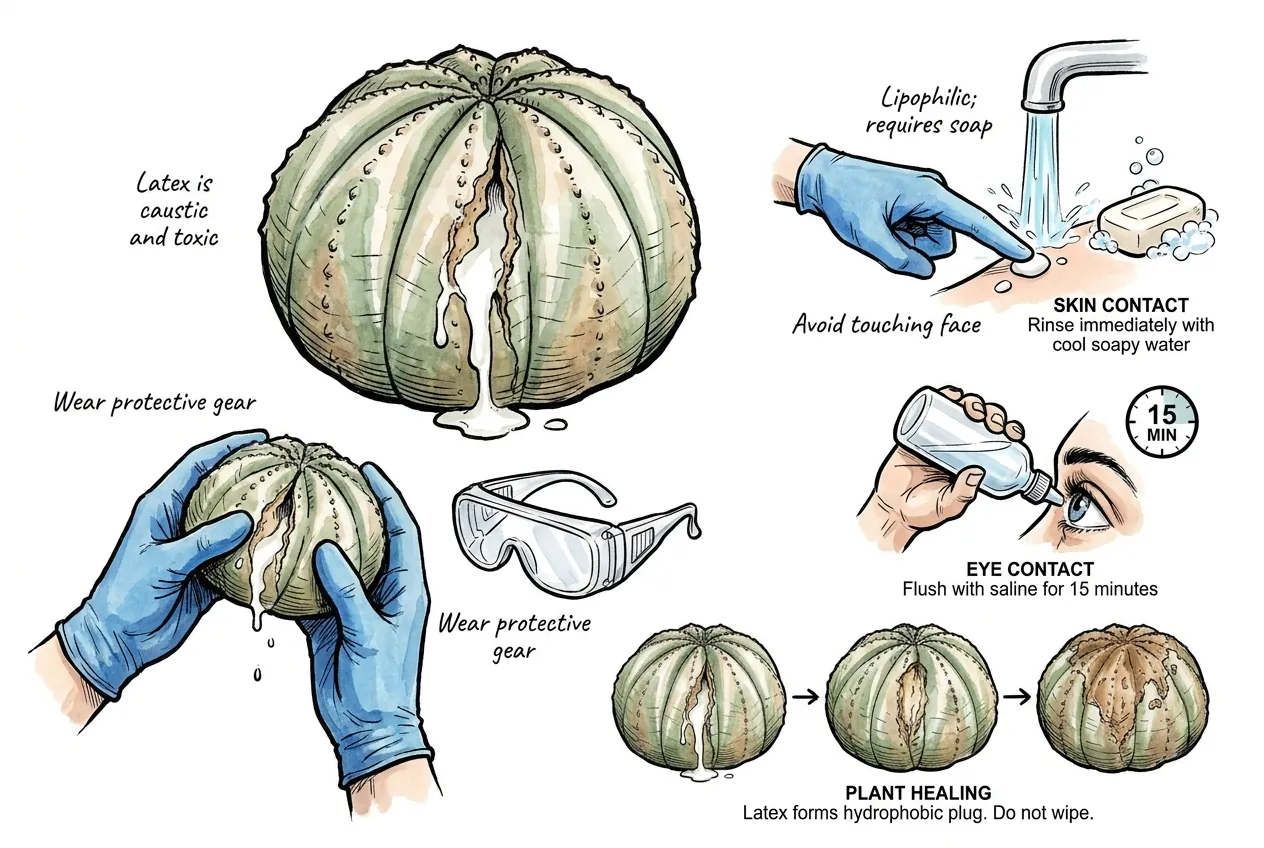
Euphorbia latex is a documented irritant. SANBI notes that it is toxic and especially irritating to cut or sensitive skin and to the eyes. Published case reports describe serious eye injury, including corneal surface loss, swelling, uveitis, and raised eye pressure that can worsen the following day. Wear nitrile gloves and eye protection whenever you handle a cut or split Euphorbia.
Wash skin exposure promptly
If latex contacts skin, wash it off promptly with cool soapy water and do not rub. A second wash is sensible because the latex is oily.
Respond immediately to eye exposure
If latex gets in an eye, remove contact lenses and rinse with clean lukewarm water or saline for at least 15 to 20 minutes, or longer if irritation persists. Seek same-day medical or ophthalmology care, and contact poison control for guidance while rinsing. A brief rinse followed by observation is not enough for an eye exposure.
Avoid secondary contact
Never touch your eyes, face, or mucous membranes while working with the plant or until you have removed gloves and washed.
Leave the plant alone if unexposed
If you have not been exposed, minimal handling is the general principle. Do not squeeze or scrub the cut. Latex on many Euphorbias may contribute to sealing a wound, but it does not sterilize anything, and the details have not been tested on E. obesa. Your safety comes first, so wash latex off skin or eyes immediately rather than leaving it in place.
Should I dust the wound with sulfur, use a fungicide, or leave it?
Let a clean wound callus in dry air
For a clean, dry split on an otherwise healthy plant, let the surface callus in a dry and airy setting. No wound is truly sterile, so watch for softening, odor, or spreading discoloration that would suggest infection rather than normal callusing.
Use sulfur only under a current label
Some growers dust a contaminated cut with elemental sulfur. If you choose to do so, treat it as a pesticide. Use a product labeled for garden or horticultural use, follow its rate and safety instructions, wear the specified protective equipment, and avoid high heat that can make sulfur phytotoxic. Dusting sulfur simply because soil touched the wound is not necessary in most cases.
Why should wound paints usually be skipped?
Commercial wound paints can trap moisture and are generally not recommended for these cuts. This default comes from tree-care research, while a few studies found coatings helpful in specific situations. Apply the guidance as a strong default rather than an absolute law.
When do I repot a split plant?
Delay repotting unless the root zone is failing
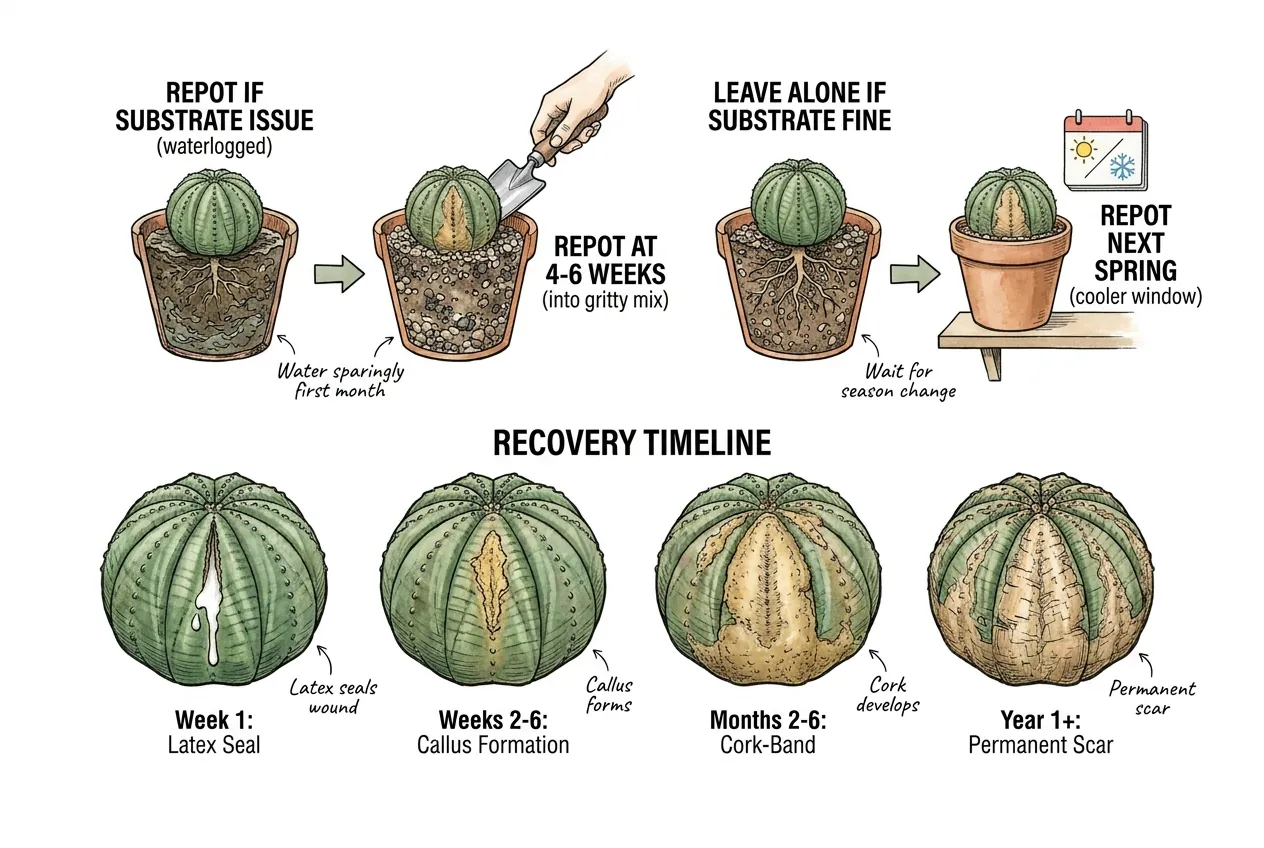
For a stable plant with a fresh split, avoiding unnecessary root disturbance for a few weeks is sensible. The plant is putting energy into sealing the wound, and root pruning during that window can slow it.
When is prompt repotting justified?
The exception is a substrate problem. If the mix is genuinely waterlogged or broken down, or roots are already rotting, waiting can do more harm than prompt repotting into a fresh, fast-draining gritty mix. Water according to the remaining roots and observed dry-down afterward. Judge by the substrate and roots rather than a fixed countdown.
Leave a sound substrate undisturbed
If the substrate is fine, leave the pot alone and repot during the plant's normal repotting season in your climate.
What does the recovery actually look like over 6 months?
Read Recovery as a Variable Sequence
Recovery often follows a rough sequence. Latex may seal the surface in the first days, callus may develop over the following weeks, and a cork band may form over the next couple of months before a permanent scar remains. Timing varies with the depth, length, and width of the split and with the plant's health, so use this as a guide rather than a fixed schedule.
Watch depth and vascular support
A shallow split often heals into a permanent cork band with little lasting effect. But a deep or extensive tear that damages a large share of the vascular tissue, the growing point, or the stem's circumference can cause problems even without infection. Watch the wound as it heals rather than assuming every split is cosmetic.
What is the week-by-week timeline?
Early days
Latex may slow as the surface dries, but the interval varies with wound size, tissue condition, and environment. Record the change rather than using a fixed 48–72 hour expectation.
Following weeks
A callusing or closing response may develop beneath the dry surface. A dry appearance does not prove that deeper tissue is sound.
Following months
Cork or periderm may develop along the wound margin. The timing and mechanical stability vary with the depth and extent of the injury.
Longer term
A stable scar may remain while new growth continues, but deeper damage can affect vigor or support. Monitor the whole plant rather than promising a fixed recovery date.
Does a healed split affect flowering or seed production?
Set modest expectations for future growth
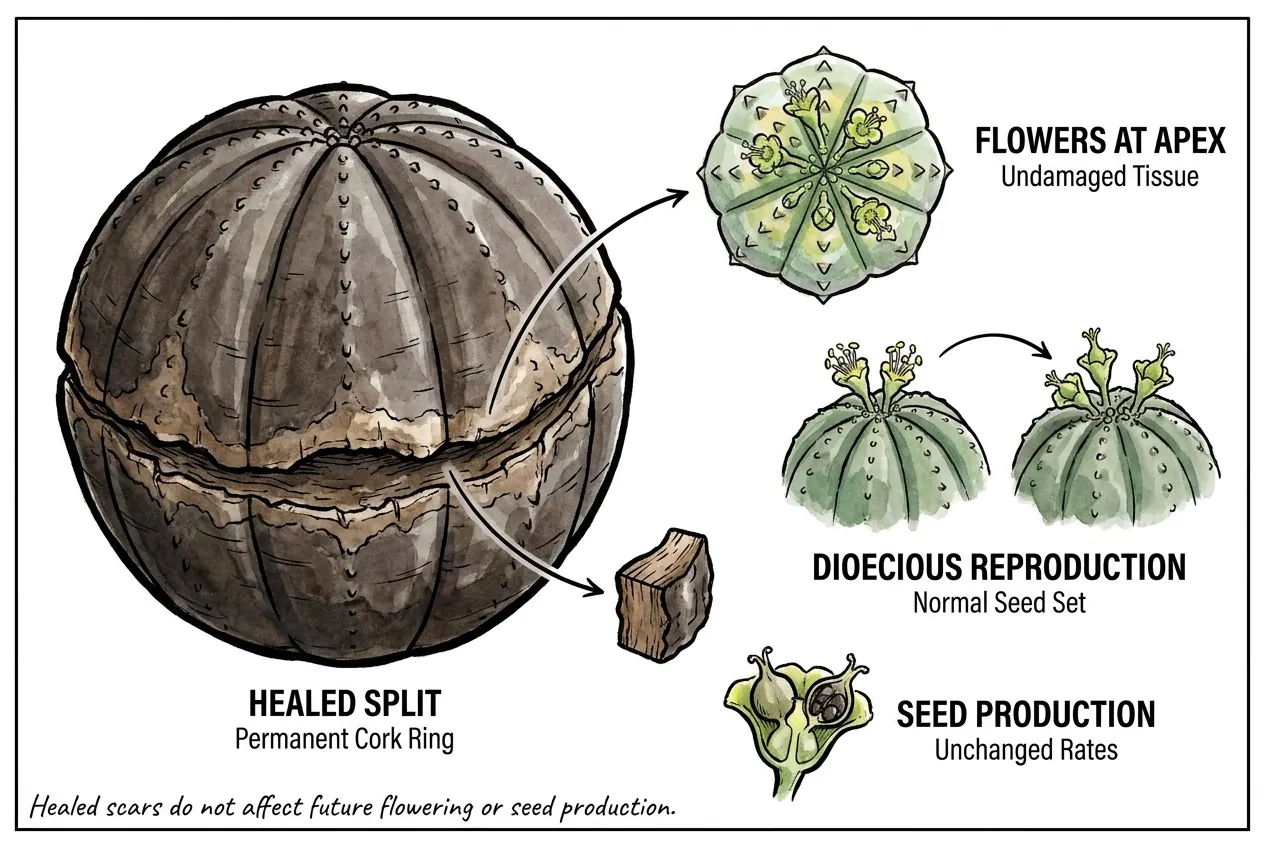
A healed shallow split usually has little effect on future flowering, since flowers form at the apex from undamaged meristematic tissue, well away from a side scar. That's a reasonable expectation rather than a guarantee. A large wound that disrupts vascular flow or stored reserves could still affect vigor.
Consider vascular damage separately
Euphorbia obesa is dioecious (separate male and female plants), and a recovered plant generally resumes normal reproduction. For most healed splits the durable outcome is simply a permanent ring of cork.
Treat scar value as subjective
Many growers value that scarring as character. Pricing of scarred specimens varies from seller to seller.
Where should you actually buy a Euphorbia obesa?
Buy Propagated Plants with Clear Provenance
Euphorbia obesa is native to a limited area of the arid Cape Karoo in South Africa, and like most succulent Euphorbia it is listed on CITES Appendix II. International trade is regulated rather than banned. Legally propagated plants can be traded with the correct CITES export or re-export paperwork, while wild-collected plants require documentation and are tightly restricted. Importing countries may add stricter rules. Wild populations have been reduced by historical over-collection, which is the reason to buy responsibly.
Check the propagation history
Buy from reputable specialist nurseries that propagate their stock (E. obesa is normally grown from seed) and can show clear provenance (look for seed-grown or ex-cultivation plants with a stated lineage). Propagation method alone doesn't guarantee legality, so favor sellers who are transparent about sourcing.
How do I tell a true Euphorbia obesa from a hybrid?
Use provenance and flowers to support identity
True Euphorbia obesa is a smooth, ribbed sphere that becomes slightly elongated with age, typically with eight ribs and subtle horizontal banding. Female plants produce one flower per cyathium, while males produce small staminate flowers in clusters.
Use accepted taxonomy as context
The plant often sold as E. symmetrica is treated by Kew as the subspecies Euphorbia obesa subsp. symmetrica. It is squatter and often clustering rather than a separate species. A genuine obesa and symmetrica cross is therefore a within-species matter, while a named hybrid should have documented parentage. Clustering and multi-headed selections are not automatically hybrids.
Do not identify from shape alone
Shape helps but does not prove identity. A symmetric, roughly eight-ribbed single globe is the classic form, yet young plants are more spherical, older plants can elongate, and cultivated specimens sometimes offset. For a confident identification, rely on provenance, flower characters, and parentage records rather than shape alone.