
Operculicarya Decaryi Bonsai Wiring: Summer Bending Guide
Operculicarya decaryi bonsai wiring in summer: why the cambium resists a bend, plus gauge, raffia, and timing to set the curve without scars.
Maya Ellison · 2026-06-13 · Updated 2026-08-04 · 19 min read
Key Takeaways
- A bend holds because the wood slowly takes a permanent set and grows new tissue in the new position. Deliberately cracking the branch is damage, not a technique.
- Wire during active warm-season growth, roughly spring through early summer, when the bend sets fastest. Sap-swollen bark also tears and scars more easily then.
- Use a wire gauge that holds without crushing the branch, and soak raffia first when a thick branch needs broader support. Aluminum is easier to tune on this soft wood.
- Bend from the inside of the curve and add heavy tension in stages with a guy wire. A single hard crank snaps brittle old wood.
- Inspect frequently during active growth and cut the wire off at the first sign of bite. Scars on this tender bark can persist for years.
An Operculicarya decaryi branch may spring back after wiring, or the bark may slip and open a pale wound along the bend. Those outcomes reflect the interaction between wood stiffness, active growth, tissue hydration, and wire pressure. The guide below uses those relationships to choose timing, support, and wire removal that reduce long-lasting scars.
Why won’t an Operculicarya decaryi branch take a bend?
Let Wood Take a Permanent Set
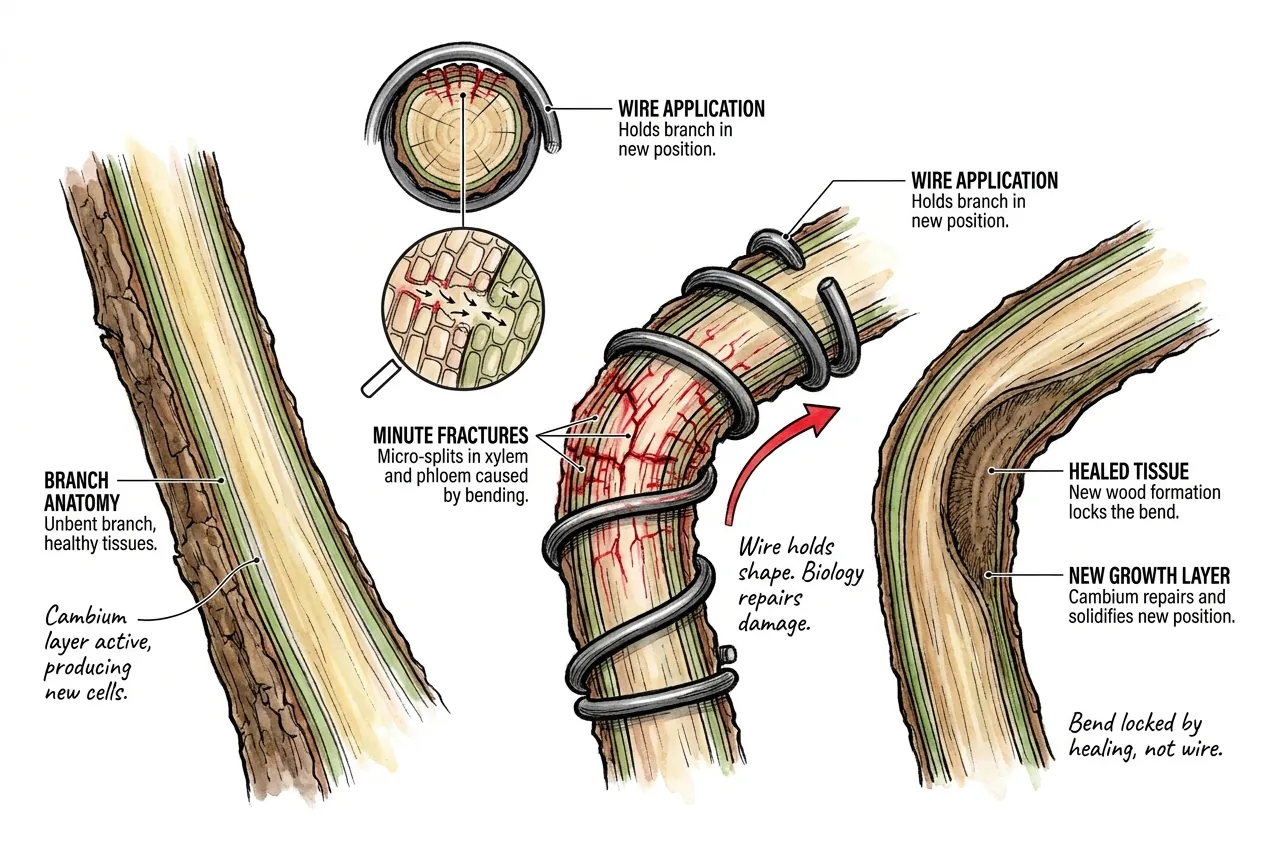
A branch resists a bend because wood is stiff and elastic. To make a new shape stick, hold it past the point where it returns on its own and let the plant grow into the position. Wood behaves as a viscoelastic material, so part of the deformation can become a permanent set. Over following weeks and months, secondary growth lays down new wood around the held shape and locks the curve in. Fibers on the outer face may micro-crack under a hard bend, but that tearing is damage to manage rather than the goal.
What actually happens inside the branch when you wire it?
Use wire as temporary support
The wire is a temporary clamp that holds the branch past its spring-back point while the wood takes a viscoelastic set and the cambium adds new layers around the curve. That combination, not a repaired fracture, fixes the bend. A branch that springs back when the wire is removed has not necessarily failed because it may simply need more time to set and grow. Mechanics literature describes the process as permanent set plus secondary growth rather than cambium healing tiny splits. Hold the shape, then give it time.
Why does old wood spring back while young shoots hold a bend?
Reserve heavy bends for flexible growth
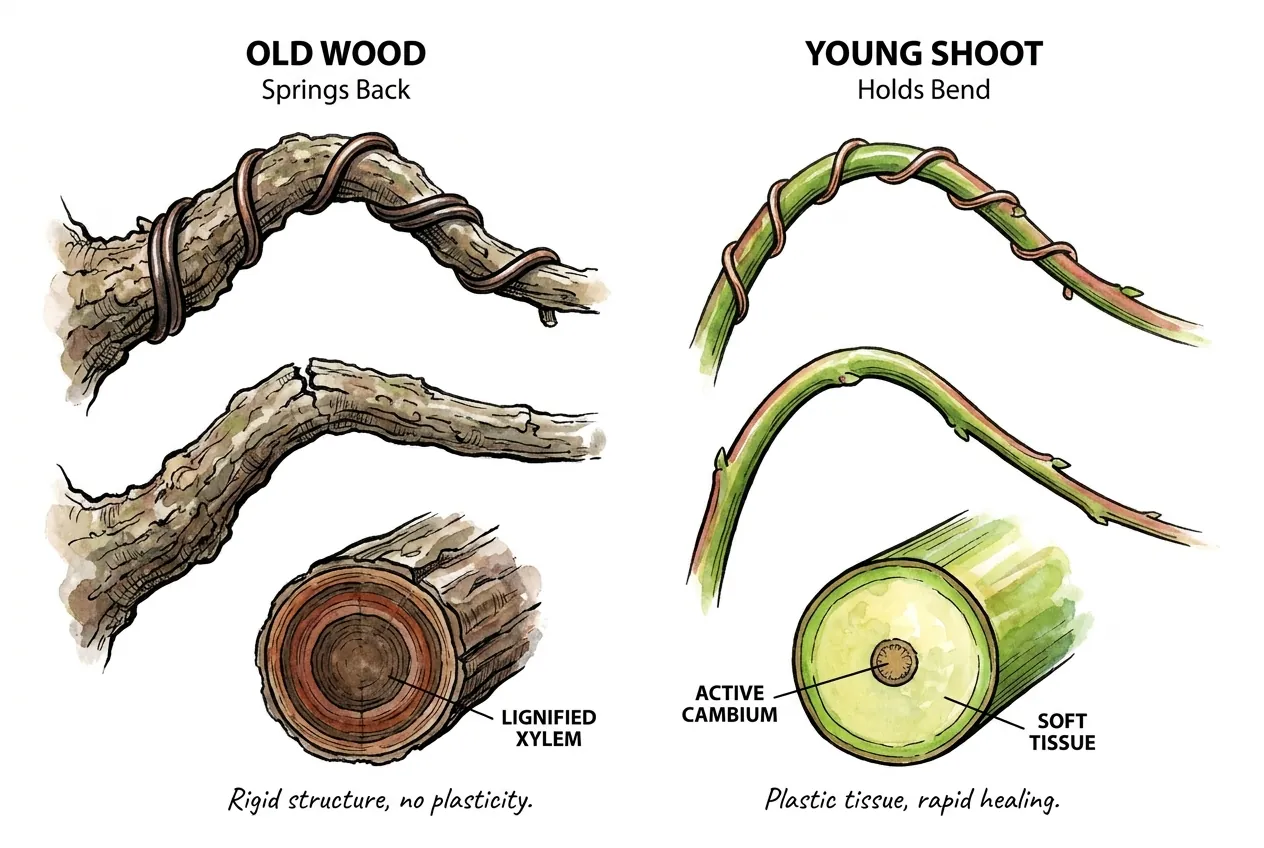
Old wood springs back more because it is stiffer and more heavily lignified. Lignin gives a branch stiffness, so a thick section takes more force to bend and is more likely to crack before taking a set. Older wood retains some plasticity, but the margin between a bend and a snap is narrow. Young green shoots bend more easily because their tissue is thinner and less lignified, although they still tear when bent too tightly or while dry. Wire while wood remains supple, use slower staged bends for thick sections, and use active growth as the timing signal because vigorous branches thicken and set sooner.
Why is summer both the best and the worst time to wire?
Balance Faster Setting Against Faster Scarring
Warm-season growth is the fastest time to set a bend and also the easiest time to ruin a branch. Vigorous growth thickens and sets the branch in weeks, while sap-swollen bark and cambium tear, slip, and let wire bite in just as quickly. The wood accepts a bend most willingly when it is growing hard, but it is also most fragile then.
Why do branches set faster in summer?
Use growth rate as the timing signal
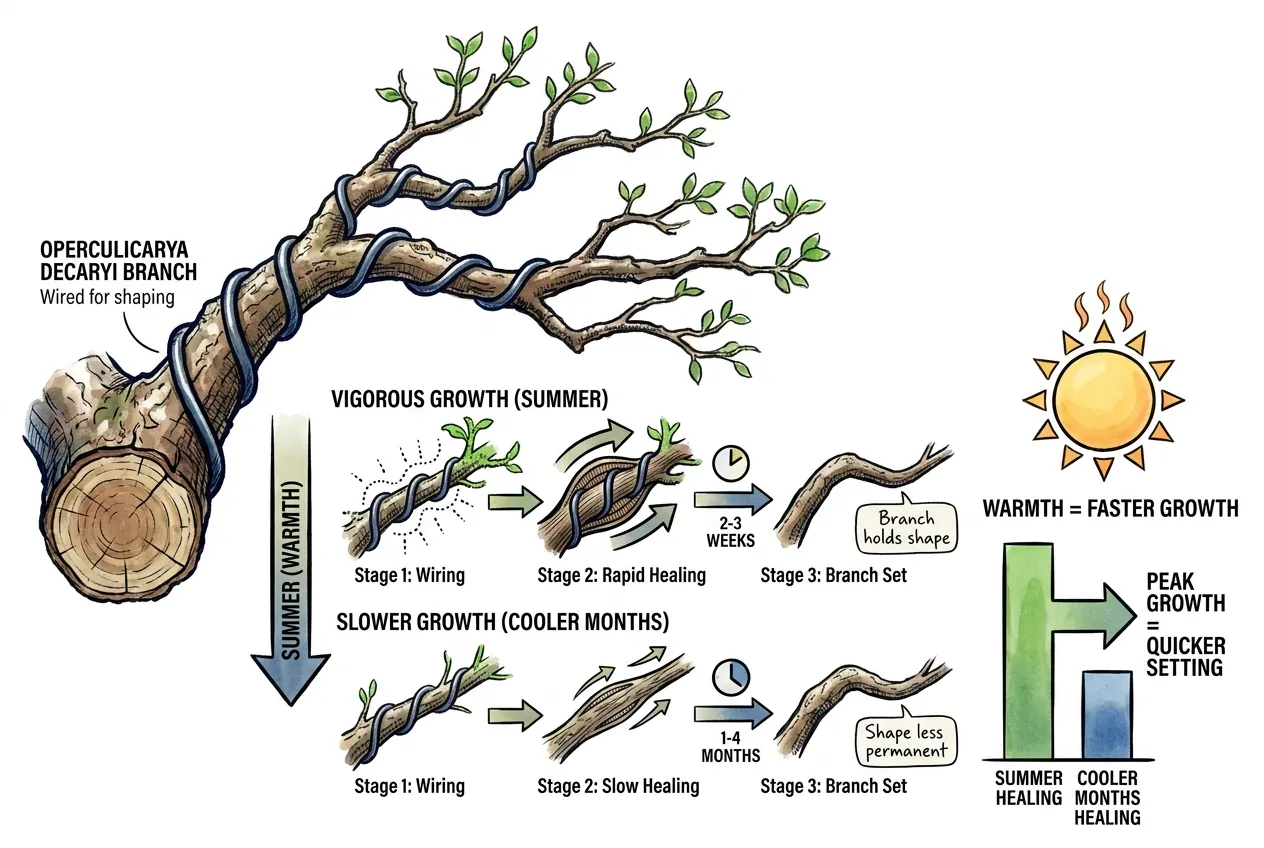
Branches set faster in warm active growth because setting tracks growth speed. General bonsai guidance gives two or three weeks as a rough minimum for a fast-growing deciduous tree and one to four months as a broader range, but those figures are not measured on this species. Warm-season growth sits toward the faster end, while a slow grower such as Operculicarya decaryi may take longer. The principle matters more than exact numbers because the plant grows hardest in warm months.
What goes wrong when you bend a sap-engorged branch?
Protect the cambium during active growth
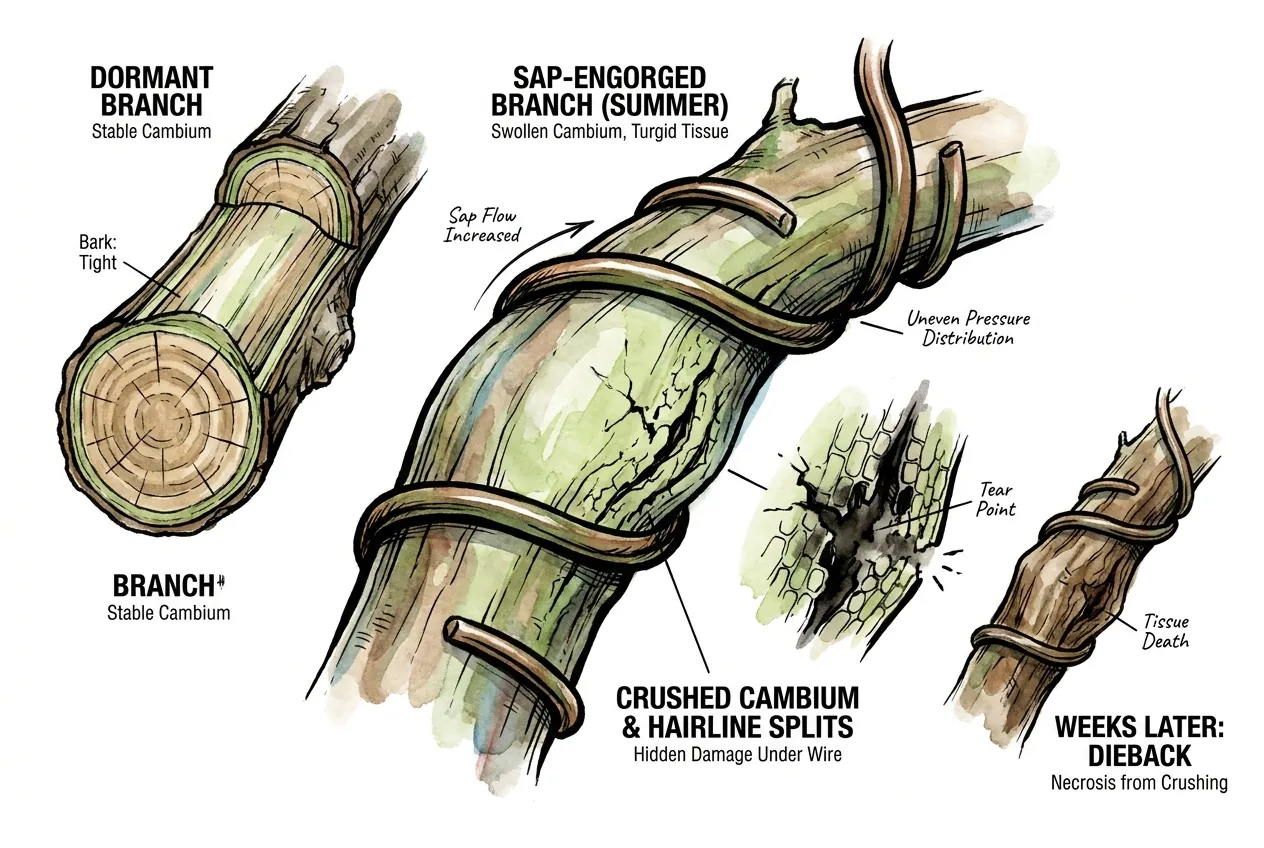
During active growth, sap flow increases and the branch swells while the living cambium is turgid and loosely attached. Hard bending can spread pressure unevenly, crush the cambium, and create hairline splits hidden under the wire that cause later dieback. This is the core risk of summer wiring. Healing can be fast, but tissue is delicate, so technique must become gentler as timing becomes more favorable.
How fast does wire bite in summer, and why does that matter?
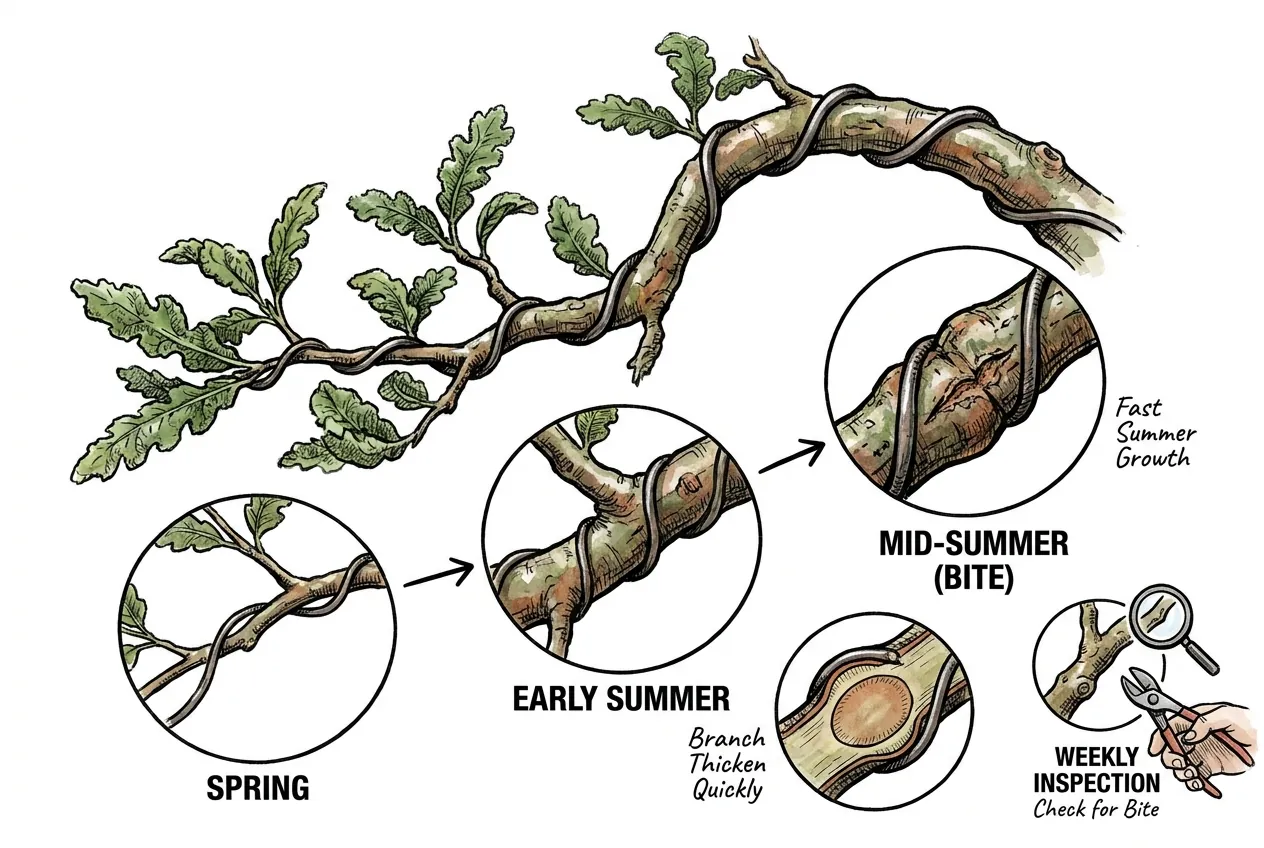
Inspect before the wire bites
Wire bites quickly because summer branches can thicken within weeks. Wire that looked loose in spring may bite by the following month, and even a brief bite can leave lasting marks on smooth bark. Treat it as structural and cosmetic damage rather than a harmless blemish. Inspect wired branches weekly during active growth and remove the wire at the first sign of bite.
What makes Operculicarya decaryi wood different from a Japanese maple?
Set a Conservative Species Baseline
Operculicarya decaryi is a slow-growing Madagascan succulent with a water-storing caudex, tender bark, and brittle older wood. Use more conservative assumptions than for a temperate broadleaf because the structure that permits a bend can also scar or crack. Fast, forceful bending is a poor match for a branch that took years to grow.
What is Operculicarya decaryi, and where does it come from?
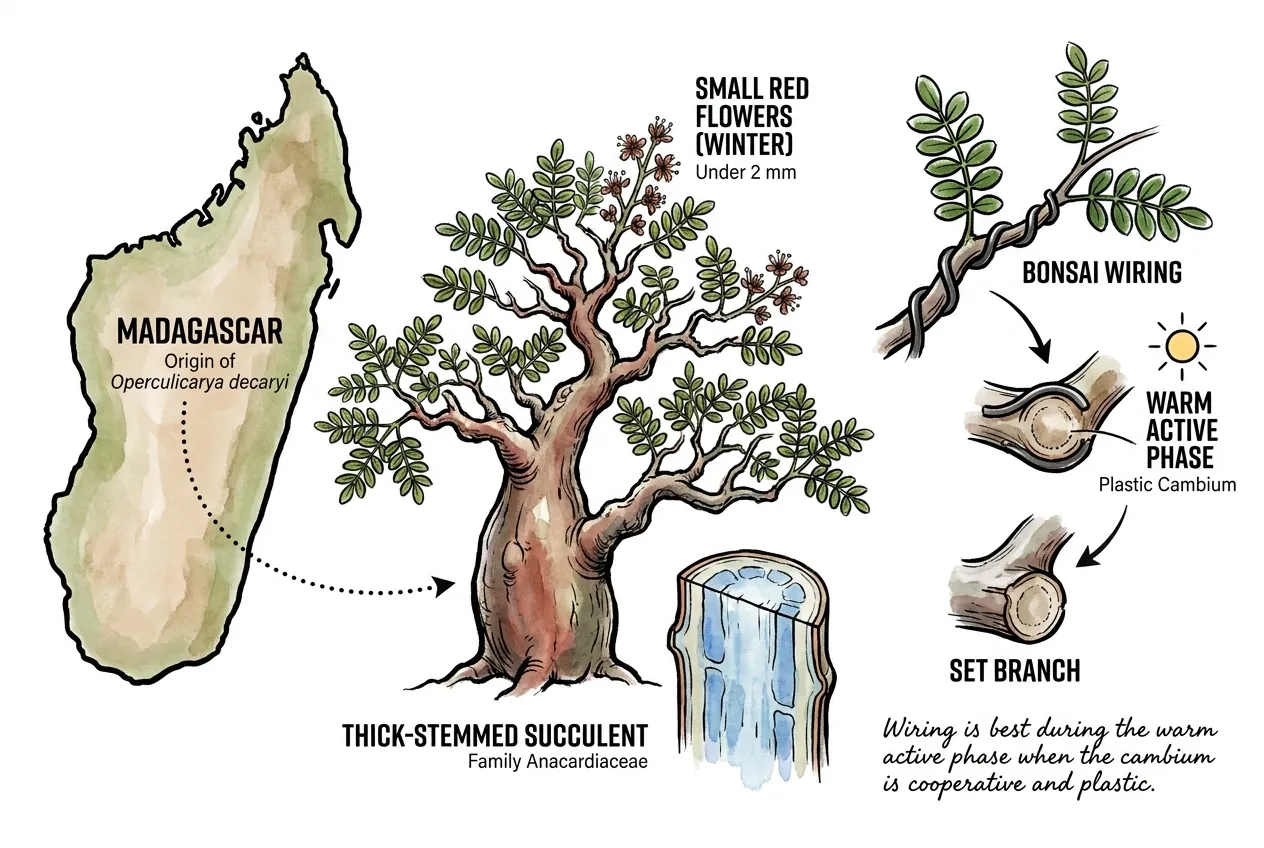
Operculicarya decaryi, the elephant tree or jabily, is a thick-stemmed succulent in the Anacardiaceae family, native to Madagascar and widely grown as bonsai. It produces small red flowers in winter, tolerates drought, and can take bright sun after acclimation, but it is frost-tender. These traits fit a hot, dry, strongly seasonal climate and explain why active warm-season growth is the most useful wiring window while cold or drought stress reduces flexibility and healing capacity.
How does the caudex and succulent tissue change its response to wire?
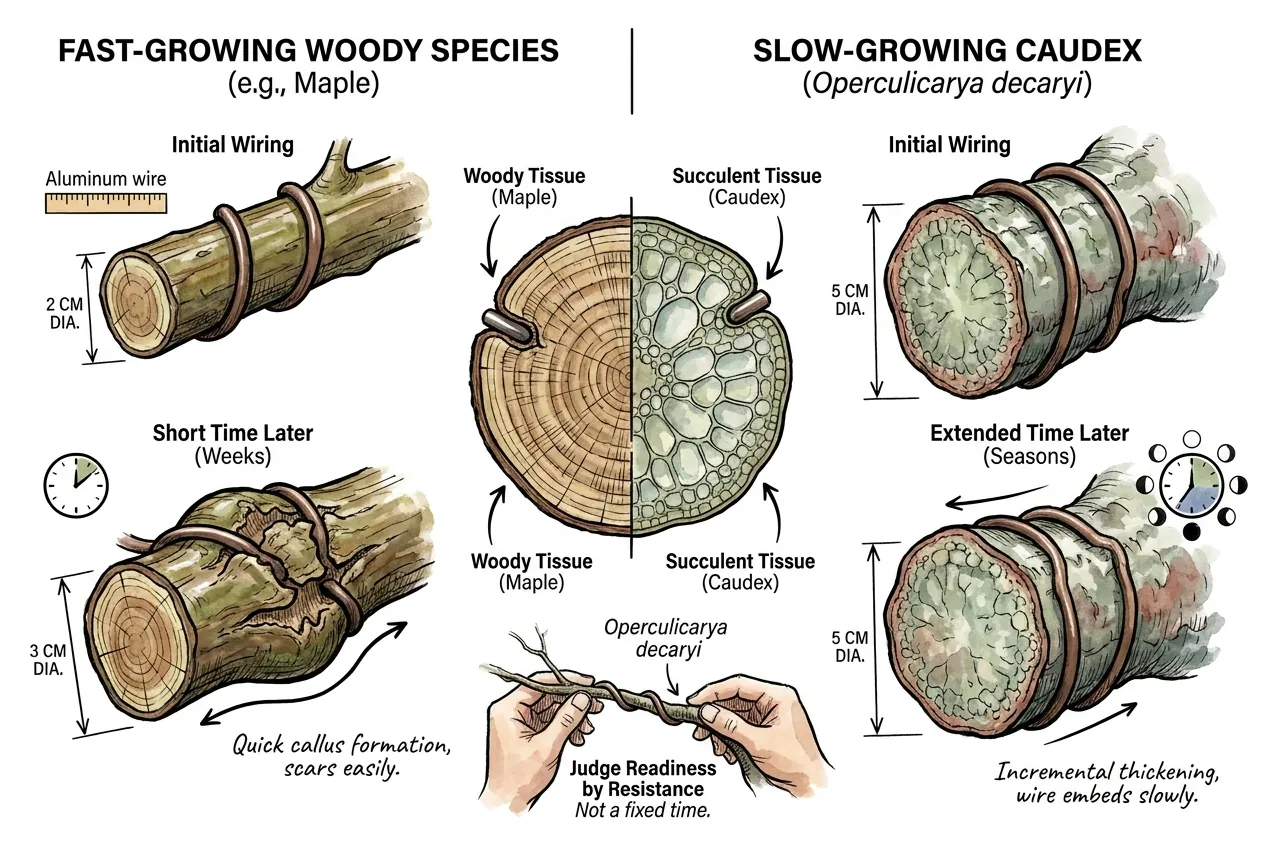
Account for caudex water reserves
The caudex makes the plant a slow, water-buffered grower rather than a fast woody one. The swollen trunk stores water and may support the plant during dormancy, while slow growth can mean slow healing and a longer setting time than a vigorous maple. Judge readiness by resistance and bark condition rather than a fixed number of weeks. Incremental seasonal thickening makes conservative bends and frequent checks important.
Why is its bark so easy to scar?
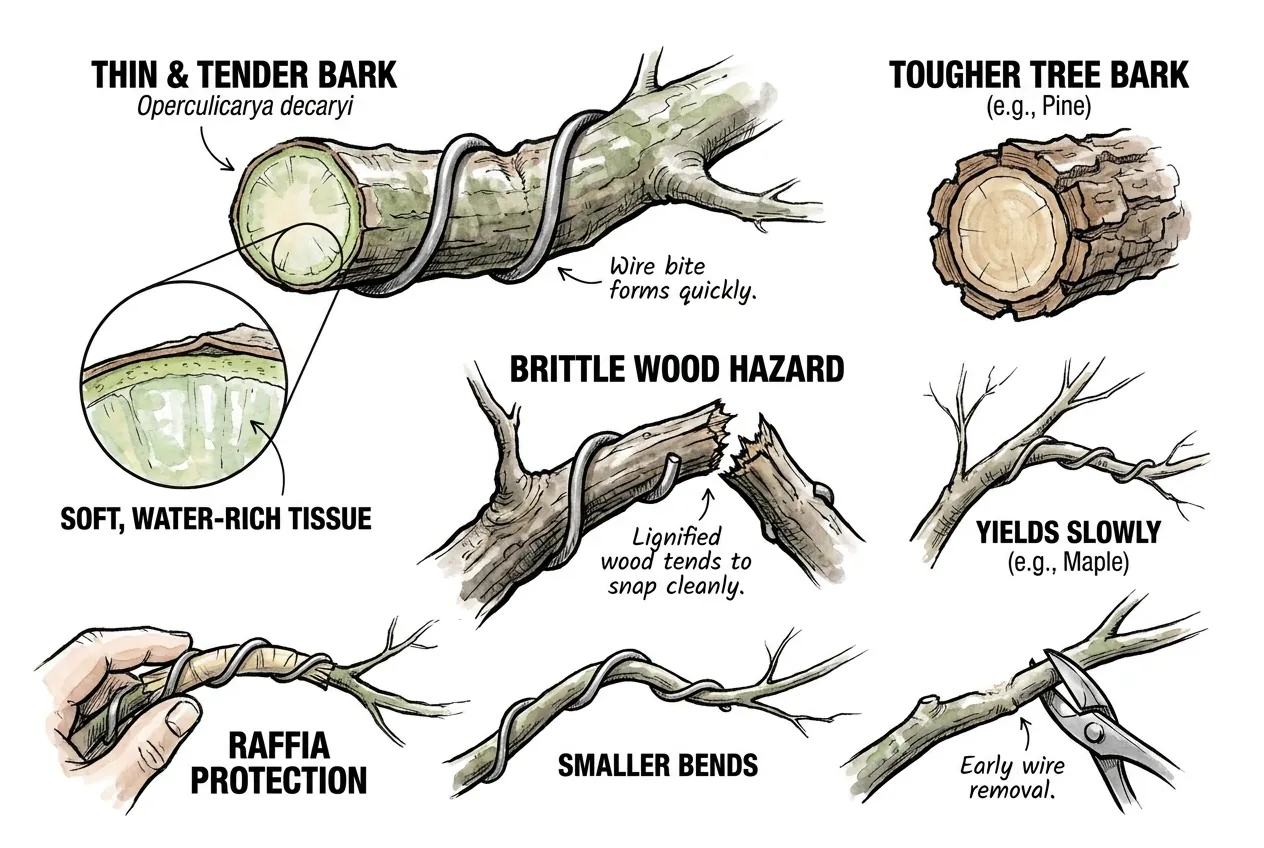
Treat tender bark as a limiting factor
Its bark can scar easily because it is thin and tender over soft, water-rich tissue, much like smooth-barked species discussed in wiring guidance.
If wire starts disappearing into the bark, remove it promptly because damage may already be developing.
Brittle older wood adds a second hazard. Where a maple branch yields slowly, lignified Operculicarya wood tends to snap cleanly once you exceed its limit, so use smaller bends per session, raffia on anything thick, and earlier wire removal than you would risk on a tougher tree.
When exactly should you wire it during the growing season?
Wire an Operculicarya decaryi while it is in vigorous, established warm-season growth, after new shoots have extended and before the plant slows.
Use active growth as the signal rather than a calendar date.
The deciduous leaf-off rule does not apply to a warm-season succulent.
Its cooperative window is heat and active growth, which is the opposite of dormant.
How do you tell the plant is in active growth?
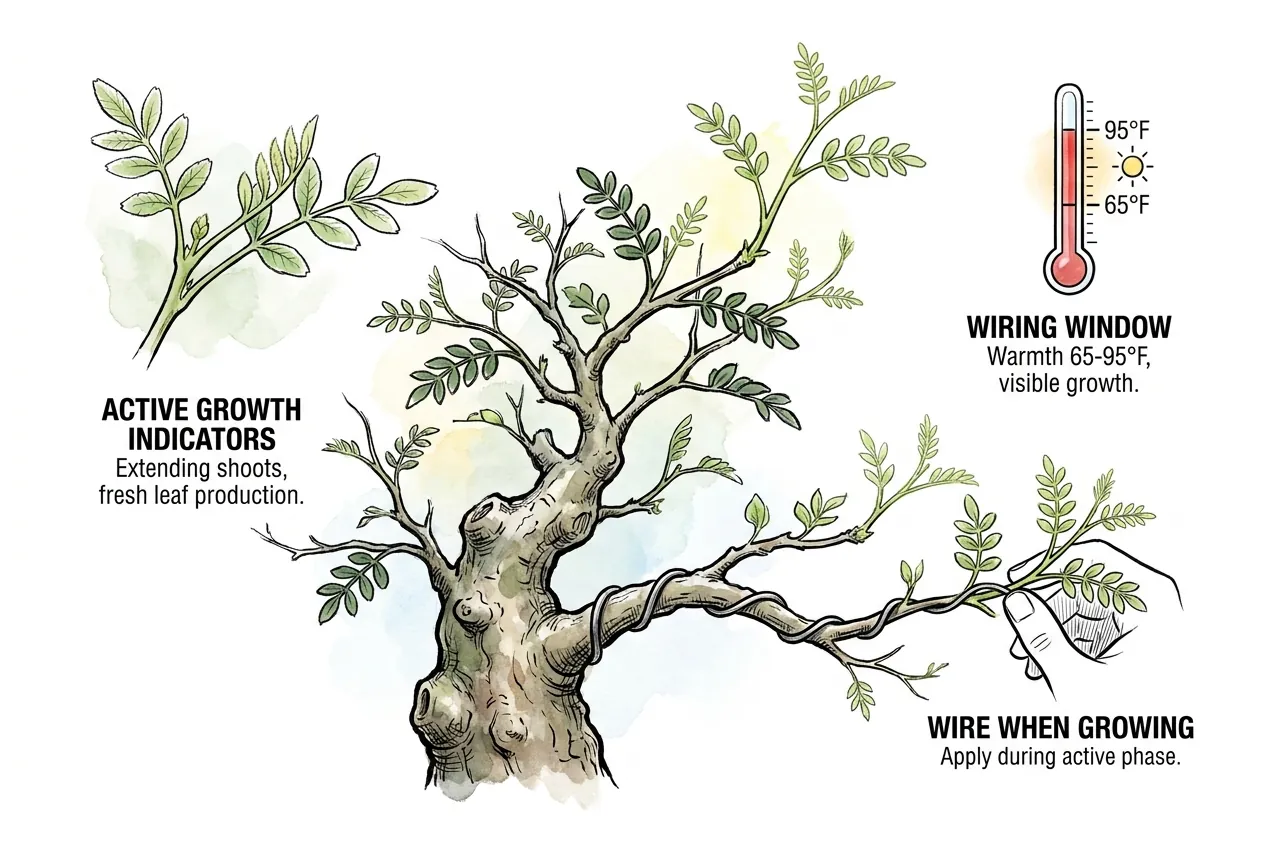
Active growth shows as extending shoots and fresh leaf production.
The species grows in warmth and may enter a cooler-season rest, when it relies more on trunk reserves.
Use temperature as context rather than a fixed band.
Wire when the plant is comfortably warm, visibly growing, and not heat-stressed. A small pot in direct sun can run much hotter than the surrounding air.
Should you wire right after repotting or a heavy watering?
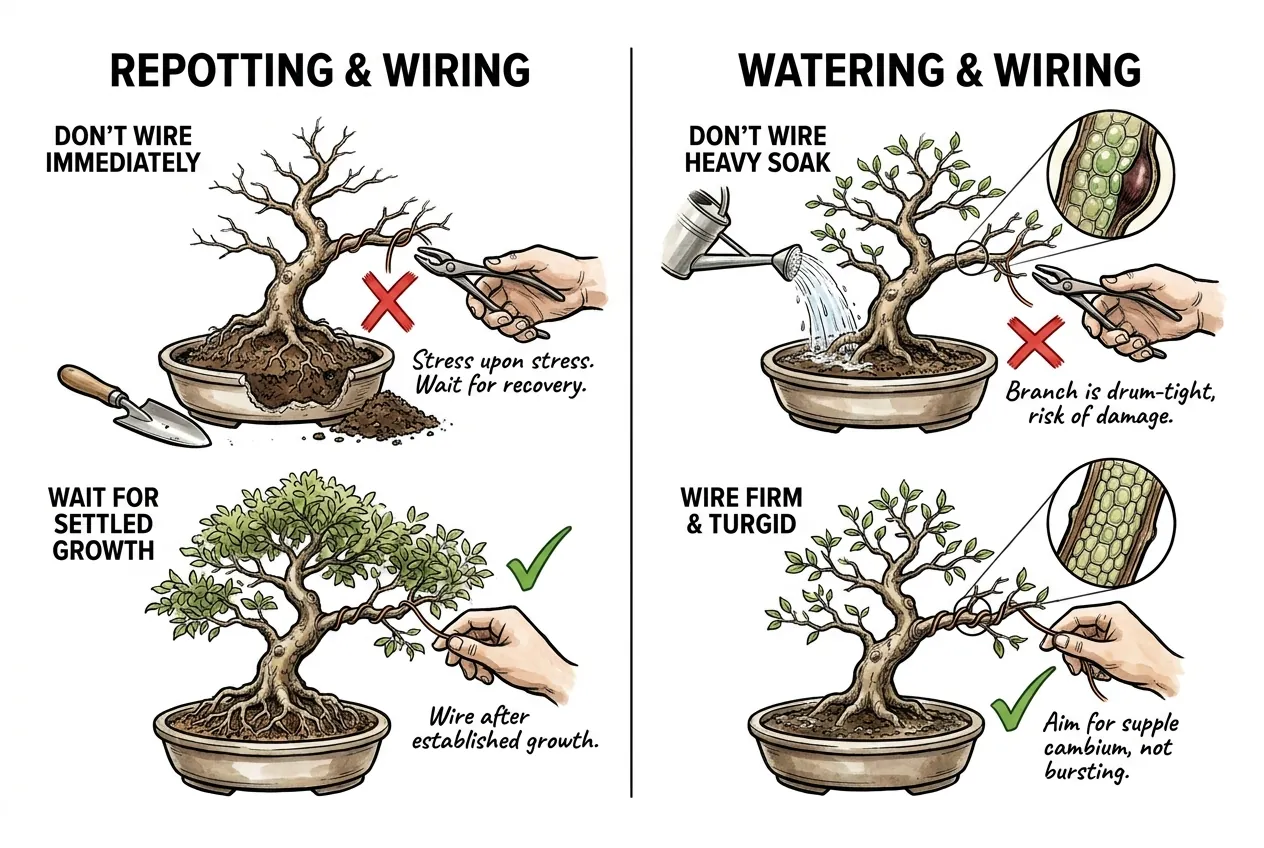
Avoid stacking repotting stress and wiring, and do not bend a branch that is maximally engorged after a fresh soak.
Wait until the plant has settled into steady growth and the branch is firm but pliable.
Water normally before you wire, but do not wire a branch that is drum-tight from a fresh soak.
Aim for firm and turgid, not maximally swollen, so the cambium is supple but not bursting.
This is also the moment the deciduous comparison earns its place.
A temperate tree is often wired at autumn leaf-off for visibility and reduced bruising.
A warm-climate succulent has no equivalent dormant slot, so summer growth is the window by default.
What wire and protection should you actually use?
Use Bonsai Training Wire in a gauge that holds the branch without crushing the bark, and wrap thick or stiff branches in water-soaked raffia first. Aluminum is often easier to modulate on soft-wooded species. Natural raffia fiber can spread the load across tender bark.
Gauge and protection reduce risk, but they do not replace gradual bending and frequent inspection.
What wire gauge matches a given branch?
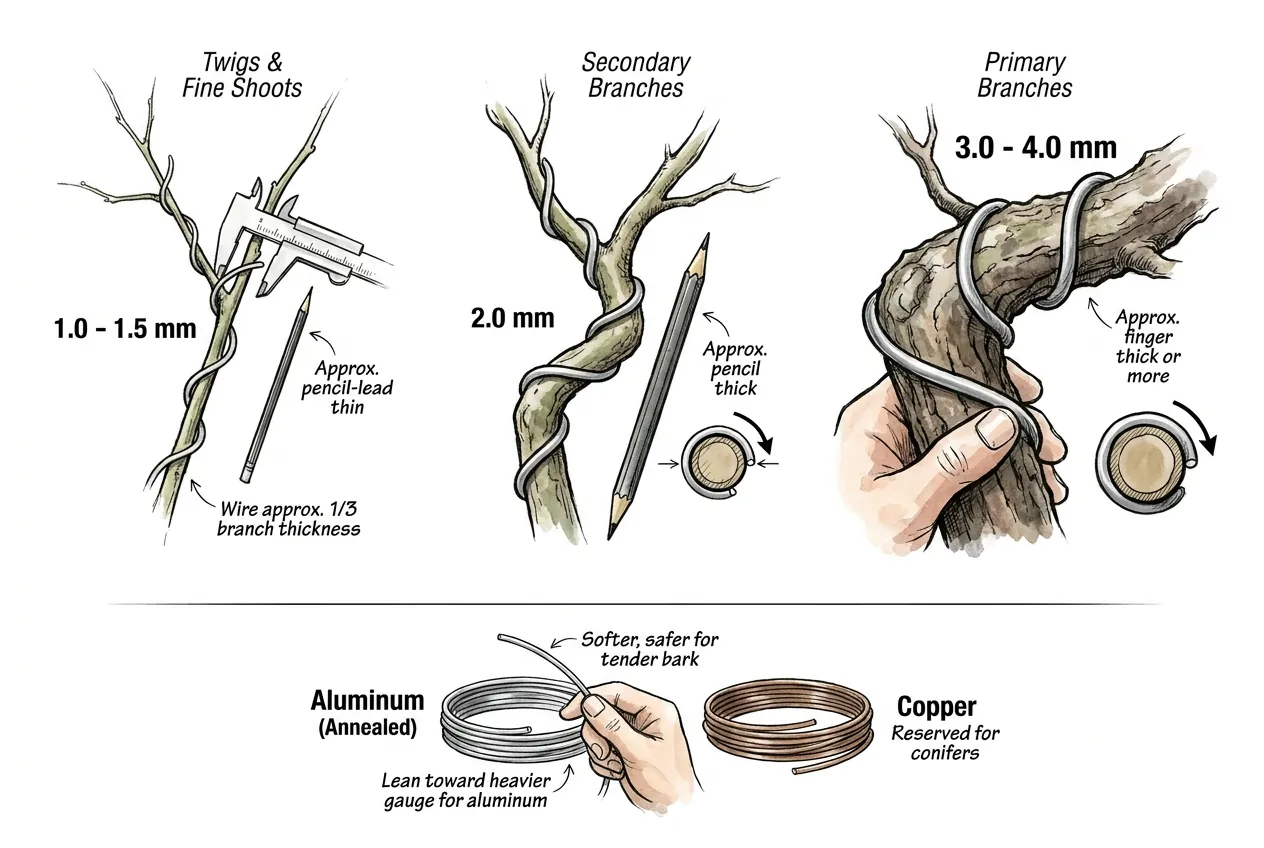
A useful starting point is a wire that can hold the branch without forcing it, but the correct gauge depends on branch length, leverage, alloy, and bark condition.
Too thin will spring back. Too thick can crush tender bark.
For aluminum specifically, lean toward the heavier side of any estimate, because aluminum is softer than copper and needs more cross-section to hold the same load.
The common gauge map below covers most of an Operculicarya canopy.
Wire gauge cheat sheet
| Branch type | Approx. branch size | Aluminum gauge |
|---|---|---|
| Twigs and fine shoots | pencil-lead thin | 1.0 to 1.5 mm |
| Secondary branches | pencil thick | 2.0 mm |
| Primary branches | finger thick or more | 3.0 to 4.0 mm |
For a soft-wooded caudex bonsai, annealed aluminum such as Bonsai Training Wire is often a practical default. Aluminum suits soft, deciduous-type wood, while harder copper is usually reserved for conifers and pines. Copper’s extra holding power may not justify its higher crush risk on tender bark. Treat the sizes in the table as starting points and confirm by holding the wire against the branch. The gauge is right when it holds the bend without your having to fight it.
A multi-gauge wire set can cover several branch sizes, but check the current listing and match the actual wire to the branch rather than copying a fixed table. A thick primary branch may need a guy wire or staged support instead of heavier coil wire.
When and how do you use raffia?
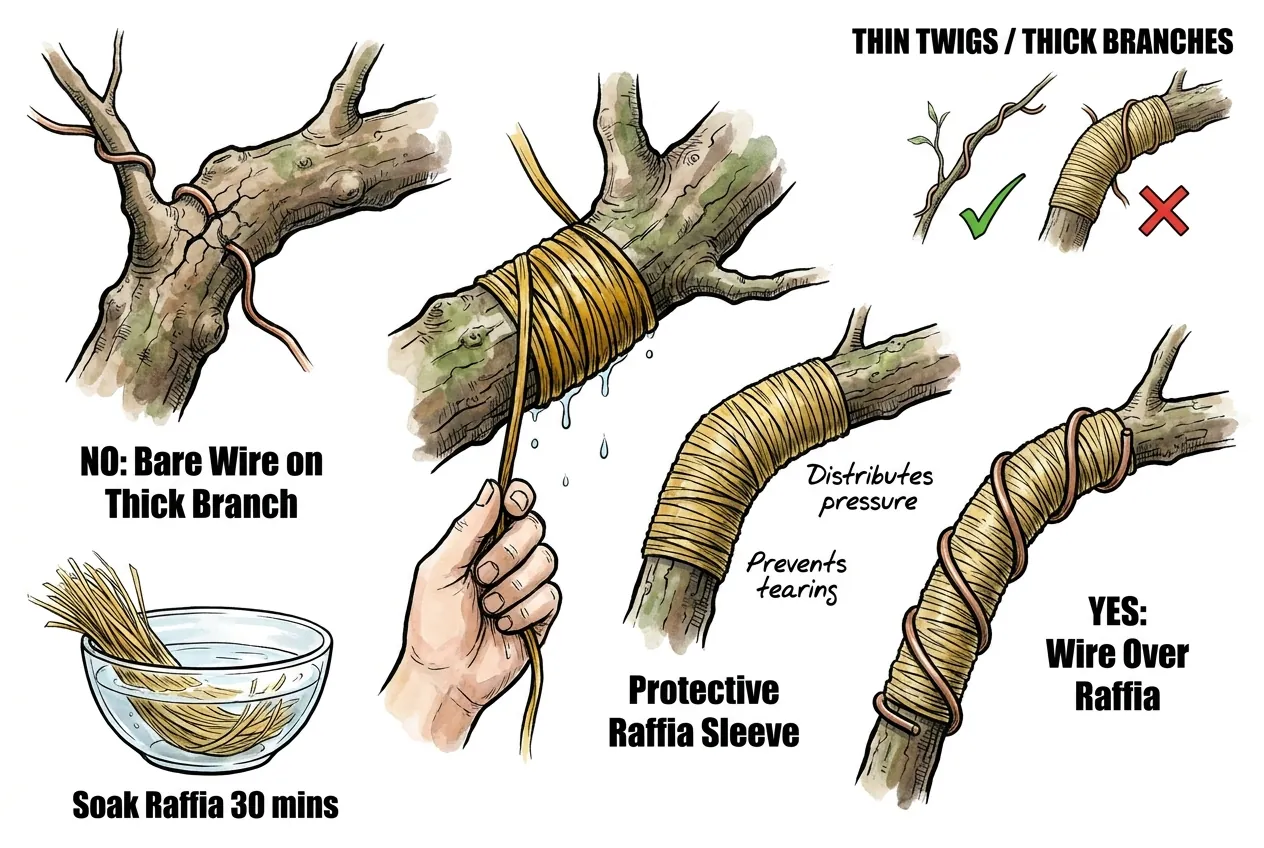
Spread pressure with soaked raffia
Use raffia on any branch thick or brittle enough that bare wire could crush it. Water-soaked raffia conforms to the branch and dries into a firm sleeve that distributes pressure and reduces splitting risk on the outer face of the bend. Soak and wrap it according to current instructions. Thin twigs may not need the added bulk.
How do you make the bend without cracking brittle wood?
Bend from the Inside in Small Increments
Wrap the wire at an even diagonal angle, then bend from the inside of the curve while supporting the outside. For branches too thick to wire safely, use a guy wire and load the bend gradually over several sessions. If the wood cracks, stop and stabilize it before considering any sealer. The technique protects the outer tension face where brittle wood fails.
What is the correct wrapping and bending technique?
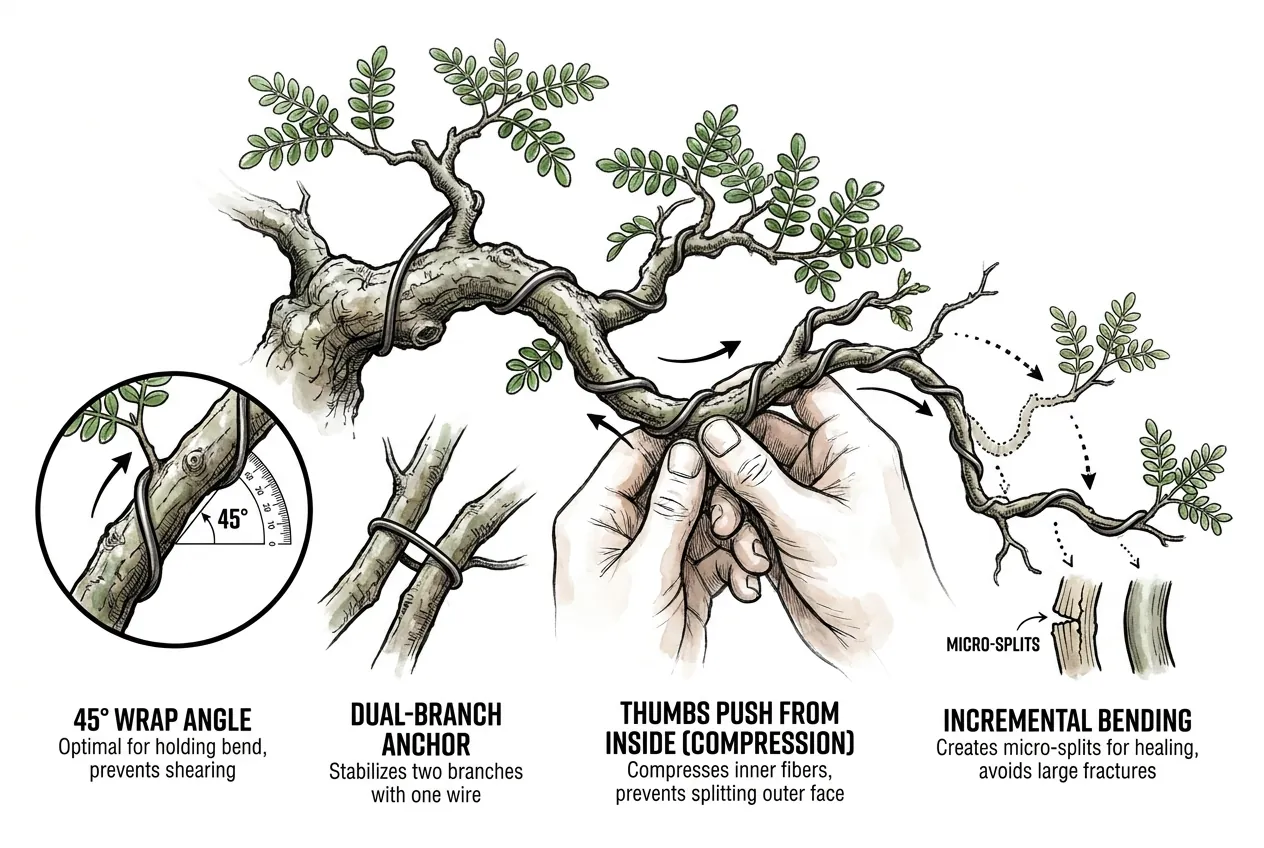
Start with an even wrap angle that holds the branch without cutting across the bark. Where two branches of similar thickness sit near each other, use one wire only when the anchor is stable and neither branch is forced. Hold the outside with your fingers and bend from the inside with your thumbs, which compresses inner fibers and protects the outer face. Move in small increments so the wood passes its spring-back point without overload. A gentle progressive bend is safer than a single hard crank.
How do you bend a branch too thick to wire?
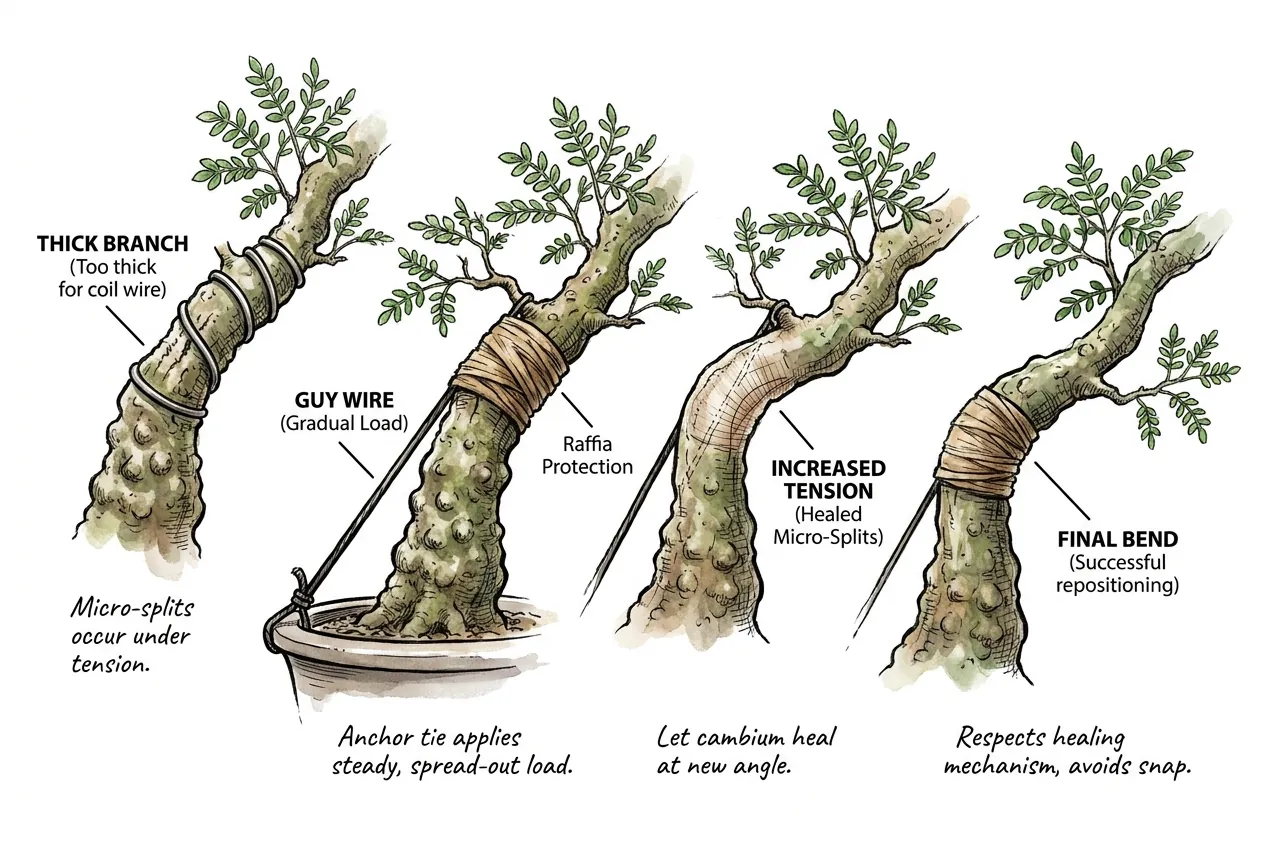
Stage heavy bends with a guy wire
For a branch too thick for safe coil wire, use a guy wire that pulls toward a fixed point and spreads the load. Make part of the bend, let the branch settle over days or weeks, then increase tension. Gradual loading stays within what the wood can take rather than overwhelming it. Heavy bends still benefit from raffia because the tie can bite tender bark at its contact point.
What do you do if the branch cracks?
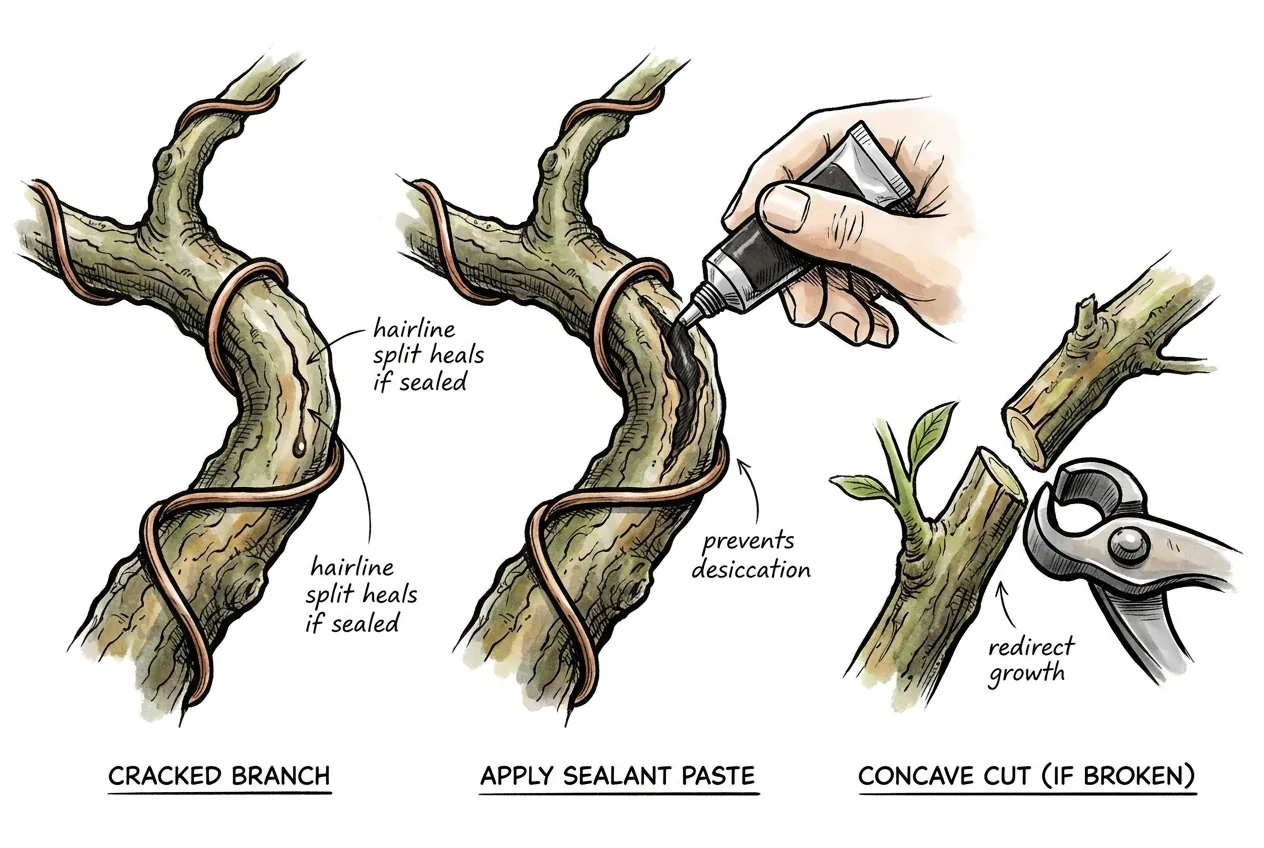
Stabilize a crack before treating the surface
If the branch cracks, stop bending and stabilize it. Ease off the tension, splint or tie the split so the faces remain aligned, and keep it from moving. Alignment and immobilization may help a small split stabilize, but complete reconnection is not guaranteed. Realignment and support matter more than paste.
Some growers finish by dabbing the crack with a cut paste such as Kiyonal sealer, a 100 g Japanese product sold for pruning and grafting cuts. Be aware, though, that university extension guidance on woody wounds generally finds that dressings do not speed closure and can trap moisture, so treat any sealer as optional, not a fix, and never as a substitute for holding the split together.
No paste restores a fully snapped branch. A branch that has broken through may be better cut back cleanly to a node where new shoots can emerge. Choose a concave branch cutter and cut location from branch size and tissue condition. The linked demonstration shows pruning and wiring on a live Operculicarya decaryi.
When and how do you remove the wire?
Remove Wire at the First Bite
Remove the wire at the first sign it bites into bark, even if the branch has not fully set. Inspect often during active growth because swelling and scarring can progress quickly. Cut the wire off in short segments rather than unwinding it. Removal is as important as setting the bend, and leaving wire after it bites can turn a successful bend into a lasting scar.
How long until the branch holds the new position?
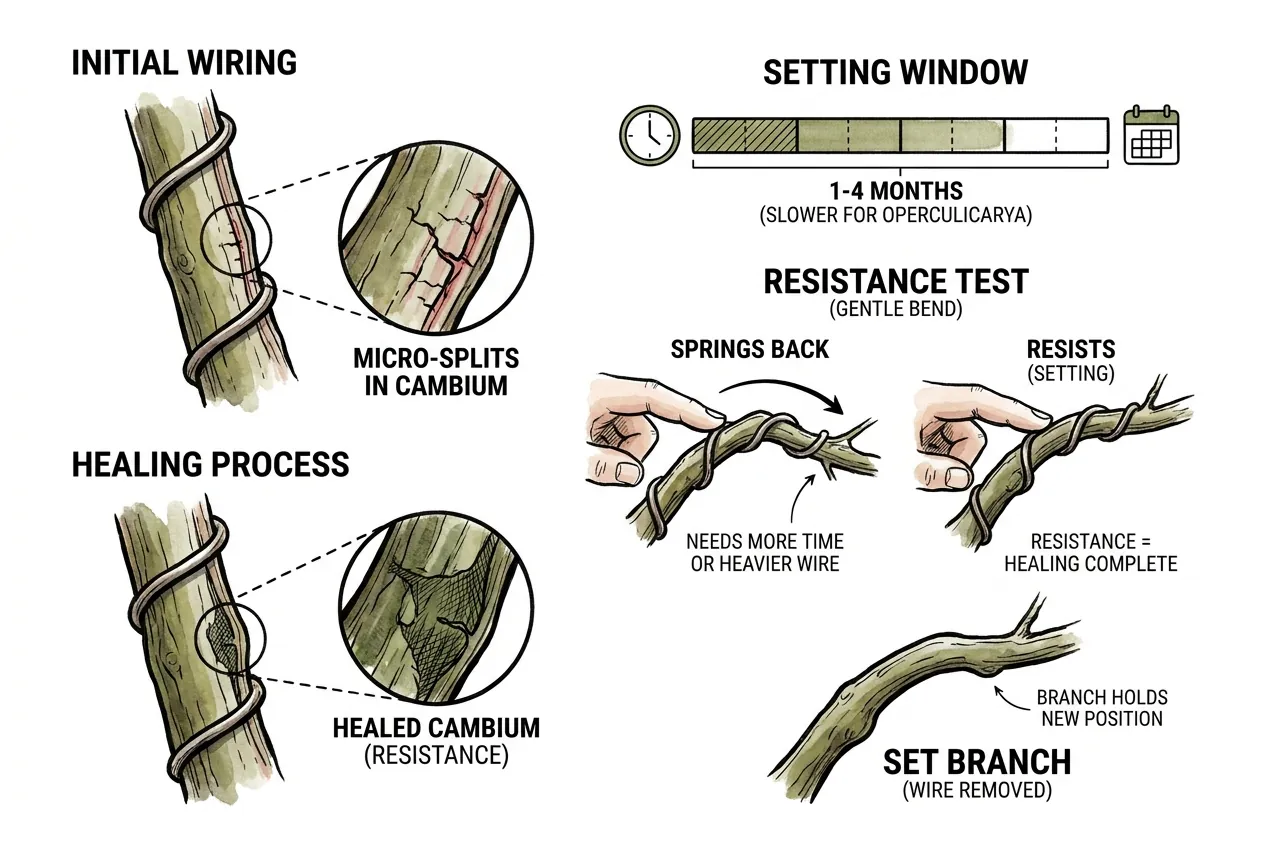
The branch holds once it has taken enough of a permanent set and grown enough new wood to resist returning. Vigorous growth may shorten the interval, while a slow plant may need longer. Judge by bark pressure and the branch’s response rather than a fixed calendar window.
The most direct set test is to remove the wire and see what the branch does on its own.
With the wire still on, much of the resistance you feel is the wire, not the wood, so it tells you little about whether the branch has set.
When you think it may be ready, cut the wire off and watch. If the branch holds its new position, it has set. If it springs partway back, re-wire and give it more time, or step up a gauge.
Because taking the wire off and re-applying it is itself a small risk to tender bark, do this only when the timeline and the feel of the branch both suggest it is close.
How often should you check a wired branch in summer?
Check frequently during active growth and after changes in watering or temperature because long intervals can miss the first bite. Watch bend points first, where pressure is highest. Remove the wire at the first subtle sign because scars can last for years on this bark.
Immediately after wiring, I take a close photograph from the branch base toward the tip and annotate three coils on a duplicate image. I choose the first anchored turn, the turn at the bend apex, and the last loaded turn. The marks exist only in the image, never on the bark.
Every inspection begins with the three witness coils in a fixed branch-side view anchored to the pot-rim mark. I check for bark swelling beside the wire, flattening under the coil, a dark contact line, or a turn sinking into tissue. A complete groove around the branch is never my removal threshold.
I record watering, strong heat, and sudden shoot extension between checks because rapid swelling can make the previous inspection interval obsolete. If any witness coil begins to bite, I cut off the entire wire in short pieces rather than loosening only that turn and leaving pressure elsewhere.
How do you take the wire off without tearing the bark?
Cut the wire off rather than unwinding it. Snip the coil into small segments with wire cutters and lift each piece away because unwinding drags it across tender bark and can tear the surface. This is gentler around tight bends. Treat any wire disappearing into bark as an emergency because the scar is already forming.
How do you care for and troubleshoot a freshly wired tree?
Return to the Established Care Rhythm
After wiring, keep the plant in its normal bright, warm spot and water according to its established dry-down cycle. Watch for crushed-cambium signs under the wire and remove or adjust it promptly. If a branch springs back, reassess wood maturity, gauge, and whether pruning is safer than another bend. These steps follow from the interaction between wood mechanics, growth, hydration, and wire pressure.
How should you care for the plant right after wiring?
Care for it as an established growing Operculicarya with bright acclimated light, protection from heat stress, and watering based on actual dry-down. A small pot in sun can dry faster than surrounding air, but overwatering to help recovery is risky because the caudex stores reserves and soggy roots add stress. Light and warmth support recovery more reliably than extra water. Use a fast-draining mix whose dry-down suits the pot and season because no fixed perlite percentage or number of days guarantees aeration.
What are the signs of crushed cambium or wiring dieback?
Recognize crushed cambium early
Signs include sunken, darkening, or dying bark under the coil and wilt or shrivel beyond the bend. Active-growth bends can crush cambium and leave hidden hairline splits that later cause dieback. When wire begins disappearing into swelling bark or discoloration appears, remove it first and assess the wound. Sealer is optional and does not replace stabilization. Early removal gives living cambium a better chance to recover.
What do you do when a branch springs back?
Change the support plan when wood refuses
When a branch springs back, the position may not have set or the wood may be too lignified to hold. Reassess timing, support, and tissue condition. Possible responses are a lighter staged re-wire during active growth, a guy wire, or pruning back to a healthy node when the branch is beyond a safe bend. New shoots are usually more flexible, but their number depends on vigor, season, and light. When old wood refuses, grow new wood and train that instead.
What are the most common summer wiring mistakes?
The most common mistakes come from treating a tender succulent like a tough temperate tree. Each one maps to a rule established above.
Forcing a thick branch in one motion
Forcing a lignified branch in a single hard bend can snap it. Bend from the inside of the curve and load gradually so tissue is not overloaded.
Skipping raffia on thick branches
Bare wire on a thick branch can crush tender bark, so wrap water-soaked raffia first on anything stiff enough to resist.
Leaving wire on to be safe
Leaving wire on longer than needed can scar the branch during active growth. Inspect frequently and remove it at the first sign of bite.
Wiring a stressed or freshly repotted plant
Stacking wiring on repotting or drought stress slows healing and invites dieback. Wire a settled, turgid plant that is actively growing.
Using copper on tender bark
Copper’s extra holding power may not offset its crush risk on tender bark. Annealed aluminum is often easier to tune for this soft-wooded species, but confirm the material and gauge against the branch before committing.
The summer wiring playbook
Use the Complete Summer Wiring Playbook
Summer wiring balances flexible active tissue against rapid thickening and scar risk. Timing, gauge, protection, and removal all matter.
Wire during established warm-season growth, when the plant is visibly extending shoots and not heat-stressed. Choose a gauge that holds without crushing and use annealed aluminum when it suits the bark.
Protect thick branches with soaked raffia, bend from the inside of the curve, and load heavy bends gradually with a guy wire.
Check often during active growth, judge set by removing the wire and seeing if the branch holds, and cut the wire off at the first hint of bite.
When old wood refuses, stop forcing it. Stabilize any crack, prune back to a healthy node when appropriate, and train fresh flexible shoots.
Affiliate Disclosure
This article contains Amazon affiliate links. As an Amazon Associate I earn from qualifying purchases. If you use these links, the site may earn a commission at no extra cost to you. Product availability, price, and specifications can change. Check the current listing before buying.