
Adenium Bonsai: Build and Shape a Strong Caudex
Build an Adenium bonsai with the right starting plant, light, substrate, feeding, root work, pruning, and grafting, without risky growth hacks.
Derek Kim · 2026-01-03 · Updated 2026-06-12 · 14 min read

Key Takeaways
- A thick Adenium base comes from genetics plus sustained active growth. Water refills and pruning cannot add permanent girth on their own.
- Start from seed when the caudex is the priority. Seedlings build the broad, continuous base. Graft only when an exact flower matters more than the base.
- Give strong light, warmth, and a fast-draining root zone that re-airs between waterings. These, plus steady modest feeding and time, are what actually thicken the base.
- Use pruning and root lifting to reveal a shape that already exists, not to add girth. Schedule one major stress at a time so the plant can recover.
- Skip growth-regulator and starvation shortcuts. The Adenium evidence does not show they build a bigger caudex, and some cause lasting injury.
An Adenium can look like a finished bonsai while still being a young succulent. That is part of its appeal, but it also creates bad advice.
Some growers starve it for a hard caudex, bury it in fertilizer, prune it to force thickness, or use a growth regulator to make it squat. Those methods confuse temporary appearance with healthy, lasting growth.
| Your priority | Best starting point | Main trade-off |
|---|---|---|
| A broad, natural-looking base | Seed-grown plant with good radial roots | Flower color and form may not match either parent |
| An exact named flower | Named scion grafted to a vigorous rootstock | The graft union may remain visible |
| Clone a plant you already own | Cutting or air layer | The base usually develops more slowly and differently |
| Compact branch structure | Healthy plant pruned during active growth | New bud number and direction are not fully predictable |
| Exposed sculptural roots | Gradual lifting at planned repots | Newly exposed tissue needs sun acclimation and closer water checks |
Should You Start an Adenium Bonsai from Seed or a Cutting?
When Seed-Grown Structure Matters
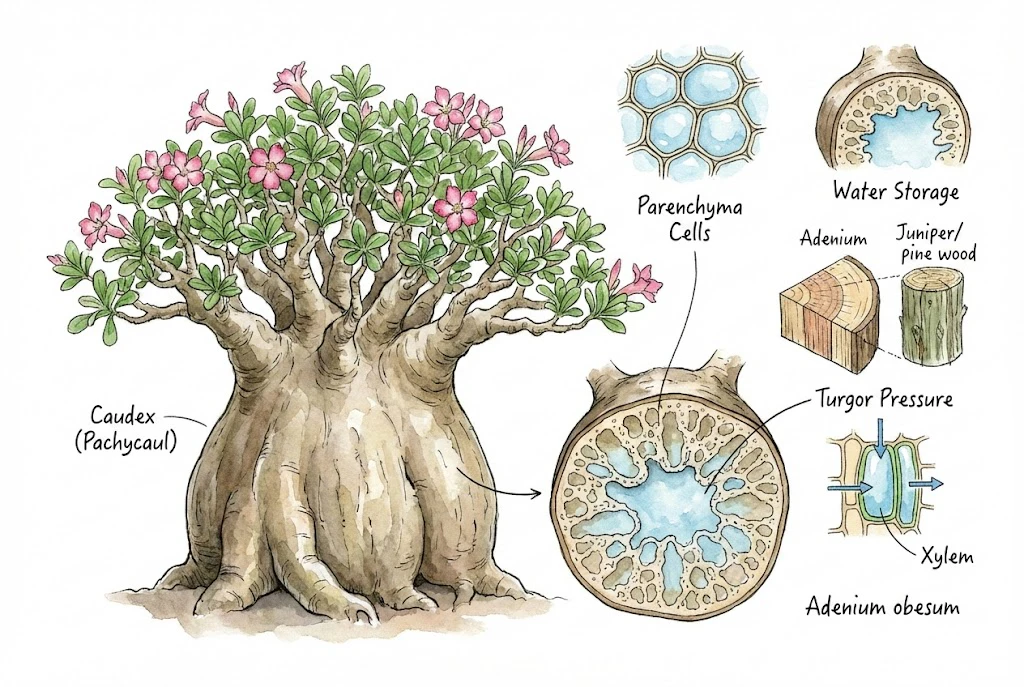
Seedlings form a swollen hypocotyl and primary-root system early. That juvenile architecture tends to produce the broad, continuous base most growers want, which is why seed-grown plants are the usual choice for bonsai stock and grafting rootstock. The seed-germination setup covers the warmer, more evenly moist conditions seedlings need before adult care begins.
When a Cutting Is the Better Choice
Cuttings are not fake caudex plants. University of Arizona guidance notes that a cutting from a well-developed plant can form a caudex over several years. It usually begins with adventitious roots, new roots straight from the stem, rather than the seedling's swollen-base-and-taproot system, so the silhouette and pace differ.
A cutting is valuable when cloning a flower matters more than preserving a seedling’s broad-base architecture.
When Flower Identity Comes First
Seeds also come with a genetic trade-off. Named Adenium cultivars do not reproduce true from seed. If an exact double or multicolor flower is non-negotiable, buy the plant in bloom or graft a verified scion onto a seed-grown base.
What Actually Makes the Caudex Thicker?
Distinguish hydration from permanent girth
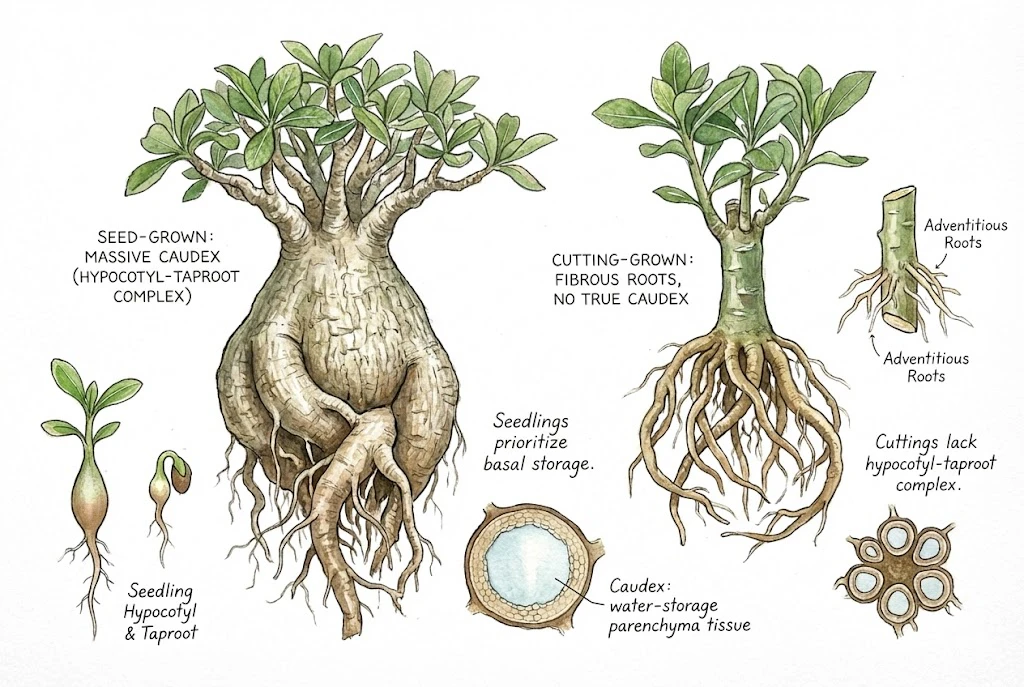
The swollen base contains living water-storage tissue supported by vascular and woody tissue. Watering restores turgor and can make a slightly soft caudex feel firm again, but that short-term refill is not the same as permanent girth. Lasting thickness comes from cell production and secondary growth supported by light, healthy roots, adequate water, nutrients, warmth, and time.
Water by Growth State
This is why repeated drought is a poor thickening program. A mature plant can survive it, but survival is not growth. During an active warm period, water the root ball thoroughly after it has dried appropriately, then let it drain and regain air. During a cool rest, reduce water because the plant is using it slowly.
Measure at the Same Point
Measure progress once a month at the same height and at a similar point in the watering cycle. A single measurement made just after watering mostly records hydration. A series records growth.
I establish a measurement band 10 mm above the first recorded soil line and keep that band unchanged after later repotting. Measurements occur 24 hours after routine watering that has drained freely for 30 minutes, and I never water solely to meet the measurement date. The same flexible tape touches the surface without compressing the caudex.
At each monthly check, I photograph two fixed sides with the pot-rim orientation visible and note any newly exposed roots. I interpret a trend only after three readings taken 30 days apart during visible leaf and shoot growth. Fixed height, hydration timing, and repeated readings keep soil exposure or one water-storage swing from appearing as structural growth.
How Much Light Does an Adenium Bonsai Need?
Acclimate light and pot heat together
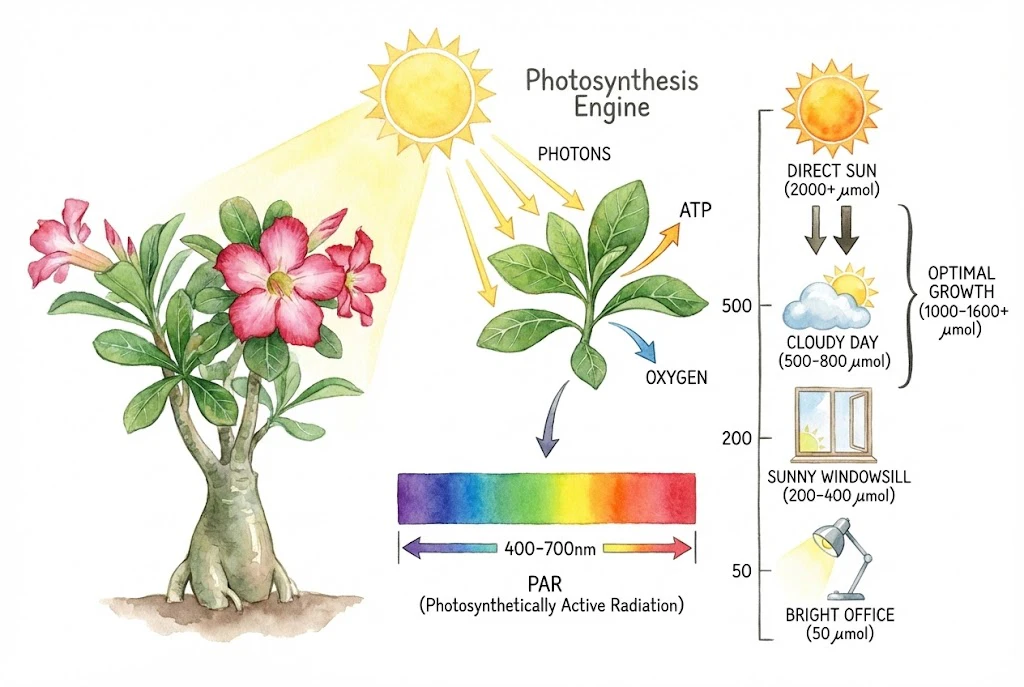
Adenium needs bright light to keep internodes compact and flower reliably. A setting described as full sun is not universal.
A plant raised indoors can burn when moved outside abruptly, and a dark pot can overheat before the leaves show obvious stress.
Increase outdoor exposure in steps and watch the plant and root zone separately.
Use PPFD to Compare Setups, Not as a Magic Minimum
Read PPFD as a Comparison
Photosynthetic photon flux density, or PPFD, is useful for comparing a windowsill and a grow light. It does not describe the whole day by itself, and the online claim that Adenium requires at least 1,000 µmol·m⁻²·s⁻¹ confuses bright midday readings with a minimum for growth.
Use Plant Signals to Adjust
Long pale internodes and a one-sided lean point to insufficient or uneven light. Bleached patches after a move outdoors point to an acclimation problem. Measure several canopy positions and adjust distance or coverage before buying more wattage. The grow-light guide explains footprint, PPFD, and daily light in one workflow.
What a Supplemental Lamp Can Do
A compact LED grow lamp can supplement light for one small plant, but its useful footprint matters more than the wattage printed on the box. Measure at the leaves and move or dim it if the canopy bleaches or heats excessively. Use it to close a measured light gap, not to promise faster caudex growth.
What the Florida Shade Trial Did and Did Not Show
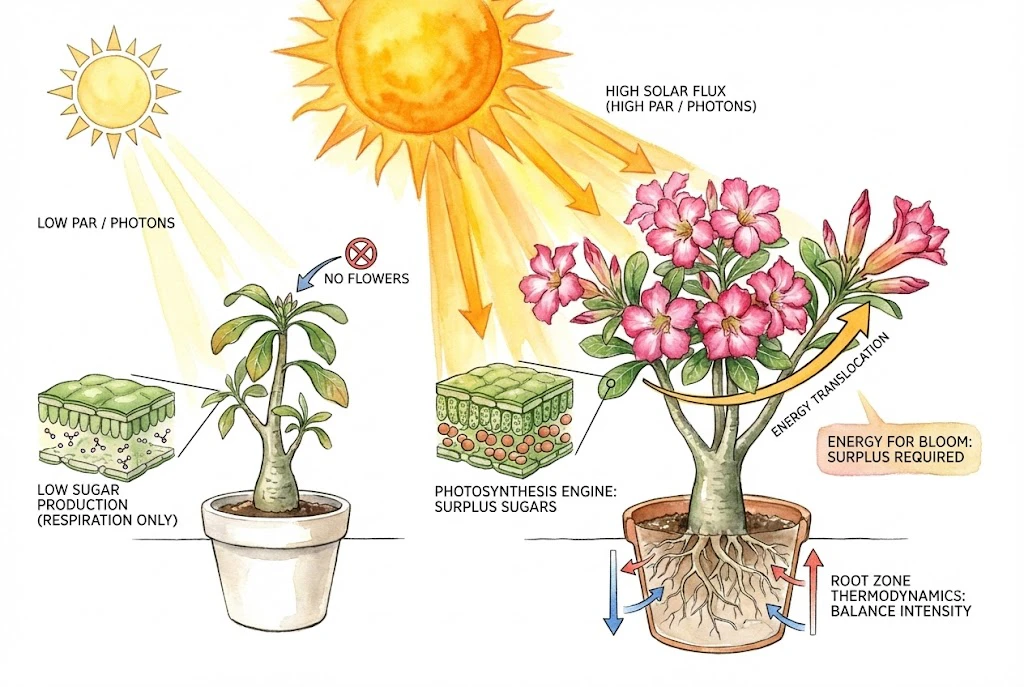
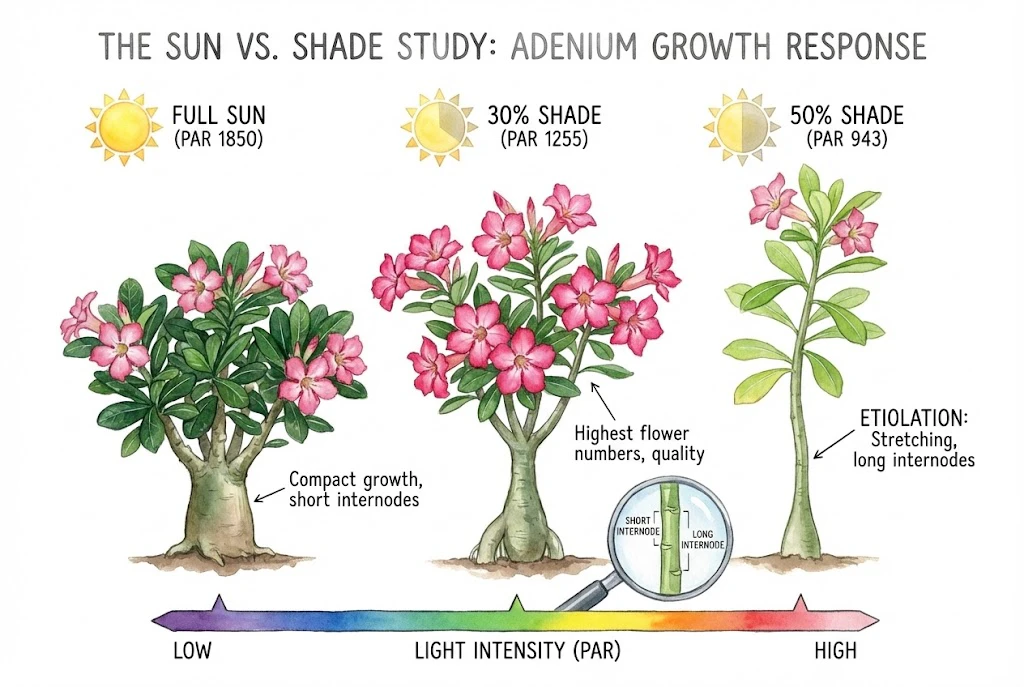
A 16-week Florida trial compared two Adenium obesum cultivars in full sun, 30% shade, and 50% shade. Under those conditions, 30% shade produced the highest flower number and overall quality, while 50% shade produced taller plants with poorer flowering. Full-sun plants stayed comparatively compact.
That result is useful in a hot, high-light climate, but it is not proof that every Adenium should receive 30% shade. The trial tested two cultivars, a particular season, and commercial container production. It did not resolve which treatment builds the largest caudex. Indoors, insufficient light remains the more common problem.
What Substrate and Watering Pattern Work for Adenium?
Choose Drying Time over a Recipe
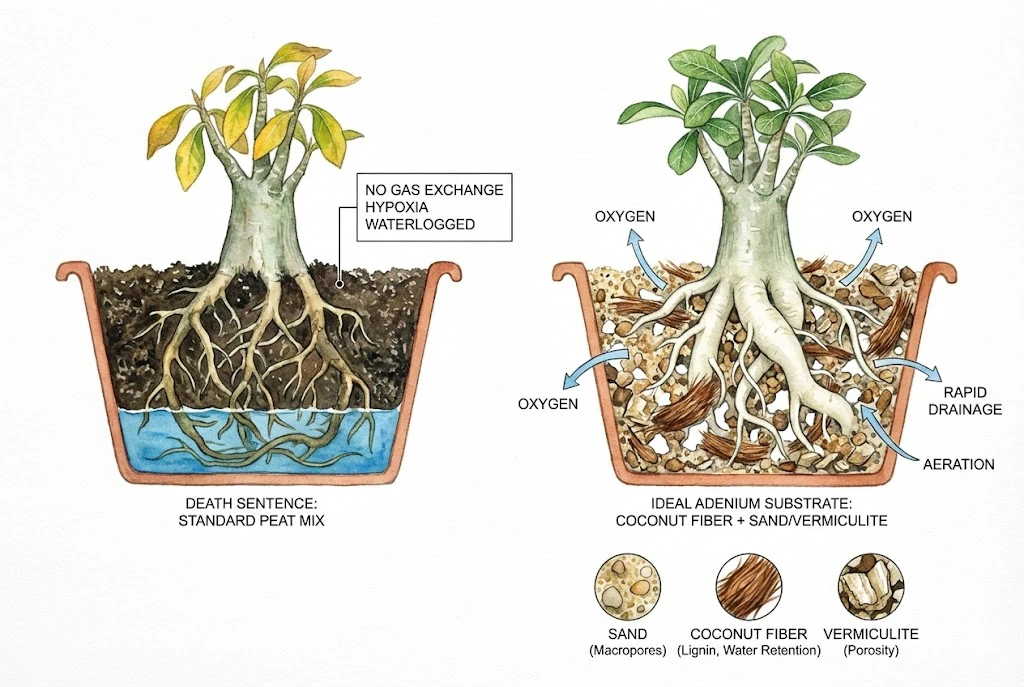
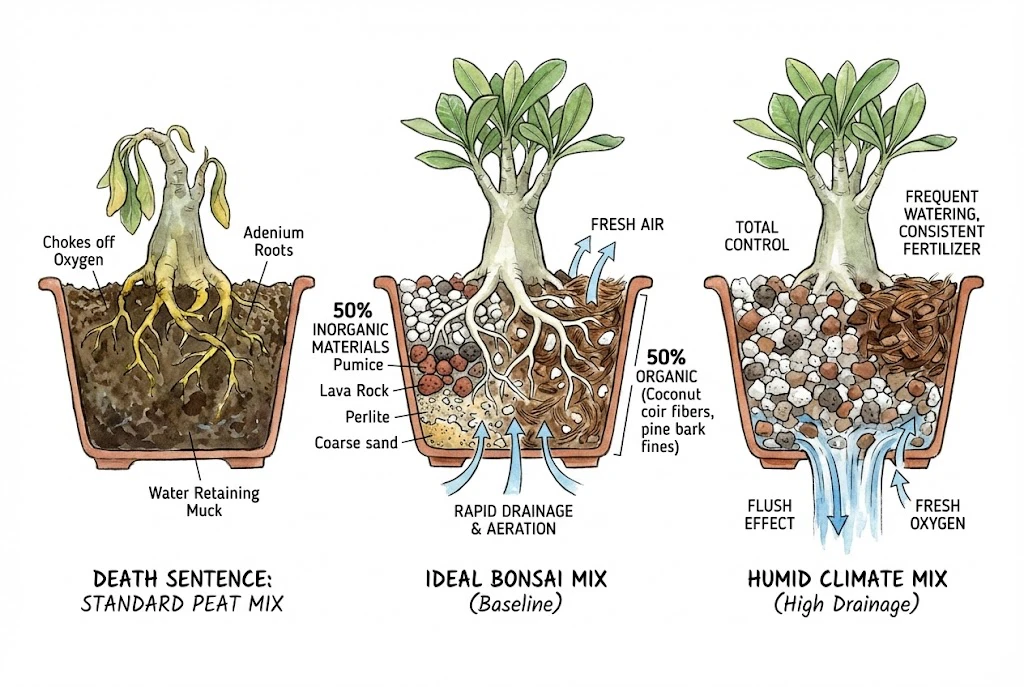
The target is not a universal half-and-half recipe. It is a mix that wets evenly, drains freely, stays structurally open, and dries at a pace that matches the pot, roots, and climate. A glazed shallow bowl in a cool room needs a different blend from a small clay pot outside in summer.
Keep Both Water and Air in the Root Zone
Check the Center of the Root Ball
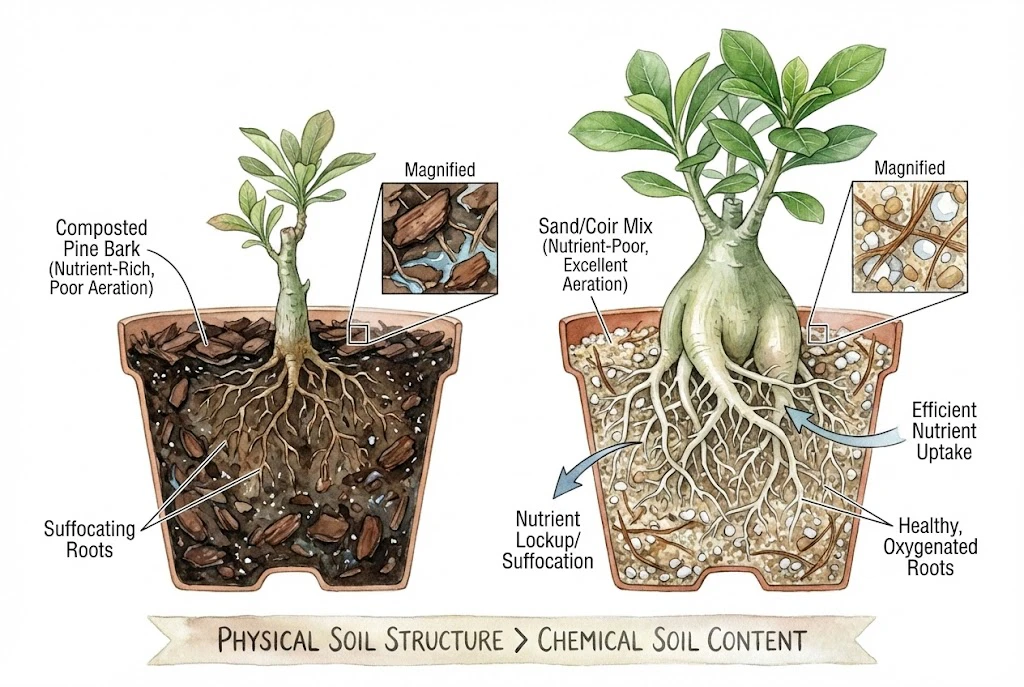
Waterlogged pores slow oxygen movement and raise the risk of root decline. A mix that is so coarse that water bypasses the root ball is not automatically better. It can produce dry pockets and demand constant correction. Check the center, not only the surface and not only how fast water exits the drainage hole.
Use substrate studies as starting evidence
Published Adenium substrate trials have found good seed emergence and early growth in semi-composted pine bark and bark-containing blends. Those were seedling-production experiments under controlled watering, not proof that pure bark is the best mature-bonsai medium. Their useful lesson is that multiple ingredients work when physical structure and water management work together.
Read the Plant's Season Before You Water
Use growth state to set watering
During active growth in warmth and strong light, soak the root ball and let excess water drain. Water again after the mix has approached dry. Use pot weight or a probe instead of a fixed number of days. The watering measurement setup gives a repeatable method.
Read seasonal slowdown with several signals
When leaves drop because conditions are cool and growth has stopped, water use falls sharply. A plant kept warm and bright may remain active, so leaf drop alone is not a command to withhold every drop. Check temperature, new growth, root health, and drying time together.
Pumice is one stable mineral component, not a complete soil formula. Use the substrate comparison to choose particle behavior, then adjust the blend after observing a full wet-dry cycle in the real pot.
What a Coarse Mineral Adds
A coarse mineral such as horticultural pumice can open a dense mix and keep that structure more stable after watering. Screen excessive dust and change the proportion to fit local drying time rather than copying a fixed percentage. It is one component, not a cure for a cold root zone or an oversized pot.
Which Fertilizer Builds an Adenium Caudex?
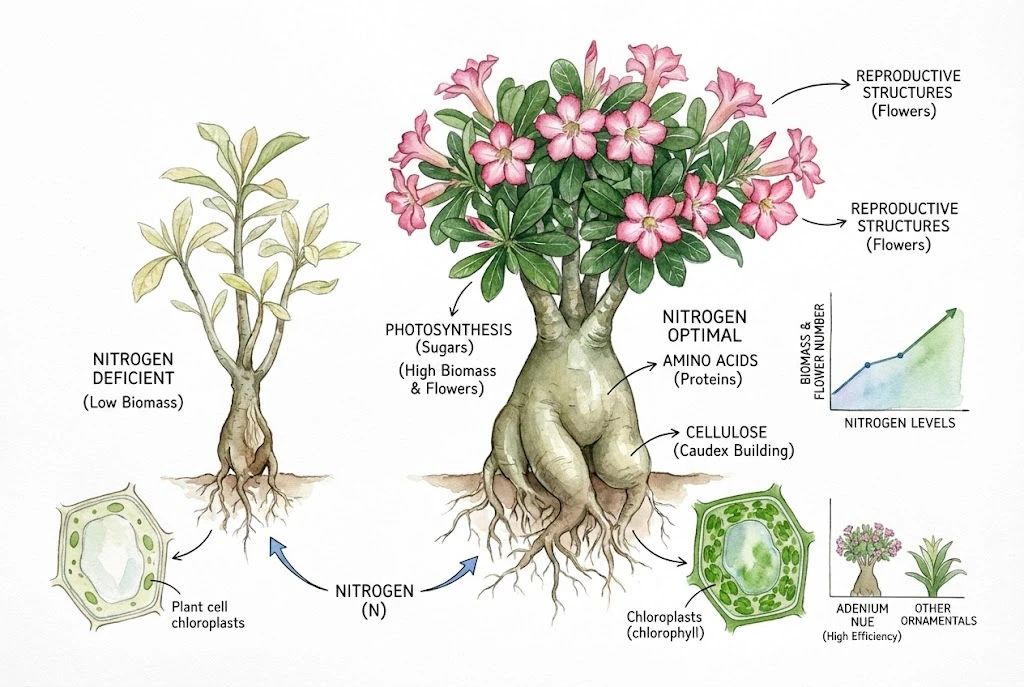
Feed a Complete Formula, Not a Special Ratio
No single N-P-K ratio targets the caudex. No single N-P-K ratio targets the caudex. Nitrogen supports leaves and proteins, phosphorus supports energy transfer and roots, and potassium participates in osmotic regulation and stomatal function. All are required. None can replace light or healthy roots.
Nitrogen Supports Growth, but the Trial Rate Is Not a Home Recipe
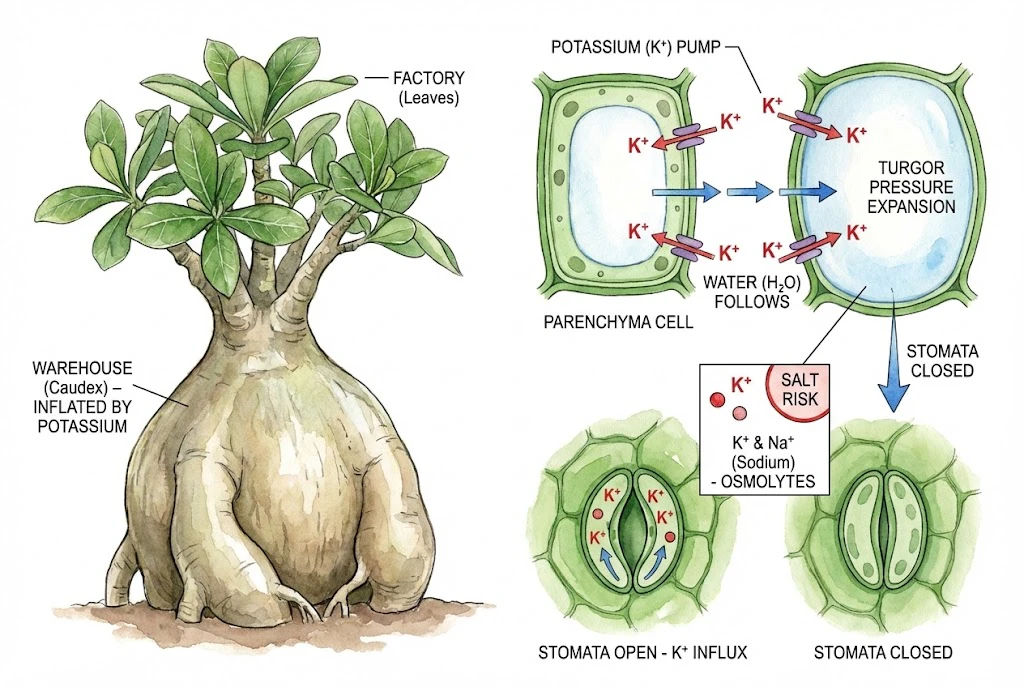
Read the Trial as a Boundary
In the Florida study, the highest of three controlled-release fertilizer treatments increased canopy size, flower number, and visual quality in both tested cultivars. That does not mean more fertilizer always gives more caudex. The rate belonged to a specific pot volume, product, climate, and 16-week trial, and the researchers called for more work on roots and caudex development.
Increase Only with Evidence
For a home plant, begin with a balanced product at the low end of its label during active growth. Increase only when light, temperature, watering, and response justify it. Pale old leaves may suggest a nutrient problem, but damaged roots, high pH, and salt accumulation can create the same appearance.
Potassium Is Necessary, Not a Hydraulic Pump
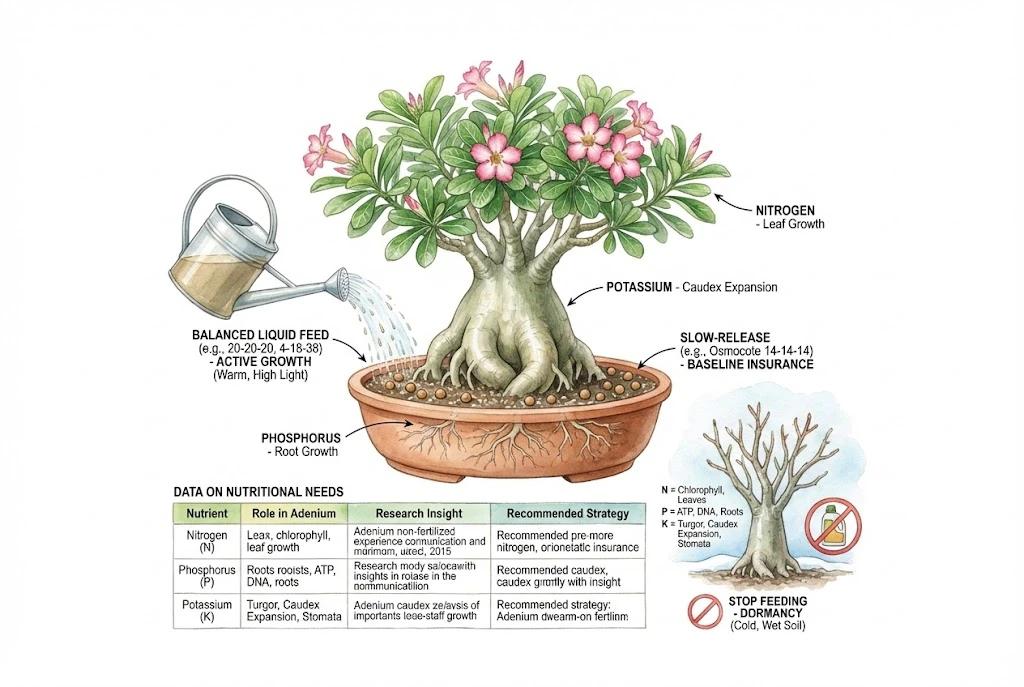
Potassium Supports Function
Potassium helps cells regulate water and turgor, but feeding extra potassium does not selectively inflate permanent caudex tissue. Avoid the seductive split that treats nitrogen as leaf food and potassium as a caudex thickener. A complete fertilizer already supplies both, and an excess can raise soluble salts without fixing the limiting factor.
Inspect Before Changing Ratios
High-phosphorus bloom boosters are equally poor as a default. Adenium flowering depends strongly on light, maturity, cultivar, temperature, and overall nutrition. If a well-lit active plant is not growing, inspect roots and conditions before changing ratios. When growth slows for the season, use the fertilizer cutoff guide. If crusts accumulate, use the salt-buildup guide before adding another product.
Use Root Work and Pruning to Reveal Structure
Expose structure without calling it new growth
Root lifting makes a base look larger because previously buried tissue becomes visible. It does not create new girth.
Lift in small stages during a planned repot, arrange only flexible roots, and keep enough fine roots to support the canopy. Mark the old soil line so you know what has changed.
Freshly exposed tissue may sunburn, and a shallower root zone can dry faster than it did before.
Treat Root Pruning as Recovery
Root pruning is a recovery event, not an annual ritual. Do it only on a healthy, actively growing plant in warm conditions. Remove dead, circling, or badly placed roots conservatively, use clean tools, and postpone canopy work if the root loss was substantial.
Pruning Changes the Canopy, Not the Caudex Growth Rate
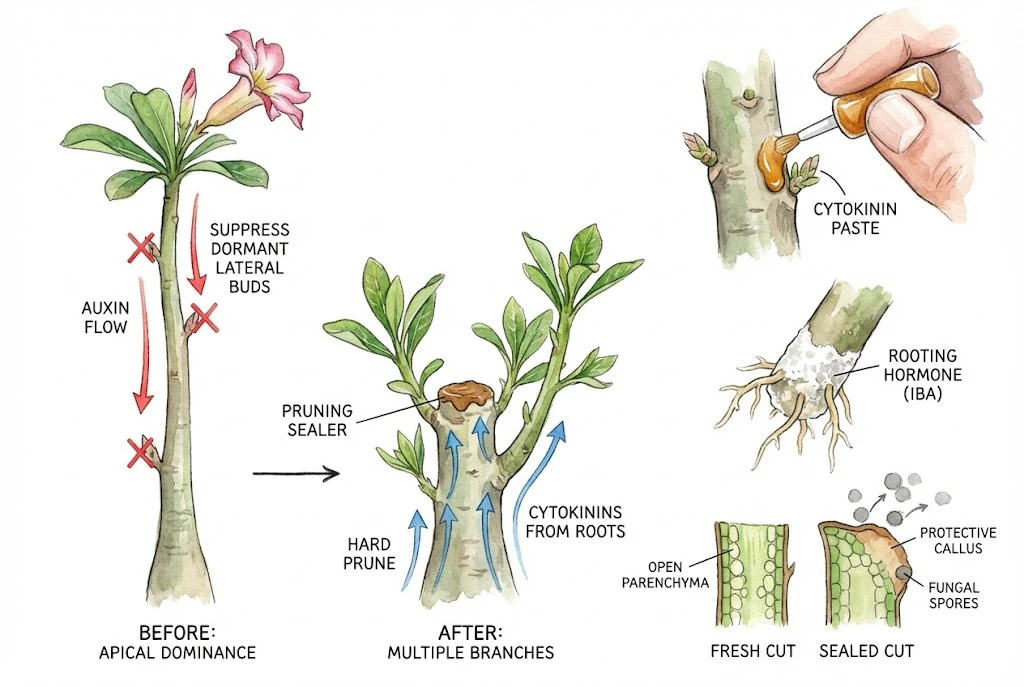
Prune for branching, not a thickness promise
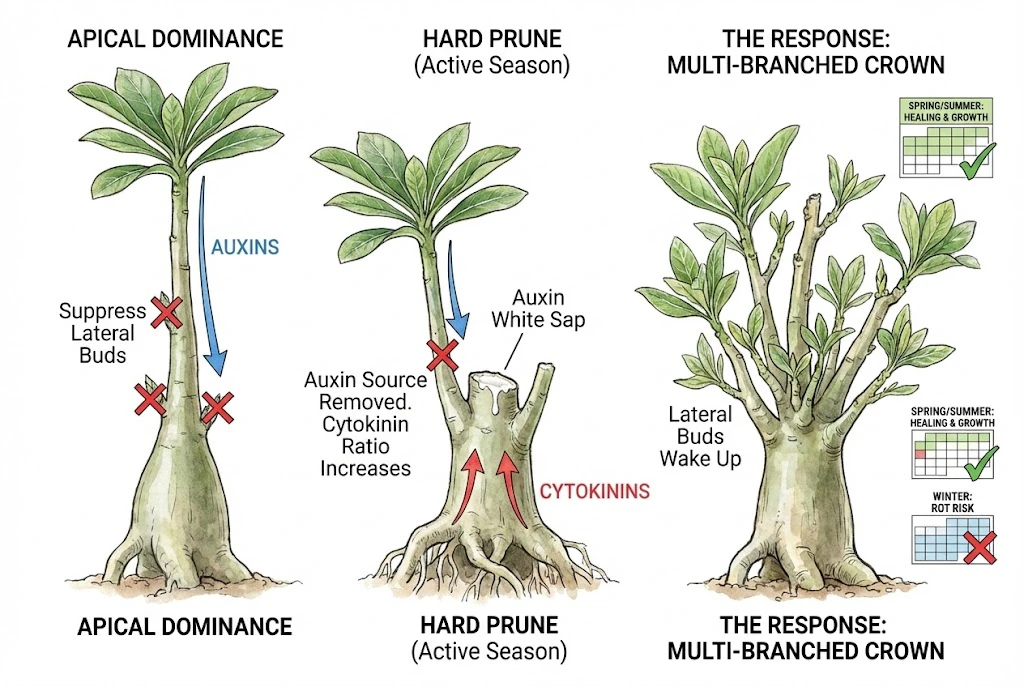
Removing a shoot tip can wake up the buds below it because the tip normally suppresses them through apical dominance. It does not guarantee three or four new branches. Cultivar, node condition, light, and plant vigor influence the response. Cut above a useful node during active growth and evaluate the first flush before cutting again. The seedling pinch guide separates a light early pinch from a structural prune on an older plant.
Handle Sap Safely
Adenium sap contains cardiac glycosides. Wear gloves and eye protection, keep hands away from the face, prevent access by children and pets, and clean tools between plants. This is a handling precaution, not a claim that brief skin contact guarantees poisoning. The repotting safety guide lists the minimal setup.
Why Isn't Paclobutrazol a Caudex Shortcut?
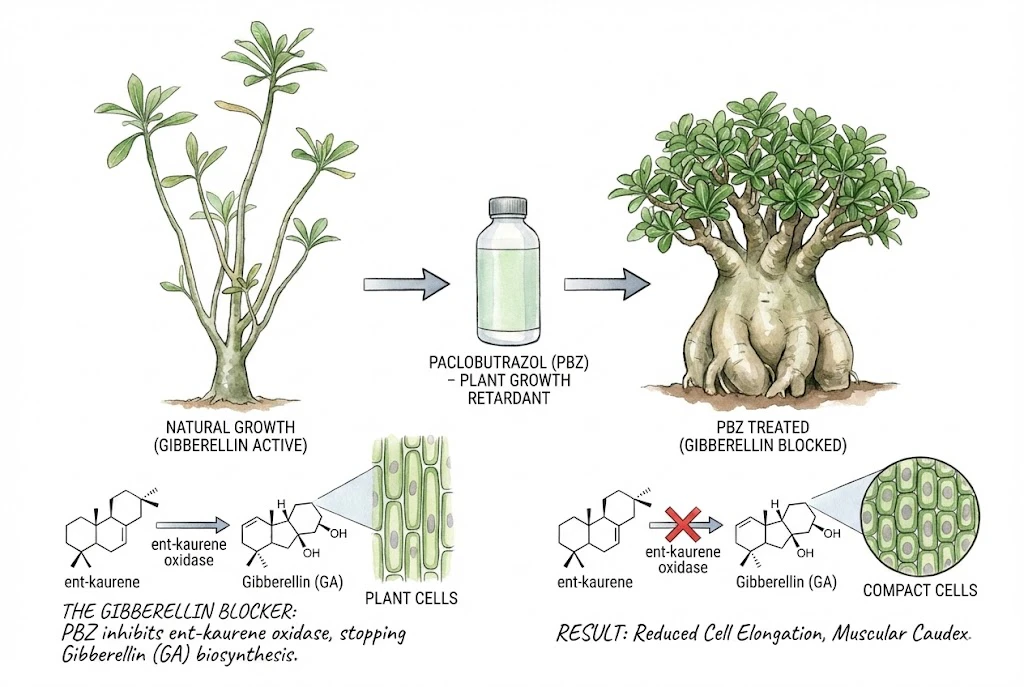
Keep height control separate from caudex growth
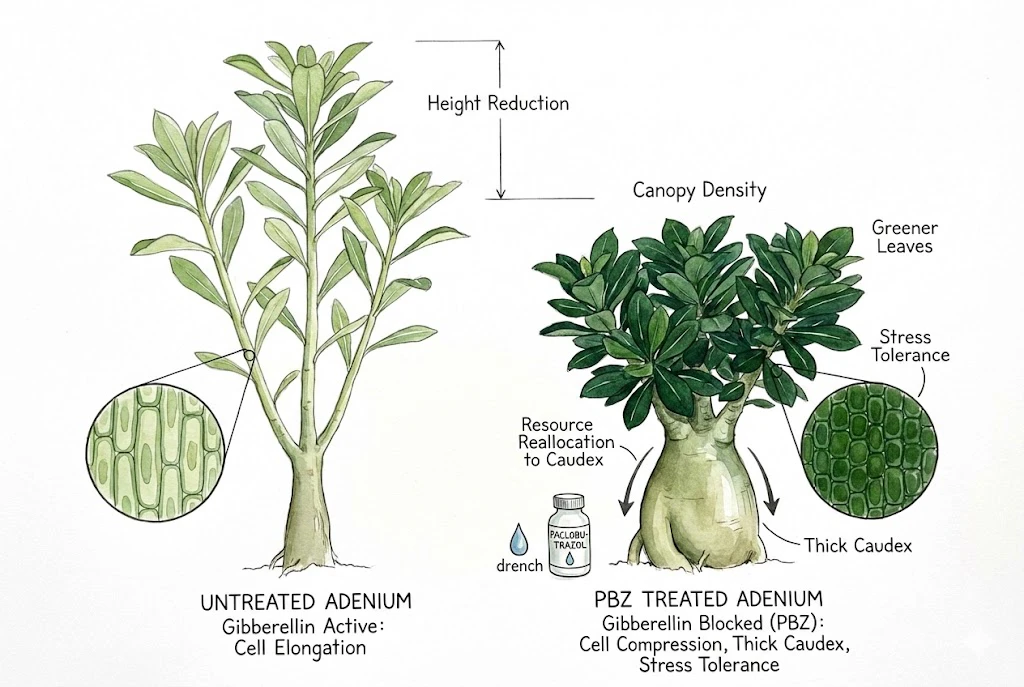
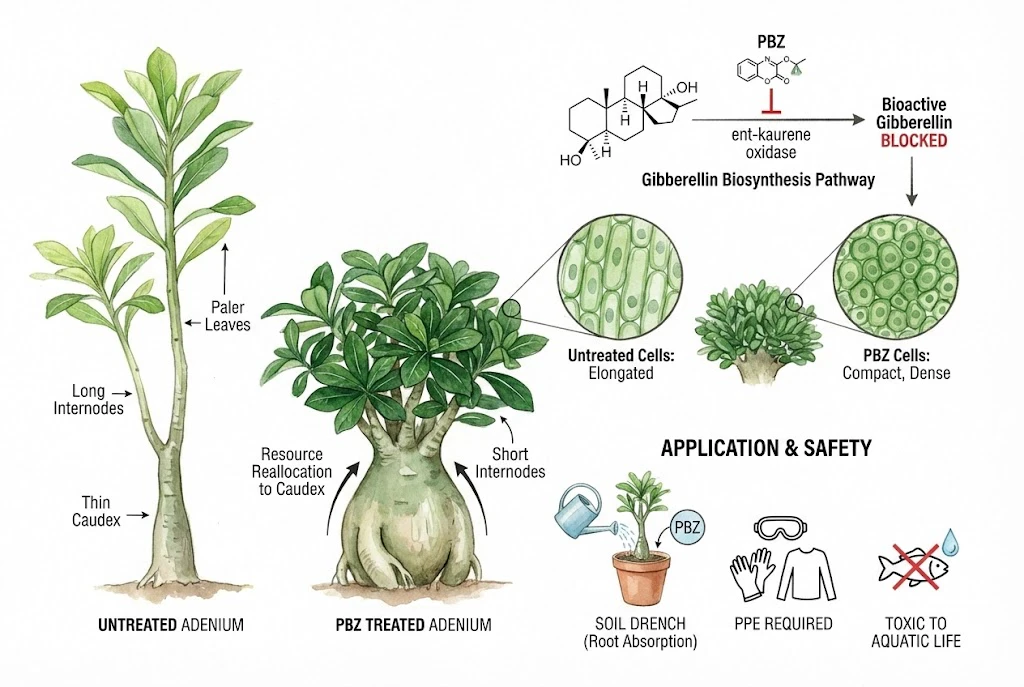
Paclobutrazol inhibits gibberellin biosynthesis and can shorten internodes. That dependable height response is often retold as redirecting growth into the caudex, but the Adenium evidence does not establish that shortcut.
Read the Study Limits
A controlled Adenium study reported a 37% shoot-length reduction at its highest treatment, along with phytotoxic effects serious enough that the authors did not recommend PBZ for commercial production. Another recent comparison of treated plants lacked an untreated control, so it could not show that PBZ produced a thicker caudex than ordinary culture.
Follow the Registered Label
In the United States, paclobutrazol products are pesticides and their registered labels control where and how they may be used. Labels differ by product and change over time. A concentration copied from a forum is not a legal or safe substitute, and no safe DIY drench recipe exists to copy. The dedicated paclobutrazol evidence review explains the study limits in detail.
Graft for Flower Identity, Not for Faster Caudex Growth
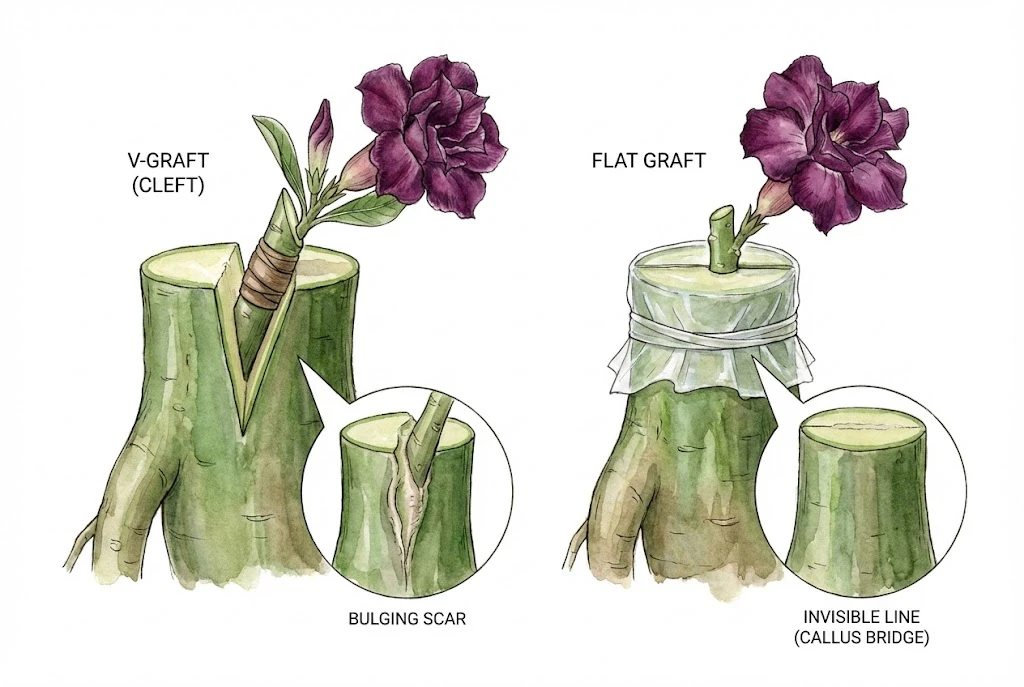
Use grafting to preserve flower identity
Grafting combines a known flowering scion with an established rootstock. It does not merge their genetics, and it does not automatically erase the union. Choose stock and scion with compatible diameters, work during active growth, keep cut surfaces clean, align living tissue, and hold the union immobile while it forms a vascular connection.
Flat, Wedge, or Cleft?
Let Compatibility Guide the Method
A five-month trial comparing five hybrids and three techniques found strong cultivar-by-method differences. Flat grafting performed well for particular combinations, but the result does not make it universally faster, stronger, or less visible than a cleft graft. A secure, well-aligned union on vigorous material matters more than declaring one cut the winner.
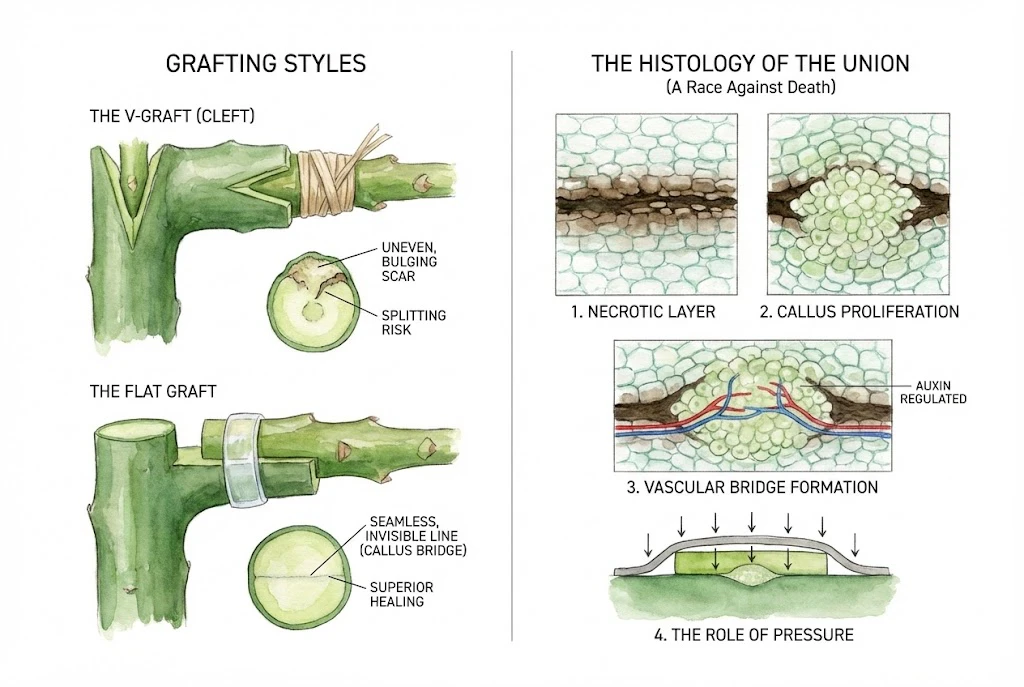
Keep Aftercare Simple
Use the Adenium grafting workflow for sanitation, alignment, wrapping, and aftercare. Avoid improvising with adhesive on living cut surfaces. Pressure and clean contact are the parts that matter.
Let Genetics Set the Range
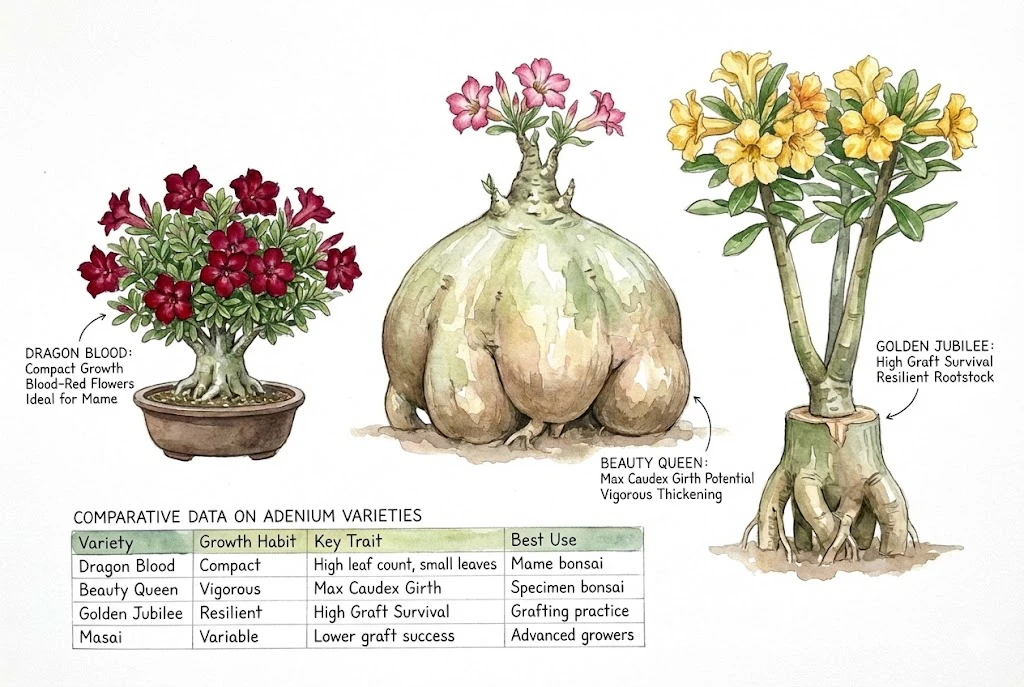
Set a genetic range instead of a ranking
Species background and cultivar influence branch spacing, leaf size, dormancy, flower form, and the shape and speed of basal growth. Rankings of named hybrids for girth and graft success can be too confident when they come from narrow trials. A treatment result in one greenhouse is not a stable catalog of genetic potential.
Judge the Plant in Front of You
For seed-grown stock, select a broad, healthy base, evenly distributed roots, short internodes, and no soft spots. For a named flowering clone, confirm the scion identity and inspect the graft. Record the plant's response for a full season before deciding it is genetically slow.
Troubleshoot Before You Train
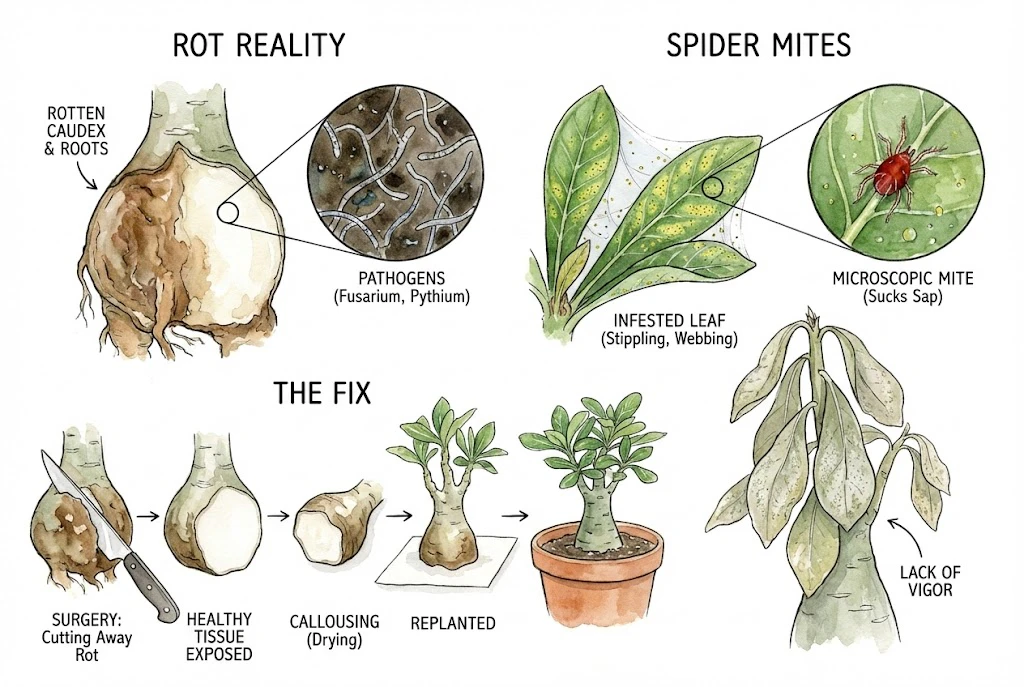
| Symptom | Check first | Training decision |
|---|---|---|
| Caudex slightly soft, mix dry | Growth state and normal dehydration | Rehydrate only if the plant is active. Do not cut on softness alone |
| Caudex soft, dark, or warm while mix stays wet | Root or basal rot | Stop styling and use the rot-rescue workflow |
| Long weak shoots | Light coverage and recent feeding | Fix light before pruning again |
| No flowers on a healthy plant | Light, maturity, cultivar, and season | Do not answer automatically with phosphorus |
| Powdery white roots or pot residue | Root mealybugs versus mineral salts | Treat the identified cause before repotting for display |
Build First, Then Refine
Build vigor before styling
Spend the main growing phase building roots, foliage, and stored energy. Measure the base monthly, rotate the plant for even light, and let the substrate tell you when watering is due.
Schedule one major stress at a time. Choose root work, hard pruning, or grafting rather than doing all three on the same day.
Refine After Recovery
The bonsai phase begins after the plant is vigorous enough to recover. Lift roots gradually, select branches after seeing where buds actually break, and accept the limits set by the individual plant.
A stable Adenium bonsai is not produced by one dramatic cut or a growth regulator. It is the visible record of several well-managed growth cycles.