
Fastest-Growing Caudex Plants: Species and Care Guide
Compare Gerrardanthus, Kedrostis, Fockea, and Dioscorea by real growth evidence, seasonal care, space needs, and the limits of popular speed hacks.
Rachel Torres · 2026-01-17 · Updated 2026-02-25 · 11 min read
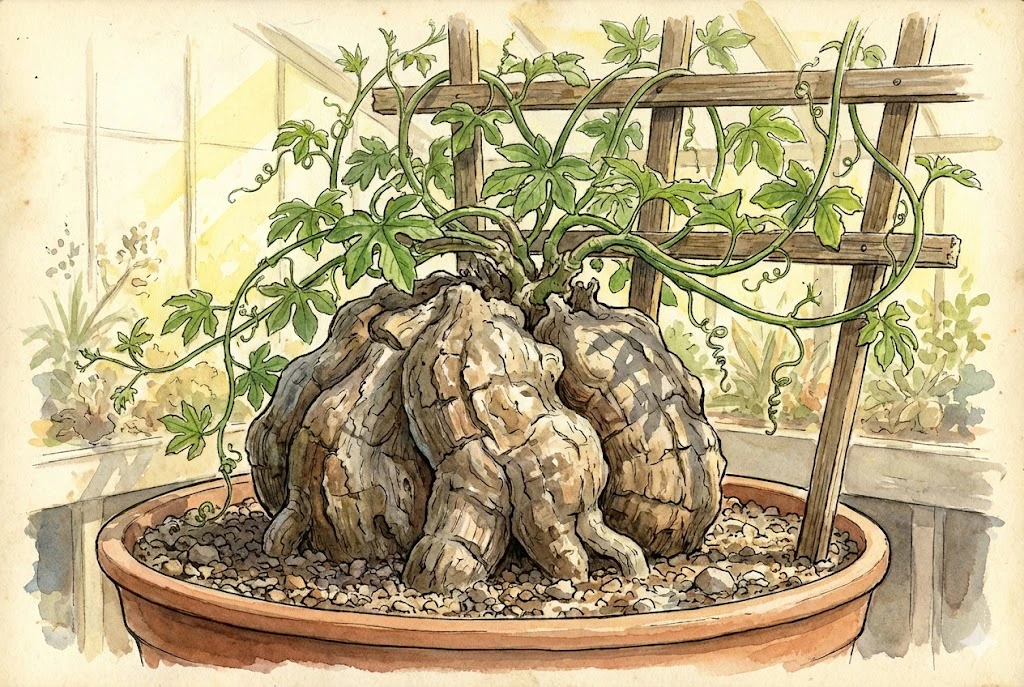
Key Takeaways
- Gerrardanthus macrorhizus has the strongest institutional support as a rapid grower, but a fast vine does not prove equally fast caudex enlargement. Measure base circumference separately from vine length.
- Kedrostis africana and Fockea edulis are also vigorous cultivation choices, while Dioscorea elephantipes is a slower, winter-growing contrast. Choose the species first.
- Remove a real limit from light, roots, water, or temperature rather than pushing every input to its maximum. A caudex cannot enlarge without photosynthate, working roots, water, and an active temperature.
- Burial, pruning, flat pots, and taproot cutting shape the plant. They are not proven to add storage tissue faster. Treat them as shaping techniques, not speed shortcuts.
- Fertilizer ratios and growth regulators have no controlled evidence as caudex-speed shortcuts. A regulator study on Adenium changed shape but not caudex width over untreated controls.
| Species | What the evidence supports | Best fit | Main tradeoff |
|---|---|---|---|
| Gerrardanthus macrorhizus | SANBI calls the species a rapid grower. No shared trial ranks its caudex gain against the others. | A warm setup with room for a large vine and trellis | Fast canopy growth and fast base growth are different measurements. |
| Kedrostis africana | Kew confirms a climbing caudex geophyte. Speed claims mostly come from growers. | A grower who wants an active warm-season vine | The vine can outrun the visible caudex. |
| Fockea edulis | Kew confirms a climbing tuberous geophyte. Its adaptability and vigor are grower-reported. | A less seasonal, flexible collection | Burial may shape the surface, but faster thickening is unproven. |
| Dioscorea elephantipes | Kew describes it as slow-growing. | A patient grower who can follow a cool-season vine | Warm-season care applied to a resting plant can damage roots. |
What Does Fast Mean for a Caudex?
There is no controlled race that puts caudiciform genera in fastest-to-slowest order. Before comparing plants, decide whether you mean vine length, time to first dormancy, caudex circumference, or years to a display-ready specimen. Those outcomes do not move at the same rate.
A long vine is easy to notice, so vigorous climbers dominate informal lists. Caudex gain is slower to see and harder to compare because starting age, whether the base is buried, and the measuring point all change the result.
Because vine length and caudex thickening are not the same result, I track them on separate lines. One line records active vine length, leaf coverage, and any training or pruning.
My second line records caudex circumference at the marked height, pot mass, and hours since the last watering. I measure only when the pot returns to its established pre-watering mass range. This separates structural growth from temporary hydration.
I add any repotting, root work, or change in light to the same record. When vine growth rises while the base is unchanged, I treat the plant as active rather than failed and leave the healthy leaf area working. The dashboard protects me from chasing instant thickness with drought, oversize feeding, or cosmetic damage.
The Shortlist, with the Claims Separated
Gerrardanthus macrorhizus
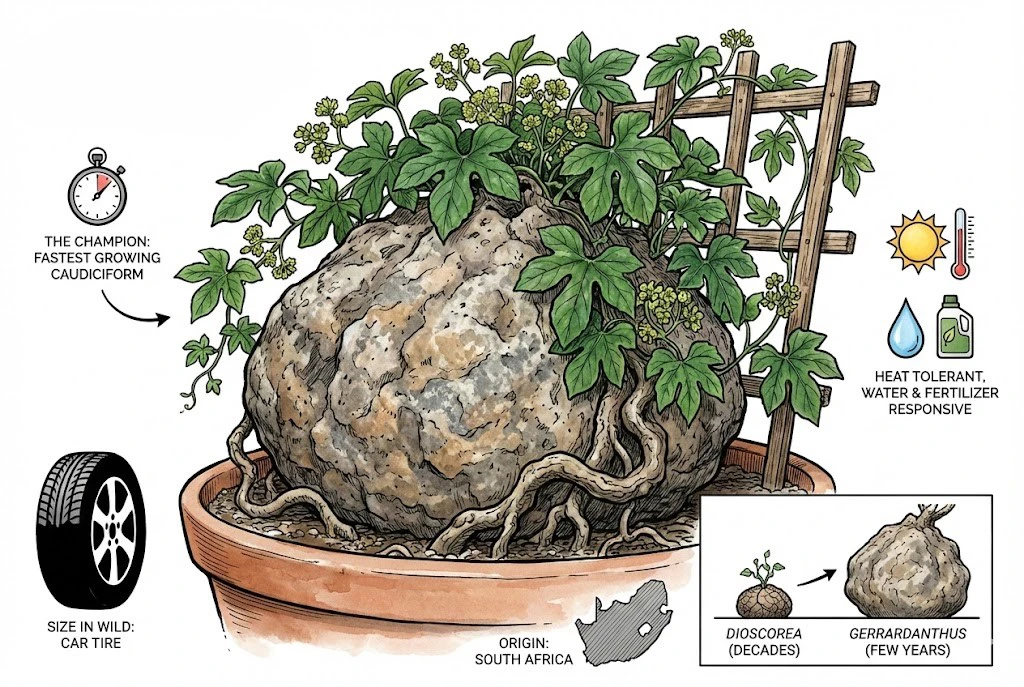
Read rapid vine growth separately from caudex gain
This is the best-documented rapid-growth candidate in this comparison. SANBI describes G. macrorhizus as a rapid grower with a massive caudex. The same source places it in shady spots on steep rocky screes.
Rapid growth should not be translated into immediate full sun and an oversized wet pot.
Support the Vine Without Chasing Speed
Give the vine a trellis and bright acclimated light, but keep an eye on canopy coverage and the root-zone temperature. Measure base circumference separately from vine length if caudex speed is the reason you bought it.
Kedrostis africana
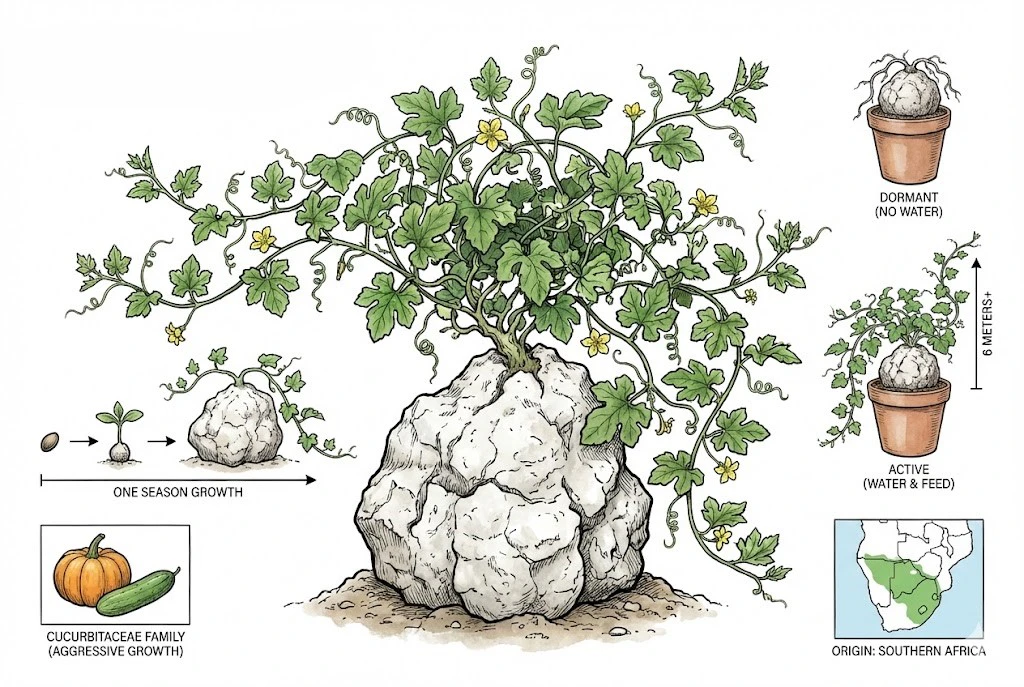
Separate Vine Growth from Caudex Growth
K. africana is a South African and Namibian climbing caudex geophyte in the cucumber family. It can make a conspicuous vine when warm, lit, and watered, which gives a beginner visible activity to monitor.
That canopy still has to support roots and storage tissue. Train rather than repeatedly cut a healthy vine, and do not assume the base is failing because it lags behind the top.
Fockea edulis
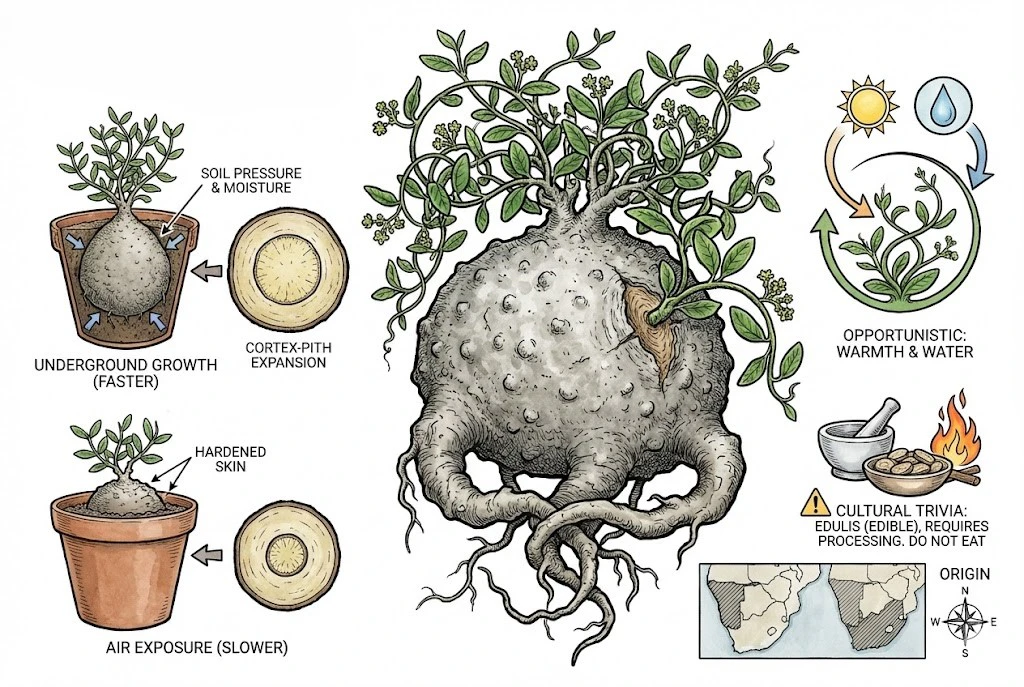
Treat Flexibility as a Care Advantage
Kew classifies F. edulis as a climbing tuberous geophyte from South Africa. In collections it has a reputation for adaptability and steady growth, although that reputation has not been converted into an annual caudex-growth trial.
Its cycle can be less tidy than a textbook summer/winter split. Follow the vine, pot weight, and roots. A partly buried plant may retain a paler, smoother surface below the soil line, but there is no controlled evidence that burial makes the base enlarge faster.
Dioscorea elephantipes
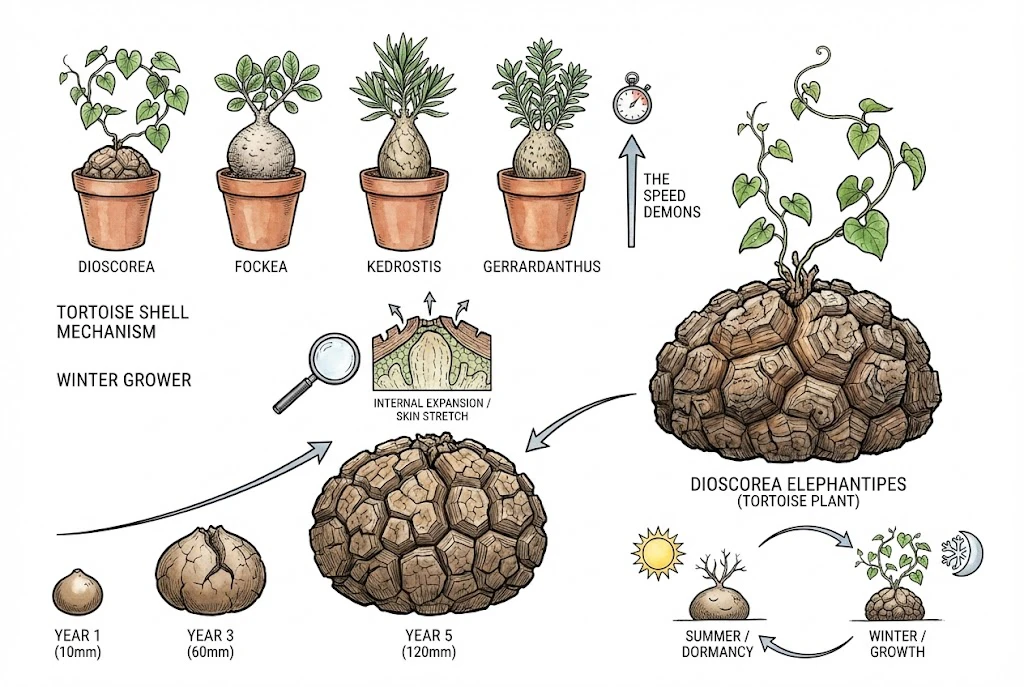
Follow the Seasonal Signal
D. elephantipes is the useful counterexample. Kew describes it as slow-growing, even though its seasonal vine can cover a trellis. The corky plates and dome that collectors want develop over years, not in proportion to one vine flush.
In Northern Hemisphere collections it is commonly winter-active, but individuals do not always follow the same date. Keep a green vine working and reduce water as it naturally yellows and dries. The Dioscorea vine-senescence guide covers the decision to cut or wait.
What Actually Supports Faster Growth?
A caudex cannot enlarge without photosynthate, functioning roots, water for cell expansion, and a temperature at which the plant is active. A safer strategy is to remove a real limit, not to keep every input at its maximum.
Water the Active Plant, Not the Label
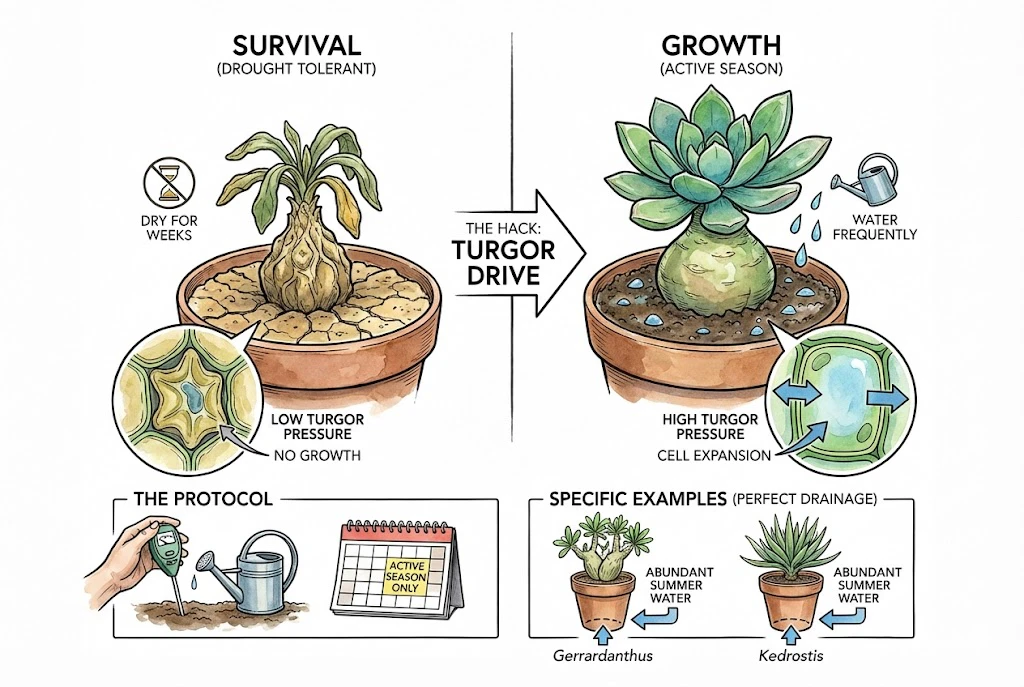
Water active plants without manufacturing stress
During active growth, wet the usable root zone after the mix approaches dry. Do not keep a growing plant chronically thirsty in the hope that stress will make it fatter. Drought tolerance is survival capacity, not evidence that drought maximizes growth.
The other extreme is just as unhelpful. An oversized pot or fine mix that stays wet can lose air around the roots, especially when temperature or leaf area falls. The caudex watering measurement guide shows how to use dry pot weight and root checks instead of a calendar.
Keep Roots Aerated and Nutrition Complete
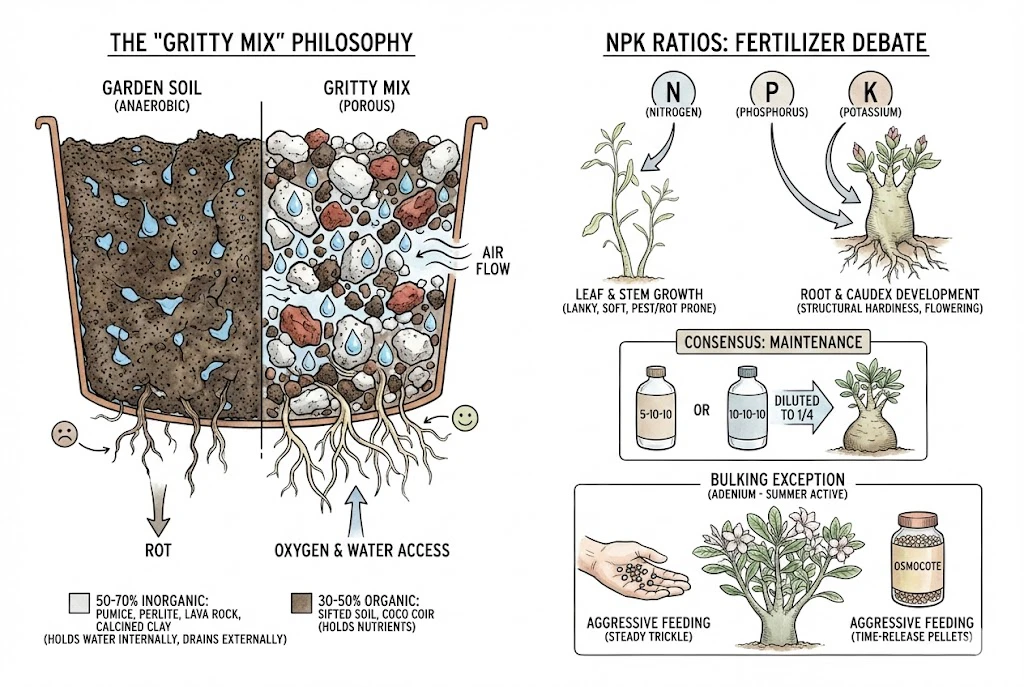
Keep roots aerated and nutrition complete
Use a structurally stable mix that wets evenly and returns near dry on a useful schedule. A warm, vigorous climber may use more water-holding material than a dormant Dioscorea in a cool room. The caudex substrate guide explains how particle size, fines, pot height, and climate change the result.
What Does Pumice Contribute?
Horticultural pumice can keep some air space open after watering, which helps a container medium drain without relying on a decorative gravel layer. It is still only one ingredient. Choose particle size and amount based on how this pot dries, because more pumice cannot compensate for a poor root temperature or watering routine.
Feed only sustained growth with a complete fertilizer at a conservative rate allowed by its label. Extra phosphorus or potassium does not force a caudex to thicken when the plant already has enough, and excess nitrogen can produce soft extension and salt buildup. The caudex fertilizer guide covers label-based concentration and stop conditions.
Skip the Hormone Shortcut
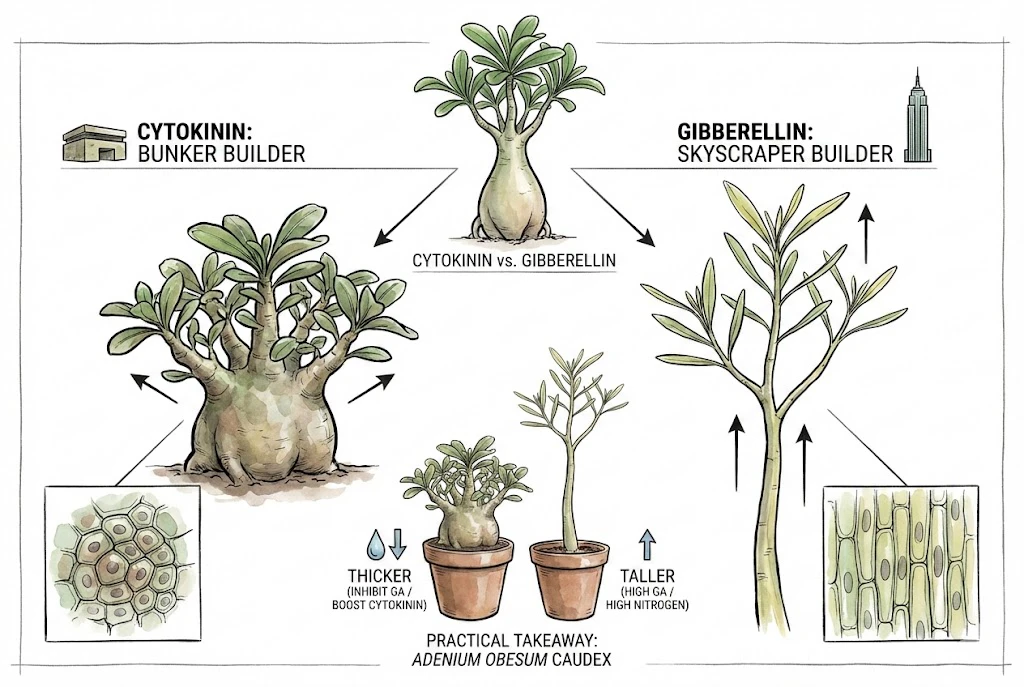
Keep hormone evidence within its tested scope
A study on Adenium obesum seedlings found that hormone and growth-retardant treatments changed height and anatomy, but did not produce a statistically significant increase in caudex width over the untreated controls. That is evidence about plant shape, not a home recipe for a larger base.
Paclobutrazol and synthetic cytokinins are regulated plant-growth products with label, exposure, and phytotoxicity constraints. Unless a product is labeled for the plant and intended use, leave it out of a speed experiment.
Match the Routine to the Growth Cycle
Warm-Season Climbers
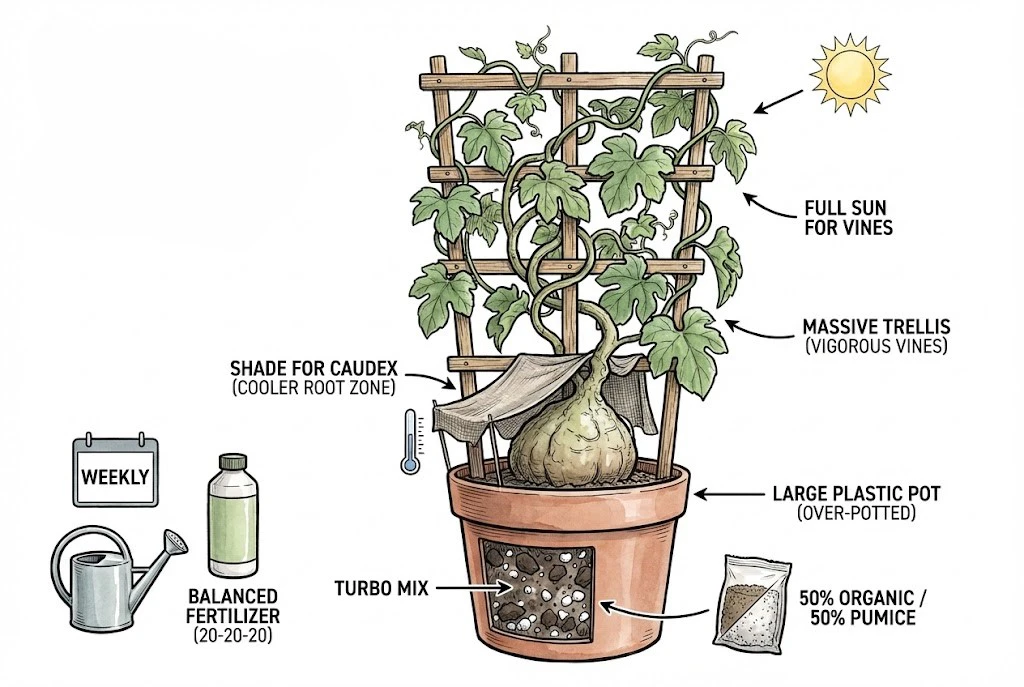
Use a warm-season routine for warm-season climbers
For Gerrardanthus or Kedrostis, use a pot only modestly larger than the functioning roots, an airy mix that does not race dry in summer, and a trellis that keeps the vine in the light. Water fully after the root zone approaches dry, and stop pushing the plant when extension slows.
A Winter-Active Dioscorea
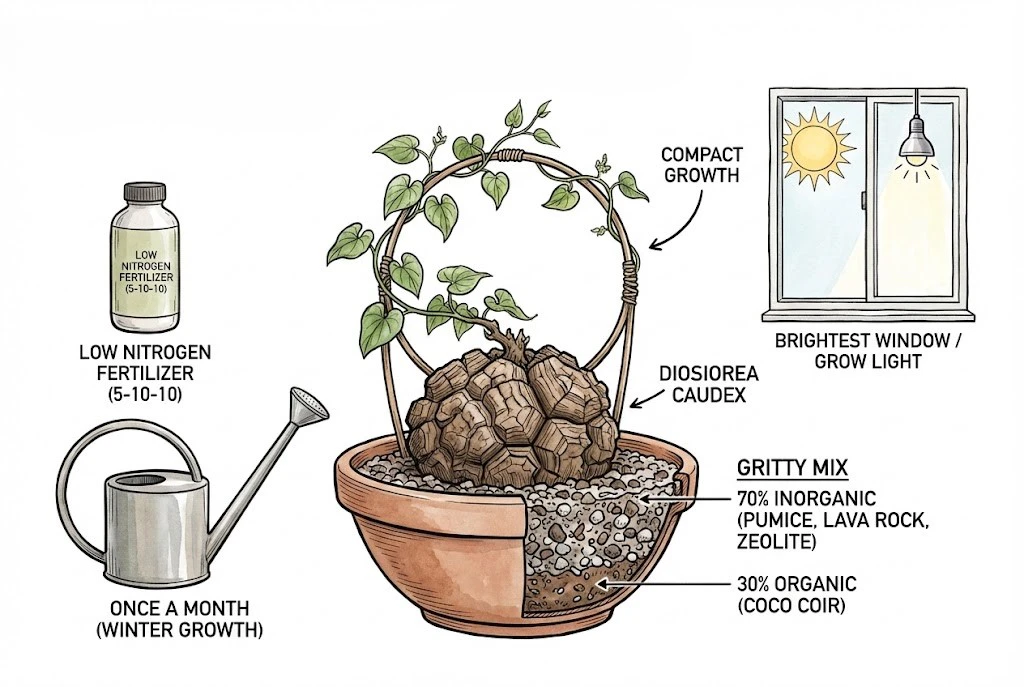
Match the routine to a winter-active cycle
Give the active vine useful light and a trellis during its own growth period. Do not copy a warm-season feeding calendar. As the vine yellows naturally, stop feeding and let the falling uptake lengthen the dry interval.
When Is a Grow Light Useful?
A compact full-spectrum LED lamp can supplement light for one vine, but it is useful only when the leaves receive measurable coverage around the trellis. Treat it as a way to close a light gap, not as a growth accelerator by itself. The caudex grow-light guide explains how to adjust distance and daily exposure.
An Opportunistic Fockea
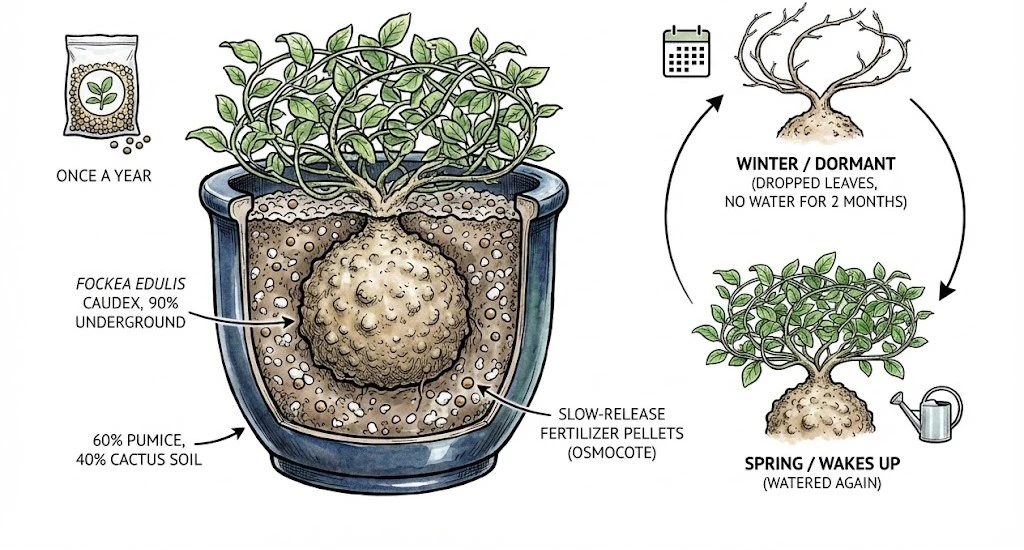
Let an opportunistic plant set its own interval
Let the vine and pot decide the schedule. A leafy, warm Fockea may keep using water when another plant has stopped, while a cool or leafless one will not. Do not treat adaptability as proof that the plant needs water year-round.
Do Burial and Pruning Make a Caudex Grow Faster?
Growing the Base Below the Soil Line
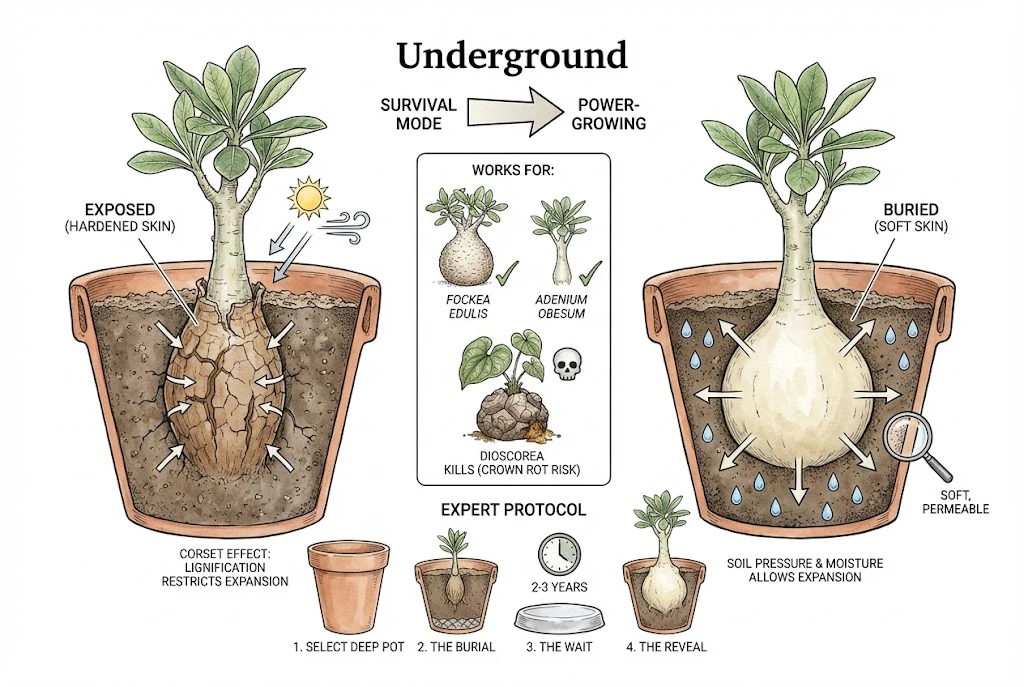
Separate surface appearance from growth evidence
Growers often keep young Fockea, Kedrostis, or Adenium bases buried and reveal them later. Burial changes light, temperature, moisture, and the surface texture. It may produce a smoother pale section, but a controlled comparison has not shown that it adds circumference faster.
When Should Burial Be Avoided?
Use it only where the plant’s crown and root anatomy tolerate the chosen soil line. Do not deeply bury a mature Dioscorea elephantipes crown or assume that more wet material around a caudex is harmless.
Flat Pots and Root Pruning
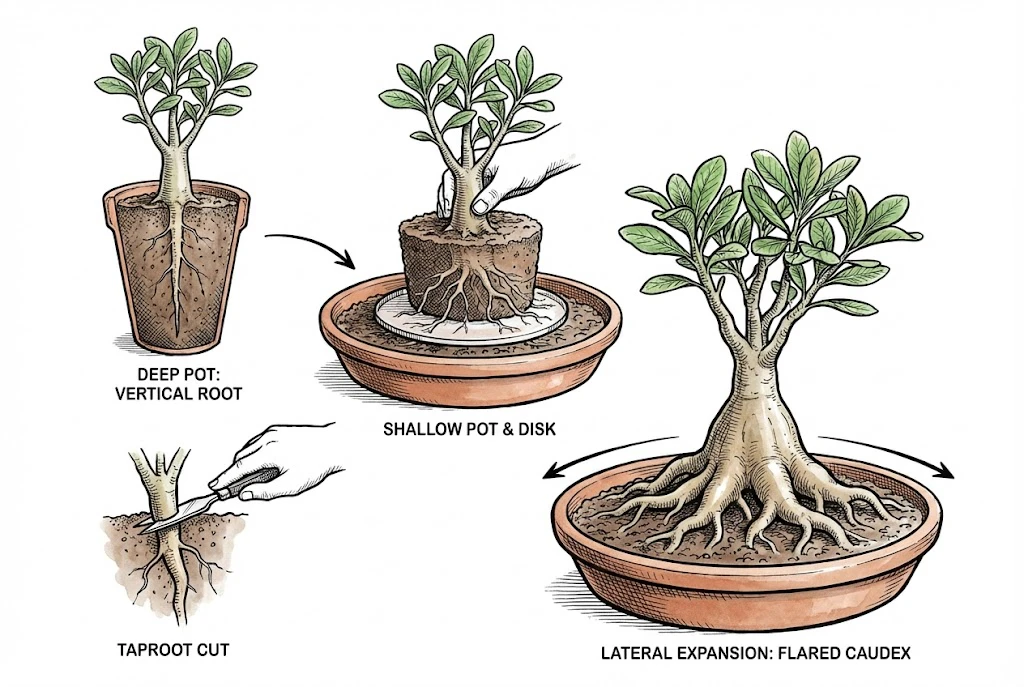
Use root work for shape, not a speed promise
A shallow pot and carefully arranged lateral roots can create a wider Adenium silhouette. That is a shaping result. Cutting the taproot has not been shown to make the plant add total storage tissue faster, and a large root wound can set growth back.
Only work on a healthy plant during active conditions, retain enough functioning roots, and protect skin and eyes from Adenium latex. The caudex repotting safety guide covers sap exposure and tool handling.
Pruning and Trellising
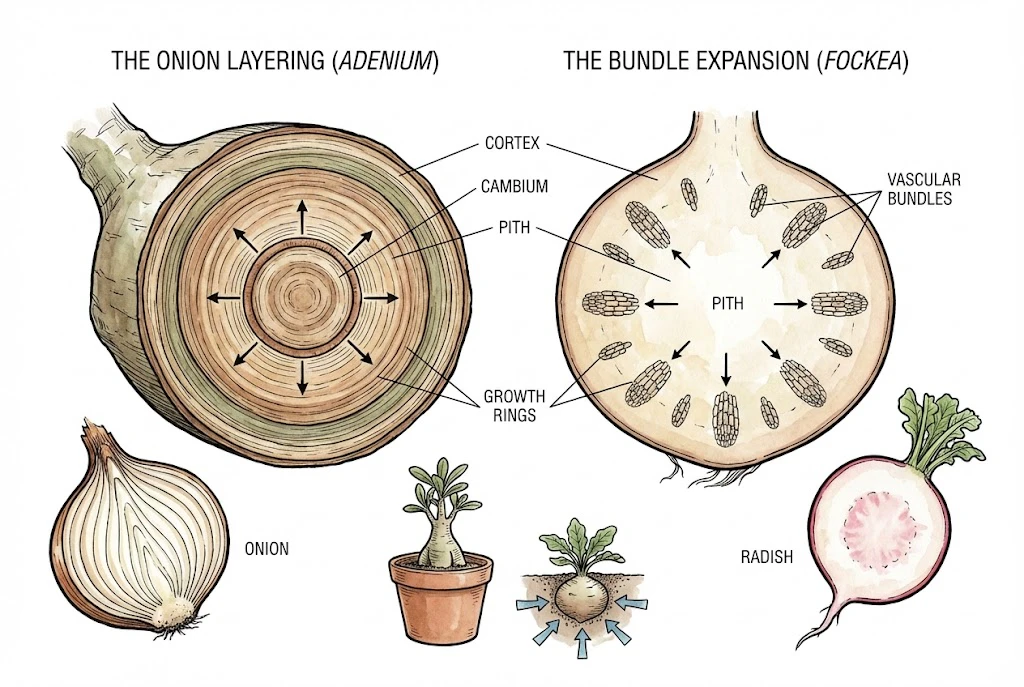
Keep Leaf Area Working
Healthy leaves make the carbohydrates that support roots and storage tissue. Heavy pruning removes that capacity, and it does not redirect a fixed bucket of energy into the caudex. Prune Adenium to shape its branches, and train healthy Fockea, Kedrostis, and Dioscorea vines when you want to preserve growth without letting them tangle.
A Soft Caudex Is Not a Watering Instruction
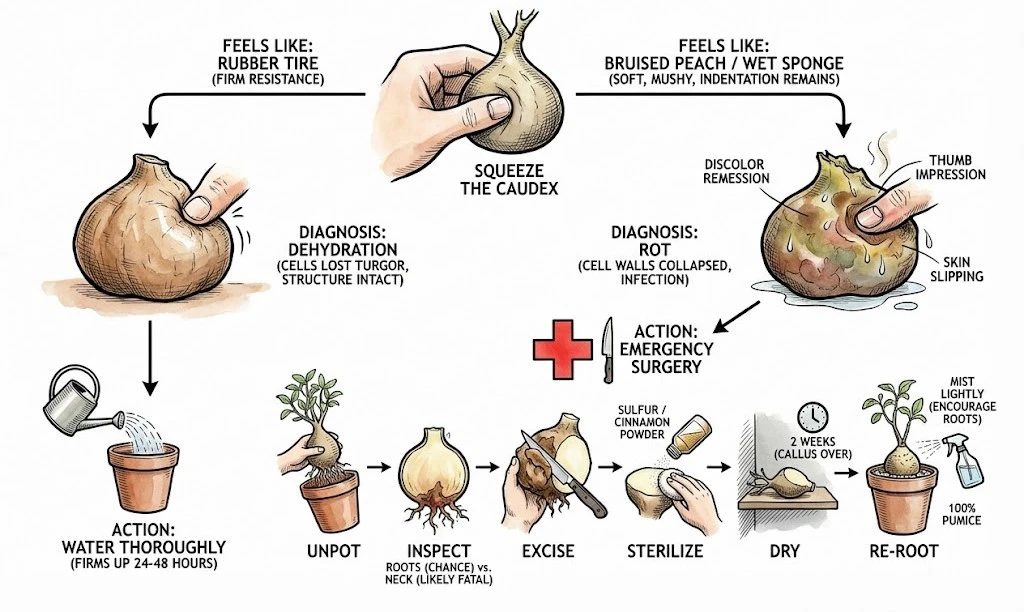
How Should a Soft Caudex Be Triaged?
Diagnose a soft base before watering or cutting
Low turgor and rot can both reduce firmness. Before adding water or cutting, check the mix, roots, base, smell, and where the softness begins.
| Finding | More likely explanation | Next step |
|---|---|---|
| Dry mix, sound roots, even mild shrinkage | Water deficit in an active or warm plant | Water thoroughly and watch the next dry-down. |
| Wet mix, collapsed roots, odor, spreading softness | Root or stem decay | Isolate and remove confirmed rot with a disinfected tool. |
| Localized mark on the exposed side | Sun, cold, or physical injury | Inspect the boundary and recent exposure before cutting. |
| Firm leafless base with a stable trend | Possible dormancy | Follow species cycle and pot moisture. Do not force a flush. |
If rot is confirmed, remove only nonviable tissue and use any fungicide according to diagnosis and label. The caudex root-rot treatment chooser provides the full sanitation and treatment path.
Dormant or Losing Roots?
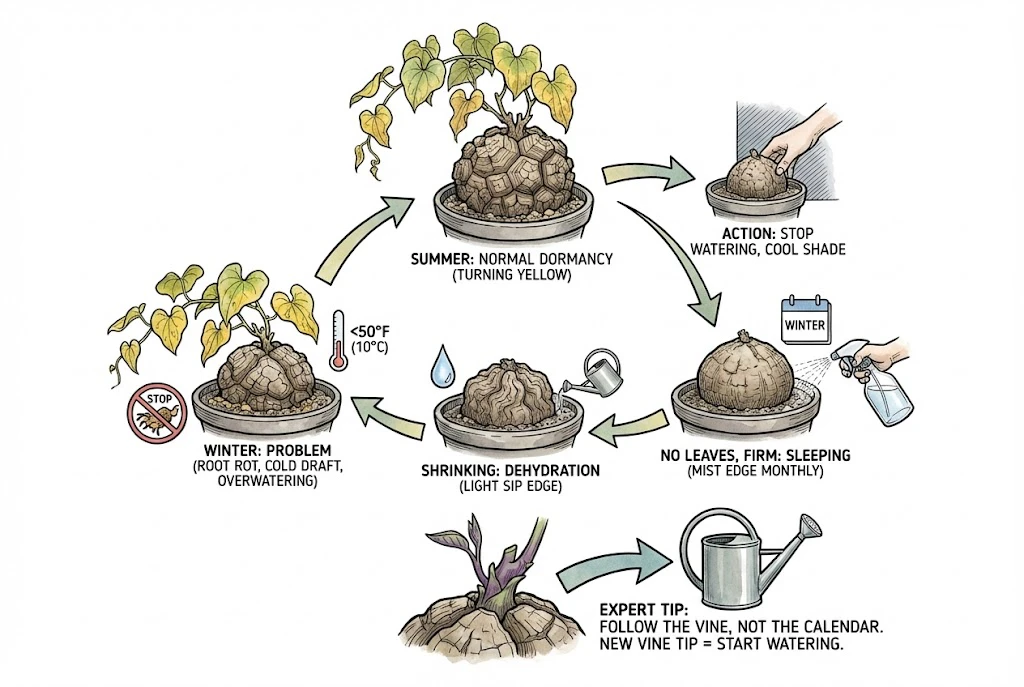
Compare dormancy with root loss
Normal senescence usually follows the plant’s established cycle and ends with a stable caudex and progressively drier pot. Yellowing during expected growth, rapid shrinkage, wet roots, odor, or spreading softness deserves investigation. A new vine tip supports a cautious return to active care, while a dried vine is a reason to reduce water rather than proof that the whole plant is dead.
Seed, Cuttings, and the Shape You Expect
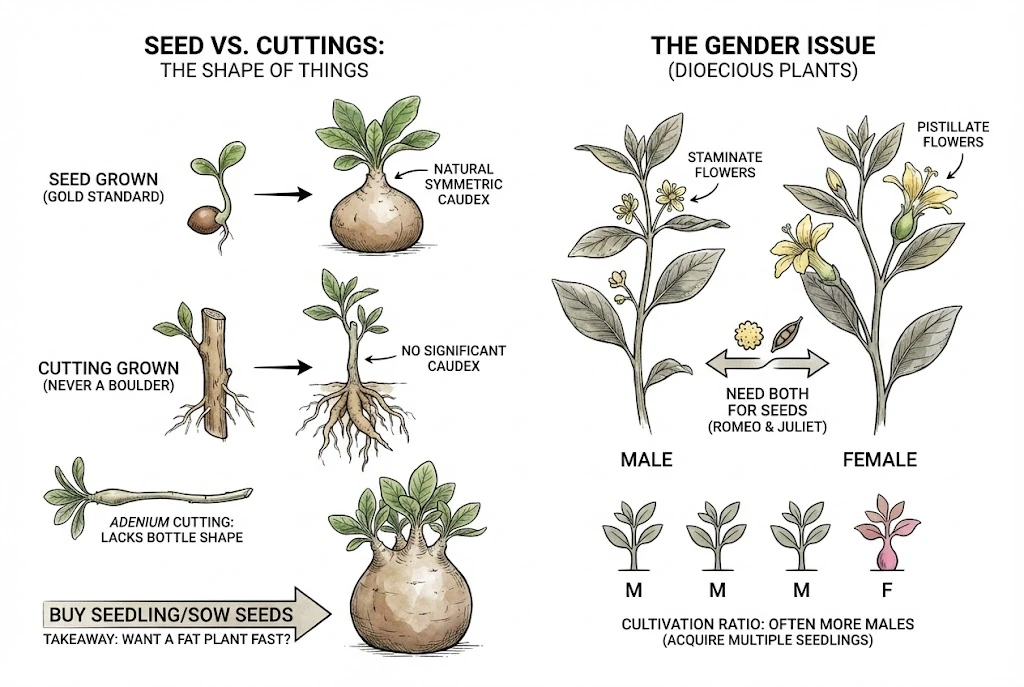
What Do Seed-Grown Plants Show?
Seed-grown plants let you observe the species’ typical juvenile root and caudex development. Cuttings can be useful for cloning a plant, but the resulting base and root flare may differ by species and may not match a seedling’s form.
What Is Needed for Caudex Seed Production?
Dioscorea, Fockea, and Gerrardanthus include dioecious species, so producing seed may require compatible male and female plants. For controlled warmth, airflow, and seed-lot records, use the caudex seed-germination setup.
Measure the Speed You Actually Care About
Take a baseline photo with the pot and measuring point marked. Record caudex circumference at the same height, dry pot weight, active-vine dates, and any repotting or exposure change. Measure the base monthly rather than reading daily swelling as permanent growth.
What Does the Measurement Tell You?
If the vine speeds up while circumference stalls, the plant is active but is not yet directing visible gain to the feature you chose. Change one limiting condition at a time. Keeping the measurement tied to observed growth helps avoid mistaking rot, chemical injury, or an unnecessary root cut for progress.