
Stephania Kaweesakii (Nova) Care Guide
A cautious care guide for Stephania kaweesakii, often sold as Stephania Nova, covering light, watering, substrate, dormancy, troubleshooting, and provenance.
Rachel Torres · 2026-01-21 · Updated 2026-03-28 · 16 min read
Key Takeaways
- Use the plant's growth state and root condition as watering triggers, not a fixed calendar. During active growth, water thoroughly once the mix has dried and the roots are functioning.
- Pot the rooted base in an airy, mostly mineral mix, and let the roots decide how much of the tuber sits above the medium. Adjust the mix's water retention to your room and pot.
- Acclimate the vine to bright light gradually. Bleached patches after a move mean the increase was too abrupt. Judge light by new growth, not the blue cast of an old leaf.
- When growth slows or the vine dies back, stop feeding, lengthen the dry interval, and inspect the root zone before watering again. A rootless or rotting tuber will not recover simply because it is watered.
- Ask for a seed-grown plant with a clear propagation history. Shape and scarring prompt questions but do not prove wild collection. Stephania kaweesakii is often sold as "Stephania Nova."
| Care factor | What to do | What should make you stop |
|---|---|---|
| Light | Use a bright window or grow light and introduce direct sun gradually. | Bleached patches after a move mean the increase was too abrupt. |
| Water | Soak an actively growing plant after the mix is dry and the pot feels light. | Soft tissue, a musty smell, or wet damaged roots call for inspection rather than another watering. |
| Substrate | Start with a mostly mineral mix, then adjust its water retention to your room and pot. | If the mix remains damp after the vine slows, it is holding too much water. |
| Dormancy | Stop feeding and reduce water as the vine yellows. | A rootless or rotting tuber will not recover simply because it is watered. |
| Sourcing | Ask for a seed-grown plant with a clear propagation history. | Shape and scarring can prompt questions, but neither proves wild collection. |
Stephania kaweesakii is often marketed under the trade name Stephania Nova. That name was not originally a formal cultivar name. Before botanists described the species, dealers used Stephania sp. nova as a placeholder for a new or unnamed Stephania.
The fissured tuber and blue-green foliage are useful descriptive features, but neither identifies a plant's provenance or sets a universal light target, while leaf size and colour also vary with age, genetics, and growing conditions.
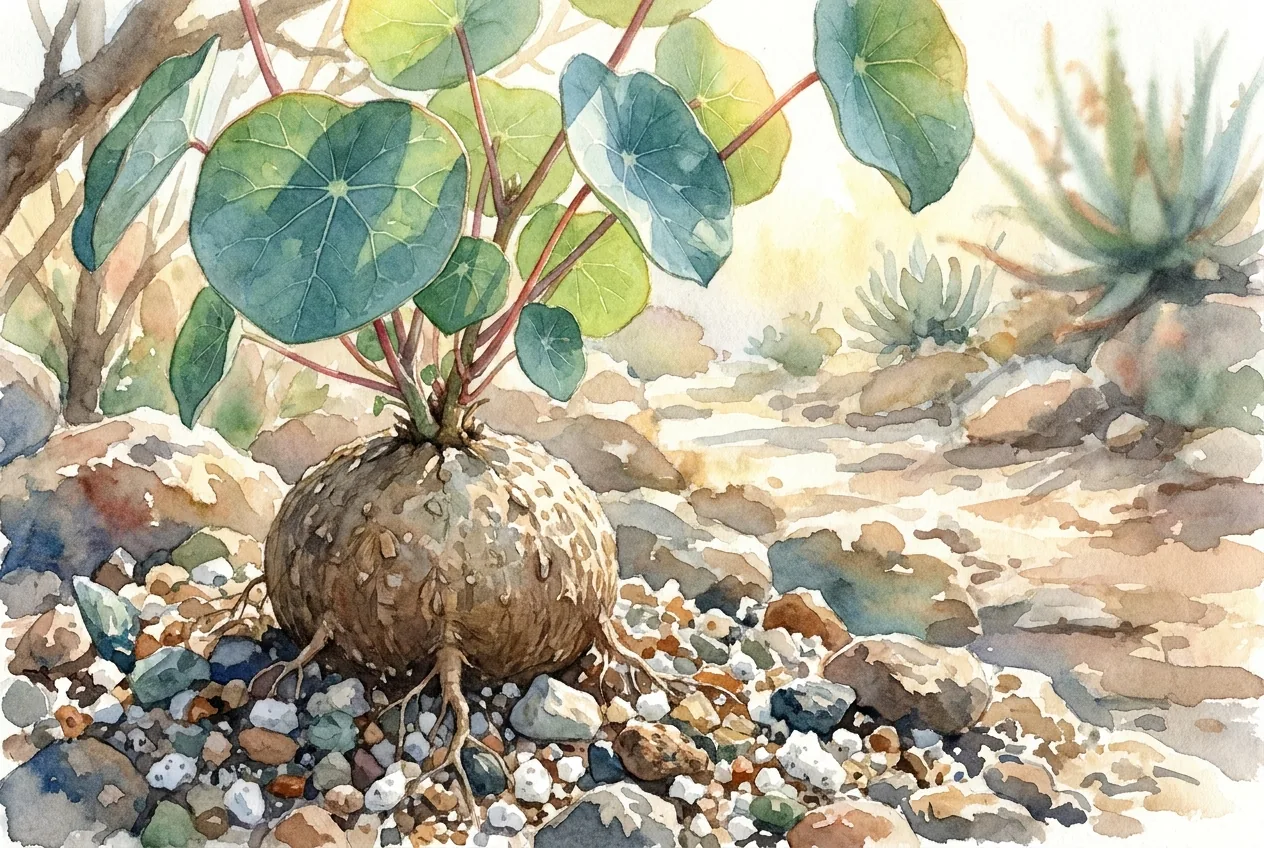
The species was described from limestone habitat in Thailand, but habitat alone does not supply a ready-made indoor recipe. There are no controlled care trials comparing it with the smoother plant sold as Stephania erecta. For cultivation, assess the plant's roots, growth state, and pot drying time rather than copying a fixed habitat formula.
Why the Nova trade name may refer to S. kaweesakii
How the Name Was Settled
What the Trade Name Tells You
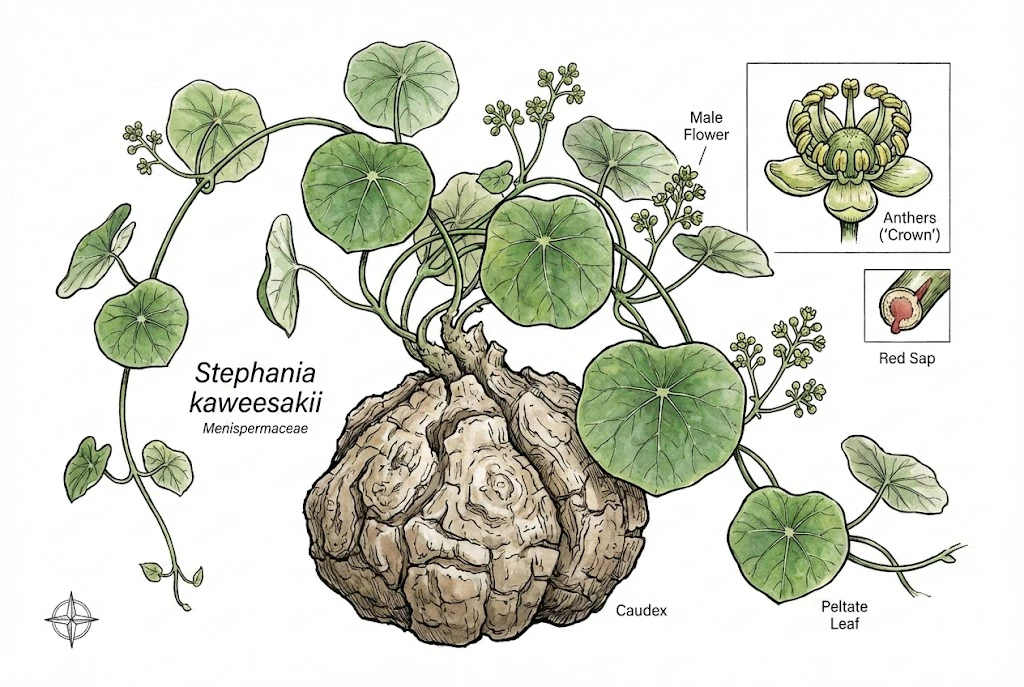
Stephania belongs to the Menispermaceae, a family made up largely of climbing plants. Its name comes from the Greek stephanos, or crown, referring to the ring of anthers in the male flowers.
Before it had a formal name, growers variously linked the Nova plant to S. suberosa or S. venosa. Thaya Jenjittikul and Saroj Ruchisansakun resolved that confusion in 2020 when they described S. kaweesakii in Phytotaxa. The name honors Kaweesak Keeratikiat, who collected the type specimen.
Use Botanical Traits for Identification
The published description distinguishes it from S. pierrei by the thick, scaly bark of the tuber and by petals in the male flowers, so those traits are more useful identifiers than a seller's use of the Nova trade name.
How It Differs from the Plant Sold as S. erecta
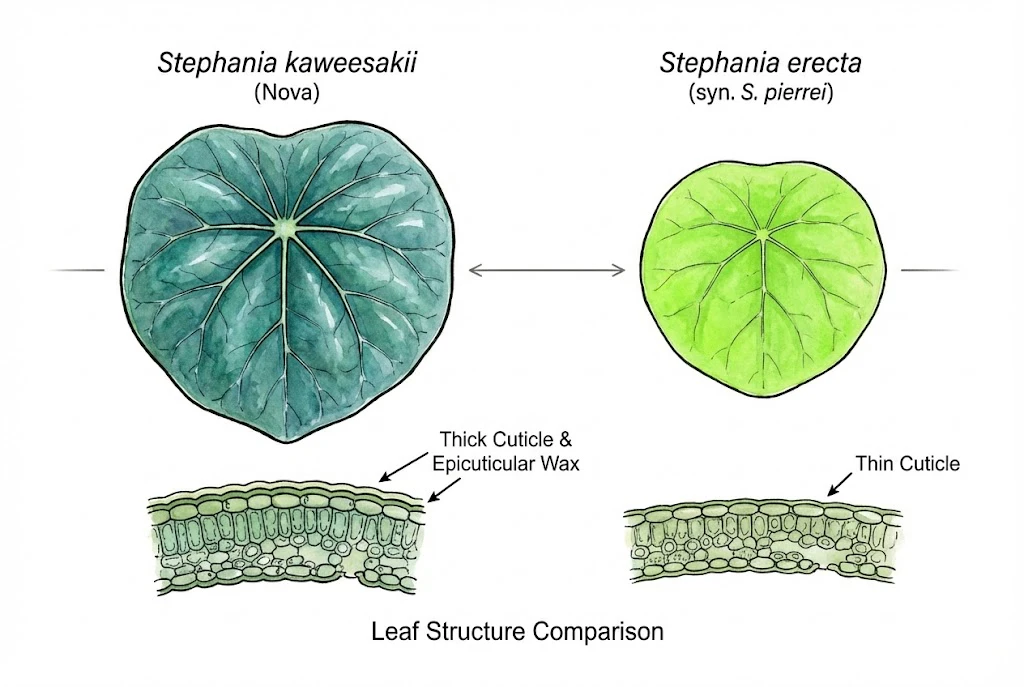
The smoother species commonly sold as S. erecta is currently accepted as S. pierrei, whose tuber has smoother, papery bark, while S. kaweesakii develops coarse scales and fissures. Flowers provide the cleaner botanical distinction because male S. kaweesakii flowers have petals.
Do Not Read Light Demand from Leaf Colour
A blue or glaucous leaf does not measure light demand. Genetics, leaf age, surface wax, and growing conditions all affect that colour. Give the plant useful light, but acclimate it gradually and judge the response of new growth instead of treating leaf colour as proof of a particular PPFD target.
How to Check Provenance
Ask for Evidence of Provenance
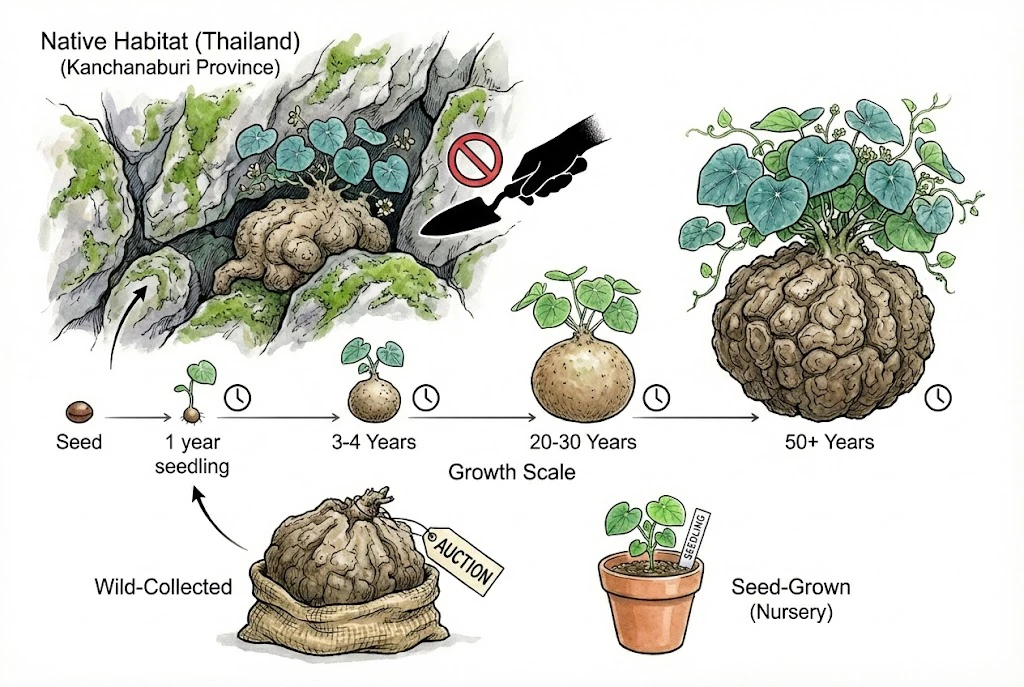
The original description records S. kaweesakii on limestone cliffs in Kanchanaburi Province, Thailand. It does not tell us how much of the current horticultural supply is wild-collected, so claims about an individual plant still need evidence from the seller.
Size Does Not Reveal a Plant's History
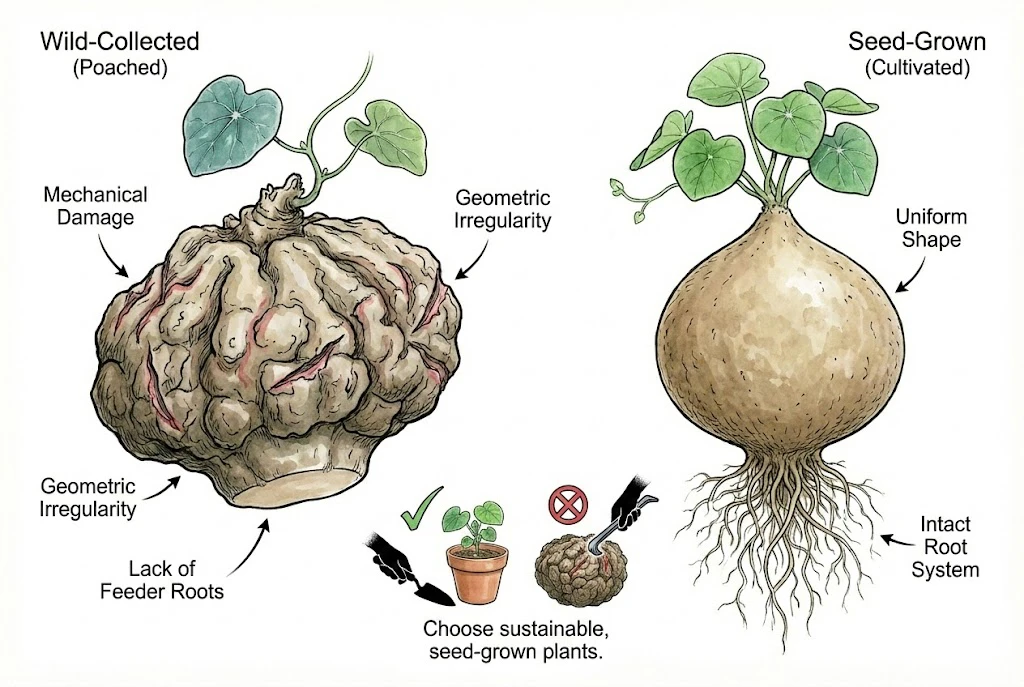
A seed-grown plant needs years to build a substantial tuber, but no species-specific growth trial lets us convert diameter into age. A large or irregular caudex is therefore a reason to ask about propagation, not proof that someone dug it from the wild.
Questions Worth Asking a Seller
Ask whether the plant was grown from seed and by whom. The following features may justify a follow-up question, but none settles the issue alone.
- An unusually flattened or irregular caudex may reflect growth in a confined space, but genetics and cultivation can also change shape.
- Deep gouges and old cut marks deserve an explanation from the seller, although handling and nursery damage can produce scars too.
- Bare-root sale does not prove field collection. Ask whether the plant was seed-grown, how long the seller has cultivated it, and whether origin records are available.
A documented seed-grown plant is the safer purchasing choice than a more dramatic specimen with a vague history, so use the wild-collected versus nursery-grown caudex checklist for a fuller set of seller questions.
Potting and Watering
What the Tuber Can and Cannot Tell You
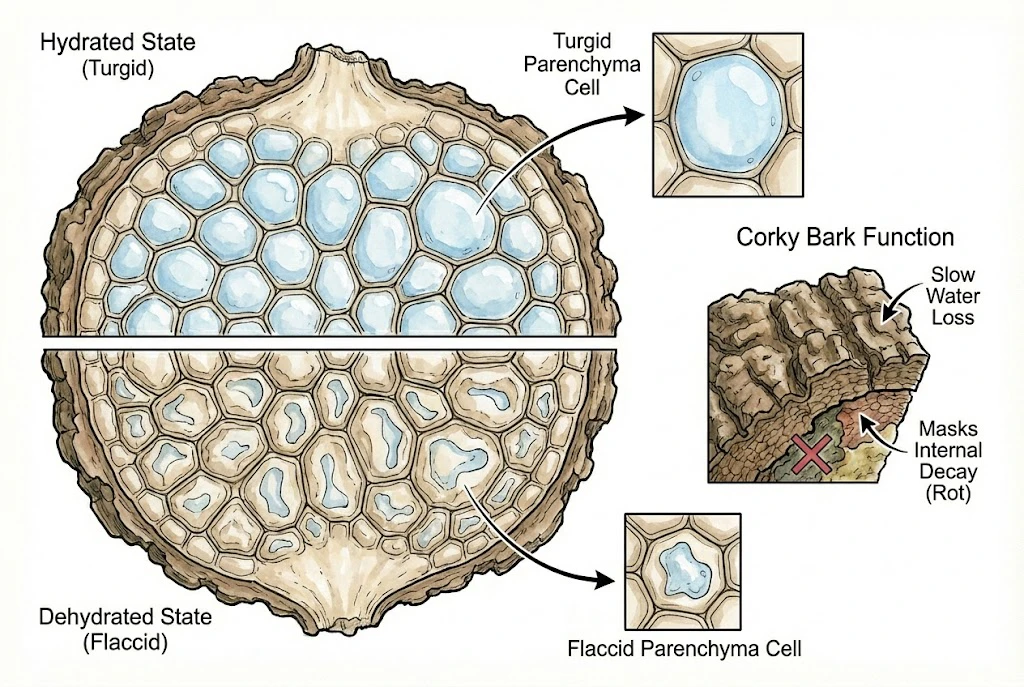
The tuber can store water and energy between wet periods. A well-hydrated plant is often firm, while one that is drawing down its reserves may feel lighter or yield slightly under gentle pressure.
Why the Squeeze Test Is Not Enough
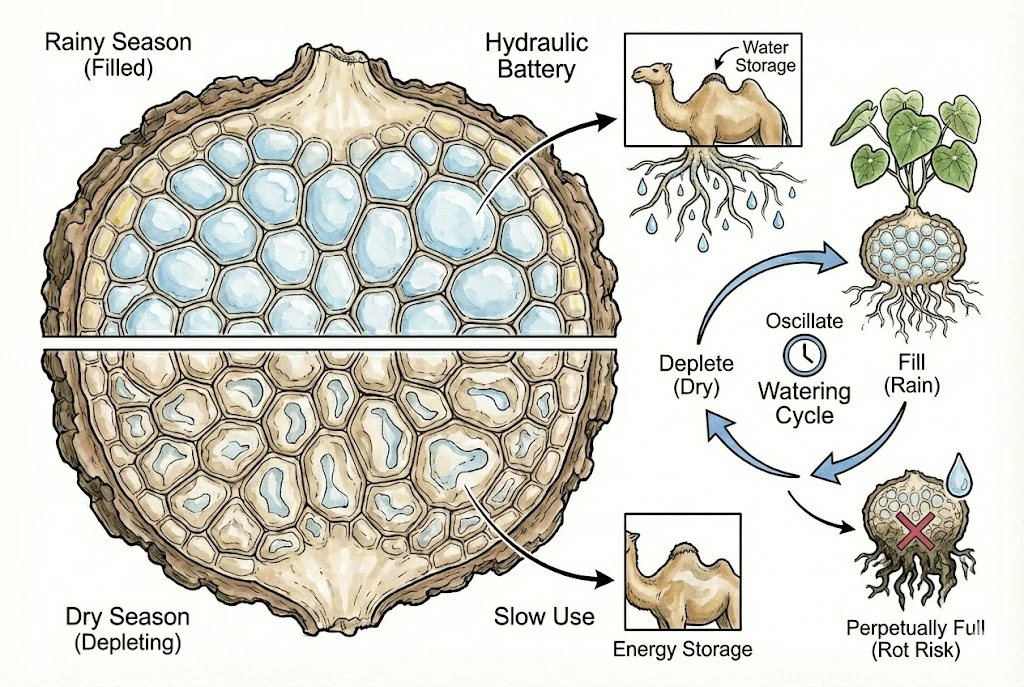
Nova's rigid bark makes a squeeze test less useful than it sounds. The shell can remain hard while the interior or roots are deteriorating. Read firmness together with pot weight, smell, recent watering, and root condition.
The bark is not what prevents overwatering. Roots still fail when the mix stays wet and short of air. In a pot, a workable routine is a thorough watering followed by enough drying time for air to return to the root zone.
Build the Mix Around Drying Time
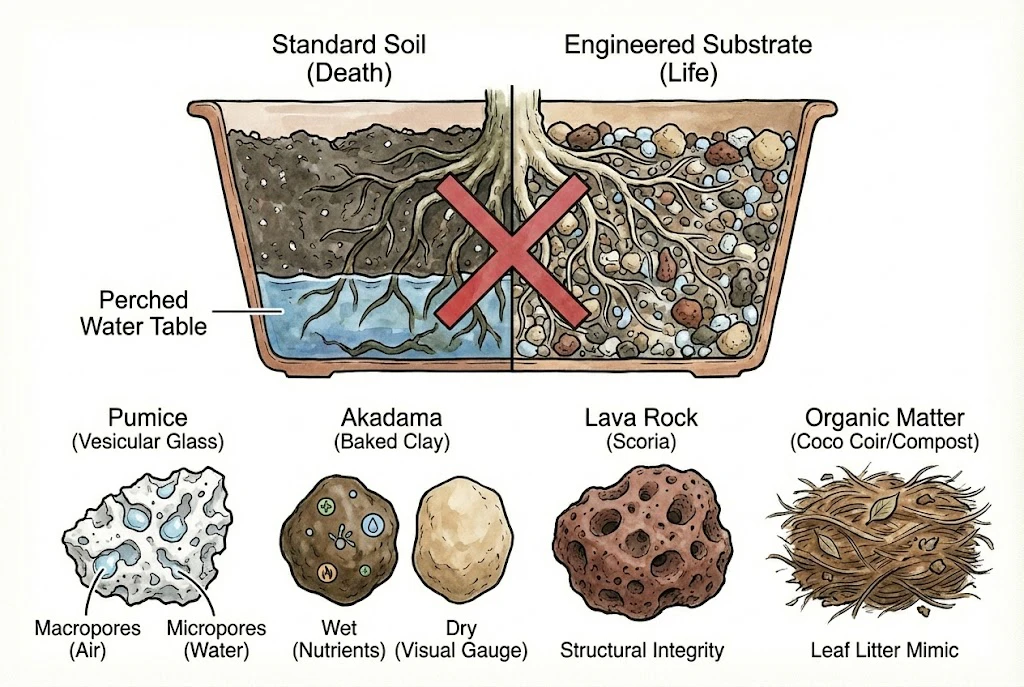
A dense mix that remains saturated for too long raises the risk of root loss. The limestone-cliff habitat points us toward an open root zone, but the final recipe still has to suit the humidity, airflow, pot, and watering habits in your room.
For the underlying pore-space and water-holding tradeoffs, compare pumice, akadama, and gritty caudex mixes before choosing a recipe.
What Each Ingredient Contributes
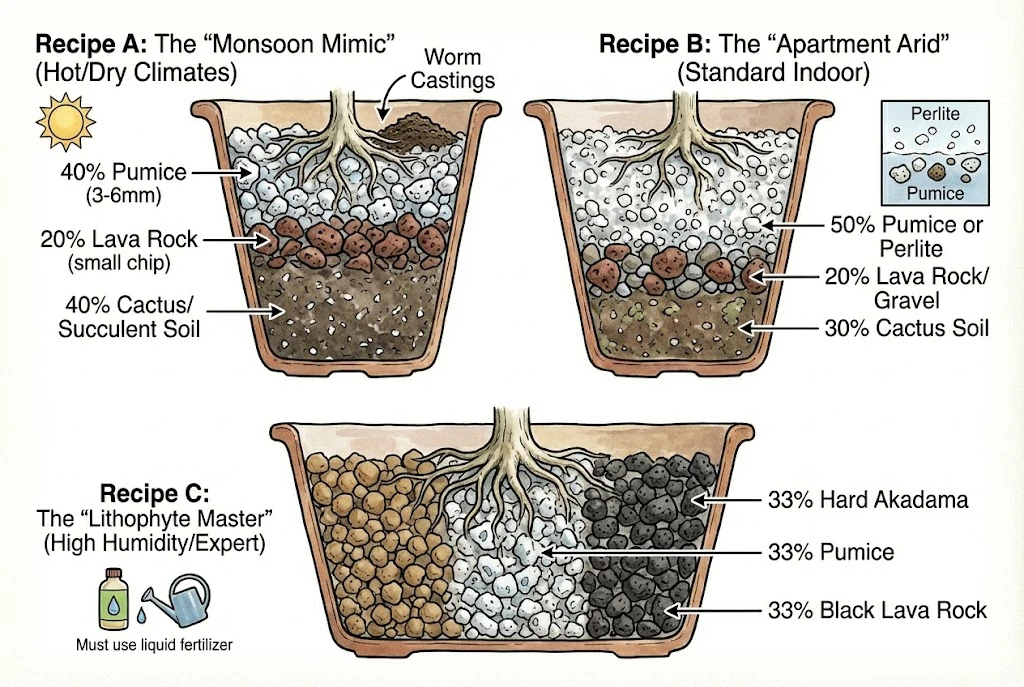
A useful mix combines coarse particles that preserve air space with a smaller fraction that holds water between visits. These materials can serve different roles.
- Pumice. It is porous, light, and slow to compact. It holds some water inside the particle while leaving gaps around the roots.
- Akadama. This fired clay can hold water and exchange nutrients, and it often darkens when wet. Even hard grades eventually soften, so check an older mix rather than assuming it remains unchanged.
- Lava rock. It adds structure and weight. Its water retention depends on the particle and source.
- A little organic matter. Coco coir, screened compost, or a suitable bagged succulent mix can add controlled water retention. The right amount depends on particle size, airflow, humidity, and how quickly your pot actually dries.
When Pumice Fits
Horticultural pumice is one option for the coarse mineral role described above. Its practical value is a clean, porous particle that helps preserve air space around the roots when the size fits the pot. Another clean horticultural pumice with a suitable particle size can fill the same role.
Choose a Starting Blend
There is no tested percentage recipe for S. kaweesakii. Start with clean, stable particles that leave air space after watering, then adjust the water-holding fraction to the pot, root mass, airflow, temperature, and drying time in your room.
- In a humid room or an oversized pot, use more durable coarse mineral material and less fine or organic material, then confirm that the mix dries through rather than staying saturated.
- In a hot, dry setup or a small root system, retain enough moisture for the plant to reach the next check without turning the medium into a permanent reservoir.
- Treat pumice, lava, akadama, perlite, and commercial cactus mixes as different materials, not interchangeable percentages. Particle size and the actual product composition matter.
Change one component at a time and record the wet and dry pot weights. If the pot remains damp after growth slows, reduce the fine or organic fraction. If a healthy plant dries unusually fast during active growth, add a little retention rather than watering by the clock.
When Akadama Adds Useful Retention
If the mix dries too quickly, akadama can supply a finer water-holding fraction alongside the coarse particles. It is a starting material rather than a tested requirement for this species. Hard grades also soften over time, so check the older mix instead of assuming the original pore structure remains.
Choose the Pot After You See the Roots
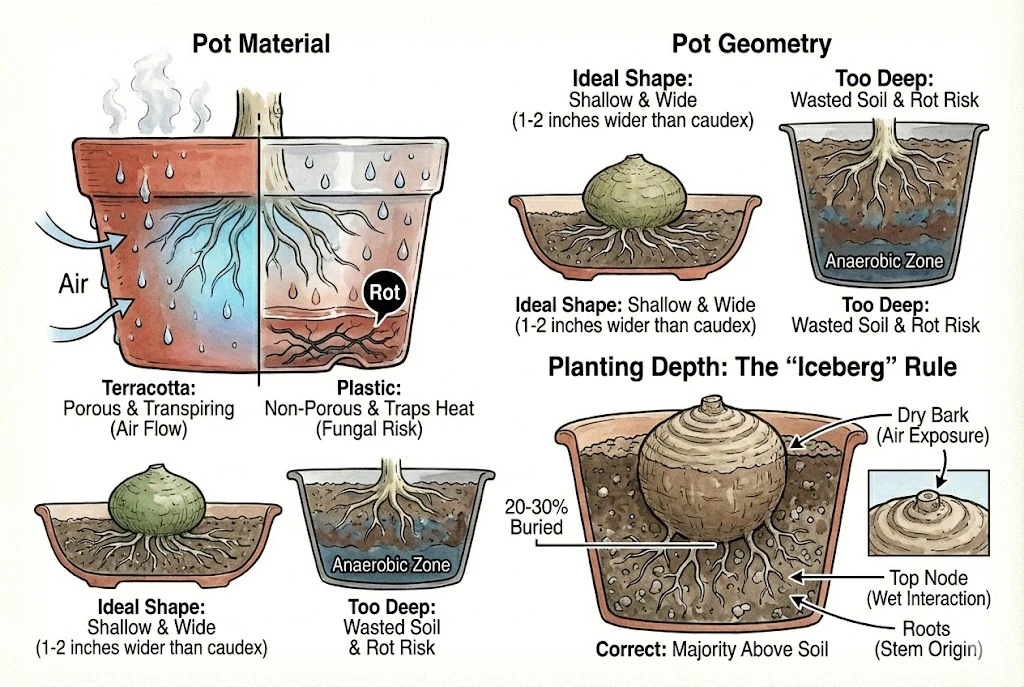
Pot Material
Unglazed terracotta speeds drying through the pot wall, which can be useful in humid rooms or for a heavy-handed waterer. Plastic is not unsafe. It simply holds moisture longer and may need a coarser mix or a longer interval between waterings.
Pot Shape and Size
Match the pot to the roots rather than to the widest part of the tuber. A large volume of unused mix stays wet after the active roots have taken what they need.
A shallow pot does not eliminate the saturated layer that forms at the bottom of a container. With the same substrate, that layer occupies a larger share of a shallow pot. Particle size, drainage, and avoiding an oversized pot matter more than choosing a dramatic bonsai silhouette.
Planting Depth
Bury the rooted base deeply enough to make the plant stable, but keep most of the non-rooting tuber above the mix. There is no useful universal percentage. Root placement and stability decide the depth.
A node or ring where stems emerge may help with orientation, while the lower side may be flatter or show old root marks. Treat those features as clues rather than a species-wide anatomical rule.
Care Through the Growth Cycle
When a Dormant Tuber Starts to Wake
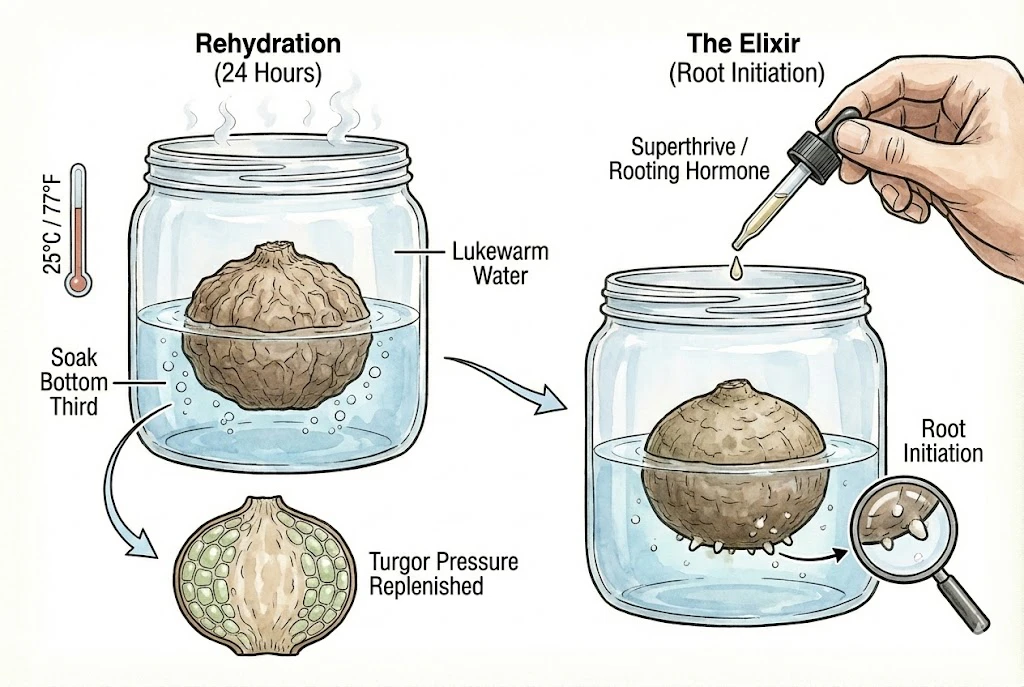
Use the plant's signs rather than the calendar. New buds and live roots matter more than the month. The transition period is the interval between the first sign of growth and a root system that is taking up water again.
If the Tuber Is Rootless
A dry, rootless tuber needs a root-status check before extra moisture is added. If the base is intact and genuinely dehydrated, use a brief, controlled rehydration and let it drain completely, rather than leaving it submerged or turning a general soak into a fixed species protocol.
Plain water is sufficient for that check. Available extension guidance does not establish vitamin B1 as a dependable root stimulant, and an auxin product can help, do nothing, or injure tissue depending on the organ and concentration. Neither is a dependable wake-up additive.
Using Warmth and a Humidity Cover
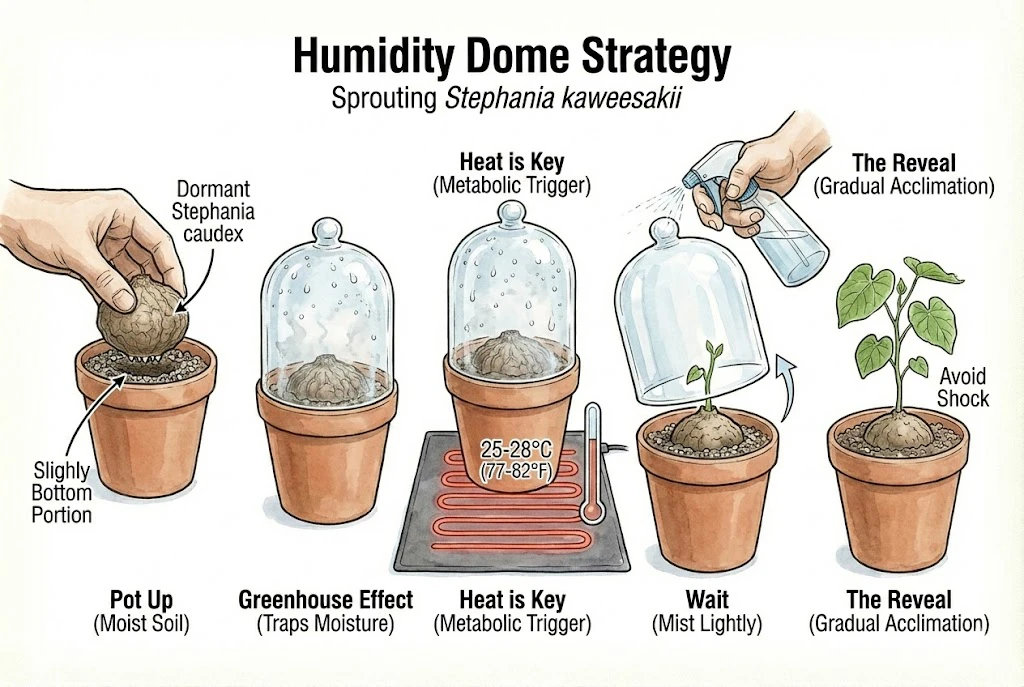
Set the tuber over a barely moist mix in a warm location. If the room is cool, use a thermostat-controlled heat mat. An unregulated mat can overheat the base even when the air feels comfortable.
A clear cup or bag can slow moisture loss, but it also traps condensation. Vent it whenever condensation persists and remove it if you smell mustiness or see mold or soft tissue, then increase airflow progressively as the shoot grows and the plant resumes transpiration.
While the Vine Is Growing
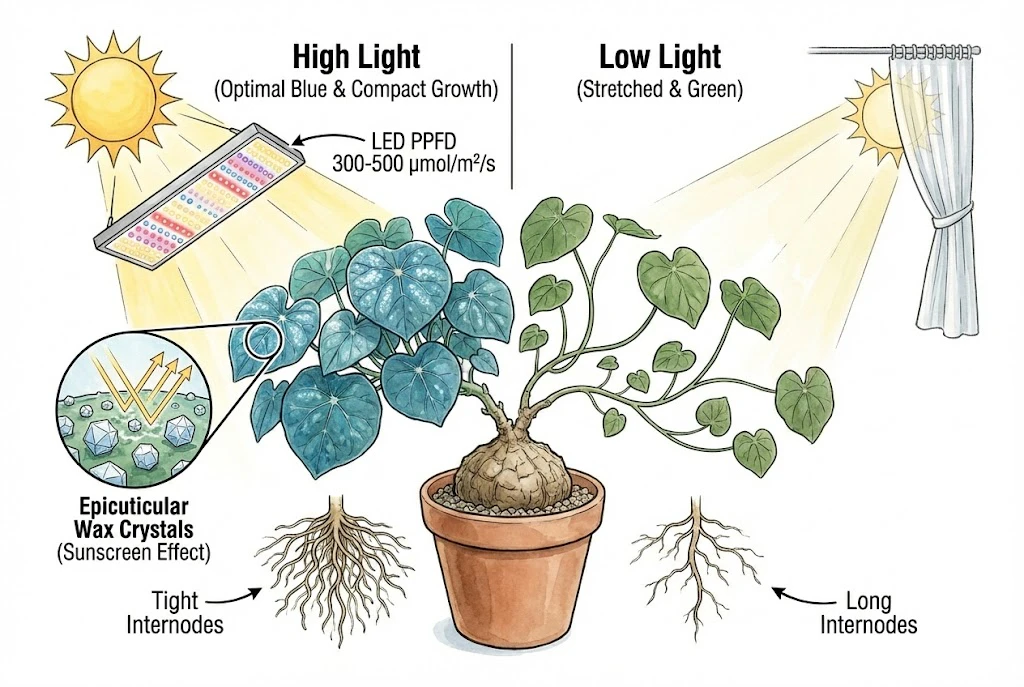
Match water and light to active growth
A leafing plant can use more water and light, but the root system still sets the pace.
Light Requirements
Judge light by the new vine rather than the blue cast of an old leaf. Compact internodes and normally sized leaves suggest that the level is workable. Bleaching or dry patches after a move point to an increase that was too fast.
An east or west window with gentle direct sun is a practical starting place, while a bright south window may need filtered midday sun until the leaves have acclimated. The sun-acclimation procedure gives a conservative way to increase exposure. Under a full-spectrum LED, use the caudex grow-light guide to measure light at the leaf canopy instead of guessing from lamp wattage.
Watering
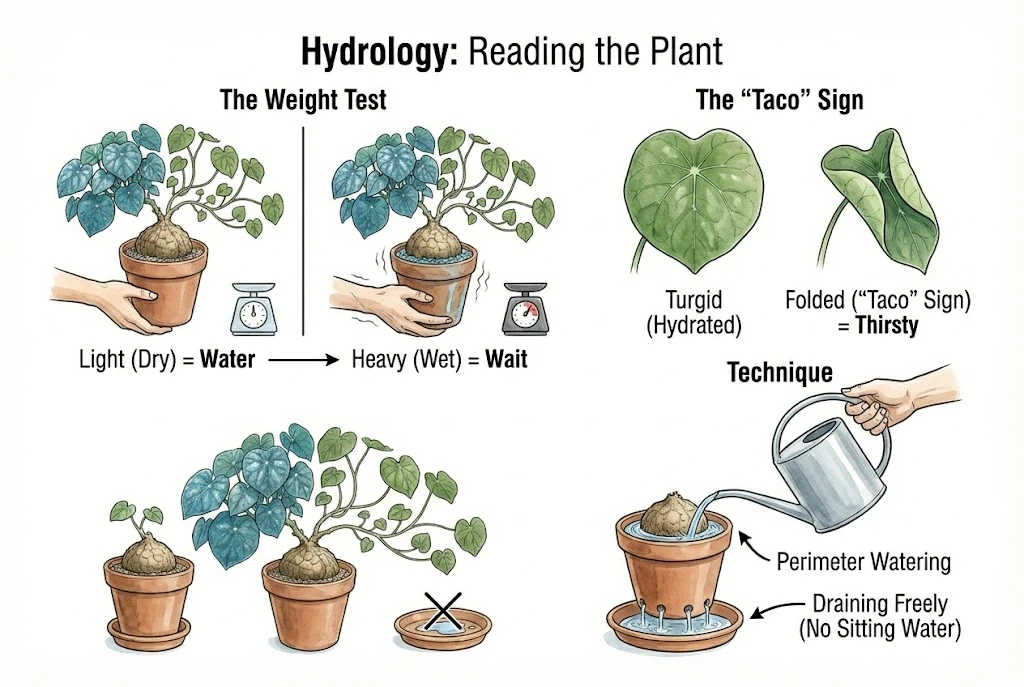
Use pot weight with root condition
Lift the pot before you water. If the mix is dry, the pot is close to its dry weight, and the roots are healthy, soak the mix until water reaches the drainage holes. Empty the saucer afterward. The caudex watering measurement guide shows how to establish that dry-weight reference.
Drooping leaves support a dry-pot diagnosis, but they do not establish it. Damaged roots can produce the same wilt because they cannot move water into the vine.
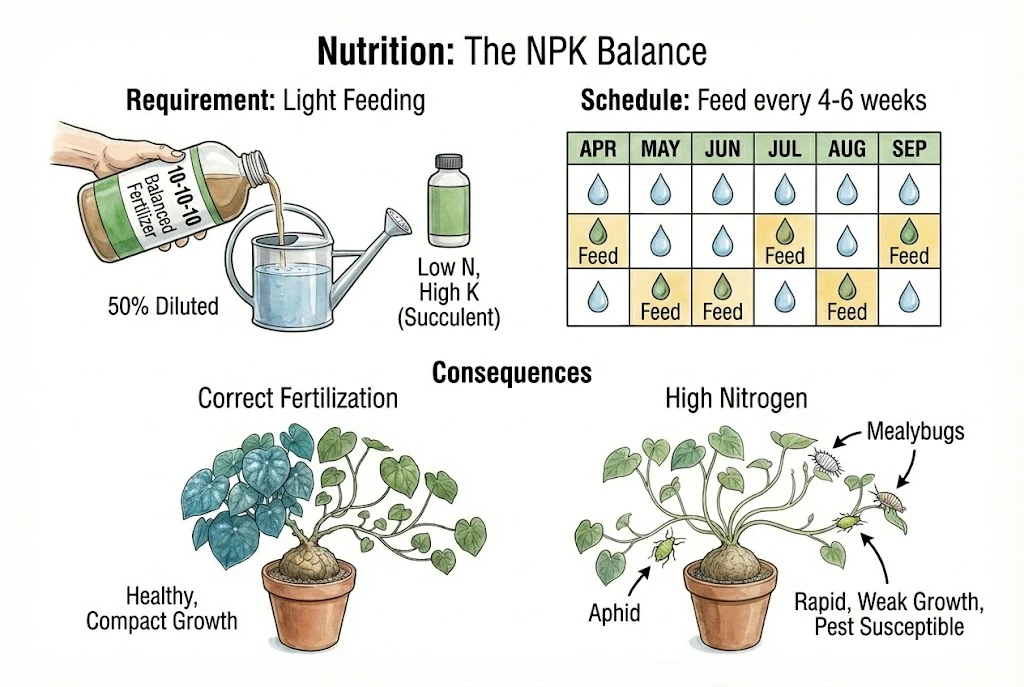
Fertilization
Feed only while the vine is making leaves, and follow a diluted rate and interval that match the fertilizer label, the water quality, and the nutrition already in the mix. Reassess the plant rather than repeating a calendar dose, and stop when growth slows. The caudex fertilizer guide shows how to choose a starting dilution and adjust feeding to active growth, root health, and pot dry-down.
When the Vine Dies Back
Let the Plant Set the Dry Interval
Yellowing leaves, a slowing vine, and a pot that takes longer to dry usually mark the start of dormancy. Reduce water as those changes appear and stop fertilizer. More water will not keep a naturally senescing vine green.
Check Before a Dormant Watering
After leaf fall, protect the tuber from a cold, wet mix. A fixed temperature cutoff has not been established for this species, so use the plant's growth state, root condition, pot moisture, and the duration of the cold period together.
There is no useful monthly ration for a dormant plant. If a rooted tuber remains firm and the mix is cool or damp, leave it alone. A small watering at the pot's edge can be considered when the mix is fully dry, the roots appear sound, and the tuber has been steadily shrinking. Mustiness, spreading softness, or a rootless base calls for inspection. The dormant-versus-failing Stephania checks walk through that decision.
Troubleshooting
Read the Root Zone Before the Symptom
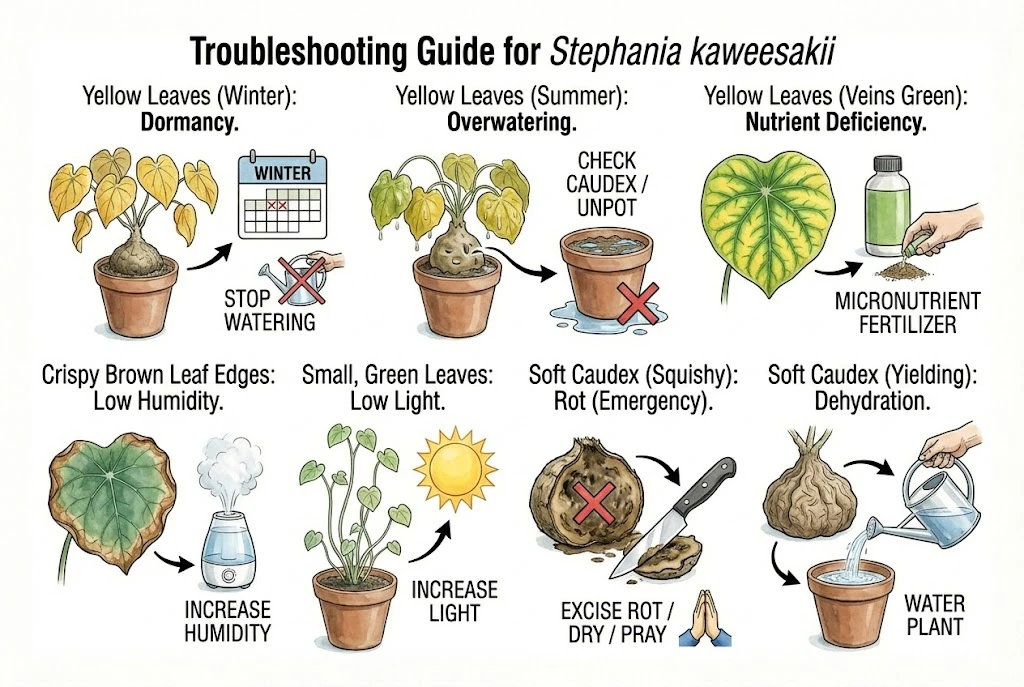
Diagnose the root zone before the symptom
Start with the root zone and recent care before choosing a treatment. The same leaf symptom can come from too much water, failed roots, light stress, or a normal seasonal change.
| Symptom | Possible causes | What to check first | Next action |
|---|---|---|---|
| Yellow leaves as growth slows | Normal dormancy, cold stress, or root stress | Season, vine growth, mix temperature, and tuber firmness | Reduce watering as the vine shuts down. Inspect if tissue softens or odor appears. |
| Yellow leaves during active growth | Wet roots, damaged roots, heat, or nutrient imbalance | Pot weight, drainage, root condition, and recent feeding | Correct the measured cause. Do not add water or fertilizer automatically. |
| Yellow tissue with greener veins | Possible nutrient unavailability, root damage, or pH problem | Root health, mix age, water quality, and feeding history | Fix root or pH problems before applying a micronutrient fertilizer. |
| Crispy brown edges | Dry root zone, salt buildup, abrupt light, hot air, or failed roots | Pot weight, runoff salts, recent light change, and roots | Correct the confirmed stressor. Humidity alone is not a diagnosis. |
| Long vine or small, pale leaves | Often inadequate light. Root trouble can mimic it. | Internode length, measured light, and root condition | Increase light gradually after confirming the roots are functional. |
| Soft, mushy tuber in damp mix | Likely rot | Odor, discoloration, wet roots, and spreading softness | Stop watering. Unpot, isolate, and remove only confirmed rotten tissue with sanitized tools. |
| Slightly yielding tuber in dry mix | Dehydration, dormancy, or root loss | Pot weight, root status, and whether the vine is active | Water only when the mix is dry and healthy roots can take it up. Otherwise inspect. |
A slightly yielding tuber in dry mix may be short of water, but only if it still has functioning roots. A plant with dead roots can be both dry and unable to drink. Damp mix combined with spreading softness, discoloration, collapsed roots, or a foul smell points much more strongly toward rot.
If you find confirmed rot, wear gloves and eye protection. Use a sharp blade, disinfect it between cuts, and remove only diseased tissue until the cut surface is clean and firm. Bag the waste, clean the pot and tools, isolate the plant, and keep the wound dry while it calluses. Extensive rot may leave too little healthy tissue to save.
Long internodes and undersized pale leaves often mean low light, but check the roots before raising exposure. Yellowing at the end of a growth cycle is expected. Yellowing during active growth, especially with soft tissue or odor, needs a broader diagnosis.
Mealybugs in the Bark
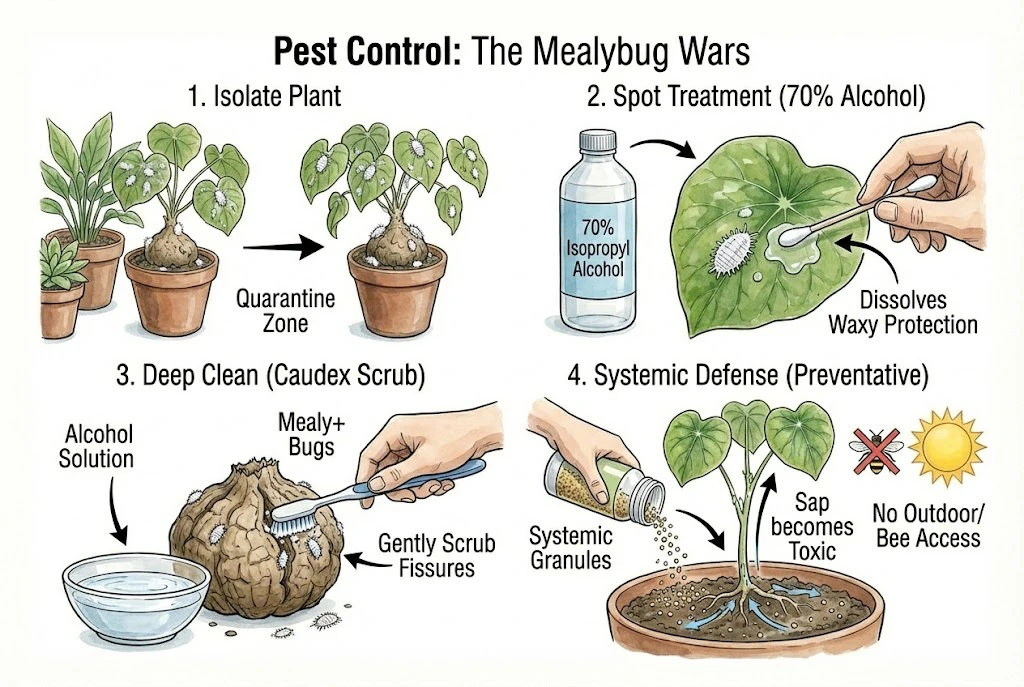
The fissured bark gives mealybugs plenty of cover. Isolate the plant, then touch visible insects with a cotton swab dampened with a plant-safe, label-compatible contact method. Test a small area first because alcohol-based products can damage foliage, and keep them away from flame.
Check Bark and Roots Separately
Repeat the inspection twice weekly. One pass will miss eggs and insects buried in the bark. Check below the soil line as well.
White wax on the roots calls for the root-mealybug confirmation and cleanout protocol. If you use a systemic insecticide, its label must cover the pest and indoor ornamental use. Follow the stated dose and safety instructions, and do not move a treated plant outdoors where pollinators can visit it.
Before I call a pale mark a pest, I photograph the same three bark crevices with magnification and hold a white card below them. I inspect the same points on days 0, 3, and 7, then twice weekly while any live insect or fresh wax remains.
The three-to-four-day spacing can reveal newly mobile crawlers before a full week passes without turning every pale bark mark into daily handling. It also keeps bark checks separate from the root-zone evidence.
When Routine Breaks
After a Fall or Broken Pot
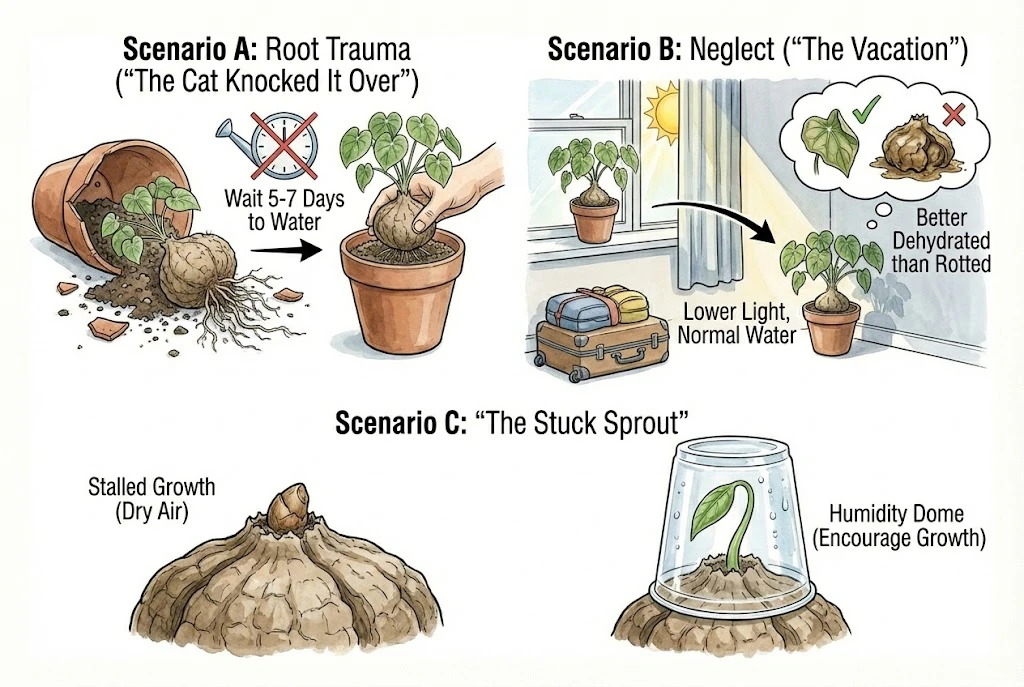
Inspect the roots before repotting. If some are torn, use clean, dry mix and delay watering until the wound surface has dried while the plant remains warm and ventilated. A large cut in cool, still air needs more time than a few fine breaks on a warm, actively growing plant.
Before a Trip
Water only if the plant is already due by its normal dry-mix and pot-weight checks. An extra soaking is more likely to leave the roots wet than to protect the tuber.
Keep the plant in its usual bright conditions. For a long absence, give the caretaker a dry-weight target and explicit reasons not to water, including damp mix, a dormant vine, odor, or new softness.
When a New Shoot Stalls
Check the tuber, root-zone moisture, temperature, and light before blaming dry air. If the tuber and roots are sound and the room is unusually dry, a vented clear cup can raise local humidity for a short period. Remove it if condensation persists or the tuber softens.
Growing S. kaweesakii from Seed
Pollination and Sowing
Start with a Small Seed Trial
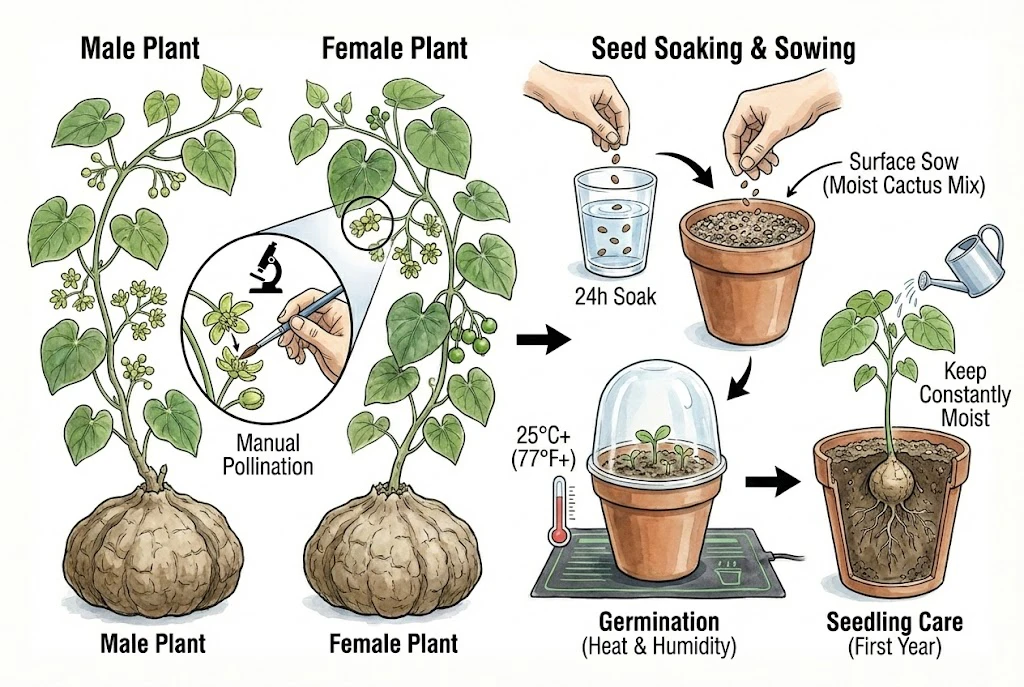
The species is dioecious, so seed production requires a male and a female plant. Its flowers are small enough that hand pollination takes a fine brush and a steady hand.
The botanical description does not include a tested horticultural germination protocol. Fresh mature seed, a clean airy medium, moderate warmth, and controlled humidity are reasonable starting variables, but they should be tested on a small batch rather than presented as a fixed recipe. Stop a trial if seed turns soft or smells foul. The caudex seed-germination setup covers heat control, dome ventilation, and damping-off.
Young seedlings lack the adult plant's water reserve. Keep their medium more evenly moist, while still allowing air into the root zone, until the underground tuber begins to develop.
A Workable Routine
Adjust the Routine by Stage
Keep the routine adjustable
During active growth, give the vine good light, soak a dry pot, and let the mix drain. As the vine shuts down, stop feeding and lengthen the dry interval. At either stage, check the roots before treating a soft or wilted plant as simply thirsty.
That routine is easier to adjust when the room, pot, or season changes than a calendar-based recipe.