
Root Mealybug Treatment for Caudex Plants
Confirm root mealybugs before treatment. Decide whether to discard or rescue a caudex, replace infested mix, clean tools, and check systemic labels.
Nathan Brooks · 2026-07-30 · Updated 2026-08-05 · 10 min read
Key Takeaways
- Confirm the insect before treating the roots, and let the current product label set the method. White material can be wax, salts, or fungal growth, so look for slow-moving oval insects first.
- Isolate the pot and contain its drainage the moment you suspect an infestation. Crawlers travel on pots, media, tools, hands, and irrigation water.
- Decide whether rescue is worth the risk (discarding a heavily infested, replaceable plant protects the rest of the collection). A rescue means bagging the old mix, preserving viable roots, cleaning everything, and repotting in fresh medium.
- Do not improvise a homemade alcohol or oil root dip. Any pesticide you add must have a current label covering the plant, site, pest, and method. Bonide BND951 is a soil-incorporated granule, not a root dip.
- Prove control with repeated inspections over a multi-month separation, not a clean-looking two-week hold. Ground mealybugs have a two-to-four-month generation time.
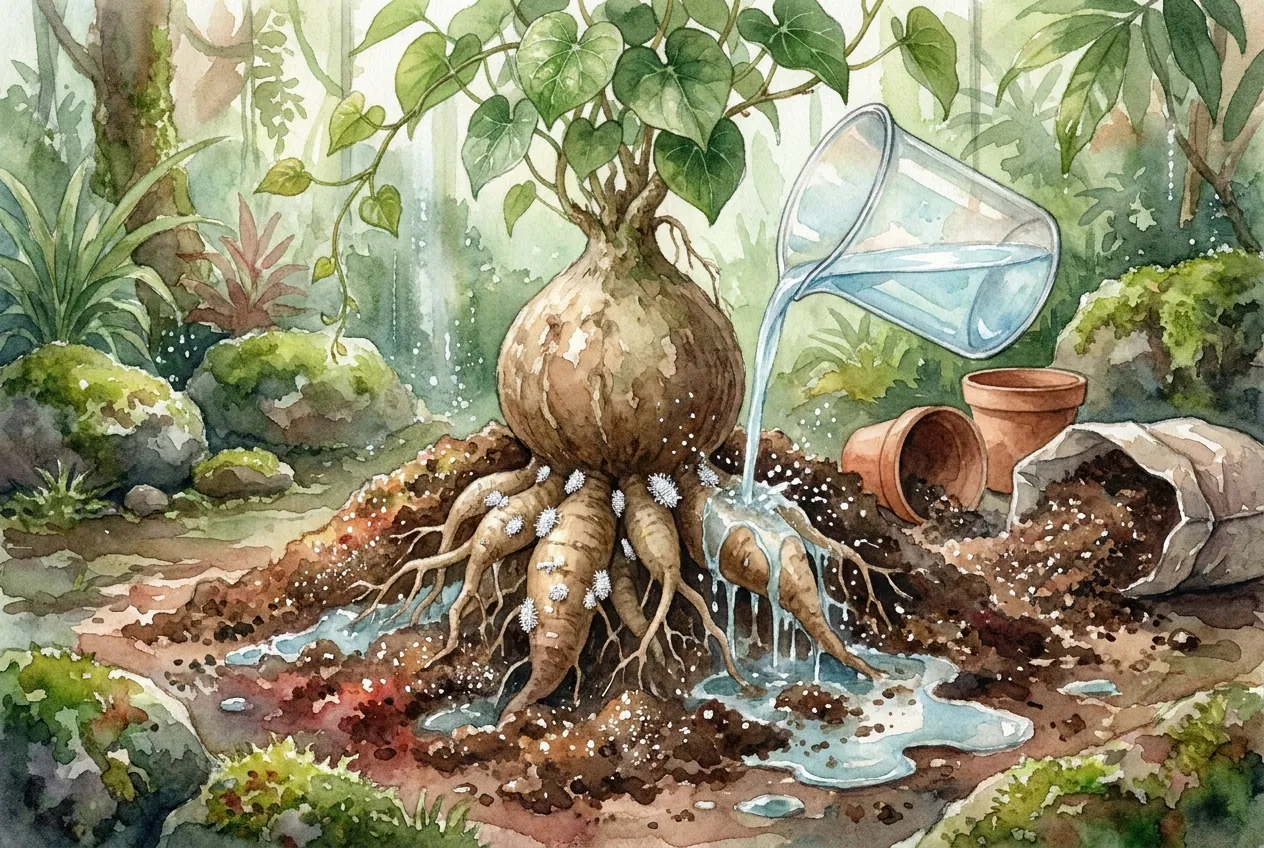
Root mealybugs are easy to miss because the plant can simply stop growing while everything above the soil still looks respectable. During repotting, look for powdery white material along the roots, pot wall, or outer edge of the root ball. That sight is a reason to inspect, not a diagnosis by itself. Once live insects are confirmed, the difficult choice is not which bottle to buy. It is whether to discard the plant or accept a careful cleanout followed by months of separation and reinspection.
How Do You Confirm Root Mealybugs?
Inspect the Root Ball in Containment
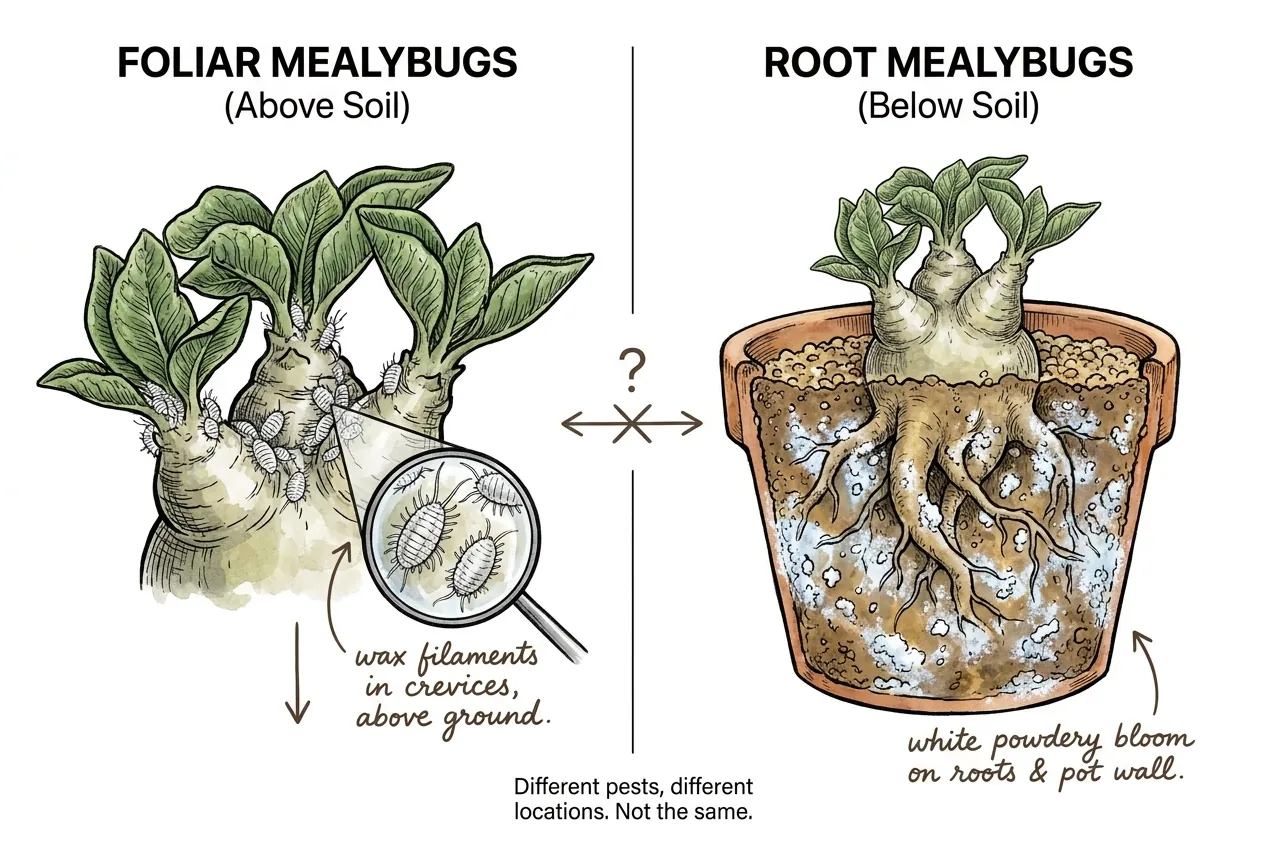
Move the suspect plant away from the collection before unpotting it. Work over a surface that can contain loose mix and water, then examine the outer root ball and the inside wall of the pot under bright light. UC IPM describes ground mealybugs as small, oval, whitish insects covered with powdery wax. Look for bodies, legs, and slow movement rather than relying on a white crust alone.
Separate symptoms from diagnosis
Slow growth, yellowing, or decline can justify a root inspection, but none of those symptoms identifies the pest. Fertilizer salts, root hairs, fungal growth, and root rot can all complicate the picture. If the white insects are in leaf axils or caudex folds instead of below the soil line, use the separate guide to foliar mealybugs in caudex folds.
Use magnification for repeat checks
A loupe is useful when the insects are too small to distinguish from debris, but magnification does not replace the movement-and-body check. A clear phone photo taken through the loupe can also help you compare repeated inspections without repeatedly disturbing the roots.
Should You Discard or Rescue the Plant?
Start with Collection Risk
Disposal is a legitimate pest-control decision, not a failure. Root mealybugs can occur throughout a root mass, and UC IPM notes that completely disinfesting roots is difficult. One common plant can put a rare shelf at risk through shared trays, runoff, contaminated media, or tools.
| What you find | Practical choice | Why |
|---|---|---|
| Heavy infestation on a replaceable plant | Bag and discard the plant and mix | This removes a difficult reservoir before it reaches higher-value plants. |
| Localized infestation on a stable, valued plant | Consider a controlled rescue | The plant may justify the root disturbance and long isolation period. |
| Severe root loss, active rot, and widespread insects | Favor disposal unless the plant is irreplaceable | Pest removal and root recovery are separate problems, each with uncertain outcomes. |
| Several nearby pots show signs | Treat this as a collection-level incident | Inspect neighbors, trays, stored media, tools, and the watering route before rescuing one pot in isolation. |
Inspect every new arrival
Origin alone does not prove pest status. Nursery-grown and imported material both deserve an intake check. The wild-collected versus nursery-grown guide explains the broader provenance questions.
How Do You Contain the Infestation?
Contain the First Pot
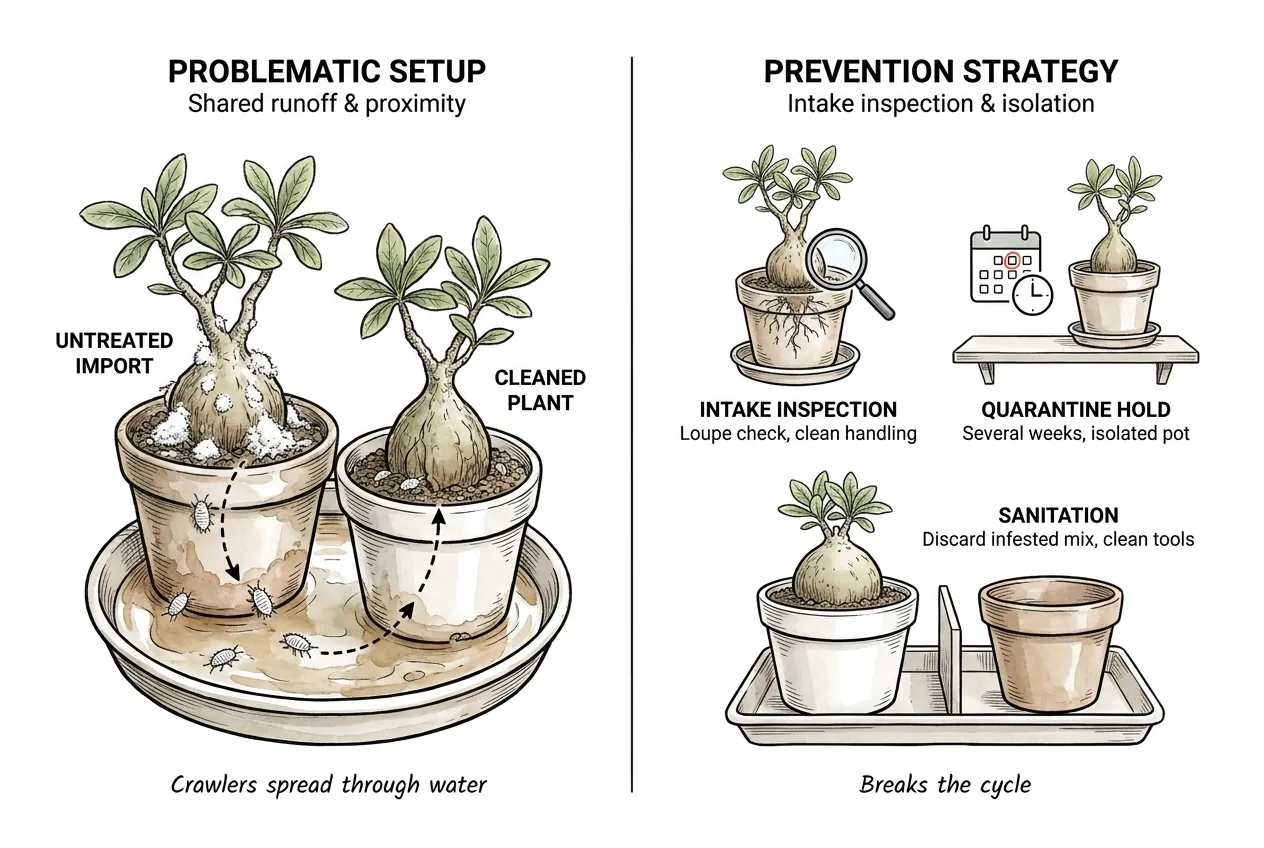
Give the plant its own washable tray and keep its drainage away from clean pots. Do not reuse runoff. Bag discarded mix and debris at the work surface instead of carrying them uncovered through the collection. Wash soil from reusable pots, then disinfect the pots, tools, and bench using a method appropriate to the material. Wash your hands before touching other plants.
Trace shared routes
Those details matter because crawlers can move with pots, media, tools, hands, clothing, and irrigation water. If several plants shared a tray, inspect all of them. Cleaning only the visible victim leaves the route of spread intact.
Clean before disinfecting
The University of Minnesota recommends removing organic debris before disinfecting tools because dirt reduces a disinfectant's effectiveness. Follow the selected disinfectant's contact time and safety directions rather than mixing household cleaners.
What Does a Physical Cleanout Involve?
- Prepare containment first. Set out a bag for infested mix, a separate tray for the plant, and clean tools before opening the pot.
- Ease the root ball apart. Remove mix gradually. Do not tear sound roots merely to make the plant look perfectly bare.
- Discard the old medium. Do not compost or save a portion for reuse.
- Remove visible insects. A controlled water rinse and a soft brush can dislodge wax and insects. Keep the wash water away from drains, clean benches, and other plants.
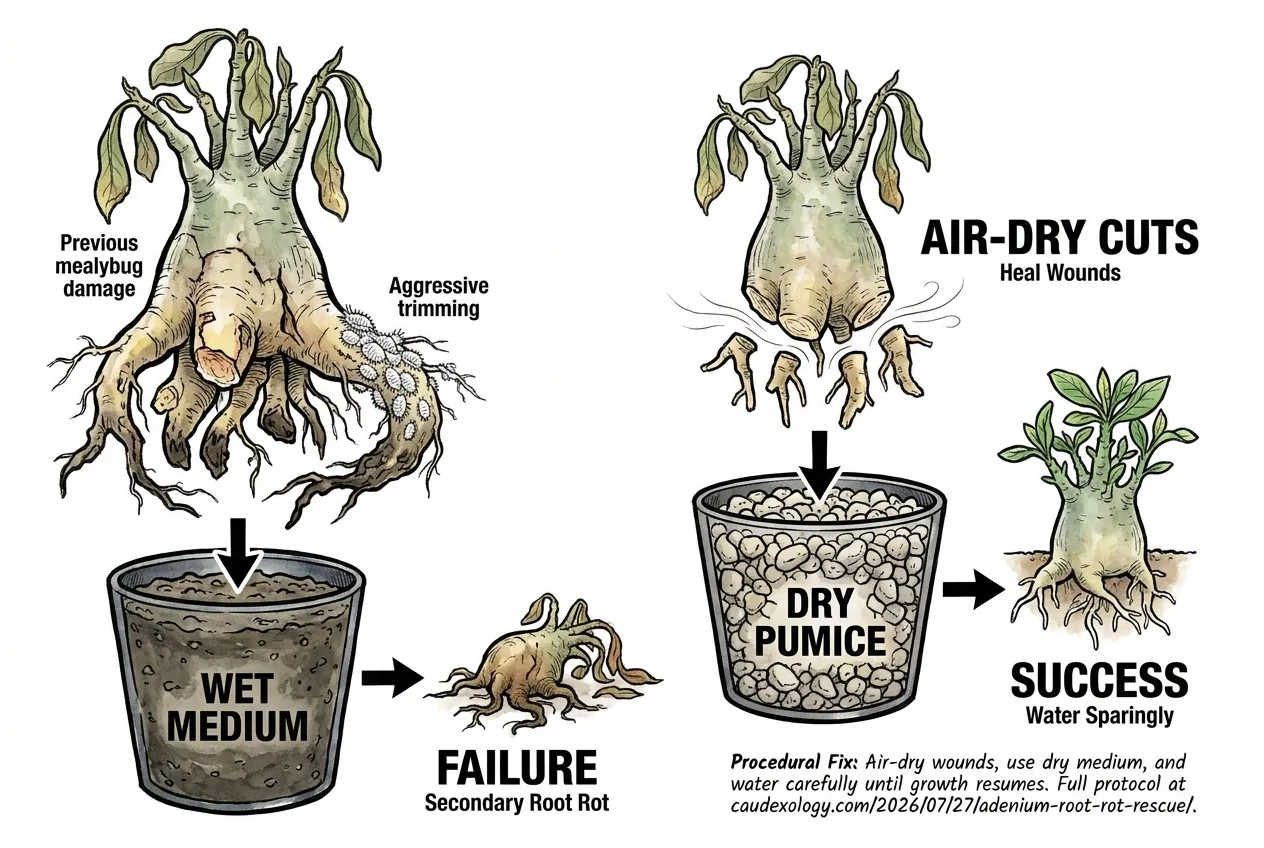
- Assess the roots separately. Preserve firm, viable roots. Trim only dead or rotten tissue with a clean blade. See the diagnosis-first root rot guide if decay is present.
- Clean the container and work area. A sound pot may be washed and disinfected instead of discarded.
- Repot in fresh, pest-free medium. Adjust the first watering to the species, root condition, season, and any cuts rather than following a universal dry-day count.
Accept the Cost of Physical Cleanout
Bare-rooting is not harmless. It can set back a weak plant, and aggressive trimming creates more wounds. The aim is to remove the infested medium while retaining as much functioning root as practical. For a recently imported Pachypodium, the bare-root Pachypodium arrival guide covers the rooting decision in more detail.
Can You Dip Roots in Alcohol or Oil?
Keep Whole-Root Dips Out of the Routine
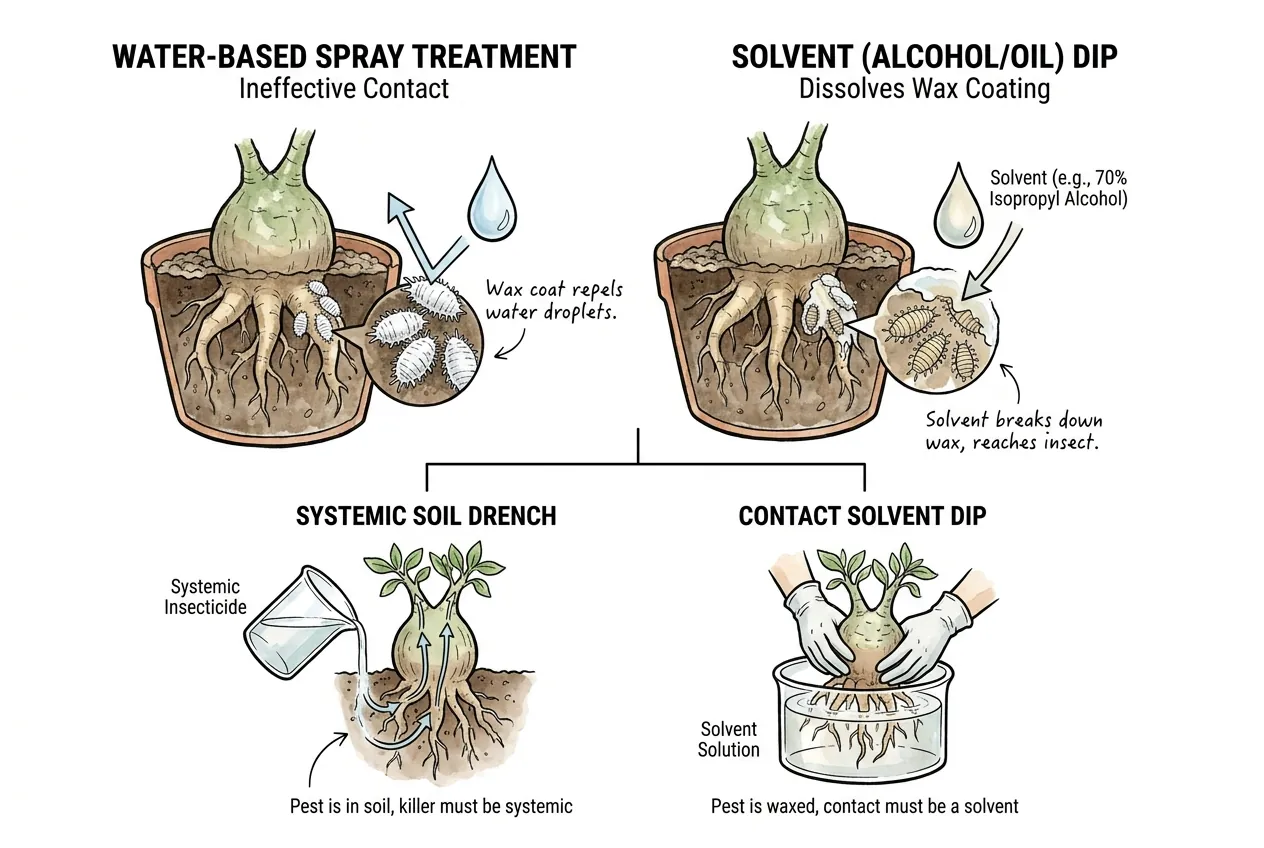
Do not improvise a whole-root alcohol, soap, or horticultural-oil soak. A contact product's ability to affect exposed mealybugs does not make an unlabeled root immersion safe for a caudex. Root species, wound condition, concentration, contact time, and temperature all change the injury risk.
Use mechanical removal as the baseline
Mechanical removal into fresh medium is the safer baseline. If a contact treatment is being considered for exposed insects, use it only where the current label covers the plant, site, pest, and method. Do not translate a foliar spot-treatment direction into a timed root bath.
Does Bonide Systemic Houseplant Control Fit?
Check What the Granule Actually Does
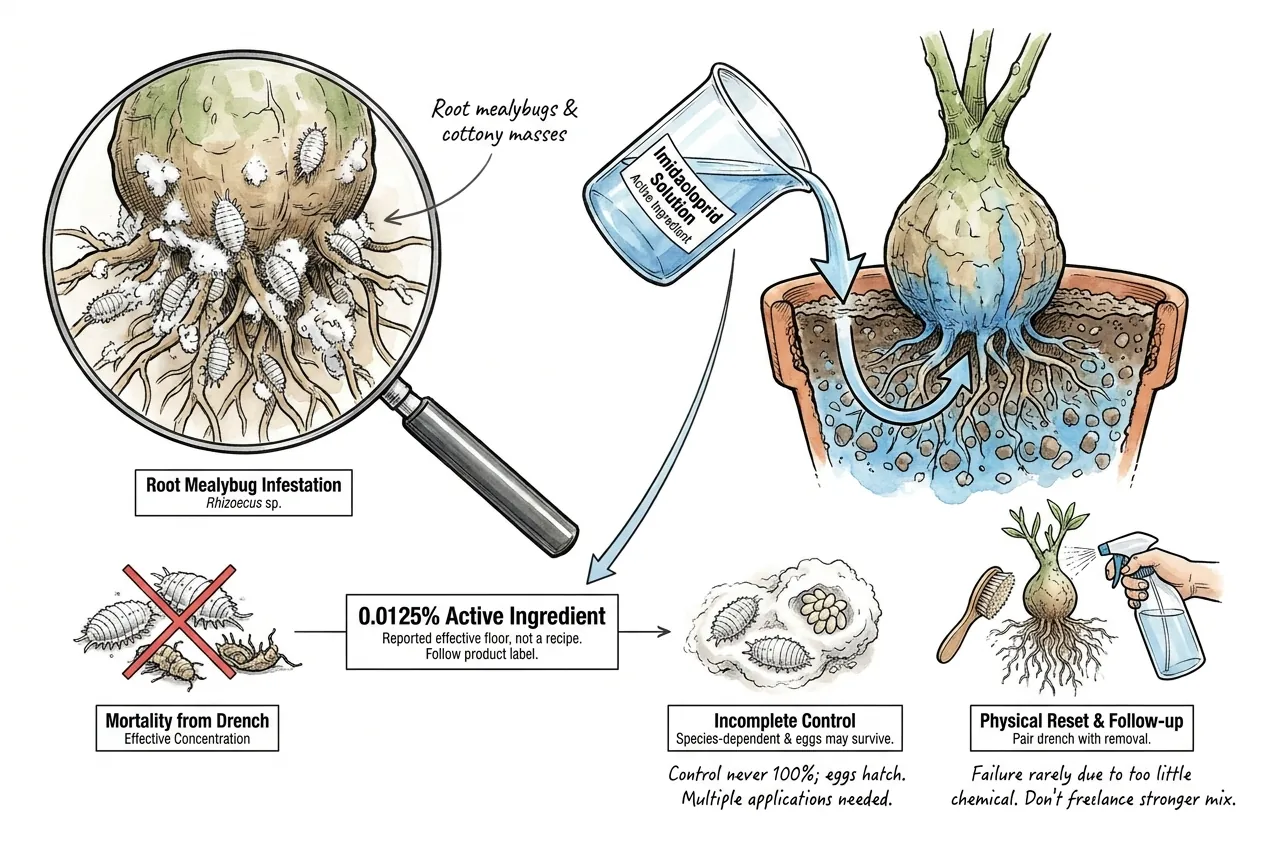
Bonide Systemic Houseplant Insect Control Granules, sold as BND951, contains 0.22% imidacloprid. The current manufacturer label covers containerized, non-edible household plants and lists mealybugs among the target pests. It directs the user to distribute granules over the soil surface, mix them into the upper soil without damaging roots, and water them in. That makes this a soil-incorporated granule, not a liquid drench, root wash, or bare-root treatment.
Read the label as a boundary
The label lists mealybugs. It does not separately validate every root-mealybug species on every caudex. Before buying, confirm that the label on the actual container is current for your location and covers your plant, site, pest, and intended application. Use the label’s pot-size amount and reapplication restrictions rather than reproducing or recalculating a dose.
Contain irrigation and runoff
Do not convert an experimental active-ingredient concentration into a homemade mix. Product formulation and labeled use matter. The BND951 label warns that imidacloprid is highly toxic to aquatic invertebrates and that runoff must not reach drains or surface water.
| Item | Useful role | Boundary to check |
|---|---|---|
| Bonide BND951 granules | Optional labeled systemic support after diagnosis | Non-edible container plant, local label, listed pest, soil-incorporation method, and runoff controls |
| Bonsai Jack pumice | A mineral component for fresh, draining medium | Pumice does not starve root mealybugs and need not be the whole mix |
| JARLINK illuminated loupe | Closer inspection of insects and repeat-photo records | A loupe helps reveal a body and movement. White residue alone remains inconclusive |
What Medium Should You Repot Into?
Repot into Clean Medium That Fits the Plant
Use fresh, pest-free medium suited to the plant and your watering conditions. Root mealybugs feed on roots, so pumice does not starve them. Its practical advantages are drainage, air space, and a structure that can make later inspection easier.
Use pumice as one component
Pumice can be one component of a species-appropriate mix. Pure pumice dries quickly and holds little nutrition, which may be a poor fit for a grower who cannot adjust watering and feeding. The pumice, akadama, and gritty-mix comparison explains those tradeoffs.
How Do You Inspect and Quarantine?
Record Each Inspection
Keep the rescued plant on its own tray and mark the date, affected roots, and treatment used. Reinspect the pot wall, drainage holes, and accessible outer roots at intervals that do not cause repeated root damage. Photograph anything suspicious under the same light so a stationary salt patch is not mistaken for a returning insect.
To avoid ending quarantine during a temporary lull, I start the release clock with the last live insect I saw, not with the treatment date. If I find another live insect, I restart the clock and record exactly where it appeared. That keeps two clean-looking weeks from being mistaken for eradication.
I number the drainage holes on the pot rim and photograph each numbered opening under the same lamp position and exposure at every inspection. That fixed map distinguishes unchanged residue from fresh material in a new place without scraping every white mark off the roots.
My inspection moves through three rings. The treated plant comes first, followed by every pot that shared its tray or runoff and then the nearest plants. Separate notes for each ring prevent a clean treated plant from being mistaken for proof that neighboring pots were never colonized.
Allow time for repeat evidence
UC IPM reports a roughly two-to-four-month generation time for ground mealybugs. That does not create a universal quarantine deadline, but it does show why a clean-looking two-week hold cannot prove eradication. Use repeated inspections over a multi-month separation period, and extend it if insects or fresh wax reappear. Check nearby pots on the same schedule.
Is Hot Water a Safe Alternative?
Do Not Borrow Nursery Heat Values
Do not treat published nursery heat values as a caudex recipe. The often-repeated hot-water figures for root mealybugs came from controlled work on potted Rhapis palms. UC IPM explicitly advises testing a heat treatment on a small sample of the specific plant cultivar because plant sensitivity varies.
Protect stressed roots
A bath that is lethal to an insect can also injure roots, especially on a recently imported, drought-stressed, or wounded plant. Without crop-specific validation and accurate root-ball temperature control, hot water is not the default home treatment recommended here.
How Do You Know Treatment Worked?
Require Repeated Evidence of Control
Success means no live insects across repeated inspections, no fresh wax on the pot wall or accessible roots, and no spread to neighboring plants. Stabilized growth is encouraging, but it is not proof. A dormant caudex may stay still after successful control, while a plant can briefly grow despite a surviving population.
Reopen the plan if signs return
If insects return, reopen the diagnosis and containment plan. Do not automatically add a stronger dose or shorten a pesticide interval. Recheck the current label, confirm that the product and method fit, and consider whether disposal now presents less risk than another rescue. If the plant is softening or roots are collapsing, evaluate rot as a separate condition rather than assuming every symptom is pest damage.
Affiliate Disclosure
This article contains Amazon affiliate links. As an Amazon Associate I earn from qualifying purchases. If you use these links, the site may earn a commission at no extra cost to you. Product availability, price, and specifications can change. Check the current listing before buying.