
Caudex Root Rot Fungicide: Diagnose Before You Drench
Choose a caudex root rot fungicide by diagnosis and label, not symptoms alone. Compare phosphite, mefenoxam, thiophanate, and safer first steps.
Rachel Torres · 2026-07-31 · Updated 2026-08-03 · 15 min read
Key Takeaways
- There is no honest symptom-to-fungicide shortcut for a rotting caudex. Isolate the plant, inspect its roots and recent conditions, and correct standing water or a poorly aerated mix before reaching for any bottle.
- Soft roots have many causes besides infection. Waterlogging, cold, salts, bacteria, true fungi, and oomycetes such as Pythium and Phytophthora all look similar, so for a valuable plant a diagnostic lab is the shortest route to a defensible treatment.
- Buy a fungicide only when its label covers your use site, plant group, target disease, and application method. The container label, not an online recipe, sets the dose, interval, protective equipment, and maximum applications.
- Oomycetes are not true fungi, so the chemistry has to match the pathogen. Phosphite and mefenoxam target Pythium and Phytophthora, while thiophanate-methyl targets certain true fungi and explicitly does not control oomycetes.
- A fungicide cannot rebuild dead roots or fix a saturated pot. If decay keeps advancing after you correct drainage, reassess whether the plant is still recoverable instead of drenching again.
When a caudex turns soft, the understandable impulse is to buy the strongest bottle and drench immediately. That can waste the short window in which the plant is still salvageable, and it can injure stressed roots or select for a resistant pathogen.
Do You Need a Fungicide at All?
Not every soft or damaged root is an infectious root rot. A dormant caudex may lose firmness as stored water is used. Roots can also die after a cold, prolonged saturation, fertilizer injury, a sudden repot, or severe heat in a dark pot. Those problems need an environmental correction, not another chemical stress.
- Recent conditions include a pot that stayed wet for days, sat in a saucer, became chilled while wet, or received a strong fertilizer solution.
- The direction of change matters. Is the soft area spreading over a day or two, or is the plant simply a little less firm during dormancy?
- Root and crown condition matters. Are roots collapsing, discolored, or separating from their central strand? Is the crown affected?
- Plant value matters. Would losing the plant cost more than a diagnosis from a local university or commercial plant clinic?
If the caudex is only mildly soft and the roots are firm, first compare the situation with the guide to an Adenium that feels soft after watering. If roots are clearly decaying, isolate the pot from the collection and move to inspection. Do not let drainage water run through neighboring pots.
| What you find | Best next move | Fungicide decision |
|---|---|---|
| Slight loss of firmness, firm roots, no spreading lesion | Review dormancy, temperature, watering, and root loss | Do not drench without evidence |
| Wet, airless mix with dead roots but no confirmed pathogen | Replace the failed root environment and monitor | A fungicide cannot correct poor drainage |
| Rapidly advancing decay on a valuable plant | Contact a diagnostic lab before washing or cutting away the sample | Wait for a diagnosis when time allows |
| Pythium or Phytophthora supported by a lab or strong professional diagnosis | Check an oomycete-active product against the exact label | Phosphite or mefenoxam may fit only if every label gate passes |
| A label-listed true fungus is identified | Match the organism, ornamental use, and application method | Thiophanate-methyl may fit, but it is not an oomycete treatment |
| Crown is extensively collapsed or decay continues after correction | Ask whether the plant is realistically recoverable | Repeated drenches may add exposure without saving the plant |
Can Symptoms Identify the Root-Rot Pathogen?
No. Texture and color help you decide that a plant needs attention, but they do not reliably identify the organism. Michigan State University notes that root-rot symptoms overlap and that laboratory examination may be needed to distinguish causes. Cornell similarly lists several fungi and water molds that can produce broadly similar decline.
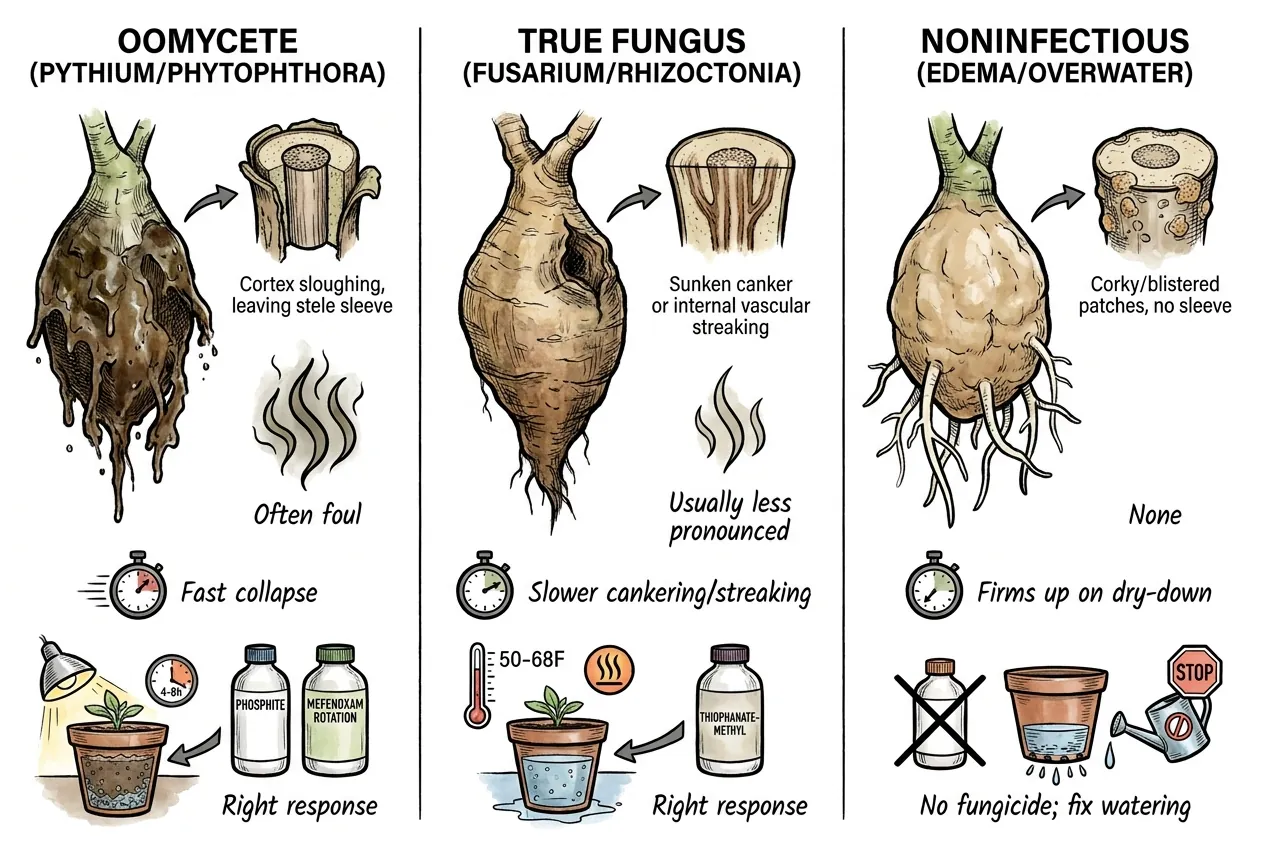
A cortex that slips away from the central root can occur with oomycete disease, but it is not a species test. A dry canker does not prove a true fungus. Bacterial decay, old mechanical damage, and secondary colonizers can further blur the picture. Smell is equally nonspecific.
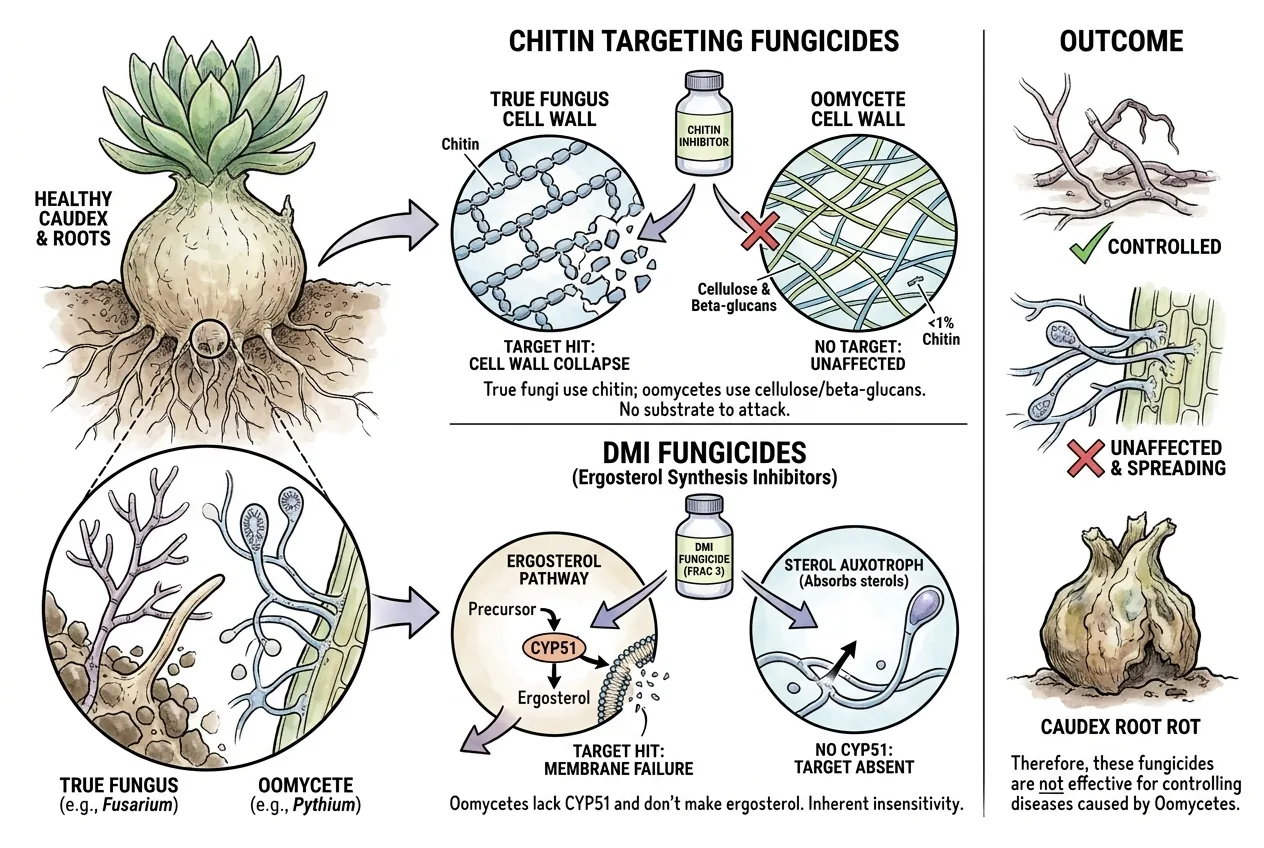
The distinction matters because oomycetes are not true fungi. Some fungicide groups that act on true fungi do not control Pythium or Phytophthora. The reverse is also true. An oomycete-specific product is a poor answer to an unidentified Fusarium or Rhizoctonia problem.
Preserve Evidence Before Treatment
For a diagnostic sample, contact the lab before cleaning the plant. A clinic may want roots plus the transition between healthy and affected tissue, along with photos and growing-history notes. Once everything has been washed, cut, or treated, the sample can become less useful.
Before the roots touch water, I make four photographs in a fixed sequence. The set covers the potted plant, intact root ball, wettest or most collapsed face, and firm-to-soft transition beside a metric ruler showing 1 mm divisions. The ruler stays in the same plane as the exposed roots, and a pot-rim orientation mark traces each dark patch back to its container position.
I work over two clean disposable sheets. One is reserved for the untouched root ball and photographs. The other is for washing or rescue cuts after I decide whether a diagnostic lab is needed, and I stop at the first sheet if a sample may be submitted.
In my record, every later cut, rinse, repot, and pesticide application becomes a separate dated event. That sequence distinguishes symptoms already present from those first seen after treatment. Once a rinse or product touches exposed roots, their next photograph no longer belongs to the untreated evidence set.
How Do You Read a Fungicide Label for a Caudex?
In the United States, a pesticide label is a legally enforceable use document. The EPA explains that it defines where and how a product may be used, how much may be applied, how often, and what precautions are required. Retail availability does not make every use legal or appropriate.
Pass the Six Label Gates Before Buying
- Check the use site. Does the label cover a home ornamental, greenhouse, nursery container, or other site that actually matches yours?
- Check the plant group. Does it include ornamentals or the relevant plant category, and are there exclusions?
- Check the disease or pathogen. Is the suspected organism or root-rot disease named?
- Check the application method. Does it permit a soil drench, dip, foliar spray, or surface sanitation for that use?
- Check safety and tolerance. Can you follow the PPE, ventilation, re-entry, disposal, and small-area tolerance directions?
- Check resistance limits. Can you obey the maximum applications, sequencing, and rotation directions?
| Product type | Example product | What could make it fit | Why you might skip it |
|---|---|---|---|
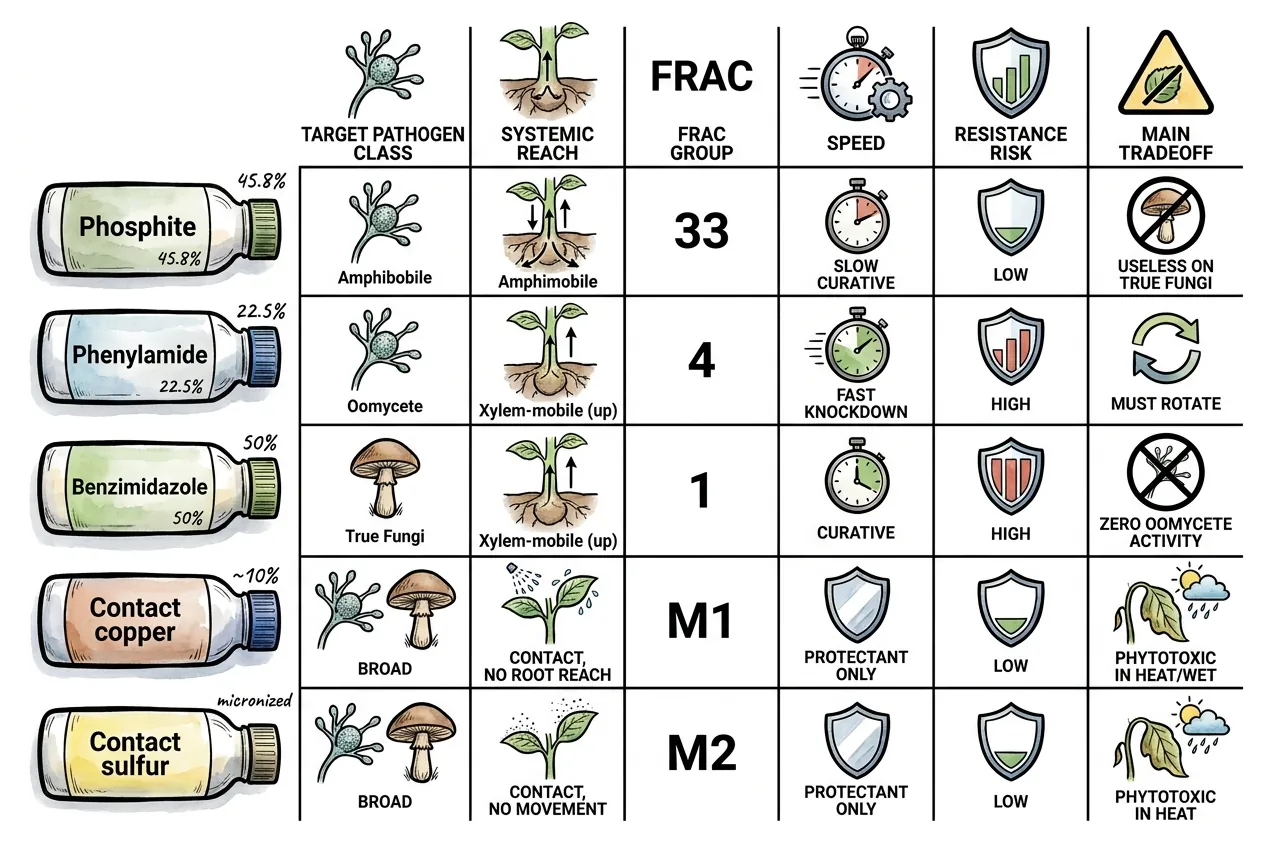
| Phosphite / phosphorous acid salts | Monterey Garden Phos | Current label, use site, and diagnosis all support Pythium or Phytophthora suppression on ornamentals | Diagnosis is unknown, a true fungus is suspected, or the label does not cover your use |
| Mefenoxam, FRAC 4 | Quali-Pro Mefenoxam 2 AQ | A supported oomycete diagnosis and the professional-scale label precisely match the site and plant group | Hobby-scale measurement is impractical, the home use is not covered, or resistance is a concern |
| Thiophanate-methyl, FRAC 1 | Southern Ag Thiomyl | A label-listed true-fungus disease and ornamental use are established | The suspected cause is Pythium or Phytophthora. Its label says those are not controlled |
| Copper contact fungicide | Bonide copper | A listed surface disease and foliar use match the label | You need an internal root cure or want to paint a cut surface without a labeled direction |
| Peroxide/peroxyacetic pesticide | BioSafe ZeroTol 2.0 | The label specifically covers the intended horticultural plant or surface application and you can handle a corrosive concentrate | You want a casual household tool cleaner or systemic cure |
| Sulfur contact fungicide | Bonide sulfur | A listed plant and surface disease fit the current label | You need root-level control, recently used oil, or cannot meet temperature restrictions |
Read the Current Label
The current label attached to the container is the authority. Formulations and registrations change, and state rules can be more restrictive. Outside the United States, use the local registered label and pesticide law.
Before opening a pesticide, I photograph the front panel, active ingredient and concentration, registration number, formulation name, relevant use directions, precautions, and any supplemental label supplied with that exact container. I save the manufacturer or regulator label file with the access date and link it to the plant record. A product name without its formulation and registration details is not enough to reconstruct the decision later.
I copy the permitted plant or site, target disease, method, rate units, interval, maximum applications, protective equipment, and disposal directions onto one worksheet. Any unit conversion stays visible beside the original label units and receives a second check before mixing. When the formulation changes, I start a new worksheet instead of reusing the arithmetic from a familiar active ingredient.
When Does a Phosphite Product Fit?
Phosphite products are associated with oomycete disease management, but systemic action does not mean universal control. The current Monterey Garden Phos label includes home ornamentals and a soil-drench use for root rot caused by Phytophthora and Pythium. It also tells users to test a small number of plants for sensitivity before wider treatment.
That makes Monterey Garden Phos a product to consider when an oomycete diagnosis is plausible and the exact use matches the label. It does not make phosphite a rescue tonic for every soft caudex. It cannot restore dead roots, fix a saturated pot, or cover a disease that is absent from the label.
Measure Phosphite from the Label
Do not copy a dilution from a different phosphite formulation. Read the root-rot section on your own container, use its measuring units, and observe its application limits. If a rare Pachypodium, Adenium, or other caudiciform is not known to be tolerant, the label's small test is particularly important.
When Does Mefenoxam Fit?
Mefenoxam is an oomycete-active FRAC 4 fungicide with a high resistance risk. The Quali-Pro label covers specified ornamental and nursery settings, plant groups, diseases, and application methods. Those categories are not interchangeable with an unlabeled indoor collection.
The label also makes two limits unusually clear. The product will not correct poor drainage, and it will not revitalize plants with moderate to severe root rot. Those limits are more useful to a caudex grower than any claim of fast knockdown.
Measure a Professional-Scale Concentrate
Quali-Pro Mefenoxam 2 AQ is a professional-scale concentrate. Its rates vary by plant group and use, and reducing a large-volume table to a few drops for one pot invites a serious measurement error. Do not invent a teaspoon-per-gallon recipe or round a calculated amount upward. Skip it and consult a plant-health professional if the label does not cover the use or you cannot measure the labeled amount with suitable equipment.
Follow Resistance Limits
Resistance management is not optional. Follow the product label's limits on sequential treatments and rotation. A monthly preventive drench assembled from a blog is neither a diagnosis nor a resistance plan.
When Does Thiophanate-Methyl Fit?
Thiophanate-methyl belongs on the other side of the diagnosis. The Southern Ag Thiomyl label lists root-rot uses for specified true fungi in ornamental plant settings, then expressly says it does not control Pythium or Phytophthora. That is why fungicide is too broad a shopping category.
Consider Southern Ag Thiomyl only when the diagnosis, disease, plant group, site, and drench direction all match its label. A dry lesion or vascular discoloration alone does not prove that match. Like mefenoxam, this single-site chemistry carries resistance constraints that must come from the label rather than a homemade rotation calendar.
What Are Copper, Sulfur, and Peroxide Products For?
These products are not substitutes for an internal root-rot diagnosis. The current Bonide copper product is presented as a contact foliar spray. Bonide copper fungicide should therefore be used only on plants and diseases named on its label and by the listed method. Do not paint it onto a fresh caudex cut as a wound dressing because that is not a labeled use. Copper can injure sensitive tissue and is hazardous to aquatic organisms, so natural is not the same as harmless.
Sulfur is also a contact product. It does not move through a caudex to cure decaying roots. Its label carries crop, temperature, and oil-application restrictions. Read all of them before considering it.
Treat Oxidizing Products as High-Risk
ZeroTol 2.0 is a concentrated hydrogen-dioxide/peroxyacetic-acid pesticide for labeled horticultural uses. Its current safety data classify it as a strong oxidizer that can cause severe skin burns and eye damage. It is not a benign bottle to improvise with at a kitchen sink. Use it only if the intended plant or surface application is on the label and you can meet every handling direction.
Clean Tools Without Escalating Chemicals
For ordinary pruning tools, a simpler workflow is often enough. Remove dirt and sap, then use a disinfectant method recommended by an extension service. The University of Minnesota includes 70% isopropyl alcohol among its tool-disinfection options and discusses the tradeoffs. Keep alcohol away from flame and let the tool dry. A clean blade between cuts matters more than buying the most aggressive concentrate.
What Should You Do Before Any Drench?
Start with a clean diagnosis workflow. A pesticide cannot rebuild dead roots, and cutting first can destroy the best diagnostic sample.
- Isolate the plant. Move it away from shared trays and stop any routine that sends its drainage through other pots.
- Record the history. Photograph the plant, roots, pot, and mix. Note watering dates, minimum temperatures, fertilizer, repotting, and how quickly the damage changed.
- Decide on testing before washing. For a valuable or rapidly declining plant, call a diagnostic lab and follow its sampling instructions.
- Inspect the root environment. Check drainage holes, perched water, compacted organic material, heat damage, and whether the pot stayed wet during cool weather.
- Remove only tissue that is clearly dead when rescue surgery is warranted. Use a cleaned, disinfected tool and avoid chasing every stain into firm living tissue. Extensive crown involvement may make surgery futile.
- Reset the conditions. Use a clean container and a mix appropriate to the species, root system, climate, and watering habits. The goal is gas exchange without forcing a fixed all-mineral percentage on every caudex.
- Apply a pesticide only after the label gate passes. Follow your container's directions exactly. Never combine products simply because each appears in this comparison.
- Monitor the plant, not a calendar. Record lesion movement, root condition, new growth, and moisture behavior. Reassess if decline continues.
The order of events matters more than the final appearance, so I timestamp isolation, unpotting, washing, cutting, repotting, moves, watering, and pesticide use separately. When it is safe, I take the same root and whole-plant photographs immediately before the next event. That keeps a later dry wound or new discoloration attached to the sequence that preceded it.
I avoid changing light, feeding, and watering practice at the moment of pesticide application unless the rescue itself requires it. When several corrections are unavoidable, I record them together and refuse to credit the product alone for recovery. Surgery, improved aeration, natural reserve use, and chemistry can all occur in the same case.
Adverse effects stay in the same ledger as the treatment. I date any new burn, collapse, or stalled root response and compare it with the untreated evidence set under the label and professional guidance. Starting a fresh success log after the plant changes would hide a poor response, so the original sequence remains intact.
Use Related Guides within the Label Boundary
The caudex substrate comparison explains why particle behavior and watering practice matter together. Growers dealing with a heat-damaged black pot should also read the Pachypodium hot-soil root-rot case. For a species-specific example, use the Adenium root-rot rescue guide as a companion, not as a substitute for the pesticide label.
Is There a Safe Re-Treatment Calendar?
No single calendar applies to all six products, all diagnoses, or all caudex species. Intervals and maximum applications differ by label, disease, site, and formulation. Some single-site fungicides also limit consecutive applications before a change in mode of action.
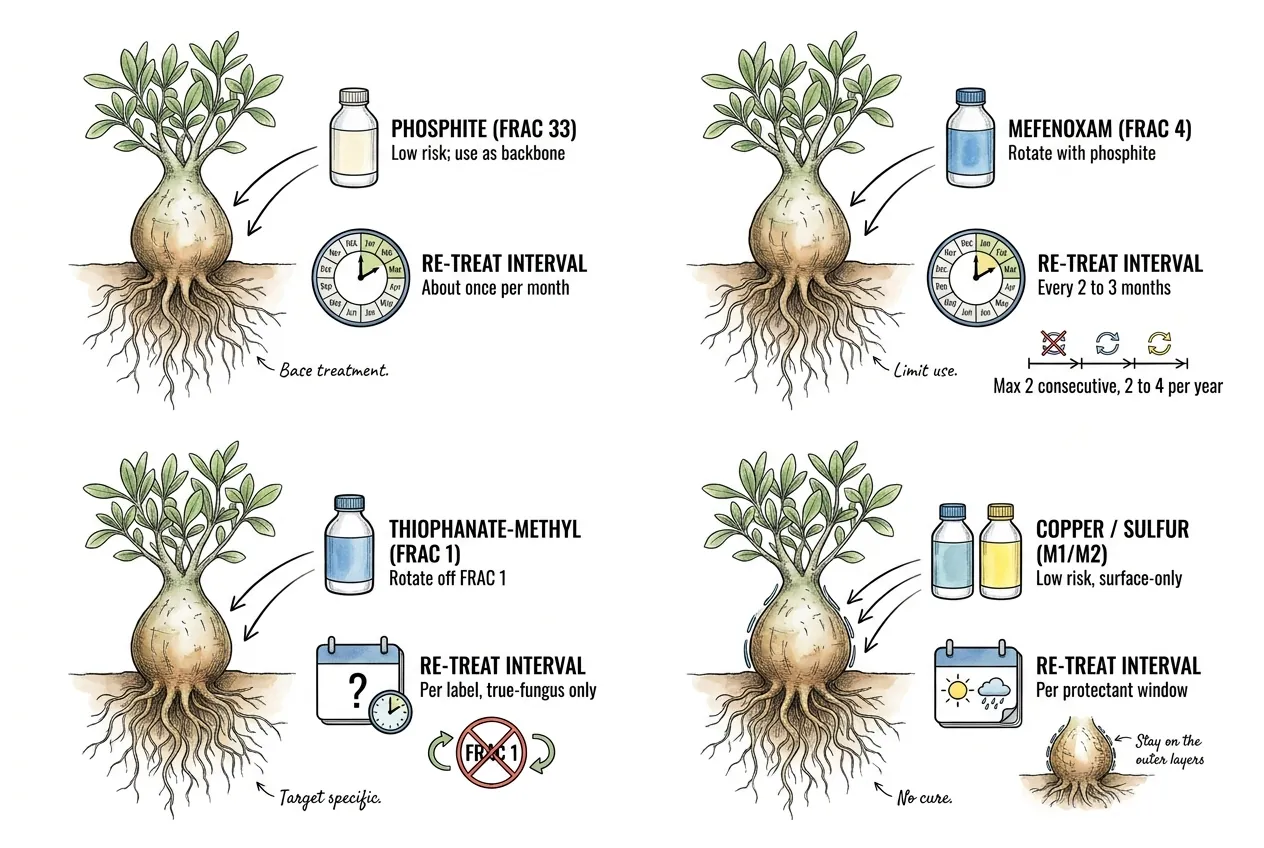
Do Not Build a Calendar from a Blog
Treat any generic rotation graphic as orientation only. It cannot replace the current label on the container in your hand. Do not alternate phosphite, mefenoxam, and thiophanate-methyl on an unidentified rot merely to cover everything. That increases exposure while hiding whether the environmental failure was ever fixed.
Aspirin and salicylic-acid experiments are also not a fungicide rotation. If you are evaluating a salicylic-acid plant-immunity method, keep its evidence limits separate from treatment of an active, unidentified rot.
When Should You Stop Treating?
Stop and reassess when the diagnosis is still unknown, the label does not cover the use, injury appears after an application, or decay continues despite correcting the root environment. More product is not evidence that the first choice was right.
UC IPM notes that plants with substantial Phytophthora infection rarely recover and that pesticides should not be relied on alone. A caudex with widespread crown collapse, no firm transition tissue, or repeated progression may be beyond rescue. A diagnostic clinic or experienced local grower can help decide whether disposal is safer for the collection.
Prevent the Next Case Through Culture
The prevention habits are less dramatic but more dependable. Quarantine new arrivals, use clean pots and tools, keep drainage water from moving between plants, match watering to temperature and growth, and inspect roots before a problem reaches the crown. No monthly insurance drench replaces those habits.
Affiliate Disclosure
This article contains Amazon affiliate links. As an Amazon Associate I earn from qualifying purchases. If you use these links, the site may earn a commission at no extra cost to you. Product availability, price, and specifications can change. Check the current listing before buying.