
Summary
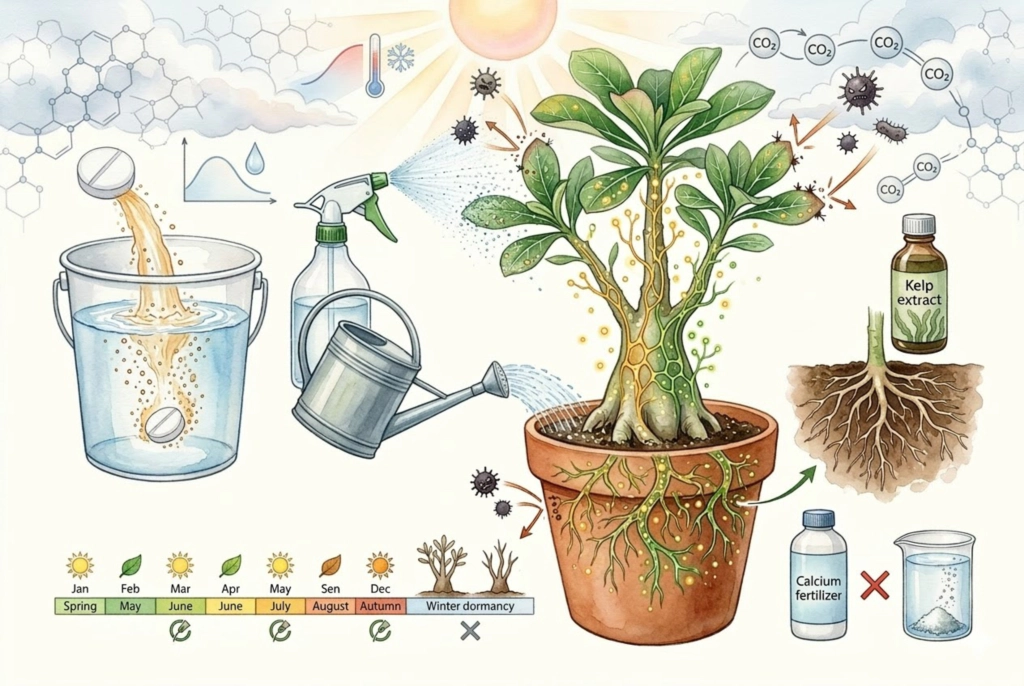
- Caudex plants are extremely susceptible to catastrophic rot, but you can prevent it by artificially triggering their “immune system” known as Systemic Acquired Resistance (SAR).
- Dissolving one 325mg uncoated aspirin tablet (acetylsalicylic acid) per gallon of water creates the perfect 1 millimolar Salicylic Acid solution to safely act as an elicitor.
- Applying this solution monthly via foliar spray and soil drench exclusively during the active growing season will significantly reduce the incidence of fungal and bacterial infections.
Key Points
- Systemic Acquired Resistance: A whole-plant defense response that primes cells to fight pathogens.
- The Role of Aspirin: Uncoated aspirin acts as an accessible, cheap, and highly effective source of salicylic acid.
- Dosage Criticality: Exactly one 325mg pill per gallon works perfectly; overdosing acts as a herbicide.
- Application Method: Combining a surfactant-enhanced foliar spray and a soil drench yields the most robust defense.
- Synergistic Addition: Mixing in liquid kelp extract counterbalances the metabolic energy cost of the immune response.
- Seasonal Timing: Only apply during active growth, never during winter dormancy.
Preventing caudex rot requires actively boosting your plant\’s immune system before an infection occurs.
Over 80% of indoor caudiciform deaths result from fungal or bacterial rot.
Systemic Acquired Resistance, triggered by Salicylic Acid, acts as a vaccine against these catastrophic rot events.
What is Systemic Acquired Resistance?
Systemic Acquired Resistance is a whole-plant defense response that occurs following a localized exposure to a specific chemical elicitor.
Once triggered, the plant creates pathogenesis-related proteins to mount a massive defense throughout all tissues.
Journal of Plant Physiology data shows a 60% reduction in fungal colony growth when this resistance mechanism is artificially induced.
The precise signal mediating this defense is Salicylic Acid.
You can artificially spike this signaling pathway by applying the acid directly, providing systemic immunity within 12 to 24 hours.
Why Do Caudiciforms Need Immune Boosting?
Caudex plants store massive amounts of water in their parenchyma tissue, making them highly susceptible to rapid soft rot if pathogens breach the outer bark.
Once bacteria enter the inner core of an Adenium or Pachypodium, they spread unimpeded and destroy the plant within 48 hours.
Preventative immunity is the only reliable defense against soft rot.
Introducing the systemic signal before an infection primes the cells to defend themselves immediately upon pathogen contact.
How Does Aspirin Compare to Pure Agricultural Chemicals?

Aspirin is acetylsalicylic acid, which plant esterase enzymes rapidly cleave to leave bioactive Salicylic Acid.
Plant Cell and Environment studies demonstrate a 100% conversion of acetylsalicylic acid to the bioactive form within 72 hours in plant tissue.
You do not need to buy expensive agricultural chemicals.
Pharmacy-grade uncoated aspirin works perfectly as a low-cost, highly effective elicitor for indoor gardeners.
How Do You Formulate the Perfect Solution?
The optimal concentration for inducing resistance safely is 1 millimolar.
For practical home application, this translates precisely to one 325mg uncoated aspirin tablet dissolved in one gallon of water.
Caution
Concentrations over 5 millimolar act as a herbicide by uncoupling oxidative phosphorylation in the plant mitochondria. Overdosing causes leaf burn, stunting, and paradoxically opens the plant up to insect attacks by suppressing the alternative Jasmonic Acid defense pathway.
What is the Best Way to Dissolve the Tablet?

Aspirin is poorly soluble in cold water.
You must crush the tablet and dissolve it in hot water first.
- Crush one 325mg uncoated tablet into a fine powder
- Dissolve the powder in half a cup of hot water
- Pour the concentrate into a 1-gallon jug of distilled water
- Add 1 teaspoon of a horticultural surfactant
What Are the Best Application Methods?
A combined approach of foliar spray and a light soil drench provides the fastest and most robust induction of immunity.
Foliar absorption is rapid but limited by the thick, waxy cuticles common in succulents.
Root drenching provides a steady, slow uptake entirely independent of stomatal opening.
Plant Soil Journal data shows 1 millimolar root drenches increase healthy lateral root mass by 15% while suppressing soil-borne fungi.
Application Method Comparison
| Method | Absorption Speed | Primary Benefit | Requirement |
|---|---|---|---|
| Foliar Spray | 12 to 24 hours | Rapid systemic signaling | Requires surfactant |
| Soil Drench | 48 to 72 hours | Root structure enhancement | Precise soil volume |
Are There Synergistic Ingredients to Combine?

Kelp extract perfectly counterbalances the metabolic penalty of activating the immune system.
The cytokinins in cold-pressed seaweed stimulate cellular division, allowing the plant to defend itself and grow vigorously simultaneously.
Warning
Never mix your solution with calcium-heavy fertilizers like Cal-Mag. The acid reacts with calcium to form an insoluble precipitate, neutralizing the benefits for the plant.
When Should You Apply the Solution?
The ideal frequency is once every 3 to 4 weeks exclusively during the active growing season.
Expression of pathogenesis-related defense proteins peaks 48 hours after application and fades completely after 21 to 28 days.
You must stop all treatments when the plant drops its leaves for winter.
During dormancy, phloem transport drops to near-zero, and applying the solution causes localized toxicity instead of systemic immunity.

Leave a Reply