
GA3 for Caudex Seeds: A Safer Test-Batch Guide
GA3 is not a universal caudex seed soak. Learn when dormancy is plausible, why Adenium and fresh Pachypodium may not need it, and how to run a control.
Derek Kim · 2026-02-15 · Updated 2026-07-27 · 11 min read
Key Takeaways
- Do not give every caudex seed the same GA3 concentration or a routine 24-hour soak. Caudex is a growth form, not one dormancy type. Adenium, Pachypodium, Stephania, and Dioscorea do not share a seed coat or a dormancy mechanism.
- Sow fresh Adenium and Pachypodium with an untreated or water-only control before considering GA3. In tested studies these germinate well without a hormone.
- A failed lot may be dead rather than dormant, and no hormone restores dead tissue. Adenium and Pachypodium seed lose viability quickly, so audit freshness, temperature, moisture, and aeration first.
- Use a concentration and soak time only when a source tested the same species and describes a reproducible method. There is no defensible Adenium–Pachypodium–Stephania dosage table.
- Split a representative batch and change one variable, comparing the evidence-based GA3 treatment against a control under identical conditions. Without the control, ordinary germination is easily credited to GA3.
Does GA3 Make Caudex Seeds Germinate?
Keep the Hormone Mechanism Within Its Evidence
Sometimes. Gibberellins are plant hormones involved in the transition from dormancy to germination, including embryo growth and the weakening of tissues that restrain radicle emergence. Applied GA3 can substitute for part of that signal in some physiologically dormant seeds. The response depends on species, seed lot, concentration, exposure, temperature, light, and the state of the embryo.
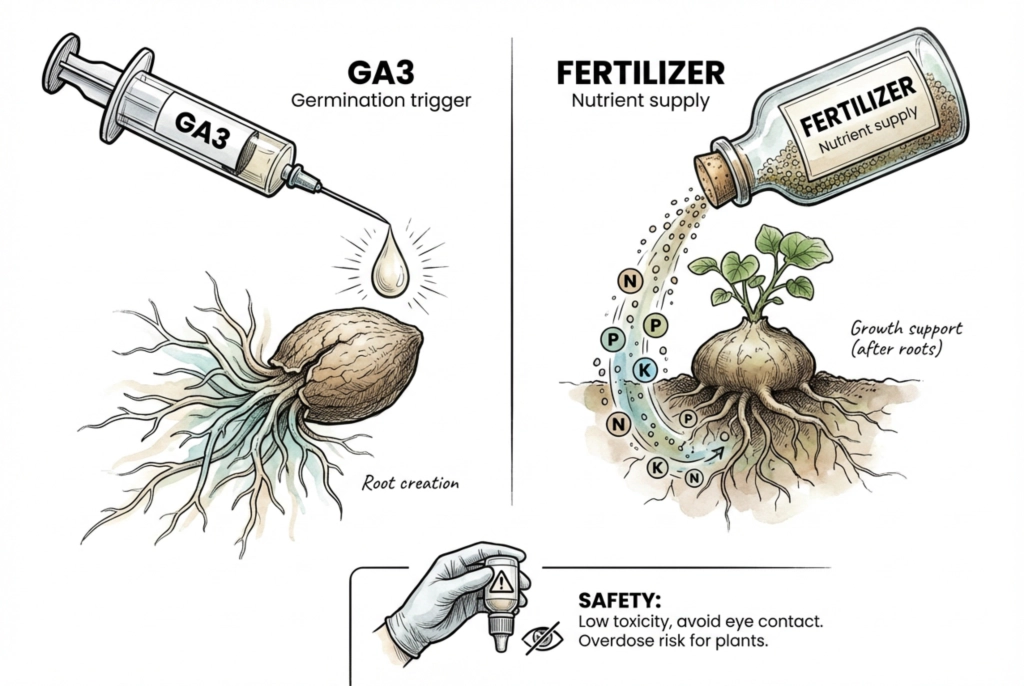
GA3 is not fertilizer and it is not a viability treatment. A dead embryo cannot respond to a hormone. Nor will GA3 reliably fix an impermeable seed coat, unsuitable temperature, insufficient oxygen, desiccation, or decay. The caudex seed germination setup covers those environmental controls first.
Separate mechanism evidence from dose evidence
Research on one species can explain a mechanism without supplying a dose for another. For example, a study of Suaeda glauca linked GA3 treatment with changes in the balance of germination-related hormones and starch metabolism. That is useful biology, but it is not evidence for an Adenium or Pachypodium soak.
Do Adenium Seeds Need GA3?
Start Fresh Adenium with an Untreated Control
Routine GA3 treatment is difficult to justify for fresh, viable Adenium obesum seed. In a peer-reviewed in-vitro study of four commercial varieties, seeds germinated across media with and without GA3. The tested GA3 concentrations did not significantly affect germination.
One variety reached 100% germination on water and agar alone.
That experiment placed GA3 in tissue-culture media at 0.25 or 0.5 mg/L. It did not test a home 200 ppm soak, so it cannot validate the dosage often repeated online. It does, however, provide a strong reason to run an untreated control before exposing a scarce lot to a hormone.
| Adenium seed situation | First move | What it tells you |
|---|---|---|
| Fresh seed with a known harvest date | Sow an untreated control in a stable setup | Whether the lot already germinates without a hormone |
| Old or poorly stored seed | Treat viability as the leading uncertainty | GA3 cannot distinguish dormancy from dead embryos |
| A valuable lot with published treatment evidence | Reserve seeds for a small control and test | Whether that lot responds under your conditions |
Do Pachypodium Seeds Need GA3?
Check Seed Viability Before Adding a Hormone
Freshness usually deserves attention before GA3. The South African National Biodiversity Institute describes Pachypodium seed as easy to germinate when fresh and notes that it soon loses viability. A study of stored Pachypodium lamerei and Adenium obesum embryos likewise found rapid viability loss with storage.
Those sources do not support a 500–1000 ppm Pachypodium prescription. If a fresh lot fails, audit sowing depth, temperature, moisture, aeration, and fungal loss before assuming physiological dormancy. If an old lot fails, low viability remains the simpler explanation.
The SANBI propagation page gives 27–35°C for the Pachypodium material it discusses, but even that should not be turned into a genus-wide thermostat setting without checking the species. Use provenance and species guidance, then record the actual medium temperature rather than relying on room temperature.
What GA3 Dosage Should You Use?
Use Only a Species-Matched Concentration
There is no defensible Adenium–Pachypodium–Stephania dosage table. Use a concentration and exposure only when a reliable source tested the same species, or a clearly relevant seed type, and describes the method well enough to reproduce. If that evidence is missing, the article cannot honestly turn 200, 500, or 1000 ppm into a recommendation.
Do not treat a higher concentration as a universal solution
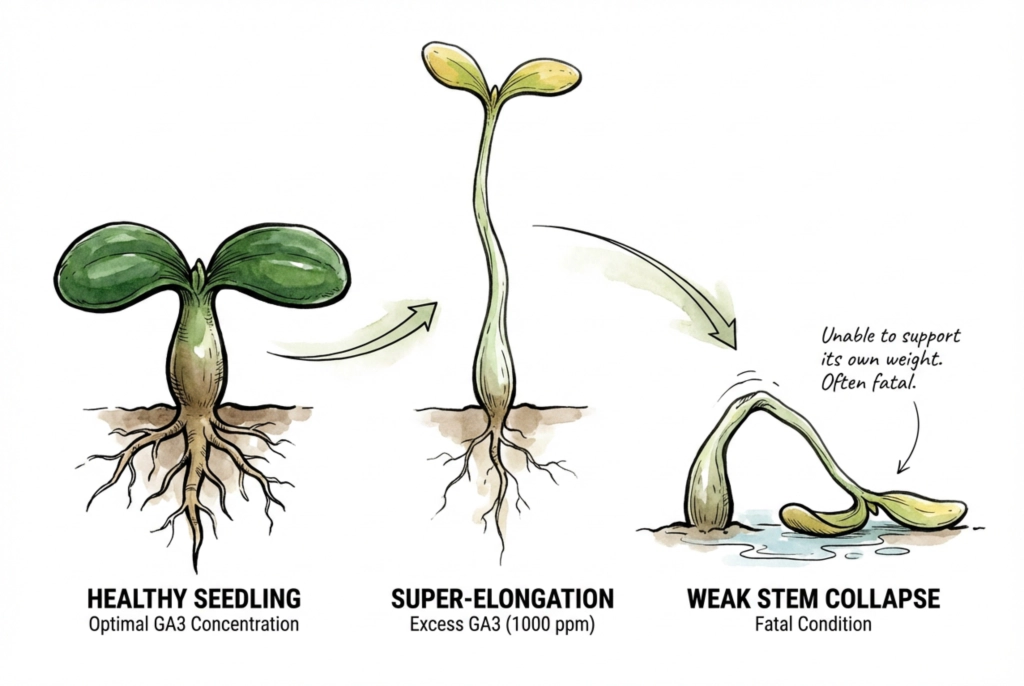
GA responses can be non-linear, and gibberellins also promote elongation. A concentration that improved germination in a gentian or grass cannot be transferred to a caudiciform merely because both are seeds.
How should evidence be ranked?
Best evidence
Use a replicated study or recognized propagation protocol for the same species and seed condition.
Limited evidence
Evidence for a close relative with the same documented dormancy mechanism can guide an experiment, but it is not a prescription.
Insufficient evidence
A generic hard-seed chart, seller directions with no species basis, or an anecdotal dose copied across unrelated genera is not enough to set a GA3 treatment.
Hard-coated does not automatically mean GA-responsive. A water-impermeable coat is a physical barrier. Scarification may be relevant for a species known to have physical dormancy, while GA3 targets a different part of the germination system. Never scarify an unidentified seed just because it has not sprouted.
| GA3 powder is a reasonable purchase when… | Hold off when… |
|---|---|
| You have a species-level protocol with a stated concentration and method. | The only instruction is a generic seller dosage chart. |
| The lot is large enough to keep a meaningful untreated control. | You have only a few irreplaceable seeds and no evidence for their response. |
| You can verify active percentage and measure the product accurately. | The listing provides no label, SDS, lot information, or purity documentation. |
Is a 24-Hour Soak Universal?
Keep Soak Duration Species-Specific
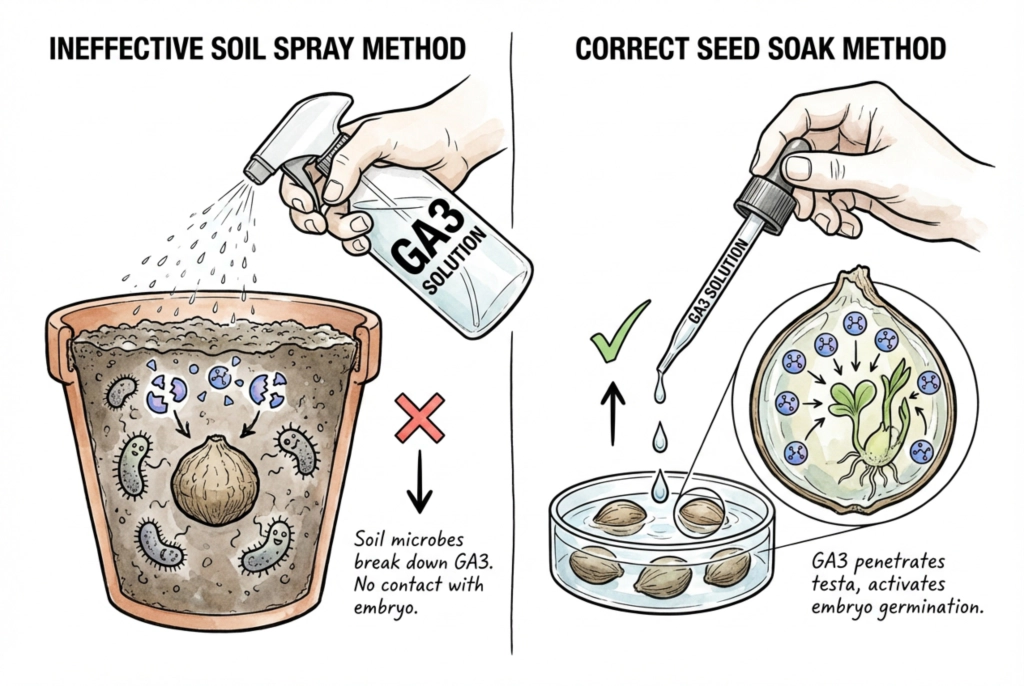
No. Concentration and exposure time form one treatment, and species respond differently to both. Published work includes GA3 in agar media, short agitated soaks, longer soaks, seed coatings, and commercial mist treatments. A 24-hour exposure is a study condition in some experiments, not a default law of germination.
A current product label can also contradict internet habits. The EPA-accepted ProGibb 40% label includes commercial rice and turf-seed uses, but it specifically says not to put that product into the 24-hour presoak water. It also does not authorize a caudex-seed bath. The lesson is not to use ProGibb on caudex seed. It is that the product label and crop-specific method control the application.
How Do You Run a Useful Test Batch?
Run a Split-Lot Test
A good test changes one variable and keeps the rest of the setup equal. It will not produce a publication-quality result from five seeds, but it can stop you from treating an entire valuable lot on the strength of a copied recipe.
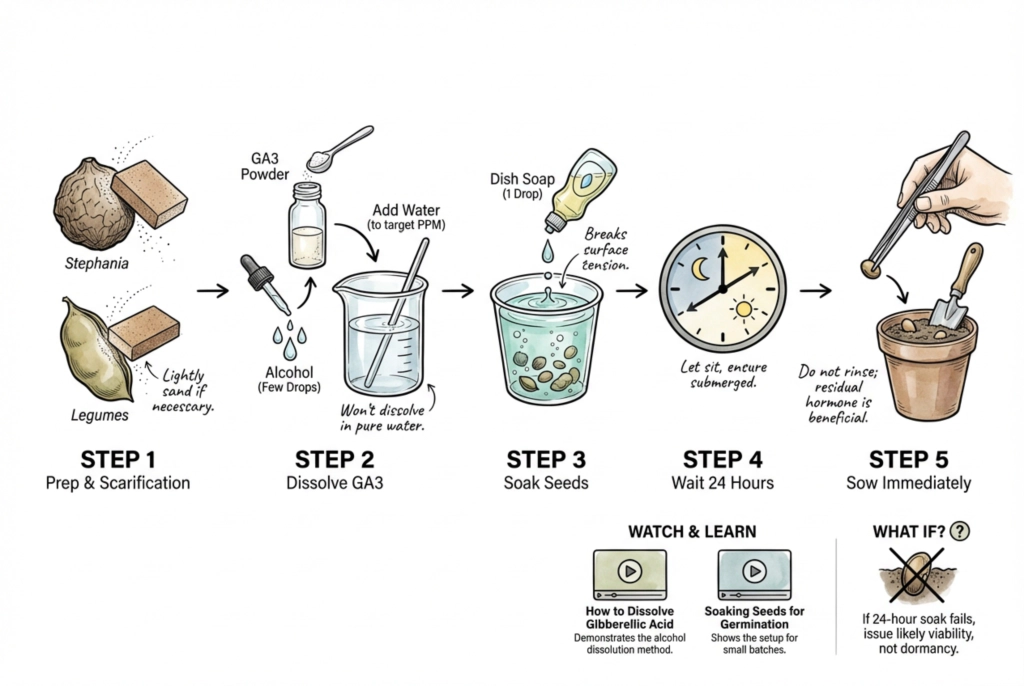
- Identify the seed by recording the accepted name, supplier, harvest or purchase date, storage history, and number of seeds.
- Find species-level evidence and write down the concentration, exposure, temperature, and application method from the source. If those details are absent, you do not have a reproducible protocol.
- Reserve a control by randomly dividing enough representative seeds between an untreated or water-only control and the single GA3 treatment. Do not put all visibly plump seeds in one group.
- Keep sowing conditions identical by using the same medium batch, depth, tray position, temperature, moisture, and light. Label each group before treatment.
- Record more than the first sprout by tracking time to radicle emergence, total germination, malformed seedlings, survival, and early elongation for each group.
- Do not change a second variable mid-test because peroxide, scarification, smoke water, a different temperature, and a second hormone all make the result harder to interpret.
To compare the treatment fairly, I put the control and treated groups in separate labeled cells before any soak, then photograph the tray map and seed count. Each label includes the lot identifier and treatment only. I keep the seed size and appearance notes in the record rather than silently putting the best-looking seeds into one group.
I log every emergence against its original cell, including malformed or weak seedlings. This has kept me from calling a treatment successful because the first seed happened to sprout there. When the untreated group performs similarly, I know I have saved the rest of the lot from an unnecessary repeat treatment.
If the control performs as well as the GA3 group, the simpler method wins. If neither group germinates, the experiment has not proved that a stronger dose is needed. Viability or the sowing environment may still be the limiting factor.
How Do You Mix and Handle GA3?
Read the Product Documentation First
Start with the actual product, not a generic formula. Confirm the active ingredient percentage, formulation, intended use, current label, safety data sheet, lot information, and measuring directions. A label that says 90% powder does not tell you what the remaining material is, whether the product is registered for the intended use, or which protective steps its formulation requires.
Parts per million in a water-based research solution is commonly treated as milligrams per liter, but the amount of product required depends on active percentage and formulation. A kitchen spoon cannot reliably measure milligram quantities for repeatable testing. Do not improvise a purity correction or solvent system unless the product documentation and the species protocol support it.
Wear the protective equipment specified by the product label and SDS, avoid generating or inhaling dust, keep the material away from children and pets, and use dedicated labeled tools. Follow the product's first-aid, storage, and disposal directions because a technical-grade chemical listing is not automatically a home-gardening instruction.
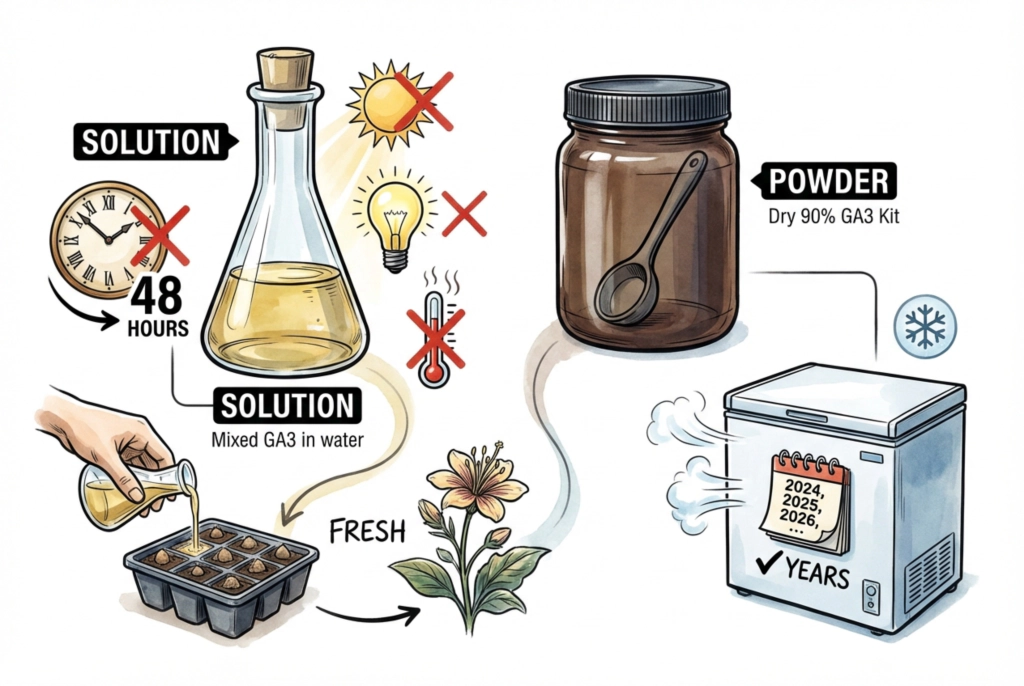
Dry GA3 and a prepared solution do not share one shelf life. PubChem notes that dry gibberellic acid is stable at room temperature while aqueous solutions can hydrolyze over time. Light, heat, pH, formulation, and contamination all matter, so use the product's storage information and do not keep an unlabeled leftover solution. For a grower who already has that protocol, a small pouch is more practical than buying agricultural quantities.
What product specification matters?
Look for a documented active percentage that lets you prepare repeatable test batches, not simply a scoop included in the bag. Confirm that documentation on the current listing before ordering.
Can GA3 Rescue Old Seeds?
Separate Dormancy Release from Viability
GA3 may release dormancy in a living seed. It cannot restore cells that died during storage. That distinction is especially important for Adenium and Pachypodium, whose seed viability can decline quickly. A seller's purchase date is not the same as a harvest date.
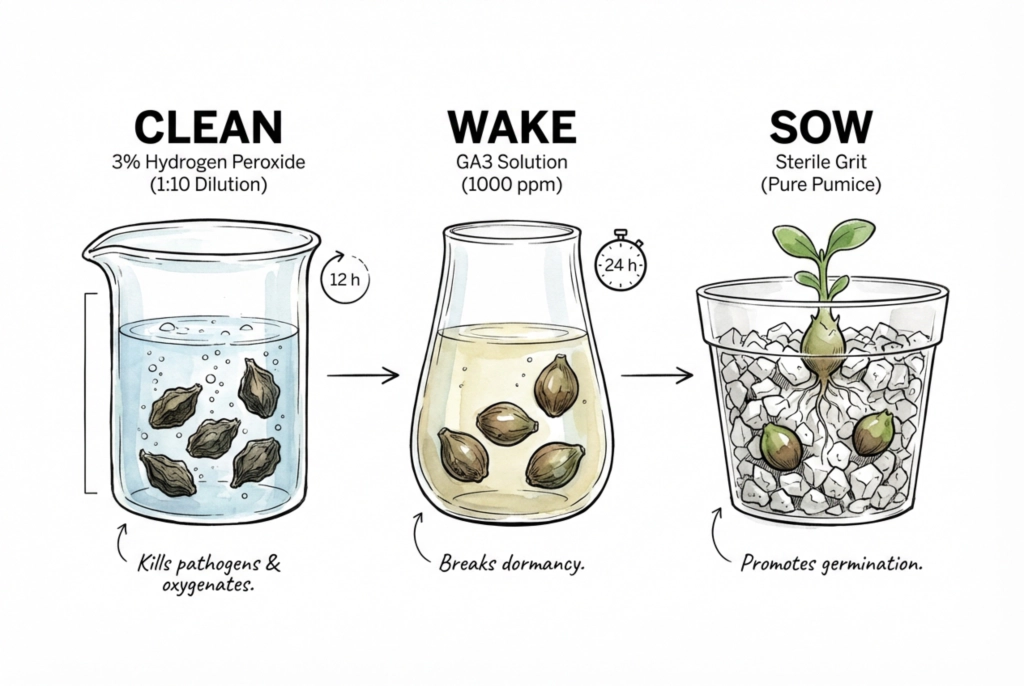
Do not stack treatments simply because a lot is old. A peroxide soak followed by GA3 changes sanitation, oxidation exposure, hydration time, and hormone exposure at once, and that combined exposure may also injure the remaining viable embryos. If surface contamination is the concern, review the evidence boundaries in the hydrogen peroxide seed-soak guide and test sanitation separately.
When seeds are scarce, reserving an untreated control can feel wasteful. In practice, the control is what tells you whether the added chemical did anything. Without it, ordinary germination is easily credited to GA3.
What If Treated Seedlings Stretch?
Monitor Treated Seedlings for Unwanted Stretching
Gibberellins promote elongation, but a GA3-treated seedling is not guaranteed to become leggy. Genetics, dose, duration, temperature, and light all contribute, so record the proportion of weak or malformed seedlings in both treatment and control groups instead of judging one dramatic plant.
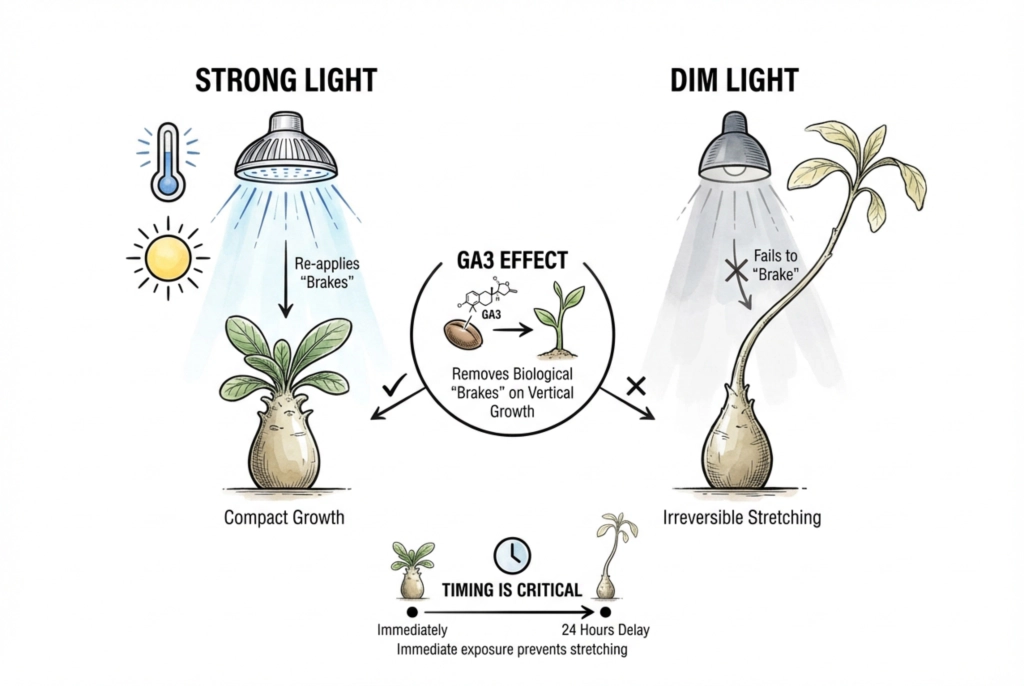
After emergence, provide the species-appropriate light promptly, with airflow and temperature control. Increase intensity gradually if the seedlings began under a cover or low light. The caudex grow-light guide explains how to measure the setup rather than copying one hanging height.
If the tray has outgrown a dim windowsill, a compact full-spectrum grow bulb is a simple way to give a small seedling area its own light. It makes the most sense in an adjustable fixture, because coverage and intensity still depend on mounting distance. It cannot undo an excessive hormone treatment, but it can remove poor light as the next avoidable variable.
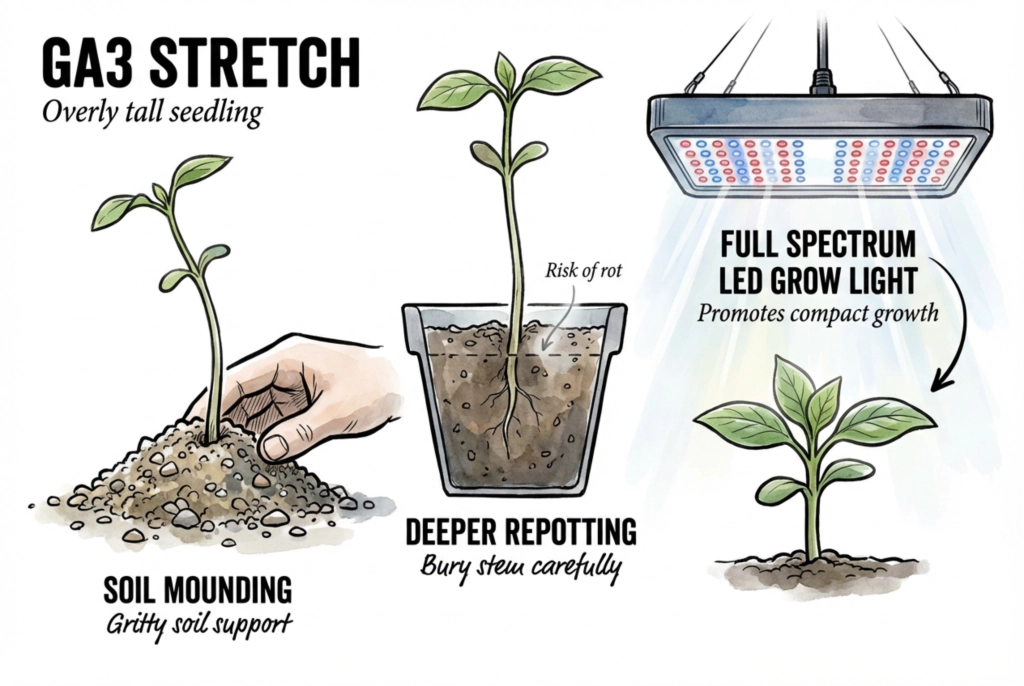
If a seedling cannot stand, use a loose, non-abrasive support while correcting the growing conditions. Do not mound wet medium against tender succulent stem tissue. Existing elongated growth will not shorten, but later growth can become sturdier if light and temperature are brought into balance.
Is Smoke Water Better Than GA3?
Keep Smoke Cues as a Separate Experiment
Not as a generic caudex treatment. Smoke-derived karrikins and gibberellins act through different signaling systems.
A response in a fire-adapted species does not predict a response in Adenium or Pachypodium. There is no sound basis here for combining smoke water and GA3 as an extra-strong rescue.
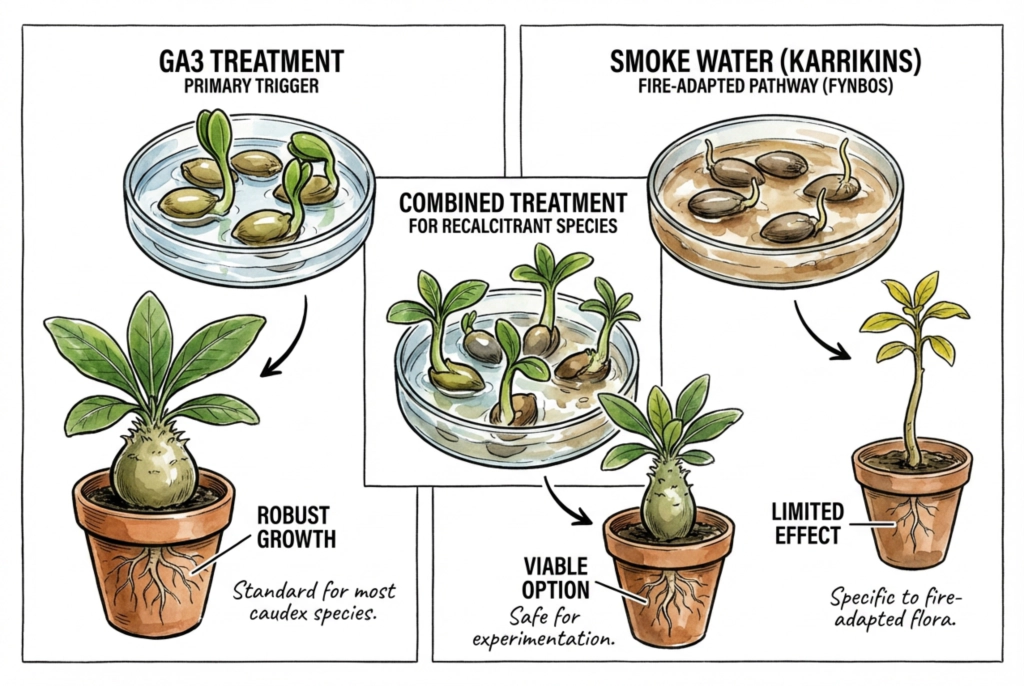
If a documented propagation source identifies smoke cues for the exact species, test that cue against a control as its own experiment. Otherwise, correct the ordinary germination setup and seed-freshness problem before adding another treatment.