
Mycorrhizae (AMF) for Caudiciforms in Gritty Soil: What Helps
Arbuscular mycorrhizal fungi (AMF) can help many caudex plants take up phosphorus in lean gritty mixes, but they aren't essential, and results vary. What's real, what's overstated, and how to inoculate if you try it.
Maya Ellison · 2026-03-20 · Updated 2026-05-08 · 11 min read
Key Takeaways
- AMF can extend phosphorus uptake in some lean, gritty mixes, but they are not essential for caudiciforms. Many caudex plants grow well without any added inoculant.
- The benefit is conditional, not a guaranteed transformation. Hyphae forage for phosphorus beyond the roots in exchange for sugars, and that helps only in some conditions.
- If you try an inoculant, choose an arbuscular product suited to succulents. An ectomycorrhizal tree-and-shrub blend is meant for hosts like pines and oaks, not an Adenium or Pachypodium.
- Place inoculant near living roots at repotting rather than broadcasting it over chunky mix. Surface application is less effective, and independent tests often show little or no benefit.
- Diagnose phosphorus symptoms before inoculating a stressed plant. Purple lower leaves have many possible causes, so check watering, roots, pH, and feeding first. AMF is not emergency fertilizer.
Caudiciforms are famous for their water-storing trunks, and they’re usually grown in lean, gritty mineral mixes that drain fast to avoid rot. Those mixes hold little nutrient, so growers rightly think about how their plants get phosphorus, a nutrient that moves slowly in soil.
Arbuscular mycorrhizal fungi (AMF) are an ancient plant-fungus partnership that some growers use as a possible aid. These fungi associate with many plants and can extend a root system’s reach for phosphorus. That can help, but be wary of near-total starvation claims. Caudex plants are not universally phosphorus-starved in gritty mix (you can also just feed them appropriately), and AMF is a possible aid, not a required rescue.
Where it works, AMF can improve phosphorus uptake. Whether that translates into a noticeably fatter, harder caudex is not established for these plants. Even studies where the fungal pathway supplied plenty of phosphorus did not always produce more growth, so keep expectations grounded.
What is Arbuscular Mycorrhizal Fungi (AMF)?
Arbuscular mycorrhizal fungi are obligate endomycorrhizal symbionts that physically penetrate the cortical cells of roots to build specialized exchange structures called arbuscules.
Keep the Exchange Interface Separate From Cytoplasm
First, the arbuscule is not a direct cytoplasmic bridge. The fungus stays outside the plant’s cytoplasm, separated by the plant-derived periarbuscular membrane, and nutrients cross through transporters at that interface.
Treat carbon cost as a range
Second, the carbon the plant gives up is real but usually cited in the range of roughly a few to ~20% of fixed carbon (as sugars and lipids), not a fixed 20–30%. A large majority of land plants can form AM symbioses, but can form isn’t the same as will benefit in a given pot.
How does AMF differ from generic ‘myco’ products?
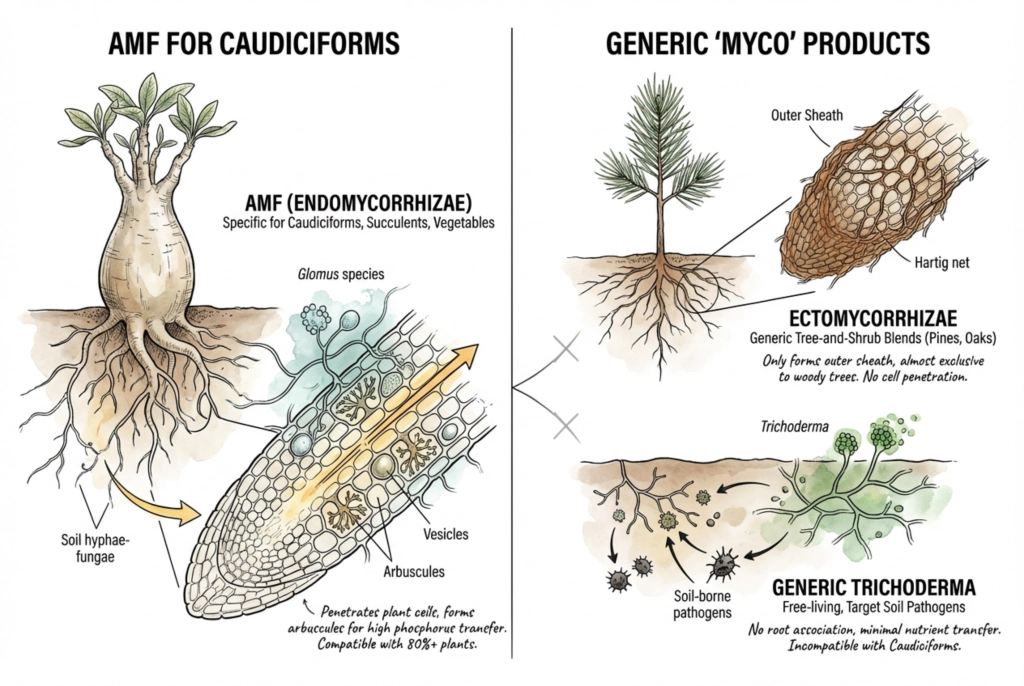
| Feature | Arbuscular mycorrhizae (AMF) | Ectomycorrhizae | Trichoderma |
|---|---|---|---|
| Root relationship | Forms arbuscules inside root cortical cells across a broad host range | Forms an external mantle and Hartig net, mainly with particular tree hosts | Can colonize roots or persist in the rhizosphere, depending on strain |
| Host fit | Many succulents and herbaceous plants can host AMF, but compatibility varies | Often associated with pines, oaks, and other ectomycorrhizal trees | Host effects are strain- and context-dependent |
| Potential contribution | May improve phosphorus or water acquisition in some conditions | Can exchange mineral nutrients and carbon with compatible trees | May influence root growth, nutrient uptake, or stress and pathogen responses |
Use AMF for succulent hosts
Arbuscular (endo-) mycorrhizae are the type that partners with succulents and most herbaceous plants, while ectomycorrhizae mainly partner with certain trees (pines, oaks), so an ectomycorrhizal-only tree-and-shrub blend is usually a poor fit for an Adenium or Pachypodium.
Keep the comparison table simplified
The comparison table is a practical summary, not a complete biology lesson. Ectomycorrhizae exchange nutrients through a Hartig net, and organisms such as Trichoderma can colonize roots and affect growth rather than behaving as purely free-living microbes. Use the rows to choose a product category, not to infer precise behavior in every pot.
Check viable propagules, not species names alone
If you buy an inoculant, choose an arbuscular product such as one listing Rhizophagus irregularis or R. intraradices, but remember that a species name on the label does not guarantee viable propagules or successful colonization. Product quality varies substantially.
Why do caudiciforms specifically need this fungus?
Keep root-system diversity visible
Root systems vary a lot among caudiciforms. Some have coarse, sparse roots, while others are quite fibrous, so trading fine roots for a caudex is not a general rule.
Place inoculant near living roots
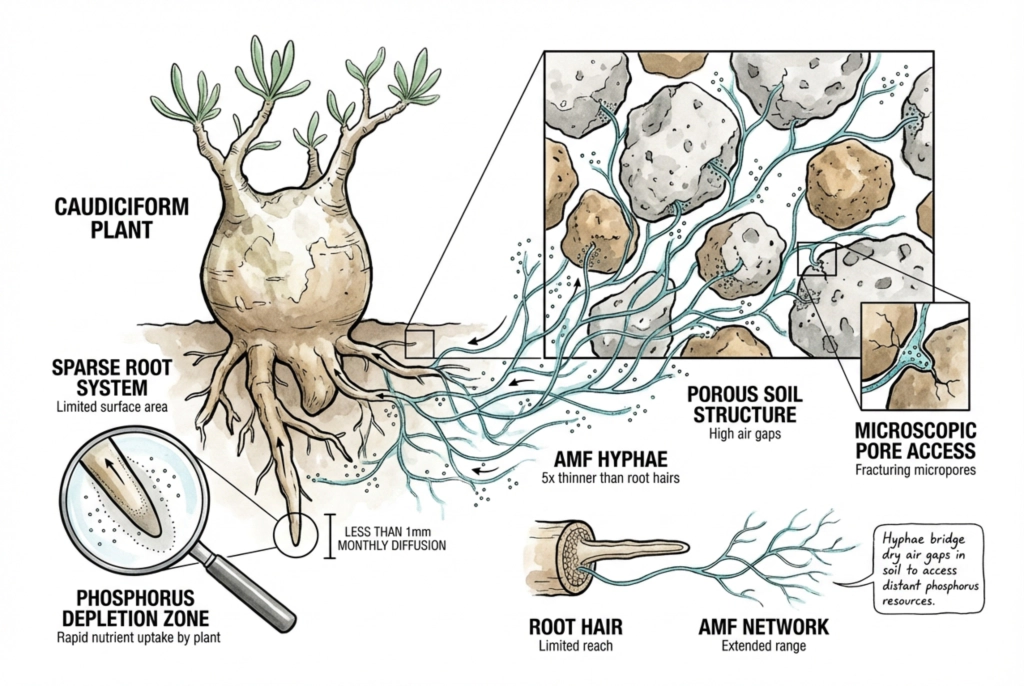
The real, well-established point is that phosphorus moves slowly in soil and forms a depletion zone right around roots, and AMF hyphae are much finer than roots and can forage beyond that zone.
Keep diffusion numbers conditional
Treat specific numbers cautiously, though. The exact diffusion rate and depletion-zone width depend on moisture and the soil, and the claim that hyphae can’t cross gaps larger than ~0.5 mm is actually contradicted by experiments where AMF hyphae bridged several-millimeter air gaps.
Prefer root-zone contact over broadcasting
So surface application is less effective than root-zone contact, but it isn’t a guaranteed total failure.
Keep microbiome evidence separate
As Wang et al. describe, AMF enhance phosphorus uptake partly by stimulating the surrounding soil microbiome to turn over phosphorus.
How does soil composition affect the fungal network?
Balance Drainage With Establishment Moisture
High-porosity mixes drain fast (good for avoiding rot), but a chunky, dry mineral mix isn’t an ideal place for spores to establish, and it doesn’t perfectly replicate a natural arid soil (which has fines, organic matter, microbes, and moisture pulses a pot lacks).
Keep establishment moisture near living roots
Keeping the root zone reliably moist during establishment, and placing inoculant near living roots, matters more than any exact recipe.
Separate CEC from phosphate binding
It’s sometimes said that akadama’s high cation exchange capacity binds phosphorus. That mixes up the terms. Cation exchange capacity is about positively-charged ions, whereas phosphate is a negative ion.
Use material-specific phosphate evidence
Some clays and iron/aluminum oxides can adsorb phosphate strongly, but that’s a different mechanism than CEC and depends on the specific material and pH, so don’t assume akadama is hiding your phosphorus.
Keep ordinary nutrition in the comparison
Horticultural pumice is one component of a gritty mix. Use the substrate comparison to evaluate drainage, particle size, and moisture retention. An inoculant may be tested alongside ordinary nutrition and root care, but it is not what prevents a gritty mix from starving a plant.
How do I successfully inoculate a plant in gritty mix?
Follow the label and protect living roots
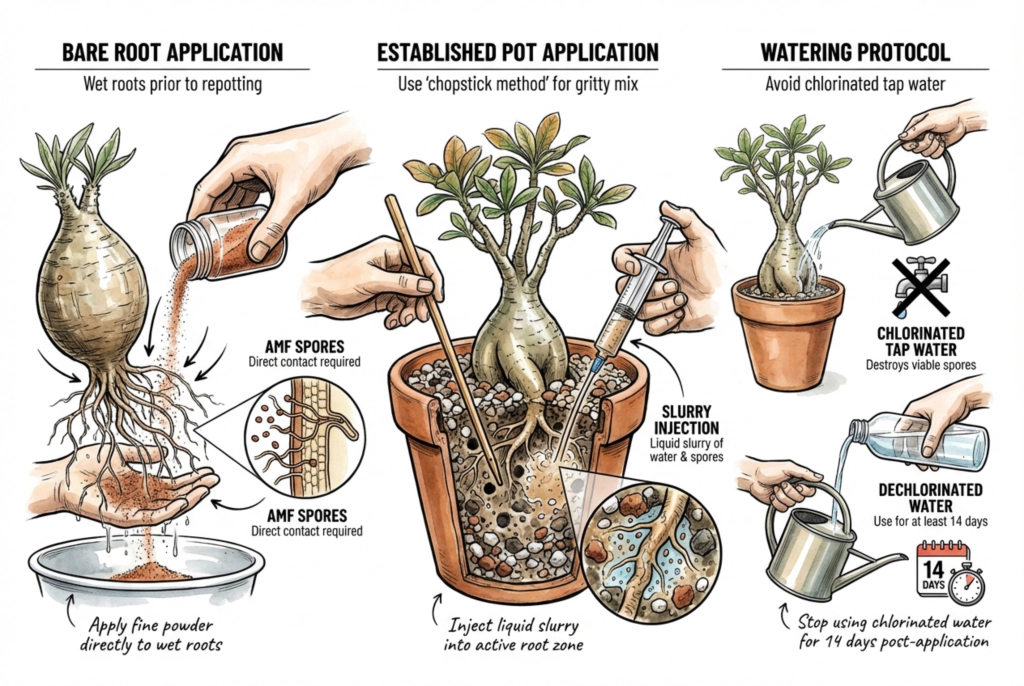
If you test an AMF product, follow its label and place the inoculant where living roots can contact it. Root exposure at repotting can make that placement easier, but avoid damaging roots just to apply powder.
Apply inoculant where roots can reach it
For an established pot, you can work a slurry of water and inoculant into holes near the root zone.
Use moisture only to establish contact
The goal is simply contact with living roots plus enough moisture to establish.
Keep chlorine advice proportionate
Avoiding heavily chlorinated tap water right around application may be a sensible precaution, but a fixed stop-tap-water period is not well supported. Effects depend on chlorine level and contact time.
Choose a practical water source
Letting tap water stand, or using filtered/rainwater during establishment, is a reasonable middle ground.
Evaluate the product as an experiment
An arbuscular inoculant listing a species such as Rhizophagus intraradices is one example of the product type. Check the current label for host, storage, application, and fertilizer guidance. A species name or compatibility claim does not prove viable propagules or colonization. Independent evaluations often find little measurable benefit, so treat any trial as an experiment.
Can AMF survive severe dry dormancies?
Keep aggregation claims bounded
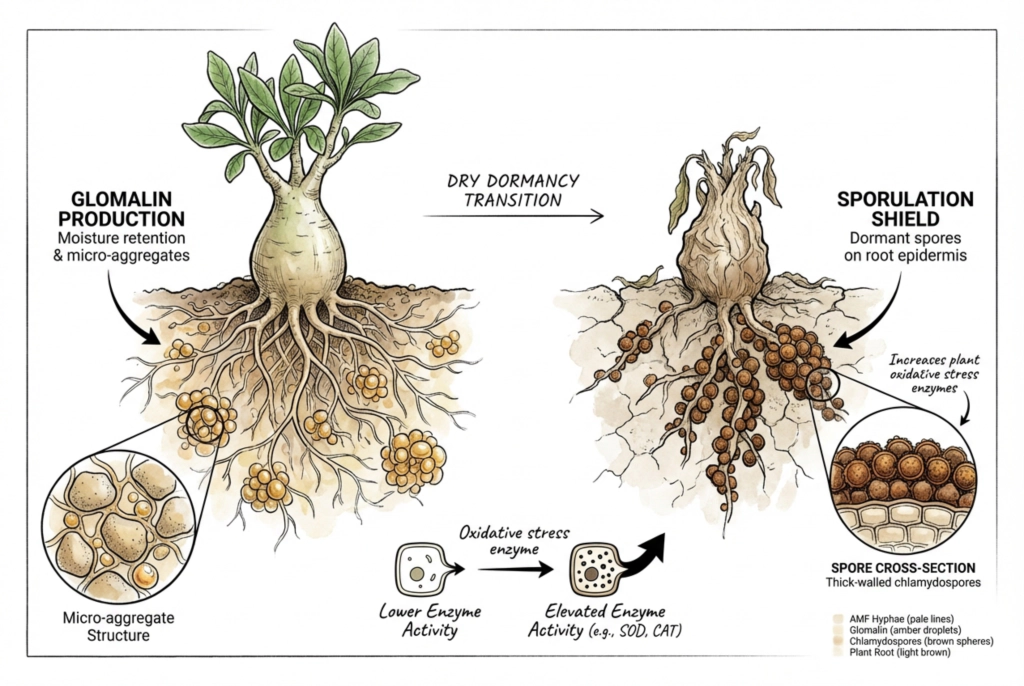
AMF are associated with glomalin-related soil protein, which is linked to soil aggregation.
Keep glomalin terminology provisional
Be aware the older glomalin is a single glue the fungus secretes picture has been reassessed. What exactly is measured, and how it drives aggregation, is still debated.
Do not turn aggregation into a mix promise
So the idea that it binds a chunky pot mix into moisture-holding micro-aggregates is plausible in principle but not a proven, quantified benefit for these plants.
Do not overstate drought protection
AMF do produce resting spores and can persist through dry periods, and there’s evidence they can influence a host’s stress and antioxidant responses.
Keep drought-protection mechanisms uncertain
But the specific story that dormancy triggers heavy sporulation forming a protective shield that prevents cells rupturing on spring rewatering isn’t established. In fact drought tends to reduce spore density and colonization in some studies.
Use dry-period persistence as a limited claim
So treat this as speculative, not a documented mechanism.
Diagnosing and Solving Phosphorus Lock-Up
Read Purple Leaves as a Differential Signal
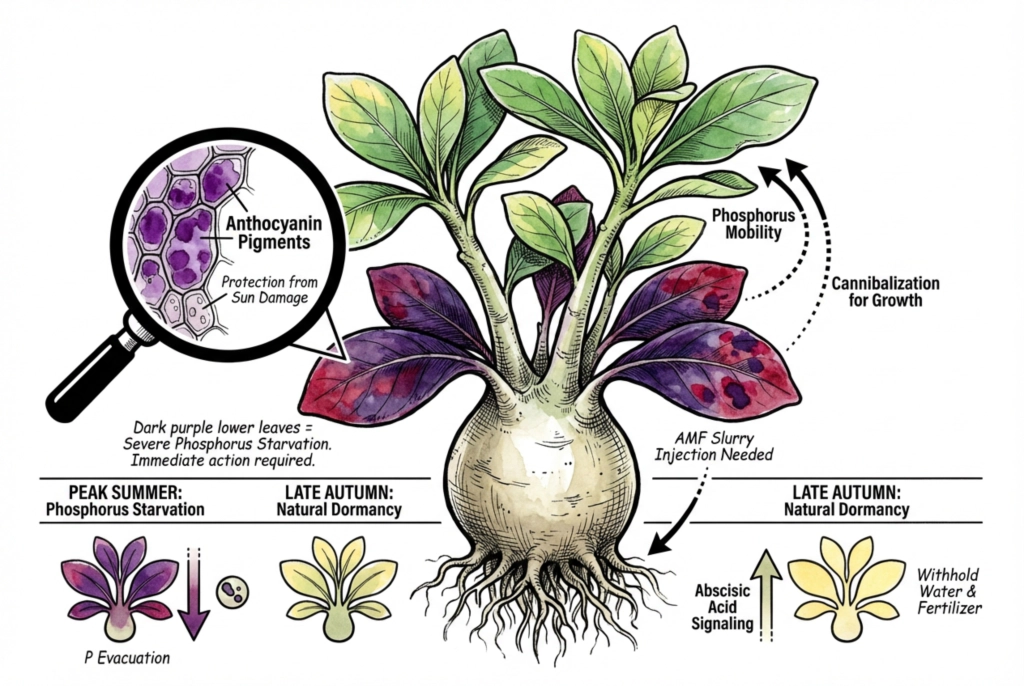
A plant badly short on phosphorus can show symptoms that often get misread as sunburn or normal dormancy.
Keep visible growth effects separate
Phosphorus starvation can stunt cell expansion, leaving the caudex thin and woody despite years of growth.
Why are my oldest leaves turning dark purple?
Read purple leaves as one possibility
Dark purple lower leaves can indicate phosphorus deficiency because phosphorus is mobile and a plant moves it from older leaves to new growth. Low-phosphorus tissue can turn dark green, red, or purple, but that is only one possibility among many.
Check other causes before adding inoculant
Purple or red coloring also comes from genetics/cultivar, bright light, cold, drought, root damage, pH or salt problems, other nutrient issues, aging, and disease, so color alone is not a diagnosis.
Test water, substrate, and tissue when needed
Before assuming severe phosphorus starvation, check watering, root health, and your water/substrate pH and feeding. A tissue or substrate test is the real answer.
Do not use AMF as emergency fertilizer
AMF is not an emergency phosphorus fertilizer. Establishing a working fungal network takes time and often fails on the first try. A genuinely deficient plant needs its underlying problem corrected through appropriate feeding, pH management, or root care, not just an inoculant.
Keep dormancy and deficiency separate
Uniform pale yellowing can accompany seasonal dormancy, but light, roots, moisture, and nutrition still need to be checked. Reduce water and fertilizer only when the plant's observed dormancy pattern supports it.
How does alkaline water trap phosphorus?
Keep alkaline binding conditional
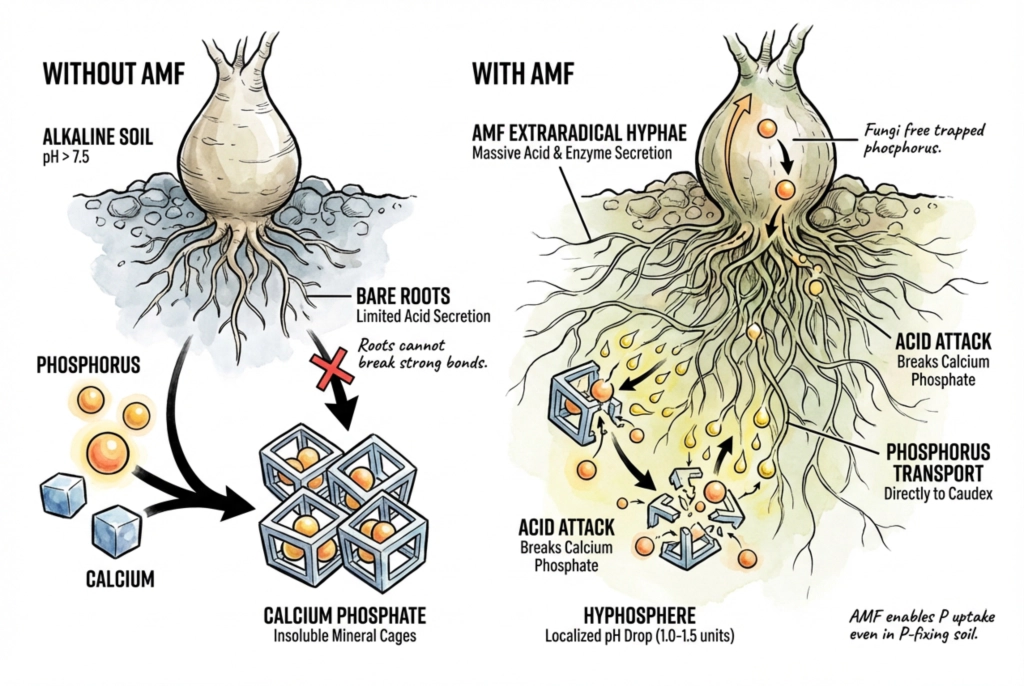
In high-calcium, alkaline conditions, phosphate can bind with calcium into less-soluble forms, reducing what’s available. The effect is real, but there is no universal pH 7.5 switch because it also depends on calcium levels, alkalinity, and the material.
Keep AMF chemistry context-specific
AMF hyphae can alter the chemistry and microbial activity around roots through exudates and phosphatases, potentially changing phosphorus availability. The size of that effect depends on the soil, pH, host, and fungal partner. It should not be reduced to a universal pH drop or guaranteed unlocking of phosphate.
Separate phosphorus supply from growth
Isotope-tracer studies (in crops like wheat, not caudiciforms) have shown the fungal pathway can supply a large share of a plant’s phosphorus even in P-fixing soils.
Check growth instead of assuming a response
Crucially, though, those same studies found that this didn’t always produce more growth. In some conditions colonized plants even grew less.
Keep the two outcomes separate
So the fungus provides lots of P and the plant grows bigger are separate questions, and the second one isn’t guaranteed.
Practical Applications for Caudex Care
Inoculating Seedlings for Possible Girth Gains
What to look for
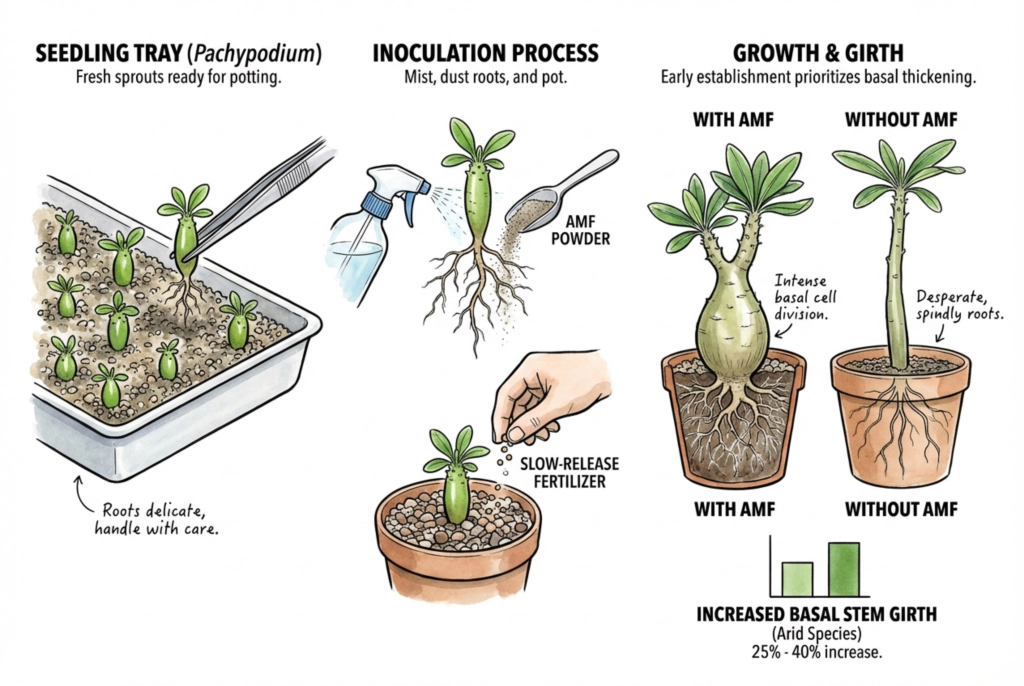
A tray of freshly sprouted Pachypodium is ready for individual pots.
How to respond
Lightly moisten the roots, apply the AMF product according to its label before placing the plant in the gritty mix, and feed conservatively according to the fertilizer label.
Why it might help
If colonization succeeds, better phosphorus supply could support growth.
Keep girth claims unvalidated
Be skeptical of specific claims, though. There is no measured 25–40% greater girth result for these plants, and the idea that inoculation rewires a seedling toward caudex growth instead of roots isn’t backed by anatomy or biomass data.
Treat seedlings as a low-risk experiment
Treat inoculating seedlings as a low-risk experiment, not a proven way to bulk up a caudex.
For an AMF comparison, I start with 12 seedlings from one seed lot and rank them by caudex circumference at a marked height. I make six adjacent-size pairs, then flip a coin to assign one seedling in each pair to the treated group.
I assign the 12 pots to shuffled grid positions and reshuffle them every seven days. On the same weekday and hour, I record leaf count, caudex circumference at the mark, and pot mass after drainage stops.
Six pairs fit one shelf while providing six independent comparisons, and weekly reshuffling reduces the chance that one treatment stays at a bright edge. This screen cannot prove colonization, so I treat mixed pair results as inconclusive unless root testing confirms the fungus.
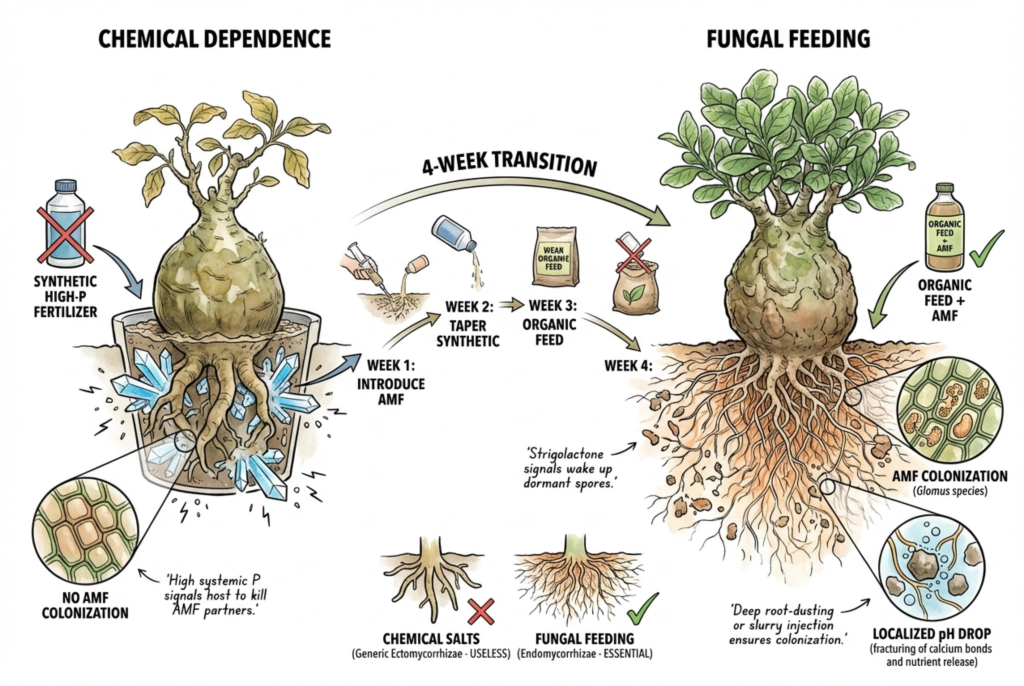
Transitioning from Chemical Salts to Fungal Feeding
What to look for
A mature specimen leaning hard on high-P chemical bloom boosters that you want to move onto an organic regimen.
How to respond
If you want AMF to establish, avoid heavy high-phosphorus feeding, since abundant available phosphorus does tend to suppress colonization.
Keep synthetic and organic feeding comparable
You don’t need to demonize synthetic feeding, though. It’s the phosphorus level that matters, and organic fertilizers can also be high in P. A modest, balanced or low-P feed is fine.
The nuance
High available phosphorus reduces the plant’s signals (like strigolactones) that invite fungal colonization. It doesn’t simply kill the fungus, and there’s no evidence a specific four-week taper reliably wakes spores and builds a stable network.
Use a gradual feeding decision
So keep phosphorus moderate and give it time, rather than following a fixed switch-over schedule.