
Bare-Root Pachypodium Rooting: Arrival Triage & Setup
Root a bare-root Pachypodium by triaging live, dead, and rotting tissue first. Decide when to cut, callus, use heat, choose media, and start watering.
Rachel Torres · 2026-07-27 · Updated 2026-07-31 · 14 min read
Key Takeaways
- Do not automatically soak, recut, powder, and heat every bare-root Pachypodium. First sort the plant into one of three states: viable roots with a firm base, a clean rootless or freshly cut base, or active soft decay.
- Preserve firm tissue and remove only clearly dead or advancing rotten tissue with a cleaned tool. Let any fresh cut become fully dry and stable before it touches medium.
- Use a clean, well-aerated mix in a drained container, and skip the reflexive rooting hormone and sulfur. Neither is proven on imported Pachypodium, and sulfur wound dressing is not on the product label.
- Add bottom heat only when the measured medium is actually cool. General propagation ranges (about 70–80 °F) are a starting orientation, not a species-specific recipe.
- Judge every step by the tissue and the pot, not a calendar. Firmness, continuity with living tissue, and change over time beat color or a fixed day-seven ritual.
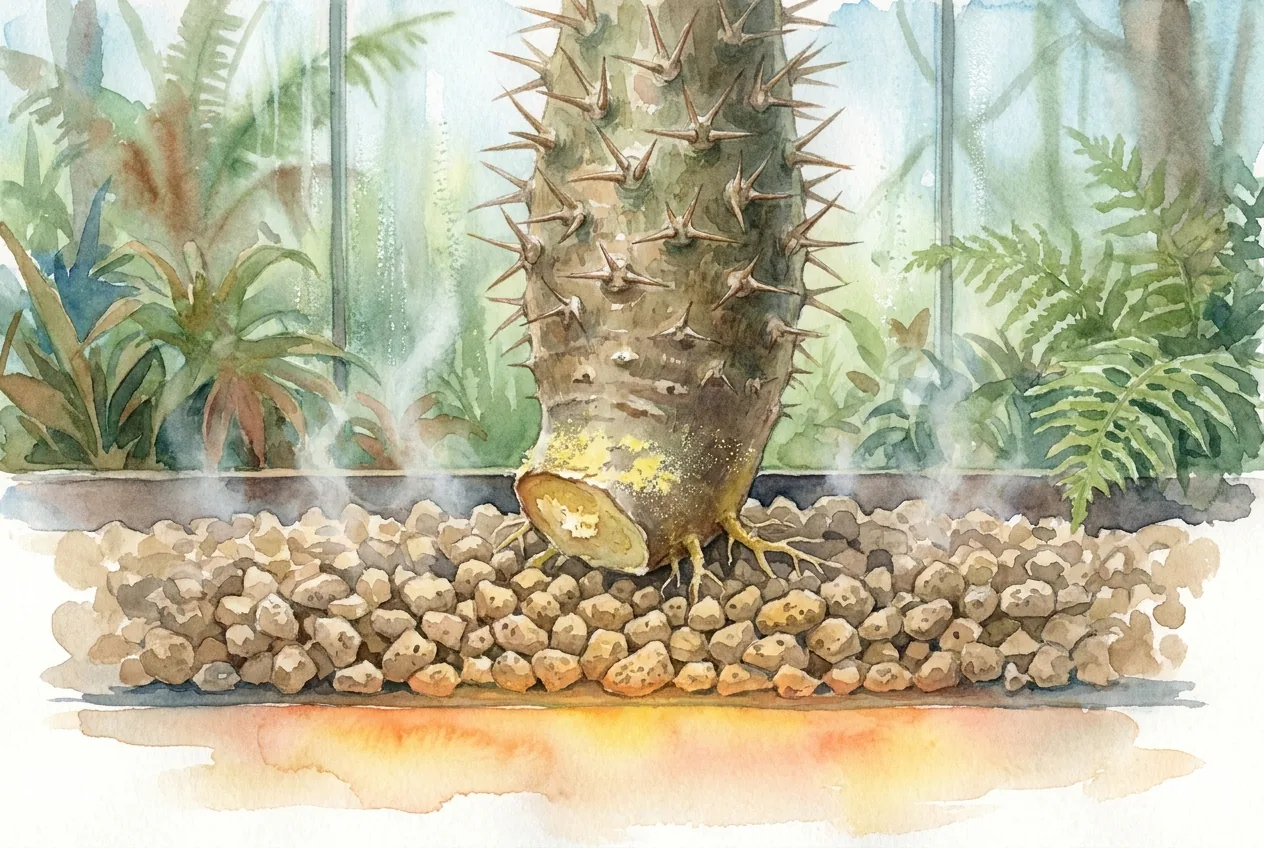
A shipping box does not tell you what the plant needs next. One bare-root Pachypodium arrives with firm, usable roots. Another has a clean rootless base. A third is already losing tissue to rot. Treating all three with the same soak-and-powder ritual is how viable roots get cut off and a wet lesion gets hidden in pumice.
For accepted taxonomy, import-document boundaries, and a species-focused workflow, use How to Root Imported Pachypodium gracilius Safely.
Is the Pachypodium Ready to Pot or Still Rotting?
Record the Arrival State
Unpack the plant over a clean, disposable surface and photograph it before cleaning. Record how long it was in transit, whether the package was hot or cold, and whether the root area was dry, damp, or foul-smelling. That history matters if symptoms progress or a diagnostic lab needs context.
Choose the next step from tissue condition
| Arrival state | What supports the diagnosis | First action |
|---|---|---|
| Viable roots remain | Roots and base are firm. No expanding soft or wet area | Preserve the roots, remove loose packing debris, and pot without a prophylactic base cut |
| Rootless but stable | Base is firm and dry, with no expanding discoloration or fluid | Keep dry while you prepare a stable, clean rooting setup |
| Freshly broken or deliberately cut | New wound is moist but surrounding tissue is firm | Let the cut surface dry and stabilize before it contacts a rooting medium |
| Active decay suspected | Softness, collapse, fluid, or discoloration is moving into the base | Isolate the plant. Consider a diagnostic lab for a valuable plant, and remove only clearly affected tissue if rescue is still realistic |
| Core or crown is extensively soft | No firm transition remains, or decay continues after a recut | Repeated surgery is unlikely to restore dead tissue. Protect the rest of the collection |
Read Tissue over Color
A dark root is not automatically dead, and a pale root is not automatically healthy. Firmness, continuity with living tissue, and change over time are more useful than color alone. Avoid repeated squeezing. Pressure can bruise a dehydrated plant and create another wound.
What Should You Buy and What Should You Skip?
Buy for the Diagnosed Task
Most rescues need a clean tool, a clean pot, an appropriate medium, warmth, and patience. They do not need every product in the shopping results.
Treat the list as a decision aid rather than a shopping list. Choose the smallest tool that matches the tissue you actually need to cut, and buy a product only when its label and your measured conditions support the intended use.
| Role | Product example | Reason to buy | Reason to skip |
|---|---|---|---|
| Fine-root trimming | gonicc Micro-Tip Snips | Small dead roots need a controlled cut | The only cut crosses a thick woody base |
| Base recut | outROAR Folding Scalpel | A replaceable sharp blade suits a limited, deliberate cut | You need a locking or fully sterilizable surgical instrument |
| Tool disinfection | McKesson 70% Isopropyl Alcohol | You do not already have a suitable tool disinfectant | An equivalent product is already available at home |
| Rooting hormone | Garden Safe TakeRoot | You have decided to treat a fresh cutting exactly as its label directs | The base needs a long dry cure, viable roots remain, or you expect Pachypodium-specific proof |
| Sulfur product | Bonide Sulfur | A label-listed plant and surface disease need sulfur | You intend to dust a caudex wound or cure internal root rot |
| Mineral medium component | Bonsai Jack Pumice | Your mix needs a clean, stable, porous mineral component | A pure coarse grade would dry too fast or fail to support the plant in your conditions |
| Bottom heat | VIVOSUN Heat Mat and Thermostat | A probe shows that the medium is below a conservative rooting range | The medium is already warm or you cannot keep the probe and electrical connections safe |
Should You Cut the Roots or Base?
Cut Only Confirmed Damage
Do not make a fresh wound merely because the plant is imported or root-poor. Every cut removes stored tissue and opens a new route for infection. Preserve firm attached roots even when they look weathered.
Cut when tissue is clearly dead, crushed, detached, or actively softening. Clean visible soil and sap from the blade before disinfecting it. The University of Minnesota recommends 70% or stronger isopropyl alcohol for small hand tools and advises dipping, wiping, or spraying the blade before moving between plants. Keep alcohol away from flame and allow the tool to dry.
Match the Tool to the Tissue
For fine roots, micro-tip snips can make a controlled cut without forcing a thick base between small blades. A replaceable-blade scalpel is an option for a flat base cut, but the linked folding tool is not a locking surgical handle. Use the instrument you can control safely rather than choosing by product hardness or blade count. Seventy-percent isopropyl alcohol is a practical tool disinfectant, not a plant dip, so do not pour it over living roots or a caudex wound.
Stop When Firm Tissue Returns
After a necessary base cut, stop cutting when the remaining tissue is uniformly firm and the advancing soft zone is gone.
If the lesion approaches the crown or keeps moving after a clean recut, a diagnostic lab is more informative than repeatedly shortening the plant.
Should You Soak a Bare-Root Pachypodium?
Do Not Transfer Rose-Soak Advice
There is no sound basis for transferring an 8–12 hour bare-root rose soak directly to Pachypodium. A rose with dormant roots and a freshly cut succulent base are different tissues with different failure risks.
Do not submerge a soft, suspicious, or freshly cut base. Water can obscure the lesion, spread debris across the wound, and delay drying. If a valuable plant may go to a diagnostic lab, ask the lab how it wants the sample before washing anything. For a firm plant with intact dry roots, remove loose packing material and follow the supplier's species-specific acclimation advice. If a rinse is needed to inspect the roots, use clean water briefly and dry the plant promptly in moving air. Do not expect a rootless caudex to rehydrate substantially through a cut surface simply because it sat in a bowl.
How Long Should a Fresh Cut Dry?
Judge the Wound, Not the Calendar
Use the wound, not a fixed calendar. Iowa State's succulent-cutting guidance recommends letting a cut end dry and callus for several days before placing it in well-drained medium. That is a useful analogy, but it is not a trial on thick imported Pachypodium bases. A small, shallow cut in warm dry air may stabilize quickly, while a broad caudex cut in humid air can take longer. Keep the plant shaded from harsh sun, with airflow and no contact between the cut face and a damp surface. The base is ready for the next step when the surface is dry, firm, and no longer changing, not merely because seven days have passed. If softness or discoloration continues during the dry period, reassess the tissue and diagnosis rather than assuming the plant is merely slow to callus.
Does Rooting Hormone or Sulfur Belong on the Cut?
Separate Rooting Aid from Disease Control
Neither product is essential, and the two labels answer different questions.
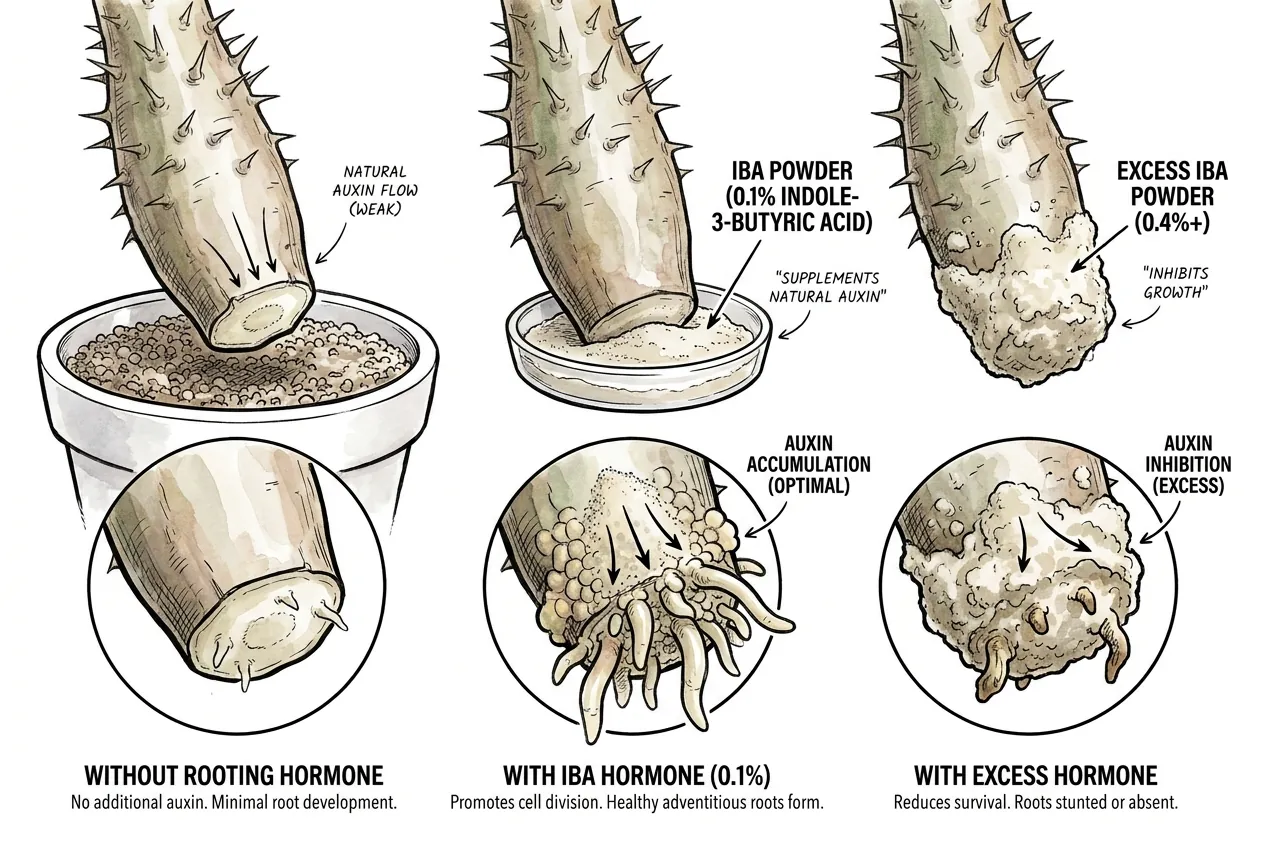
Garden Safe TakeRoot contains 0.1% indole-3-butyric acid (IBA). Its label tells the user to slightly moisten a cutting, coat the cut end, remove excess powder, and plant it in rooting medium. That sequence is not the same as coating a broad caudex cut and leaving it to dry for a week, and published IBA results from peach or other woody cuttings cannot supply a Pachypodium success rate.
Use TakeRoot Only by Label
If you consider TakeRoot, use it only when you are treating a cutting in a way consistent with its current label. Skip it when viable roots remain, when the wound still needs a dry cure, or when you are relying on it to stop rot. Follow the container's handling, storage, and disposal directions, and do not improvise a stronger concentration.
Keep Sulfur on Listed Uses
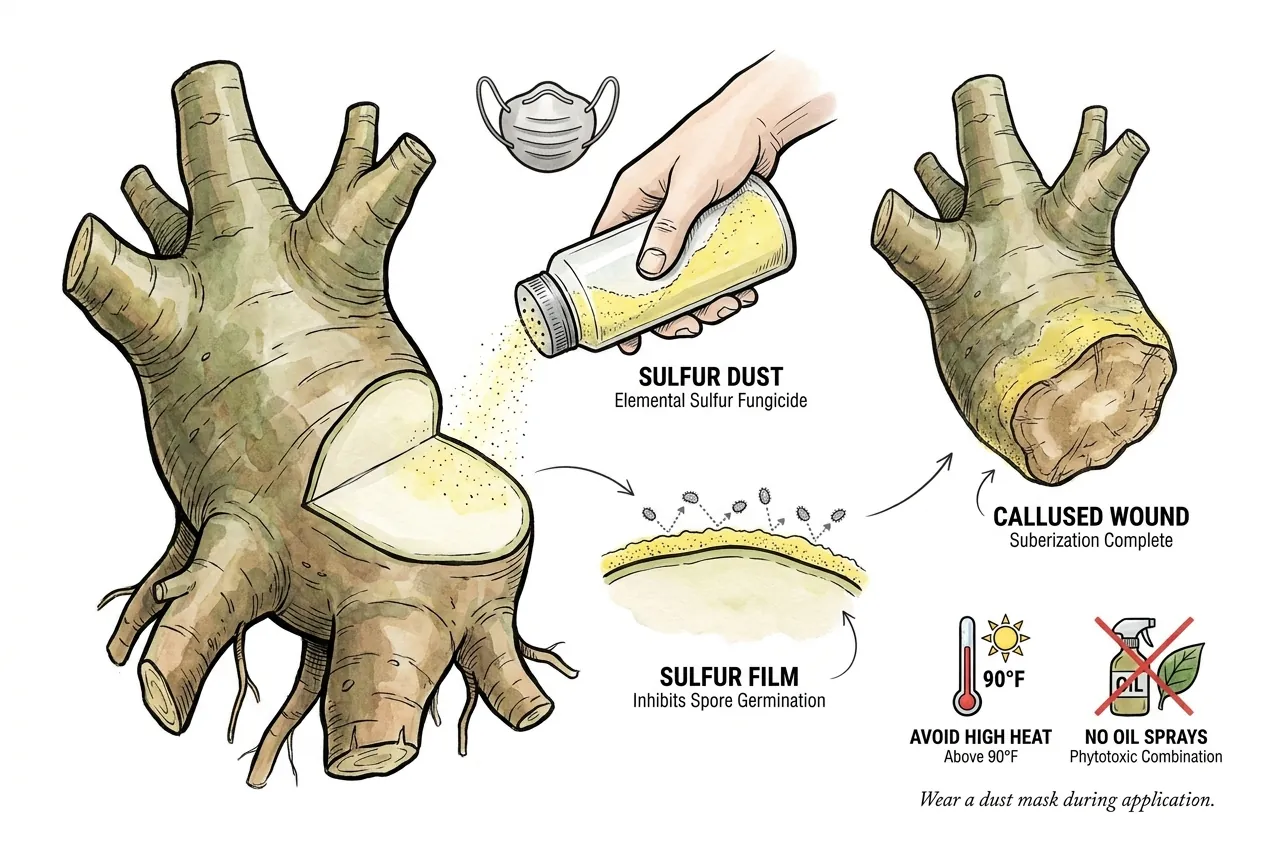
Bonide Sulfur is labeled for specified surface diseases and pests on listed plants and animals. Do not use it as a Pachypodium cut-wound dressing because that use is not on the label. It also cannot diagnose or cure an internal bacterial, fungal, or oomycete rot. Read the caudex root-rot fungicide chooser before turning a rescue into an unverified pesticide program.
What Rooting Medium and Pot Should You Use?
Stabilize the Base without Burying It
Choose a clean container with an open drainage hole and enough weight or external support to keep the caudex from rocking. Repeated movement at the base can damage new root initials, so do not solve instability by burying a large part of the caudex in damp medium.
Use Pumice as One Mix Component
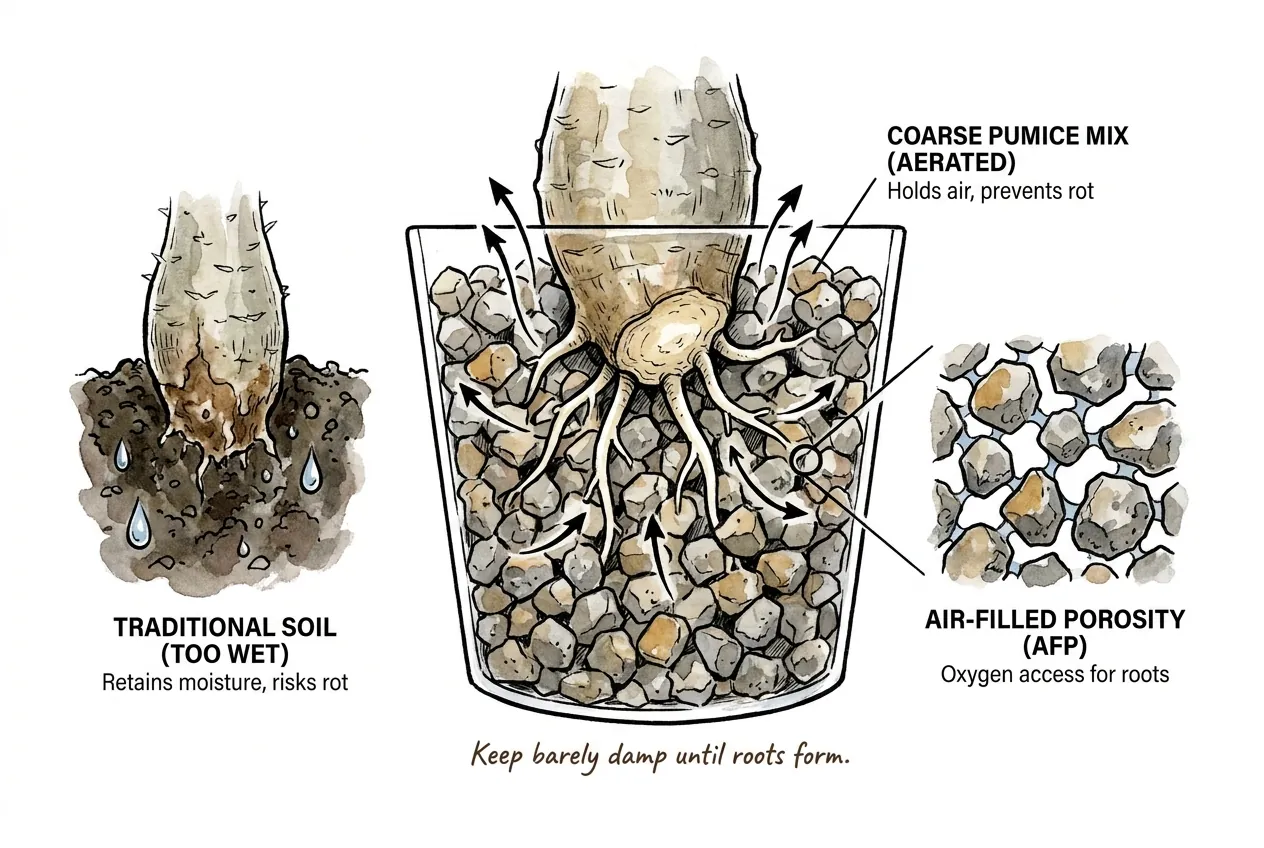
Pumice is a useful mineral component because it is stable and porous, but a bag label or nominal quarter-inch grade does not prove the air-filled porosity of the finished pot. Physical behavior changes with fines, particle distribution, pot height, compaction, and whatever else is mixed with it.
Use horticultural pumice alone only if your climate and monitoring can support a fast-drying mineral setup. Otherwise combine clean components to produce a medium that drains promptly, holds some evenly distributed moisture, and does not collapse around the cut base.
The pumice, akadama, and gritty-mix comparison explains why the whole mix matters.
UC Agriculture and Natural Resources gives general container-media minimums for total and air-filled porosity, but those are broad production targets, not evidence that one branded pumice grade automatically meets them. If precise physical properties matter, test the finished mix in the actual pot.
When Does Bottom Heat Help?
Measure the Medium Before Adding Heat
Measure the medium before adding a heat mat. General extension guidance for propagation commonly places rooting media around 70–80°F (22–27°C), depending on species and system. No cited trial establishes a precise optimum for imported Pachypodium, so use that as a conservative orientation rather than a promise that 30°C roots faster.
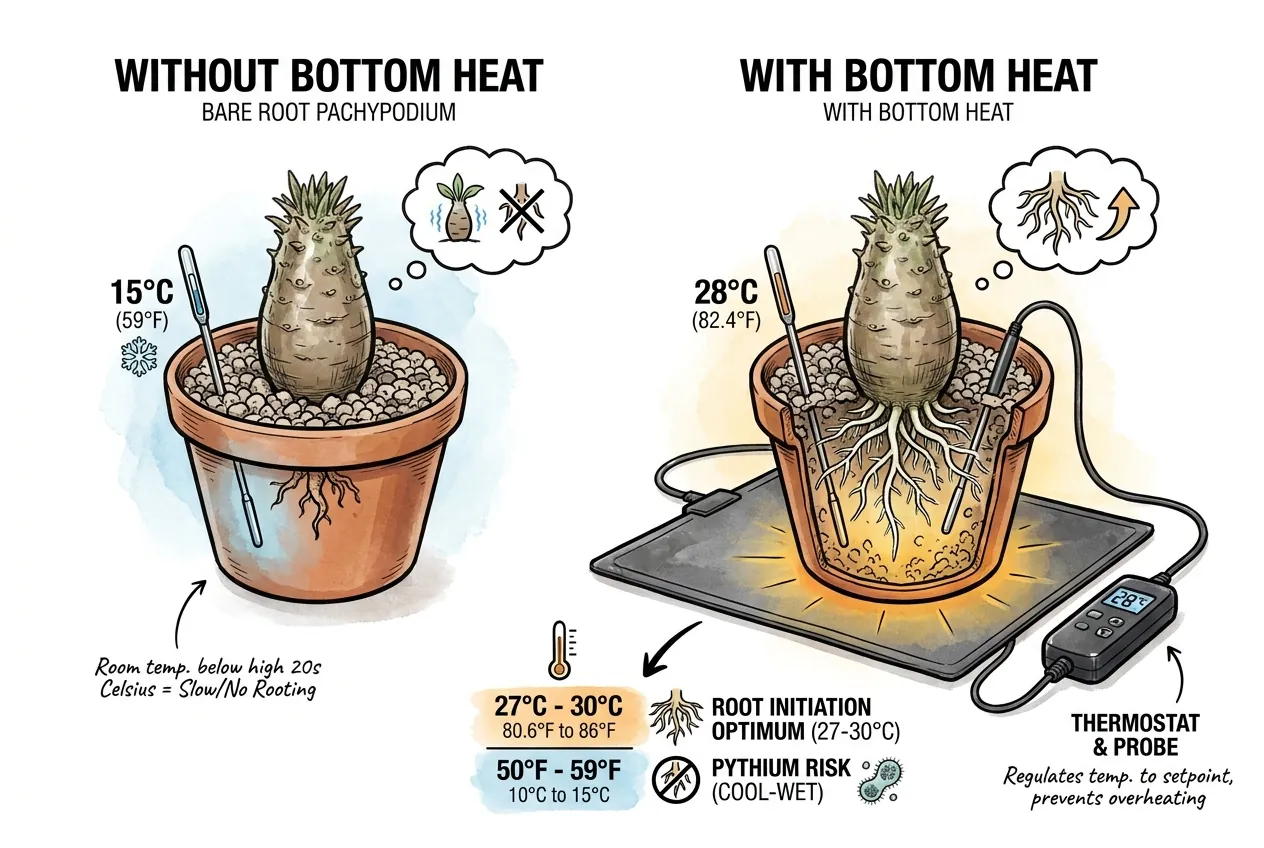
If the medium is already in that general band, skip extra heat. If it is cool, a thermostatic mat can narrow the gap. Put the probe in the medium near the expected root zone without pressing it against the mat or pot wall, then verify with a second thermometer. Warmth does not sterilize the mix. Some root-rot organisms remain active in warm media.
Treat Controller Range as a Limit
The current VIVOSUN combo documentation lists a 20 W, 120 V mat with a controller range extending far above a sensible rooting target. The fact that the controller can be set to 40°C does not make that a plant recommendation. Use the linked heat-mat combo only under its manual, keep electrical connections dry, and inspect the actual root-zone temperature.
The heat-mat soil-temperature chooser covers probe placement and load selection in more depth. The hot-soil Pachypodium root-rot case is the necessary reminder that warmth plus excess moisture is not protection.
How Do You Pot and Start Watering?
Match the Sequence to the Arrival State
- Pot viable roots gently into the prepared medium. Give only enough water to settle the medium if the species, temperature, and wound condition support it, then let all excess drain.
- Seat a rootless but old and fully dry base shallowly and brace it. Introduce moisture cautiously only under warm, bright conditions. Do not maintain a permanently damp zone against the base.
- If a fresh cut was necessary, wait until the surface is fully dry and stable before potting. Begin with dry medium when in doubt, then introduce modest wetting after the setup is warm and the wound remains unchanged.
- If rot is still moving, do not hide the lesion in a pot. Reassess, sample for diagnosis if warranted, or stop the rescue.
There is no defensible fixed day-seven watering schedule for all imported plants. Pot material, airflow, temperature, retained roots, and the size of the wound change the drying rate.
Record pot mass and inspect for change instead of keeping the medium barely moist every day.
Bright indirect light is useful during the unstable phase. Avoid harsh midday sun on a dehydrated import, but do not place it in a dark humid box.
New leaves can draw on stored water before a working root system exists, so leaf movement alone is not proof of rooting.
How Do You Know New Roots Have Formed?
Read Stability and Water Use
Do not perform a daily tug test. Repeated pulling can break the very roots you are trying to confirm. The safer signs are increasing stability without manipulation, sustained new growth, and a change in how the pot dries after a measured watering. None is perfect by itself.
When I brace a rootless plant, I draw a fine alignment mark across each brace at pot-rim height and photograph the setup from one fixed side. If a brace slips or the caudex rotates, I know that an apparent change in stability came from the support rather than new roots.
After each cautious watering the plant’s condition supports, I record the applied volume and weigh the pot after 30 minutes of free drainage. I reweigh at 24 and 48 hours, then compare those fixed daily intervals across three safe watering cycles. Three cycles reduce the chance that heat, wind, a spill, or a shifted brace will be mistaken for new root activity.
I leave the brace alone until at least two independent signals agree. Visible roots at a drainage opening are the clearest sign. Without that view, I want unchanged brace marks plus sustained growth and a repeatable change in water use before I describe the plant as establishing.
If the base stays firm and the plant remains stable, give it time. Recovery often takes weeks rather than days, but there is no Pachypodium-wide deadline. Species, season, stored reserves, retained vascular tissue, and medium temperature all matter.
Unpot only when the decision value exceeds the disturbance, such as when the base is softening, the medium is not drying, odor appears, or the plant is steadily losing stability. A healthy-looking top does not rule out hidden base decline.
When Should You Stop Retrying?
Set a Recovery Boundary
Stop cutting when no firm transition tissue remains, the decay has reached the crown, or each recut is followed by new collapse. A pesticide or hormone cannot restore dead vascular tissue. Isolate the plant and protect nearby pots from shared drainage or contaminated tools.
If a valuable plant repeatedly fails, a plant diagnostic clinic may be able to distinguish an infectious rot from shipping injury or environmental collapse. That evidence is more useful than adding sulfur, IBA, and heat simultaneously, because changing every variable makes the failure impossible to interpret.
For suspicious decay, use the diagnosis-first fungicide guide. It explains why symptoms alone cannot select a chemical and why the product label must match the organism, plant group, use site, and application method.
Sources and Product Labels
Affiliate Disclosure
This article contains Amazon affiliate links. As an Amazon Associate I earn from qualifying purchases. If you use these links, the site may earn a commission at no extra cost to you. Product availability, price, and specifications can change. Check the current listing before buying.