
Dorstenia foetida Seed Discs: Catch Them Before They Release
How to recognize a developing Dorstenia foetida coenanthium, contain ballistic seed dispersal with breathable mesh, and sow fresh seed without treating calendar or temperature rules as guarantees.
Maya Ellison · 2026-07-01 · Updated 2026-07-08 · 25 min read
Key Takeaways
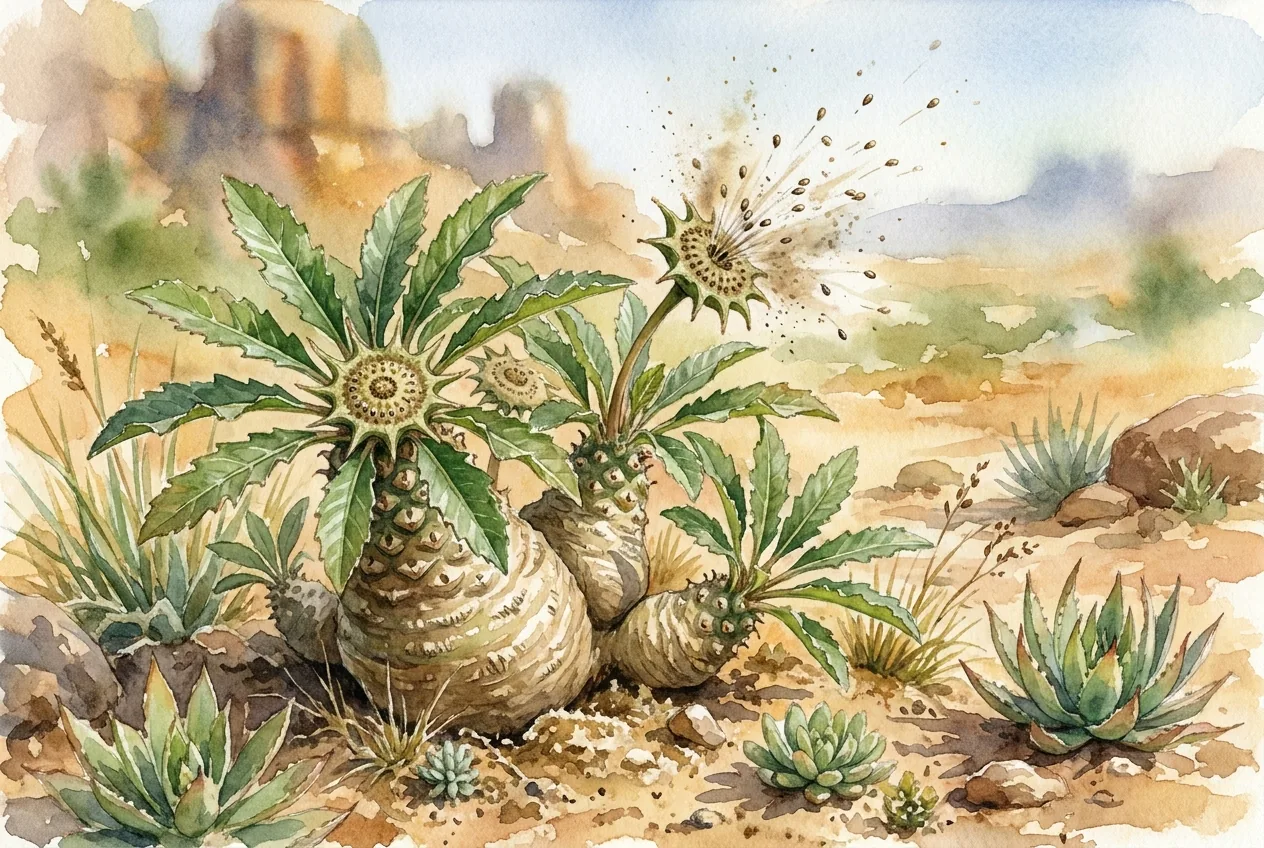
- A single Dorstenia foetida can produce volunteers, so contain developing discs even if you only own one plant. The seed disc launches diaspores ballistically, up to about 2 meters.
- Watch each disc for a shift from fresh green toward a duller, drier look, and treat it as a prompt to inspect. No validated color or day-count predicts release in this species.
- Bag the disc with breathable organza mesh before seed release, and avoid sealed plastic. Solid plastic traps moisture against the fleshy receptacle.
- Sow reasonably fresh on a gritty, mostly-mineral mix under warm, monitored conditions. Guard against damping-off in cool, wet, poorly drained trays.
- Handle the milky sap cautiously: wear gloves, wash promptly, and keep sap-contacted skin out of direct sun. Its furanocoumarins can cause a phototoxic skin reaction.
Dorstenia foetida can release seeds from a developing disc with little visible warning. The useful response is to observe each disc, contain it before release, and handle the plant safely.
Identify the reproductive structure, use mesh to contain ripe seed, sow fresh seed under suitable conditions, control volunteers, and handle sap cautiously. Timing evidence remains too limited for a fixed harvest schedule.
What is Dorstenia foetida, and why do collectors love it?
Dorstenia foetida is a caudiciform succulent in the fig family (Moraceae). It stores water in a swollen, dark-green-to-mahogany trunk called a caudex.
Read the Plant as a Caudex, Not a Leafy Houseplant
The caudex is roughly 15 cm wide and 30 to 40 cm tall, often with peeling bark on older parts.
Understand what the caudex stores
That fat, sculptural base is what caudex hobbyists collect. Growers display the caudex raised proud of the soil, the same way they show off an Adenium or a Pachypodium.
Keep storage biology in the care decision
The caudex is a drought-survival organ that stores water and carbohydrates while the plant may reduce leaf growth during a dry season.
Follow the root zone rather than a houseplant routine
That storage habit means care should follow the caudex and root-zone condition rather than the routine used for a leafy houseplant.
The species is native to the seasonally dry bushland of northeast tropical Africa (including Ethiopia, Eritrea, Djibouti, Somalia, Sudan–South Sudan, Kenya, and Tanzania) and the Arabian Peninsula (Yemen, Oman, Saudi Arabia). The genus honors the German botanist Theodor Dorsten.
What is that flat, star-shaped structure (a flower or a seed disc?)
Read the hypanthodium as the reproductive structure
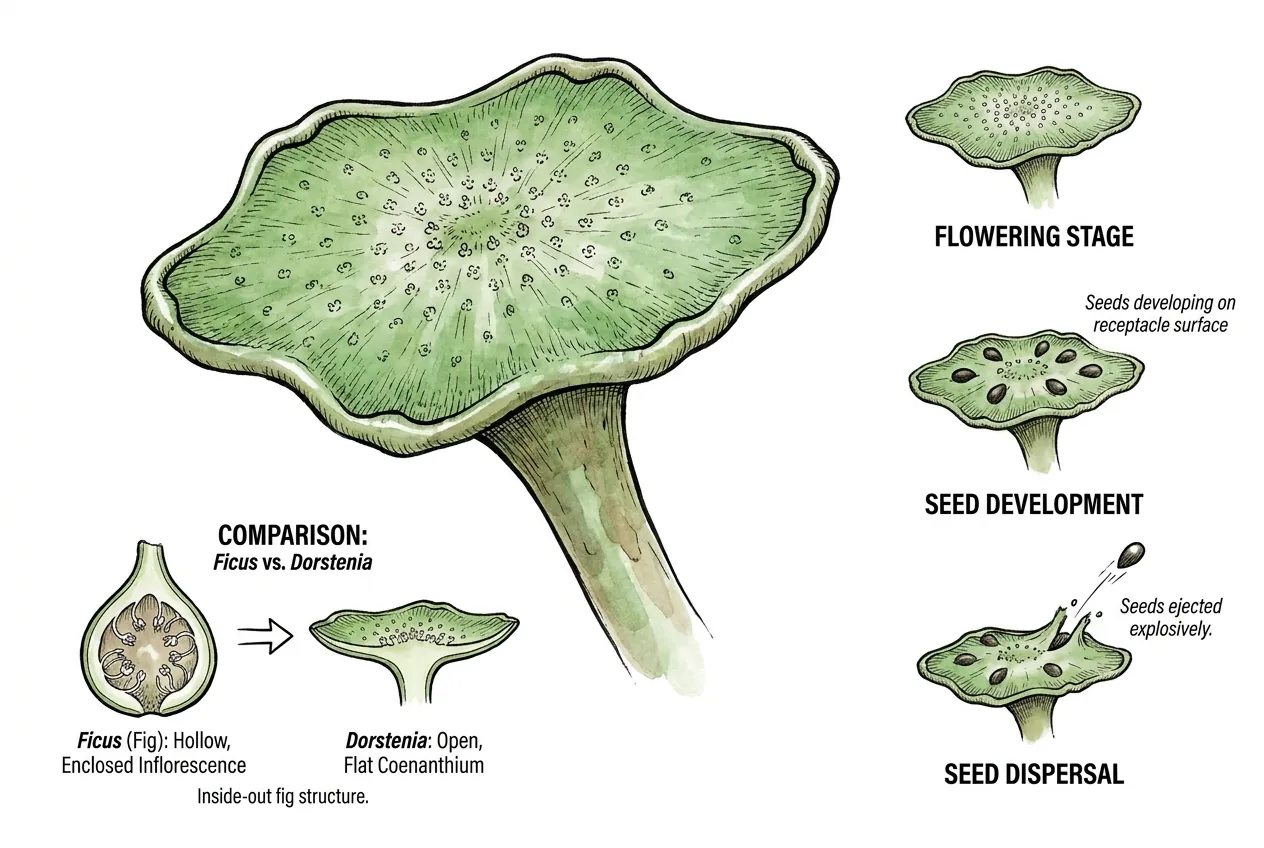
It is neither. The flat green disc is a hypanthodium, an inflorescence carrying dozens of tiny male and female flowers on one fleshy, saucer-shaped receptacle.
Use the inside-out fig analogy carefully
Think of a fig turned inside out. A fig (Ficus) is a related structure folded closed into a hollow ball with the flowers hidden inside.
Expect many fruits from one disc
Dorstenia opens the structure into a flat coenanthium. Tiny flowers occupy deep surface cavities, and developing fruits later protrude from those cavities.
Do not wait for a showy flower
Because the disc is a whole cluster of flowers, one receptacle can set many small fruits at once. That helps explain why a single plant can produce volunteers, although the amount varies with pollination and growing conditions.
Do not wait for a showy flower. The disc is the visible reproductive structure.
Why does it act like a weed in a collection?
Treat volunteer spread as a containment problem
One plant can spread volunteers across nearby pots when its discs release viable diaspores. The release mechanism is ballistic, but the distance and number of successful seedlings vary with the plant and setup.
Allow selfing as a possibility, not a guarantee
Many Dorstenia are monoecious, carrying both sexes on one disc. That arrangement can permit self-pollination, but it does not prove self-compatibility.
Contain even a single plant
Growers often report volunteers from a single D. foetida, so containment is sensible even though controlled self-versus-cross data for this species is limited.
How does Dorstenia foetida actually release its seeds?
Understand the Release Mechanism Before Handling
Dorstenia does not open a conventional pod. As the receptacle matures, tissue around each small fruit changes and can propel the diaspore outward.
Keep the physical analogy within its evidence limits
The familiar watermelon-seed comparison is only a handling analogy. The exact force, speed, duration, and trigger for D. foetida have not been directly measured.
Use distance reports as broad context
Hobby and society sources report distances from roughly 1 m to 2 m, with occasional larger claims. Treat those values as broad context rather than a guaranteed boundary.
Keep related-species anatomy bounded
Peer-reviewed morphoanatomical work on other Dorstenia describes specialized tissue and suggests that aerenchyma in pistillate flowers may aid ballistic ejection. That study did not test D. foetida.
What is the physics behind the squeeze?
Use related fruit studies as background only
Related ballistic fruits can store elastic energy through tissue hydration and cell-wall structure. Those studies help explain a possible mechanism, but they do not establish the internal state or trigger of D. foetida.
Keep milliseconds and turgor values comparative
For Impatiens capensis, dehiscence completes in about 4.2 milliseconds and the energy-storage capacity depends on hydration. For Cardamine hirsuta, explosive release occurs while the fruit is turgid and relies on asymmetric lignin.
Contain before handling the mature disc
Use those comparisons as background only. Avoid brushing or squeezing a mature disc, support it from below, and contain it before handling.
How do I read a seed disc so I know when it may release?
Use Individual Disc Changes as the Cue
Watch each disc as a practical cue. A fresh receptacle can be grayish-green, orange, or pink according to Kew. Later changes in surface texture or color may signal development, but no validated color threshold predicts release in this species.
Use surface change as a prompt
A dull or dry-edged disc deserves closer inspection and early containment. Do not treat a papery-brown whole receptacle or a fixed two-day window as a documented rule.
Keep fruit measurements in scale
Kew’s pale-brown 1 to 1.4 mm measurement describes the endocarp of the tiny fruit, not the whole disc. It can provide scale when selecting mesh, but it is not a receptacle ripeness measurement.
Contain before the release warning arrives
There is no conventional open-pod warning stage. Once a diaspore has released, it may already be outside the pot, so a loose breathable cover is safer than trying to time the exact moment.
Keep an individual inspection log
Inspect discs regularly after they stop looking fresh and contain them when their individual progression suggests that release may be approaching.
How long does a disc take to release, and does it need a partner?
Avoid a fixed release countdown
No reliable species-specific day count links a fresh disc to seed release. Record the interval on your own plant rather than treating a few-week estimate as a protocol.
Keep self-compatibility separate from monoecy
Controlled evidence for self-compatibility in D. foetida is limited. Monoecy and protogyny describe flower arrangement, not guaranteed selfing.
Contain early when the disc changes
Contain a developing disc early enough to allow for uncertainty, and inspect more often than a fixed weekly schedule once the disc is changing.
When is a mature disc most likely to release?
Handle trigger claims as uncertain
Warmth, tissue hydration, or contact may coincide with release, but direct measurements for D. foetida are not published.
Keep related-fruit triggers bounded
Related fruits can release when turgid and can respond to disturbance. That comparison is not a species-specific trigger test.
Handle only under breathable cover
Handle a mature disc gently and, ideally, only after it is inside a loose breathable cover.
Why does it fruit in July, and how does that shift by setup?
Track the Plant Rather Than a Calendar
Dorstenia foetida may produce more discs during active warm growth, but a universal June-to-September or July peak has not been established.
Account for the native range
Its native range spans regions with different rainfall patterns, so a calendar based on one locality cannot predict every cultivated plant.
Log disc progression on the individual plant
Track light, temperature, watering, leaf activity, and disc progression on the individual plant. Use those observations to decide when containment should be ready.
Does heat help or hurt seed set?
Balance warmth with reproductive quality
Warmth can support fruiting, but excessive heat can reduce seed quality. Reproductive tissue is often among the more heat-sensitive stages of a plant’s life.
Do not equate heavy fruiting with viable seed
A plant that flowers heavily in a heatwave can still set mostly dud seed.
Keep temperature models bounded
The numbers come from a controlled modeling study of temperature on pollen and seed set, not field data on Dorstenia. Relative to an 18 degrees C optimum, 30 degrees C cut seed number by 74 percent and 34 degrees C cut it by 85 percent. Pollen viability dropped 21 percent after a single day at 30 degrees C.
Cool measured heat load
Use bright, warm, ventilated conditions as a starting point, then watch the plant rather than treating a borrowed temperature range as a Dorstenia optimum.
Adjust shade and airflow when heat rises
If a heatwave raises tissue temperature sharply, add measured shade and airflow. The response depends on exposure duration, humidity, watering, and acclimation.
What is the realistic harvest calendar by setup?
Build a harvest log for the actual setup
There is no validated harvest calendar by windowsill, patio, or greenhouse. Keep a simple log of disc appearance, light, tissue or root-zone temperature, watering, and release outcome so the timing becomes an observation of your plant rather than a borrowed month.
Keep setup differences visible
Indoor setups can reduce abrupt heat changes. Outdoor and greenhouse setups may produce more active growth, but they also need monitoring for tissue temperature, airflow, and moisture.
Record sowing conditions separately
For sowing, use warm, stable conditions that you can measure. No Dorstenia foetida trial establishes one temperature as a viability optimum.
How do I catch the seed before it releases?
Start with a Loose Breathable Barrier
Enclose a developing disc in a loose, breathable fine-mesh cover. The barrier should catch released diaspores without pressing on the disc or trapping condensation.
Test the actual mesh opening
Fine mesh matters because ordinary fruit netting may have openings larger than the diaspore. Test the actual cover with representative material before relying on it.
Keep the barrier breathable
Breathability matters because solid plastic can hold moisture against the fleshy receptacle. Use a cover that allows air movement and inspect for condensation.
Cover before release is obvious
Timing should follow the individual disc. Cover early enough to allow for uncertain release, but avoid tightening the bag around a developing stalk or changing pollination conditions unnecessarily.
Fit the bag to the stalk and disc
A useful specification is a loose drawstring mesh sized to the disc, with a tested retention opening and enough ventilation for the actual setup.
Because discs may release at different times, I give each one its own bag and put the disc number and bagging date on the drawstring tag. A pot-rim mark fixes the photographed face of that numbered disc before covering and during later checks through the mesh. This keeps multiple discs on one plant from turning into one vague harvest date.
The bag never comes off over my bench. With a shallow white tray or sheet beneath the disc, I pinch the bag closed above its contents before loosening the drawstring. Inverting it over that white surface exposes tiny diaspores and dried receptacle fragments that would disappear on dark potting mix.
I record the first release date and the last date a new diaspore appeared rather than recording harvest day alone. The release span from one numbered disc is much more useful when deciding how early to cover the next disc on that same plant.
What should I buy for bagging?
Choose a cover by fit and mesh opening
Choose a fine, breathable drawstring cover that fits over the disc without pressing the stalk. Because product apertures vary, test the actual bag against a few diaspores before relying on it.
Check listing details against the use
Small drawstring organza gift bags, roughly 4×6 inch, are one option to evaluate. Their fabric may provide a useful barrier, but no listing establishes an aperture or species-specific retention result. Bulk multi-packs are more than one or two discs usually require, so a single tested bag or another clean breathable cover may be enough.
Test any alternative before trusting it
An unverified alternative should not be treated as a tighter or safer mesh. If you compare another cover, confirm its actual opening, fit around the stalk, ventilation, and ease of cleaning before use.
Can I hand-harvest a ripe disc instead?
Handle a mature disc only after containment
Only consider hand harvest after the disc is enclosed, because handling a mature disc may release diaspores. The exact response of D. foetida is not directly measured.
Keep related-species footage bounded
The specialist grower footage cited here shows Dorstenia bahiensis, a relative, so it demonstrates a genus-level handling idea rather than a species-specific trigger.
Hold a cover over the disc before cutting
Wear gloves and hold an open breathable bag or cup over the disc before any snip or detachment. Do not try to catch a mature disc bare-handed.
How do I tell viable seed from chaff?
Separate viable seed from dried chaff
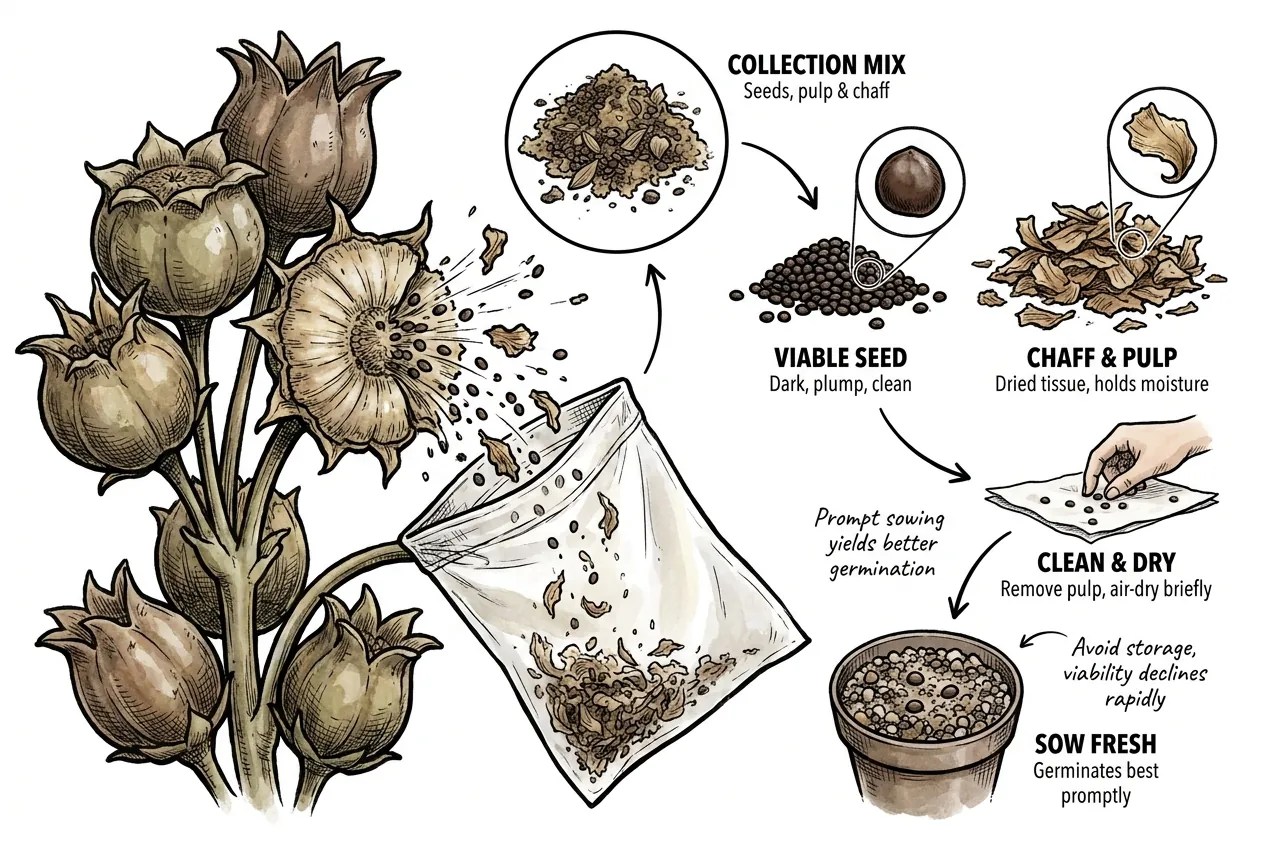
Separate the tiny diaspores from the dried disc debris, then clean and dry them before sowing. After release into the bag, small diaspores will be mixed with bits of dried receptacle. Color alone is not a reliable viability test. A cut test or a small sowing trial tells you more than appearance.
Dry chaff briefly before sowing
Clean off the debris, let the diaspores surface-dry briefly, then sow reasonably fresh. Leftover chaff can hold moisture and harbor mold, but the storage life and viability decline of this species have not been quantified.
How do I turn caught seed into plants?
Sow Fresh Without Treating Freshness as a Deadline
Sow it reasonably fresh on a gritty, mostly-mineral mix under warm, monitored conditions, and expect uneven germination. Dorstenia foetida is often treated as a straightforward caudiciform from seed, but the lot, storage history, and conditions still determine the result.
Keep freshness as a preference
Sowing reasonably fresh is a conservative approach because direct shelf-life data for D. foetida is not available. Treat freshness as a practical preference, not a hard deadline.
Use a low-organic surface that drains well
Sow the diaspore on or very near the surface of a fast-draining, low-organic mix. Keep the surface evenly moist without leaving the tray saturated, and hold it in a warm, observable location. If you cover it at all, use only a light scatter of fine grit so the diaspore still contacts the medium.
Adjust the mix to the tray
A small, clean, well-aerated seed mix is a reasonable starting point. The exact proportion should be adjusted for particle size, water retention, container depth, and the behavior of the actual tray.
Record germination instead of a deadline
Germination timing can vary by lot and setup. Record sowing date, temperature, moisture, and emergence rather than promising a fixed number of days.
What temperature and substrate give the best germination?
Measure warmth instead of copying a number
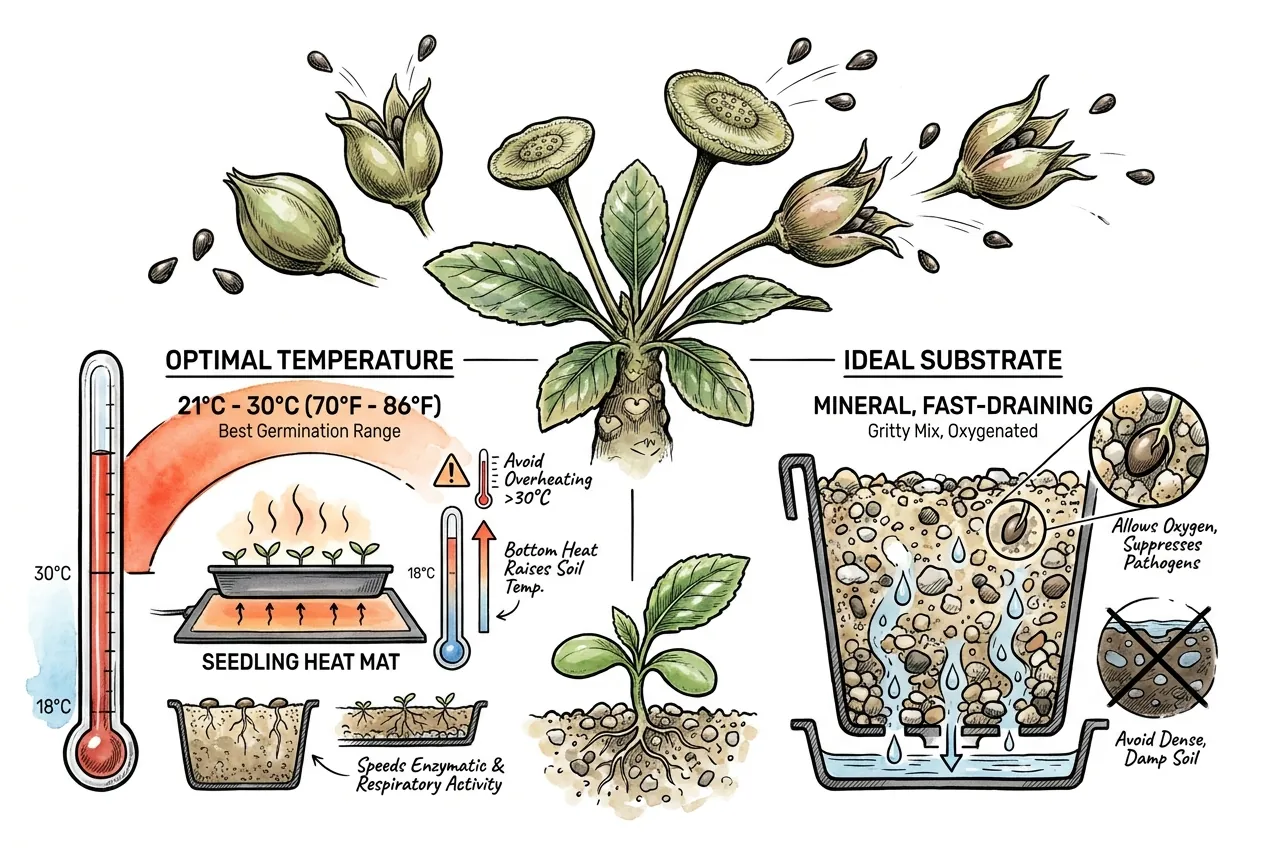
Warm, stable conditions are a reasonable empirical starting point on a mineral, fast-draining surface. Warmth may support imbibition and radicle emergence, while a gritty, well-aerated surface helps avoid saturated conditions. Neither relationship supplies a Dorstenia-specific optimum.
Use tray response in a cool room
Germination may slow in a cooler room. If yours runs cold, gentle bottom heat can help, but use a thermometer and adjust to the response of the actual tray rather than treating a borrowed temperature range as a guarantee.
Choose a heat mat only for measured need
A seedling heat mat may help when the sowing tray is consistently cooler than the surrounding room. If you are weighing whether one is worth it, you can size a heat mat by measured soil temperature rather than by a fixed temperature claim.
Use a thermostat and independent reading
Choose a waterproof mat that can be monitored under the sowing tray, and use an independent thermometer rather than relying on a fixed temperature claim. Pair it with a thermostat when possible because an unregulated mat can overheat a shallow tray. A warm room may not need one.
Compare ready mixes with local materials
If a ready-made medium is preferred, this gritty-mix comparison describes how to evaluate an ultra-fast-draining blend. A coarse pine bark, calcined clay, and Monto clay blend may drain quickly, but no direct trial establishes any single blend as the best germination medium for this species. For fine diaspores, sieve out the largest chunks or add a finer surface layer so the diaspore makes contact.
Skip a bagged mix when clean local media fits
If you already keep pumice and perlite, you do not need a bagged mix at all.
Why do my seedlings collapse overnight?
Prevent damping-off conditions first
Sudden collapse at the soil line can be damping-off, but desiccation, heat or salt injury, and physical damage can look similar. Cool, wet, poorly drained trays favor several soil-borne pathogens, including Pythium, Phytophthora, and Rhizoctonia.
Recognize basal collapse
The classic sign is a water-soaked, then constricted and darkened stem at the base, with the seedling flopping over. The most conducive conditions are cool and wet.
Vent, drain, and record the tray
Use a clean, well-draining mix. A sterile commercial seed mix may be preferable because fresh material is not automatically sterile. Ensure drainage, avoid overwatering, vent any humidity dome, and record temperature and moisture.
Remove collapsed seedlings promptly
Pull and destroy any collapsed seedling immediately, and clean the tray and tools. Infected seedlings often do not recover, and the goal is to protect the ones not yet affected.
Do not seal a cool wet dome
A closed dome left sealed and wet in a cool room is a damping-off incubator. Venting it, easing off water, and warming the tray removes the conditions the pathogens need, which helps limit further spread.
How do I grow a seedling into a real caudex?
Build the caudex over successive seasons
Grow it slowly and gradually expose the caudex as the plant gains size. Seed-grown plants are commonly considered the most reliable route to the characteristic swollen base, but propagation outcome can vary and a universal cutting rule is not established.
Let the base thicken before exposing it
The caudex thickens from the seedling stem base over successive seasons.
Keep young roots anchored
Prick out seedlings once they have their first pair of true leaves, into small individual pots of the same gritty mix. With very young seedlings, let roots establish first and raise the caudex gradually as the plant bulks up (hoisting a tiny seedling proud of the soil too early just risks drying it out and toppling it). The goal over time is to keep the mature caudex from sitting in constant moisture, which rots the swollen tissue.
Judge growth over seasons
Allow the surface to dry slightly between waterings, and keep the seedlings warm and bright.
Caudex development takes time. Judge progress over successive growing seasons rather than expecting a fixed size by a particular date.
How do I stop the volunteers from taking over my bench?
Use Early Containment Before Volunteers Establish
Contain the discs or remove volunteers early. Keeping the plant away from a partner may not prevent seed set when one plant can produce viable diaspores. Nearby pots are potential landing zones because hobby sources report release distances on the order of meters.
Use three containment levers
Three practical levers are available. Cover the discs so diaspores cannot reach neighbors, remove volunteer seedlings while their roots are shallow, or remove developing discs before they mature.
How does covering the seed disc contain the spread?
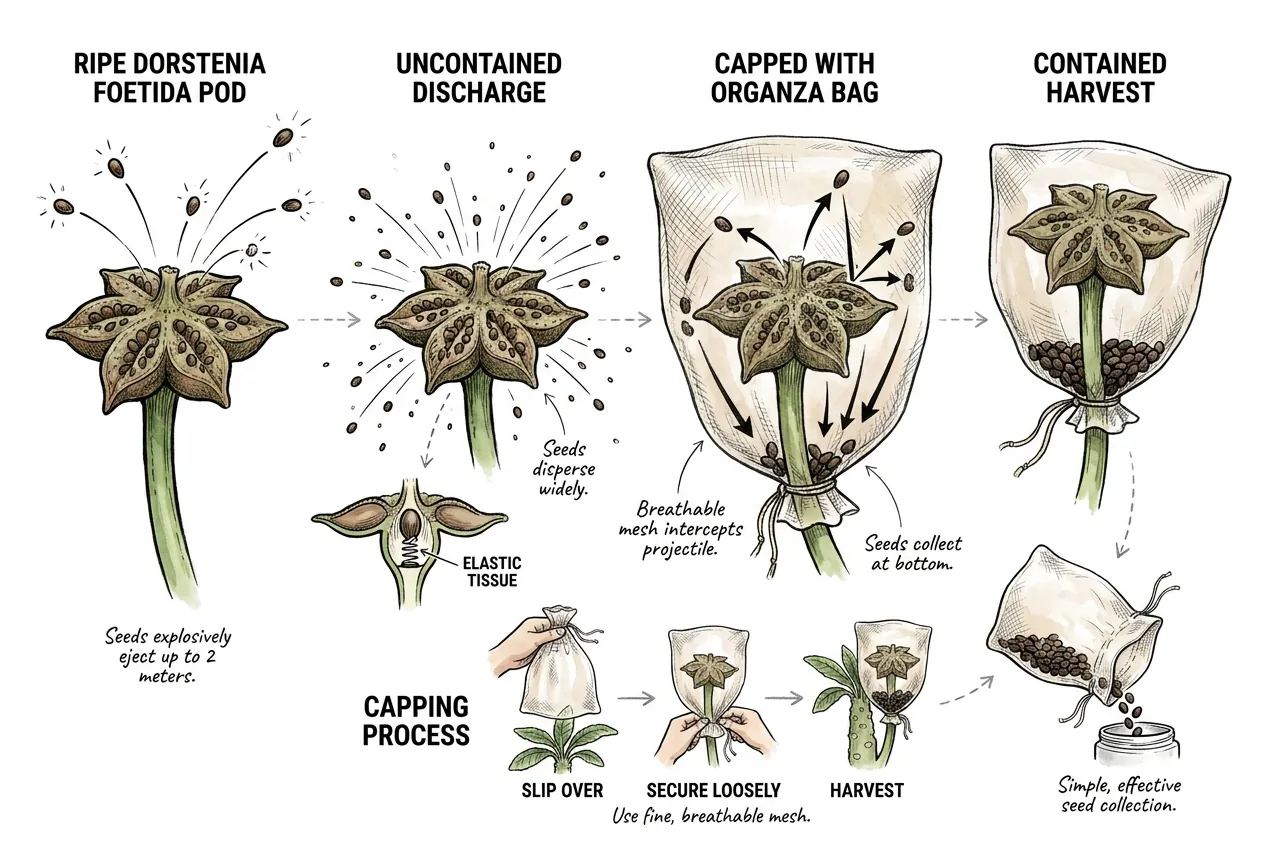
Use mesh as a barrier close to the disc
The same type of loose mesh used for harvest can contain released diaspores. It does not stop the discharge, but it places a barrier close to the disc so the material can be collected instead of scattering.
Fit the barrier without trapping humidity
Slip a fine organza drawstring bag, tulle, or a hairnet loosely over the whole plant or over individual developing discs. Breathable mesh is preferable because sealed plastic can trap humidity against the receptacle.
Check the edges after fitting
Cover the plant when the first discs begin to develop or when your observation log suggests release is approaching. Check the fit and edges so diaspores cannot slip out around a loose drawstring.
Does deadheading harm the plant?
Use deadheading for containment, not a growth promise
Deadheading before ripening is generally a low-risk containment option. Removing developing hypanthodia before seed matures may reduce resource investment in seed set, although the effect on this species is not quantified. The main tradeoff to weigh is that each removal is a small wound and a fresh latex exposure, so it isn't entirely free.
Keep general deadheading evidence bounded
Extension horticulture supports the general principle that removing spent flowers can prevent seed formation and redirect some resources, but that guidance comes from herbaceous ornamentals rather than Dorstenia specifically.
Separate seed goals from growth claims
Seed production draws on plant resources, but interrupting it does not prove that the saved carbon or nutrients will be redirected to the caudex. Any change depends on light, roots, water, temperature, and the plant’s overall condition.
Remove soft discs before they harden
If you want to minimize seed, remove young discs while they are still soft, before they harden. Wear gloves because Moraceae latex may be photo-irritating, and inspect the plant regularly while it is producing discs rather than waiting for a color threshold.
Bag the discs you want to keep
If you want some seed and some containment, bag only the discs you want to keep and deadhead the rest early.
How do I remove volunteers already sprouting in other pots?
Remove young volunteers before roots knit
Remove volunteers while they are small, ideally when the surrounding medium is workable and the host roots can remain undisturbed. Young seedlings usually have less extensive roots, so early removal is easier.
Look for the first caudex swelling
Look for tiny green seedlings with a pinhead swelling at the base, the beginning of a caudex, in surrounding pots. Scout the bench regularly, because once a caudex thickens the volunteer’s roots knit into the host’s root ball and pulling it disturbs your good plant.
Use barriers instead of distance alone
Spacing can reduce incidental spread, but reported launch distances are not a guaranteed boundary. A tray, mesh cover, and regular scouting are more dependable containment measures than distance alone.
Is the milky sap dangerous, and how do I handle it safely?
Treat Latex Exposure as a Real Safety Issue
Keep the sap off skin and away from eyes. Wash promptly after any contact and keep exposed skin out of direct sun until it is clean.
Keep chemistry evidence bounded
A 2011 Phytochemistry study isolated psoralen and bergapten from D. foetida leaves. It did not measure latex concentration or quantify human skin reactions, so the practical exposure risk is uncertain.
Use the same response despite uncertainty
These compounds belong to a phototoxic class associated with plant-sap reactions, but fig-sap timing and severity cannot be transferred directly to D. foetida. Use the safety response consistently even when the exact risk is unknown.
Use a simple first-aid routine
Use a practical, safety-first routine.
- Prune, cut discs, or repot indoors or in shade, not in blazing midday sun.
- Wear nitrile gloves and eye protection. If sap reaches bare skin, wash it off promptly with soap and cool water.
- Never rub an eye with sappy fingers. If sap gets in an eye, rinse with clean water for 15 to 20 minutes and seek medical or poison-control advice.
- If sap gets on skin and you cannot wash it right away, cover that area and keep it out of direct sun. Wash as soon as you can. If blistering, pain, or a spreading rash develops, contact poison control or a clinician.
- Keep cut discs and sappy tools away from children and pets, and clean tools and work surfaces afterward.
Escalate pet exposure to current advice
If a pet ingests plant material or gets sap in an eye, do not use absence from a poison list as proof of safety. Treat the latex as an irritant, rinse an affected eye with clean water, and call a veterinarian or an animal poison service for current advice.
Should I remove some discs to protect the mother plant?
Thin discs only for a defined containment goal
On a plant grown for its caudex, thinning developing discs can be a reasonable containment choice. Seed production uses plant resources, but the amount and destination of any saved resources in D. foetida have not been measured.
Keep the resource tradeoff visible
General reproduction-versus-growth trade-offs do not prove that removing discs will enlarge the caudex. Consider the plant’s condition, your seed goals, and the repeated-wound and sap-exposure cost.
Check care causes before thinning heavily
If a heavily fruiting plant seems to be growing slowly, first check light, roots, watering, temperature, and pests. Removing some developing discs may reduce unwanted seed, but it is not a treatment for an unexplained growth problem.
Treat deadheading as containment
Deadheading is a containment option rather than a proven caudex-growth intervention.
What year-round care keeps a Dorstenia foetida healthy?
Keep year-round care condition-based
Give it bright light, a gritty fast-draining mix, and watering that follows active growth and the drying behavior of the pot. During leafless rest, reduce watering in response to the actual root zone and tissue condition rather than following a calendar rule.
Keep dormant pots airy
Keeping a dormant plant in wet, poorly aerated medium can increase rot risk, but the cause of soft tissue still needs investigation.
Water with active growth and root evidence
Use a mix that does not stay soggy, and water more generously only when active growth and the root zone support it. Check the actual pot and plant response rather than applying one temperature or frequency to every setup.
Document soft tissue before deciding to cut
If the caudex becomes soft or discolored, isolate and document the change before cutting. Soft tissue can reflect excess moisture, root failure, cold, heat, or mechanical injury. Use gloves and eye protection, and seek experienced or diagnostic help when the area is extensive, rapidly changing, or uncertain. Unplanned cutting can remove salvageable tissue or spread contamination.