
When to Restart Watering a Winter-Growing Caudex
Late-summer watering restart for winter-growing caudex plants. Use a 3-signal go/no-go test, a measured first soak, and a smart fungicide-drench call.
Derek Kim · 2026-08-18 · 14 min read
Key Takeaways
- Water only when all three signals align at once. Cool nights, a visible new growth point, and a firm caudex in season must coincide.
- One cool morning or a lone warm-spell growth push is a no-go. Wait for the conjunction before you reach for the watering can.
- Make the first watering a small controlled test, not the start of a schedule. Then ramp up over three to four weeks by how the plant responds.
- Skip the fungicide drench on healthy plants in fast mix. Reserve it for slow-drying pots or a rot history.
- Wet mix with no growth means do not water. A soft caudex means stop and inspect. These two failure signals override everything else.
Late summer is when most winter-growing caudex plants get killed, and the weapon is a watering can.
The grower sees a cool morning, assumes the rest is over, and soaks a plant whose roots are still asleep.
Do not water from a single cool morning. Use a hard go/no-go rule for the first watering, its volume, and the decision that keeps rot out.
The plants in scope here are the winter growers that rest through summer heat and wake as autumn nights cool.
Summer growers like most Adenium and Pachypodium follow the opposite clock, so none of this applies to them.
Which Caudex Plants Restart in Late Summer
Winter growers rest in the hot season and push new growth as nights cool in autumn.
In the Northern Hemisphere that restart window runs from late August into October. Their roots stay nearly idle through summer, then reactivate on the cooling cue.
The core winter-growing caudiciforms are a short, recognizable list.
- Dioscorea and Testudinaria, the elephant’s foot, summer-dormant with winter and spring growth.
- Fockea, deciduous or semi-deciduous, living on the caudex through its warm-season rest.
- Tylecodon, active in autumn and winter, with leaves produced through the cool months.
- Othonna, a strict winter grower running early fall through late spring.
- Winter-growing Pelargonium species on a cool-wet-winter, hot-dry-summer cycle.
- Some Cyphostemma, though several are summer growers, so identify your species first.
The Southern-Hemisphere Calendar Trap
Most trustworthy cultivation references for these plants are South African, and their calendar is inverted from a US grower’s.
When a source says a plant rests in summer and drops leaves in October, that October is spring in the Northern Hemisphere.
Read the cue, which is heat breaking and nights cooling, and ignore the month name.
Dioscorea elephantipes grows in winter and spring and rests through the hot dry season, resuming as temperatures fall.
Tylecodon becomes active in autumn and winter and holds its leaves through the cool period. Othonna may begin growing on its own around cooling October nights, and a good soaking then helps it leaf out.
What Waking Actually Is Inside the Plant
A dormant caudex is idling, not dead, and that distinction sets the whole timing rule. In dormancy the plant slows sharply, photosynthesis falls, water and nutrient uptake drop, and roots grow only very slowly. The stored reserves in the caudex carry it through the rest.
Breaking dormancy is a sequence, not a switch. As temperature and daylight shift toward the growth season, metabolism restarts, and shortly after water uptake begins, respiration rises and growth resumes.
The plant reactivates roots and pushes a new growth point as it wakes.
Why Timing Water to Roots Beats Timing It to the Calendar
Water only helps once there are active roots to drink it. A leafless caudex with dormant roots cannot pull moisture from the mix, so the substrate stays wet and low on oxygen. That is the exact condition soil fungi need to move in.
The dangerous gap sits between wet soil and drinking roots. Restarting on a date rather than on live signals widens that gap and invites rot. Once genuine wake begins, dormant roots perk up fast and take up a thorough soak, which is why the same watering is safe later and lethal early.
The 3-Signal Go/No-Go Trigger Test
Restart water only when all three signals are present at once. Any single signal on its own is a no-go. The conjunction is what tells you a real wake has started rather than a passing warm or cool spell.
Signal 1. Sustained Night Cooling
Winter growers respond to a run of cooler nights, not one cool morning. A practical rule of thumb is nights settling into roughly the 60 to 65F, or 15 to 18C, range or below for about a week.
One cold front is not the signal, because the roots read the trend, not a single reading.
Signal 2. A Visible New Growth Point
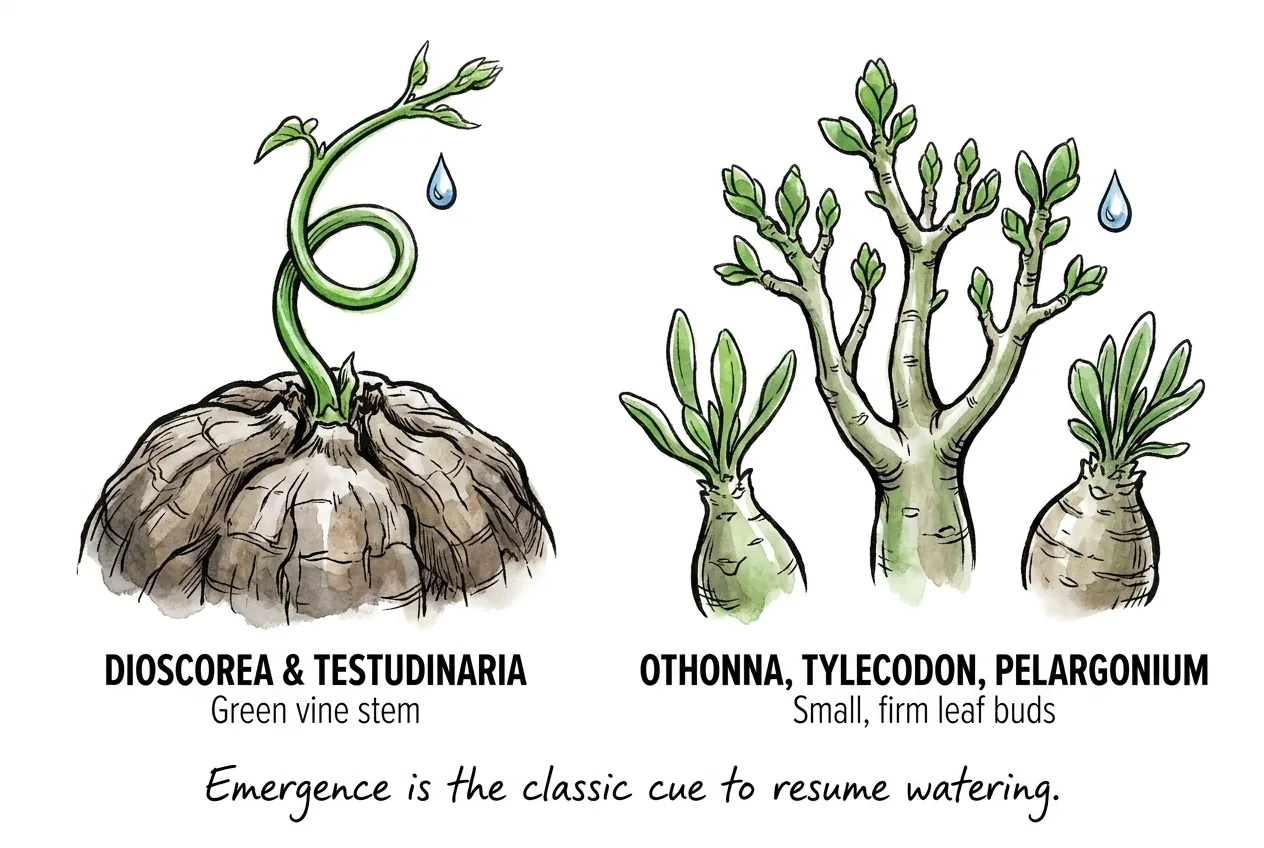
The plant pushing growth is the most reliable single indicator. For Dioscorea and Testudinaria that is a green vine stem emerging from the top of the caudex.
For Othonna, Tylecodon, and winter Pelargonium it is small, firm new leaf buds, and their emergence is the classic cue to resume watering.
Signal 3. Plant-Side and Seasonal Readiness
The caudex should be firm, and the date should fall inside the genuine restart window from late summer into autumn.
A firm, heavy caudex past its usual wake date is almost always alive and simply late, so it is safe to trigger once the first two signals appear.
A soft caudex is a rot flag rather than a wake flag, and it changes the plan entirely.
Why All Three, Not Any One
Each signal alone can lie to you. A cold front without root activity means water just sits, a growth push during lingering heat carries the same risk, and a calendar date is only a guess.
Together the three confirm the roots are actually ready to drink, which is the only thing that makes water safe.
| Signal | Go condition | No-go condition |
|---|---|---|
| Night cooling | Nights ~60-65F / 15-18C or below for about a week | One cold night, then heat returns |
| New growth point | Vine or firm leaf buds emerging | No visible growth |
| Plant and date | Firm caudex, late summer to autumn | Soft caudex, or out of season |
The restart decision stays concrete when I record the three signals on separate lines. The entry includes the first night in the current cooling run and the date when a photograph from the fixed pot-rim orientation first shows a real growth point.
The firmness entry names the exact caudex point shown on the pot-rim photograph and the date it was checked. I make that entry before watering so the evidence cannot be reconstructed from memory afterward.
If a warm spell returns, I restart only the cooling run and retain the original growth-point date. A bud that stalls or dries gets its own dated note instead of remaining a permanent go signal. All three current conditions still have to agree on the watering day.
After the first test watering, I record pot mass after drainage and photograph the marked growth point again. I repeat both at 24, 48, and 72 hours with the same scale and camera position. No additional water enters the 72-hour comparison, so three daily intervals show whether mass loss and bud extension continue together.
The First Watering Is a Test, Not a Schedule
Once all three signals line up, give one controlled soak and then read the response. Treat it as a probe of whether roots are drinking, not the start of your full winter cadence.
What you do next depends entirely on how the plant and mix behave over the following week.
How Much Water on the First Restart
There are two defensible volumes, and the safer default fits most home setups. The conservative ramp starts with a light watering that just dampens the top inch or the pot edges.
It then waits a full week and only gives a larger drink if the plant responded.
Over roughly three to four weeks you work back to a normal thorough soak.
The confident soak is a full drench that runs from the drainage holes, and it suits only strong signals plus fast-draining mix.
Waking roots absorb it quickly, but a dense mix or plastic pot turns that same drench into standing water. Lean conservative whenever dry-down is slow.
Method That Keeps Rot Out
Water at the soil and never over the caudex crown or into leaf axils, because trapped water there invites fungal entry. Bottom-watering gives good control for a first drink. Set the pot in a tray, let the mix wick up for ten to fifteen minutes, then pour off the excess so the pot never stands in water.
Water in the morning so the surface and crown dry through the day. Terracotta breathes and dries faster, which buys margin, while plastic and glazed pots hold moisture and demand restraint.
Match the volume to how fast that exact pot and mix dry, not to a fixed number of millilitres.
Confirm Before You Escalate
Look for the growth point extending, the caudex firming, and the mix drying at a normal pace. Those three together confirm the roots are drinking. If the mix stays wet for many days, the roots are not active yet, so hold and add nothing more.
If you are still assembling the tools to measure dry-down and water precisely, our caudex watering-tools and measurement setup guide walks through what actually helps here.
The Fungicide-Drench Decision
A preventive fungicide drench is the exception, not the routine, and pot size, drainage, and rot history decide it. Most healthy plants in fast-draining mix never need one. The drench earns its place only where water will linger around barely-active roots.
What Attacks a Re-Wetted Caudex
Re-wetting reintroduces free water to soil-borne fungi that were waiting. A peer-reviewed survey of cacti and succulents recovered Fusarium oxysporum, Fusarium proliferatum, and Neocosmospora falciformis, all causing soft and dry rot, root and crown rot, and stem rot.
Pythium and Phytophthora are the classic water molds that flare when roots drown in saturated mix.
These fungi persist in soil as resting structures on debris and strike when conditions turn wet.
That is why the same soil is harmless when roots drink fast and dangerous when they do not.
When to Skip the Drench
Skip it for a healthy plant, in gritty fast-draining mix, in a small terracotta pot that dries quickly, with no rot history.
Correct timing, a controlled first watering, and airflow do the work. Reaching for fungicide by default treats a risk you have not actually created.
When a Drench Is Worth Considering
Consider a labeled soil-drench fungicide at the first watering in the higher-risk cases below.
- A large or deep pot that dries slowly and holds water around inactive roots.
- A dense, water-retentive substrate you have not yet corrected.
- A plant with prior root or crown rot, or a recently wounded or scarred caudex.
- A cool, humid, still-air restart environment.
Fixing the Risk Beats Masking It
A drench cannot rescue a plant sitting wet with no active roots. Repotting into faster-draining mix, downsizing the pot so it dries, and timing the first water correctly remove the actual hazard.
Treat fungicide as insurance on a good setup, never as a substitute for one.
Any fungicide is a pesticide, so follow the product label for dose, concentration, ventilation, and protective equipment.
Keep it away from people and pets, and never mix a stronger dose than the label states.
Ramp-Up Cadence After the First Watering
The first soak is one data point, and the second watering depends on what followed it.
Do not drop straight into a fixed weekly winter slot. Let the plant’s response set the pace.
The Interval
Wait about a week after the first light watering, confirm a positive response, then give a slightly larger drink.
Build to a normal thorough soak over roughly three to four weeks. For Dioscorea specifically, once the vine is clearly growing, a full drench about once weekly becomes typical winter cadence.
Signs to Escalate Versus Hold
Escalate when the growth point extends, the caudex firms, and the mix dries at a healthy pace.
Hold when the mix stays damp for many days, the growth point stalls, or you see any softening at the base. Wet mix with no growth always means add nothing.
Once the plant is in clear active growth with fast, healthy dry-down, transition to the genus’s normal winter routine.
For most winter growers that means watering when the top inch of mix is dry. Let the dry-down interval, not the calendar, set frequency for the rest of the season.
When the Restart Goes Wrong
Most restart failures trace to water given before roots were active, and each has a clear triage path. The diagnostic loop is simple. Wet mix with no growth means do not water, a firm caudex with a growth point and fast dry-down means proceed, and a soft caudex means stop and inspect.
Rot After the First Fall Watering
Unpot gently, shake off the wet mix, and inspect the roots and caudex base. Trim soft, discolored, or mushy roots with sterilized shears. A labeled copper-based fungicide can go on the remaining tissue, after which the plant air-dries for a day or two before returning to dry, fast-draining mix.
Hold all water after repotting until new roots and clear growth appear. Adding water to damaged roots only accelerates the rot you just cut out.
Signals Never Converge by Mid-Autumn
A firm, heavy caudex past its wake date is almost always alive and simply late. Do not force it with water. Keep it in bright light with cool nights, wait for the growth point, and re-run the three-signal test.
A Soft Spot at the Base After Re-Wetting
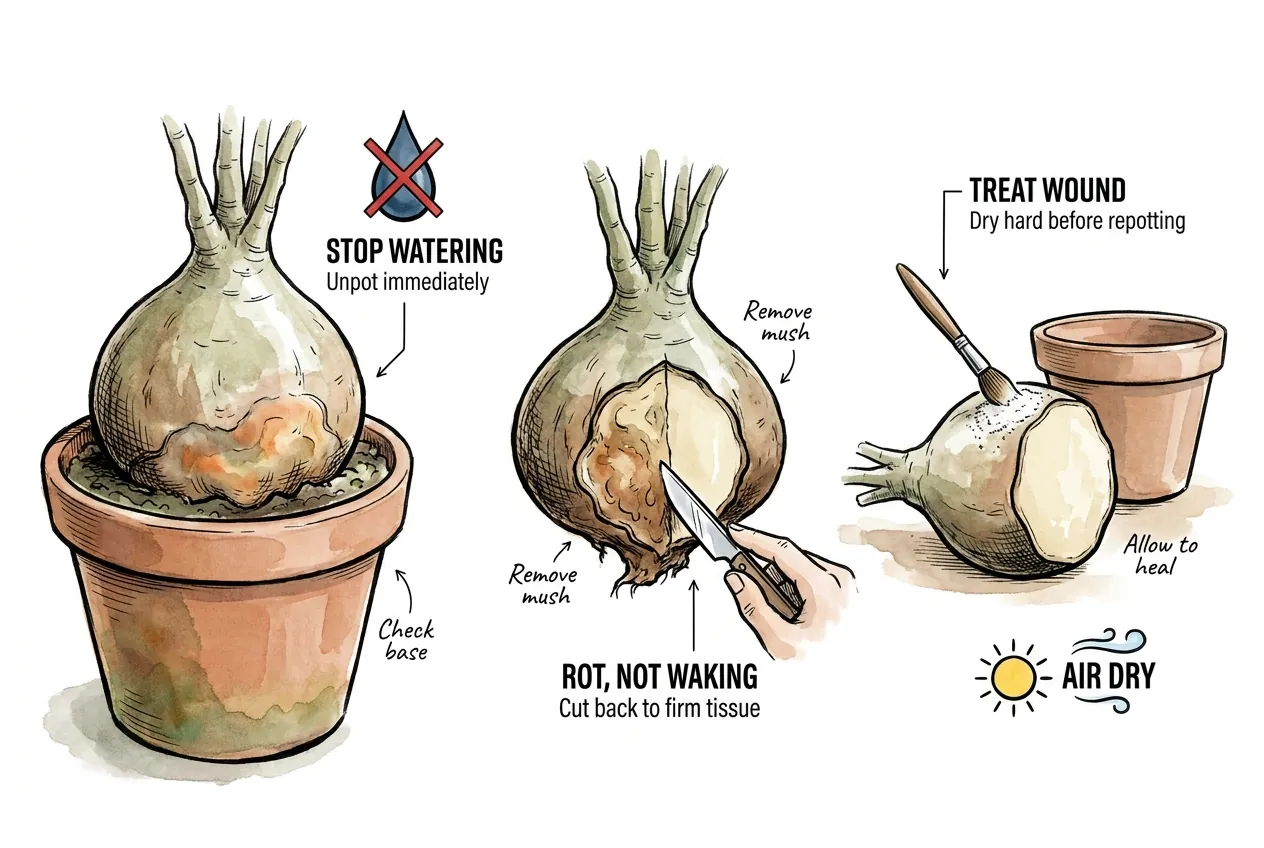
A soft, squishy, or discolored area at the base is rot, not waking. Stop watering at once and unpot to inspect. If the soft tissue is shallow, cut back to firm clean tissue, treat the wound, and dry hard before any further water.
Restart Notes by Genus
Each genus gives its wake signal a little differently, so locate your plant here before applying the general rule.
The three-signal test still governs, but the growth point looks different across the group.
Dioscorea and Testudinaria
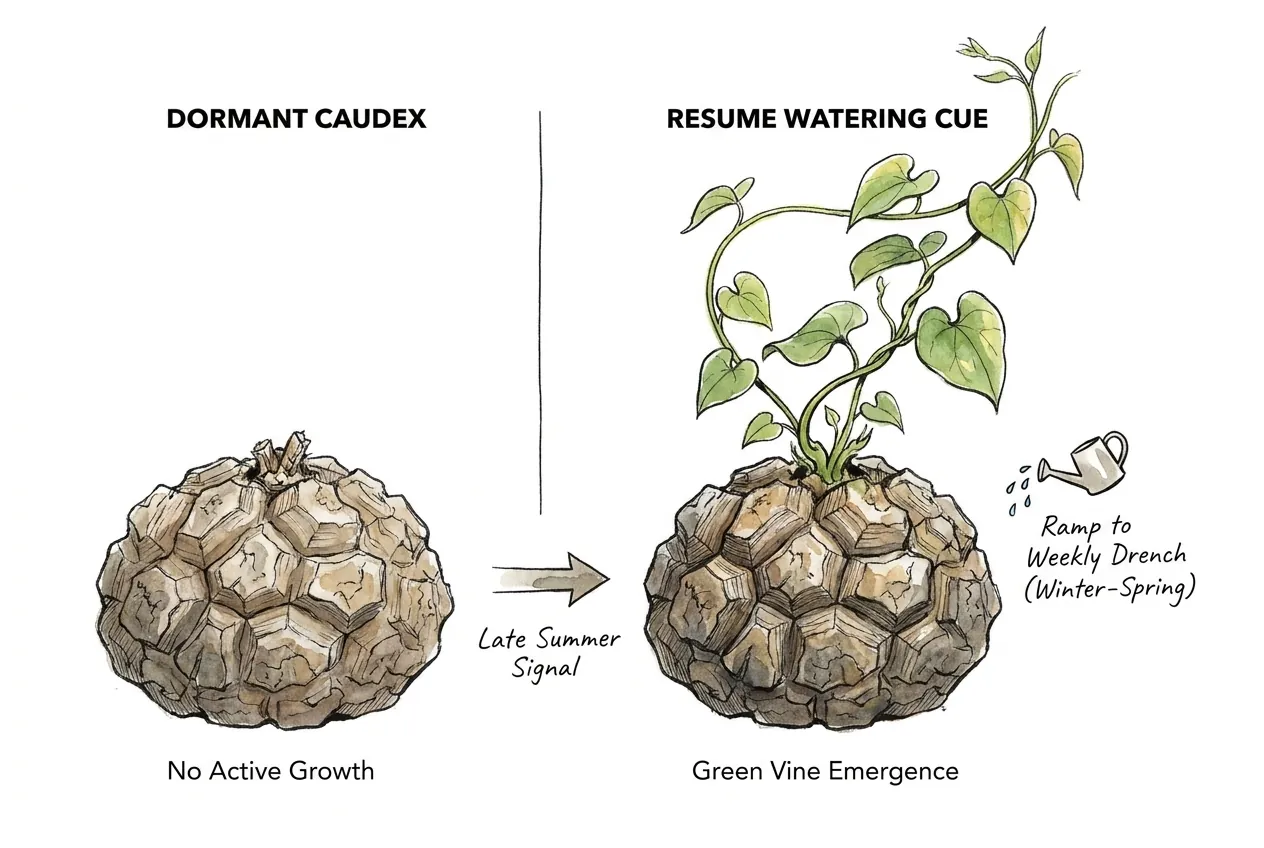
This is the clearest signal of the group. A green vine pushes from the top of the caudex in late summer, and that is the resume cue.
Once it is growing, ramp toward a full drench about weekly through winter and spring.
Fockea
Fockea is deciduous to semi-deciduous and lives on the caudex through its rest. Autumn returns it to active growth, so water when the top inch of mix is dry once growth resumes.
Keep winter minimums above roughly 41 to 45F, or 5 to 7C.
Tylecodon
Tylecodon runs active through autumn and winter, producing leaves in the cool months. Water moderately during growth and let the substrate dry between waterings. Withdraw water in spring as it heads back to rest, and hold a winter minimum near 5 to 8C.
Othonna
Othonna is a strict winter grower from early fall through late spring. Around cooling October nights it may start growing on its own, and a good soaking then helps it leaf out.
Stop water and move it cooler and shadier for its summer rest.
Winter-Growing Pelargonium
These follow a Mediterranean cycle of cool wet winters and hot dry summers. Small, firm new leaf buds are the cue to slowly reintroduce moisture. Keep them on the dry side through the coldest weeks, near a cool 45 to 50F space.
Cyphostemma (Confirm Your Species First)
This group is mixed, and the popular Cyphostemma juttae actually leafs in summer and rests in winter.
That makes it a summer grower, so this late-summer restart does not apply to it. Identify your exact species before choosing a watering rule.