
Fockea and Dioscorea Winter Watering Without the Rot
Fockea and Dioscorea run on opposite clocks and never fully sleep. Skip the bone-dry calendar rule and water by caudex firmness and shoot growth instead.
Rachel Torres · 2026-10-03 · 12 min read
Key Takeaways
- Dormancy is a slowdown, not an off switch. A resting caudex still respires and slowly spends reserves.
- Fockea grows in summer and rests in winter. Dioscorea often grows in winter, so one dry rule fails one of them.
- Dioscorea is opportunistic and clone-variable. Water by the shoot in front of you, never by the calendar.
- Cold plus wet soil is the rot trap, because low transpiration leaves water parked in the Pythium danger band.
- Read firmness, pot weight, and shoot growth. Water only when the caudex softens and the pot hits its dry weight.
The usual winter advice for caudex plants is one word. Dry. That single rule quietly kills one of these two plants and starves the other.
Fockea and Dioscorea sit on opposite clocks. Fockea edulis is a summer grower that slows down in winter. Dioscorea elephantipes is, more often than not, a winter grower that rests in summer heat.
Hand them the same bone-dry winter cutoff and you are right for one and badly wrong for the other.
The deeper problem is the word dormant. Neither plant fully stops. The error is treating a slowdown as an off switch, and treating the calendar as if it knew what your specific tuber is doing.
Key Takeaways
- Dormancy is a slowdown, not an off switch. A resting caudex still respires and slowly spends reserves.
- Fockea grows in summer and rests in winter. Dioscorea often grows in winter, so one dry rule fails one of them.
- Dioscorea is opportunistic and clone-variable. Water by the shoot in front of you, never by the calendar.
- Cold plus wet soil is the rot trap, because low transpiration leaves water parked in the Pythium danger band.
- Read firmness, pot weight, and shoot growth. Water only when the caudex softens and the pot hits its dry weight.
Dormant means slowed, not switched off
A resting caudex is still alive and still working. Metabolic activity does not stop entirely, it just slows dramatically. Respiration continues at a reduced rate and the plant keeps up basic cellular maintenance while it draws slowly on stored reserves.
Those reserves live in the parenchyma cells of the caudex, loaded during the growing season. Through the rest period the tuber spends them a little at a time. That is why a dormant caudex becomes slightly less turgid over winter, and why minor surface wrinkling is normal rather than alarming.
Two signals drive the slowdown. Night temperatures that stay low and days that get shorter both tell the plant to conserve.
Note what this means for watering. A tuber that is still respiring and slowly losing water is not an inert lump you can forget until spring.
Fockea makes the point bluntly. One botanical reference says it never goes into complete dormancy and always carries some leaves, showing only decreased activity from January to April.
The plant does not sleep. It idles.
Fockea edulis is a summer grower that idles in winter
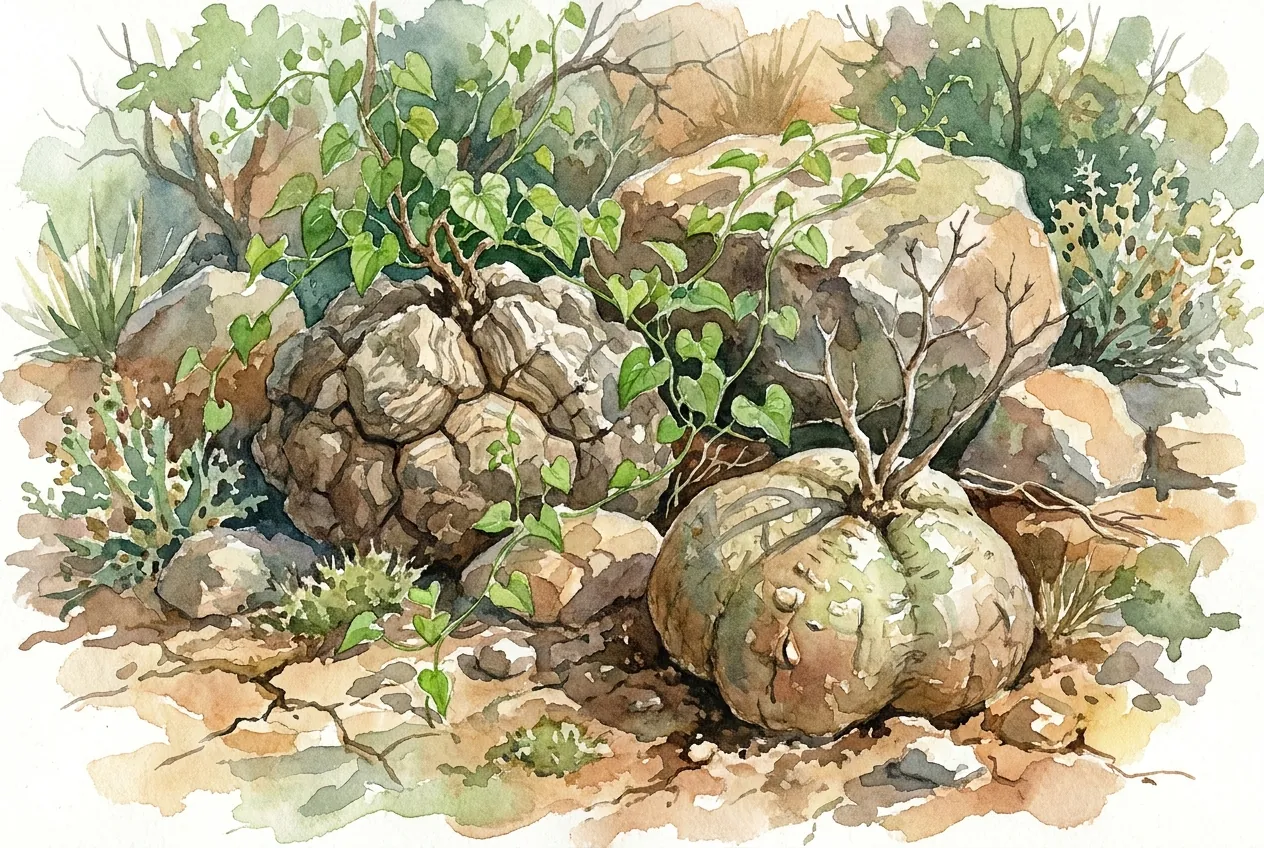
Fockea edulis comes from dry savanna and rocky slopes in the Cape Provinces and KwaZulu-Natal. The caudex is a buried water reservoir that reaches up to 60 cm across in habitat.
It is built to ride out drought, not to drink in the cold.
In cultivation it grows through spring and summer and slows as things turn cool and dry.
Growers usually call it semi-deciduous because it sheds some or most leaves when kept cold and dry.
Through the slow period you water significantly less or not at all, giving only enough to keep the caudex from shriveling.
Keep two numbers in mind. Protect it below about 7 C and ideally hold it above 10 C. It tolerates only occasional light frost to around minus 2 C, so a cold wet windowsill is a real hazard.
The failure mode is specific. Overwatering is the frequent problem, and it causes caudex rot, worst during the cool resting period.
A soft squishy caudex is the overwatering signal. Shriveling tells you the tuber has run low, while softness tells you it is rotting, and the two call for opposite responses.
Dioscorea elephantipes grows when it wants, often in winter
Dioscorea elephantipes is the mirror image, and it is stubborn about it. In habitat it is primarily a winter grower, pushing slender climbing vines and flowering in winter, then dropping its leaves and resting through the hot dry summer.
Its corky-plated caudex is a starch store that can grow enormous over decades.
Here is the catch that breaks every schedule. In cultivation the plant is opportunistic. One specialist reference says it grows from autumn to spring but sometimes ignores its proper seasons, keeping vines going into the rest period or starting early.
A long-time grower put it plainly. They have had plants grow in all seasons, some dormant for a couple of weeks and others for months.
Even several plants in the same pot can go dormant at different times. The plant will go dormant when it wants to.
That is why the standard advice collapses into one instruction. Pay attention to the plant and not the calendar. You cannot force this species onto a schedule, and overwatering a resting one will simply rot it.
Hold it above about 5 C in winter and keep the caudex shaded. In habitat it takes cold to around minus 4 C and heat above 40 C, but the pot on your shelf is not habitat.
The slow-growth error, named
Now the mistake is obvious. You read winter, you reach for the dry rule, and you apply it to both pots.
For the Fockea you are usually right. For a Dioscorea that is actively pushing a vine you have just cut off water during its growing season.
A winter-growing Dioscorea denied water does not die outright. It stalls. The vine stays thin and pale, elongates weakly, and the caudex never thickens, because you starved the one season it meant to grow.
That stalled, leggy, caudex-that-never-fattens look is the slow-growth error made visible.
The opposite over-correction is just as bad. Spooked by a shriveling Fockea, you water it like it is July. A truly resting tuber in cold wet soil is the classic setup for caudex rot.
So the tell is never the month. It is whether a fresh shoot is actively elongating.
A plant growing a vine wants water. A plant with a yellowed or dropped vine and a firm caudex wants to be left dry.
Why cold plus wet is the actual trap
The reason winter water is dangerous is not magic. It is pathology plus physics. Cold, wet, poorly aerated soil is the precise condition the main root-rot organisms want.
Pythium and Phytophthora are most likely to cause root rot in cool to cold, wet, poorly aerated soils, and they need both free moisture and cool temperatures to get going.
Pythium is favored by cool wet poorly drained soil and by overwatering, and it attacks the young feeding roots first.
Soil held at or above about 70 percent of its water capacity is the conducive zone.
Fusarium rounds out the threat. It tends to cause root rot under cool conditions near 57 F, and Fusarium species have been recovered from cacti and other succulents showing dry rot and soft rot.
Now add the physics. A slowed or leafless plant transpires very little, so it barely pulls water from the pot. Cold roots take up water slowly too.
A normal drink that would vanish in a week of summer growth just sits cold and wet for far longer, parked in the moisture band those pathogens exploit.
The levers that change the math are drainage, pot size, warmth, and timing. A gritty fast-draining mix and a pot that is not oversized both drain faster. Keeping the plant above its minimum temperature and watering only when the root zone has truly dried pull the soil out of that danger band.
If you are rebuilding your mix for this, start with the caudex substrate comparison.
Read the plant, not the month
If the calendar is the wrong instrument, what do you use instead. Three cheap reads cover almost every decision. Firmness, pot weight, and shoot watch.
Firmness and pot weight tell a dormant plant from a rotting one
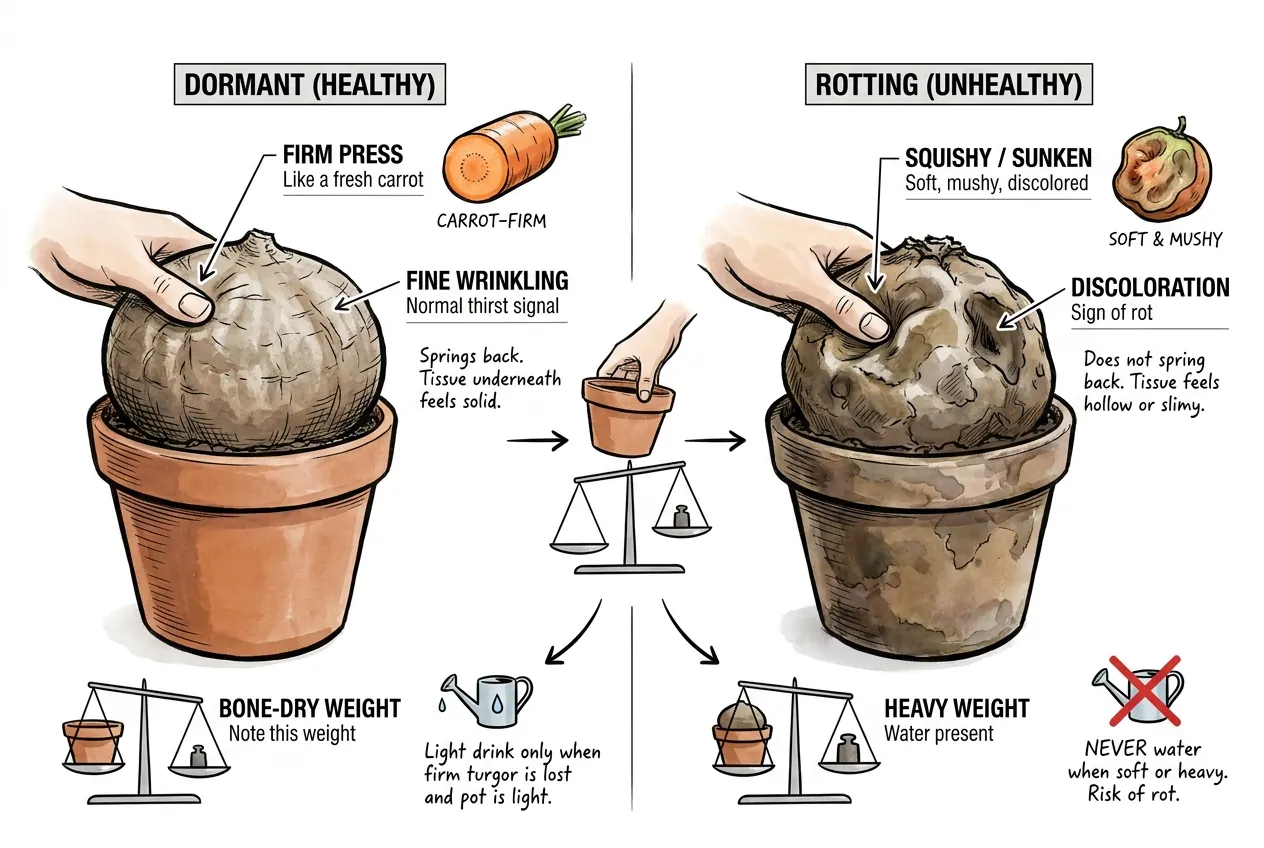
Start with the caudex. Press it gently and compare the feel to a fresh carrot. A healthy resting tuber is firm with a little give, not hollow, crispy, or mushy.
Light surface wrinkling in winter is normal and usually just means thirsty, and the tissue underneath should still feel firm.
The two soft signals point in opposite directions, so do not confuse them. Fine wrinkling that still springs back is thirst. A soft, squishy, sunken, or discolored caudex is rot, and the answer to rot is never more water.
Pot weight removes the last guesswork about the root zone. Here is the method I use on every dormant tuber. After a full dry-down I lift the pot and learn its bone-dry weight, then I note it.
Through winter I re-check firmness by light thumb pressure on the caudex shoulder every 10 to 14 days.
I give a light drink only when two things agree. The caudex has lost clear turgor, meaning soft give rather than carrot-firm or fine wrinkling that does not spring back, and the pot is back at its recorded dry weight.
A caudex that stays carrot-firm gets nothing. I press, I do not squeeze hard enough to bruise, and a sour-smelling or discolored caudex becomes a rot inspection rather than a watering trigger.
Why these two together. Firmness tells you the tuber has actually spent down its reserves and could use water. Pot weight confirms the soil is dry enough that a light drink will not sit cold and wet in the Pythium band.
Neither reading alone is enough, because a thirsty tuber in still-wet soil must wait and a dry pot with a firm tuber needs nothing.
Shoot watch tells a grower from a rester
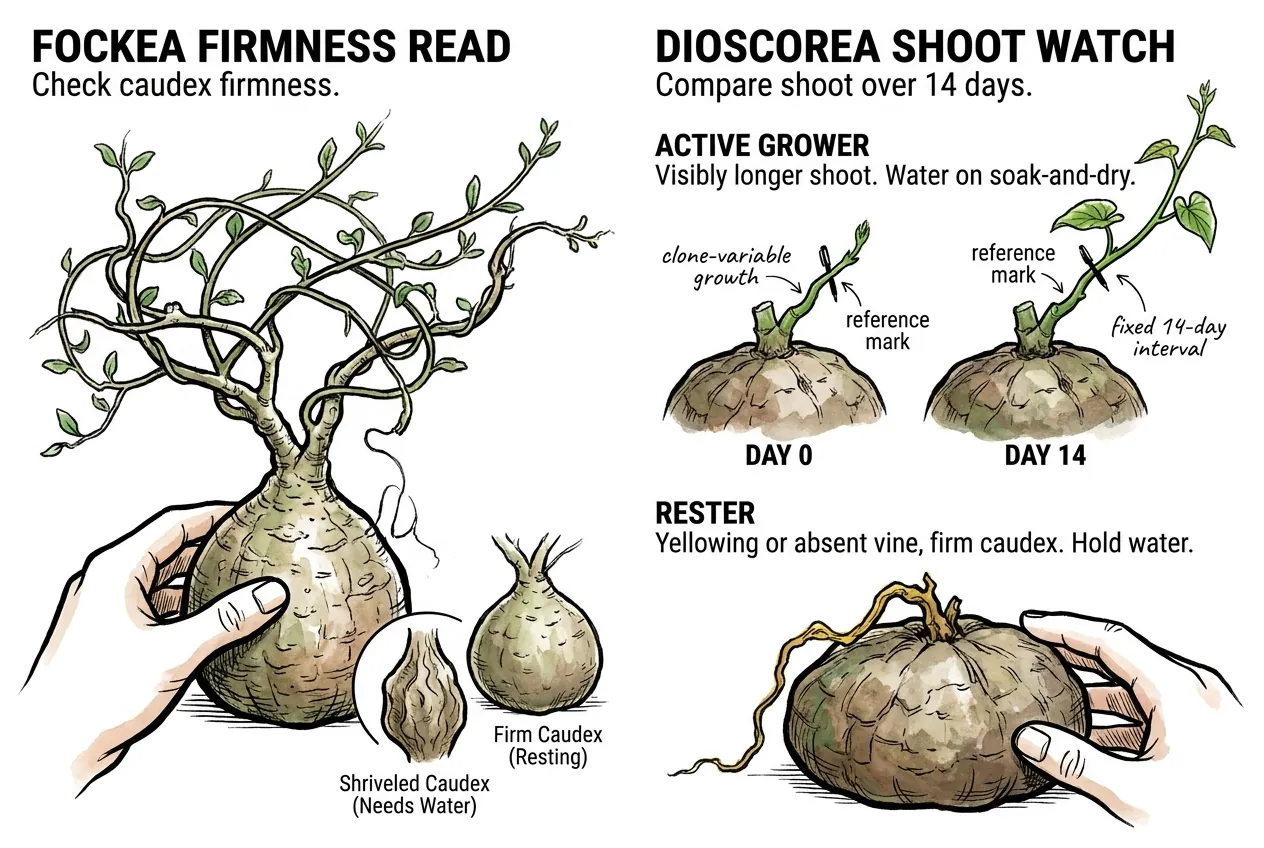
The firmness read keeps a Fockea alive. Shoot watch is what saves the Dioscorea from the slow-growth error.
The question is simple. Is this clone actually growing right now.
Mark or photograph the growing point on the caudex. On a fixed 14-day interval through the cool season, compare shoot length and leaf expansion against that reference.
The interval is long enough to show real change without hovering over the plant.
The decision rule follows directly. If a shoot is present and visibly longer across one 14-day interval, treat the plant as an active winter grower and water it on soak-and-dry. If the vine is yellowing or absent and the caudex is firm, hold water and let it rest.
This works precisely because growth timing in this species is clone-variable. Two plants from the same batch can run on different clocks, so the only honest trigger is the shoot in front of you, not the date.
Fine roots die, so a big soak is wasted anyway
There is a root-level reason a heavy winter watering backfires. In a true dry rest the fine feeding roots die back, while the thick storage roots and the caudex survive and regrow when water returns.
This matters twice. A deeply rested tuber with no working fine roots cannot absorb a large volume, so a big soak just sits around the caudex doing nothing but staying cold and wet.
And Pythium attacks the young feeding roots first, which are exactly the tissue that is weakest or missing during rest.
So the restart is a ramp, not a switch. The first waterings after a rest are deliberately small and spaced, enough to coax new fine roots into forming before the plant can drink normally again. Only once a shoot is active and the caudex firms up do you return to full soak-and-dry.
Two routines, one set of eyes
Put it together and you run two different programs off the same three observations. The plant tells you which program it is on.
For a Fockea through the cool season, hold water by default. Keep it above about 7 to 10 C in a gritty mix.
Check firmness and pot weight every 10 to 14 days, and give a light sip only when the caudex has lost turgor and the pot is at its dry weight. Soft, discolored, or sour means inspect for rot, not water.
For a Dioscorea, decide by shoot. If a vine is present and elongating over a 14-day interval, water soak-and-dry like it is the growing season it thinks it is.
If the vine has yellowed or dropped and the caudex is firm, cut water, keep it near 5 C and shaded, and wait for a new shoot.
When growth resumes for either plant, ramp up slowly. Start with small spaced waterings to rebuild fine roots, then move to full soak-and-dry once the shoot is active and the caudex plumps back.
If you want a reliable way to read soil moisture or pot weight rather than guessing, see the caudex watering tools setup.
The one-word winter rule was never wrong because dry is bad. It was wrong because it answered a question the plant had not asked. Watch the caudex and the shoot, and both plants will tell you exactly when to reach for the watering can.