
Cold Wet Soil Caudex Root Rot: Why Autumn Kills Roots
Cold wet soil rots caudex roots in autumn, not the watering amount. Learn the oxygen mechanism, how to measure it, and how to stop rot early.
Rachel Torres · 2026-09-25 · 13 min read

Key Takeaways
- Cold soil, not water volume, drives autumn caudex rot by keeping the root zone wet for days.
- Oxygen moves about 10,000 times slower in water, so saturated pores go anaerobic within hours.
- Measure root-zone temperature at mid-pot depth in the evening, the coldest and most telling reading.
- Weigh the pot to track dry-down, and treat a mix still wet past 4 days as a rot risk.
- Wilting with wet soil means drowning roots, so shorten the wet spell instead of adding water.
The dose that kept your caudex happy all summer can drown it in October. Nothing about the water changed. The soil did.
Cold soil changes what happens to water after it lands in the pot. Evaporation stalls, the roots stop drinking, and the mix stays wet for days instead of hours.
That long wet spell, not the volume you poured, is what starves roots of oxygen and starts the rot.
This is a decision guide for the autumn root zone. You will learn the mechanism, how to measure the two variables you cannot see, and how to change your watering before the rot begins.
Why the same watering is safe in summer and lethal in cold soil
The amount of water is the wrong thing to watch. What matters is how long that water stays in the root zone and whether oxygen can get back in.
In warm soil a normal dose is gone within a day. In cold soil that identical dose can sit around the roots for the better part of a week. Four physical changes stack up to make that happen.
The four changes that turn a safe dose lethal
Cold soil suppresses evaporation, uptake, and oxygen return all at once. Each one alone would lengthen the wet spell. Together they multiply it.
| Change | Warm soil (summer) | Cold soil (autumn) |
|---|---|---|
| Surface evaporation | Fast, pot dries in a day or two | Slow, moisture lingers for days |
| Root water uptake | High, roots pull water steadily | Low, cold roots drink far less |
| Saturation dwell time | Short, hours to a day | Long, several days |
| Oxygen return to pores | Quick once pores drain | Blocked while pores stay full |
Evaporation falls because cooler air holds less water vapor and there is less energy to drive it off.
Root uptake falls because cold roots move water more slowly. With both the exit routes throttled, the water just sits.
The last row is the killer. Oxygen diffuses through water about 10,000 times slower than through air. Once the pores are full of water, the oxygen roots and soil microbes consume is not replaced, and a saturated root zone can turn anaerobic within a few hours.
The danger is the length of the wet spell and the loss of oxygen, not the number of milliliters you poured.
What actually kills the roots when soil stays wet
The first damage is drowning, not infection. The pathogens come second, feeding on tissue the lack of oxygen already wounded.
How oxygen starvation kills root tissue
When pores stay water-filled, roots run out of the oxygen they need to respire. They switch from normal aerobic respiration to anaerobic fermentation, which produces lactate and other toxic compounds and builds up damaging reactive oxygen species.
Actively growing root tips begin to die within a few days of waterlogging. That is the primary injury. It happens even in sterile soil with no pathogen present, purely from the lack of oxygen.
Prolonged wet soil kills roots by suffocation before any pathogen gets involved.
The rot pathogens that move in next
Oxygen-starved roots are easy prey for water molds and fungi already living in the mix. These organisms do not start the problem, they exploit it.
Pythium and Phytophthora are oomycetes, water molds rather than true fungi. Their swimming spores are motile in water and move through water-filled pores to reach roots. Soil moisture at 70 percent or more of available water capacity favors Pythium infection.
Cold does not make the pot safe from infection. Some Pythium species are active only at low soil temperatures, so cooling the root zone can slow the plant more than it slows the pathogen.
Fusarium and the related genus Neocosmospora are also documented rotting cacti and other succulents.
You cannot fungicide your way out of a drowning pot. If the root zone keeps going anaerobic, tissue keeps dying and re-infecting.
Measure the root-zone temperature, not the room
Room temperature lies to you about the roots. The number that governs uptake and oxygen demand is the temperature deep in the pot, and it lags the air.
Why the pot core stays colder than the room
Root hydraulic conductivity, the ease with which roots move water, declines as root temperature falls across roughly 10 to 35 degrees C. Below a critical point it drops steeply.
Low root temperature also lowers whole-plant water transport and leaf water potential.
Soil changes temperature slowly, and the dense center of a root ball trails the surrounding air.
A pot on a windowsill sits in a cold trough for hours in the evening and overnight. That trough is colder than the daytime room reading suggests.
Read the temperature at root depth in the coldest part of the day, because that is when uptake bottoms out.
How I read the root-zone temperature
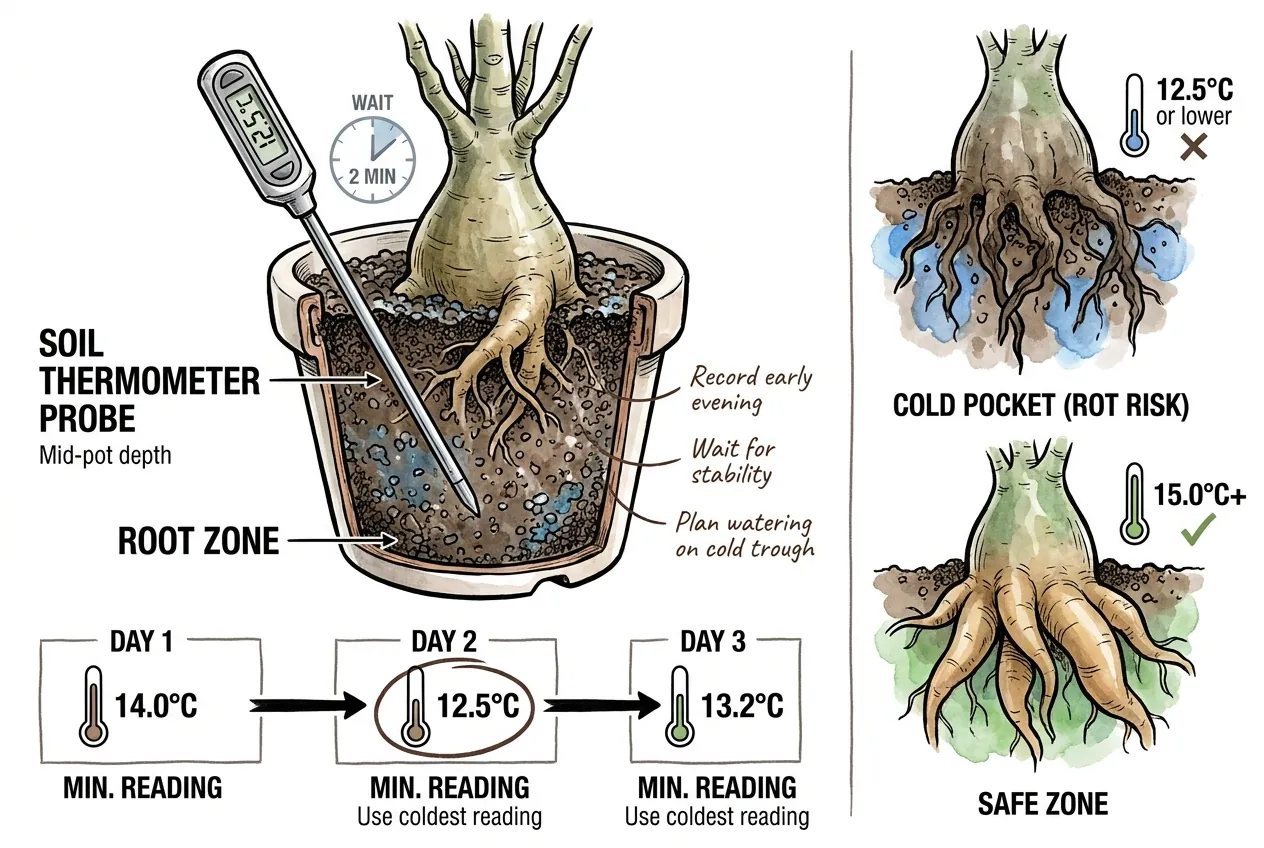
I take the number that governs the roots, not the one on the wall. I push a probe thermometer to mid-pot depth right next to the root ball and let the reading settle for about 2 minutes before I trust it.
I record that reading in the early evening for 3 consecutive days. Then I plan around the coldest of the three, not the daytime peak, because the roots sit in that cold trough for hours.
This is my working rule to avoid watering into a cold pocket, not a published cutoff.
If you want to pick a probe or soil thermometer, the tool decision lives in the soil-temperature tool guide and the watering-tools measurement setup.
Measure how long the mix stays wet
Saturation dwell time is how many hours or days the root zone stays wet after a watering.
It predicts rot better than watering frequency, because the damage depends on how long the pores stay full, not on the calendar.
Why days-since-watering is the wrong number
Most growers track days since the last watering. That misses the variable that actually drives rot. Two pots watered on the same day can hold water for very different lengths of time depending on mix, pot, and temperature.
The honest way to know your dwell time is to weigh the pot. Weight tells you directly how much water is still in the mix, with no guessing.
How I measure dwell time with a scale
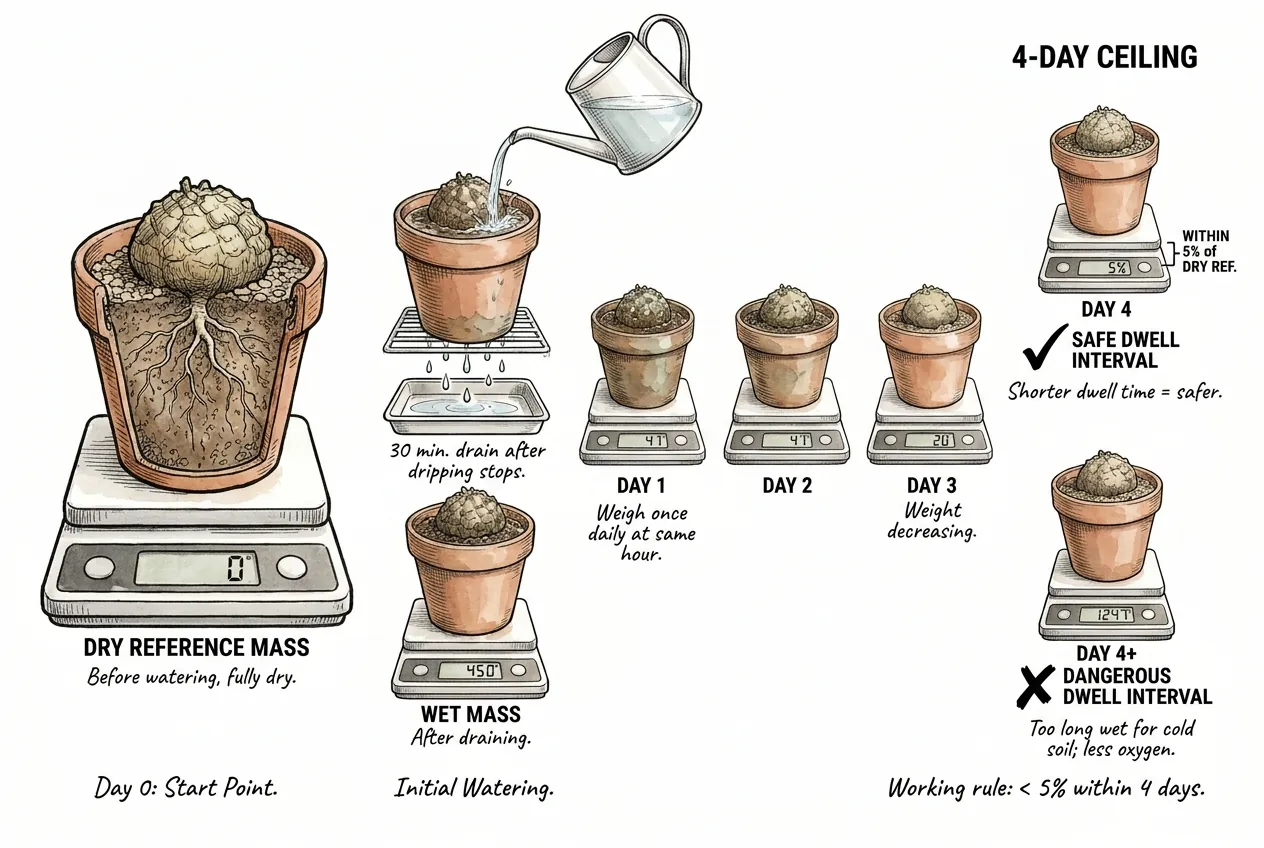
I weigh the pot on a kitchen scale before watering to get the fully dry reference mass in grams.
I water, let it drain for 30 minutes after dripping stops, then weigh again for the wet mass.
After that I weigh once a day at the same hour. I count the days until the pot returns to within 5 percent of that dry reference mass. That day count is the dwell interval.
My working rule is simple. If the pot has not returned to within 5 percent of the dry reference within 4 days, the mix is holding water too long for cold soil. The next watering waits, or the mix has to drain faster.
The 5 percent tolerance and the 4-day ceiling are my conservative values to remove guesswork, not published standards.
Shorter dwell time is safer, because less time saturated means less time without oxygen.
This pot-weight method is the same one behind the weigh-before-watering dry-down guidance. If your mix stays wet too long, the fix is a faster-draining mix, covered in the substrate comparison.
Catch rot early and tell it apart from dormancy
Autumn softening can be dormancy or it can be rot, and the two demand opposite responses.
Read the signals before you reach for the watering can or the knife.
What healthy and rotting tissue look like
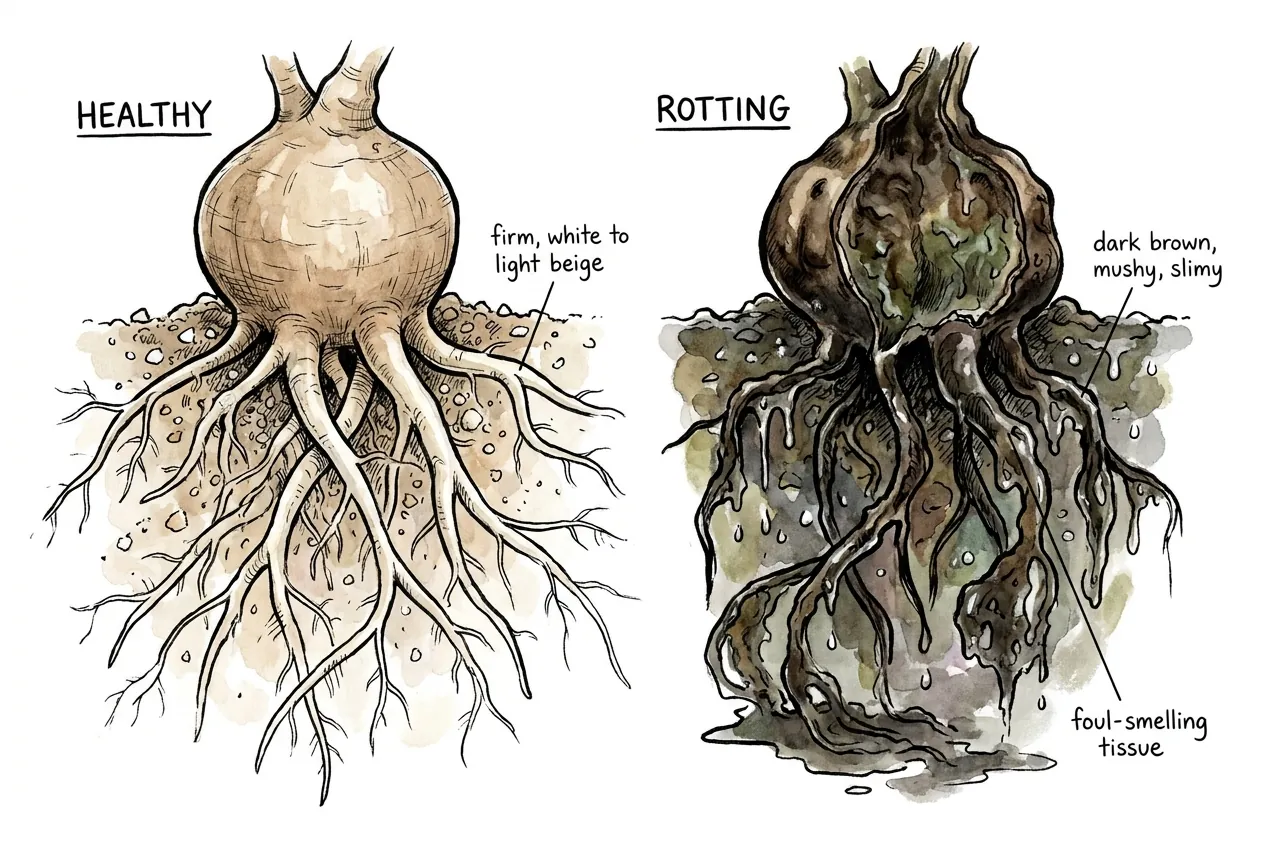
Healthy roots are firm and white to light beige or light brown. Rotting roots turn dark brown to black, soft, mushy, and often slimy. Firm white roots collapse into dark slime as the rot advances.
On the caudex itself, black, mushy, or foul-smelling tissue points to rot. A foul smell is one of the strongest signals you can get.
The signs that fool people
Wilting and yellowing leaves look like thirst but often mean the opposite. When roots can no longer take up water, the plant wilts while the soil is still wet. Watering then pours fuel on the fire.
Persistently wet soil days after watering is itself a warning. It tells you the roots have stopped drinking.
Dormancy looks different. The plant slows and may soften slightly at the leaves, but the base stays firm and the mix still dries on a reasonable schedule.
Wilting with soil that stays wet is a drowning signal, not a thirst signal, so do not add water.
When to unpot and look
Unpot when the base is losing firmness, when the mix will not dry, or when you catch any off smell.
Those three signs justify pulling the plant to inspect the roots directly.
If the plant is merely slowing with firm tissue and a normal dry-down, inspection is premature and the disturbance is not worth it.
For a deeper firmness map of how soft is too soft, see the soft-caudex firmness map.
Prevent cold-soil rot by shortening the wet spell
The fix is not simply pouring less water. If dwell time stays long, a small dose still sits anaerobic around the roots for days.
The goal is to shorten the time the root zone stays saturated. You do that by adjusting the mix, the warmth, and the timing together, guided by the two numbers you now measure.
Levers that shorten dwell time
A grittier, more open mix holds less water at field capacity and drains and re-aerates faster.
That single change can cut the wet spell from days to hours. The mix choices are compared in the substrate comparison guide.
A smaller water charge helps only when the mix drains fast, so the small amount clears quickly instead of lingering.
Warming the root zone raises both uptake and evaporation, which shortens dwell and lifts the plant off the uptake floor.
Moving the pot off a cold windowsill and improving airflow does the same.
When to warm and when to withhold
Warming is the right move when the plant is still growing and the mix simply dries too slowly because the roots are cold. Warming the root zone speeds drying and restores uptake. The warmth setup is covered in the caudex overwintering setup.
Withholding is the right move when the plant is entering dormancy and asking for almost no water.
Then you stretch the interval and let the mix run dry. Measured temperature and dwell time tell you which situation you are in.
Manage the length of the wet spell, not just the volume, and cold-soil rot loses its opening.
For the companion decision of where your soil-temperature break point for watering sits, see the soil-temperature autumn watering guide.
What to do if rot has already started
Once rot is confirmed, the order of steps matters and the first one is to stop watering. More water extends the anaerobic pocket and feeds the swimming spores.
The triage sequence
Move quickly but deliberately through these steps.
| Step | Action | Why it matters |
|---|---|---|
| 1 | Stop watering immediately | Halts the anaerobic spread and starves swimming spores |
| 2 | Unpot and shake off the wet mix | Lets you see the roots and removes the wet environment |
| 3 | Assess extent, firm versus mushy | Firm pale tissue is alive, dark mushy tissue is dead |
| 4 | Cut back to firm clean tissue | Any rot left behind can keep spreading |
| 5 | Let the cuts and roots air-dry | Removes the wet, low-oxygen conditions rot needs |
| 6 | Repot into fresh open mix, water sparingly | Restores drainage and oxygen, lets the surface dry fully |
Reading your odds
Survival depends on how far the rot reached. If damage is limited to fine roots and part of the root system, cutting the dead tissue, drying, and repotting into an open mix often saves the plant.
If rot has climbed into the caudex or crown and most tissue is soft, the odds fall sharply. At that point you are salvaging whatever firm tissue remains.
A fungicide drench is a further step, not the first one. For shallow, freshly caught rot, drying and repotting into fresh open mix is often enough. Whether to drench and which product to use is covered in the caudex root rot fungicide chooser.
Autumn habits that quietly raise your rot risk
A few common routines make cold-soil rot worse by lengthening dwell or cooling the roots. Recognizing them is half the fix.
Watering by the calendar
A summer rhythm carried into autumn ignores the crash in evaporation and uptake. The interval that emptied the pot in August leaves it saturated for days in October. Let the measured dry-down set the schedule, not the date.
Treating a wilting caudex as thirsty
A drowning plant looks thirsty because it cannot drink. Adding water because the leaves droop, while the soil is still wet, accelerates the rot. Check whether the soil is actually dry before you respond to a wilt.
Bottom-watering and misting into cold soil
Bottom-watering into a cold, slow mix pulls water up and keeps it there, lengthening dwell. Frequent misting keeps surfaces and the root zone damp without the plant using the water. Both raise saturation time in exactly the season you want it short.
In cold soil, judge every watering habit by whether it shortens or lengthens the wet spell.
Key Takeaways
- Cold soil, not water volume, drives autumn caudex rot by keeping the root zone wet for days.
- Oxygen diffuses about 10,000 times slower in water, so saturated pores go anaerobic within hours.
- Measure root-zone temperature at mid-pot depth in the evening, the coldest and most telling reading.
- Weigh the pot to track dry-down, and treat a mix that stays wet past 4 days as a rot risk.
- Wilting with wet soil means drowning roots, so shorten the wet spell instead of adding water.