
Soft Caudex: Rot or Dormancy? Read It Before You Cut
Tell caudex rot from dormancy softness with a zone-by-zone firmness map, so you know when to cut, when to wait, and when to dry the plant out.
Derek Kim · 2026-08-20 · 17 min read
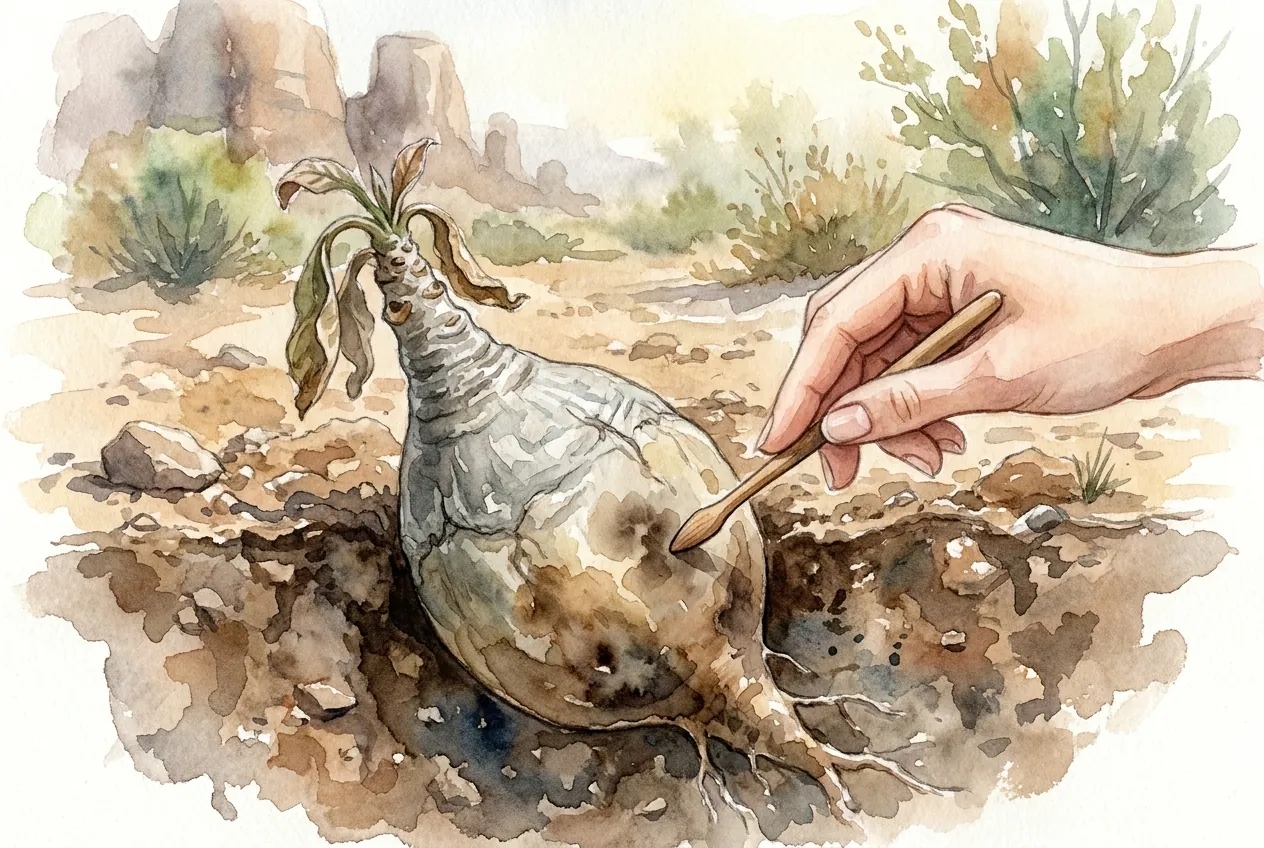
Key Takeaways
- A soft caudex is either reversible water loss or active rot, and cutting the wrong one kills the plant.
- Map firmness by zone, since softness increasing downward toward the roots is the fingerprint of basal rot.
- A foul smell with a wet mushy base and slipping skin is bacterial rot until proven otherwise.
- Cut only to a clean firm margin past the visible brown, then dry the wound before water returns.
- Whole-plant dry wrinkling with no odor in dormancy needs a dry rest, not a blade.
A soft caudex sends most growers straight for a knife. That reflex kills more plants than the rot they fear. A yielding caudex can mean active rot that must be removed, or it can mean ordinary water loss that only needs patience.
This is a hands-on way to tell the two apart before any blade touches the plant.
You map firmness zone by zone, read four softness signatures, run a few quick tests, and land on one of three actions.
What a soft caudex actually means
A caudex goes soft for one of two reasons, and they demand opposite responses. One is reversible water loss in living tissue. The other is tissue being killed and broken down by pathogens.
Getting this split right is the whole job. Cut a plant that is only dehydrated and you wound a healthy water organ. Wait on true bacterial soft rot and it can race through the base in days.
Turgor loss looks soft but stays alive
Turgor loss is reversible softness in cells that are still alive. Turgor pressure is the internal water pressure that pushes each cell against its wall and keeps tissue rigid.
When water leaves faster than roots replace it, that pressure drops and the tissue softens.
The caudex is a water-storage organ built for exactly this. During drought or dormancy the plant deliberately draws down its stored water. Mild softening and fine wrinkling in that state is a survival response, not a disease.
Turgor-loss tissue reads a specific way under the thumb. It is soft but cool, dry at the surface, and uniform without a wet mushy core. A dehydrated caudex firms back up after correct watering, so softness alone is never proof of rot.
Rot is tissue being eaten alive
Rot is active breakdown of tissue by microbes, and it does not reverse. Three culprits matter for caudex plants, and they feel different from each other.
Bacterial soft rot from Pectobacterium and Dickeya dissolves the glue between cells with enzymes. It turns tissue into wet, slimy, foul-smelling mush fast. This is the plant that looked fine last week and collapses this week.
Fungal rot from Fusarium and Neocosmospora tends to be firmer and drier, brown or black, often starting at the roots and base.
Water molds like Phytophthora and Pythium cause dark, water-soaked collapse in cold, wet, poorly drained soil. Discolored, wet, or foul-smelling tissue with skin that slips off the surface is rot until you prove otherwise.
Map the caudex firmness zone by zone
Read firmness zone by zone rather than with one squeeze. Rot rarely starts everywhere at once. It begins where water sits, where a wound opened, or where cold killed tissue.
Mapping tells you where the softness is, and location is the strongest clue to cause. A single random press can miss a soft basal pocket or misread a normally soft apex.
The zones worth reading
Divide the caudex top to bottom into bands you can feel. The apex is the growth point at the top, which softens normally in dormancy and is also where cold damage shows first.
The upper body is the widest storage tissue and usually your firmest, most stable reference.
Below that sit the mid-body, the basal flare where the caudex widens, and the soil line.
The soil line is the single highest-risk band because trapped moisture and poor airflow collect there.
Just under it are the upper roots, which you check next whenever the base feels soft.
How to press without bruising the plant
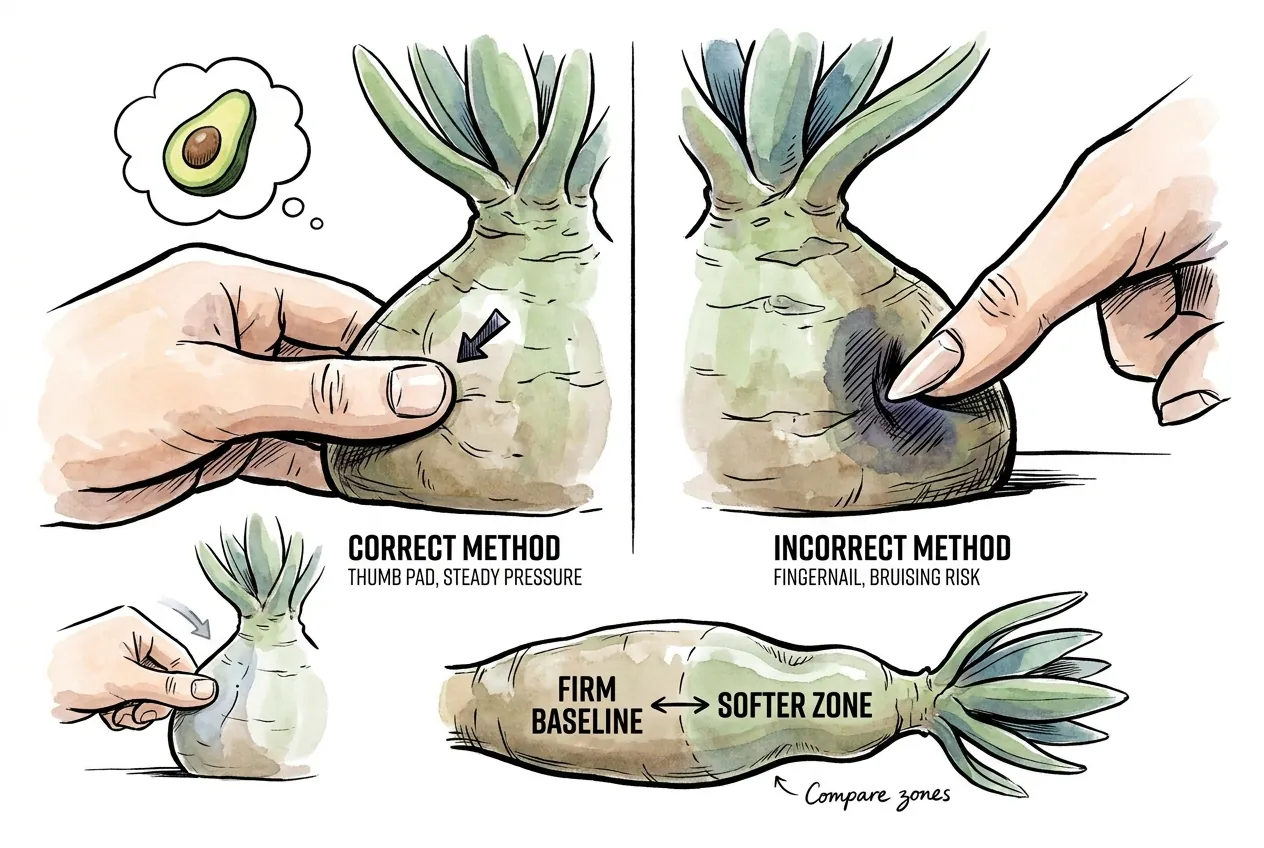
Use the pad of the thumb, never a nail. Press with steady moderate pressure, about what you would use to test a ripe avocado, then release and watch the rebound.
Roll the thumb across the surface to feel for a soft pocket hiding under intact skin.
Always compare zones on the same plant, because firmness is relative. Your upper body is the baseline, and a base that reads markedly softer than that baseline is the warning sign.
Rotate the plant and check all sides, since early rot is often one-sided.
A vague soft area only becomes trackable when I mark the pot rim and treat that point as twelve o'clock. I record the apex, upper body, mid-body, basal flare, and soil line at twelve, three, six, and nine o'clock without writing on the plant. A note such as soft at the basal flare near three o'clock gives me a location I can actually find again.
I photograph each marked side before touching the caudex and keep the camera distance and light as consistent as I can. This stops a shadow on one day or a different face of the plant from looking like a spreading lesion.
The same suspect spot is never squeezed repeatedly. If color, odor, fluid, and shape remain stable, I make one gentle map and schedule one comparison 24 hours later. A full day-night interval gives me a fixed comparison without repeated pressing, while any worsening sign sends me to immediate inspection.
Reading the firmness gradient
The direction of softening tells you a lot. A healthy plant softens upward if anything, because the apex draws down its water first in drought. Firm base, slightly yielding top, is a reassuring pattern.
The dangerous pattern is the reverse. A firm top over a soft or mushy base and soil line points to rot climbing up from wet soil. Softness that increases downward toward the roots is the classic fingerprint of basal rot.
The whole routine takes about a minute. Steady the pot, press the upper body baseline, then the apex, then work down through mid-body, basal flare, and soil line while rotating the plant.
Note any zone that reads softer than baseline, wet, discolored, or smelly.
Four softness signatures and what each one means
Most soft caudices fall into four patterns, and each points to a cause. Match what you feel, see, and smell against these before deciding anything. The table below is the quick reference, and the sections after it explain each signature.
| Signature | Where and how it feels | Color and smell | Likely cause |
|---|---|---|---|
| Dehydration or dormancy | Uniform soft, fine wrinkles, softest at top, dry surface | Normal color, no odor | Benign water drawdown |
| Cold or edema | Puffy or limp, sometimes after a cold night, firm core | Translucent or bruised patches, little odor | Cold injury or overwatering |
| Surface rot, firm core | Soft patch in one spot, firm tissue around and under it | Discrete brown or black lesion, musty | Fungal or early rot at a wound |
| Deep basal rot | Mushy, collapsing, hollow at base, no rebound | Dark, spreading, sour or foul | Advanced bacterial or root rot |
Dehydration and dormancy softness
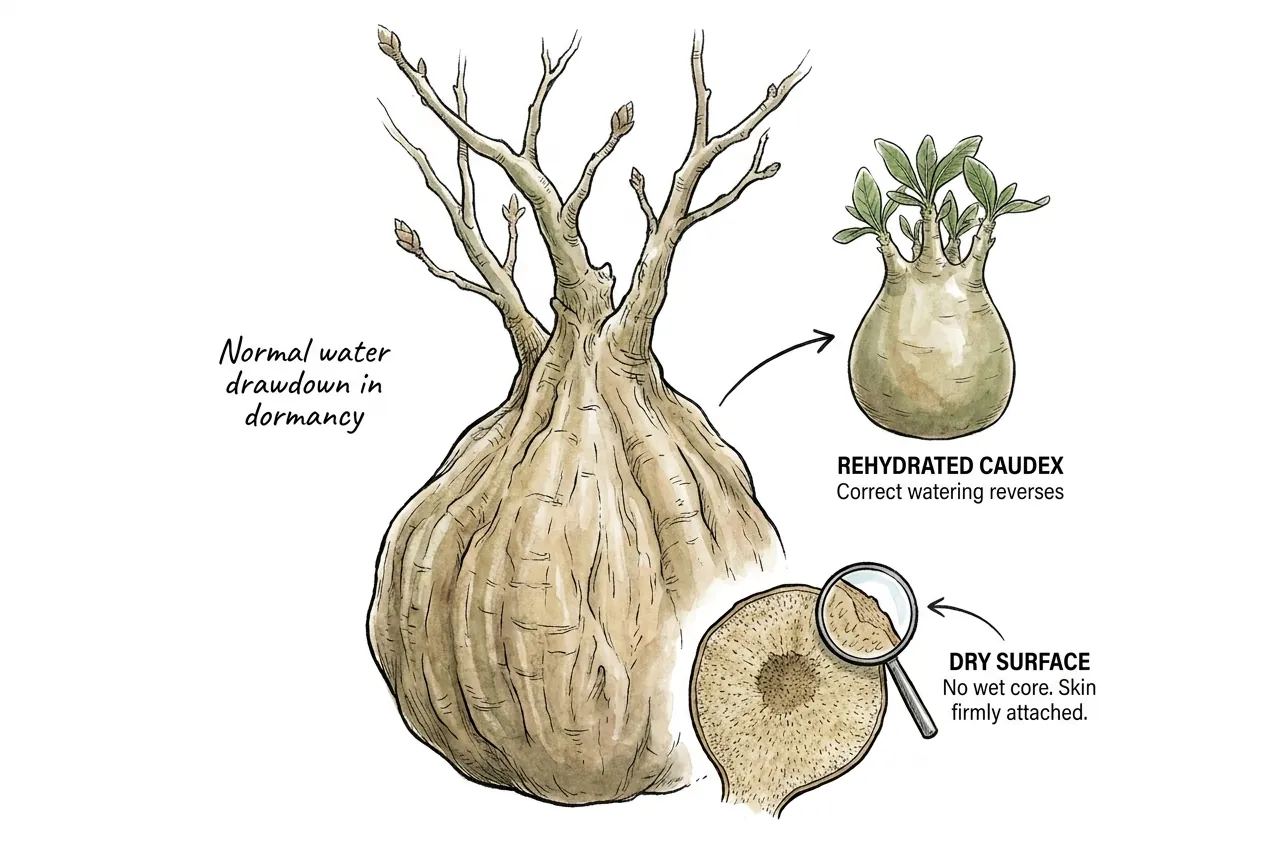
This is the benign one, and it is the most often misread. The tissue is uniformly soft or spongy with fine longitudinal wrinkles in the skin. Color stays normal, the surface is dry, and there is no smell.
Press it and there is no wet core, and the skin stays firmly attached. The cause is normal drawdown of stored water in drought or dormancy. Correct watering, in season, reverses it.
Cold and edema softness
This is a warning state that tips into rot if you ignore it. The tissue feels puffy and waterlogged or limp and chilled rather than wrinkled. You may see translucent or bruised patches, often after a cold night or heavy watering.
The core is usually still firm underneath at this stage. Cold damages cell membranes and overwatering makes cells take up more water than they can hold. Fix the conditions now, before this becomes deep rot.
Surface rot over a firm core
This is the best case among the rots because it is catchable. You feel a soft or sunken spot in one place, with firm tissue right around and beneath it.
There is usually a discrete brown or black lesion, often at a wound, graft union, or splash point.
The core just below stays firm, which means the rot has not reached the vascular center. A firm core under a localized lesion is the sign that a clean cut can still remove the whole problem.
Deep basal or interior rot
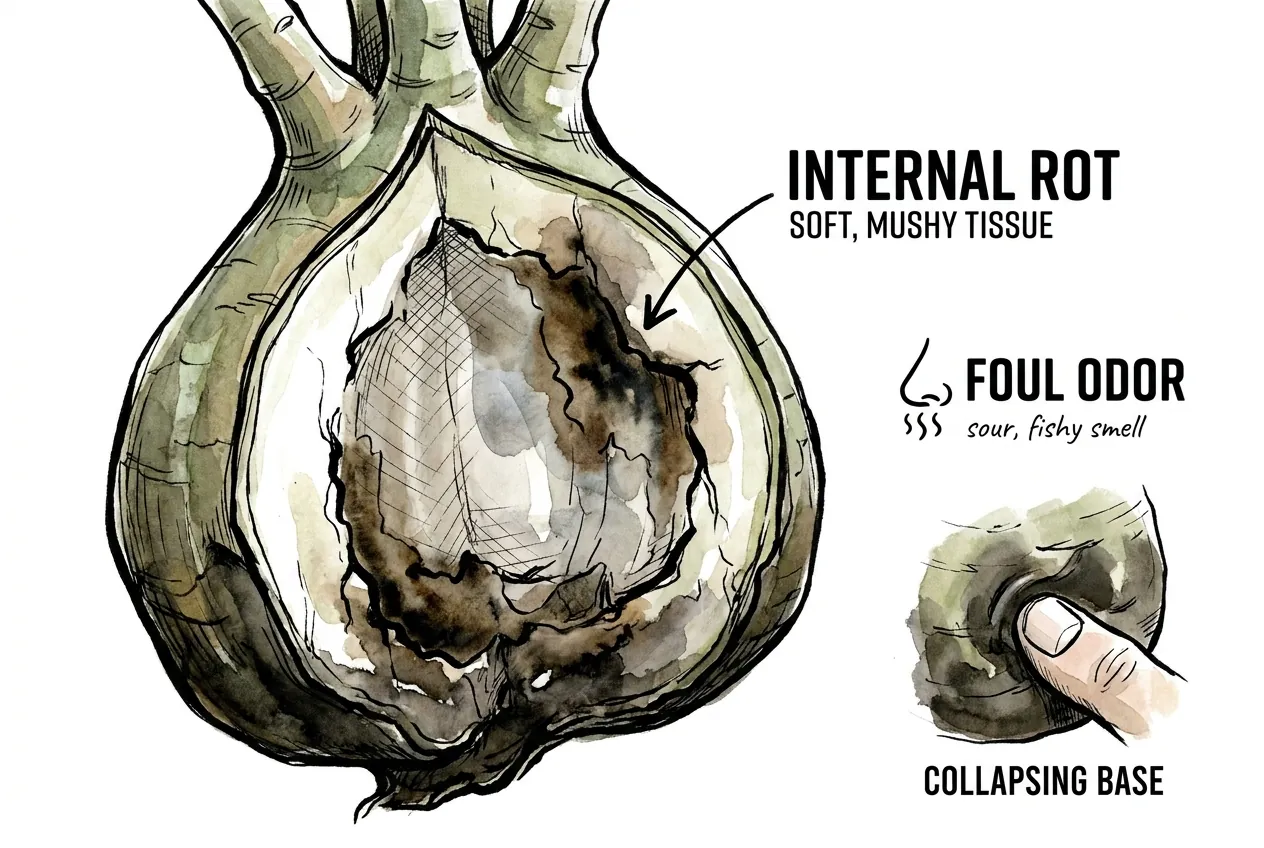
This is the emergency. The base and soil line feel mushy, collapsing, or hollow, and the thumb sinks in without rebound.
The tissue is dark brown, black, or translucent, often spreading upward with a discolored margin.
The smell is sour, foul, or fishy, and the skin slips off the tissue beneath. A strong odor with a wet mushy base means bacterial soft rot until proven otherwise. This is the reading that justifies immediate action.
Confirm the diagnosis before the blade
Run a few checks before cutting, ordered from least to most invasive. Firmness mapping narrows the cause, and these tests raise or lower your confidence. Do the gentle ones first, and only nick the plant when you still cannot decide.
Checks that do no damage
The smell test is the strongest single clue. Bring your nose close to the soft zone and the soil line. A sour, rotten, or fishy odor points hard at bacterial soft rot, while turgor loss and dormancy have no smell at all.
The skin-slip test comes next. Push or roll the skin gently over the soft zone with a thumb. Healthy or merely dehydrated skin stays attached, while rot loosens the surface so it slides or peels.
Then read color and rebound. Look for dark, translucent, or water-soaked patches and whether they have a spreading margin. A gentle press that dents and slowly weeps dark fluid is rotted, while firm rebound is living tissue.
The nick test when you still cannot tell
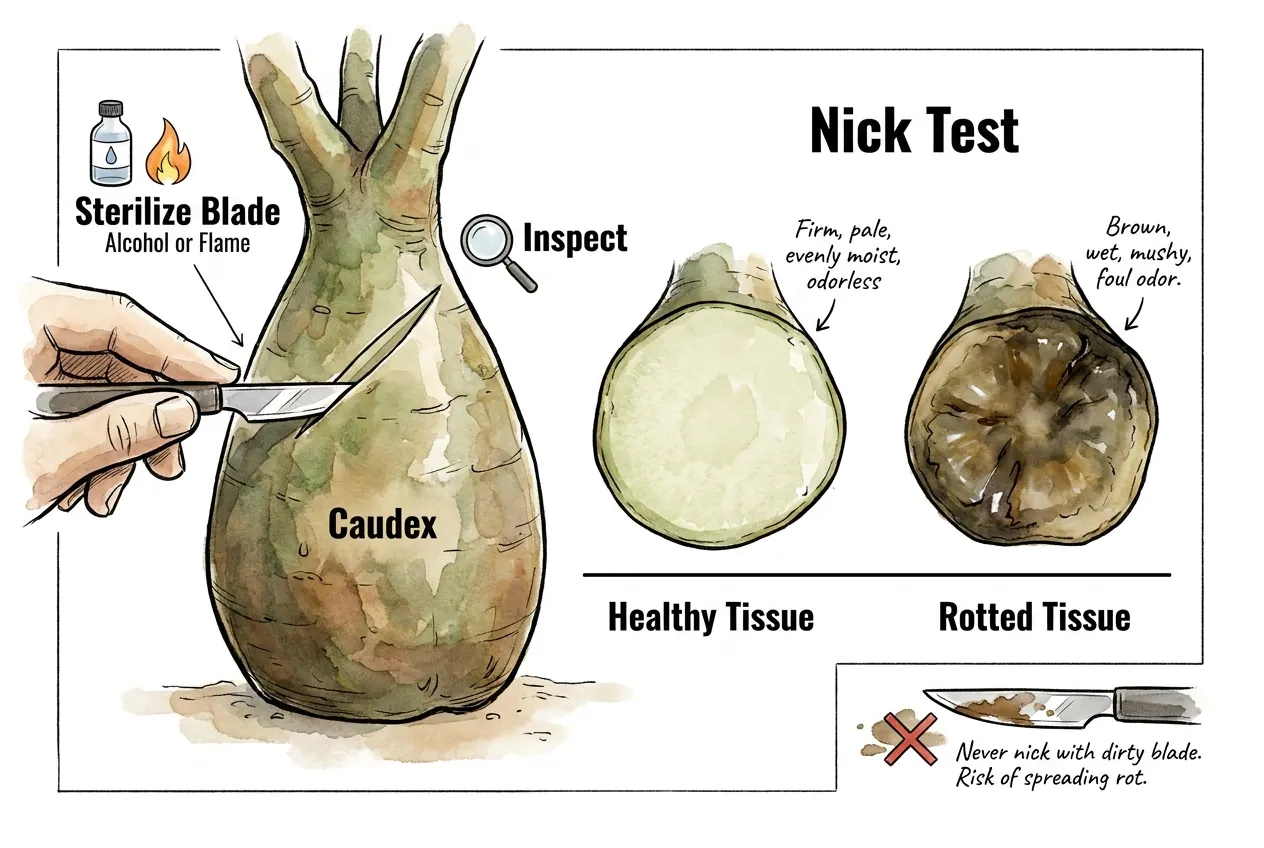
When the gentle checks stay ambiguous, make one shallow clean cut with a sterilized blade at the edge of the suspect zone.
Healthy tissue is firm, pale green to cream, evenly moist, and odorless. Rotted tissue is brown, black, or translucent, wet or mushy, and often foul.
The margin is what decides. Find clean firm pale tissue between the rot and the healthy body and the rot is bounded, so a cut can remove it.
Brown that runs into the vascular core with no clean margin means the rot is deep.
Sterilize the blade before and after every plant with isopropyl alcohol or a flame. This one habit keeps you from carrying rot from a sick plant to a healthy one. Never nick a plant with a dirty blade, because a contaminated cut can start the rot you were only testing for.
Cut, wait, or dry out
The triage ends in one of three actions, and each maps to a firmness reading plus your test results.
Use the table as the decision, then read the branch that fits your plant. When you are genuinely unsure, the safest default is to stop watering and wait.
| Reading | Action | Why |
|---|---|---|
| Foul smell, wet mushy base, slipping skin, brown core at nick | Cut now to clean tissue | Advanced rot spreads in days |
| Localized soft spot, firm core, no smell, or recent overwatering or cold | Withhold water, add airflow, reassess | Early or reversible, drying often halts it |
| Whole-plant or apical wrinkle, dry, odorless, dormant season | Dry rest, do not cut | Benign turgor loss, resolves on watering restart |
When to cut now
Cut when the reading is high-confidence rot with a locatable clean margin. That means a foul or sour smell, a wet or mushy zone, slipping skin, or a nick showing brown wet tissue above a clean margin.
Remove tissue back to clean, firm, pale, odorless tissue. Cut past the visible margin into healthy tissue, because the pathogen front runs ahead of the discoloration you can see. A small buffer beyond the brown is normal and wise.
Keep re-cutting in thin slices until every exposed surface is uniformly clean. Any remaining brown fleck or streak in the vascular ring means cut higher. If the entire base is gone with no clean margin below, the plant may only be savable as a clean top cutting.
When to wait and dry out
Wait when the reading is ambiguous or early. A localized soft spot with a firm core, mild discoloration, no foul smell, or softness that appeared after cold or overwatering all call for patience, not a blade.
Stop watering at once, because wet tissue feeds every rot pathogen. Increase airflow and warmth, move the plant to bright shade, and let the substrate dry fully.
Dry moving air halts most early rot and lets cold-shock and edema tissue recover.
Reassess with the firmness map every few days. If the spot firms and does not spread, it was reversible. If it grows, wets, or smells, move to the cut branch without further delay.
When a dry rest is all it needs
Do nothing surgical when the reading is benign dormancy softness. That means whole-plant or apical softness, fine wrinkling, a dry surface, no odor, and no discoloration, usually during a dormant season. This is turgor loss, not disease.
Do not cut, and do not panic-water either. A dormant caudex sitting in cold wet soil is exactly how benign softness turns into rot. Give a proper dry rest with appropriate warmth for the genus.
Resume normal watering only when the plant’s own growth cue returns. Correct dormancy softness resolves as the plant wakes and rehydrates, and the caudex firms and plumps over one to a few weeks.
When you reach a real watering-tool decision, the caudex watering measurement setup shows a repeatable dry-down method.
Aftercare once you have cut
A cut only holds if the wound closes before water returns. Rush the plant back into wet soil and you reopen the door to the rot you just removed.
The steps are drying, callus, and a careful return to water.
Drying and callus
Keep the plant dry and out of soil after cutting to clean tissue. Set it in bright indirect light with good airflow at normal room warmth. The cut surface should dry and form a firm, dry, slightly sunken sealing layer.
Small wounds may callus in a few days, while large basal cuts can take one to several weeks.
Do not water and do not repot into moist soil until the wound has firmly callused.
A wet wound is an open feeding site for bacteria and fungi.
Warmth and moving air are the two biggest levers for safe callusing. Cold, still, humid air slows the wound and favors rot. Keep the raw surface out of direct sun and leave it undisturbed.
Wound protectants and their limits
A protectant dust plays a small supporting role, not a starring one. Sulfur and some fungicide dusts are used to discourage fungal colonization of a fresh cut. They do not replace a clean cut to healthy tissue or proper drying.
Cinnamon is a popular home remedy with mild antifungal compounds, but the evidence for it as a reliable wound protectant is weak.
Treat it as optional rather than a fix. A clean cut and dry air do most of the work, and no dust rescues a wound that stayed wet.
Choosing which product to reach for is a separate buying decision. When you get there, the caudex root rot fungicide chooser walks through diagnosis before any drench or dust.
Returning to water and soil
Repot only after firm callus, into fresh, fast-draining, mostly mineral substrate that is dry to barely damp. Do not seat the callused wound in wet mix. Withhold water for several days after repotting so the wound stays sealed, then resume lightly.
Watch the cut zone with the firmness map over the following weeks. Firm, dry, unchanged tissue means the cut held. New softening, browning, or smell at or above the cut means the rot advanced, so cut higher into clean tissue and dry it again.
Where the rules bend by genus
The firmness map holds across caudiciforms, but baseline firmness and benign seasonal give shift by genus.
Calibrate to the plant in front of you rather than an absolute ideal. A few genus habits are worth knowing before you read a soft spot as rot.
Adenium and pachypodium
Adenium runs firm and plump in growth and softens normally during a cool-season dry rest. Its highest risk is soil-line and basal rot from cold wet soil, plus rot at graft unions.
A squishy adenium caudex right after watering in cool weather is a classic early warning, covered in the adenium squishy caudex after watering guide.
Pachypodium is firm and often spiny, and many species are winter-dormant. Imported bare-root plants feel soft and unstable until they root, which fools growers into cutting a plant that only needs rooting conditions.
A soft, blackening growth tip on pachypodium is usually terminal crown rot.
Both genera carry a handling note. Adenium sap contains cardiac glycosides, so wear gloves during any surgery and keep tools away from your face.
Euphorbia, fockea, dioscorea, and cyphostemma
Euphorbia stems are firm but bleed copious white latex from any cut. That latex is a skin and eye irritant, so gloves and eye protection are mandatory before any nick.
Euphorbia soft rot can also run through a column fast, so act quickly on a wet, foul lesion.
Fockea and dioscorea shrivel and soften strongly while dormant and leafless, and this is where benign dormancy softness is most often mistaken for rot.
Weighing the plant tracks hydration better than squeezing does, as shown in the fockea caudex shriveling weigh-before-watering method.
Cyphostemma bark can split or feel loose after a heatwave without meaning rot, so read a bark split as mechanical until a wet foul margin says otherwise.
Stop it from happening again
The cut fixes today’s rot, and prevention removes the reason the caudex went soft. Soft basal rot is overwhelmingly a wet-and-cold problem. Fix the conditions and you rarely reach for the blade again.
Water and temperature discipline
Match watering to active growth and warmth. Water hard while the plant is warm and growing, then let the mineral mix approach dry before watering again.
Cold dormant roots do not drink, so water given then just sits and rots tissue.
Use plant weight or a probe instead of a fixed calendar. A dormant caudex that shrivels slightly is far safer than one kept wet and cold. The combination that kills caudex plants is a cold night on wet soil, so avoid it above all.
Substrate, pot, and airflow
A fast-draining, mostly mineral, gritty substrate keeps water from lingering at the base. This is the structural fix that makes every watering mistake more forgiving. When you compare mixes, the caudex substrate comparison breaks down pumice, akadama, and gritty blends.
The pot matters as much as the mix. A freely draining pot that dries in a reasonable window beats an oversized one holding cold water against the roots.
Keep air moving so surfaces dry quickly, which reduces both rot and shriveling.
Hygiene and inspection
Every wound is a rot entry point. Sterilize tools between plants, avoid careless nicks, and let any accidental wound dry before it sits in soil. The grower who waters to plant demand, uses a gritty mix, and keeps dormant plants warm and dry removes almost every driver of soft basal rot.
Inspect roots and the basal flare whenever the plant is out of its pot. Remove any already-soft or blackened root before it climbs into the caudex. Prevention is cheaper than surgery and keeps the caudex whole.
Key Takeaways
- A soft caudex means either reversible water loss or active rot, and cutting the wrong one kills the plant.
- Map firmness by zone, since softness that increases downward toward the roots is the fingerprint of basal rot.
- A foul smell with a wet mushy base and slipping skin is bacterial rot until proven otherwise.
- Cut only to a clean firm margin, past the visible brown, then dry the wound before water returns.
- Whole-plant dry wrinkling with no odor in dormancy needs a dry rest, not a blade.