
Caudex Soil Temperature: The Autumn Watering Break Point
Caudex soil temperature, not the air, drives autumn watering. The 2-inch root zone lags days, breaks near 59°F, and cold-plus-wet is what rots plants.
Nathan Brooks · 2026-08-23 · 27 min read
Key Takeaways
- Measure the 2-inch root zone at the pre-dawn low over several nights, not the air thermometer or the calendar.
- Root water uptake breaks near 59°F (15°C), where aquaporins gate shut and applied water just sits.
- Hold summer cadence above 59°F, step down from 50 to 59°F with smaller morning pours, stop below 50°F.
- Cold plus wet rots caudex plants, but cold plus dry does not, so go into cold slightly dry.
- Shift up toward 60°F for tender Euphorbia, and winter-growers like Dioscorea want more water as soil cools.
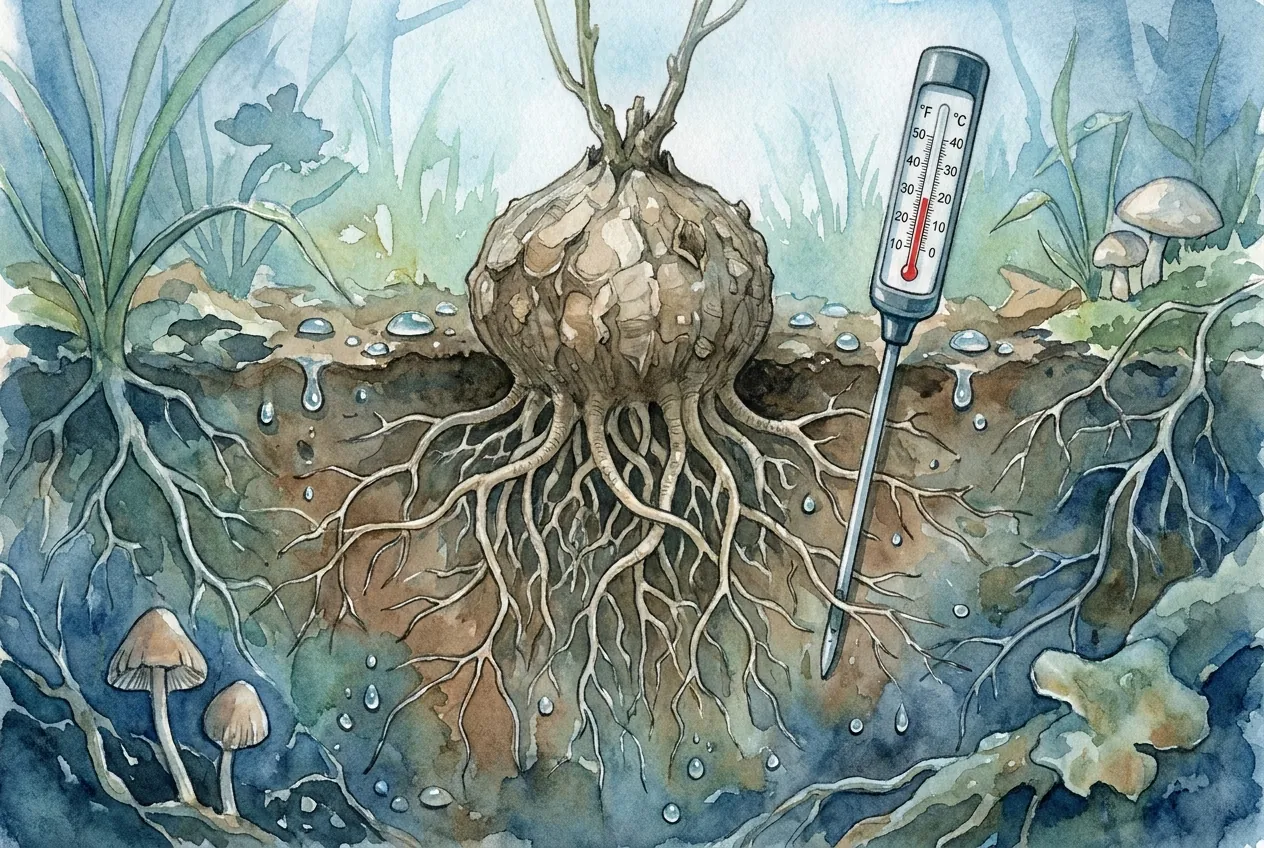
The wall thermometer reads 48°F at dawn and your instinct screams to cut water. Push a probe two inches into the pot and it may read 58 or 60°F.
That gap is the whole autumn watering decision, and reading the wrong number rots more caudex plants than any pest.
Your potting mix carries far more heat than the air and sheds it slowly. So in fall the root zone stays warmer than the air for days to over a week, and the roots keep drinking while the sky says winter has come.
The number that governs your watering is the one at the roots, not the one on the wall.
Why Your Pot Trails the Air by Days in Autumn
Substrate cools slower than air because it stores vastly more heat per unit volume. Air has almost no thermal mass and turns over constantly, so it tracks the sky in real time.
A wet, dense root ball banks summer heat and gives it back slowly, so it runs warmer than the air right through the cooling season.
The numbers behind this are not subtle. Water stores about 4.18 joules per gram per degree C, while quartz mineral stores 0.75 and still air carries almost none by volume.
Volumetric heat capacity rises in a straight line with water content, so a moist mix resists temperature change far harder than the air above it.
That stored heat then leaves slowly. The mix loses it mostly by conduction out through the pot wall and drainage holes and by evaporation at the surface.
Air changes temperature the instant conditions change, so the root zone simply cannot keep up and always arrives late.
How Many Degrees and How Many Days the Lag Actually Runs
For a hobby pot the trailing warmth runs a few degrees F and days to a bit over a week, not the months seen deep in field soil. The lag scales with depth. Shallow substrate tracks the air within a day or two, while deep soil lags the seasonal cycle by weeks to months.
A container root ball is shallow and thin-walled, so it sits at the fast end of that spectrum.
A surface temperature change propagates downward at roughly 2 cm per hour, and the daily soil maximum trails the air peak by several hours.
At the seasonal scale the effect is huge, with a three-month gap between the surface minimum in January and the deep minimum months later.
None of this means one cold night has chilled your roots. A cold snap that drops overnight lows from 62°F to 45°F on a Tuesday may not settle the two-inch reading into the low 50s until the following week. Confirm a cooling trend across several consecutive nights on a substrate reading before you change anything, because a single cold night barely moves the multi-day root-zone temperature.
Autumn Is the Mirror Image of Spring, and Moisture Sets the Lag Size
The same thermal inertia that keeps the root zone warm in autumn keeps it cold in spring.
In spring the air warms first and the mix trails behind, so soil is colder than air and root activity lags the calendar.
In autumn the sign reverses, the soil is the warmer partner, and roots stay active after the air has turned cold.
This is why fall carries a specific rot risk that spring does not. The same 55°F air reading means opposite things in April and October. In April the roots are likely colder than 55°F and sluggish, while in October those same roots are likely warmer than 55°F and still drinking.
Moisture is the dial that sets how strongly the root zone lags. Every added gram of water raises the energy needed to change the mix by a degree, and surface evaporation carries more heat away as latent heat.
A wet pot therefore rides out a cold snap with a smaller, more delayed temperature dip than a dried-down one.
This cuts both ways and is the trap in disguise. Wet soil also conducts heat better than dry mix, so once a wet root zone finally goes cold it stays cold and wet. Let the mix dry between waterings as autumn deepens so a warm, wet buffer does not convert into a cold, saturated liability.
How the Pot Itself Moves the Root Zone by Double-Digit Degrees
The container is a thermal amplifier or a thermal buffer, and the choice shifts the autumn root zone by many degrees.
Color, material, and soil volume each change how warm the roots run by day, how fast they cool at night, and how wet the mix stays going into the cold.
Sort your collection by these traits and read each group separately rather than trusting one blanket date.
Color Is the Biggest Daytime Lever
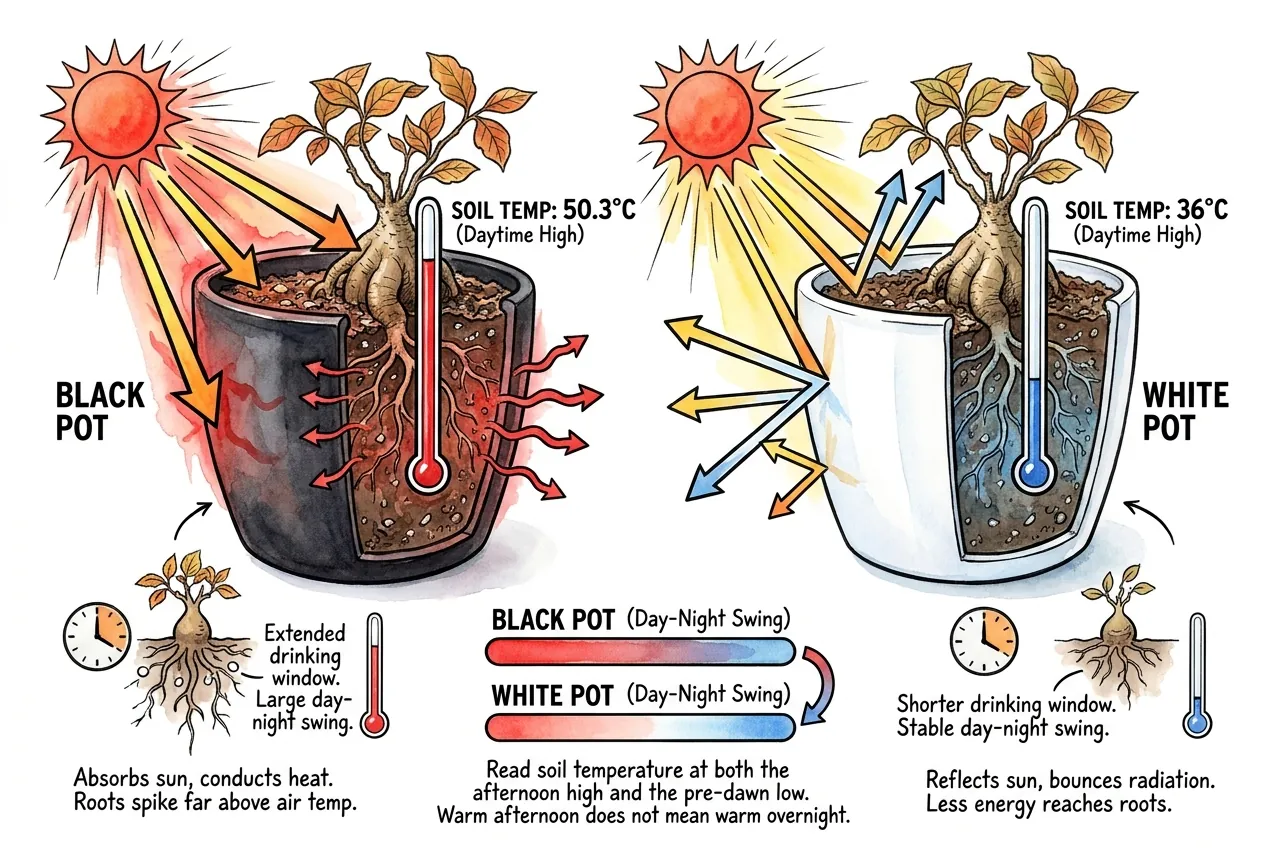
A dark pot wall absorbs sunlight and conducts it straight into the mix, so the root zone spikes far above air on any sunny autumn afternoon.
In a Kansas State bean trial, sun-facing media averaged about 36°C in white pots versus 50.3°C in the black control, a spread near 14°C.
Field data from a Tennessee nursery recorded black plastic substrate up to 30°F above ambient air with peaks near 133°F.
A white or reflective wall bounces much of that radiation, so less energy reaches the roots.
The pot wall behaves like a warm brick, and color decides how hot the brick gets.
A black glazed pot on a south-facing sill can read root-zone highs in the 80s°F on a sunny October afternoon while the air sits in the 50s.
That daytime warmth extends the drinking window but produces a bigger day-night swing. Read soil temperature at both the afternoon high and the pre-dawn low before deciding, because a warm afternoon reading does not mean the roots stayed warm overnight.
Material Decides How Wet the Mix Stays Into the Cold
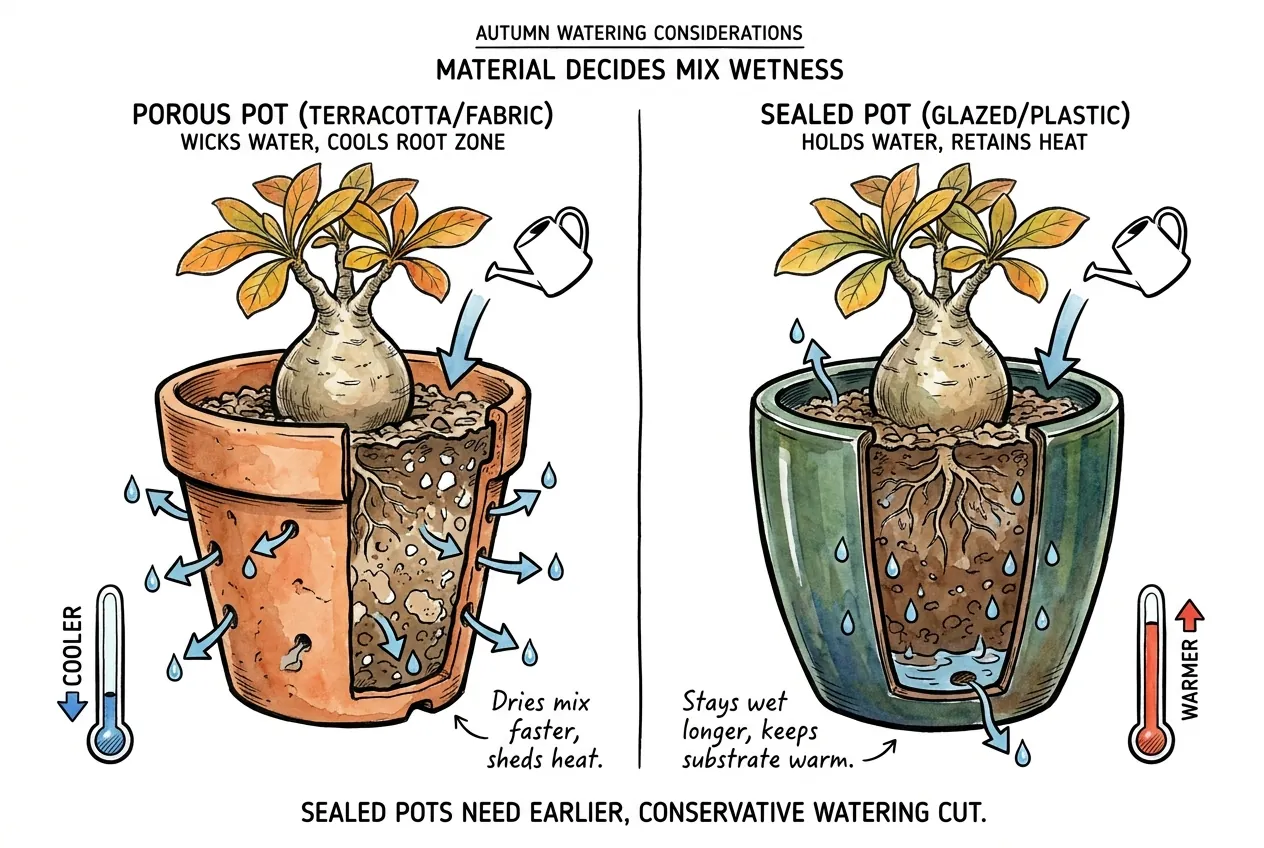
Container material controls heat loss and evaporation at once, and both feed the autumn rot risk.
Unglazed terracotta is porous, so water wicks through the wall and evaporates, cooling the root zone and drying the mix faster. Fabric pots do the same through their whole breathable wall.
Glazed ceramic and plastic are effectively sealed. The mix loses water only from the surface and the drainage hole, so it stays wet far longer, and glazed ceramic adds mass that holds daytime warmth.
A peer-reviewed arborvitae study found black plastic held the root zone above 38°C and 46°C for 15 and 17 percent longer than white and fabric containers.
The practical split is clean. A porous pot keeps drying the mix and shedding heat, while a sealed pot keeps the substrate warm and wet. A caudex in glazed or plastic needs an earlier, more conservative watering cut than the same plant in terracotta or fabric.
Soil Volume Decides How Fast the Root Zone Tracks the Air
A big soil mass has more thermal inertia, so it lags the air more and buffers swings.
Nursery work found summer root-zone temperatures 5 to 6°C lower in 57-liter containers than in 10-liter ones.
Larger pots hold cooler, more stable cores because roots can reach zones away from the hot sun-facing wall.
A small pot is the fast-follower that chills to air within a night or two. A caudex in a 4-inch pot can go cold with the first snap. The same species in a 2-gallon pot holds autumn warmth for extra days and may still read a warm, drinking core a week later.
Size the step-down decision to the pot volume, not one shelf-wide date, or you will rot the small pots and needlessly starve the large ones.
Why Cold Roots Stop Drinking at a Sharp Break, Not a Gentle Slope
Root water uptake is set by root-zone temperature, and it does not fade gently. It breaks near 15°C, which is 59°F, where the root membrane’s water channels gate shut.
Above that point water is drunk near summer rates, and below it the plant largely stops, leaving applied water to sit in the pot.
The 59°F Break Point Is a Physiological Cliff
In a controlled study of rice roots, hydraulic conductivity showed a single break point at 15°C in the Arrhenius plot.
Above it the temperature sensitivity was mild, with an activation energy of 28 kJ per mole, only slightly above what water viscosity alone predicts.
Below it the value jumped to 204 kJ per mole, roughly a sevenfold rise in cold sensitivity.
That steep sub-15°C drop is far too large to be thicker water alone. It reflects a change in the root membrane itself, specifically the gating of aquaporins, which are the water-channel proteins in root cell walls.
Blocking those channels with an inhibitor cut water exudation by 97 percent, showing they carry almost all the flow.
So the number that matters is measured at the root, not the wall. A pot at 62°F and one at 55°F are not a little different but sit on opposite sides of a cliff. Treat roughly 59°F at the two-inch root zone as the line where root physiology changes regime.
Warm-Growing Caudex Plants Quit Earliest of All
The warmer a plant’s home climate, the higher its cold cutoff, so warm-growing caudex plants stop drinking soonest.
Across 16 European tree species, mean water uptake after six hours fell about 35 percent at 7°C and 71 percent at 2°C relative to 15°C.
At 7°C the ranking matched each species’ upper elevation limit, with warm-climate, low-elevation species the most sensitive.
A companion review found the steep decline begins above 10°C for chilling-sensitive herbs versus below 5°C for boreal trees.
A caudex genus from hot, seasonally dry habitat sits at the warm-sensitive end of that spectrum.
This is why the 59°F default is a warm-grower number, and if anything it errs toward stopping early. Do not borrow a roots-fine-to-freezing rule from a temperate garden shrub, because your caudex quits drinking at a much warmer root zone.
Slowed Uptake Plus Slowed Evaporation Keeps the Pot Wet for Days
A pot loses water two ways, through the plant as transpiration and from the surface as evaporation.
Cold roots cut the first and cool air cuts the second, so both exits close at once.
The same volume that vanished in two summer days can linger a week in cold autumn mix.
Cold soil closes stomata through impaired water supply, cutting stomatal conductance 50 to 75 percent under soil frost and throttling transpiration.
When potting mix stays wet for long periods, water fills the pore spaces and oxygen drops, so roots stop growing and eventually die.
A cold pot that still feels heavy has not finished the last watering.
Judge dryness by actual substrate moisture and root-zone temperature, not by how many days have passed. A summer schedule of water-every-few-days applied to a 55°F root zone stacks water on water, because uptake and evaporation have both collapsed.
Why Cold Plus Wet Rots the Plant When Cold Plus Dry Does Not
The danger in autumn is almost entirely the water, not the cold. A dried-down caudex has stored starch and water to ride out months of leafless dormancy. A saturated one in the same cold has no defense and goes soft weeks later.
Saturated Soil Injures the Roots Before Any Pathogen Arrives
Waterlogging is not neutral holding, because it actively damages roots by starving them of oxygen. Exposing roots to saturated conditions for as little as 18 hours damages the sensitive membranes and leaks nutrients from the cells.
Aerobic root respiration is restricted once soil oxygen falls to roughly 1 to 5 percent, which happens fast in saturated mix.
Those leaked sugars and amino acids are a chemical dinner bell for rot organisms. The plant simultaneously weakens its own defense and advertises the wound. It is the standing water, not the temperature, that leaks the roots.
Keeping the mix dry through cold spells removes the membrane injury, the oxygen crash, and the exudate signal in one move. Cold plus dry is categorically safer than cold plus wet, so a slightly dried caudex going into cold is in its designed state rather than deprived.
The Rot Organisms Love Exactly This Cool, Wet Pot
Growers assume rot needs heat, but two of the three main culprits are happiest in the cool, wet band an autumn pot occupies.
Ideal soil conditions for Phytophthora are wet soil at 59 to 74°F. Cool-season Pythium runs roughly 55 to 70°F, and some species are active only at low soil temperatures.
Phytophthora and Pythium are water molds, not true fungi. They swim to roots as zoospores that need a continuous water film, so a saturated pot is a swimming pool and a dry pot is impassable.
Phytophthora can begin infection with as little as 4 to 8 hours of soil saturation.
A pot that reads 62°F at two inches and stays wet for a week sits in the dead center of the pathogen’s ideal range. The single most powerful control is denying the water film by letting the mix dry so zoospores cannot swim.
The Failure Is Silent, Then Sudden
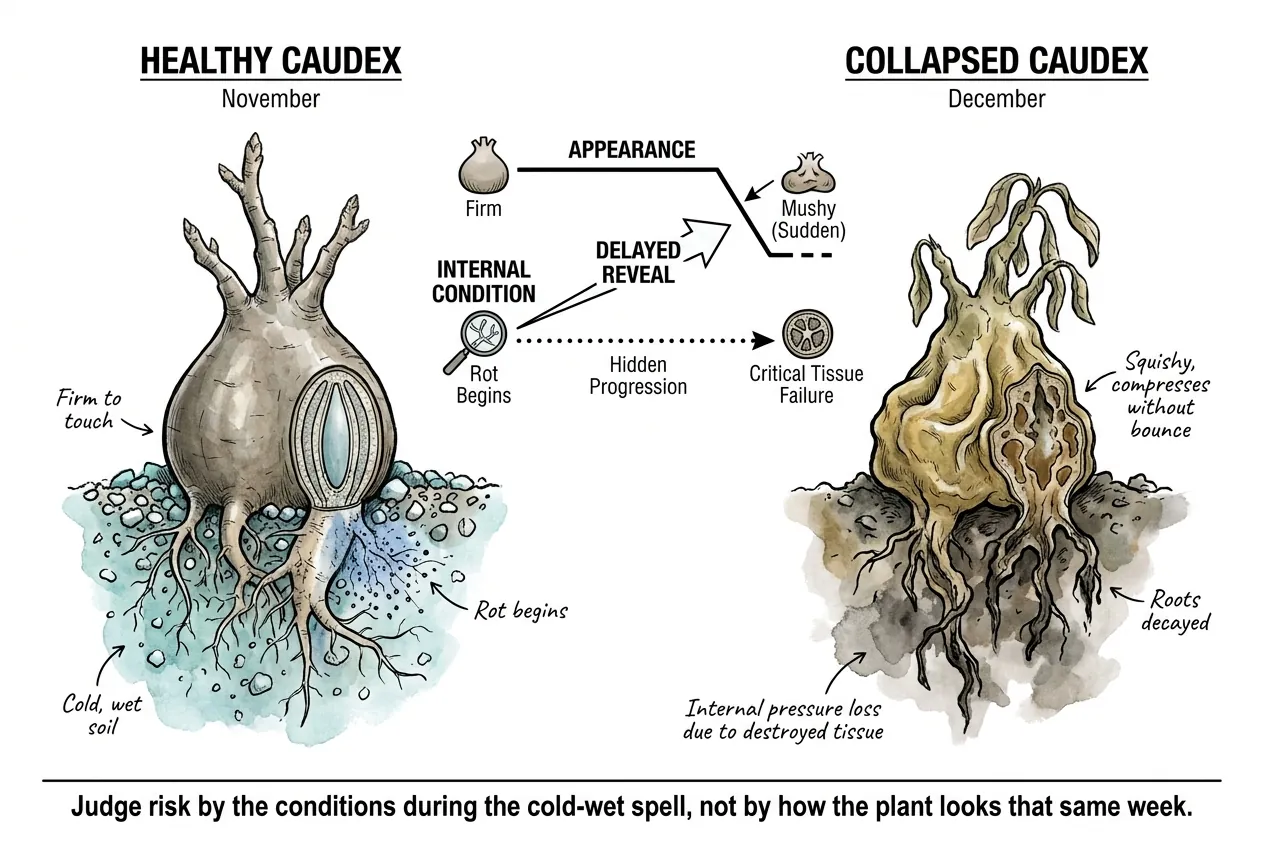
Cold-wet rot rarely shows the day it starts. The pathogen colonizes roots and creeps into the crown while the caudex still looks and feels fine, then the plant seems to collapse suddenly. This lag is why growers misdiagnose the cause.
Turgor and appearance hold until a critical fraction of the conductive tissue is destroyed, then the caudex loses internal water pressure and the firm trunk goes mushy.
A caudex can look perfect going into a rainy cold week in November and turn squishy in early December.
The rot started in the wet roots in November, and the December softening is the delayed reveal.
A dormant caudex feels firm even if slightly flexible, while a distressed one feels soft or compresses without bouncing back.
By the time it is soft, the root system is usually already gone. Judge risk by the conditions during the cold-wet spell, not by how the plant looks that same week.
How to Actually Measure the Root Zone
The signal that drives the whole decision is the temperature of the mix at the center of the root mass, roughly two inches deep. A cheap dial or digital soil probe reads it. The tricks are the depth, the placement, the time of day, and the number of nights you average.
Push the Probe to Root-Ball Depth, on the Shaded Side
The reading that matters is where the fine feeder roots sit, which is the center of the root mass around two inches down.
Extension guidance standardizes on a 2-inch depth for shallow roots and 4 to 6 inches for transplants.
Greenhouse practice places substrate sensors 1 to 2 inches below the surface.
A surface reading tracks the air and the sun and swings wildly, so it is useless as a root signal.
Soil-surface temperature amplitude of about 7°C damps to roughly 3°C by 10 cm depth, so a buried center reading is far steadier.
A grower who lays a bulb on the surface can see 48°F at dawn and panic while the probe two inches down reads 58°F.
Placement matters as much as depth. The sun-facing wall runs dramatically hotter than the core, so a probe jammed against it tells you the roots are still hot when the actual core has already cooled.
A black pot on a south-facing patio can show a west-wall reading 20 to 30°F above its core.
Insert the probe toward the center, on the shaded side, away from direct sun and out of the top half-inch of mix. Never read against the sun-exposed wall or in the surface crust, because both over-report how warm the roots actually are.
Read at the Same Time and Average Several Nights
One reading is a snapshot, not a trend. Soil rides a daily wave with its minimum near dawn and its maximum after noon, so time of day changes the number by several degrees.
Extension protocols read at the same time each day and require the value to hold across several consecutive days before acting.
Reading the pre-dawn low captures the worst-case cold the roots sit in overnight, which is the number that governs rot risk.
Planting decisions use a five-day running average and a hold of five to seven consecutive days.
Let the probe equilibrate 2 to 5 minutes each time before reading.
A pot that reads 61°F at 2 p.m. and 54°F at dawn is not at 61°F, because the roots endure the 54°F trough every night. Read at one time daily, ideally the pre-dawn low, over at least three to five consecutive nights, and act on the trend rather than one cold night.
When you reach the point of asking which probe or thermometer to actually buy, hand that decision to the site’s caudex watering tools and measurement setup guide.
It walks through soil-temperature probes, pot-weight checks, and logging so you pick the right instrument for this decision.
The Watering Step-Down Decision, Band by Band
Root-zone temperature converts cleanly into a go, hold, or stop watering action. The 59°F break point sets the top band, and the low 50s set the danger band where cold-wet rot peaks.
Read the two-inch pre-dawn low across several nights, then match it to the bands below.
The Go, Hold, and Stop Bands
Set your action threshold at the two-inch soil reading, not the air, and read it at the pre-dawn low across several consecutive nights. Three bands cover the whole autumn.
Go and hold summer cadence
The two-inch soil sits at or above about 59°F, which is 15°C. Roots are above the hydraulic break point and drinking, so water normally. Air on the porch reading 48°F while the probe reads 61°F is still a full-drinking situation.
Step down
The two-inch soil holds roughly 50 to 59°F across several consecutive nights. Lengthen intervals, cut volume so you wet the root ball rather than flood it, and water only in the morning of mild days.
Slowed uptake means the same soak now lingers, so cut both frequency and total wetness together.
Stop
The two-inch soil holds below about 50°F, or the plant is clearly dormant. Withhold water, giving at most a token drink if a warm-grower caudex shrivels. This band deliberately keeps the pot dry through the 50 to 59°F range where Pythium rot is most favored.
Trigger the step-down on the two-inch root-zone temperature at the pre-dawn low across several nights, never on the air reading or the calendar.
Shift Frequency, Volume, and Time of Day Together
Stepping down is not just watering less often. As uptake slows the same volume sits in the pot far longer, so frequency and total wetness must both drop.
Adenium growers report needing water every 5 to 7 days in active growth, while the same soak lasts 3 to 4 weeks once the root zone cools.
The water you do give should go in early on a mild, ideally sunny day. Morning watering lets surface evaporation and any residual uptake pull the free water down before nighttime cold locks it in.
Evening watering before a cold night does the opposite and traps free water in a cooling root ball.
In September you might soak weekly. By mid-October, with soil holding in the low 60s, you shift to a smaller morning drink every 2 to 3 weeks. Skip any watering that would leave the pot wet going into a forecast cold snap.
When a Warm Window Reopens After a Cold Snap
Thermal lag runs both ways, so a short cold snap chills the air but a buffered root ball recovers quickly on a warm day.
Do not treat the first cold snap as the end of the year. If the soil climbs back above 59°F and holds there for several days, a light morning-only cadence is defensible for a warm-grower not yet fully dormant.
Recovery of uptake below the break point is slow, taking hours rather than minutes, so give the root zone time to confirm it is genuinely warm before a full soak.
The Cambridge University Botanic Garden glasshouse team waters mostly in autumn and spring and stops during overcast, very cold periods, resuming as conditions turn mild.
They also skip watering any succulent that is still plump and turgid.
Committing to done-for-the-year after one cold night leaves a still-active plant under-watered. Chasing every warm afternoon risks a wet pot going into the next cold night. Keep the call soil-number-gated, multi-day, and morning-only so neither error catches you.
How the Threshold Shifts by Genus
The 59°F default is a physiological anchor, not a universal law. Warm-growing genera cluster their keep-dry thresholds in a band from about 50°F for the toughest up to 60°F for the most rot-prone.
Winter-growers invert the whole logic, so the genus on your shelf decides which way to move the number.
Warm-Grower Genera Anchor a 50 to 60°F Band
Across the main warm-growing caudex genera, the keep-dry thresholds cluster in a narrow but real band.
Adenium can be held to 50°F before going bone dry, with 55°F a safe indoor minimum.
Most Pachypodium want a winter minimum above 10°C, which is 50°F, with tender species held nearer 60°F.
Caudex Euphorbia is the most cold-intolerant group and does best at 60°F or above, with below 50°F often not survivable.
Fockea edulis should be protected below 45°F and ideally kept above 50°F. Provenance drives the number, because taxa from cooler Cape or plateau habitats tolerate cooler roots than lowland tropical species.
Move the default down toward 50°F for the toughest warm-growers and up toward 60°F for tender caudex Euphorbia. Step caudex Euphorbia down first and hardest, because it crosses its uptake and rot threshold several degrees warmer than an Adenium does.
Winter-Growers Invert the Logic Entirely
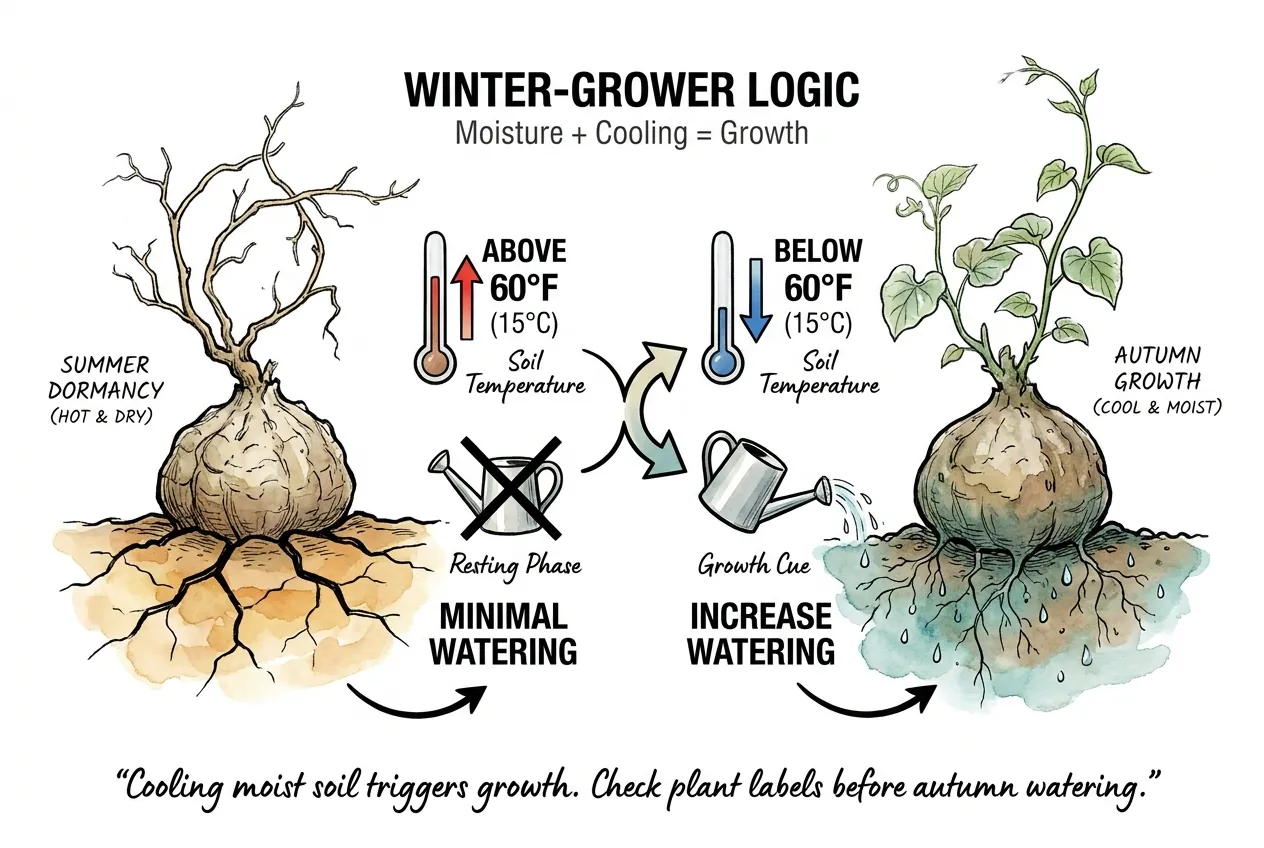
Tylecodon, Othonna, and Dioscorea elephantipes are winter-growers, also called summer-dormant. They shed leaves and rest in summer heat, then resume growth as autumn cooling begins, which is the exact moment a warm-grower owner steps down. Cooling moist soil is their growth cue, not a dormancy trigger.
Dioscorea elephantipes grows in winter and spring and rests through the hot dry summer, and summer overwatering can shorten its life by at least half.
Winter-growers grow most once night temperatures drop below about 60°F. For these plants, autumn is when you ramp water up, not down.
A grower who cuts water on all pots at 55°F soil will correctly protect an Adenium and simultaneously desiccate a just-waking Dioscorea. Check the grow-season label before any autumn step-down, and never apply a warm-grower cut to a plant marked winter grower or summer dormant.
The Two Symmetric Mistakes and How to Avoid Them
Autumn caudex losses cluster around two mirror-image errors plus a handful of measurement blunders. Both errors trace to reading the wrong number, and the corrective is identical. Measure the two-inch root zone, at the same time each day, across several consecutive days, and act on the sustained trend.
Stopping Too Early, or Running Summer Autopilot Too Late
The most common mistake is watching the air crash into the low 50s and immediately cutting water.
Thermal lag means the root zone stays several degrees warmer for days, so the roots keep drinking above the 59°F break point.
Cutting water then dehydrates a plant that could still use it and wastes the last productive weeks of the season.
The mirror-image mistake is running the full summer soak into a root zone that has already crossed below the threshold.
Below 59°F uptake collapses, evaporation is slow, and the pot stays saturated for days. In Arabidopsis, dropping the root zone from 23°C to 10°C for five days sharply cut root and shoot growth, confirming cold roots throttle whole-plant activity.
A plant can look fine going into a cold-wet week and go soft weeks later once rot reaches the crown.
The corrective for both errors is to push a probe to two inches before acting. Hold the summer cadence in the high 50s to low 60s, and stop hard once soil holds below 59°F across several nights.
Measurement Blunders and the One-Cold-Night Overreaction
Every measurement shortcut biases the reading toward panic or complacency. A surface reading or a probe near a sun-baked wall reads far too warm at midday and lulls a grower into a late soak.
A single reading, the wrong depth, or ignoring pot color all misjudge how the root zone is actually tracking.
The one-cold-night overreaction is its own trap. Perennials shift dormancy on a sustained soil trend held for a week or more, not on a single event, so one cold night does not mean dormant.
Extension planting guidance triggers on a two-inch soil reading plus a sustained forecast, and the same discipline runs autumn in reverse.
Probe to two inches, keep the tip off the wall, shade the dial, and read at the same time on several consecutive days. Require a sustained multi-night soil trend below threshold before declaring a caudex dormant, and treat a warm-soil rebound as a reopened watering window.
Key Takeaways
The autumn watering decision belongs to the root zone, not the wall thermometer and not the calendar. Here is the whole method in five moves.
- Measure the two-inch root zone at the pre-dawn low, on the shaded side away from the sun-baked wall, over several consecutive nights before acting.
- Hold the summer cadence while the soil sits at or above about 59°F, step down in the 50 to 59°F band with longer intervals and morning-only watering, and stop below about 50°F.
- Water early on mild days so the pot trends dry before the cold night, because slowed uptake plus slow evaporation leaves free water sitting in a cold root ball where rot begins.
- Go into cold slightly dry rather than topped off, since the caudex stores months of water and starch and a saturated pot adds only rot risk.
- Shift the 59°F default up toward 60°F for tender caudex Euphorbia and down toward 50°F for tough Adenium and Fockea, and remember winter-growers like Dioscorea and Tylecodon want more water as autumn cools, not less.