
Spider Mites on Caudex Plants Indoors: The Week-One Surge
Why spider mites explode the first week after caudex plants move under lights, how to scout the surge early, and how to stop it without rotting the caudex.
Maya Ellison · 2026-10-04 · 14 min read
Key Takeaways
- Moving plants under lights strips away humidity, predators, rain, and wind on the same day.
- Warm dry air runs the mite life cycle in about 8 days instead of 28, so hitchhikers surge fast.
- Scout soft index plants with a hand lens and a white-paper tap test. Webbing is a late sign.
- Confirm first. Thrips, broad mite, edema, and mineral spotting all mimic mite stippling.
- Rinse the canopy and raise leaf-zone humidity, but keep the caudex and mix dry to avoid rot.
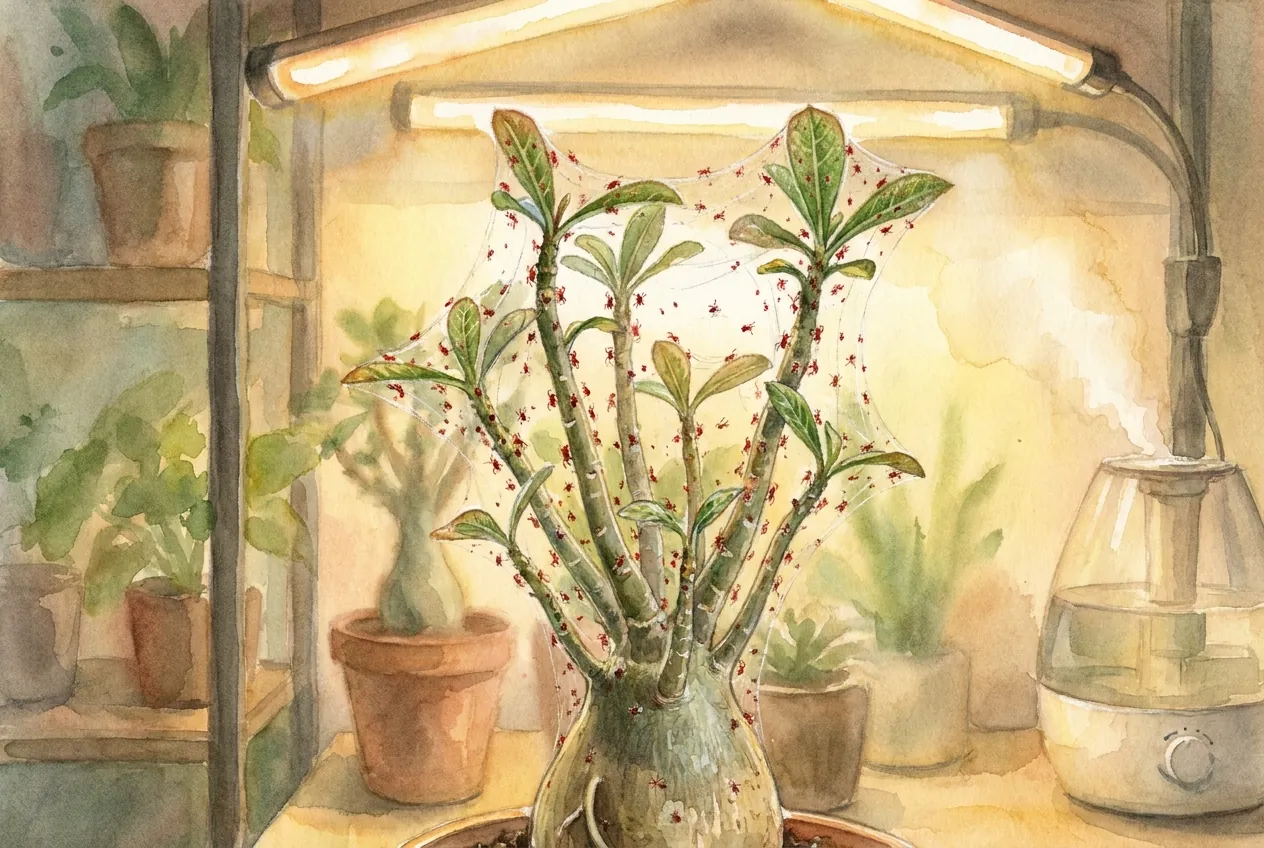
Your caudex collection came inside clean, then stippled out in the second week. That is not bad luck. The warm, dry, still air under a grow light is close to an ideal mite nursery.
A few hitchhikers can become a visible colony in about one generation. This is a mechanism problem with a short fuse, and you can interrupt it if you know where to look and when.
Why the surge hits in week one, not at the move
The mites were already on the plant outdoors. They were just held back by humid air, rain, wind, and predators. Moving the plant under lights removes all four brakes on the same day, and the population you never noticed starts compounding.
Temperature sets the clock. Egg-to-adult development takes about 28 days at 60 F but only about 8 days at 82 F. A warm indoor shelf runs the life cycle roughly three and a half times faster than a cool fall night.
A grow light holds the canopy near 25 to 30 C for 12 to 16 hours a day, which is the mite’s fast lane.
Dry air is the second accelerant. Spider mites feed more under low humidity because it helps them evaporate the excess water they excrete, and their populations increase fastest in warm dry conditions. A heated indoor room under lights gives spider mites their two favorite conditions at once, warmth and dryness, with no predators to slow them.
The 7-to-14-day lag is just the first indoor generation incubating. The plant looks fine for several days because the mites that rode in are still maturing and laying.
By the end of week one or two, that first generation has hatched and fed, and the stippling appears all at once.
What the move indoors actually changes
Bringing a plant inside is a release event for whatever mites it already carried. Four outdoor controls vanish together, and the grow-light microclimate replaces them with the opposite.
The four brakes you remove at the move
Humidity drops first. Late-summer outdoor and greenhouse air is far more humid than a heated indoor room, which often turns dry once the furnace runs. Lower humidity raises mite feeding and egg-laying.
Predators stay outside. Outdoor predatory mites, predatory thrips, and lady beetle larvae do not follow the plant in, and most mite predators need humid air and suffer in dry rooms.
Rain and wind also stop. Outdoors both knock mites off and tear webbing, so colonies rebuild slowly, while an undisturbed indoor leaf lets a colony spread.
Temperature stops swinging. Cool fall nights that slowed outdoor development disappear, replaced by a steady warm canopy under the fixture. Every suppressor that kept the outdoor population small is gone the moment the plant sits under lights.
Why the grow-light shelf is the worst microclimate
An LED or fluorescent fixture adds radiant warmth and dries the immediate leaf zone. Still air under a shelf means no wind disruption and a stable warm boundary layer right where mites feed. That is the most mite-favorable spot a home grower routinely builds.
Why caudex plants hide the surge longer
Fat-stemmed and thick-leaved plants mask the early surge and punish careless water control. Two features make them different from a thin-leaved houseplant.
Where the mites actually sit
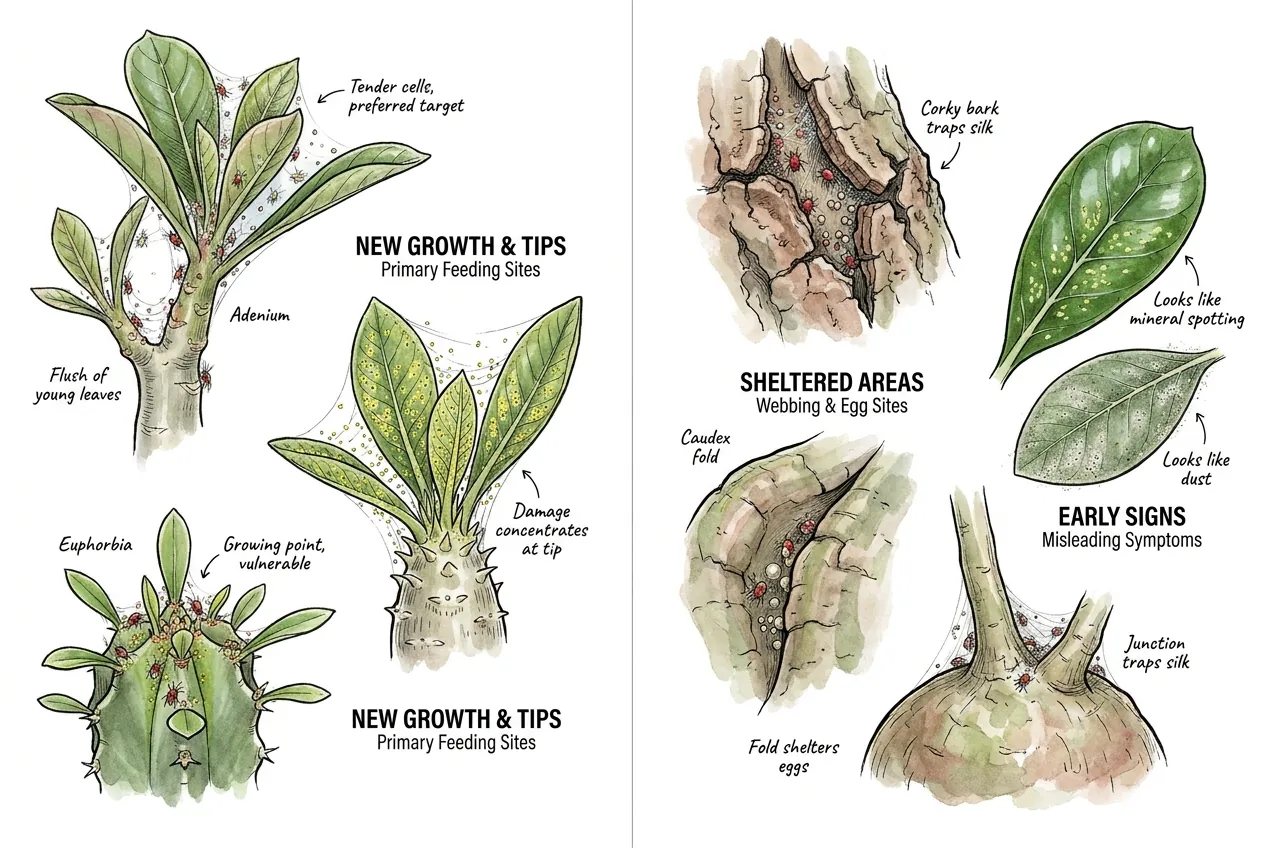
Soft new growth is the target. Adenium flush leaves, pachypodium shoot tips, euphorbia growing points, and leafy cyphostemma, dioscorea, and fockea all carry the tender cells mites prefer.
Thick mature succulent leaves resist feeding, so damage concentrates at the tips where you may not be looking.
Webbing hides in structure a smooth-leaved plant does not have. Corky bark seams, caudex folds, and the junction where stem meets caudex all trap fine silk and shelter eggs.
A quick glance at a leaf underside walks right past these spots.
Stippling also reads as something else on a thick cuticle. On a glossy adenium or a dusty pachypodium, early flecking looks like mineral spotting or dust.
Slow succulent growth means the plant does not deform for a while, so the population outruns the visible symptom.
The rot tradeoff that changes the playbook
Standard mite advice says raise humidity and rinse the foliage. On a caudiciform, done carelessly, that advice starts rot. A wet caudex, a wet stem-caudex junction, or a saturated gritty mix in cool still air invites soft rot of the storage organ.
Every water-based mite control on a caudex must wet the canopy only and leave the caudex and the mix dry.
How to catch it with a hand lens and a sheet of paper
The reliable early detector is a hand lens plus a white-paper tap test, not the naked eye.
Extension IPM programs scout by tapping foliage over paper because mites look like dirt specks until webbing appears, and webbing is already a late sign.
The tap test and what you are looking at
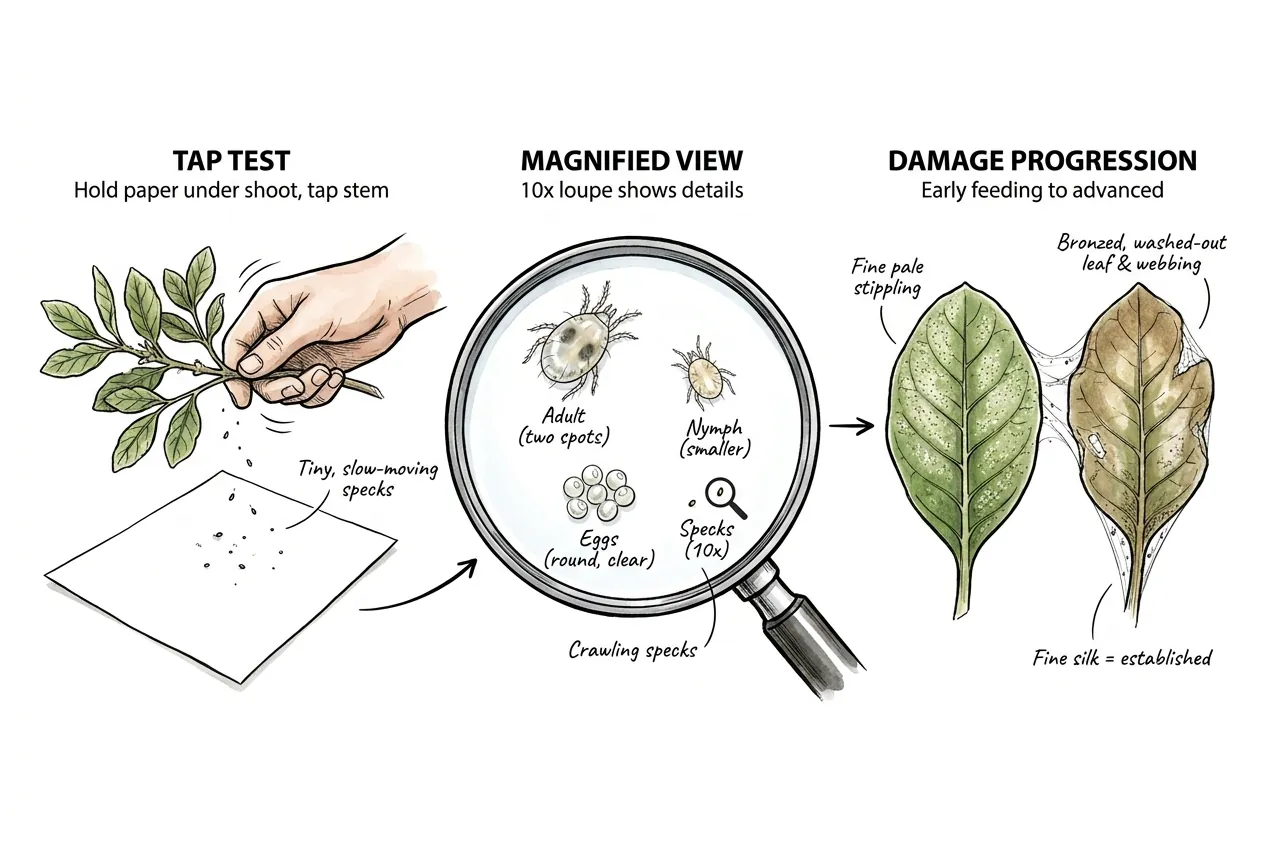
Hold a sheet of white paper under a shoot, tap or shake the stem against it, and watch for tiny slow-moving specks that crawl. A 10x loupe then shows the detail. Adults are translucent ovals with two dark spots, nymphs are smaller, and eggs are round and clear on the leaf underside and along veins.
Early feeding shows as fine pale stippling where mites emptied single leaf cells of chlorophyll. It progresses from scattered dots to a bronzed, washed-out leaf. Fine silk on leaf edges, undersides, and in axils means an established colony, so if you see webbing you are already behind.
On a caudex, scout in order. Start at the growing tips and new leaves, move to leaf undersides, then probe the caudex folds, bark seams, and the stem-caudex junction where webbing shelters.
My tap-count routine for the first two weeks
I run a tap-count on two or three index plants rather than trusting a vague lens impression.
I pick the softest, fastest-growing arrivals, usually an adenium in leaf or a pachypodium pushing a tip, because they stipple first and warn earliest for the whole shelf.
I hold white printer paper under a shoot, tap the stem sharply three times, wait about ten seconds, and count the specks that crawl.
I keep one plant that never left indoor quarantine as my zero-mite reference, so I know what a clean tap looks like on my own paper and lens.
To separate mites from dust, I smear a speck, because a two-spotted mite leaves a faint greenish streak and dust does not move or streak.
My working cadence is a tap-count every third day through the first two weeks, which is my house rule rather than a published standard.
I chose every third day so I sample several times inside one indoor generation of roughly 8 to 10 days.
Any crawling speck from a plant that tapped clean a week earlier sends that plant into isolation and onto the rinse protocol.
Two taps in a row with rising counts tell me the population is reproducing, not just hitchhiking.
Make sure it is actually spider mites
Three feeding patterns and three watering or light problems all mimic mite stippling. Treating the wrong one wastes a spray cycle and can breed resistance in any real mites present.
Webbing plus a positive tap test is the only combination that confirms spider mites.
The look-alike table
| Cause | Damage look | Webbing | Confirm by |
|---|---|---|---|
| Two-spotted spider mite | Fine pale stippling, later bronzing | Yes, fine silk late | Hand lens plus moving specks on tap test |
| Thrips | Silvery bleached scars with black frass dots | No | Black frass dots, elongated insects, silvering not stippling |
| Broad or cyclamen mite | Distorted, cupped, hardened new growth | No | Damage on newest growth only, invisible without a microscope |
| Edema | Corky raised bumps on leaf underside | No | Follows overwatering or cold wet roots, not feeding |
| Hard-water spotting | White or tan flecks in a spray pattern | No | Specks do not move, wipe off, align with misting |
| Dust or sun stipple | Diffuse dullness or fleck | No | No mites on tap, pattern follows exposure not veins |
Reading the table on a succulent
Thrips leave reflective silvering plus black frass and the insects themselves, not the matte pinpoint flecking of mites.
Broad and cyclamen mites twist and harden the newest growth with no webbing and stay invisible without a microscope.
So twisted hard new leaves with a clean 10x lens and no silk point to broad mite, not spider mite.
Edema is a watering disorder, common on fockea and pelargonium kept too wet in cool air, and its corky bumps carry no mites.
Mineral spotting and dust do not crawl on the tap test and wipe away. Abiotic stipple from a cold draft or light scorch follows the exposed face of the plant rather than the leaf veins where mites feed.
If a tap test finds no moving specks and there is no fine webbing, do not reach for a miticide.
Interrupting the surge in week one without rotting the caudex
Week-one control is physical, not chemical. Isolation, a forceful foliar rinse, higher canopy humidity, and some air movement can stall the surge.
On a caudiciform, every one of those water steps has to spare the storage organ.
The physical controls that work
A forceful jet of water physically removes and kills many mites, washes off the dust that shelters them, and tears the webbing, which delays egg-laying until new silk is spun.
Because water does not kill eggs, repeat the rinse at roughly one- to two-week intervals while the population persists, matching the egg-hatch window.
Aim it at the foliage with the plant tipped so water sheds off the caudex, not into the folds.
Raising local humidity slows the mites directly, since they favor dry air and feed less as humidity climbs.
Gentle airflow and strict isolation of the surging plant also help, because still air builds colonies and short-range crawling spreads them to neighbors.
My canopy-humidity method that keeps the caudex dry
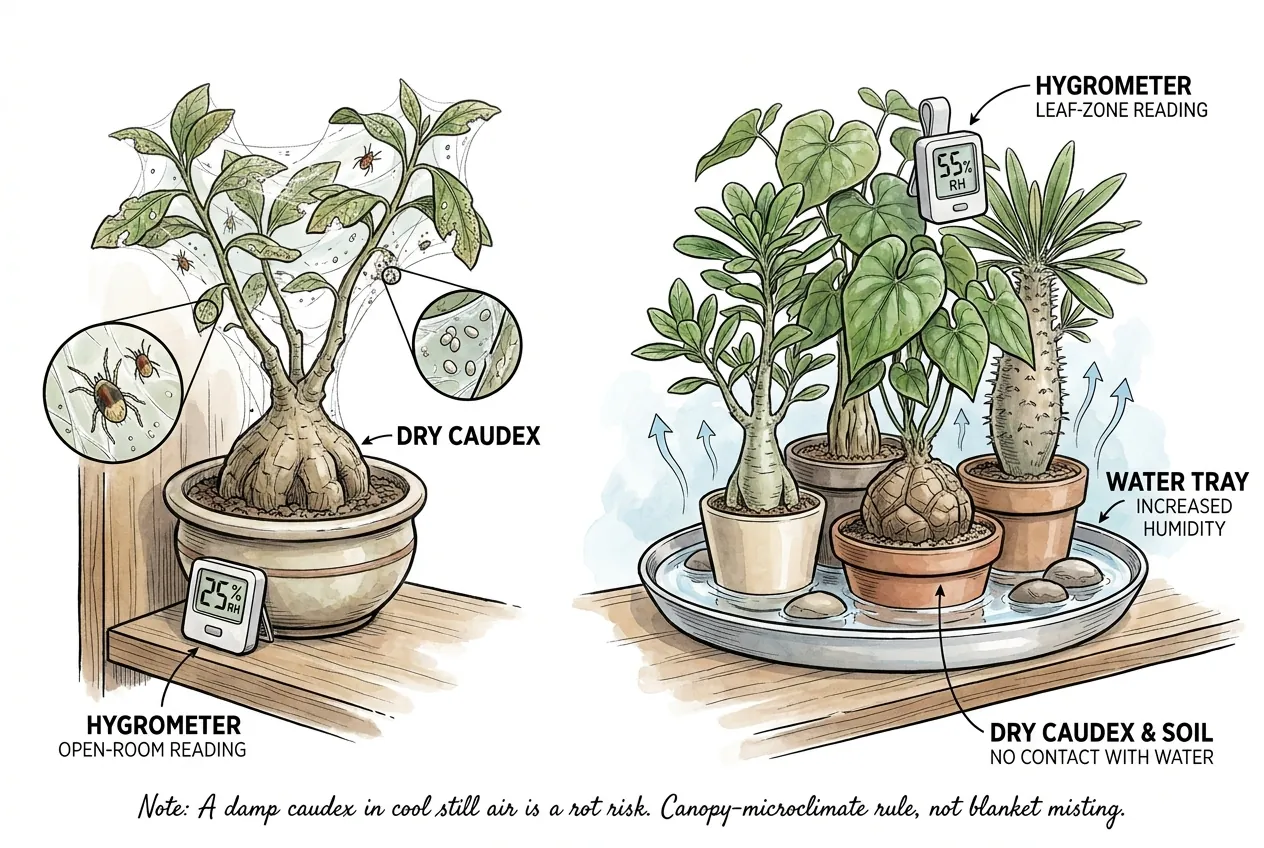
I lift humidity at the leaves without wetting the storage organ, and I measure it rather than guess.
I clip an inexpensive hygrometer at leaf height and first record the open-room reading, so I am tracking the lift and not an absolute number.
Then I group plants and set a nearby open water tray without wetting the pots, and I re-read after about an hour.
I keep the leaf-zone reading meaningfully above the dry room baseline while the caudex surface and the top of the mix stay dry to the touch.
If the caudex base ever feels damp, I pull the water source back, because a damp caudex in cool still air is a rot risk that outweighs the mite benefit.
This is a canopy-microclimate rule, not a blanket instruction to mist your succulents.
When physical control is not enough
A miticide is the last tier for two mechanical reasons, and both argue for catching the surge early instead.
Most miticides do not kill eggs, so a single spray knocks down the adults and then the surviving eggs hatch and refill the colony.
That is why a repeat application at roughly a 10- to 14-day interval is usually needed.
Repeated single-mode spraying also breeds resistant mites, and resistant strains develop readily. The same short generation time that drives the indoor surge selects for resistance fast when one product is used over and over.
So extension IPM runs a hierarchy, forceful water first, then insecticidal soap or horticultural oil, and a selective miticide only when the population persists.
Escalate from physical control to a miticide decision when any of these hold after two or three rinse cycles over about two weeks.
Tap counts are still rising, or fresh webbing returns within days of each rinse. Stippling spreads to previously clean plants despite isolation.
At that point, product choice, mode-of-action rotation, and repeat timing become a buying decision, and that is covered in the spider mite treatment chooser for caudex.
The first two weeks, start to finish
The surge is beatable because it is predictable. One indoor generation runs about 8 to 10 days, so a two-week scouting window with a fixed cadence catches that first generation before it closes.
Start before the plant comes in. A ten-minute inspection and rinse removes the heaviest hitchhiker load, which is the single highest-value step, and that is the job of the pre-move pest gate for caudex plants.
Then isolate arrivals for two to four weeks in a separate space, because a new plant on the same shelf as the collection is not really quarantined.
The fortnight decision tree
| Step | Day | Action | Decision |
|---|---|---|---|
| 1 | Before move | Pre-move pest gate, rinse and inspect | Reject heavily infested plants to a treatment area |
| 2 | Day 0 | Isolate arrivals, pick 2-3 soft index plants | Quarantine zone away from the collection |
| 3 | Days 0-14 | Tap-test index plants every third day, log counts | Clean taps continue the watch |
| 4 | Day 14 | Graduate plants if taps stayed clean | Move into the main collection |
| 5 | Any crawling speck | Isolate that plant, start rinse and canopy humidity | Keep the caudex dry |
| 6 | Rising counts or webbing | Escalate after 2-3 rinse cycles | Go to the miticide chooser decision |
Pick index plants with the softest, fastest new growth, since they stipple first and act as an early warning for the whole shelf. If the tap counts on your index plants stay clean through day 14, the collection cleared the surge window and can rejoin the shelf.
Key Takeaways
- The surge is a release event. Moving plants under lights removes humidity, predators, rain, and wind on the same day.
- Warm dry air runs the mite life cycle about 8 days instead of 28, so week-one hitchhikers become a visible colony fast.
- Scout with a hand lens and a white-paper tap test on soft index plants. Webbing is a late sign, not an early one.
- Confirm before you treat. Thrips, broad mite, edema, and mineral spotting all mimic mite stippling.
- Rinse the canopy and raise leaf-zone humidity, but keep the caudex and mix dry to avoid rot.