
Spider Mite Treatment for Caudex: Product Chooser
Confirm spider mites, compare indoor-labeled soap, oil, predators, and professional miticides, and choose a treatment that fits your caudex collection.
Maya Ellison · 2026-08-05 · Updated 2026-08-09 · 15 min read
Key Takeaways
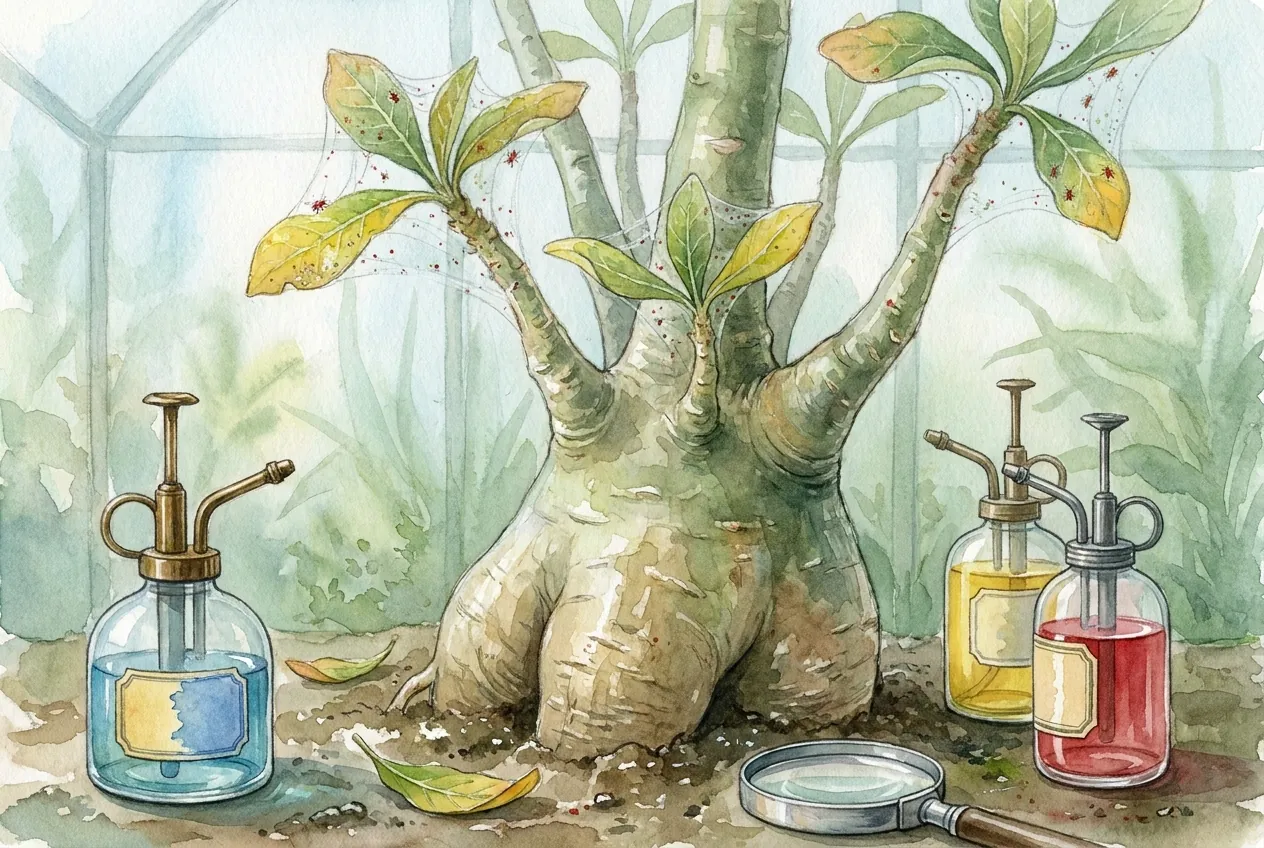
- Confirm moving mites before buying any pesticide. Isolate the plant, inspect leaf undersides with a 10× lens, and tap foliage over white paper.
- For one or a few indoor plants, washing (where tolerated) plus an indoor-labeled ready-to-use insecticidal soap are the most proportionate first steps. Patch-test one area and follow the current container label.
- Do not buy a seven-product rotation kit. Avid and TetraSan are commercial-use, and Actuate is a state-registered concentrate with application limits. The label, not an internet calendar, sets every interval and maximum.
- Predatory mites are a good nonchemical purchase only when the pest species, room humidity, shipping, and prior pesticide residues all fit. They are live, perishable organisms, so seller quality is part of the product.
- Escalate only if monitoring shows the first legal, plant-safe option failed after correct coverage. Discarding one heavily infested, replaceable plant is a valid control decision, not a failure.
For a single infested Adenium on a windowsill, do not start by ordering three professional concentrates. The practical job is to identify the pest, reduce the population without injuring the plant, and escalate only if monitoring shows that the first legal, plant-safe option failed.
Is it actually spider mites?
Confirm the Pest Before Treating Damage
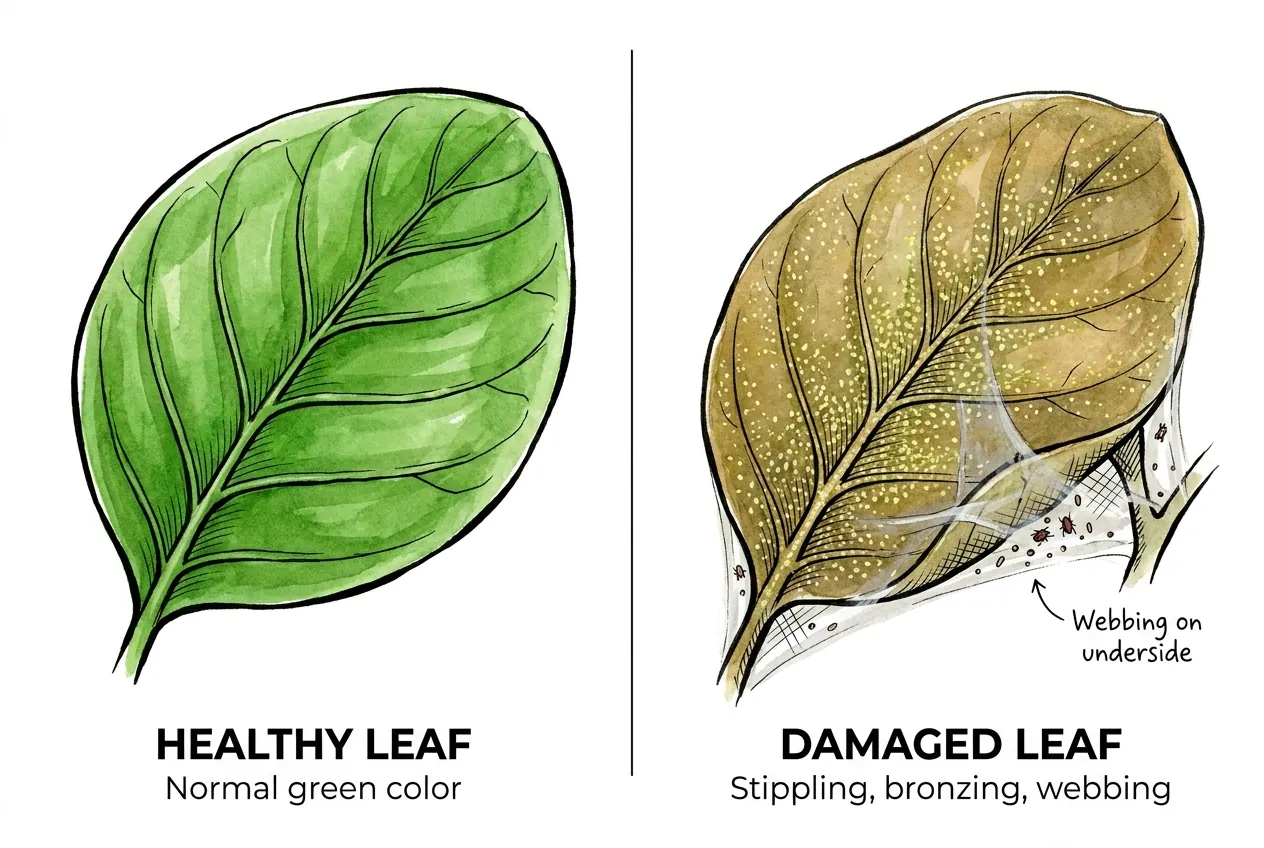
Spider-mite feeding often appears as many pale stipples that merge into a dull or bronzed area. Webbing usually means the infestation is established, but lack of webbing does not rule mites out. Inspect the underside of several affected and unaffected leaves, not just the worst leaf.
Use a hand lens and white-paper test
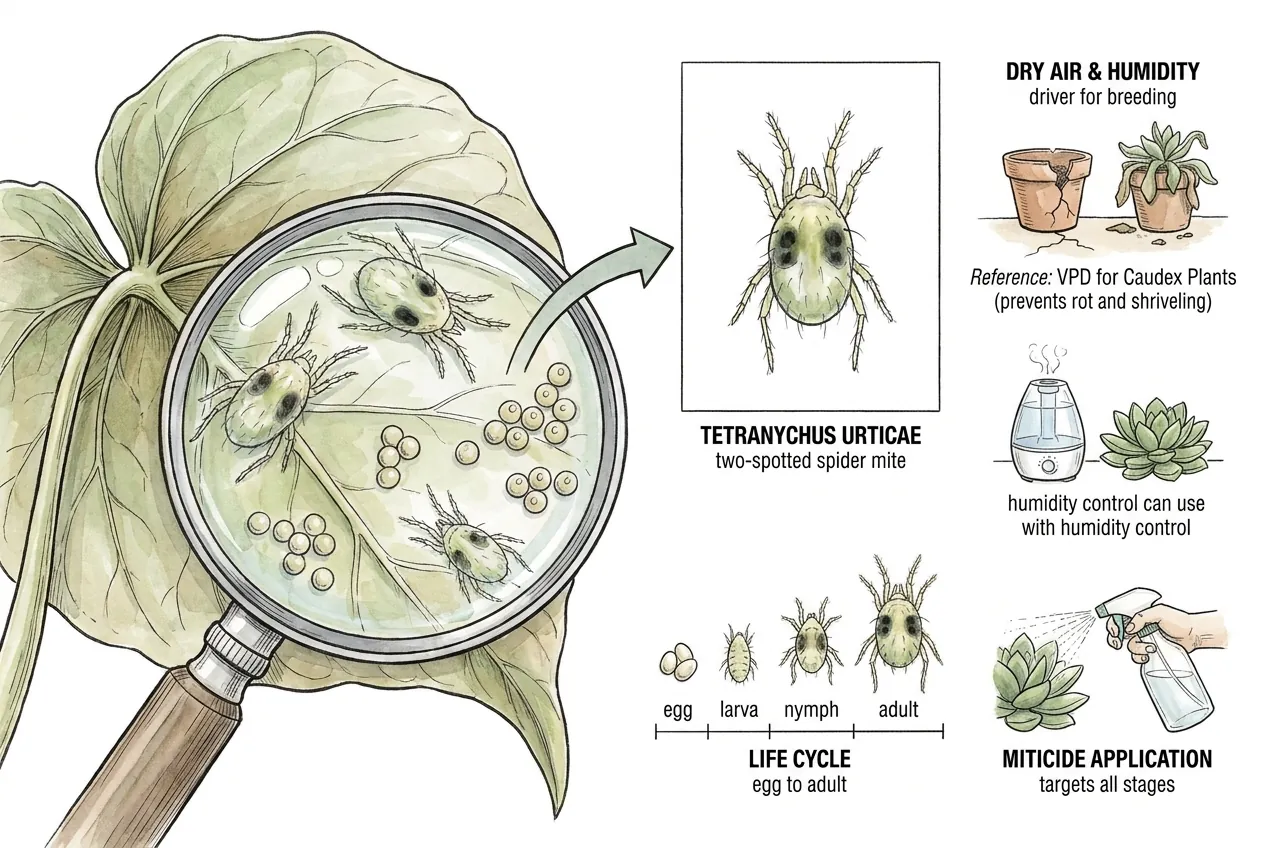
Tap a leaf over white paper and watch for moving dots, then use a hand lens. Adult spider mites have eight legs, but several plant-feeding mite species and harmless predatory mites can occur together. Broad and cyclamen mites are much smaller and can produce distorted new growth without obvious webbing. A product that lists Tetranychus spider mites may not control those pests.
Keep look-alikes in the differential
Do not diagnose from leaf color alone. Sun injury, edema, spray burn, nutrient problems, thrips, and leaf-spot disease can overlap. The Adenium white-spots checklist helps separate stippling from several common look-alikes.
What should you do before buying a pesticide?
Isolate the Plant and Check Its Neighbors
Move the plant away from the collection and stop shared runoff. Bag badly infested fallen leaves, clean the shelf, and wash your hands before handling other plants. Check neighboring plants because a clean-looking plant can still carry a small population.
Use water removal without creating a wet root zone
Where the species and potting setup tolerate it, a firm water spray can remove many mites from leaf undersides. Protect the pot from becoming waterlogged and avoid damaging tender leaves. Reduce dust and correct genuine water stress, but do not raise humidity blindly. A caudex with a wet root zone does not become safer because mites prefer dry conditions.
Record a baseline before judging control
Photograph the same leaves and record a baseline count from the white-paper tap test. Old stippling will not turn green again, so treatment success means fewer live mites and healthier new growth, not cosmetic repair of damaged tissue.
Before washing or treatment, I choose three sentinel leaves on one plant. The set includes one older stippled leaf, one middle-aged leaf, and the youngest fully expanded leaf. A fixed pot-rim canopy photograph locates each leaf with numbered labels placed in the mix, never on the plant.
Each check starts with the same three leaf undersides, followed by tapping each branch over its numbered white card. I record moving mites separately from eggs, webbing, and old stippling, and I make the check before spraying or rinsing that day. Clean new tissue and a falling live-mite count tell me more than the color of the oldest damaged leaf.
If a sentinel leaf drops or must be removed, I retire that identifier and start a new line for its replacement. I never splice the replacement count onto the old leaf’s history because removing a heavily infested leaf can otherwise make treatment appear more successful than it was.
Discard when containment is safer
Discarding one heavily infested, replaceable plant can be cheaper and safer than repeatedly spraying an indoor collection. That is a valid control decision, not a failure.
Which products deserve a place on the shortlist?
Match the Option to the Setting
The available options do not belong in one cart. They serve different users, sites, and risk levels.
| Option | Reason to consider it | Reason to skip it |
|---|---|---|
| Bonide Insecticidal Soap RTU | Current label includes indoor houseplants and spider mites. No mixing | Contact-only. Requires coverage and a plant-sensitivity test |
| Bonide All Seasons Oil RTU | Current label includes certain houseplants and spider mites | Caudex species may be absent. Heat, drought, sulfur, and light restrictions |
| Avid 0.15EC | Commercial Group 6 option for labeled ornamental production | Not a household default. Commercial label and substantial PPE requirements |
| Actuate SC | Group 20D label covers listed mites on potted ornamentals in several settings | Concentrate, state registration, application limits, and plant tolerance matter |
| TetraSan 5WDG | Commercial Group 10B growth inhibitor for labeled ornamental uses | Intended for commercial use. No adult knockdown and strict application limits |
| Phytoseiulus persimilis | Fast specialist predator for confirmed Tetranychus in suitable humidity | Short shelf life, climate-sensitive, and needs compatible pesticide history |
| Neoseiulus californicus | Broader operating range and better persistence at low spider-mite density | Still climate- and residue-sensitive. Live-delivery quality is seller-dependent |
Which product is the default for indoor caudex plants?
Use Indoor-Labeled Soap as the Narrow Household Option
Bonide Insecticidal Soap RTU is the clearest fit among these listings for a home grower. Its current U.S. label identifies 1% potassium salts of fatty acids, lists spider mites, and permits use on houseplants in homes. It is ready to use, which removes concentrate-measuring error.
Coverage matters more than a calendar
This is a contact product. The label requires direct wetting of pests and all plant parts, including leaf undersides. It permits weekly or biweekly repetition if needed. That does not mean every caudex needs a weekly spray. Reinspect first and do not exceed the label.
Patch-test a small area and wait for injury before treating the plant. The label warns against full-sun application and calls for care on seedlings, transplants, and blooms. Spray drift, floors, pets, aquariums, and runoff still matter even for a lower-risk product.
Buy soap only when the label and patch test fit
Buy it when mites are confirmed, the plant is a label-covered indoor houseplant, the canopy is small enough to cover thoroughly, and you can repeat inspections. Skip it when the plant reacted to the patch test, mites cannot be confirmed, or the infestation is so extensive that disposal is safer.
When does horticultural oil fit?
Check the Complete Oil Label
Bonide All Seasons Horticultural Oil RTU uses 2% mineral oil and controls listed mites by coating them. Its current U.S. label includes a houseplant section, but it names plants. Do not assume ornamental automatically covers every Adenium, Pachypodium, Euphorbia, or other caudex species.
Respect temperature and sulfur restrictions
The restrictions are more important than the marketing. The label says not to apply above 90°F or below 40°F, to drought-injured plants, in direct sunlight behind glass, or within 30 days of sulfur. It identifies sensitive plants and instructs users to test a small number of plants or branches before general spraying.
Choose one labeled contact option at a time
Choose soap or oil according to the applicable label. Do not invent a soap-and-oil tank mix. Each can injure foliage, and neither product label on this page supplies a universal caudex combination recipe.
Buy oil only when plant and site coverage are explicit
Buy it when your exact plant or use site is covered, sulfur history and temperature are safe, the plant is not water-stressed, and a patch test passes. Skip it when the species is absent or ambiguous, the plant sits in hot window light, or you recently used sulfur.
Should a home grower buy Avid, Actuate, or TetraSan?
Keep Professional Concentrates Outside the Household Default
Usually not Avid or TetraSan. These are not interchangeable stronger versions of houseplant soap.
| Product | Current U.S. label signal | Decision for a typical home collection |
|---|---|---|
| Avid 0.15EC | Group 6 abamectin. Agricultural/Commercial Use. Greenhouse handlers need specified respiratory protection | Skip and use an indoor-labeled home option or licensed professional |
| Actuate SC | Group 20D bifenazate. Potted ornamentals and some residential/interior landscaping uses. No more than two applications per crop year | Possible escalation only after state, site, plant, pest, PPE, measuring, and disposal checks |
| TetraSan 5WDG | Group 10B etoxazole. Intended for commercial use. Ornamental restriction of one application per growing season | Skip for casual household use. It also does not provide adult knockdown |
Treat Actuate as a regulated escalation
Actuate is the only one of these three whose specimen label explicitly includes potted ornamentals around residences and interior landscaping. That does not make it a universal indoor recommendation. Registration varies by state, not every ornamental variety has been tested, and the label requires thorough coverage, record keeping, application limits, and protection of people, water, fish, birds, pollinators, and treated areas.
Read the exact container label
None should be selected from active ingredient alone. Read the label attached to the exact container you will buy. Marketplace photos and copied descriptions can lag behind. Outside the United States, use your national registration database and local label.
What does IRAC rotation really mean?
Use Resistance Groups as Management Context
IRAC classifies abamectin as Group 6, etoxazole as 10B, and bifenazate as 20D. Different group numbers indicate different primary modes of action. That helps a professional avoid repeatedly exposing successive pest generations to one group.
Do not build a rotation from group numbers
It does not mean a home grower should buy one bottle from every group or switch products every five to seven days. IRAC describes spray windows and says local expert advice, pest biology, cross-resistance, and product labels determine timing. Several applications of one group may be allowed within a window, while some labels on this page permit only one or two applications in a much longer period.
Follow a proportionate household sequence
For household use, the decision order remains simple.
- Confirm the mite and the label-covered plant and site.
- Start with physical removal and one proportionate, selective option.
- Reinspect using the same method and wait for the label's evaluation or repeat interval.
- If control fails at the label rate after correct coverage, verify identification and ask extension or a licensed professional before changing chemistry.
Do not call a rebound resistance from timing alone. Missed undersides, new arrivals from adjacent plants, a wrong mite identification, heat injury, and eggs hatching after a contact treatment can look similar.
Are predatory mites a better purchase?
Buy Predators as Live Biological Agents
They can be, especially when avoiding indoor pesticide exposure matters and the infestation is still measurable. They are live, perishable organisms, so seller quality and delivery timing are part of the product, not afterthoughts.
Match the species to the confirmed pest
Phytoseiulus persimilis is a specialist for two-spotted and related Tetranychus mites. Koppert lists an effective range of 13–27°C and sensitivity below 70% relative humidity. It should not be bought for broad, cyclamen, or russet mites, and it needs prey to persist.
Check room conditions before ordering
Neoseiulus californicus tolerates warmer and somewhat drier conditions and can persist on other foods when spider mites are scarce. Koppert still lists sensitivity below 60% relative humidity, so dry-room predator is relative, not unlimited.
Verify live-delivery conditions before ordering
Buy only from a seller that states the species, count, dispatch date, shipping method, arrival guarantee, storage instructions, regional restrictions, and support for calculating a release rate. Compare those terms on the exact Amazon offer. A product title alone cannot prove viability. Arrange delivery for a day when you can inspect and release promptly.
How do pesticide residues affect predators?
Do Not Assume a Universal Residue Interval
There is no universal wait until the residual clears number. Toxicity differs by active ingredient, formulation, dose, crop, predator species, and time since application. Washing a leaf does not reliably erase a systemic or translaminar exposure.
Give the predator supplier a complete residue history
Build a complete treatment history before ordering live mites. Record the exact product, EPA or national registration number, rate, date, number of applications, and any tank mix. Give that list to the predator supplier and check its compatibility database for the exact predator.
Use product-specific compatibility evidence
Do not assume every residual miticide kills every predator. The current Actuate label specifically lists Phytoseiulus persimilis, Neoseiulus species, and other beneficials as compatible when the product is used as directed. Other products can have different direct and residual effects. Product-specific evidence wins over a blanket rule.
Delay release when compatibility is unclear
If the pesticide history is unknown, delay the purchase and ask the supplier. Live mites delivered into an incompatible residue are an expensive loss and a failed treatment.
How do you know whether treatment worked?
Use the Same Monitoring Method
Use the same inspection method each time. Record live mites from the same number of leaves or white-paper taps, new webbing, new stippling, plant water status, and which neighboring plants were checked. A single clean leaf is not proof that the collection is clear.
Evaluate on the product or supplier interval
Judge contact products after the label's stated repeat or evaluation interval. Reapply only if the label permits it and live mites remain. For predators, use the supplier's scouting and repeat-release plan. The absence of visible predators immediately after release does not prove failure.
Reassess before raising the dose
Stop and reassess if damage continues but mites are no longer found, if leaves burn after a patch test, or if the product fails at its label rate after verified coverage. Do not raise the dose. Recheck the pest, product storage, spray coverage, nearby source plants, and environmental stress, then contact extension or a licensed pest professional.
Continue isolation after clean checks
Once no live mites are detected across repeated checks and new growth is clean, keep the plant isolated through at least the monitoring period recommended by your chosen label or biological-control supplier. Continue checking neighboring plants instead of applying preventive pesticides without a target.
Which product fits your situation?
| Situation | Most defensible next step | Do not buy yet |
|---|---|---|
| Damage but no confirmed mites | Hand lens, white-paper test, photos, expert identification | Any miticide |
| One or a few indoor plants, light confirmed infestation | Isolation, washing if tolerated, indoor-labeled RTU soap | Commercial concentrates and a full “rotation” |
| Soap-sensitive plant or label mismatch | Ask extension or the plant supplier for a label-covered alternative | Household detergent or an unlabeled oil mix |
| Exact plant is on the oil label and all restrictions pass | Patch-test the RTU oil and follow that label alone | Oil after sulfur, in hot glass light, or on a dry-stressed plant |
| Confirmed Tetranychus, suitable room, no incompatible residue | Live predator from a supported, time-definite seller | A listing without species, count, dispatch, or live-arrival terms |
| Large collection or repeated label-rate failure | Extension, certified crop adviser, or licensed pest professional | Avid/TetraSan for improvised household use |
| Experienced U.S. ornamental grower considering Actuate | Verify state registration, exact label, plant tolerance, PPE, records, and disposal | Purchase based only on IRAC group or marketplace copy |
Choose the Narrowest Legal Option
The most defensible choice is the narrowest legal tool that matches the confirmed pest, plant, site, and scale. For most indoor readers, that means a ready-to-use soap or a carefully vetted live predator, not a shelf of professional concentrates.
Route root-zone pests separately
If the moving pests are in the root zone rather than on leaf undersides, stop and use the root-mealybug identification guide. If tiny flies and larvae are emerging from wet substrate, use the fungus-gnat treatment chooser. Neither problem is solved by a foliar spider-mite rotation.
Recheck current labels and availability
The options described here rely on current official labels, supplier specifications, and marketplace information rather than hands-on product testing. Registrations, labels, sellers, live counts, prices, and availability can change, so confirm the current offer and label before use.
Affiliate Disclosure
This article contains Amazon affiliate links. As an Amazon Associate I earn from qualifying purchases. If you use these links, the site may earn a commission at no extra cost to you. Product availability, price, and specifications can change. Check the current listing before buying.