
Fungus Gnat Control for Caudex Plants
Confirm fungus gnats with traps and a potato slice, correct the wet habitat, and choose the right labeled Bti size without risky DIY soil drenches.
Rachel Torres · 2026-08-04 · Updated 2026-08-05 · 15 min read
Key Takeaways
- Confirm larvae, correct the wet habitat, and use only a Bti product whose current label covers fungus gnats. Check with a yellow trap and a raw potato slice before buying anything.
- Killing adults without finding the wet source buys a quiet week, not control. At least one pot, tray, drain, or open bag of mix is staying damp enough to breed larvae.
- Seedlings and fresh cuttings are far more vulnerable to larval root feeding than an established caudex in a mineral mix. A declining mature plant with a few gnats usually needs a root and drainage inspection, not a stronger insecticide.
- Match the Bti package to your scale, and follow the exact label on the product you receive. Mosquito Bits and Gnatrol are both Bti but differ in strain, concentration, and directions.
- Moisture and sanitation changes do the long-term work. The pesticide only buys time. Skip peroxide drenches and foliar spinosad, which are not labeled for a fungus gnat soil drench.
What should you buy first for fungus gnats?
Confirm the Insect Before Buying Treatment
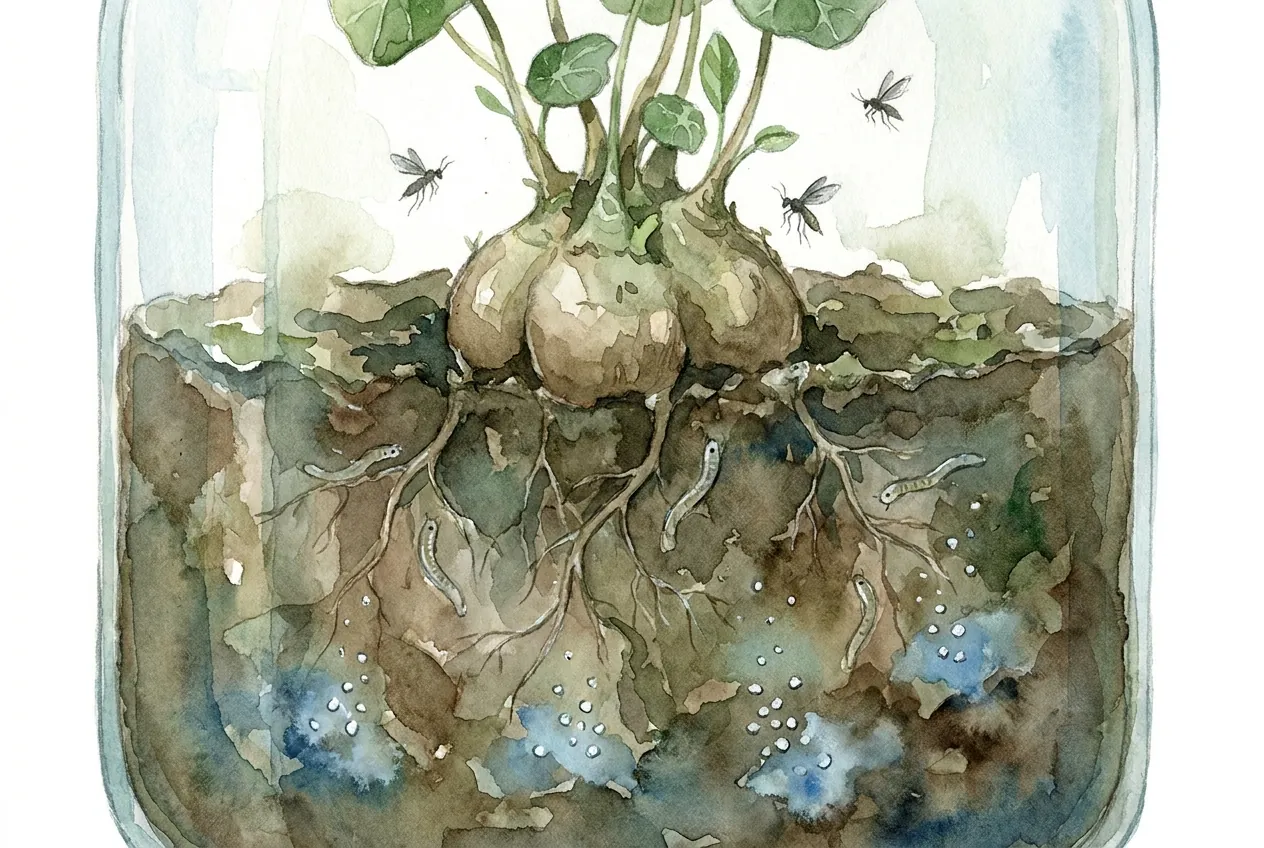
Buy nothing until you confirm the source. Fruit flies, drain flies, shore flies, and fungus gnats call for different cleanup. A small yellow sticky trap shows which pot the adults visit, while a slice of raw potato placed cut-side down on the mix can attract fungus gnat larvae. Check the underside after a few days for translucent, legless larvae with dark head capsules.
Keep the first kit small
If the diagnosis is clear, the minimum useful kit is usually a labeled Bti product plus yellow cards. The cards monitor adults. Bti targets feeding larvae. Moisture and sanitation changes do the long-term work.
| Situation | First action | Likely purchase |
|---|---|---|
| One or two adults, no larvae found, plant healthy | Find damp source, remove debris, and adjust watering | A few yellow cards, or nothing |
| Larvae confirmed in one to several pots | Correct moisture and apply a home-use Bti exactly as labeled | Mosquito Bits plus cards |
| Large bench with recurring confirmed larvae | Standardize scouting, watering, and a label-compliant Bti program | Only then consider bulk Gnatrol WDG |
| Collapsed mix, sour smell, or damaged roots | Inspect roots and repot if needed | Fresh substrate. Insecticide alone will not repair the habitat |
How much harm do fungus gnats cause a caudex?
Separate Nuisance Adults from Root-Feeding Larvae
Adults do not feed on the plant. They are mainly a nuisance and a monitoring signal. Larvae feed mostly on fungi and decaying organic matter, but high populations can feed on fine roots. Seedlings, cuttings, and young plants are more exposed than a mature caudex with a healthy root system.
Do not blame every decline on gnats
That distinction is more useful than treating every fly as a root-rot emergency. UC IPM notes that excess or deficient water, poor drainage, and root disease are more common causes of wilting than fungus gnat injury. If a mature Pachypodium is soft or stalled, inspect the roots instead of assuming the larvae caused it.
Keep pathogen evidence in context
Fungus gnats can also move plant pathogens under production conditions. A controlled study showed Bradysia impatiens larvae transmitting Pythium aphanidermatum to geranium seedlings. That supports prevention around propagation material. It does not prove that every gnat beside an Adenium carries Pythium or that the insect caused an existing rot.
Use a separate root-rot diagnosis
If the caudex itself is soft, discolored, or foul-smelling, use the root-rot diagnosis and treatment guide. Gnat control and root-rot diagnosis are related jobs, not interchangeable ones.
Why does one treatment often appear to fail?
Account for overlapping life stages
Eggs, larvae, pupae, and adults overlap in an established infestation. Bti acts on susceptible feeding larvae. It does not kill the adults already on a trap or the pupae about to emerge. New adults can therefore appear after an effective larval treatment.
Follow the label course
The current Mosquito Bits water-treatment directions call for weekly applications for three weeks. The current residential Gnatrol/VectoBac WDG directions also use a weekly course, but the formulation and rate are different. Read the product in your hand because labels and local registrations can change.
What is Bti, and what does its label still require?
Keep Bti Within Its Labeled Target
Bacillus thuringiensis subsp. israelensis, or Bti, is a microbial larvicide used against certain fly larvae. Fungus gnat larvae must consume it. That narrow target is why Bti is a reasonable first pesticide option after cultural control, and why it does nothing to the adults on the window.
Follow the biological product label
Biological does not mean instruction-free. The current EPA labels for both Mosquito Bits and Gnatrol carry the signal word CAUTION and include precautions for dust, mist, eyes, skin, storage, and disposal. Follow the physical label, use the required protective measures, keep the product in its original container, and do not improvise a stronger mix.
Fit treatment to watering safety
With a caudex, fold the treatment into a normal watering event whenever the label allows. Do not add an extra soaking to a cold, dormant, or root-damaged plant merely to deliver Bti. If the plant cannot safely be watered, correct the root-zone problem first.
Before I prepare any labeled Bti treatment, I use the pot records to identify which confirmed-source pots are actually ready for a normal watering. I total only the volume those pots can receive under the label method and mix for that treatment group. A nearby quarantine pot does not receive extra water merely because solution is available.
The labeled concentration never changes merely to fit a smaller water allowance. If the required application and the plant’s safe watering state cannot coexist, I keep the pot isolated until a label-compliant opportunity or different labeled plan is available. My treatment entry lists prepared volume, volume delivered to each pot, drainage containment, and label-directed disposal.
Which Bti size should you buy?
Match Package Size to Confirmed Scale
The active ingredient matters, but so do package size, the exact label attached to that package, and how many pots you can treat before the product sits around opened. The available options serve very different scales.
Mosquito Bits for a home collection
Use a smaller labeled option for a home collection
The 30-ounce Summit Mosquito Bits listing is the straightforward home-collection choice when several pots are confirmed. The current EPA label permits either a measured surface application or a water treatment for fungus gnat larvae.
For the water method, the accepted label says to mix four tablespoons per gallon, soak for 30 minutes, remove the floating carrier, and apply enough treated water to wet the media surface. It then specifies weekly treatment for three weeks. Treat that as a summary for comparison, not a substitute for the label on the package you receive.
The 8-ounce Mosquito Bits multi-pack listing separates the same type of product into smaller containers. Compare the current bottle count and total ounces on Amazon before ordering because marketplace bundles change. It suits a grower who values sealed smaller containers more than the lowest cost per ounce.
Do not buy before confirmation
Skip either size if you have not found larvae or if one healthy plant produced a single stray adult. A label-compliant pesticide still has no job when the diagnosis is missing.
When does bulk Gnatrol WDG make sense?
Reserve bulk product for recurring larger-scale work
The linked 16-pound Gnatrol WDG pail is not Mosquito Bits. It is a water-dispersible granule containing 37.4% Bti strain AM 65-52 under EPA registration 73049-56. The current label includes distinct commercial and residential sublabels and rates.
This package fits a nursery-scale bench with recurring larvae, measured mixing, staff who will follow the applicable label, and enough throughput to use a 16-pound pail correctly. It is badly oversized for a windowsill collection. For most home growers, the bulk pail increases cost, storage burden, dust exposure, and dosing risk without improving the result.
The current residential sublabel directs 1–1.5 teaspoons per gallon as a soil drench, repeated weekly for at least three weeks. A commercial pail may bear a different applicable sublabel, so the container label controls. Never transfer a rate from a blog, or from Mosquito Bits, to Gnatrol by active-ingredient name alone.
Which traps and substrate changes help?
Use yellow cards as a trend, not a cure
Use cards to compare the trend
The Faicuk 20-pack of dual-sided yellow cards is useful for a multi-pot collection because the sheets can be cut down and mapped to problem areas. Sticky cards capture adults, but they do not reveal how many larvae remain in the pot.
Put a numbered card near the media or lower canopy, keep its position and inspection interval consistent, and record catches once or twice a week. Replace it on the same schedule. A downward trend after cultural and Bti treatment is informative. Comparing an old full card with a new card is not.
Skip a 20-pack for one small plant if a few inexpensive plant-sized cards will do. Also keep large exposed cards away from leaves, hair, pets, and wildlife. The adhesive is indiscriminate.
On an affected bench, I give every pot an identifier and draw a quick map before moving anything. Each sticky card stays with one pot and at one height. When I replace a card, I write the pot identifier and exposure dates on the backing so a wandering adult does not turn into a vague collection-wide diagnosis.
Equal-size potato pieces go only on pots made suspicious by the first card round, with every bait started together. I photograph each underside beside its pot tag after the exposure period written on all bait labels. A piece that dries, curls away from the mix, or is disturbed becomes an invalid check rather than a false zero.
I keep adult captures, visible larvae, and the last watering date in separate columns, then divide each card count by its exposure days before comparing pots. A pot with repeated adult activity and a valid larval check moves to the front of my source list. One fly on one card remains a clue rather than proof.
Does a pumice cap stop fungus gnats?
Use a mineral layer only for a defined substrate role
Do not treat a decorative mineral layer as a sealed barrier. Adults can use gaps, drainage holes, or another wet pot, and the organic mix below can remain moist even when the stones look dry. A cap can make the surface cleaner and faster-drying, but it does not replace watering correction or Bti.
Bonsai Jack quarter-inch pumice is worth buying when you already need screened mineral aggregate for a better-draining caudex mix or a clean top dressing. It is easy to remove for inspection and fits the material choices in the pumice, akadama, and gritty-mix comparison.
Do not hide a wet habitat
Skip it if the only goal is to bury an unresolved infestation. Adding half an inch of stone to a water-retentive, decomposed mix can hide the moisture signal without changing the habitat underneath.
Why aren’t peroxide and Deadbug Brew in this plan?
Do Not Improvise a Peroxide Drench
Swan 3% hydrogen peroxide is not a sound fungus gnat soil treatment choice. The household product is not labeled with a fungus gnat soil-drench rate, and university IPM recommendations do not need it when moisture control and labeled Bti are available. Its breakdown products do not establish that a DIY dilution is effective or harmless to stressed roots.
Keep foliar products on their labeled site
Bonide Captain Jack’s Deadbug Brew concentrate is also a poor fit for this job. Bonide’s current product page describes a spray for listed foliage-feeding pests. It does not list a fungus gnat soil drench. Spinosad can be useful on pests and sites named by a product label, but that does not authorize moving this formulation into a caudex pot.
Recheck the diagnosis when Bti and habitat correction fail
If a labeled Bti course and habitat correction fail, re-check the identification and source. UC IPM lists Steinernema feltiae nematodes as another biological option under suitable temperature and moisture conditions. A local extension or licensed pest professional can help with a persistent greenhouse-scale problem.
What is the step-by-step control plan?
Use a Staged Control Loop
- Isolate and map. Keep newly affected plants away from propagation trays. Place numbered yellow cards and check nearby drains, saucers, wet moss, and open potting mix.
- Confirm larvae. Put a raw potato slice cut-side down on suspect media. Inspect and replace it after a few days.
- Remove the habitat. Clear dead leaves, algae, and spilled organic mix. Empty standing water. Make sure drainage holes are open.
- Adjust watering to the plant. Let the surface dry as far as that species and growth stage safely allow. A seedling tray may need Bti because it cannot dry like a dormant Pachypodium.
- Apply one labeled Bti product. Use its fungus gnat directions, rate, protective measures, and interval. Do not stack Mosquito Bits and Gnatrol.
- Review the trend. Count adult captures on a fixed schedule and re-check potato slices. Expect some adults to emerge while earlier pupae finish development.
- Inspect or repot when the mix is the problem. Collapsed, persistently wet media and decaying roots require a clean pot and suitable fresh substrate, not another pesticide.
Bottom-watering can keep the upper surface drier, but it is not a complete pest program and it can concentrate salts when used without periodic leaching. The top-down versus bottom-watering guide explains that tradeoff. For repeatable moisture decisions, use the caudex watering measurement setup.
What makes fungus gnat control fail?
Check the Common Failure Modes
- Wrong insect. Sticky cards catch several small flying pests, so confirm body shape and larvae rather than relying on the word gnat.
- Wrong source. Treating pots does nothing when larvae are developing in a drain, propagation bin, or forgotten bag of moist mix.
- Adult-only control. A full yellow card can reduce nuisance adults but leaves larvae in the media.
- Mixed label directions. Mosquito Bits and Gnatrol are both Bti products, but concentration, rate, and package instructions differ.
- One treatment. Overlapping life stages often require the full label course and follow-up monitoring.
- Wet habitat left unchanged. Bti can reduce larvae. It cannot open a blocked drain hole or rebuild decomposed substrate.
- Overcorrection. Drying an actively growing seedling too far or soaking a dormant caudex for a drench can harm the plant more than the gnats.
After captures return to a low baseline and potato slices stay clear, stop treating on autopilot. Continue normal sanitation and moisture checks. Pesticide maintenance without evidence creates expense and can hide the care problem that invited the gnats.
When catches fall, I do not release the collection from monitoring on the strength of one empty card. I replace all mapped cards together, run the same valid bait check on the former source pots, and keep the exposure interval unchanged. A dried bait or a card that fell over does not count as a clean result.
The final source map also covers wet areas outside ordinary plant pots, including propagation enclosures, cachepots, stored open mix, saucers, and nearby drains. If adults reappear, I add the overlooked source instead of restarting treatment across every pot. My exit note states the monitored interval and evidence found, never that the room is permanently gnat-free.
Frequently asked questions
Does Bti kill adult fungus gnats?
No. It targets susceptible larvae after ingestion. Use cards to monitor or reduce adults, and judge the larval treatment over the full labeled course rather than by tomorrow’s window count.
How long until the gnats are gone?
There is no responsible overnight promise. Existing pupae can still emerge, and reinfestation can come from another wet source. Follow the product’s multi-week label directions and look for declining card and potato-slice counts.
Should I use a 1:4 hydrogen peroxide drench?
Do not use a fixed DIY peroxide dilution. The linked household peroxide is not labeled for fungus gnat soil treatment, and root tolerance does not become predictable because the starting bottle says 3%.
Are the flies harming an established caudex?
The adults are mainly a nuisance. High larval populations can injure fine roots, especially in seedlings and young plants, but watering, drainage, and root disease are more common explanations for a declining mature specimen.
Do I need Bti, traps, pumice, peroxide, and spinosad?
No. A confirmed home infestation usually calls for habitat correction, one appropriately sized labeled Bti product, and enough yellow card material to monitor the affected area. Pumice is conditional substrate material. Peroxide and this spinosad formulation are not in the treatment plan.
Are Mosquito Bits and Gnatrol the same product?
No. Both contain Bti, but they use different strains or formulations, concentrations, package sizes, and directions. The current Mosquito Bits label lists 2.86% strain SUM-6218. The current Gnatrol/VectoBac WDG label lists 37.4% strain AM 65-52. Follow the label for the exact product.
Can I drench a dormant caudex with Bti?
Do not add an otherwise unnecessary watering to a cold or dormant plant. Isolate it, remove the damp source, trap adults, and wait for a safe watering opportunity unless the physical label and a plant-health professional support another approach.
Should I repot every plant with fungus gnats?
No. Repot when the mix is decomposed, persistently wet, contaminated, or associated with damaged roots. A light infestation in sound, fast-draining media can often be managed without disturbing a healthy caudex.
Affiliate Disclosure
This article contains Amazon affiliate links. As an Amazon Associate I earn from qualifying purchases. If you use these links, the site may earn a commission at no extra cost to you. Product availability, price, and specifications can change. Check the current listing before buying.