
Why Your Adenium Drops Flower Buds in Heat (Bud Blast)
Adenium flower buds can drop during heat, but bud blast is only one possibility. Compare moisture, roots, recent changes, and heat exposure before adjusting care.
Rachel Torres · 2026-07-05 · Updated 2026-07-13 · 17 min read
Key Takeaways
- Check moisture before adding water. A firm caudex with still-damp soil points away from thirst, so check the actual soil and roots before deciding whether to water.
- Treat heat as a risk signal, not an exact cutoff. Severe heat can abort developing buds (bud blast), but desert roses flower into the low-to-mid 30s °C, so do not assume 35 °C alone is the culprit.
- Keep other causes in the differential. Reproductive tissue is more heat-sensitive than leaves, so a plant can look healthy while buds drop from over- or under-watering, root damage, sudden changes, dry air, wind, or pests.
- Water from dryness, not a schedule. Chronic overwatering in heat is a major killer, so water only when the mix is genuinely dry, but do not withhold water from a plant that has actually dried out.
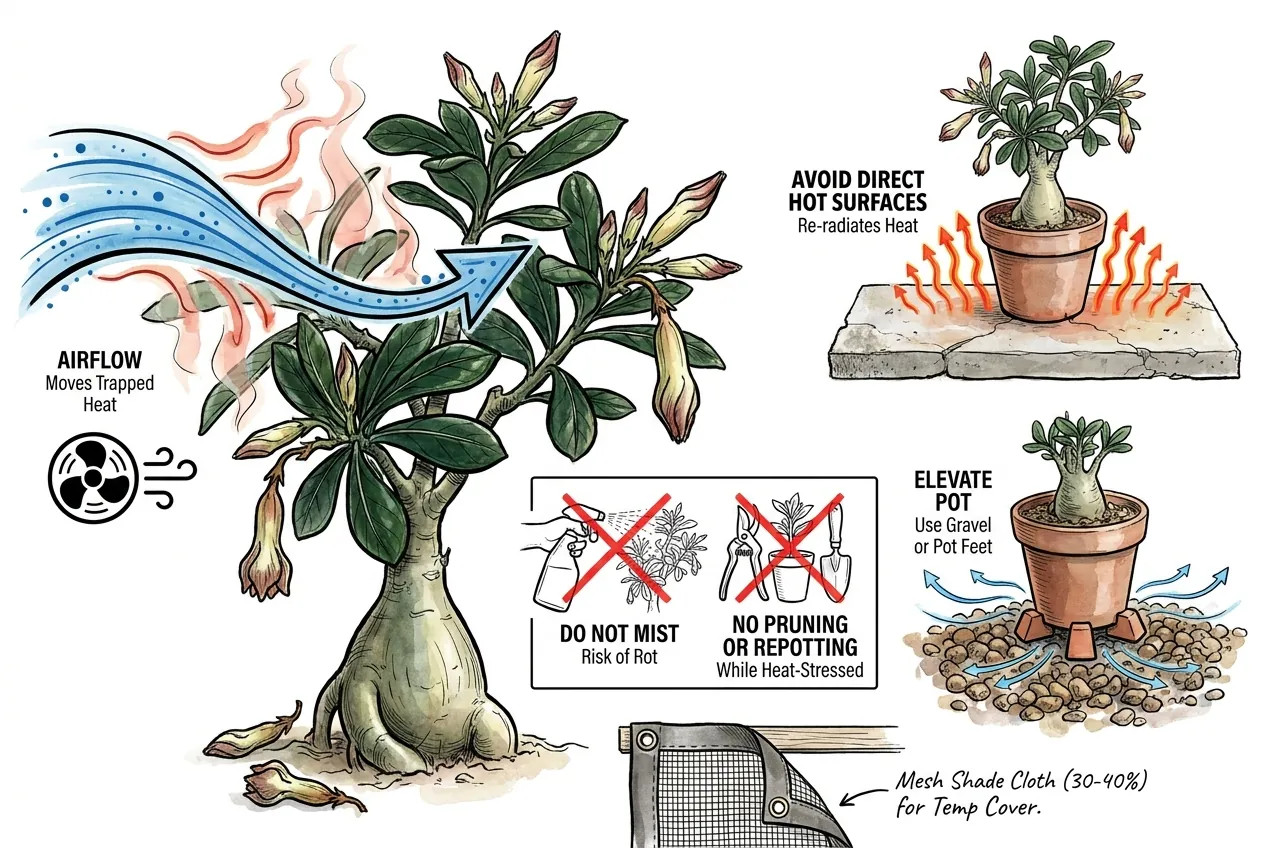
- Cool the plant during peak exposure. Use light afternoon shade, airflow, and a position away from hot concrete during the hottest hours.
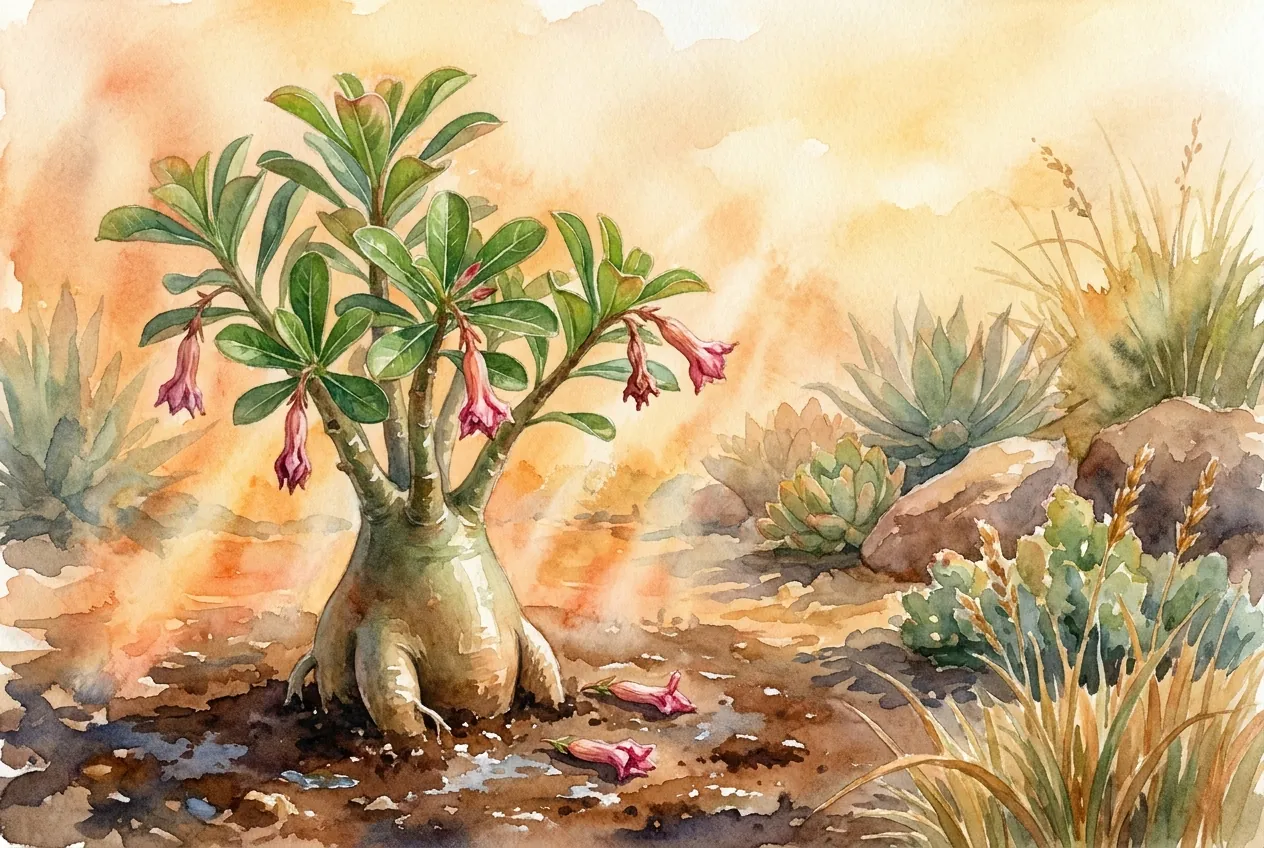
Your desert rose set a dozen fat buds, a heat wave rolled in, and then the buds yellowed and dropped before a single one opened. The reflex is to grab the watering can, but if the plant already has water, drenching it can do more harm than good on a rot-prone caudex succulent.
One likely cause during a heat wave is bud blast, a heat-driven drop of developing flowers. But it is not the only cause of bud drop, so the goal here is to diagnose before you act, not to reach for the hose by default.
What is bud blast, and why isn’t it always underwatering?
Keep heat as one suspect among several
Bud blast is the abortion and drop of developing flower buds under heat stress on the plant's reproductive tissue, rather than from a lack of water. When it gets hot enough, the tissue that builds pollen inside a bud can fail, and the plant sheds the bud it can no longer finish. Note, though, that flower buds also drop for other reasons, over- or under-watering, root damage, a sudden move or environmental change, dry air, wind, or pests, so heat is one suspect, not an automatic verdict.
Underwatering can produce leaf and caudex changes before or alongside bud loss, but symptoms overlap. Turgid leaves and a firm caudex make simple thirst less likely. Confirm with the mix, roots where accessible, and the plant’s recent history rather than assuming.
The trap is that several problems all end in dropped buds, so growers reach for the cause they can act on fastest. Adding water to a plant that already has enough just floods the root zone, and warm, wet soil is where a desert rose rots.
The opposite mistake is also real. Letting a genuinely dry plant stay dry in the heat because you assumed bud blast can damage it, which is why you check the soil.
How do I screen bud blast against thirst?
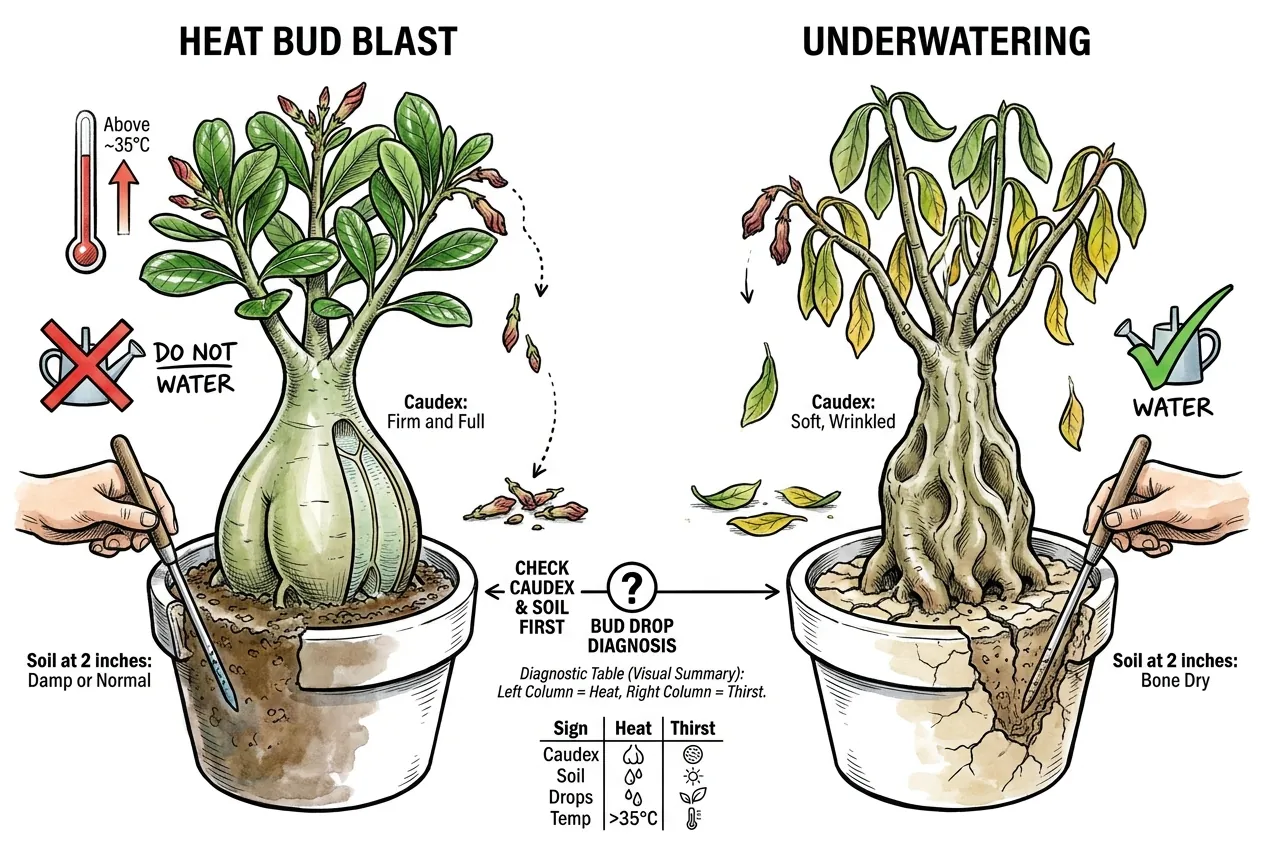
Check caudex firmness and soil moisture
A firm caudex with soil that is still damp points away from simple thirst.
The caudex stores water, so firmness is useful context but not a hydration meter. A soft, mushy, or wrinkled caudex can reflect rot, dehydration, temperature stress, or root loss. Compare it with soil moisture and other signs.
Check more than one part of the mix without injuring roots. A large pot can be damp at the surface and dry deeper down, or the reverse. Use the result with caudex condition, leaf posture, and recent weather. If the root zone is genuinely dry, water appropriately. If it remains wet, correct the environment before adding more.
Diagnostic table
| Sign | Pattern consistent with heat bud blast | Pattern consistent with underwatering |
|---|---|---|
| Caudex | Firm and full | Soft, wrinkled |
| Root-zone moisture | Damp or normal | Genuinely dry |
| Leaves | Turgid, healthy | Limp, drooping, dropping |
| What drops first | Buds, foliage stays fine | Leaves, then buds |
| Air temperature | During sustained heat | Any temperature |
If the signs point to heat rather than thirst and the soil is still moist, focus on cooling the plant instead of watering. If the soil is dry, water it. Cooling and correct watering are not mutually exclusive.
Because old and new buds can respond differently, I place numbered labels in the mix beneath the main flowering branches and photograph the same marked side each morning. The labels stay off the plant, but their numbers remain visible below each cluster in the image. This lets me return to the same buds after the canopy has shifted or the pot has been moved.
For each heat event, I follow one cohort that was already visible and count the buds that remain firm, yellow, or drop. Buds initiated after shade or cooling changes go into a separate cohort in my notes. Mixing old damaged buds with new ones can make an intervention look ineffective or successful for the wrong reason.
I pair each morning count with the maximum and minimum air temperatures recorded at bud height, the pre-watering pot mass, and the root-zone temperature. I also log watering, moves, shade changes, and pest treatments. Because bud fall can lag, I compare it with this short exposure history rather than the weather when it lands.
At what temperature does a desert rose start dropping buds?
Use temperature as a risk signal, not a cutoff
There is no validated Adenium temperature at which every bud begins to fail. Available cultivation observations and broader flowering studies show that response depends on cultivar, developmental stage, day and night temperatures, water status, airflow, and the duration of exposure.
Treat any single threshold as a study condition, not a home alarm.
What broader plant science does establish a useful principle. Reproductive tissue is more heat-sensitive than foliage.
In maize, a 48-hour spell of 35 °C day / 25 °C night at a vulnerable stage of pollen development cut pollen germination from about 80 percent to roughly 20 percent. In wheat, pollen sterility climbs once anthesis-stage temperatures pass about 31 °C.
These are different crops with different thresholds, so they do not set Adenium's number. But they show why a sustained, severe heat spell can damage flowers even when the leaves look fine.
Use the heat evidence within its limits
Truly extreme, prolonged heat can abort Adenium buds, while a normal warm summer may not do so on a well-acclimated plant. If your buds are dropping at ordinary summer temperatures, look harder at watering, roots, and sudden changes before blaming the heat alone.
Do hot nights matter, or just hot days?
Include the full day-night heat load
Hot nights can add to heat load because flowering responds to the full day-night pattern, not only the midday peak. How much they matter depends on the plant, pot, airflow, and exposure duration.
Use sustained heat as a risk signal rather than a fixed comfort band. Measure the plant’s microclimate where practical and look for concurrent moisture, root, or pest stress before assigning the bud loss to temperature alone.
A pot sitting on hot concrete can stay warm after sunset, because masonry stores heat and radiates it back at night. That warm-night effect can add to daytime heat stress.
Why does heat actually kill a flower bud?
Use reproductive heat biology as bounded context
In studied crops, severe heat disrupts pollen-making tissue partly through reactive oxygen species and by throwing off the precise timing the anther needs to build pollen. When that development is derailed badly enough, the bud fails and the plant drops it.
This mechanism is well documented in cereals. It has not been measured step-by-step in Adenium, so treat the following as the likely general explanation rather than a proven Adenium-specific pathway.
Inside a developing bud, a nurse tissue called the tapetum feeds the young pollen and then self-destructs on a strict schedule to release its nutrients. That self-destruction is driven by a controlled burst of reactive oxygen species. Heat makes the burst too big and too early.
When the tapetum dies at the wrong time, the developing pollen starves. Reactive oxygen species also damage membranes, proteins, and DNA directly. The bud ends up with sterile or dead pollen, and a flower that cannot be pollinated is not worth the plant’s energy.
Why do buds drop days after the heat wave passes?
Allow for delayed bud loss
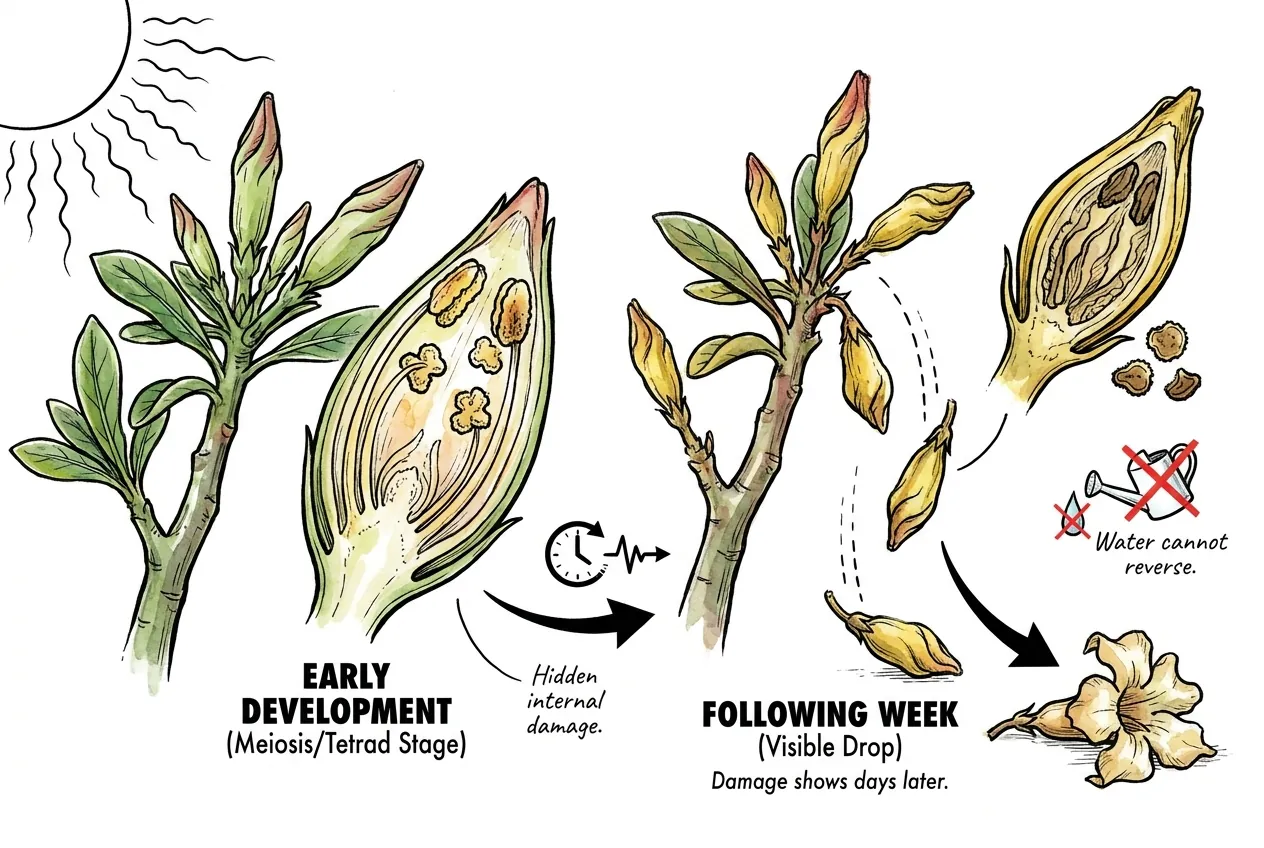
Because the damage happens at a hidden internal stage, days before the bud visibly yellows. The most heat-sensitive window is early in pollen development, around meiosis and the tetrad stage, deep inside a bud that still looks perfectly healthy on the outside.
Other crops show that damage during an early reproductive window can appear only when the flower opens. That lag is plausible in Adenium, but the timing and severity are not a validated schedule for this genus.
This lag is why watering may fail as a fix. By the time you see the drop, earlier damage may already be irreversible, so water cannot be assumed to restore that bud.
Why is watering more the wrong move?
Do not water a moist pot by reflex
A bud-dropping Adenium with a firm caudex and moist soil is usually not thirsty, and chronic overwatering during heat is one of the most common ways these plants die. If the soil is already moist, more water treats a problem the plant does not have and can create a fatal one.
If the soil is genuinely dry, of course, water it. The point is to check first, not to withhold water on principle.
The caudex is a buffer. It holds a reserve of water that carries the plant through dry spells that would wilt a thin-stemmed houseplant. When buds drop but the caudex is firm, that reserve is full.
Warm, persistently waterlogged soil can reduce oxygen and increase disease risk, but the cause depends on pathogen, roots, substrate, temperature, and duration. Root-rot context is useful. It is not proof that every bud drop or caudex change came from overwatering.
What does correct summer watering look like?
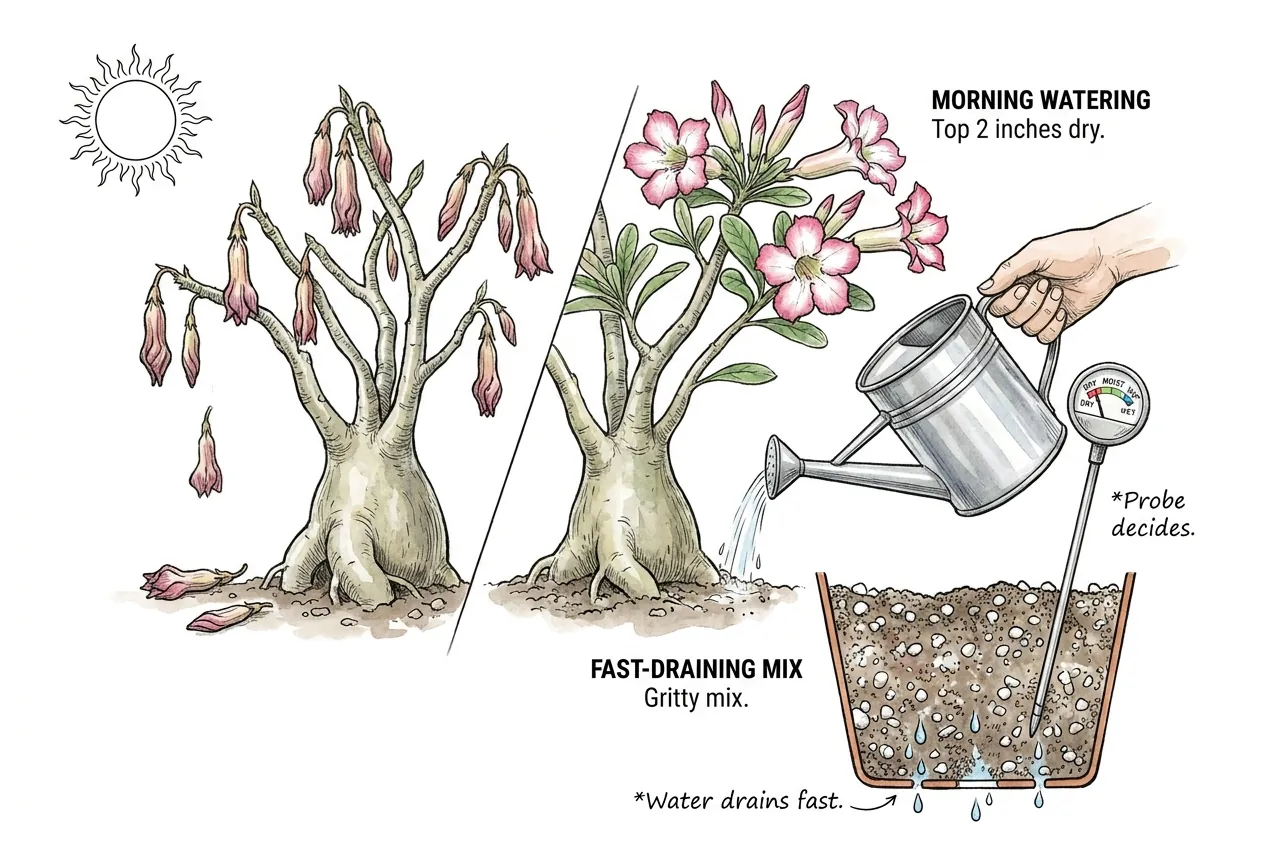
Water by the actual root-zone condition
Water when the root zone is dry for that container and the plant can use the moisture. A fast-draining mix and good drainage reduce the time roots remain saturated.
Morning watering can give a container more time to drain and dry, but the schedule still depends on pot, substrate, weather, and roots. Use repeated observations rather than a fixed interval or one probe reading.
Use a gritty cactus or succulent mix with added perlite or pumice so water drains promptly and roots are not left saturated for long periods.
The instrument that ends the guesswork
A fixed water-when-dry-at-two-inches rule can mislead because pots and mixes dry unevenly. Use it as a rough cue, not a universal test.
The XLUX meter is a no-battery analog probe you push toward root depth for a relative reading. That reading can inform a watering decision when you compare it with the actual pot, mix, and plant condition.
Honest tradeoff
Analog meters report relative moisture, not an exact percentage, so calibrate it by comparing a bone-dry reading against a freshly watered one on your own mix. If you already read soil confidently by finger, you do not need it.
How do I actually cool the plant and save the next buds?
Cool the plant during peak exposure
If heat is genuinely the problem, lowering the temperature the plant experiences during the hottest part of the day is the main lever, and light afternoon shade is a practical home option. Bringing the peak temperature down may protect buds that have not yet been damaged.
Light shade, roughly in the 30 to 50 percent range, is a reasonable starting point for a sun-loving bloomer during a heat spike. It may reduce canopy heat while still passing useful light for flowering.
Very heavy shade left up all season can reduce blooming, so use the lightest shade that meaningfully cools the plant, and take it down when the heat passes. A light-colored or reflective cloth may cool differently from a black one of the same rating, depending on material and airflow.
Use temporary afternoon shade during the hottest exposure, then restore light gradually as conditions ease. The companion acclimation guide covers the broader transition problem.
What else cools the plant besides shade?
Use airflow and pot placement as support
Airflow and getting the pot off hot hardscape can complement shade. Stagnant air may trap heat around the plant, while a hot concrete slab can re-radiate warmth into the pot day and night.
Move the pot onto a bench, gravel, or pot feet, and off any masonry, especially overnight. Provide gentle cross-ventilation. Morning sun with afternoon shade can be a workable pattern during a heat wave.
Keep misting brief and optional
A brief morning misting can nudge humidity up and shave a little heat, but leaving a desert rose's foliage wet for long periods, especially in still, humid air, can encourage disease and does little for tissue temperature. It is not a reliable cooling tool for this succulent. Avoid repotting or hard-pruning a plant that is already heat-stressed.
The shade cloth spec to buy
Choose breathable knitted mesh you can rig over a temporary frame and take down quickly. A screen in the roughly 40 to 55 percent range can be tested for peak-hour heat protection. On a full-sun bloomer, use it only during the hottest hours rather than as a permanent cover, and prefer a lighter or reflective option if it suits the site.
The garden shade cloth is useful as a temporary overhead screen during peak heat. Its value comes from placement and duration, not the product name. Remove it when the heat passes so the plant keeps sufficient light.
Honest tradeoff
At the 55 percent end this cloth is a touch heavy for a full-sun bloomer. Treat it as a heat-wave tool for peak hours only, not a season-long cover. If you get only brief afternoon heat, a patio umbrella does much the same job.
How do I know when I’m crossing the danger line?
Measure the plant microclimate
You confirm it with a min-max sensor placed right beside the plant, because the shade-air temperature on your weather app is not what your sunlit buds actually feel. Tissue in full sun runs hotter than the reported air temperature. Set the sensor in shade, at canopy height, next to the pot.
A min-max thermometer records both the day’s high and the overnight low. That lets you see whether your plant’s real microclimate is reaching a sustained heat level associated with risk, without treating one number as a universal failure threshold. It also shows whether nights stay warm enough to add stress.
Which thermometer, and how do I read it?
Any digital max-min model works. The useful feature is that it remembers the high and low between checks. A digital max-min sensor gives you both numbers at a glance so you can log your true daily swing.
The greenhouse thermometer helps you track the plant's local high and low rather than relying on city weather data. Place it beside the canopy and log both readings during a heat event.
Honest tradeoff
It reads air, not leaf-surface, temperature, and sunlit tissue in direct sun can run hotter than the surrounding air (a well-watered leaf can also run near or below air temperature). So use it to track how hot and how prolonged your plant's real microclimate gets, rather than as a precise bud-failure alarm. If your area regularly sees sustained extreme heat, you can skip the gadget and just plan to shade during heat spikes.
Together, an air thermometer and a moisture check give you two useful readings. One shows how severe and sustained the heat is, and the other shows whether the soil is actually dry. Those readings inform the watering-and-cooling decision, but they do not replace looking at the whole plant. Leaves, caudex, roots, and recent changes all matter.
Should I just accept that some buds will blast in summer?
Keep summer bud loss in proportion
Some bud loss can occur during severe heat, but it is not automatically normal or proof of a single mechanism. Check moisture, roots, pests, wind, and recent moves before accepting it as heat damage.
Because reproductive tissue can be more heat-sensitive than foliage, an Adenium may retain a firm caudex and glossy leaves while buds abort during the worst weeks. That pattern is consistent with heat stress, but it still needs to be weighed against moisture, roots, pests, and recent changes.
When will it flower reliably again?
Flowering often improves when heat and night temperatures moderate, but the timing and range depend on cultivar and local conditions. Keep the plant stable and reassess new buds after the stress has passed.
Your job during extreme heat is to keep the plant healthy so it has the reserves to bloom well when conditions ease. Tidy up spent, aborted buds. Keep light strong, watering matched to dryness, and feeding moderate.
Heavy feeding in heat can push soft growth without solving the heat problem. A balanced fertilizer during active growth is a sound default. The idea that a high-phosphorus bloom booster forces flowers is largely a myth, since flowering is driven mainly by light, maturity, and temperature. Save steady feeding for when temperatures let buds actually mature.
Practical conclusion
Check before watering
A firm caudex with still-damp soil points away from thirst. Check the soil before watering, and do not drench a plant that is not dry.
Judge heat by duration and context
There is no exact Adenium danger line. Severe, sustained heat is the concern rather than any single number, and other causes still need to be ruled out.
Protect flowers without sacrificing roots
Reproductive tissue is more heat-sensitive than leaves, so a plant can look healthy while buds drop. Rule out watering, root, and environment problems before assigning the loss to heat.
Use a measured cooling response
Water on dryness rather than schedule, while still watering a genuinely dry plant. If heat is the cause, use light afternoon shade over peak hours, airflow, and pots off hot concrete.
Expect recovery after conditions moderate
Some summer bud loss can occur under severe stress. Flowering often improves when heat and night temperatures moderate.
Affiliate Disclosure
This article contains Amazon affiliate links. As an Amazon Associate I earn from qualifying purchases. If you use these links, the site may earn a commission at no extra cost to you. Product availability, price, and specifications can change. Check the current listing before buying.