
Why Fockea and Dioscorea Won't Break Dormancy
Fockea and Dioscorea won't break dormancy on time? A late caudex is usually alive. Test whether daylength or soil temperature is the trigger.
Derek Kim · 2026-08-15 · Updated 2026-08-17 · 13 min read
Key Takeaways
- A firm, heavy tuber past its wake date is almost always alive, just late. Firmness and weight tell you almost everything.
- Dioscorea grows in winter and rests in summer. Fockea runs the reverse. Judge lateness by each genus's true season, not a shared date.
- Endodormant tubers cannot be forced. Only ecodormant ones answer a cue. If weeks of warmth and light do nothing, the tuber is still endodormant.
- Test the trigger by holding light steady and varying substrate temperature, then flipping it. Any wake belongs to the one variable you changed.
- Never water a dormant tuber on a schedule. Weigh first. A dormant tuber draws almost no water, so wet medium it cannot use is what rots it.
A caudex that stays bare past its expected wake date is not proof of failure. Most late tubers are alive and simply waiting on a cue the grower has not supplied or measured.
The two cues that matter, daylength and substrate temperature, act at different points in the dormancy cycle, so you can test which one is holding your plant back.
This is a diagnostic, not a rescue. Before you warm, light, or water a stalled tuber, you need to know which trigger it is actually reading, and whether it is even capable of responding yet.
Dormancy is three different states, and only one can be forced
A dormant tuber is in one of three conditions, and the difference decides whether any cue will work.
Paradormancy is growth suppressed by another organ, such as an apical bud holding back a side bud. Endodormancy is growth blocked by a signal inside the meristem itself.
Ecodormancy is the third state, where the bud is ready and only waits on the environment.
An ecodormant tuber responds within days once you supply warmth or light. An endodormant tuber ignores ideal conditions until its internal requirement is met.
This is why forcing a freshly rested tuber fails. In yam, a close relative of your Dioscorea, the first dormancy phase runs about 220 days and is unresponsive to any treatment.
Only the later phases, together under 70 days, respond to environment or growth regulators.
The practical read is simple. If weeks of warmth and light produce nothing, the tuber is probably still endodormant and cannot be hurried.
If it moves within days of a change, it was ecodormant and you have found its cue.
Photoperiod is one trigger, but often not the deciding one
Plants measure daylength through phytochrome, a pigment that switches between two forms. Red light converts it to the active form, and darkness reverses it. The level left at dawn encodes how long the night was, which tells the plant the season.
For many temperate perennials, short days induce dormancy and lengthening days help release it. The molecular path runs through PHYB and a flowering gene called FT2, which drives cell division at the bud once days grow long.
So extending the light window can support a wake, but only in a tuber that has already left endodormancy.
Here is the catch. In several important species, release is driven mainly by temperature, not photoperiod. Apple, for instance, keys on cold and warmth rather than short days.
That matters for a winter-growing Dioscorea, which can begin under cooling autumn conditions rather than lengthening days.
Do not assume more light will wake a tuber whose real gate is substrate temperature. Treat photoperiod as one hypothesis to test, not the default switch.
Indoors, the daylength signal is easy to corrupt. Phytochrome reads the dark period, so a room lit late at night or a drifting timer blurs the cue.
A clean, uninterrupted dark period on a fixed schedule is the minimum for a tuber to read season correctly.
Soil temperature, not air temperature, is what the tuber reads
Budbreak in many plants tracks accumulated heat above a base temperature, not a date on the calendar. Below the base, development barely progresses. A single warm afternoon does nothing, because the plant integrates warmth over time.
For Dioscorea, published work gives usable numbers. Water yam development shows a base temperature near 12°C and an optimum near 25 to 27°C.
Yam microtubers also sprout faster at 25°C than at 18°C, which sets a clear target band.
The trap is that the tuber does not feel the air. Substrate lags and buffers room temperature through its thermal mass. A surface swing of several degrees is damped to roughly half that by 10 cm depth, and the peak arrives later the deeper you go.
So a warm room can sit over a cold pot, especially near a window or floor.
If the substrate reads in the high teens Celsius, a Dioscorea can stall even though the air feels fine. Measure at the tuber, not on the wall.
The one tool this makes non-negotiable is a substrate thermometer. A basic soil or probe thermometer pushed into the medium beside the caudex tells you the number that governs release. Nothing else in the test can substitute for it.
| Reading | Air temperature | Substrate temperature |
|---|---|---|
| Speed of change | Fast, swings widely | Slow, lagged and buffered |
| What it governs | Room comfort | Tuber’s actual heat sum |
| Where to measure | Irrelevant to the tuber | In the medium beside the caudex |
Fockea and Dioscorea run opposite calendars, so late means different months
Half of all wake-on-schedule panic comes from applying one calendar to two genera that grow in opposite seasons. Get the season right and much of the lateness disappears.
Dioscorea elephantipes grows in winter and rests through summer
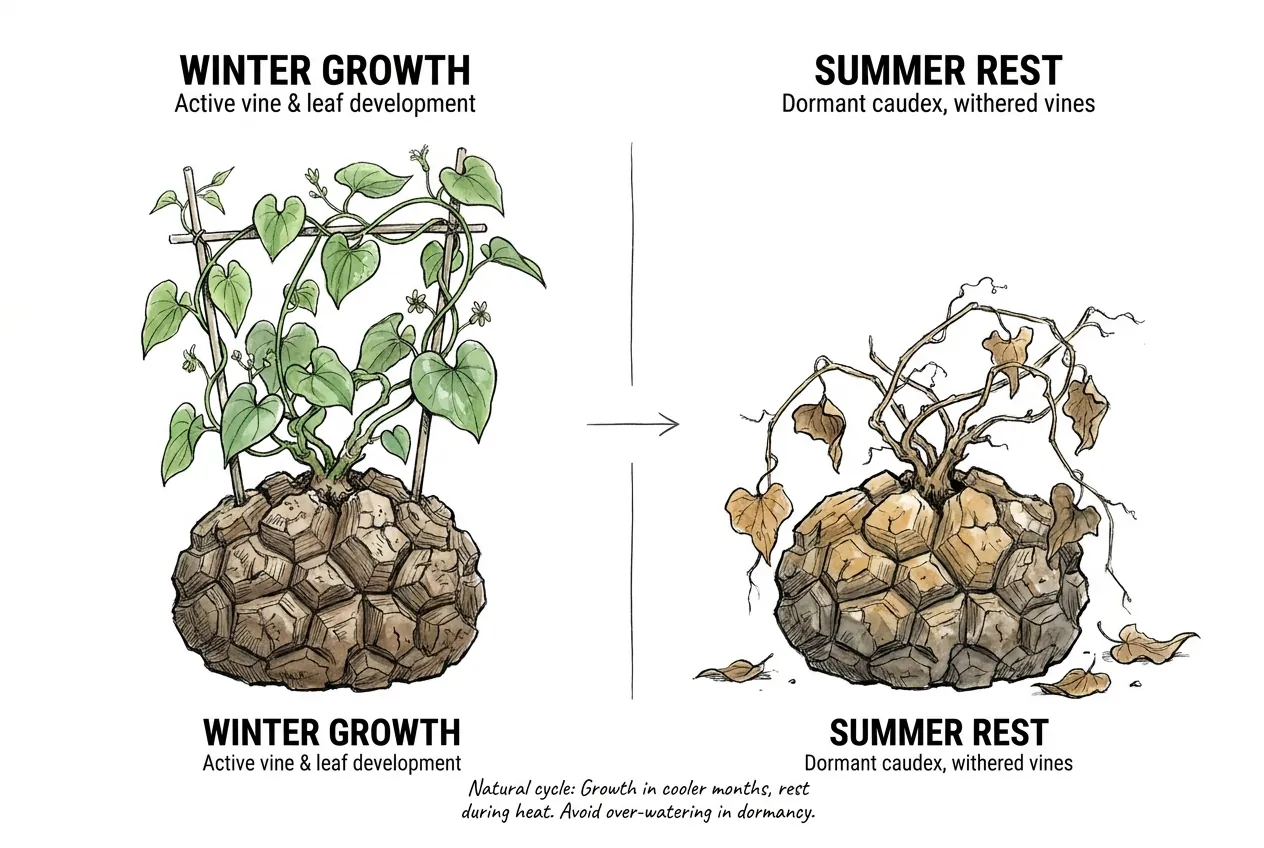
Dioscorea elephantipes is a winter-and-spring grower from the Western and Eastern Cape of South Africa. The species record notes it drops its leaves in mid-to-late autumn (around October to November), before the summer heat, and rests through the dry season.
It tolerates extremes from above 40°C down to about -4°C.
So a Dioscorea sitting bare in July is on time, not failing. Summer is its natural rest. The same record warns plainly against over-watering during that rest.
Fockea edulis grows in summer and rests leafless in winter
Fockea edulis runs the inverse schedule. It is largely deciduous, growing from spring through late summer and usually dropping most or all of its foliage in winter dormancy.
During that winter rest, watering drops sharply, just enough to keep the caudex from shrivelling.
A Fockea still leafless in January is therefore on schedule, while a Dioscorea in January may be actively growing. Judge lateness against each genus’s true season, not a shared date.
Indoor conditions blur these native seasons further. A northern-hemisphere room inverts the southern-hemisphere calendar and weakens the seasonal cues, so plants often follow their own internal timing.
Two tubers from the same batch can wake weeks apart under identical care.
The trigger test (hold one variable, move the other)
Because photoperiod and substrate temperature act separately, you can isolate them. Hold one constant and change the other, then read the tuber’s response. Any wake belongs to the variable you changed.
What each arm of the test does
Run two windows, one at a time. In the temperature arm, keep the light window fixed and raise substrate temperature into the low-to-mid 20s Celsius.
In the photoperiod arm, hold substrate temperature steady and extend a stable, uninterrupted light window.
Change only one variable per window. If both move, the result tells you nothing. Write down which single input each window is testing before you start.
How to read a real response, not hope
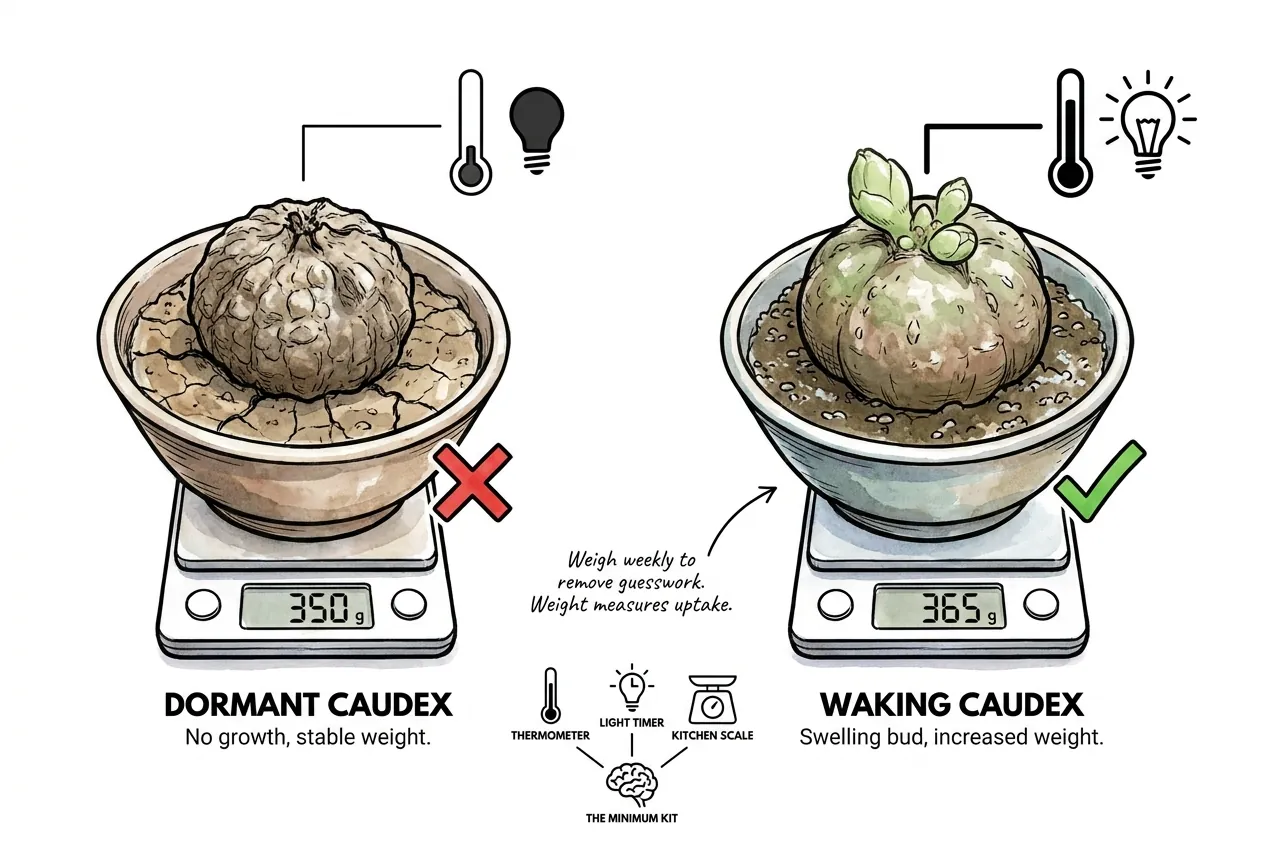
A genuine wake shows a swelling bud or a new root. Whole-pot mass alone cannot prove uptake because irrigation and evaporation also change it. I weigh the same pot on the same scale every seven days before watering and record the local time and hours since the previous irrigation.
A flat weight with no growth point after a change means that cue was not the gate. Move to the other arm. A firm, heavy tuber is alive and simply has not been given its trigger yet.
Before changing anything, I photograph the growth point beside a metric ruler showing 1 mm divisions in the same plane. The sheet names the tested cue, pot mass, hours since irrigation, root-zone temperature, and timer setting. If I water, I close that phase and start a new mass baseline after 30 minutes of drainage because added water would hide the comparison.
I classify each later view as unchanged or as bud width or shoot length increasing by at least 1 mm from baseline. If a response appears, I repeat the recorded light window, seven-day prewatering weigh-in, and daytime and overnight temperature ranges before changing another input. If not, I do not stack heat, water, fertilizer, and light on a tuber that may need more time.
The minimum kit
The whole test needs three things. A substrate thermometer for temperature at the tuber, a timer-controlled light for a repeatable day, and a kitchen scale for weekly weight. Nothing exotic is required.
The real danger is watering a tuber that has not woken
The failure that actually kills caudex plants is not slowness. It is water applied to a tuber that cannot use it. A dormant tuber draws almost no moisture, so the medium stays wet far longer than in growth.
That standing moisture, not the water itself, is the hazard. Waterlogged, cold-wet, poorly drained substrate is ideal for Pythium, Phytophthora, and bacterial rot. Caudex roots are more sensitive to wet soil than most succulents, and a dormant tuber’s defenses are low.
Weigh before you water
Weight turns watering into evidence. A healthy tuber is heavy and firm for its size, because it is full of stored water. As reserves are spent it loses weight and softens slightly.
So log the potted weight and only offer a light sip after a clear downward trend or mild softening. Never water on a calendar. A tuber holding its weight and firmness through the rest needs nothing, whatever the date says.
If a long rest brings mild shrivel with no growth yet, give a small drink and let the medium dry again. Do not soak it. The goal is to offset reserve loss without leaving water the tuber cannot draw on.
Late or dead? Read firmness, weight, and the growth point
Most tubers declared dead are simply late. Before you unpot or cut, read the plant with your hands. Firmness and weight tell you almost everything.
A living dormant tuber feels firm and heavy for its size, like a fresh, firm root vegetable.
A tuber that feels soft, squishy, or spongy is rotting. One that feels light and brittle, like styrofoam, has mummified and dried out.
Check the growth point and its neck too. The connection between the tuber body and its crown must be solid, or stored energy cannot reach the emerging shoot.
A firm tuber with a healthy, intact growth eye simply has not received its cue.
How long to wait before acting
Patience of several weeks past the expected wake is normal, not alarming. Yam endodormancy can run past 200 days, and cultivated Dioscorea often behave opportunistically. A wide spread of wake dates is ordinary biology.
Keep waiting, with minimal moisture, as long as the tuber stays firm and heavy. Escalate to unpotting only if it turns soft, smells foul, or discolors. Then inspect the roots and cut back to clean, firm tissue if rot is localized.
Once you know the gate, fix it gently
The test names the cue. The fix should be narrow and slow, because the bigger risk is overcorrecting. Match the action to the gate the test revealed.
If temperature is the gate
Raise substrate temperature into the low-to-mid 20s Celsius, where Dioscorea advances fastest. Use gentle bottom warmth under the pot and verify with the probe, not the room. Moving a pot off a cold sill onto mild warmth can lift the medium from the teens into the low 20s.
Avoid overshooting into damaging heat. The goal is to accumulate thermal time in the target band, not to cook the roots.
If photoperiod is the gate
Set a timer for a consistent, longer day and remove any stray night light. A clean long-day signal raises the FT2 pathway that drives budbreak, but only once endodormancy is past.
A drifting timer or evening room light can stall a tuber whose gate is daylength.
What not to do
Three moves cause most self-inflicted losses. Do not force an endodormant tuber, which cannot respond. Do not leave it cold and wet, which invites rot.
Do not fertilize a tuber that is not yet active, which leaves salts in medium the roots are not using.
Resume normal watering and any feeding only after a bud or root actually appears. Tie every intervention to visible activity, not the calendar.