
Caudex Dormancy: Is It Daylength, Not Cold?
Does daylength or cold trigger caudex dormancy in autumn. Learn how short days drive the slowdown, how to test the cue, and when to cut water.
Rachel Torres · 2026-09-14 · 14 min read
Key Takeaways
- In the best-studied plants, shortening days drive autumn dormancy and cold mostly speeds it up.
- The plant reads night length in its leaves, so a committed plant will not restart just from added heat.
- Caudex genera keep different calendars, so confirm your plant’s schedule before you act.
- Compare a warmed plant against an ambient one on the same short days to find the real trigger.
- Weigh the pot to catch falling water use, then stretch the interval so a resting caudex will not rot.
Your caudex may be reading the calendar off the length of the night, not the thermometer.
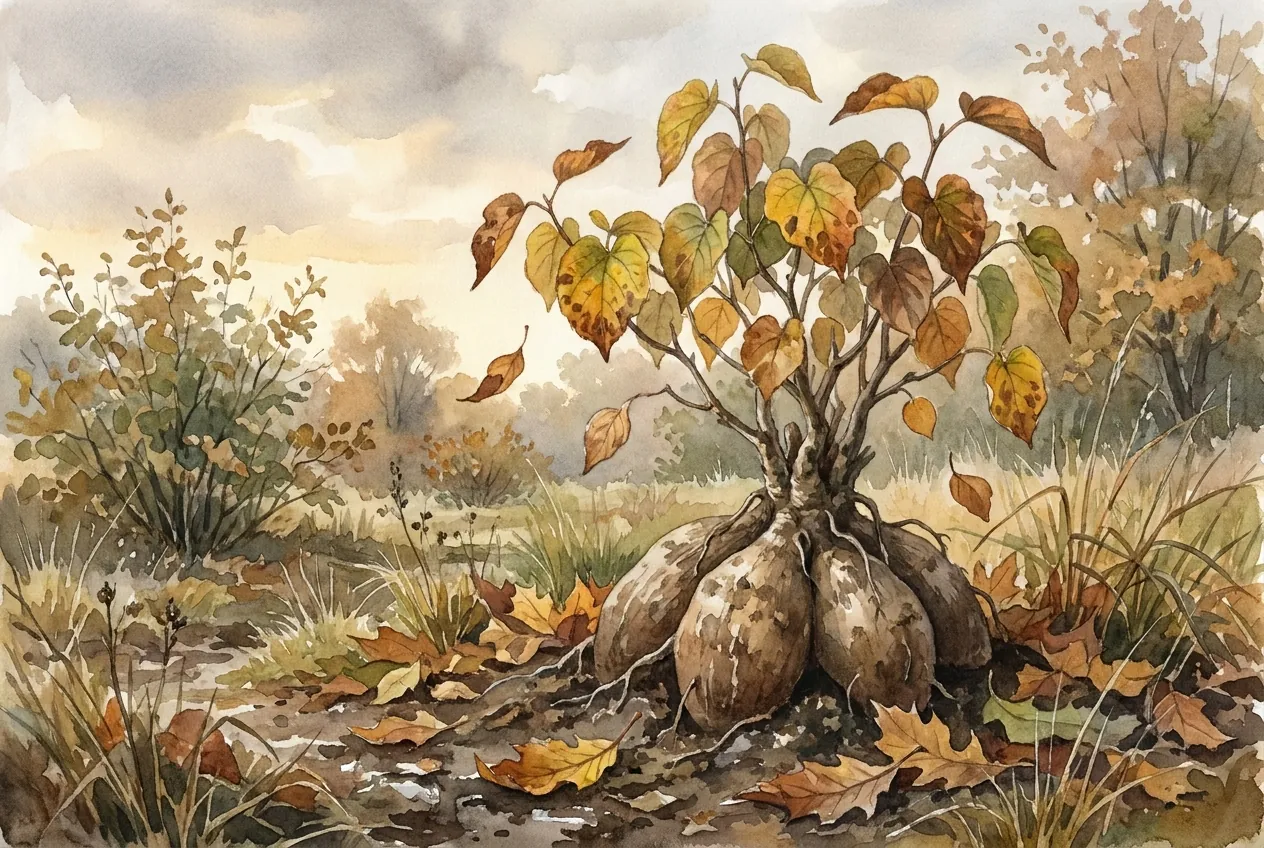
When a plant slows and drops leaves in autumn, most advice blames the cold. The plant-physiology evidence tells a more useful story, and it changes how you water.
The short version is that in the best-studied perennials, shortening days drive the slowdown and temperature mostly speeds it up. That distinction is not academic. It decides whether adding heat will keep your plant growing or just rot its roots.
Daylength or cold, which one actually triggers the slowdown
For the plants science has tested most, the primary trigger is daylength, not cold. In boreal and temperate trees such as poplar, aspen, and many Prunus species, autumn growth cessation is controlled by photoperiod.
Temperature modifies the timing and speed, but the shortening day is the seasonal alarm clock.
Treat the autumn slowdown as a daylength signal first and a cold signal second, because that is what the tree evidence shows.
There is an honest limit to this rule. A few species break it. In apple, pear, and Sorbus, low temperature alone is enough to stop growth no matter the daylength.
In Prunus the two cues interact, and at warm temperature those plants ignore short days and keep growing.
Growth cessation, hardiness, and true dormancy are three different things
Growers pack three separate events into one word. Separating them tells you what to expect next.
The first event is growth cessation. The plant stops pushing new leaves and stems, and this is the photoperiod-driven step you notice first.
The second is cold hardiness, where tissue becomes freeze tolerant, and this leans more on temperature.
The third is true dormancy, where the plant will not restart until it has met a chilling requirement, even in good conditions.
For a caudex grower, the early event that matters is growth cessation. That is the moment your watering needs to change, well before the plant looks fully asleep.
How a plant measures the length of the night
The plant does not count daylight hours. It measures the length of the uninterrupted dark period. This matters because it explains why a stray light can change the plant’s behavior while a warm night cannot.
A daylength-measuring system needs three parts. It needs photoreceptors to sense light, a circadian clock to keep time, and a mobile signal to carry the reading to where growth happens.
Because the plant tracks darkness, a brief light in the middle of the night reads as a long day.
Where the signal is read and where it acts
Daylength is sensed in the leaves, then a signal travels to the growing tips. The photoreceptors that do the early sensing are the phytochromes. Red light suppresses short-day growth cessation in poplar, and a following pulse of far-red light reverses that effect, which is the classic phytochrome fingerprint.
The reading then moves to the shoot tip as a mobile protein. Under long days that signal promotes growth. Under short days it is switched off, and growth stops.
What locks the shutdown in place
Once the short-day reading is made, hormones make it hard to reverse. Gibberellin in the shoot tip falls, which halts stem elongation. Abscisic acid rises, drives dormancy, and in poplar even closes the tiny channels that feed the growing tip.
Some conifers go further and build physical barriers that block water from reaching the winter buds. A committed plant has locked its dormancy in with hormones and structure, so warmth alone will not simply switch growth back on.
This is why a deciduous caudex that has already dropped its leaves is further down the path.
With fewer leaves, it has fewer sensors left and less that a change of conditions can undo.
Your caudex may not follow the tree rulebook
Before you apply any of this, check what kind of grower your plant is. Most rigorous photoperiod research is on cold-climate trees, not desert caudiciforms. The mechanism is a strong model, but the thresholds and even the direction of the response vary by genus.
Warm-season, winter, and opportunist growers keep different calendars
Caudiciforms fall into groups with opposite schedules, and mixing them up inverts every watering decision.
Warm-season growers grow in spring and summer and slow in the short, cool part of the year.
Adenium grows best from roughly April through October and typically goes dormant in cooler weather and short winter days.
Many Pachypodium, Euphorbia, and Operculicarya sit here too, and for this group the daylength-versus-cold question applies directly.
Winter growers run the opposite calendar. Tylecodon looks its best in the colder months and drops leaves in summer, and Othonna grows in winter and rests in summer.
For these plants, shortening autumn days are a wake-up call, not a sleep signal.
Opportunists ignore the strict calendar and grow whenever water and warmth allow. They respond more to the immediate resource than to daylength.
Why the dormancy tables disagree
Hobby dormancy tables often place the same genus in different groups. Provenance is a big reason. A plant from a summer-rainfall region and one from a winter-rainfall region can share a genus yet keep opposite calendars.
Treat any single dormancy table as a starting point and confirm the schedule against your own plant’s behavior. The home test below does exactly that.
The Adenium case shows both cues working together
Adenium is the clearest caudex example because growers watch it closely and it responds visibly. Its dormancy is triggered by shortening days and falling temperature acting together, not by cold alone.
This makes it a clean illustration of the interaction the tree literature describes.
What the numbers say, and how much to trust them
Sources give overlapping but not identical thresholds, and that spread is part of the honest picture.
One grower reference reports the first signs of dormancy when nighttime lows consistently drop below 60°F.
A nursery guide advises no watering once nights stay below 50°F.
The consistent message is a run of cool nights near and below 60°F paired with shortening days, sustained for a week or more. A single cold snap is not the trigger. Because the exact figure varies by source, I treat about 60°F night lows as a conservative working reference rather than a fixed law.
Does keeping it warm indoors stop dormancy
Not reliably. Even growers under artificial light usually shorten light duration in winter, and Adenium still reads the shorter day and slows.
An Adenium kept warm but on a naturally short indoor photoperiod can still wind down.
An Adenium that slows while warm and on short days is reading the daylength, which tells you heat alone will not hold it in growth. That single observation is what the home comparison puts to the test.
The leaf-drop sequence is diagnostic
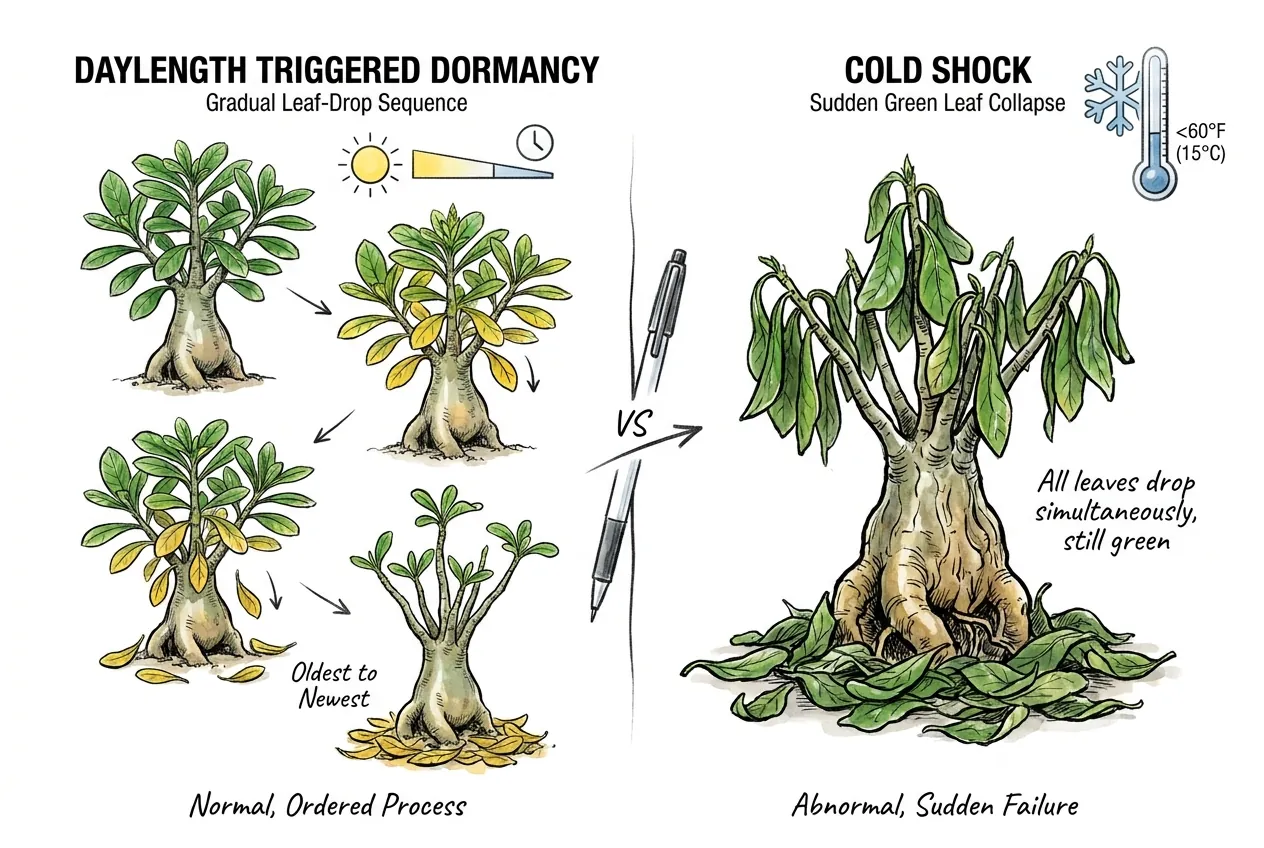
The shutdown is gradual and ordered, and the order tells you what is happening. The plant first stops making new growth. Then the oldest leaves yellow, starting low on the plant and moving upward, and over several weeks most or all leaves drop from oldest to newest.
A sudden collapse of green leaves across the whole plant is a different problem. That pattern points to cold shock, disease, or root failure rather than normal dormancy.
Tell which cue is driving your own plant
You can separate the two cues at home with a simple controlled comparison. The logic comes straight from the tree evidence.
If daylength is the lever, warmth will not keep the plant growing once short days set in.
If temperature is the lever, warming the plant while days stay short should keep new growth extending.
Run the warm-versus-ambient comparison
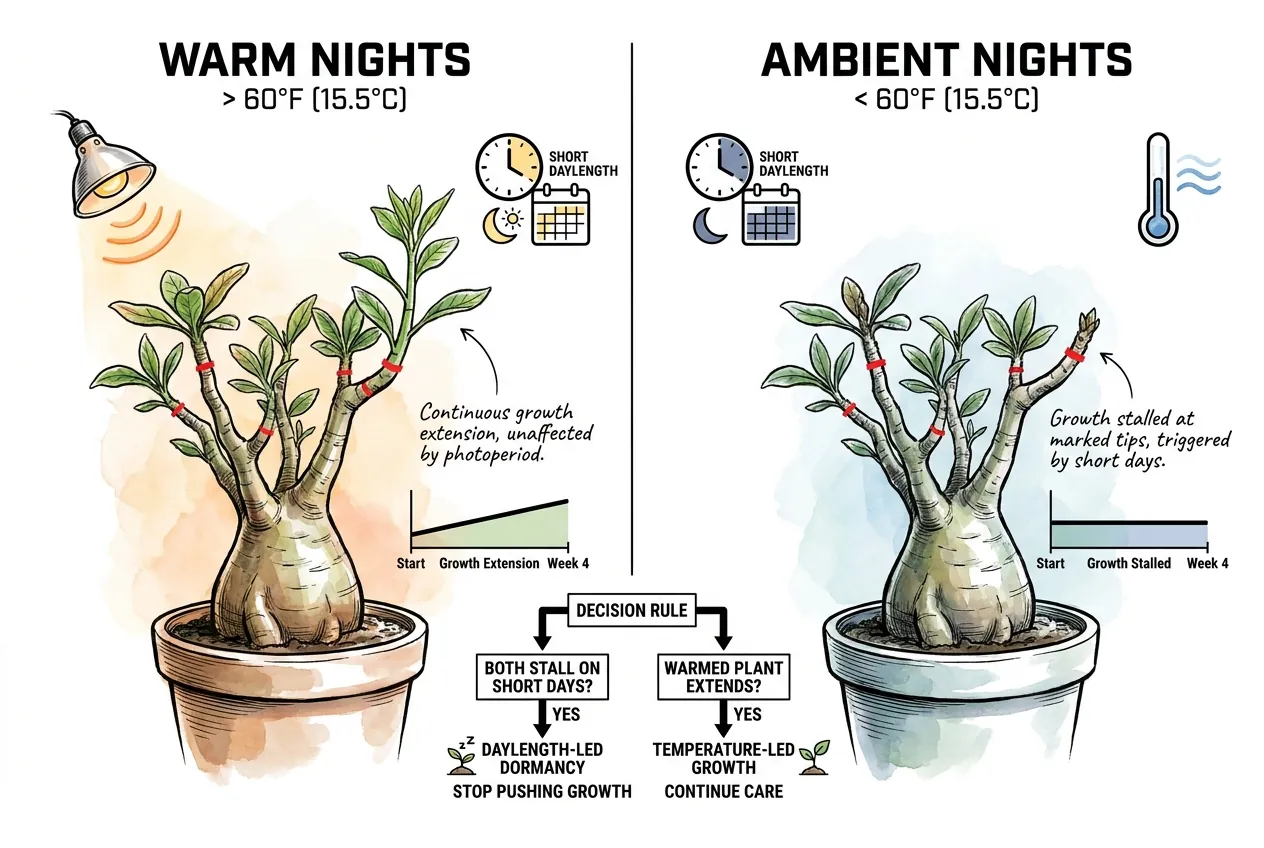
I run this as a two-plant test using the plant’s own recent growth as the reference.
I take two matched plants of the same cultivar and mark their growing tips so new extension is easy to see.
I keep light, water, pot, and mix identical between them, since more light on one plant would mask the result.
I hold one plant’s night lows above my roughly 60°F reference while it stays on the naturally short indoor photoperiod. I leave the other at ambient autumn night temperature. Then I check both every 7 days for three to four weeks.
The decision rule is straightforward. If the warmed plant keeps extending new growth while the ambient one stalls, temperature was the dominant lever for that plant.
If both stall on the same short-day schedule despite the warmth, treat the slowdown as daylength-led and stop trying to push growth.
When a plant stalls in warmth on short days, it is reading the photoperiod, so let it rest instead of chasing growth.
The roughly 60°F figure is my conservative working value drawn from Adenium guidance, not a published standard.
This is a diagnostic comparison, not a treatment, and a plant that reads as daylength-committed should be allowed to sleep.
Reading a mixed or null result
If neither plant slows across a month, the plant may not be at its trigger point yet, or it may be an opportunist that ignores daylength.
If results are mixed, weight the tip extension over leaf color. Oldest-leaf yellowing can lag the real growth decision by weeks.
Read the early signals before you commit the next watering
The single biggest autumn mistake is watering on the summer schedule after growth has stopped. A plant that has quit growing drinks far less, so the pot stays wet, and cool wet soil around a non-drinking caudex is the classic rot setup.
Watch the tip before the leaves
The tip stall comes first, before any color change. New-growth extension stops, then the oldest leaves yellow from the bottom up, and only later do leaves drop in sequence.
A grower who waits for yellow leaves is already weeks behind the plant’s decision.
Weigh the pot to catch falling water use
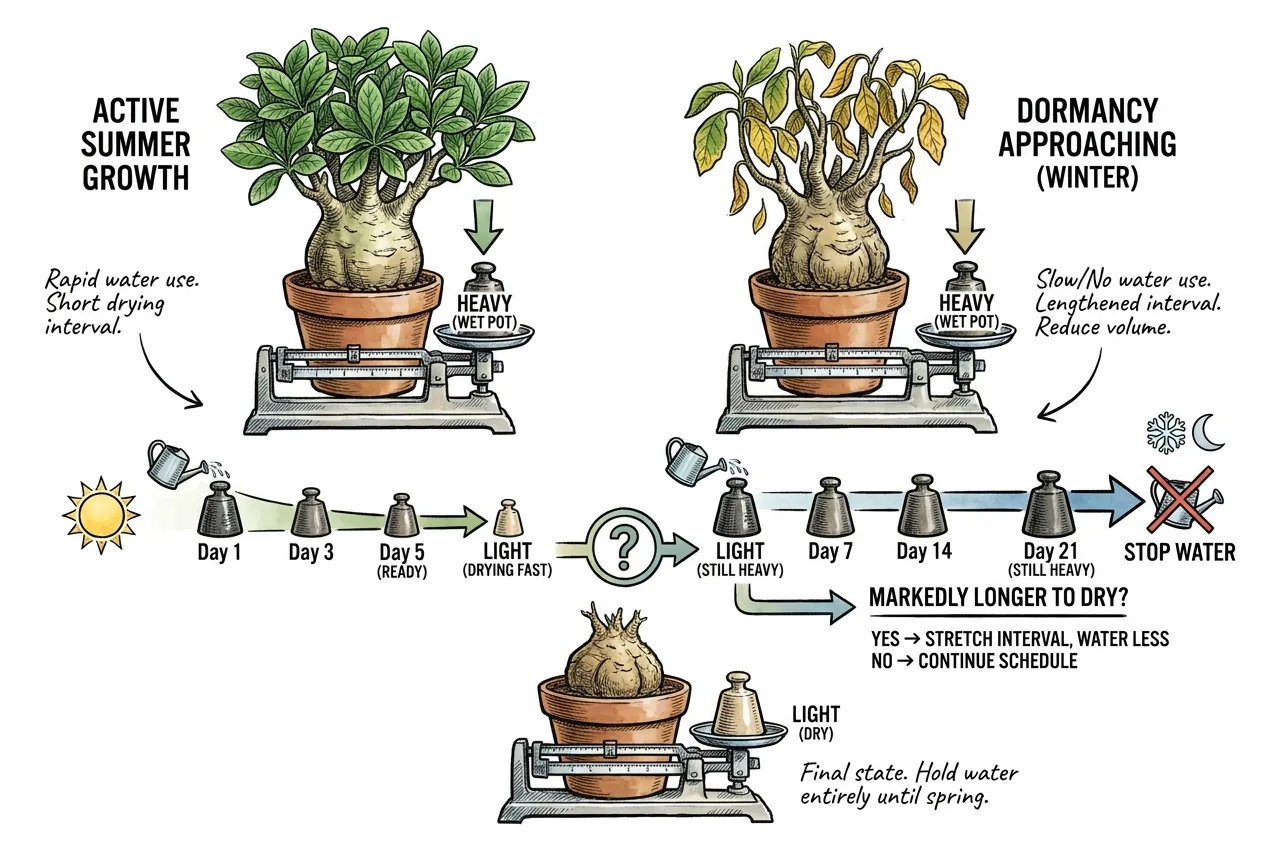
I let pot weight tell me when water use has dropped. I weigh the pot right after a full watering, then again every few days on the same scale.
I track how many days it now takes to return to the light weight that signaled ready-to-water in summer.
The decision rule uses the pot’s own history, so no universal gram or percent figure applies.
When the pot takes markedly longer to reach that familiar light weight than it did in active growth, the plant is winding down.
I lengthen the interval and cut the volume rather than watering on the old schedule.
A pot that dries far slower than it did in summer is telling you the plant has stopped drinking, so stretch the interval and water less.
If the pot barely lightens at all between checks, I hold water entirely. A wet, non-drinking pot in cool conditions should be left to dry, not topped up. For the exact cutoff, the last-watering dry-down guide sets the stop point, at the last watering before dormancy.
Why adding a light or adding heat works or fails
Whether an intervention helps depends entirely on which cue is driving your plant. Get the cue right and the fix is obvious. Get it wrong and you either waste energy or invite rot.
What a grow light can and cannot do
A light does two different jobs, and growers confuse them. Photoperiod lighting changes timing such as flowering and dormancy, but at low intensity it adds little actual growth.
High-intensity light adds growth by lifting the daily light dose the plant receives.
To hold a daylength-sensitive plant out of dormancy, you have to lengthen the effective day so it never reads a long enough night.
Commercial growers do this with day-extension lighting or with a short burst of light in the middle of the night. That night interruption reads to the plant as a long day.
A light works only if it truly extends the photoperiod past the plant’s threshold and you apply it before the plant commits.
Once the hormones and bud barriers lock in, a late light has limited effect. And if temperature was the real cue, extending the day will not hold growth on its own.
When heat helps and when it just rots roots
Warming the space holds growth only when the slowdown is temperature-led. If the plant is reading short days, heat will not restart growth, because photoperiod is the primary timer and warmth mostly changes its rate.
Heat applied to a daylength-committed plant buys no growth and raises rot risk, because a warm plant over wet soil that has stopped drinking is a rot accelerant.
When you reach the actual purchase decision, this becomes a light-and-heat provisioning question rather than a single gadget.
For choosing a fixture, see the grow light guide for caudex and the deeper LED and PPFD guide.
For the heating side, the caudex overwintering setup covers it in depth.
Turn the diagnosis into a watering and light plan
Once you know the cue and whether the plant is still drinking, the correct action follows for each case.
The one mistake to avoid everywhere is applying another plant’s calendar to yours.
The daylength-led warm-season caudex
Both plants stalled in warmth on short days, so the plant is reading the photoperiod. Let it rest and cut water sharply, following the weigh-and-watch trend toward little or no water.
Keep it frost-safe, but do not chase growth with heat, since heat over wet soil in a non-drinking caudex invites rot.
If you genuinely want to hold light growth, the only lever that can work is extending the effective day with supplemental light, applied before commitment.
The temperature-led caudex
The warmed plant kept growing while the ambient one stalled, so warmth is your lever. You can hold light growth by keeping night lows up, but water cautiously, because a barely-growing plant still drinks slowly.
Match watering to the measured dry-down, and the autumn soil-temperature watering guide covers the details.
The winter grower
If your plant is a Tylecodon, an Othonna, or another winter grower, shortening autumn days are a growth cue and the schedule runs opposite.
Water these into growth now while your summer-dormant plants dry off. Confirm the habit from provenance and behavior rather than a generic table, and the summer-grower versus winter-grower guide frames the split.
Match the watering and light plan to your plant’s diagnosed cue and growth calendar, not to a single seasonal rule of thumb.
If a resting plant turns soft, that is no longer dormancy. The soft caudex rot versus dormancy firmness check tells you which one you have.
Key Takeaways
- In the best-studied plants, shortening days drive the autumn slowdown and cold mostly speeds it up.
- The plant measures night length in its leaves, so a committed plant will not restart just because you add heat.
- Caudex genera keep different calendars, so confirm your plant’s schedule instead of trusting one dormancy table.
- Compare a warmed plant against an ambient one on the same short days to see which cue is driving yours.
- Weigh the pot to catch falling water use, then stretch the interval so a resting caudex does not rot.