
Last Watering Before Caudex Dormancy: A Dry-Down Rule
Time the last watering before caudex dormancy by how fast the pot dries, not a date. When dry-down time doubles, water once more and stop.
Derek Kim · 2026-09-07 · 23 min read
Key Takeaways
- Time the last watering by how fast the pot dries, not the calendar date.
- Weigh the pot and set a dry reference weight so dry is a number in grams.
- Water once more, then stop, when dry-down time hits twice the summer baseline.
- Keep caudex on the dry side of cold, because cold plus wet is what rots roots.
- Water winter-growers like Dioscorea more as autumn cools, not less.
A date on the calendar knows nothing about your windowsill, your pot, or your plant. Yet every autumn growers cut water on a fixed day and rot the plants that were still drinking, while starving the ones that just woke up.
The honest signal is already sitting in front of you. It is how fast the pot dries out. When a soak that used to vanish in days starts lingering for weeks, the plant has told you the season is over.
Why the Calendar Date Rots More Caudex Plants Than It Saves
A calendar date is a proxy for weather, and a bad one. The real driver of the last watering is evaporative demand. That demand is how hard the combined pull of sun, warmth, dry air, and moving air lifts water out of the pot and the plant.
That demand does not turn off on October 1. It slides down a ramp set by your own latitude, your indoor heating, your window direction, and the species on the shelf.
Two growers on the same date can hold pots in completely different states.
Evaporative Demand Collapses in Autumn, and It Sets Everything
Reference evapotranspiration is the standardized measure of that demand, and it crashes in fall. It is driven by four weather terms, which are solar radiation, air temperature, humidity, and wind.
As sun and warmth fall and air goes still and damp, demand drops toward zero.
The size of the swing is not subtle. In California, reference evapotranspiration peaks in July near a third of an inch of water lost per day and falls to near zero by December.
Solar radiation is a major driver of that evaporative demand, and daylength is shrinking fast through September.
So the pot dries slowly in autumn because the physics of demand changed, not because a month flipped over. Time the last watering to the falling evaporative demand your own pot reports, because a fixed date only works if your microclimate happens to match whoever wrote the date.
A Demand-Driven Decision Beats a Date-Driven One
A demand-driven decision watches what the pot actually does. It automatically folds in your heating, your window, your pot, and your species, because all of those already show up in how fast the mix dries.
A date-driven decision throws that information away. It assumes your conditions match an average that may not exist in your room. That is why the same date desiccates one grower’s plants and drowns another’s.
The rest of this method is about reading demand off the pot directly. You do it with a scale and a stopwatch of days, not a calendar page.
How Autumn Shuts Both of the Pot’s Water Exits at Once
A pot loses water through only two doors. Water leaves through the plant as the roots drink and the leaves transpire, and it leaves from the mix surface as plain evaporation. In autumn both doors swing shut together.
That double closure is the whole reason the pot suddenly stays wet. It is not that you watered more. It is that the water has nowhere to go.
Cold Roots Gate Their Water Channels Shut
Root water uptake does not fade gently as soil cools. It breaks at a sharp line near 15 degrees Celsius, which is 59 Fahrenheit. In a controlled rice study, root hydraulic conductivity showed a single break point at that temperature.
Above the line, the roots drink near warm-season rates. Below it, the cold sensitivity jumped roughly sevenfold, from an activation energy of 28 kilojoules per mole to 204. That is far too steep to be thicker, colder water alone.
The cause is the root membrane itself. Cold gates the aquaporins, which are the water-channel proteins in root cells, and blocking those channels cut water flow by 97 percent. Below roughly 59 Fahrenheit at the roots, the plant largely stops drinking and any water you add just sits in the pot.
Warm-Climate Plants Quit Drinking Earliest
The warmer a plant’s native home, the higher the root temperature at which it stops drinking.
Across 16 European tree species, water uptake after six hours fell about 35 percent at 7 Celsius and about 71 percent at 2 Celsius, compared with 15 Celsius. The cold sensitivity tracked each species’ native warmth.
A caudex genus from hot, seasonally dry habitat sits at the warm-sensitive end of that spectrum.
So the 59 Fahrenheit figure is a warm-grower number, and if anything it errs toward stopping early.
Do not borrow a roots-fine-to-freezing rule from a temperate garden shrub. Your desert-adapted caudex crosses its stop-drinking threshold at a much warmer root zone than a hardy perennial does.
Slow Evaporation Finishes the Job
The second door closes on its own. Cooler air, weaker sun, higher humidity, and the still air of a closed autumn room all cut surface evaporation, which is the same evaporative demand from the section above.
So both exits shrink at the same time. The same volume that vanished in two summer days can now linger a week or more in cold mix.
When potting mix stays wet for long periods, the pore spaces fill and oxygen drops, and roots stop growing and eventually die.
This is the mechanism behind the number you are about to measure. A pot drying twice as slowly is not a scheduling detail, it is the plant reporting that both of its water exits have roughly halved.
Weigh the Pot, Because the Scale Cannot Be Fooled
The most reliable moisture reading in your house is a kitchen scale under the pot. Water is heavy, and the difference between a soaked pot and a dry one is grams you can read to the nearest few.
This is not a hobbyist hack. It is the reference method that soil labs calibrate everything else against, scaled down to your bench.
The Gravimetric Method, Shrunk to a Kitchen Scale
Labs measure soil water by weight. They weigh a sample wet, dry it fully, weigh it again, and read the water content off the mass difference.
That is the gravimetric method, and it is the standard against which meters and probes are checked.
Pot experiments use the same idea on the whole container. Measuring the pot mass gives an accurate calculation of changes in soil moisture, and with surface evaporation accounted for, the change even reports the plant’s own water use.
Every gram lost is a gram of water that left through one of the two doors.
You need two numbers to run this at home. One is the saturated weight right after a soak finishes draining, and the other is the dry reference weight when the mix has gone completely dry.
Set Your Dry Reference Weight Once
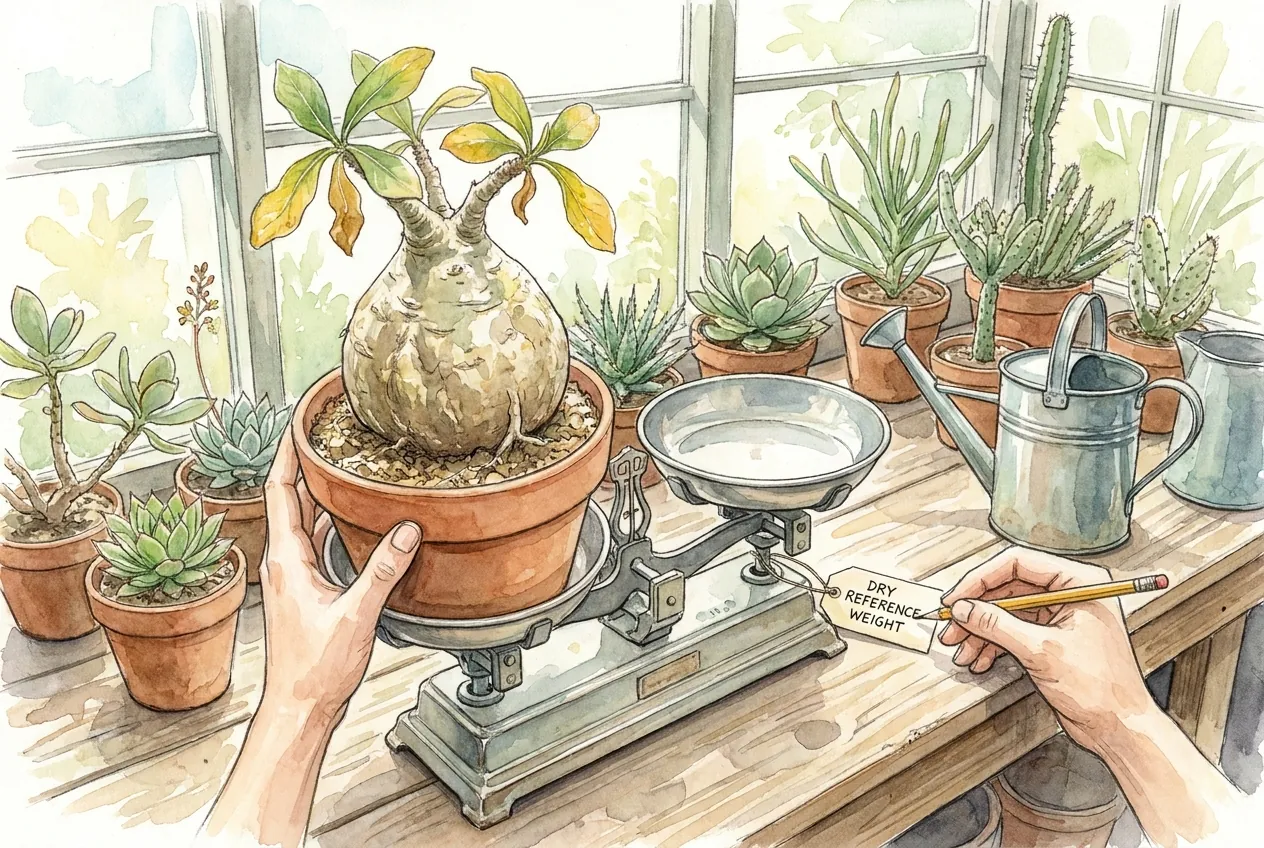
I record the dry reference weight the first time a pot finishes a long, complete dry-down, and I write it on a strip of tape stuck to the pot.
That weight is the anchor for the word dry, so dry stops being a guess and becomes a specific number in grams.
An even cleaner way is to weigh the dry mix and empty pot before you plant, then add the plant. Either route gives you the same fixed floor. I re-check that number after any repot or mix change, because a new substrate shifts both the dry weight and how the pot behaves.
With that floor set, dry means within a small tolerance of the recorded dry weight, not a number of days on the calendar. Once you have a dry reference weight in grams, every later judgment about dryness is a measurement instead of an opinion.
Why Weight Beats the Finger Test in Gritty Mix
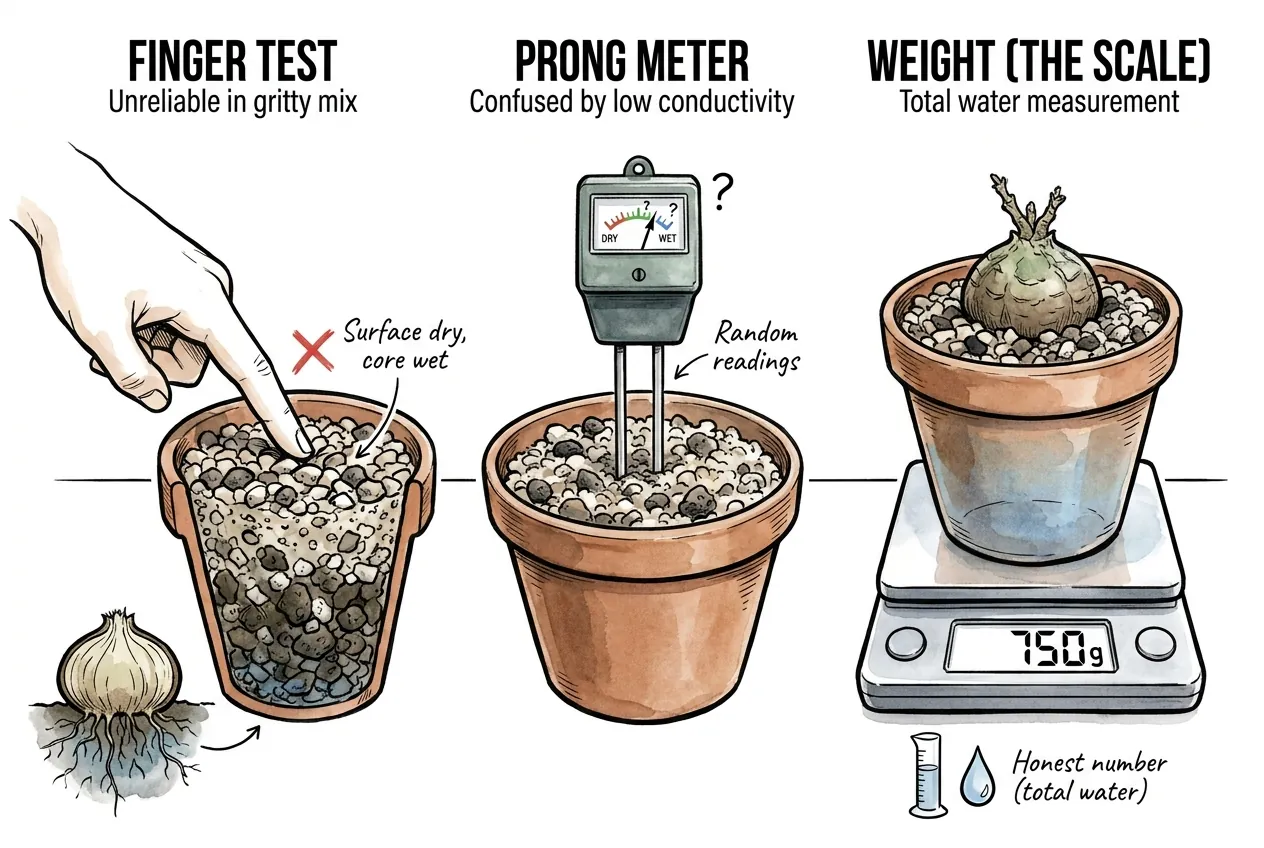
Caudex growers run gritty mixes of pumice, lava, and akadama for good reason, but those mixes lie to your finger.
The top half-inch dries and crumbles while the core stays wet, so the surface says dry when the root zone is soaked.
Cheap prong moisture meters fare no better. They infer moisture from electrical conductivity, and low-conductivity gritty media confuse them into random readings.
The scale ignores all of that. It reports the total water in the pot as a single honest number, wherever that water is hiding.
The Cutoff Itself Is a Doubling of Dry-Down Time
Here is the whole decision in one measurement. Dry-down time is the number of days a pot takes to fall from its saturated weight back to its dry reference weight.
It is the single number that captures both closing doors at once.
You do not have to measure evaporative demand, root-zone temperature, and transpiration separately. The pot integrates all of them for you. When both exits shrink, dry-down time stretches out.
One Number That Integrates Both Collapsing Exits
Dry-down time rises for exactly the reasons the earlier sections laid out. Cold roots stop drinking, cool still air stops evaporating, and the water that used to leave now stays put.
The interval between waterings grows because the plant and the weather made it grow.
That makes dry-down time self-calibrating to your real conditions. A south-window plant in a small terracotta pot and a shelf plant in a big glazed pot will show different day counts, and both are correct for their own situation.
The calendar cannot do this, and the scale does it for free.
You are not chasing a universal number of days. You are watching your own pot’s number change across the season.
My Working Cutoff Is Twice the Late-Summer Baseline
I set the trigger against each pot’s own late-summer dry-down time. If an Adenium in a given pot dried in about six days in the heat of August, that six days is its baseline.
When the same pot starts taking about twice as long to reach its dry reference weight, I give one last conservative morning watering and then hold for the season.
That doubling rule is my own conservative working threshold, not a published standard. I choose a full doubling on purpose. A doubling means demand and uptake have each roughly halved, which is an unambiguous signal, and it avoids both traps at the edges.
Waiting for a doubling stops me cutting water while the plant is still actively drinking on a warm spell.
Acting at the doubling stops me waiting until the pot never really dries, which is the exact cold and wet condition that rots roots.
The pot is now holding water twice as long as the plant can use it. When a pot’s dry-down time reaches about twice its own late-summer baseline, take the last watering and stop.
The whole rule fits in one table, read against your own August baseline for each pot.
| Current dry-down time vs summer baseline | What it means | Action for a warm-grower |
|---|---|---|
| About the same (1x) | Full evaporative demand, roots still drinking | Water on the normal warm-season cadence |
| Around 1.3 to 1.5x | Demand and uptake starting to fall | Stretch the interval, cut the volume, water mornings only |
| About 2x (doubled) | Both water exits roughly halved | Give one last conservative morning watering, then hold |
| Barely dries at all | Pot stays wet for weeks in the cold | Do not water, keep it dry through dormancy |
How I Log Dry-Down Time Across Autumn
The logging is light. I weigh the pot right after a soak has finished draining and note the saturated weight and the date.
Then I weigh every two to three days until it returns to the dry reference weight. The gap in days is that cycle’s dry-down time.
I keep the running numbers next to the plant so the trend is obvious. Six days, then nine, then eleven, then a jump toward twelve or more tells the story without any guesswork.
The moment the interval lands near double the August baseline, that pot has reached its cutoff.
When you reach the point of asking which scale, probe, or logging setup to actually buy, hand that decision to the site’s caudex watering tools and measurement setup guide.
It walks through kitchen scales, soil-temperature probes, and simple logging so you pick the right instrument for this decision.
Why Cold Plus Wet Is the Real Killer, and Cold Alone Is Not
The reason this cutoff matters is not that cold hurts a caudex. A dried-down caudex sails through months of leafless dormancy on stored water and starch. The plant that dies is the saturated one sitting in the same cold.
The danger is almost entirely the water, not the temperature. Getting the last watering right is how you keep cold and wet from ever meeting in your pot.
Standing Water Injures Roots Before Any Pathogen Shows Up
Waterlogging is not neutral holding, it actively damages roots by cutting off their oxygen. Saturated conditions for as little as 18 hours damage the sensitive root membranes and leak nutrients out of the cells.
A soaked pot drives soil oxygen down fast, and starved roots stop respiring and begin to fail.
Those leaked sugars and amino acids are a chemical dinner bell. The plant weakens its own defense and advertises the wound to rot organisms in the same moment. The standing water does the leaking, all on its own.
Keeping the mix dry through cold spells removes the membrane injury, the oxygen crash, and the exudate signal in one move. Cold plus dry is categorically safer than cold plus wet, so a slightly dry caudex going into winter is in its designed state, not deprived.
The Rot Organisms Love the Cool, Wet Autumn Pot
Growers assume rot needs heat, but the main culprits are happy in exactly the cool, wet conditions an autumn pot occupies.
Cool-season Phytophthora species prefer cool soils, not just warm ones. Some Pythium species are pathogens only above 77 Fahrenheit, but others are active only in cold soil, so the cool autumn pot never leaves the danger zone.
Both are water molds, not true fungi. They swim to roots as zoospores that need a continuous film of water, so a saturated pot is a swimming pool and a dry pot is impassable.
Phytophthora can begin infection with as little as 4 to 8 hours of soil saturation.
That short window is why one badly timed soak before a cold, damp week is enough. The single most powerful control is denying the water film, so let the mix stay dry and the zoospores cannot swim to the roots.
The Failure Is Silent, Then Sudden
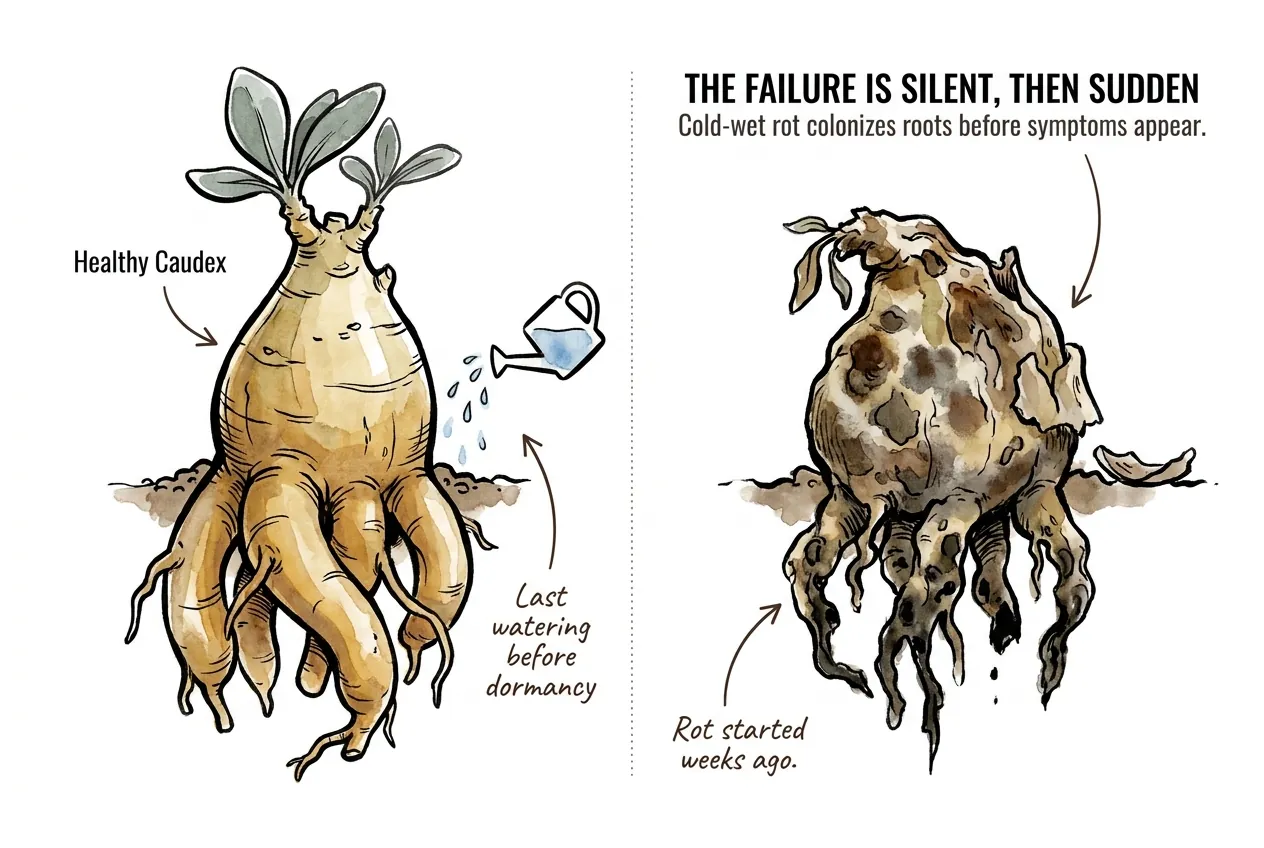
Cold-wet rot rarely shows the day it starts. The pathogen colonizes the roots and creeps into the crown while the caudex still looks and feels fine, then the plant seems to collapse overnight. That lag is why growers blame the wrong thing.
Turgor holds until a critical fraction of the conductive tissue is destroyed, and then the firm trunk goes soft.
A caudex can look perfect going into a rainy cold week in November and turn squishy in early December.
The rot started in the wet roots weeks before the softening showed.
This is why you judge risk by the conditions during the cold-wet spell, not by how the plant looks that week.
If you want a firmness reference for the soft-versus-dormant call, the site’s soft caudex firmness map walks through what firm, flexible, and failing actually feel like.
How to Give the Last Watering Well
Once the doubling signal fires, the last watering is a small, deliberate act. The goal is to send free water down and out before the next cold night, never to trap it in a cooling root ball.
Do this right and the plant enters dormancy hydrated but not soggy. Do it wrong and you hand the rot organisms the wet, cold pot they want.
Water in the Morning, on a Mild, Sunny Day
Timing is the only real lever you have left, because both water exits are nearly shut.
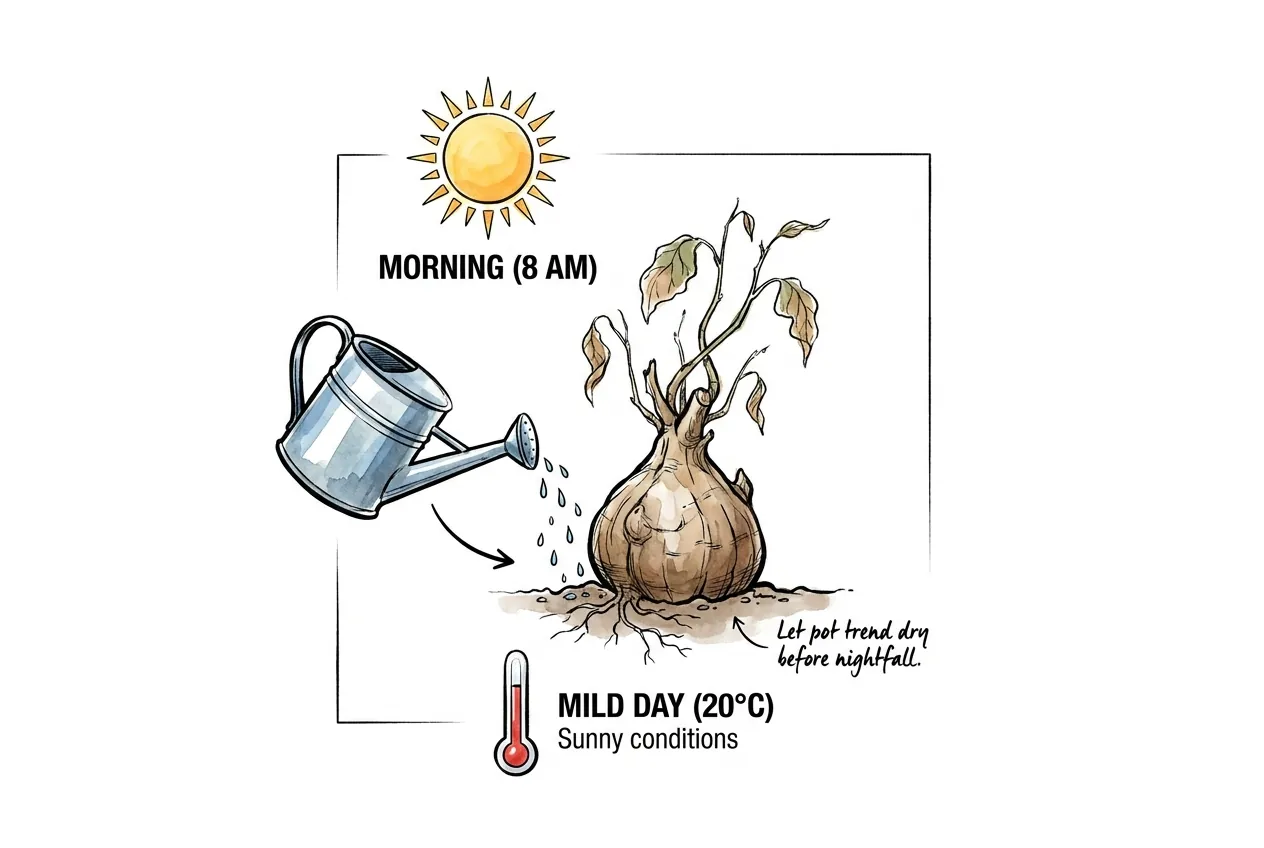
A morning watering on a mild, sunny day lets residual evaporation and any remaining uptake pull the free water downward through the day.
Evening watering before a cold night does the reverse and locks free water into a chilling pot.
Keep the volume conservative. Wet the root ball rather than flooding it, because a full summer soak now lingers for weeks instead of days.
The Cambridge University Botanic Garden glasshouse team follows this logic exactly. They water mostly in autumn and spring, stop during overcast very cold periods, resume as conditions turn mild, and skip any succulent that is still plump and turgid. Give the last watering early on a mild day so the pot trends dry before nightfall, and skip it entirely if a cold, overcast stretch is in the forecast.
When a Warm Window Reopens
Thermal lag runs both ways, so one cold snap is not always the end of the year.
A buffered root ball can rewarm on a run of mild days, and a warm-grower that is not yet fully dormant can take a light morning drink then.
Confirm the warmth is real before you act. Recovery of root uptake below the break point is slow, taking hours rather than minutes, so a single warm afternoon is not enough.
Look for the root zone climbing back above about 59 Fahrenheit and holding there for several days.
Committing to done-for-the-year after one cold night can under-water a still-active plant, while chasing every warm afternoon risks a wet pot on the next cold night. Keep the call gated on a sustained several-day warm-up, morning-only, and small, so neither error catches you.
Which Plants Follow This Rule and Which Ones Invert It
The dry-down cutoff applies to warm-growers heading into winter rest. A large group of caudex plants does the opposite, waking up as autumn cools, and for them the same signal means water more, not less.
Read the plant’s grow season before you apply any cutoff. The dry-down number tells you what is happening, but the species tells you which direction to move.
Warm-Growers Wind Down, and the Threshold Shifts by Genus
Adenium, Pachypodium, most caudex Euphorbia, and Fockea grow in the warm months and go dormant as it cools.
Their keep-dry thresholds cluster in a band from about 50 to 60 Fahrenheit, and provenance sets where each one lands.
Taxa from cooler Cape or plateau habitats tolerate cooler roots than lowland tropical species do.
Caudex Euphorbia is the most cold-intolerant of the group and does best at 60 Fahrenheit or above, with cold and wet often fatal. Fockea edulis should be protected below about 45 Fahrenheit and is rot-prone in cool, wet, dormant periods.
Adenium and most Pachypodium sit a little tougher, holding down toward 50 Fahrenheit before going bone dry.
The practical order is simple. Step caudex Euphorbia down first and hardest, because it crosses its rot and uptake threshold several degrees warmer than an Adenium does.
Winter-Growers Wake Up, So Water Them More
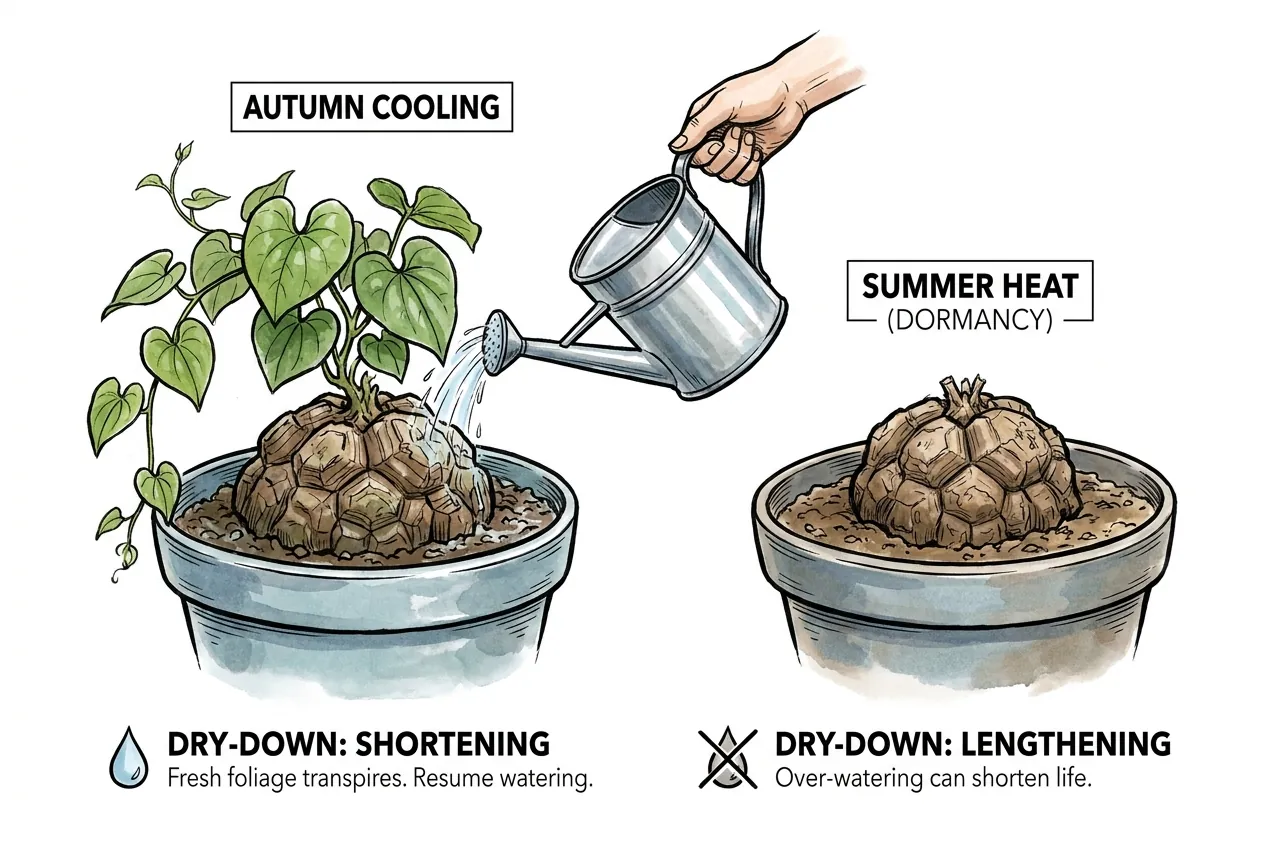
Dioscorea elephantipes, Tylecodon, Othonna, and Sinningia leucotricha run the opposite calendar. They rest in summer heat and resume growth as the weather cools, which is the exact moment a warm-grower owner is cutting water.
Dioscorea elephantipes grows in winter and spring and rests through the hot dry summer, and over-watering during that summer rest can shorten its life by at least half.
As autumn cooling leafs it out, its dry-down time shortens because the fresh foliage transpires, and it wants more water, not less.
A grower who cuts water on every pot at one autumn signal will correctly protect an Adenium and desiccate a just-waking Dioscorea in the same afternoon.
This is where the dry-down number earns its keep as a diagnostic. If a pot’s dry-down time is shortening in autumn rather than lengthening, you are looking at a waking winter-grower, so resume watering instead of cutting it.
Confirm the Cutoff With Two Cheap Cross-Checks
The dry-down doubling is the trigger, but no single number should decide alone. Two quick confirmations catch the edge cases, and both cost almost nothing.
Use the scale as the primary signal, then let root-zone temperature and caudex firmness confirm it before you commit to holding water for months.
Check the Root-Zone Temperature and the Firmness
The first confirmation is a soil probe pushed to about two inches, into the center of the root mass on the shaded side.
Read it at the pre-dawn low across several consecutive nights, not once, because uptake breaks near 59 Fahrenheit and one cold night barely moves the multi-day root-zone reading.
If the probe confirms the root zone is holding below about 59 Fahrenheit while dry-down time has doubled, the cutoff is real.
The second confirmation is your thumb. A dormant caudex feels firm even if slightly flexible, while a plant that still needs water often feels plump and turgid and should not be cut off.
For the full autumn soil-temperature logic, the site’s caudex soil temperature autumn watering guide covers probe depth, placement, and the multi-night averaging in detail.
Avoid the Five Blunders That Break the Method
Most autumn losses trace to reading the wrong thing. Watching the air thermometer instead of the pot or probe is the classic error, because the wall crashes days before the root zone does.
The pot weight and the soil probe are the truth, and the air is a distraction.
The one-cold-night overreaction is the next trap. Perennials shift dormancy on a sustained soil trend held for a week or more, not on a single event.
Require several consecutive nights below threshold before you declare a plant dormant.
Evening watering before a cold night, mistaking a winter-grower for a warm-grower, and reusing a fresh repot’s weight without re-baselining round out the list.
Each blunder has the same fix, which is to trust the measured trend over the dramatic single reading. Re-establish your dry reference weight after every repot, average several nights on the probe, and act on the sustained trend rather than one cold snap.
Key Takeaways
The last watering is a measurement, not a date on the wall. Read it off the pot and confirm it with two cheap checks.
- Time the last watering to how fast the pot dries, because falling evaporative demand, not the calendar, drives when a caudex should stop drinking.
- Weigh the pot on a kitchen scale, set a dry reference weight in grams, and treat dry as that number rather than a feel or a date.
- Take the last watering when a pot’s dry-down time reaches about twice its own late-summer baseline, then hold for the season.
- Keep the plant on the dry side of cold, since cold plus dry is safe while cold plus wet is what feeds Phytophthora and Pythium rot.
- Water winter-growers like Dioscorea and Tylecodon more as autumn cools, and confirm every cutoff with root-zone temperature and caudex firmness.