
Wiring Operculicarya decaryi in Winter: Why It Beats Summer
Wiring Operculicarya decaryi in winter beats summer: the bare, dormant plant bends cleanly. Learn gauge, 45-degree wrap, timing, and when to cut wire off.
Derek Kim · 2026-10-10 · 13 min read
Key Takeaways
- Wire at leaf-off for full branch visibility and the slowest wire bite of the year.
- Dormant is not snap-proof. Warm the plant to room temperature before bending.
- Bend slowly to set wood by creep, and stop instantly at any fiber crackle.
- Use wire about one-third the branch diameter, wrapped at 45 degrees.
- Remove wire at the first bark indentation, and cut it off instead of unwinding it.
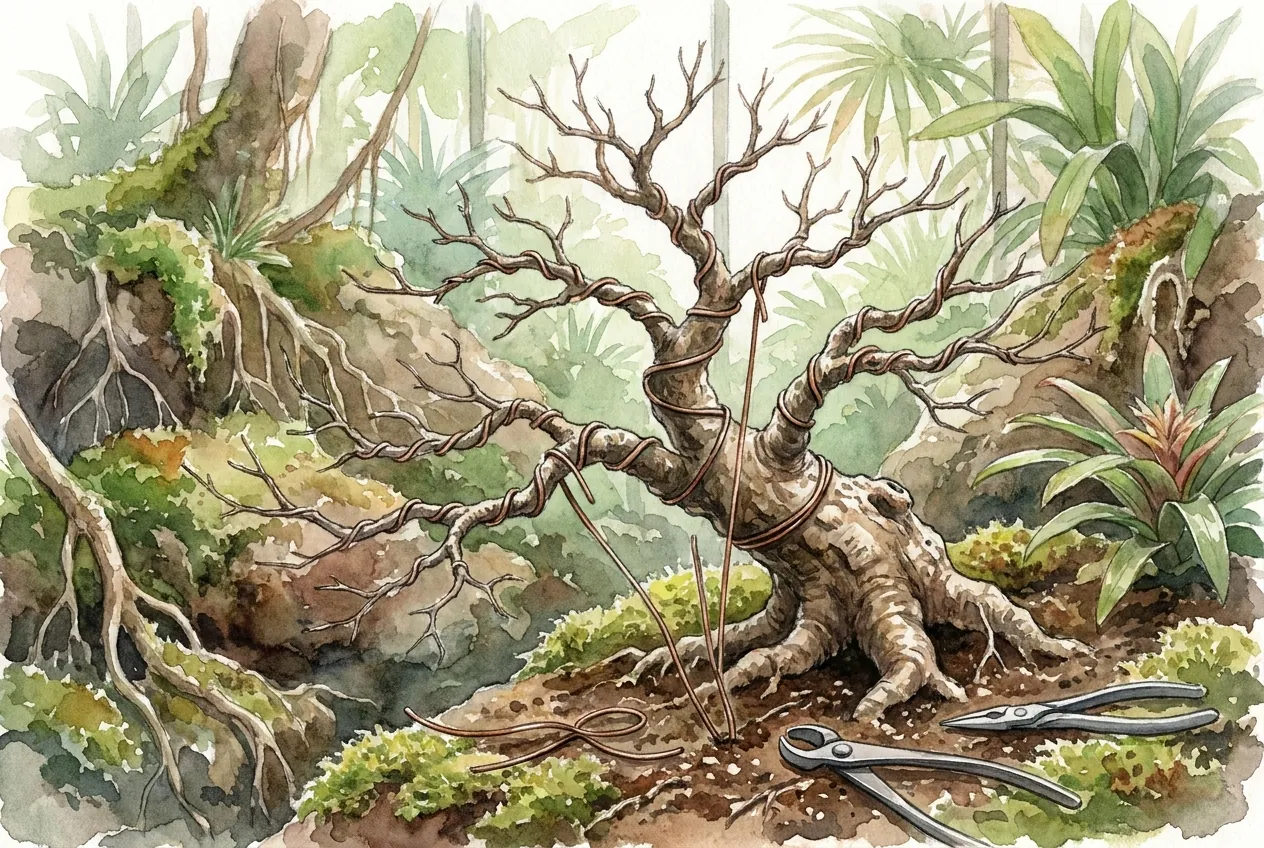
A leafless Operculicarya decaryi is not a sad plant. It is the clearest shot you will get all year at shaping its branches. The canopy is gone, the growth has paused, and the window to wire is open.
Why the dormant leafless window beats summer
Wire a deciduous caudiciform during its bare dormant window because you can see the structure and the wire bites slowly. Those are the two advantages that actually hold up. The common idea that dormancy makes branches unbreakable is only half true, and the half that is false can snap a branch.
With no foliage, you read the trunk line, the branch spacing, and every crossing directly. Bonsai practice is blunt about this. Deciduous trees are much easier to wire in late winter because the leaves are absent.
On Operculicarya that matters more than usual. The tiny pinnate leaflets hide thin arching branches all summer. Leaf-off is the only time the fine ramification is fully legible, so your wire lands where the design needs it.
The second advantage is slower wire bite. A dormant plant barely thickens, so the wire presses into the bark far more slowly than during a summer growth surge. That buys a longer uninterrupted hold before scarring becomes a risk.
The real winter advantages are clear visibility and slow wire bite, not a magic shield against snapping.
What dormancy does not do
Dormancy does not make cold wood safe to bend. This is the trap. Cold conditions reduce flexibility, and cold branches can snap rather than bend.
So separate two things that get blurred. A dormant plant has paused its growth, which is good for wiring. Cold tissue is stiff and brittle, which is bad for bending.
The fix is simple. Bring the plant up to normal room temperature for a few hours before you touch a branch.
Warm dormant wood gives you the visibility and slow-bite benefits without the cold-brittleness penalty.
Know the plant you are bending
Operculicarya decaryi is a slow-growing caudex tree from southwestern Madagascar with brittle older wood and tender bark.
Those three traits, slow growth, brittleness, and thin bark, set every rule that follows. It is deciduous, dropping its tiny leaflets as it enters a dry-season dormancy.
Slow growth has two consequences for wiring. Bends set slowly because little new wood forms around the held shape. Scars also persist for years because the plant cannot quickly grow over a wire mark.
The species is cold-sensitive. It is hardy only into the low 30s Fahrenheit for short spells, so an indoor grower keeps it well clear of that floor.
During dormancy it wants dry conditions, watered only when the soil is completely dry, which often means barely at all.
Confirm it is resting, not dying, before you wire
Check the caudex firmness before you commit wire. A firm trunk with dropped leaves is normal dormancy. A soft or shriveled caudex is a problem that outranks any styling plan.
Leaf drop alone is ambiguous on this species. The reliable signal in a leafless plant is a firm, full caudex carrying its water reserve.
If the trunk is soft, diagnose and recover root health first and leave the wire in the drawer.
Wire only a plant with a firm caudex that is resting, never one whose trunk has gone soft.
How a branch actually takes a set
A branch holds a new shape only when you bend it past springback into slow, irreversible creep, without fracturing it.
Below a threshold the branch is elastic and springs right back. Push past that threshold under a sustained load and the wood slowly, permanently deforms.
This is why patience beats force. Woody branches keep deforming under a held load, a behavior called retarded or viscoelastic bending. In hardwoods that slow component is large, roughly 47 percent of the instantaneous elastic response, versus about 34 percent in softwoods.
A wire that holds a gentle bend for weeks exploits that creep. A single hard yank does not. The yank just races toward the fracture point, and brittle Operculicarya wood fractures with little warning.
Turgor explains the summer split risk. In active growth the tissues are engorged and internally pressurized, so a hard bend can rupture turgid cells and split green wood. Dormant wood, warmed but not engorged, behaves more like seasoned material.
A branch-flex test before you commit wire
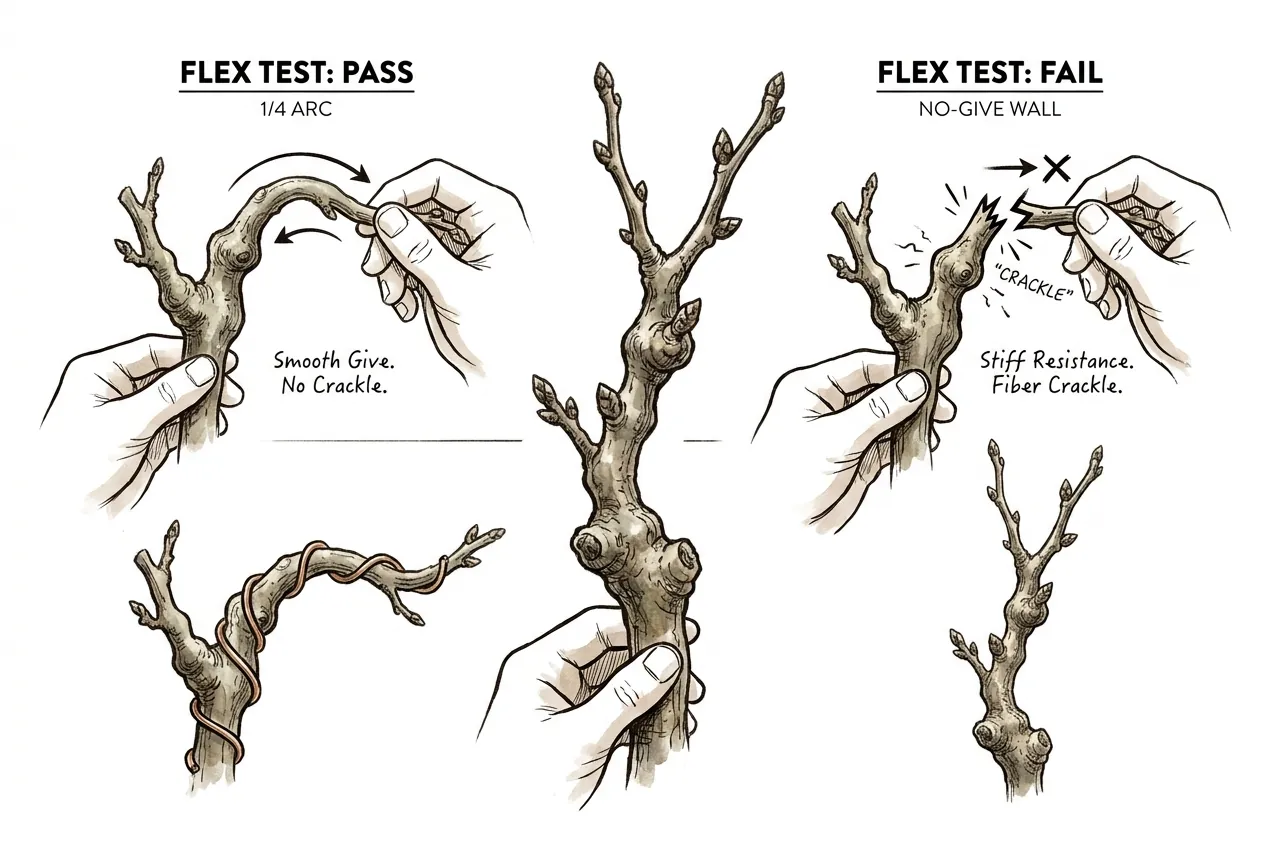
Before I wire any branch, I run a quick flex test to find its limit without discovering it by breaking the branch. I support the branch base with one hand. With the other I ease the tip through a small arc, building pressure slowly over a few seconds, and I feel for smooth fibrous give versus a hard, no-give wall.
The decision rule keeps me honest. If the branch moves smoothly through about a quarter of the arc I ultimately want and springs back with no crackle, I wire it.
If it resists stiffly or makes any fiber crackle, I leave that branch unwired this season.
That quarter-arc, no-crackle threshold is my own conservative working rule, not a published number. No source gives a species-specific safe arc for Operculicarya, so I keep a wide margin below the point where the bending research says fibers start to fail.
I bend by hand only and never use a lever or clamp to force a branch past a crackle.
The wiring technique, step by step
The method is standard bonsai wiring adjusted for brittle wood and thin bark. Pick the right gauge, anchor it, wrap at 45 degrees, wire everything first, then bend slowly with the plant warm.
Match wire gauge to branch thickness
Use a wire about one-third the diameter of the branch you are wiring. Too thin and it yields to the branch and the bend relaxes. Too thick and it crushes the tender bark under its coils.
For a 9 millimeter branch, that points to roughly 3 millimeter wire. Annealed aluminum in the 1.0 to 4.0 millimeter range covers most branches on a potted Operculicarya and is gentler than copper on soft bark.
Anchor, then wrap at 45 degrees
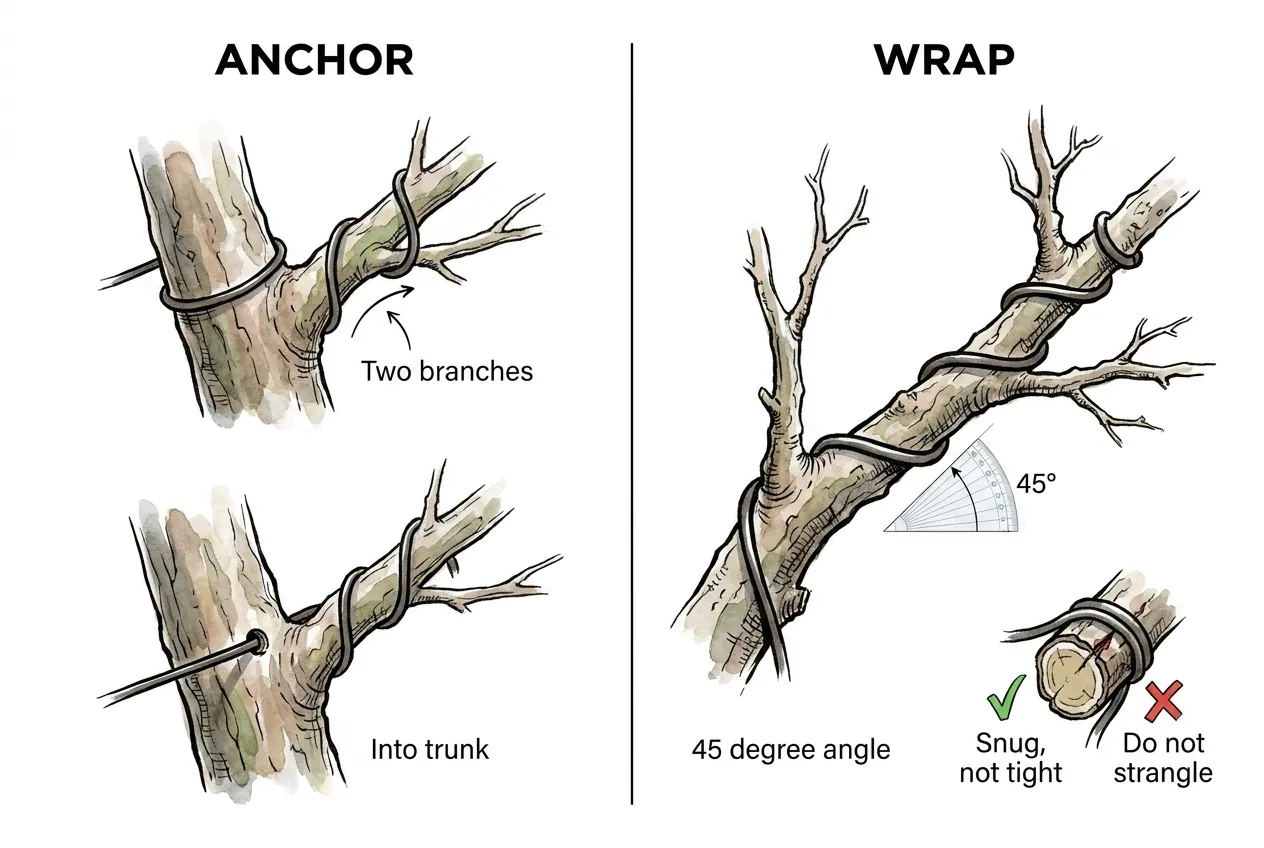
Start the wire anchored, not floating. Wire two similar nearby branches with a single piece so each anchors the other, or secure the wire into the trunk first.
Wrap at a 45 degree angle to the branch axis. That angle balances holding power against pressure on the bark, and it leaves room for the branch to thicken while keeping its new line. Keep the wrap snug, hugging the branch, never strangling it.
Wire first, then bend from the inside
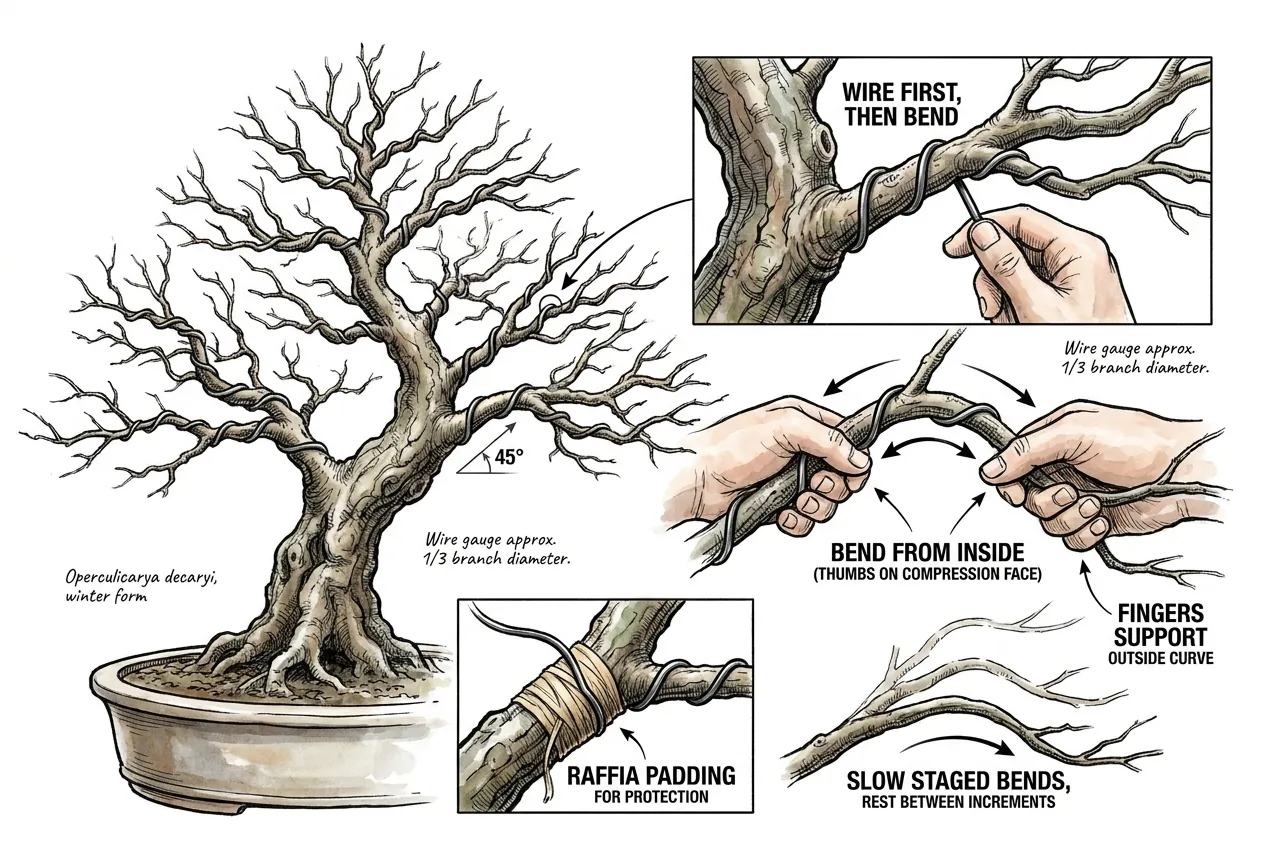
Wire every branch you intend to shape before you bend a single one. Then bend by holding the outside of the curve with your fingers and pushing from the inside with your thumbs, supporting the base the whole time.
Thumbs on the inside spread the load across the compression face so it does not kink.
Supporting the base stops leverage from cracking the branch where it attaches. Make the bend in slow stages, resting between increments rather than forcing the full arc at once.
Padding for thick or thin-barked sections
Wrap thick branches or especially tender bark with water-soaked raffia before the wire goes on. The raffia spreads the load and holds the outer fibers together, which lowers the chance of a split on a stiff branch.
Wire gauge about one-third the branch, a 45 degree wrap, and slow staged bends from the inside are the whole mechanical game.
Which wire and tools to buy
If you are stocking up on wire, raffia, and cutters, buy to the gauges your branches actually call for rather than a generic kit.
The one-third rule above tells you which diameters to keep on hand for the branch sizes on your plant.
Annealed aluminum, a pair of wire cutters, and a length of raffia cover almost everything a home grower needs.
Choose that gear the same way the rest of a caudex setup gets chosen, by measurable fit rather than by bundle.
The spec-first approach that picks a caudex pot by its drying rate is the one that picks wire by branch diameter.
Aftercare during the dormant hold
A wired dormant Operculicarya needs restraint, not attention. Keep it bright, keep it warm, water it almost never, and leave it alone so the slow creep set can accumulate.
The plant is living on its caudex reserves, so pushing water or fertilizer only invites rot.
Water only when the soil is completely dry, which in dormancy can mean weeks between drinks or none at all.
Keep the plant well above its low-30s Fahrenheit hardiness floor. No fertilizer while it rests.
How long the wire stays on
Expect the wire to stay on from leaf-off through at least early spring. Dormancy supplies the slow viscoelastic creep that starts the set. The lock-in from new wood waits for spring growth to resume.
Deciduous trees generally set a new position within one growing season once growth returns. So the plan is to wire at leaf-off, let it ride through the rest period at near-zero bite risk, and reassess when buds move.
Spring flush is the trigger that changes everything. Returning growth both cements the shape with new wood and starts thickening the branch onto the wire.
That is when the bite clock speeds up and your inspection cadence must change.
If a bend springs back after you remove the wire, the creep set was incomplete. Re-wire it and hold another cycle rather than forcing it harder.
Wire bite, and when to take the wire off
Take the wire off at the first sign it is indenting the bark, not when the shape finally looks finished.
Wire bite is the spiral scar left when a thickening branch swells around wire that stayed on too long. On this tender-barked species the mark can persist for years.
The mechanism is the branch growing, not the wire moving. As the cambium adds girth, the fixed-diameter wire gets buried and the bark bulges over it.
Once you can see the wire sinking into the surface, you are already slightly late.
A fixed-interval check keyed to the first indentation
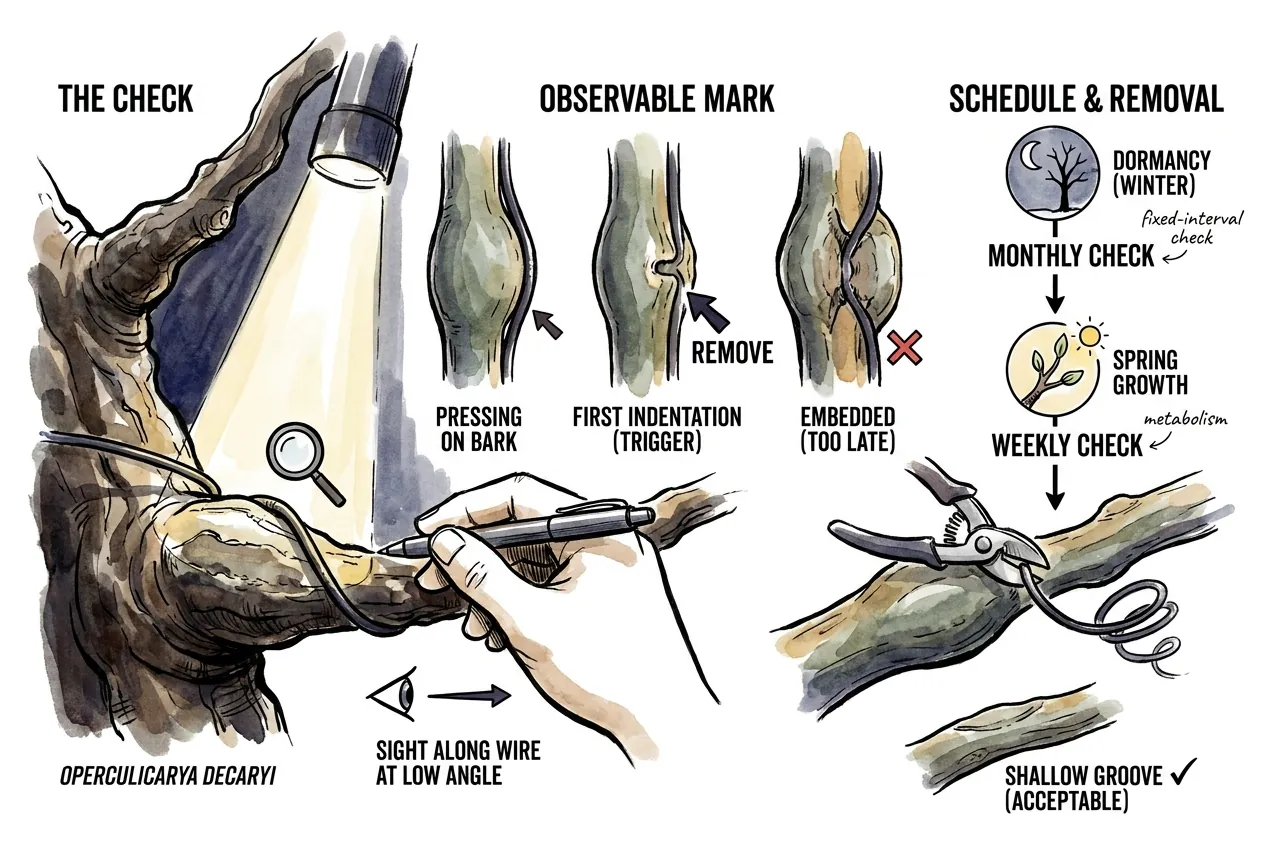
Rather than leaving the wire on until the shape looks set, I keep a scheduled look keyed to an observable mark.
On a set interval I sight along each wired section at a low angle under good light.
I am watching for the wire to begin sinking below the surrounding bark surface.
My cadence follows the plant’s metabolism. I check monthly through dormancy, when the branch barely swells. Once spring buds move and growth resumes, I switch to a weekly check until the wire is off.
The removal rule is strict because the scars are permanent here. I take the wire off the moment it begins to indent the bark rather than merely press on it.
A shallow groove I can live with. A wire disappearing under swelling bark I cannot, so first indentation is my trigger even if the branch has not fully set.
Cut the wire off, never unwind it
Remove wire by cutting it into short pieces with cutters, not by unwinding it. Unwinding levers and twists a branch you just bent and shaped, which is exactly how a brittle Operculicarya branch snaps during removal.
Remove the wire at the first bark indentation and cut it off in pieces rather than unwinding it over a brittle branch.
When not to wire, and what to do instead
Some branches should not get coil wire at all. Skip it on branches too thick or too lignified to move under a one-third-gauge wrap, and on any plant that is freshly repotted, actively rooting, or stressed.
Stacking bending stress onto a recovering plant is how you lose both the shape and the plant.
Too thick or too stiff for coil wire
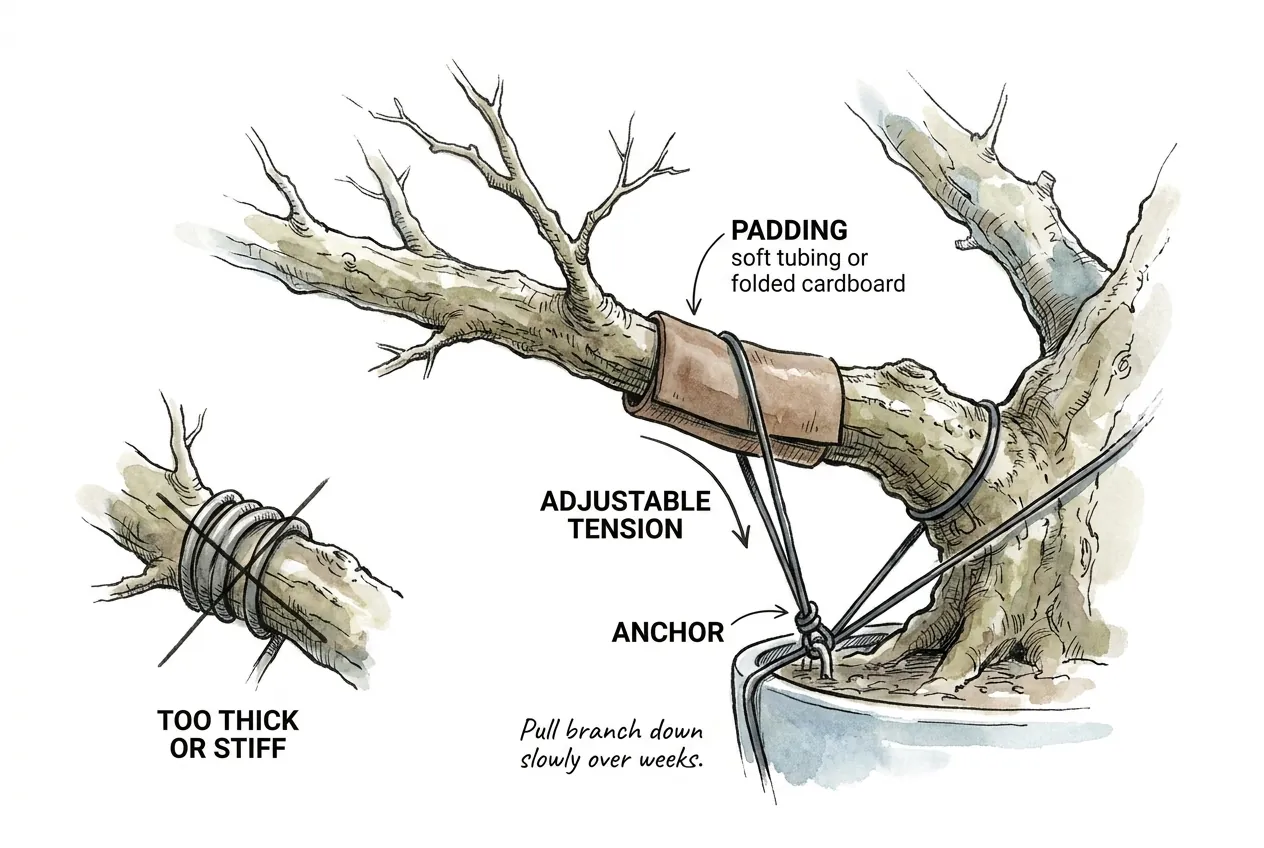
When a branch is already hardened off and a sensible gauge cannot move it, switch to a guy wire.
A guy wire is an anchored tie-down under adjustable tension, and it applies far more force than a coil wrapped around the branch.
Pad the contact point first. Soft tubing, a short length of old hose, or folded cardboard keeps the tie-down from digging a line into the bark while you tension it.
Then pull the branch down slowly over weeks, letting the same creep mechanism work without coiling the brittle wood.
Do not wire a recovering plant
Let a repot settle for a full season before you wire. A plant rebuilding roots has limited reserves and engorged, split-prone tissue, and bending stress on top of that is a bad trade.
The same goes for any plant you have just watered heavily, when the wood is at its most turgid and most likely to split.
Common mistakes and how to recover
Most wiring damage traces to two errors, bending too fast and leaving wire on too long.
Both are preventable, and some breaks are even repairable, but a brittle slow healer gives you little margin.
If a branch cracks partway
A partial break can sometimes heal if living cambium still bridges the crack. The thin green cambium ring under the bark carries vascular flow and lays down callus over several months if the pieces are held stable.
Ease the branch back into position, splint it firmly but not tightly, and seal the exposed wood with cut paste.
Reduce watering and keep the plant healthy while it mends. A clean crack with bark still attached on one side has a real chance.
If a branch snaps clean through
A full clean snap on this slow healer usually ends as a prune and redesign, not a repair.
With no cambium bridge the two pieces will not reunite without advanced grafting that rarely pays off here.
Cut cleanly back to a good collar or junction, seal the wound, and rework the design around the loss. A clean cut heals better than a ragged stub left hoping.
If you catch wire bite early
Faint spiral indentation means cut the wire off now. Keep the plant vigorous and light marks fade over a season or two as slow new growth overlays them.
Deep scars take far longer and may have to be hidden in the styling.
Key Takeaways
- Wire at leaf-off for full branch visibility and the slowest wire bite of the year.
- Dormant does not mean snap-proof, so warm the plant to room temperature before bending.
- Bend slowly to set wood by creep, and stop instantly at any fiber crackle.
- Use wire about one-third the branch diameter, wrapped at 45 degrees.
- Remove wire at the first bark indentation and cut it off rather than unwinding it.