
Best Pot for Caudex Plants? Terracotta, Plastic, Fabric
The best pot for caudex plants comes down to drying rate. Terracotta, plastic, and fabric compared by measurable specs, plus an October repotting gate.
Rachel Torres · 2026-10-07 · 15 min read
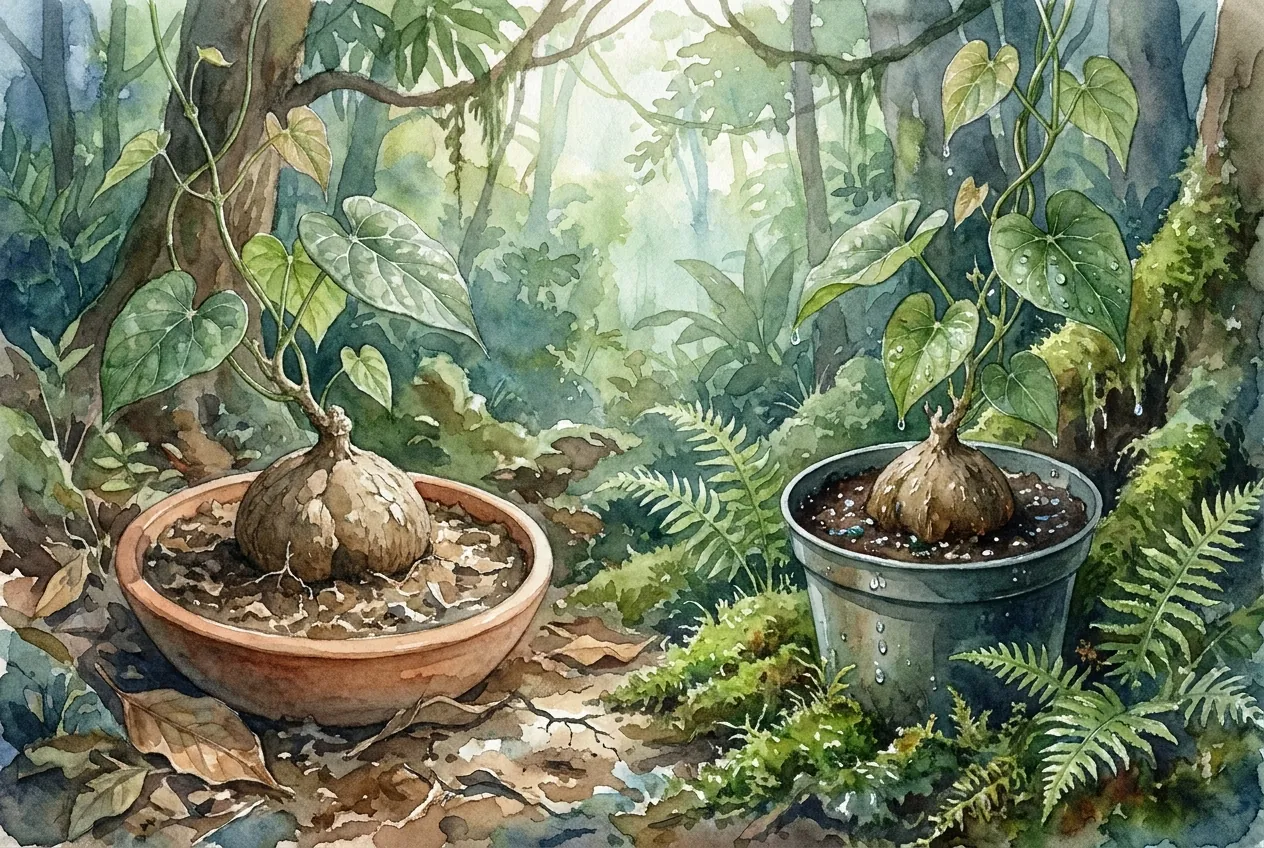
The right pot for a caudex is the one that dries at the speed your media, season, and watering hand demand. Wall material is the main dial. Unglazed terracotta dries fast, plastic dries slow, and fabric dries fastest of all.
For most growers moving a caudex this fall, the verdict is short. Put dense or peat-based media in unglazed terracotta. Keep sharp gritty mix in plastic, and save fabric air-pruning pots for next summer’s bulking phase.
Whatever you choose, screen the drainage hole and lift the pot on feet. Dry-down speed, not looks, is the buying criterion for a caudex pot.
Key Takeaways - Pot material is a drying-rate dial. Unglazed clay and fabric dry fast, while plastic and glazed ceramic dry slow. - Shallow pots stay proportionally wetter than tall pots in the same mix, so geometry must match media. - In October, slip-pot or wait.
Full repots belong to active growth, winter growers, and rot emergencies. - Screen the drainage hole and lift the pot on feet. Never add a gravel layer.
Why pot choice is a drying-rate decision
A caudex stores water in its own body and buys you time between waterings. The pot’s job is the opposite. It must shed the water you add fast enough that roots never sit in a cold, airless soup.
Three pieces of container physics decide which pot does that job for your setup.
Container capacity and the perched water layer
Every drained pot keeps a saturated layer at its base after the dripping stops. Air space in that layer is near zero, which is exactly what caudex roots cannot tolerate for long.
The height of that wet layer is set by the media, not the pot. A shallow pan and a tall cylinder of the same mix carry a similar saturated depth, so the shallow pot holds a far larger wet fraction.
Water-holding capacity falls as container height rises, which is why tall pots forgive denser mixes.
Coarse gritty media changes the math. Particles in the pumice and akadama class leave pores too large for capillary water to perch in, so the saturated layer nearly disappears.
The full media comparison lives in the guide to pumice, akadama, and gritty mix.
Wall material sets drying rate and root-zone temperature
A porous wall gives water a second exit. In an eight-hour chamber study of equal-volume nursery containers, fabric walls lost 32.9 mL through the sidewall alone while plastic walls lost 2.6 mL.
Unglazed clay sits in the same porous family, and extension guidance confirms terracotta dries the root zone more quickly than plastic.
The same porosity controls root temperature. Substrate in black plastic ran about 6 C hotter on average than in porous-walled containers, because an impermeable dark wall absorbs sun with no evaporative relief.
That margin matters, since root growth slows near 30 C, stops near 38 C, and roots can die above 40 C held for a few hours.
A porous wall is a passive drying and cooling system, and an impermeable wall is a moisture bank. Neither is a defect. Each is the right tool for a different media and season.
Cold plus wet is the winter rot window
Water-mold root rots do their damage in cool, saturated media. The ideal soil condition for Phytophthora is wet soil between 59 and 74 F, which describes most unheated October windowsills precisely.
Cold media also slows the plant’s own water use, so every watering stays in the pot longer. The pot you buy for winter has one job. It must shorten that wet window, either through a porous wall or through media that never perches.
Species-level temperature thresholds and the rescue sequence live in the post on cold wet soil and caudex root rot.
Selection criteria you can actually measure
Looks sell pots, but four measurable axes decide whether a caudex thrives in one. The table compares the pot classes on those axes.
| Criterion | Unglazed terracotta | Plastic nursery | Fabric air-pruning | Glazed ceramic |
|---|---|---|---|---|
| Wall evaporation | High | Near none | Highest | Near none |
| Dry-down speed | Fast | Slow | Fastest | Slow |
| Summer root-zone heat | Buffered by evaporation | Highest in dark colors | Lowest | Moderate |
| Weight and stability | Heavy and stable | Light and tippy | Light | Heavy and stable |
| Winter dormancy fit | Strong | Only with gritty mix | Poor | Workable with discipline |
| Root circling control | None | None | Air-prunes | None |
Read the table against your own setup, not in the abstract. A heavy-handed waterer with peat-based mix needs the terracotta column. A gritty-mix grower who waters rarely needs the plastic column, and a seedling destined for a fat caudex needs a summer in the fabric column.
Where each pot class earns its place
These are roles, not a shopping list. Most collections need one or two of the pot classes plus the drainage hardware, and nothing in this decision costs serious money.
Unglazed terracotta for dense media and dormancy insurance
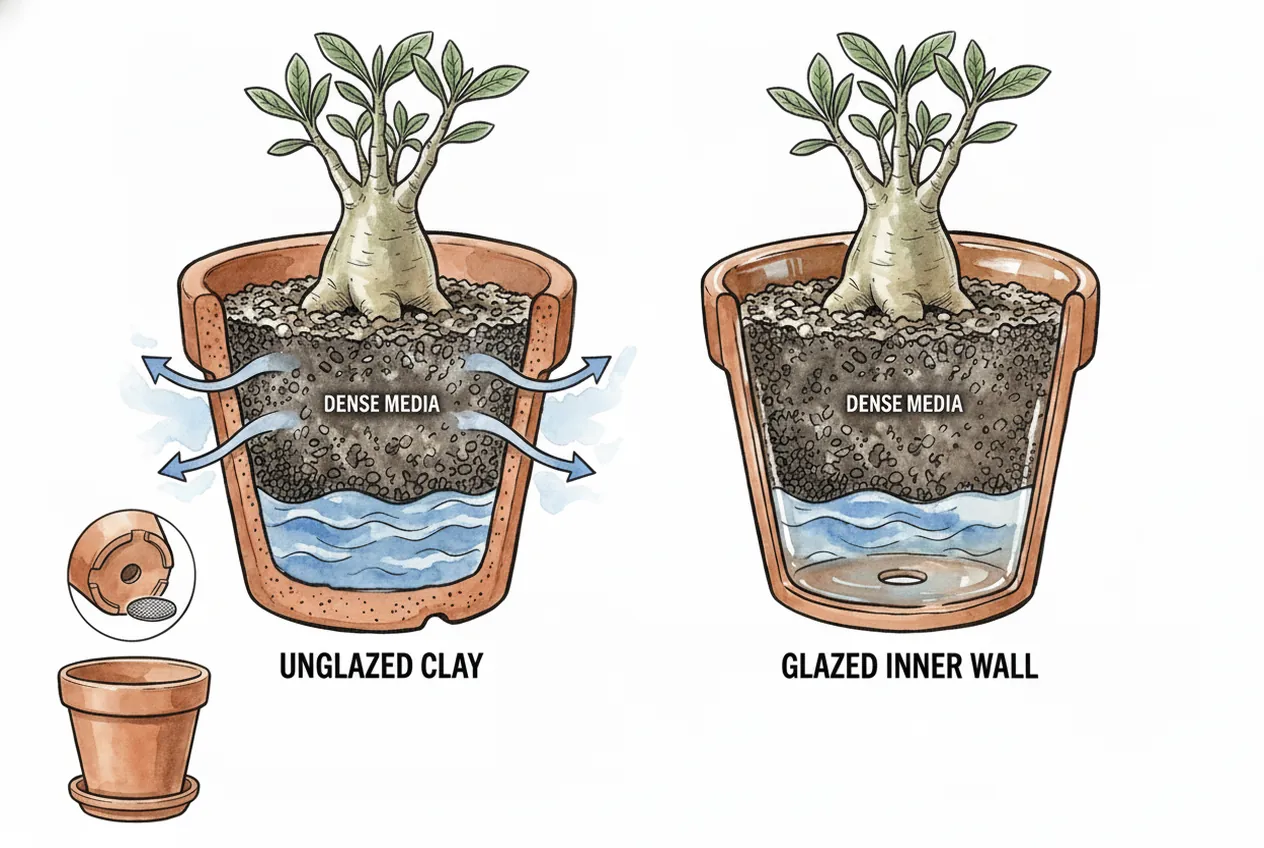
When your media holds a real perched layer, the clay wall works as passive insurance. It keeps pulling water out of the mix between waterings, through winter weeks when nothing else does.
The WildCorner 8-inch terracotta pot meets the role’s spec sheet. It is handmade unglazed clay with a bottom drainage hole, ships with a mesh pad for that hole, and includes a saucer for indoor use.
The 8-inch width suits a mid-size adenium or pachypodium moving up one pot size.
Check the interior before buying any terracotta look-alike. A glazed inner wall cancels the evaporation that justifies the material. Pairing clay with a fast mineral mix also pushes summer watering toward a daily chore.
Plastic nursery pots for gritty mix and winter growers
Plastic holds moisture because its wall gives water no exit except the drainage hole and the surface.
In a sharp mineral mix that sheds water instantly, that retention is the feature that keeps fine roots from desiccating.
It also suits winter growers that stay in active growth while your heating runs.
The homenote 6-inch plastic pots fill this role cheaply. The 15-pack has multiple bottom drainage holes per pot and matching trays, and a uniform shelf of identical pots makes watering decisions transferable between plants.
Empty the trays promptly after watering, because a pot standing in its own runoff re-saturates from below.
If your gritty mix has gone hydrophobic and water races through without wetting it, fix that first with the gritty mix rewetting method.
Fabric pots for the summer bulking phase
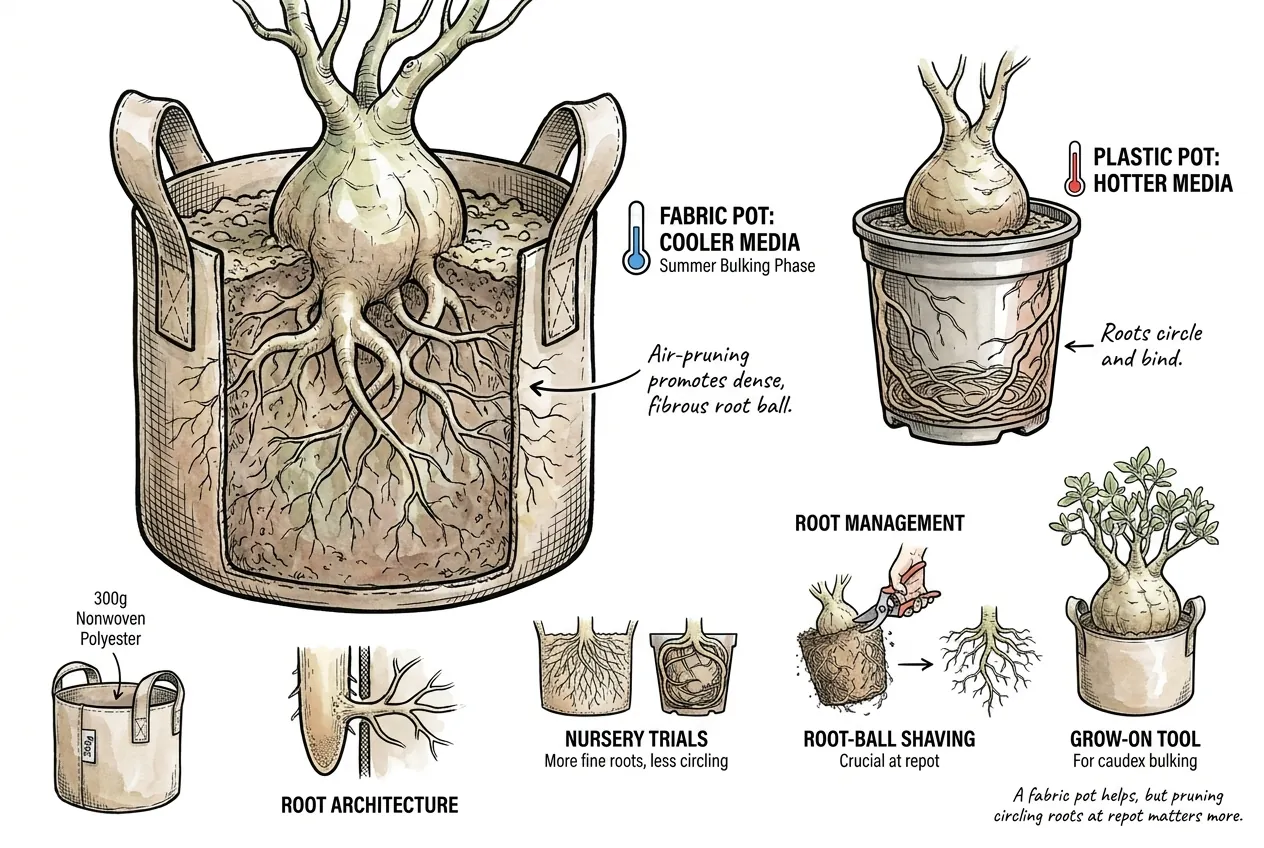
Air-pruning containers change root architecture. When a root tip reaches the dry fabric wall it stops instead of circling, and the plant answers with branching.
In nursery trials, all four tested air-pruning containers limited circling and grew more fine roots than plastic.
Fabric-pot media also ran as much as 35 F cooler on hot days.
That makes fabric the grow-on tool for the caudex-bulking years. The VIVOSUN 5-gallon grow bags are the budget entry. The manufacturer lists 300 g nonwoven polyester fabric, a 12.5-inch width with 9.9-inch height, and sewn reinforced handles that carry a full bag of soil.
Keep the claim honest. In an eight-container comparison on red maple, container type had only a small effect on final root architecture, while root-ball shaving at each repot had a large one. A fabric pot helps roots branch, but pruning circling roots at repot time matters more than the container brand.
Drainage hardware that makes any pot work
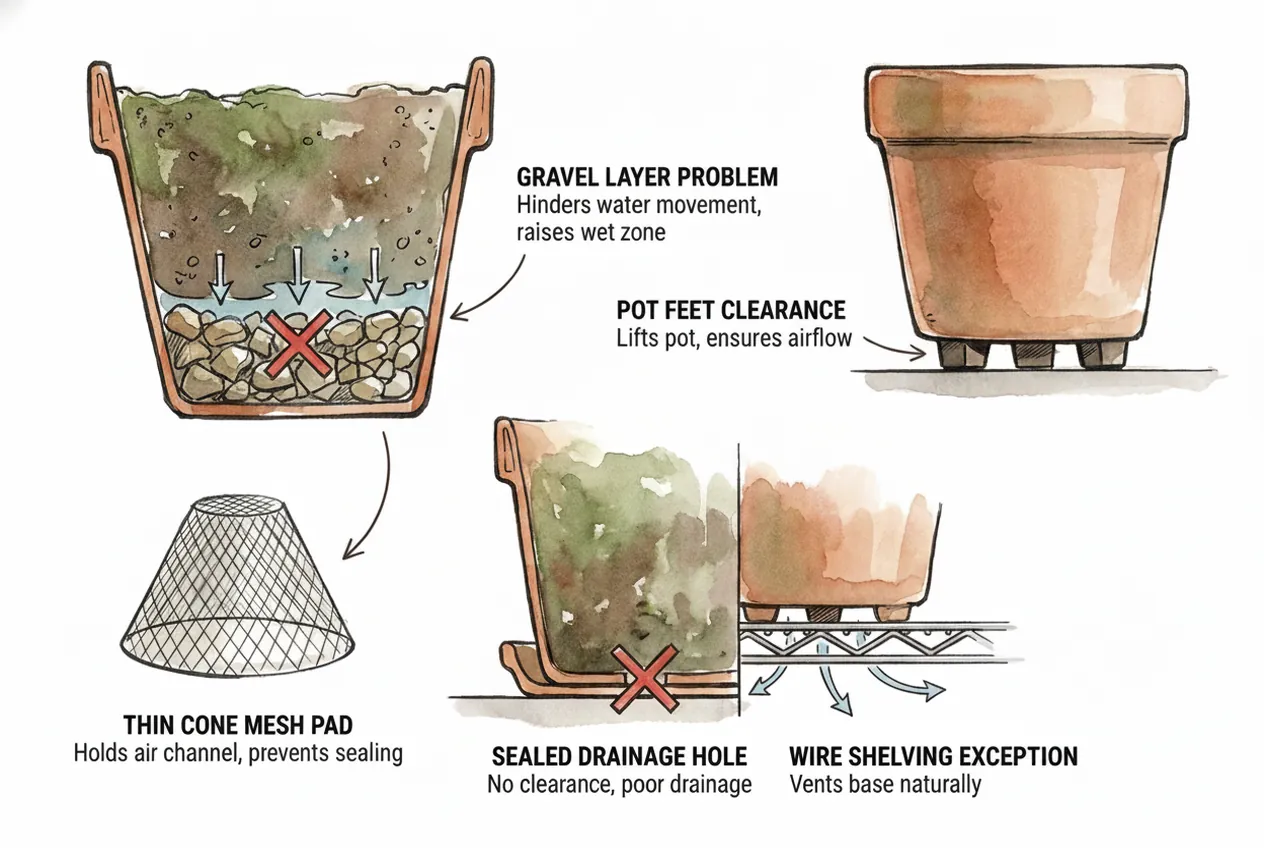
The classic gravel layer at the pot base is the one accessory to refuse. Water will not cross from fine media into a coarser layer until the fine layer saturates, so a gravel layer raises the wet zone up into the roots. Extension guidance is blunt that drainage material only hinders water movement.
A thin screen does the real job. The UtySty drainage mesh pads are a 15-pack of cone-shaped plastic screens in mixed sizes.
The dome holds an air channel under the mesh, so gritty particles stay in the pot without the media sealing the hole flat.
The hole also needs clearance below it. The POTRISERS large pot feet lift a pot 0.75 inch on 2-inch-wide pads, a 12-pack that serves three or four pots.
A drainage hole pressed flat against a saucer or deck is a sealed hole, and feet are the cheapest rot insurance in this whole setup.
Repot now or slip-pot until spring
Buying the pot is the easy half. In October, when to move the plant into it is the half that kills collections. Extension guidance restricts repotting to spring and summer while a plant grows actively, because torn roots only regenerate during growth.
The October go or no-go gate
Before any fall repot I run one watering cycle as a test. I water fully, then track how many days the pot takes to return to its usual pre-watering weight on an unheated windowsill, while watching the leaves.
My gate is simple. If the dry-down now takes more than 14 days, or the leaves are already yellowing toward drop, the plant has stopped pulling water and I do not full-repot. I slip-pot instead, or I wait for spring.
The 14-day figure is my own conservative cutoff, not a published standard. A dry-down that slow means every watering spans two weeks of the cold-wet rot window.
Two cases override the gate. Winter growers such as Tylecodon and Othonna are entering growth in October, so for them a fall repot is in-season.
Visible root rot also overrides it, because a rotting root system must be unpotted, cut clean, and dried regardless of the calendar.
Slip-potting is the low-risk middle path. Lift the intact root ball, set it in a pot one size up, backfill around the sides, and leave the root mass undisturbed.
You get fresh media and room without tearing the roots the plant cannot currently replace.
Potting steps that keep the hole working
The sequence below applies to a spring repot and an October slip-pot alike.
- Set a mesh screen over every drainage hole. No gravel, no shard layer.
- Choose a pot only 1 to 2 inches wider than the current one. Extra unoccupied media stays wet longest and stretches dry-down past the safe window.
- Plant high. Keep the caudex shoulder above the media line, because burying the stem base invites crown rot.
- Backfill with the matched media and settle it with a chopstick. Do not compact it.
- Put the pot on feet if it lives on a saucer, sill, or deck.
- Water by season. After a spring repot, wait a few days for cut roots to callus before the first thorough watering. After an October slip-pot, water lightly or not at all and resume by weight.
For the watering itself, method changes outcomes in gritty media. The comparison of top-down versus bottom watering covers which to use at each stage.
Weigh the pot to choose the pot
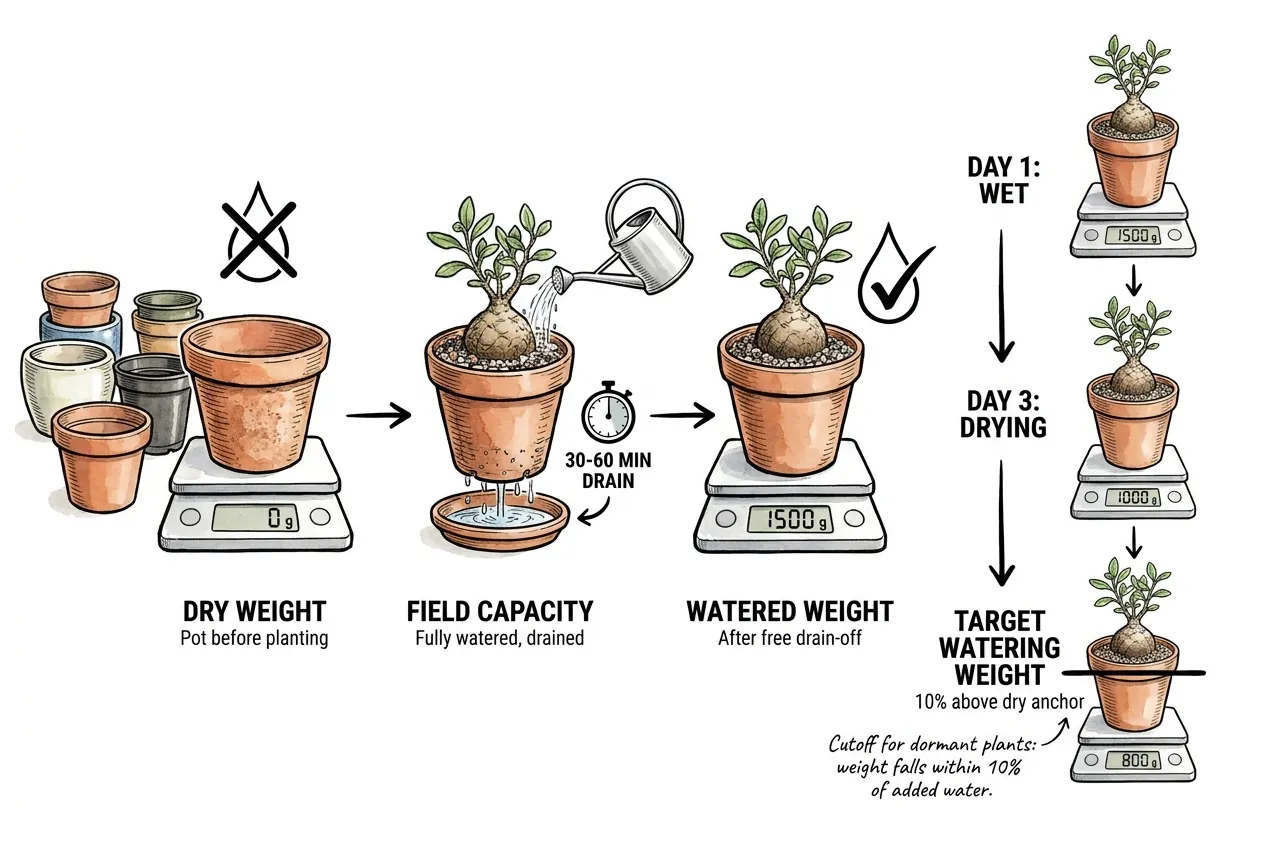
Material claims become real numbers once you weigh. Professional nurseries schedule irrigation by weight. They weigh a container at field capacity after 30 to 60 minutes of free drain-off, then re-water when it falls to a target fraction of that weight.
My home version needs one kitchen scale. Each candidate pot gets weighed twice at the start, once fully dry before planting and once watered and drained.
From then on, a daily same-hour weighing tells me exactly where the pot sits between those two anchors.
I call a pot ready for water when its weight falls to within 10 percent of the added water mass above the dry anchor.
That cutoff is my own working rule for dormant caudiciforms, set conservative because a dormant root system tolerates drought far better than saturation.
Days-to-threshold is the pot’s true dry-down time in my room, with my media.
The number picks the pot. If a terracotta and a plastic pot of equal volume get the same media and watering day, the weight log shows their real drying gap within one cycle.
I keep whichever lands a 5 to 10 day dry-down for the season and move the other to a different media pairing.
Who should not buy each pot class
Every pot class above has a buyer it fails. Check your own row before spending.
When to skip unglazed terracotta
Skip it when your gritty mix already dries in two or three days, or when your pots are tiny and desiccate between weekends. Outdoor overwintering in freeze country also rules it out.
Saturated clay walls spall and crack in hard frost, and clay punishes anyone who rearranges shelves often.
The weight that cracks your toe is also stability for a top-heavy caudex, so judge both sides.
When to skip plastic nursery pots
Skip them if you water generously into dense peat-based media on a cold windowsill. Plastic’s retention then stretches the saturated window straight through the rot zone. Dark plastic in full summer sun also cooks the root ball, so shade the pot wall or choose light colors if the bench bakes.
When to skip fabric pots
Skip them when the plant is heading into dormancy, lives indoors over finished floors, or is a display specimen.
Fabric weeps at every watering, over-dries nothing useful in winter, and reads as a nursery bag no matter the plant.
It is a seasonal grow-out tool, and winter growers under lights do better in plastic.
When to skip the drainage hardware
Almost never, given the cost. Mesh pads are pointless only for fine mixes over small holes that bridge naturally, and pot feet add nothing on open wire shelving. Everything else benefits.
Maintenance, failure modes, and replacement intervals
Terracotta accumulates white salt and lime crust on the wall. The crust is cosmetic, scrubs off with a stiff brush at repot, and a pot kept indoors lasts indefinitely.
Frost exposure while saturated is the one terminal failure, so overwinter empty clay pots dry.
Plastic nursery pots embrittle in UV over a few seasons outdoors. Treat them as a multi-season consumable, retire any pot whose rim cracks during handling, and buy multi-packs so retirement is painless.
Fabric pots mildew if stored damp. Shake out media, wash, and dry them fully between seasons, and the manufacturer positions a well-kept bag as reusable for years.
Mesh pads embrittle on the same schedule as thin plastic, so replace any that snap at repot. Pot feet outlast everything.
FAQ for caudex pot buyers
Is glazed ceramic with a drainage hole acceptable
Yes, if you manage it like plastic. Glaze seals the clay pores, so the pot holds water the way an impermeable wall does.
Buy it for looks, pair it with gritty media, and water on the slow-pot schedule your weight log shows.
Can I keep a caudex in a cachepot without a hole
Not directly. A container without drainage has no safe column, whatever the media. Keep the plant in a drained nursery pot, lift it out to water, and return it after the dripping stops.
Does a shallow bonsai pan work for display
Only with fully gritty media and a disciplined hand. A shallow pan holds a larger saturated fraction of the same mix than a tall pot, so the pan forfeits your margin for error.
Accept that trade knowingly for a styled Operculicarya, and weigh the pan on the same clock as everything else.
Do I need all four product classes
No. The roles overlap by design, and most growers land on one pot class per season plus the universal hardware.
A dormant-season terracotta, a gritty-mix plastic shelf, or a summer fabric bag each solves a different year of the same plant’s life.
What about heaters, lights, and enclosures for winter
Different purchase, different guide. Pot choice is the cheapest lever against cold-wet rot, but it cannot heat a room or light a shelf.
The full winter hardware stack is covered in the caudex overwintering setup hub.
The bottom line for October
Buy for drying rate. That means terracotta for dense media and dormancy insurance, and plastic for gritty mixes and winter growers.
Fabric waits in the drawer for next summer’s bulking run, with a screen and feet under everything.
Then hold your nerve on timing. If the plant is shutting down for winter, the new pot waits empty and the plant gets a slip-pot at most.
A caudex loses nothing by wintering one size small. It can lose everything to torn roots in cold wet media.
Affiliate Disclosure
This article contains Amazon affiliate links. As an Amazon Associate I earn from qualifying purchases. If you use these links, the site may earn a commission at no extra cost to you. Product availability, price, and specifications can change. Check the current listing before buying.