
Pachypodium Horombense Winter Watering: Once-a-Month Rule
Pachypodium horombense winter watering: why once a month (or less) is a species rule, plus the 10C floor, cold-wet rot risk, and a pot-weight check.
Rachel Torres · 2026-10-11 · 11 min read
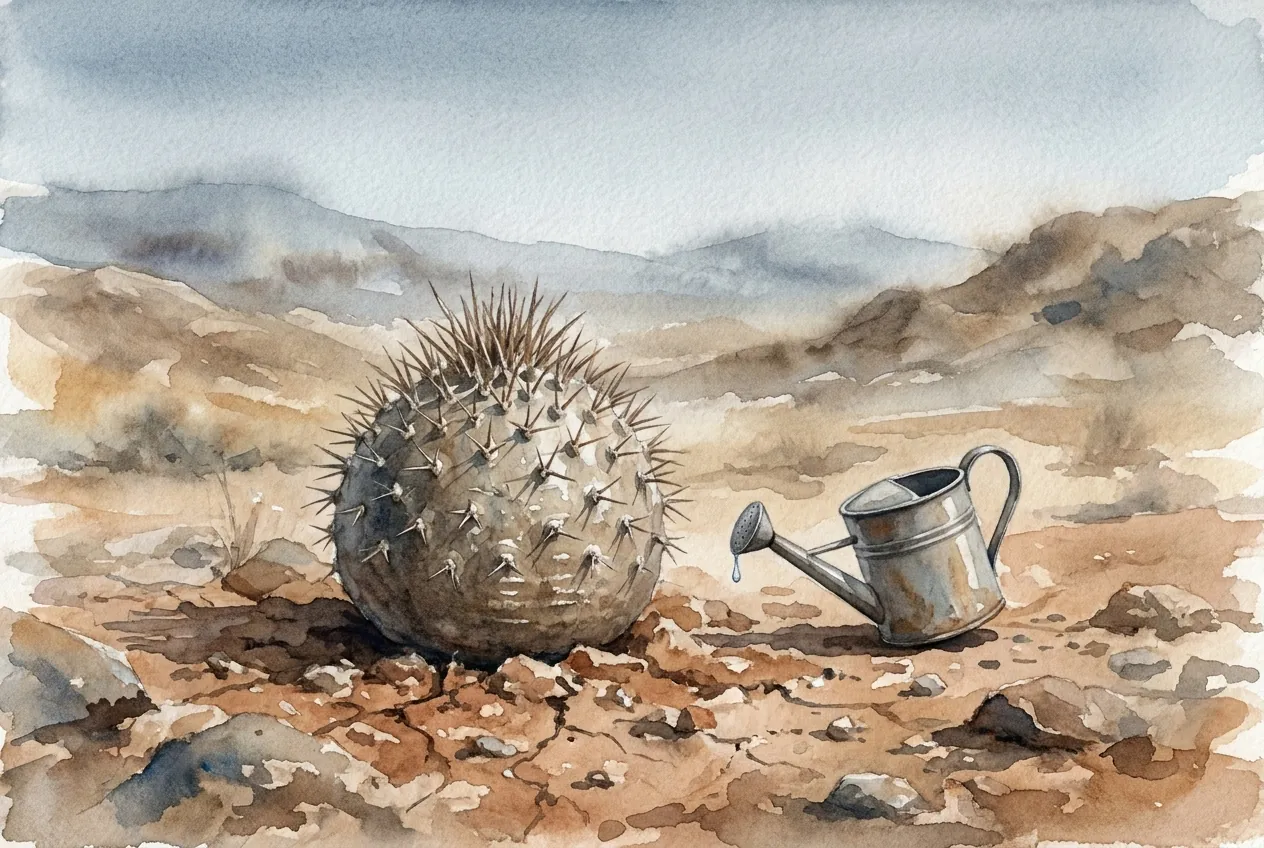
Key Takeaways
- Water a dormant Pachypodium horombense once a month at most, and often not at all until spring.
- Cold wet soil around inactive roots is the real killer, not the date you water.
- Keep the plant above about 10C, measured at pot height, not at the wall thermostat.
- Water only when the pot returns near its dry weight and the plant is leafless and cold-safe.
- In spring, resume watering only after new growth appears, then ramp up slowly.
A dormant Pachypodium horombense can go most of the winter on the water already stored in its fat caudex. That single fact decides the whole schedule.
Once a month, or even less, is not a nervous guess. It is what this deciduous, cold-sensitive Madagascan species actually needs when it drops its leaves and shuts down.
The number matters less than the reason behind it. Water a leafless plant into cold, slow-draining mix and you are not feeding it. You are setting up rot.
Below you get the cadence, the two measurements that make it defensible, and the conditions that push you toward a monthly sip or toward no water at all.
How often should you water Pachypodium horombense in winter?
Water a dormant Pachypodium horombense no more than once a month, and stop entirely if it is fully leafless in a cold room. That is the safe ceiling, not a feeding schedule.
Published guidance actually spans a range. Several species references say give no water from late autumn to mid-spring and keep the plant totally dry at around 10°C.
General Madagascar palm guidance allows watering sparingly, perhaps once or twice a month at most. Once a month sits deliberately on the cautious side of that spread.
Treat once a month as a hard ceiling you lower toward zero, never a quota you must hit. The plant leads.
If it is bare and the room is cool, the correct winter amount is often nothing at all until spring.
Why winter rewrites the watering rules for this species
Pachypodium horombense is a deciduous caudiciform from a seasonally dry habitat, so winter changes what the plant can use.
It drops its leaves, growth stalls, and water demand collapses. The same drink that was healthy in July becomes a liability in January.
What Pachypodium horombense is and where it comes from
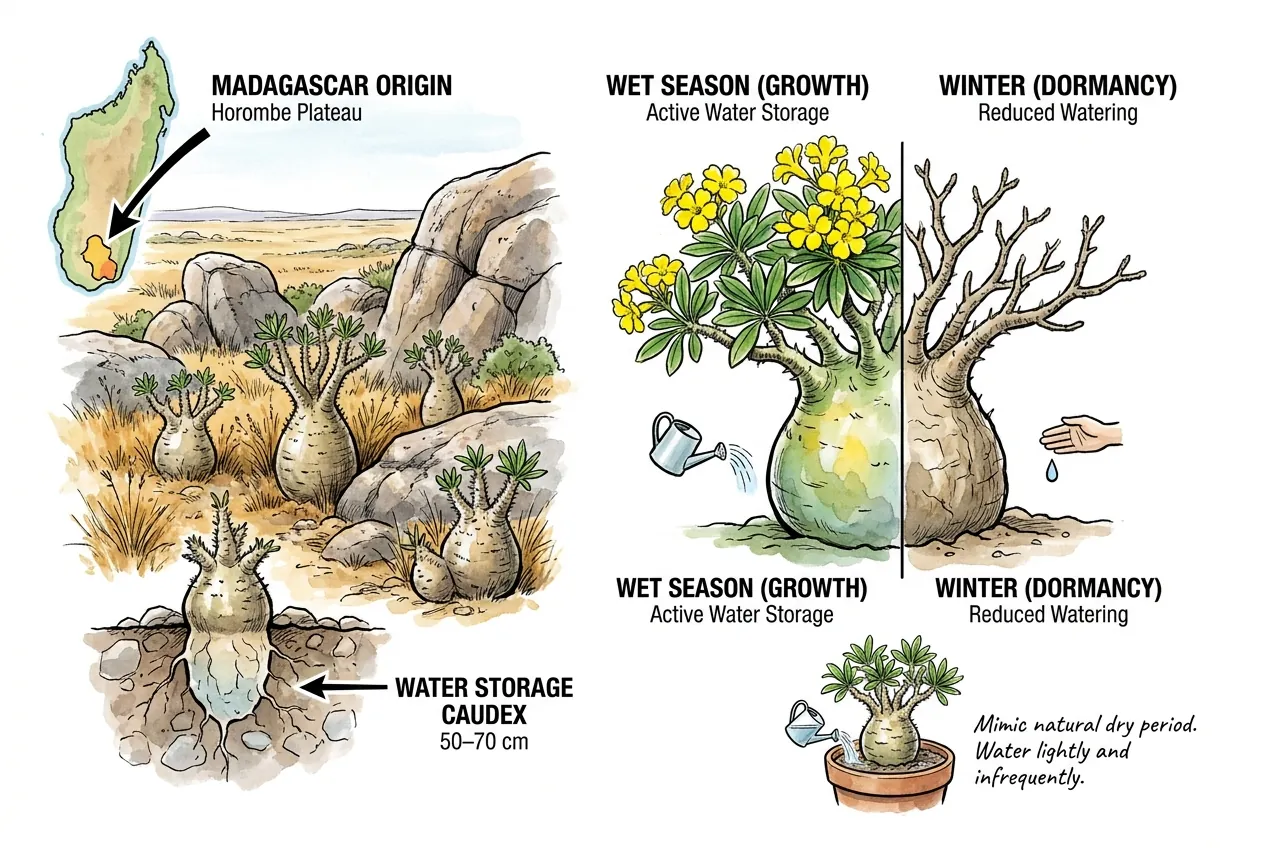
Pachypodium horombense is a dwarf, spiny succulent from the Horombe plateau of southern Madagascar. It grows on granite outcrops at roughly 500 to 1000 meters elevation, in open, rocky, seasonally dry grassland.
The plant stores water in a plump caudex, the swollen trunk-and-root base that can reach 50 to 70 cm across on mature specimens.
Short fat arms carry rosettes of leaves and bright chrome-yellow flowers in the warm months. Its whole body plan is built to bank water in the wet season and coast through the dry one.
That origin is the key to winter care. This is not a tropical plant that grows year round. It evolved to run hard in warm wet weather, then switch off when conditions turn cool and dry.
Why dormancy cuts water demand to almost nothing
A dormant, leafless plant uses almost no water because it has switched off the machinery that spends it.
Leaves are where most transpiration happens, and this species drops them for winter. No leaves means almost no water leaving the plant.
Growth also stops, so the plant is not building new tissue that would need water and nutrients.
At the same time its caudex is still full from the growing season. A resting plant draws from that internal reserve instead of pulling steadily from the pot.
A leafless, dormant Pachypodium needs so little water that the safest winter error is giving too little, not too much. Caudiciforms tolerate a long thirsty spell far better than a wet one, which quickly turns years of slow growth into mush.
The real driver: cold wet soil, not the calendar
The thing that kills a winter Pachypodium is cold wet soil around a dormant root system, not the particular day you water. Cold and wet are only dangerous together. Get either one out of the equation and rot risk falls sharply.
The temperature floor you actually build the schedule around
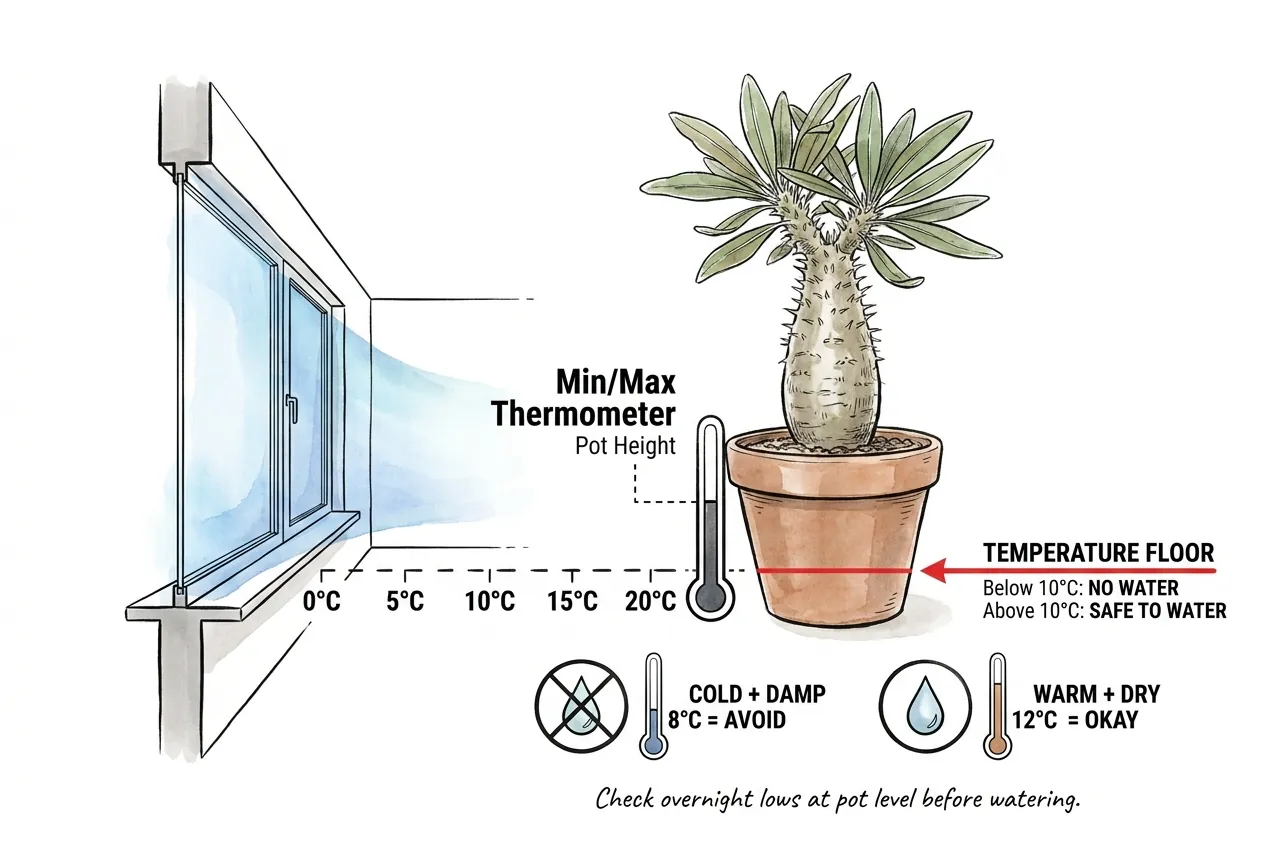
Keep Pachypodium horombense above about 10°C (50°F) through winter and protect it from frost.
Three independent references converge on roughly 10°C as the winter minimum for this plant and its close relatives.
Cold tolerance improves only when the plant is dormant and the soil is bone dry. Cold plus damp is the specific combination to avoid. One stray source cites a brief minimum near minus 3°C, but that conflicts with the cold-sensitive consensus and is not a safe number to plan around.
Your room thermostat is the wrong instrument for this. Air on a winter windowsill or near the floor can sit several degrees colder than the room average, especially overnight.
I set a cheap min/max thermometer at pot height next to the plant. Each morning for a week I read the overnight low before I fix the winter cadence.
If that measured low sits at or below 10°C, I hold water entirely until the lows recover above it. Watering into cold substrate is the rot trigger.
The 10°C figure comes from the references. Holding water at or below it is my conservative rule, not a published mandate.
Why cold plus wet rots roots so fast
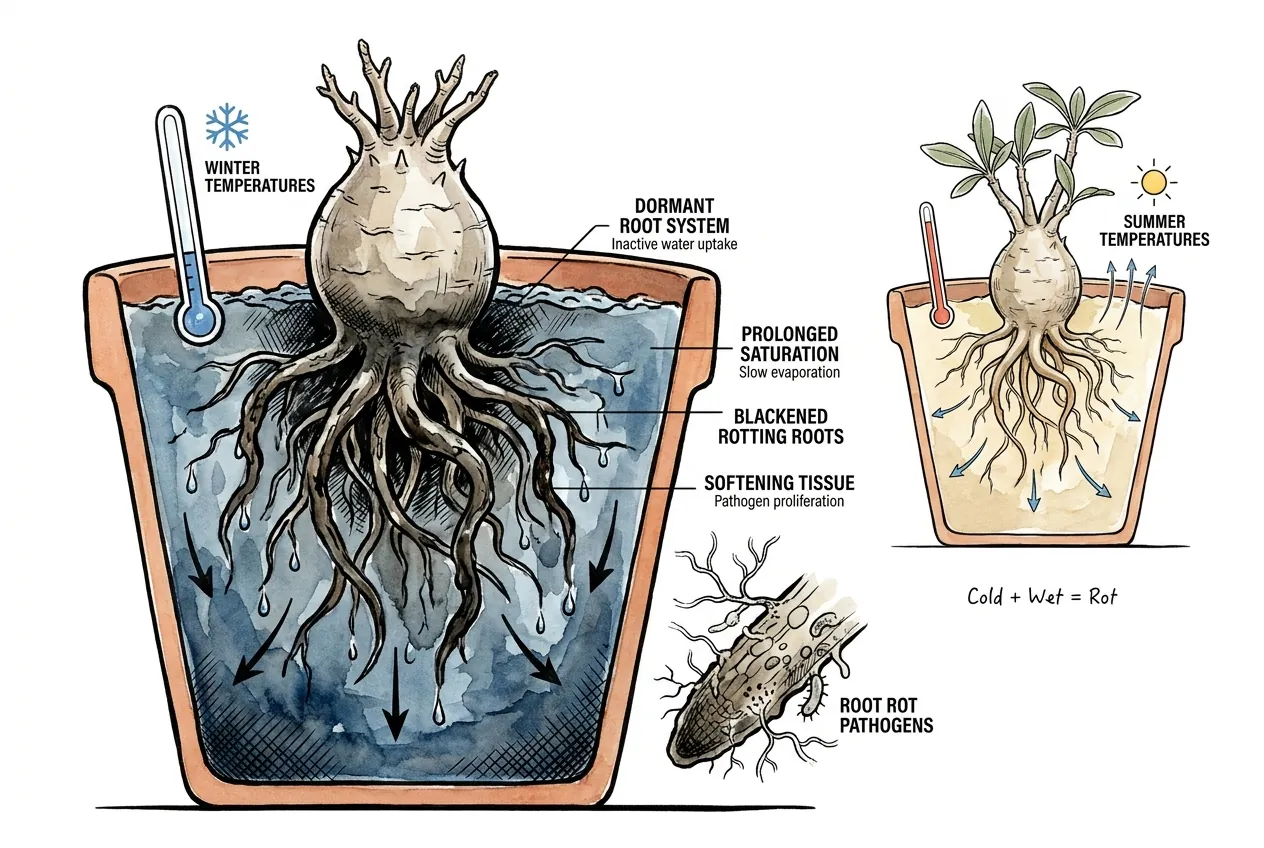
Cold slows both evaporation from the mix and water uptake by the plant, so wet substrate stays wet far longer in winter than in summer.
A drink that would dry out in two days in August can linger for two weeks in December.
That long wet spell is the problem. A dormant root system takes up almost nothing, so the water just sits around the roots.
Prolonged saturation around inactive roots is the textbook setup for root and caudex rot, which shows up as blackened roots and softening tissue.
For the full oxygen-and-saturation mechanism behind autumn root loss, the Caudexology deep dive on cold wet soil is worth reading alongside this. See why cold autumn soil kills caudex roots.
How to decide when, or whether, to water
Base the decision on three readings, not the date. Confirm the plant is dormant, confirm the mix is truly dry, and confirm the temperature is safe.
Only when all three line up does a small drink make sense.
Confirm the plant is really dormant
A fully dormant Pachypodium is leafless or nearly so, with no new growth, under cooler and shorter days. That combination is your green light for the minimal winter regime.
A plant still carrying full leaves in a warm, bright indoor room is not fully dormant.
It will tolerate, and even need, a little more water than a bare, cold one. Match the regime to the plant in front of you, not to the month on the calendar.
Verify dryness by weight, not by touch
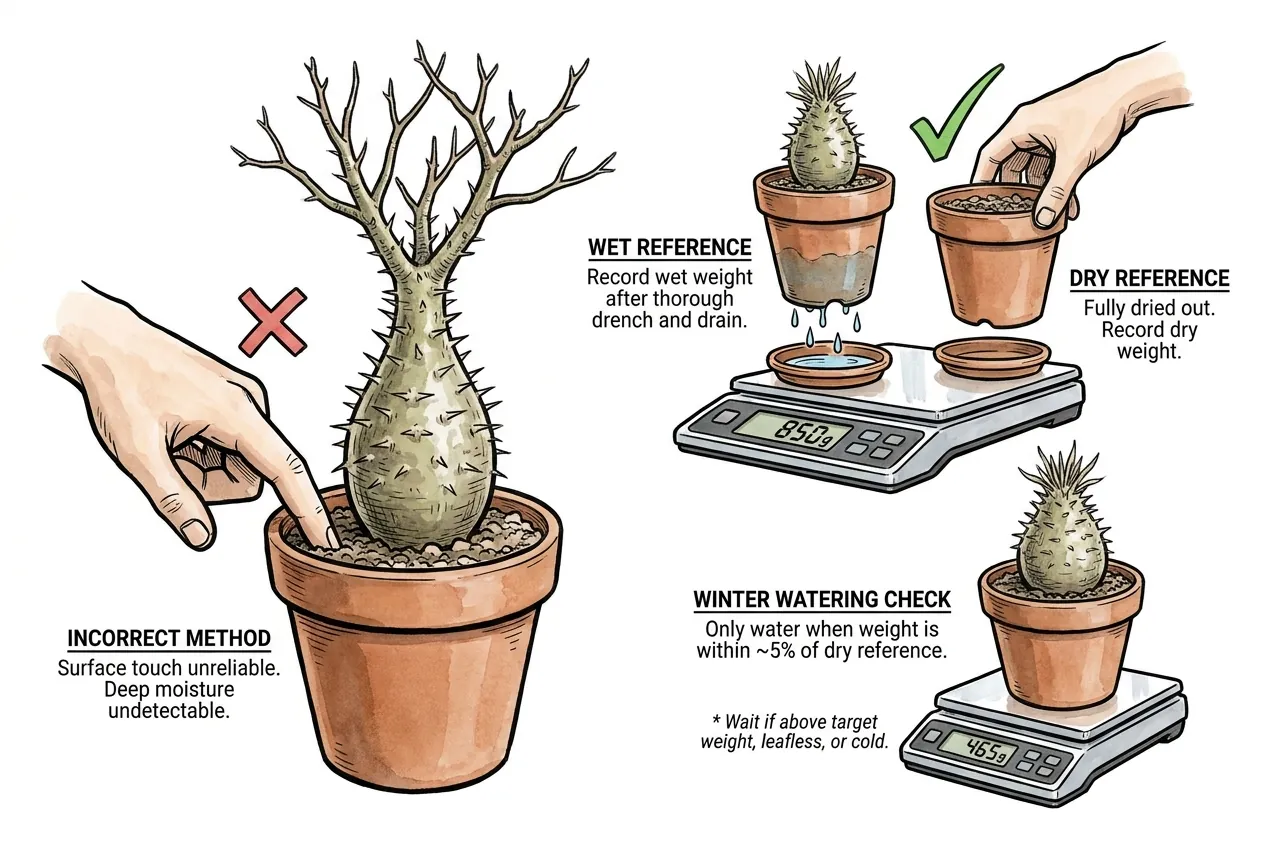
Whole-pot weight is the most reliable dryness test because water is heavy and the pot loses measurable mass as it dries.
A finger or a probe only tells you about the top layer.
The deep moisture around the roots is what drives rot, and it is exactly what you cannot feel from the surface.
Here is the check I use. I weigh the pot on a kitchen scale right after a thorough drench and drain to get a wet reference.
I weigh it again once it has fully dried out over a complete dry-down to get a dry reference, and I write both numbers down.
Through winter I weigh, or hand-lift to feel that learned difference, about once a week.
I only consider watering when three things line up. The pot has returned to within about 5% of its dry reference weight, the plant is leafless, and the overnight low stays above 10°C. If any one of those fails, I wait.
The within-5%-of-dry margin is my conservative rule to be sure the deep mix is genuinely dry, not a published standard.
The comparison direction matters because I approach the dry weight from above and never water while the pot is still heavy.
When once a month, a lighter sip, or nothing applies
The right winter amount depends on how cold, how bare, and how fast-draining your setup is.
The table below maps your conditions to the cadence, so you are scaling the species rule to your own pot rather than copying a stranger’s calendar.
| Your conditions | Winter watering | Why |
|---|---|---|
| Fully leafless, cool room, dense mix, large pot, or overnight lows at/below 10°C | None until spring | No leaves and cold wet mix mean any water just sits and rots roots |
| Mostly bare, bright spot steadily above 10°C, fast gritty mix, pot dry to its dry reference | A small amount about once a month | Warmth and fast drainage keep the wet spell short enough to be safe |
| Still carrying leaves, warm bright indoor spot, visible gradual caudex shrink | A light sip every few weeks | A partly active plant still transpires and can use a little water |
Never water on a fixed date while the plant is bare and the mix is cold and wet, no matter how many weeks have passed. The calendar is a reminder to check, not a command to pour.
Drainage decides how risky any winter watering is
Your mix, not your plant, controls how long the roots sit wet after a drink. Pachypodium horombense needs a gritty, porous, well-draining cactus mix that is not strongly acidic. That requirement is a rot-risk setting, not a nicety.
The same cup of water behaves completely differently in two substrates. A fast gritty mix sheds free water in seconds and holds only a thin film, so the cold-wet dwell time stays short.
A dense peaty mix holds a saturated core for days or weeks in winter, which is the exact condition rot needs.
You can test your own mix in a minute. Pour water in and watch.
If it runs straight through the drainage holes within a few seconds, and the surface is not still glistening a minute later, drainage is adequate.
If water pools on top or drains slowly, your mix holds too much and your winter watering should move toward zero regardless of cadence.
If that test fails and you need to rebuild the mix, the Caudexology gritty-mix rewet guide covers how to fix a mix that sheds water.
The indoor setup that makes a safe schedule possible
A safe winter cadence depends on the environment you give the plant, not just the watering can.
Temperature, placement, light, and airflow together decide how long any drink lingers and how much cold stress the plant takes.
Placement and temperature
Keep the plant above about 10°C and off cold windowsills, away from doors and heating vents that blast cold drafts.
A cold draft landing on wet mix is close to the worst case you can build.
Measure where the plant actually lives, at pot height, rather than trusting the wall thermostat. That one habit catches the overnight cold pockets that quietly push a plant below its safe floor.
Light and airflow during rest
A bare dormant plant has low light demand, but a bright spot keeps it healthier and helps the surface dry between any watering.
Gentle air movement speeds that drying and cuts the time the plant sits damp, which costs nothing and changes no watering math.
Cold, humid, still air does the opposite and keeps everything wet longer. For a full dormant-season gear and placement walkthrough, see the Caudexology overwintering setup guide.
Breaking dormancy and bringing water back in spring
Resume watering only when the plant shows new growth, not on the first warm day. Withhold water until new leaves start to appear, usually from mid-spring onward, which can take a month or two.
Reading the resume signal
The plant leads the restart. Swelling buds or the first new leaf rosettes mean the roots are becoming active again and can actually use water.
Rising, stable warmth above the winter floor and lengthening days reinforce the signal, so you resume when biology and temperature agree.
Jumping the gun is the classic spring mistake. Watering a still-bare plant on a warm afternoon is just the cold-wet-into-dormant risk wearing a spring coat.
Ramping up without shocking the plant
Once new growth is clearly underway and the mix is dry, start with one thorough drench and drain.
Then return to the normal growing-season rhythm of water, dry out, water again.
Do not leap straight to frequent summer watering while the plant is barely awake.
Let the first real watering meet active growth, never precede it. Holding off on fertilizer until growth is genuinely underway, and easing the plant back into strong light, keeps a careful winter from unraveling in a week.
Key Takeaways
- Water a dormant Pachypodium horombense once a month at most, and often not at all until spring.
- The killer is cold wet soil around inactive roots, not the watering date itself.
- Keep the plant above about 10°C, measured at pot height, not at the wall thermostat.
- Water only when the pot returns to near its dry weight and the plant is leafless and cold-safe.
- Resume watering in spring only after new growth appears, then ramp up slowly.